Exercise 3A-2 (continued)
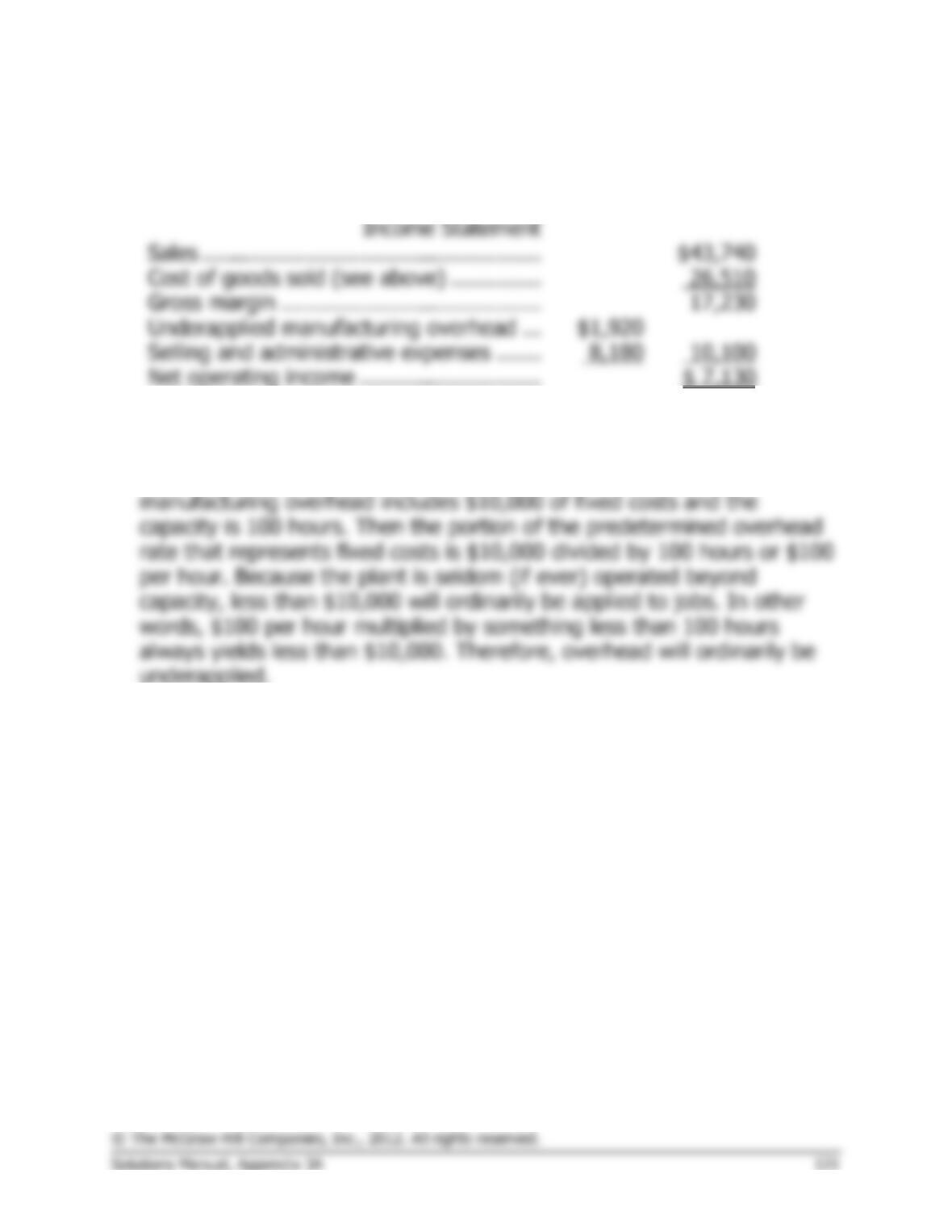
Consequently, the income statement would appear as follows:
Wixis Cabinets
2. When the predetermined overhead rate is based on capacity, overhead
is ordinarily underapplied because manufacturing overhead ordinarily
contains significant amounts of fixed costs. Suppose, for example, that
Problem 3A-3 (60 minutes)
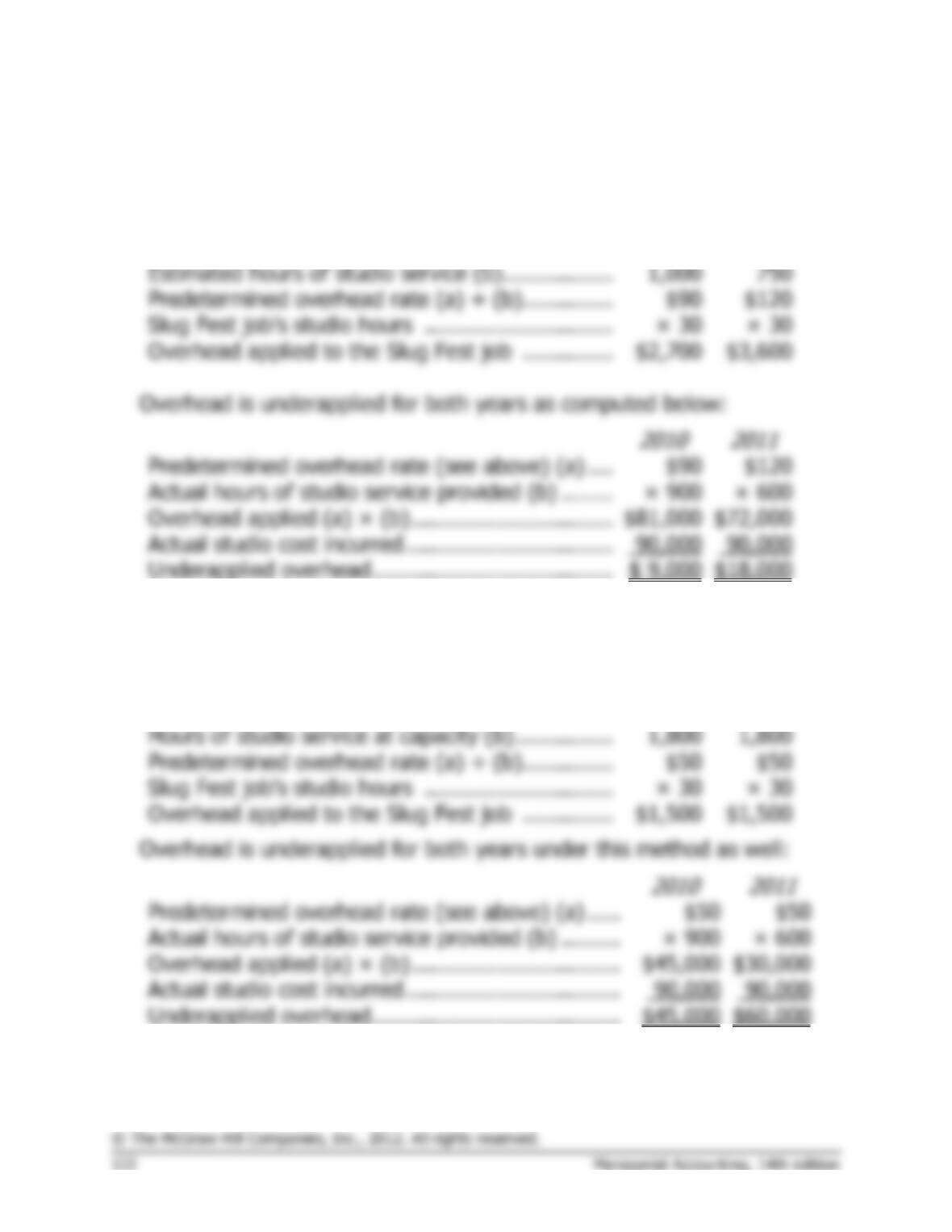
1. The overhead applied to the Slug Fest job would be computed as
follows:
2010
2011
Estimated studio overhead cost (a) ……………….
$90,000
$90,000
Estimated hours of studio service (b) ……………..
Predetermined overhead rate (a) ÷ (b) …………..
Overhead applied to the Slug Fest job …………..
2010
2011
Predetermined overhead rate (see above) (a) ….
Actual hours of studio service provided (b) ……..
Overhead applied (a) × (b) ………………………….
$81,000
$72,000
Actual studio cost incurred …………………………..
Underapplied overhead ……………………………….
$18,000
2. If the predetermined overhead rate is based on the hours of studio
service at capacity, the computations would be:
2010
2011
Estimated studio overhead cost (a) ……………….
$90,000
$90,000
Hours of studio service at capacity (b) ……………
Predetermined overhead rate (a) ÷ (b) …………..
Overhead applied to the Slug Fest job …………..
2011
Predetermined overhead rate (see above) (a) …….
Actual hours of studio service provided (b) ………..
Overhead applied (a) × (b) …………………………..
$30,000
Actual studio cost incurred ……………………………..
Underapplied overhead ………………………………….
$60,000
Problem 3A-3 (continued)
3. When the predetermined overhead rate is based on capacity,
underapplied overhead is interpreted as the cost of idle capacity.
4. Skid Road Recording’s fundamental problem is the competition that is
drawing customers away. The competition is able to offer the latest
equipment, excellent service, and attractive prices. The company must
do something to counter this threat or it will ultimately face failure.
Under the conventional approach in which the predetermined overhead
rate is based on the estimated studio hours, the apparent cost of the
Slug Fest job has increased between 2010 and 2011. That happens
because the company is losing business to competitors and therefore
the company’s fixed overhead costs are being spread over a smaller
base. This results in costs that seem to increase as the volume declines.
Skid Road Recording’s managers may be misled into thinking that the
problem is rising costs and they may be tempted to raise prices to
recover their apparently increasing costs. This would almost surely
accelerate the company’s decline.
Case 3A-4 (120 minutes)
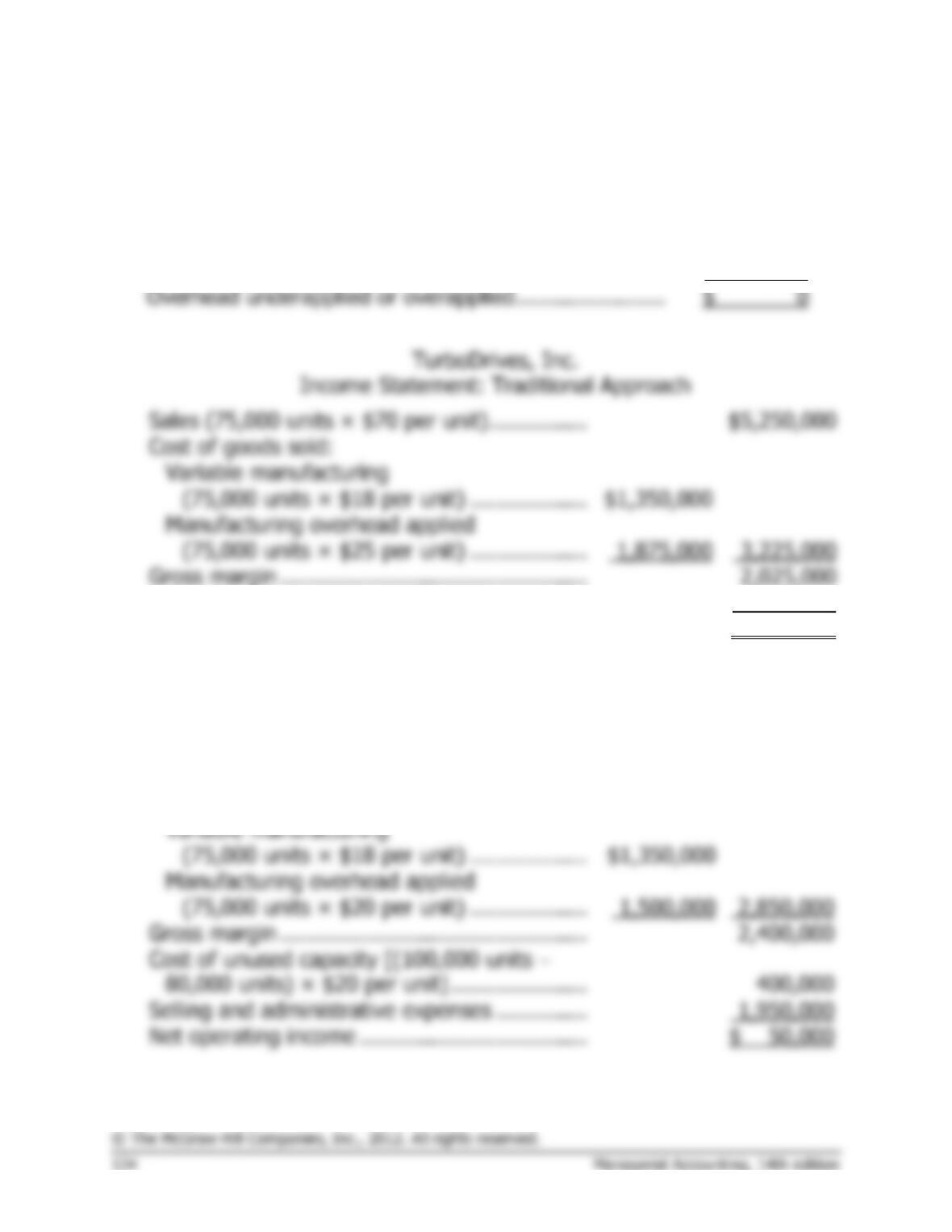
1. Traditional approach:
Actual total manufacturing overhead cost incurred
(assumed to equal the original estimate) ……………..
$2,000,000
Manufacturing overhead applied
(80,000 units × $25 per unit) …………………………...
2,000,000
Overhead underapplied or overapplied …………………..
Sales (75,000 units × $70 per unit) ……………
Cost of goods sold:
Gross margin ………………………………………..
2,025,000
Selling and administrative expenses …………..
1,950,000
Net operating income ……………………………..
$ 75,000
New approach:
TurboDrives, Inc.
Income Statement: New Approach
Sales (75,000 units × $70 per unit) ……………
$5,250,000
Cost of goods sold:
Gross margin ………………………………………..
Cost of unused capacity [(100,000 units −
Selling and administrative expenses …………..
Net operating income ……………………………..
Case 3A-4 (continued)
2. Traditional approach:
Under the traditional approach, the reported net operating income can
be increased by increasing the production level, which then results in
overapplied overhead that is deducted from Cost of Goods Sold.
Overhead applied per unit of output (b) …………………….
Actual total manufacturing overhead cost incurred ……….
Manufacturing overhead applied
[(80,000 units + 5,400 units) × $25 per unit] …………..
Overhead overapplied ……………………………………………
TurboDrives, Inc.
Income Statement: Traditional Approach
Sales (75,000 units × $70 per unit) …………..
$5,250,000
Cost of goods sold:
Variable manufacturing
(75,000 units × $18 per unit) ……………..
$1,350,000
Manufacturing overhead applied
(75,000 units × $25 per unit) ……………..
1,875,000
Less: Manufacturing overhead overapplied .
Gross margin ……………………………………….
Selling and administrative expenses ………….
Net operating income …………………………….
Case 3A-4 (continued)
New approach:
Under the new approach, the reported net operating income can be
increased by increasing the production level which then results in less of a
deduction on the income statement for the Cost of Unused Capacity.
(a) …………………………………………………………………
Overhead applied per unit of output (b) ……………………
Estimated number of units produced ……………………….
Actual number of units to be produced …………………….
TurboDrives, Inc.
Income Statement: New Approach
Sales (75,000 units × $70 per unit) ………………….
$5,250,000
Cost of goods sold:
Variable manufacturing
(75,000 units × $18 per unit) ……………………..
$1,350,000
Manufacturing overhead applied
(75,000 units × $20 per unit) ……………………..
1,500,000
2,850,000
Gross margin ……………………………………………….
2,400,000
Cost of unused capacity
[(100,000 units − 88,000 units) × $20 per unit] .
240,000
Selling and administrative expenses ………………….
1,950,000
Net operating income …………………………………….
$ 210,000
Case 3A-4 (continued)
4. As the computations in part (2) above show, the “hat trick” is a bit
harder to perform under the new method. Under the old method, the
target net operating income can be attained by producing an additional
5. One can argue that whether the “hat trick” is unethical depends on the
level of sophistication of the owners of the company and others who
read the financial statements. If they understand the effects of excess
production on net operating income and are not misled, it can be
argued that the hat trick is ethical. However, if that were the case, there
does not seem to be any reason to use the hat trick. Why would the
owners want to tie up working capital in inventories just to artificially
attain a target net operating income for the period? And increasing the

Appendix 3B
Further Classification of Labor Costs
Exercise 3B-1 (10 minutes)
Direct labor (36 hours × $18 per hour) ……….
$648
Total wages earned ………………………………..
$720

Exercise 3B-2 (10 minutes)
Direct labor (46 hours × $16 per hour) ……….
$736
Total wages earned ………………………………..
$784

Exercise 3B-3 (15 minutes)
1. No. It appears that the overtime spent completing the job was simply a
matter of how the job happened to be scheduled. Under these
2.
Direct labor: 9 hours × $20 per hour ……………..
$180
General overhead: 1 hour × $10 per hour ………
Total labor cost …………………………………………
$190
3. A charge for an overtime premium might be justified if the customer
requested that the work be done on a “rush” basis.
Exercise 3B-4 (15 minutes)
1.
Direct labor: 34 hours × $12 per hour ………………………..
$408
Manufacturing overhead: 6 hours × $12 per hour …………
Total cost …………………………………………………………….
$480
2.
Direct labor: 50 hours × $12 per hour ………………………..
$600
Manufacturing overhead: 10 hours × $6 per hour …………
60
Total cost …………………………………………………………….
$660
3. The company could treat the cost of fringe benefits relating to direct
labor workers as part of manufacturing overhead. This approach
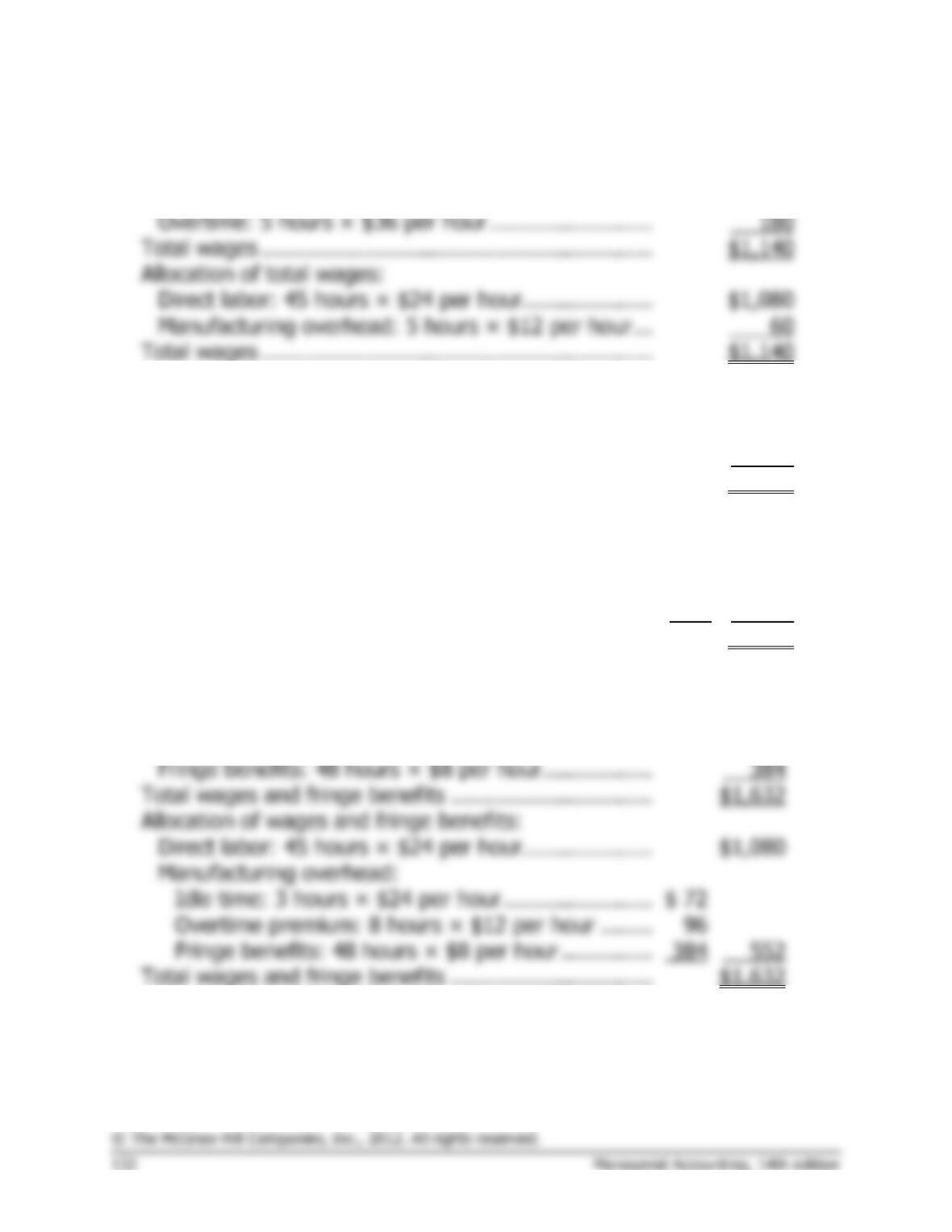
Problem 3B-5 (30 minutes)
1.
Total wages for the week:
Regular time: 40 hours × $24 per hour ………………
$ 960
Overtime: 5 hours × $36 per hour …………………….
180
Total wages ……………………………………………………
$1,140
Allocation of total wages:
Direct labor: 45 hours × $24 per hour ………………..
Manufacturing overhead: 5 hours × $12 per hour …
Total wages ……………………………………………………
$1,140
2.
Total wages for the week:
Regular time: 40 hours × $24 per hour ………………
$ 960
Overtime: 10 hours × $36 per hour …………………..
360
Total wages ……………………………………………………
$1,320
Allocation of total wages:
Direct labor: 46 hours × $24 per hour ………………..
$1,104
Manufacturing overhead:
Idle time: 4 hours × $24 per hour …………………..
$ 96
Overtime premium: 10 hours × $12 per hour…….
120
216
Total wages ……………………………………………………
$1,320
3.
Total wages and fringe benefits for the week:
Regular time: 40 hours × $24 per hour ………………
$ 960
Overtime: 8 hours × $36 per hour …………………….
288
Fringe benefits: 48 hours × $8 per hour ……………..
384
Total wages and fringe benefits ………………………….
Allocation of wages and fringe benefits:
Direct labor: 45 hours × $24 per hour ………………..
Manufacturing overhead:
Overtime premium: 8 hours × $12 per hour ……..
Fringe benefits: 48 hours × $8 per hour …………..
Total wages and fringe benefits ………………………….

Problem 3B-5 (continued)
4.
Allocation of wages and fringe benefits:
Direct labor:
Wage cost: 45 hours × $24 per hour …………….
$1,080
Fringe benefits: 45 hours × $8 per hour ………..
Overtime premium: 8 hours × $12 per hour …..
Fringe benefits: 3 hours × $8 per hour ………….