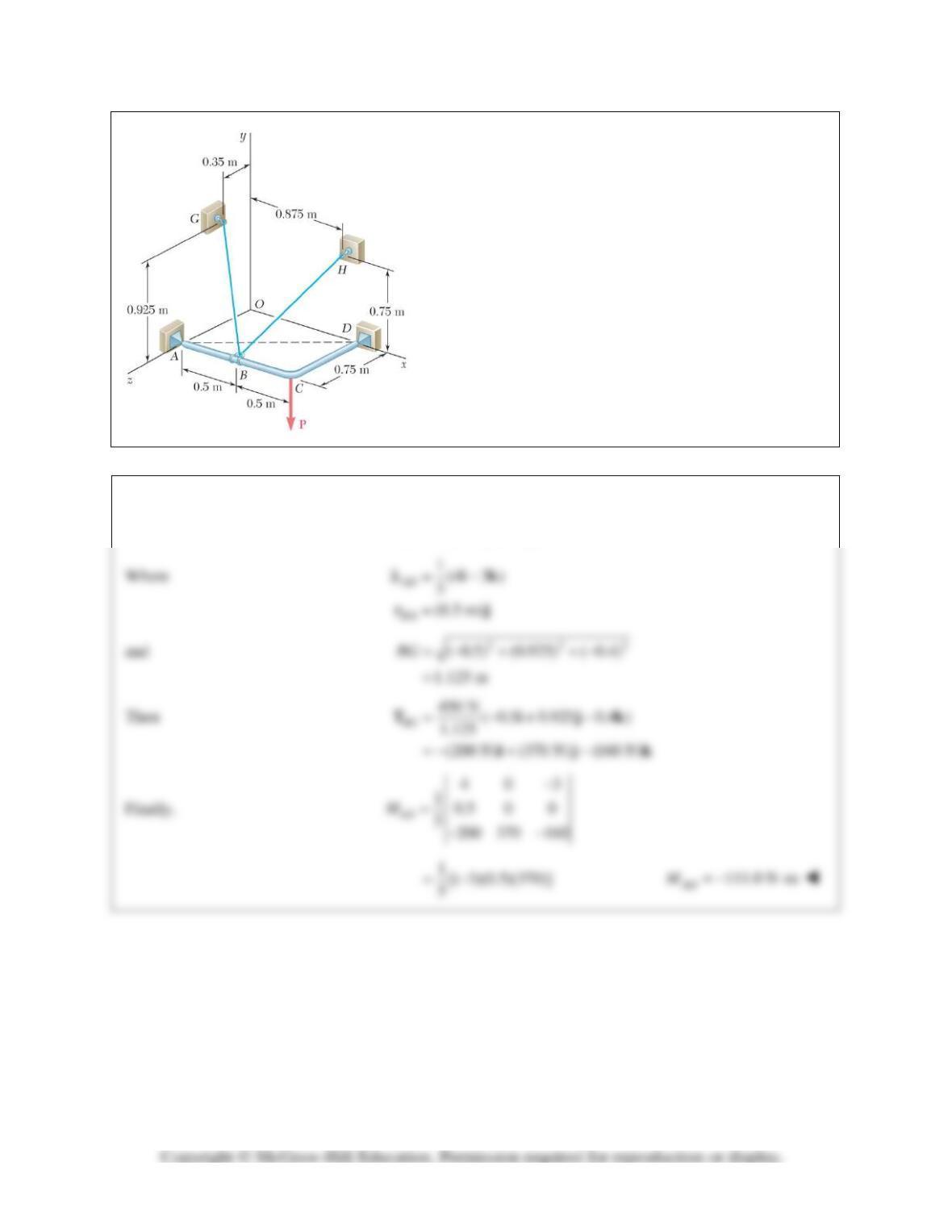
PROBLEM 3.58
In Problem 3.57, determine the moment about the diagonal
AD of the force exerted on the frame by portion BG of the
cable.
PROBLEM 3.57 The frame ACD is hinged at A and D
and is supported by a cable that passes through a ring at B
and is attached to hooks at G and H. Knowing that the
tension in the cable is 450 N, determine the moment about
the diagonal AD of the force exerted on the frame by
portion BH of the cable.
SOLUTION
/
()
AD AD B A BG
M=⋅×rTλ
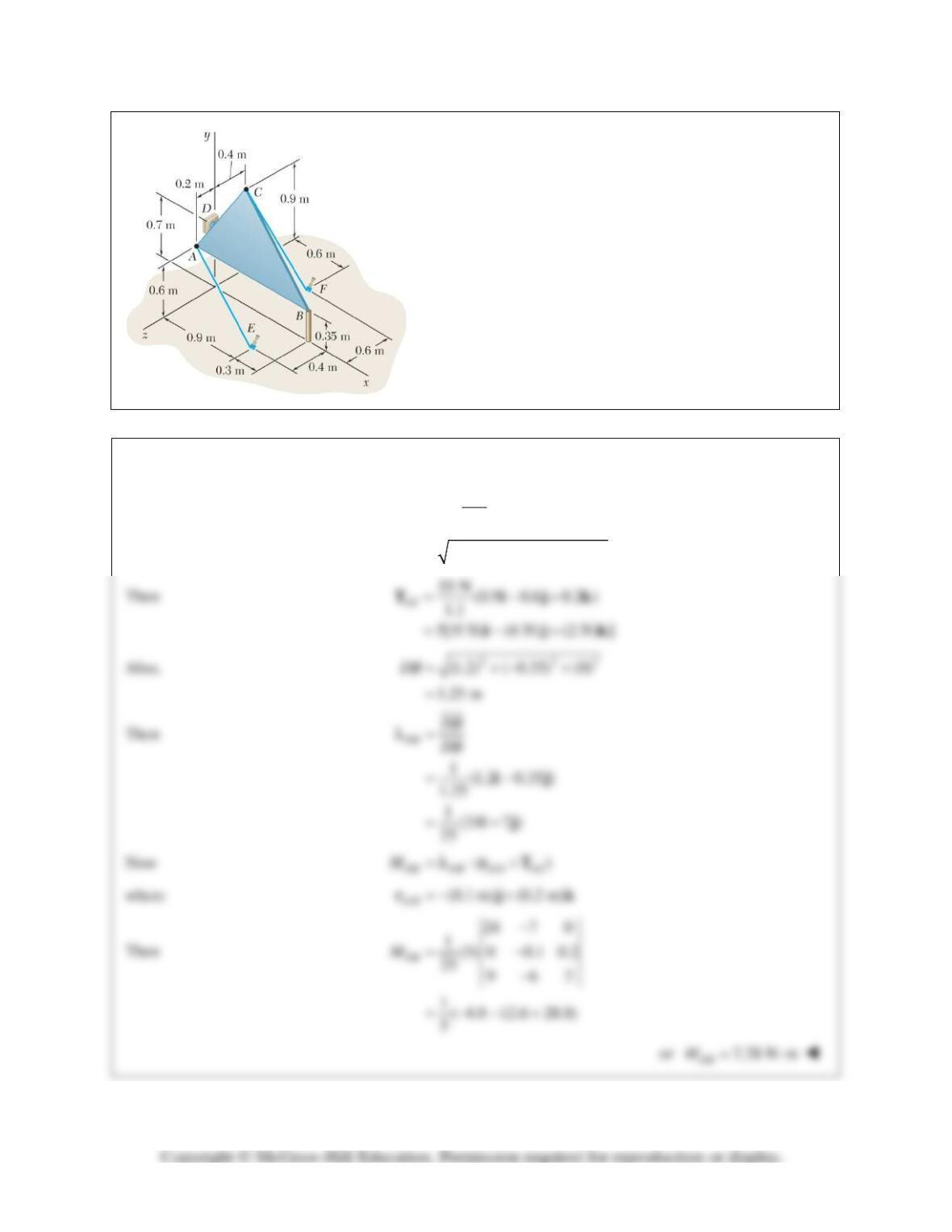
PROBLEM 3.59
The triangular plate ABC is supported by ball-and–socket
joints at B and D and is held in the position shown by
cables AE and CF. If the force exerted by cable AE at A is
55 N, determine the moment of that force about the line
joining Points D and B.
SOLUTION
First note:
AE AE
AE
TAE
=T
2 22
(0.9) ( 0.6) (0.2) 1.1 mAE = +− + =
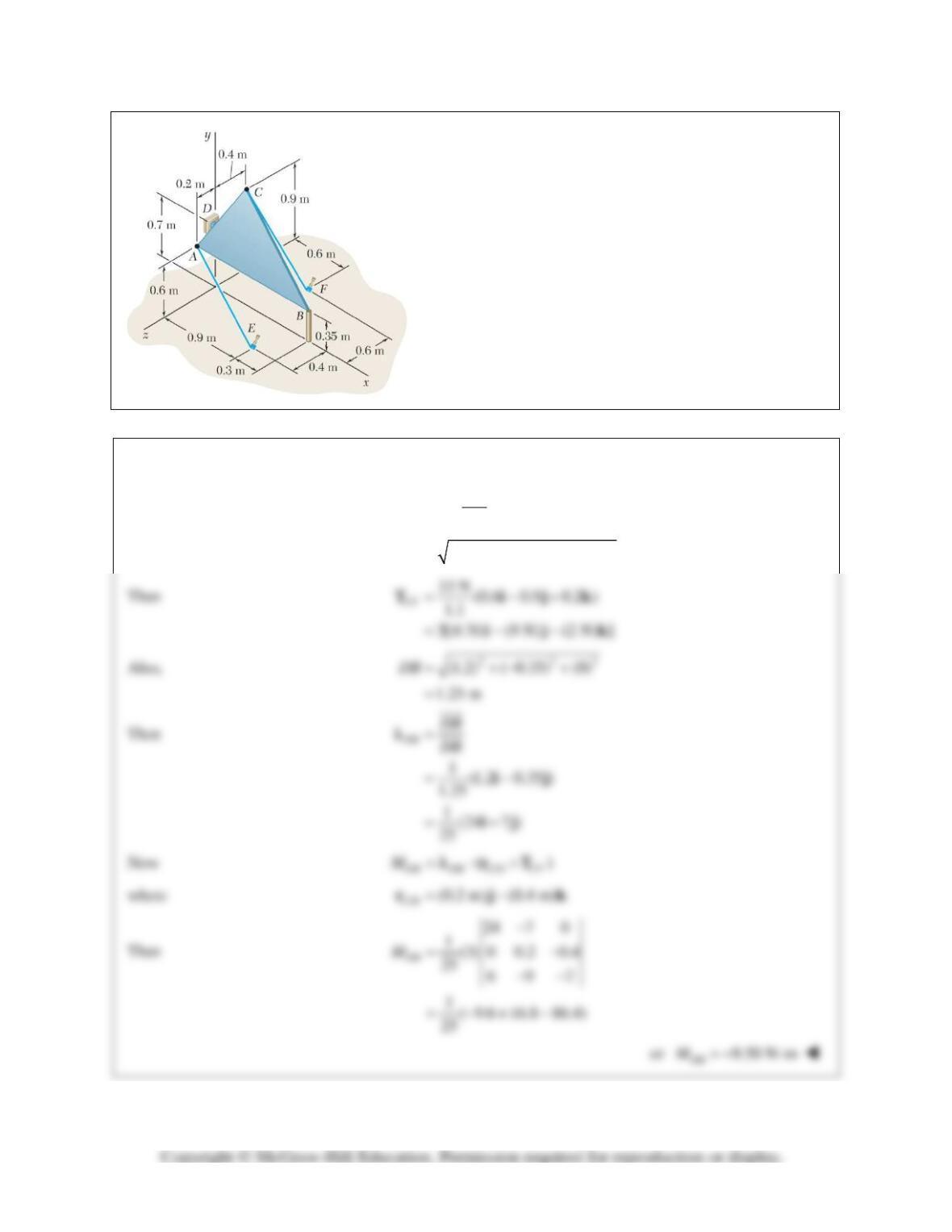
PROBLEM 3.60
The triangular plate ABC is supported by ball-and–socket
joints at B and D and is held in the position shown by
cables AE and CF. If the force exerted by cable CF at C is
33 N, determine the moment of that force about the line
joining Points D and B.
SOLUTION
First note:
CF CF
CF
TCF
=T
222
(0.6) ( 0.9) ( 0.2) 1.1 mCF = +− +− =
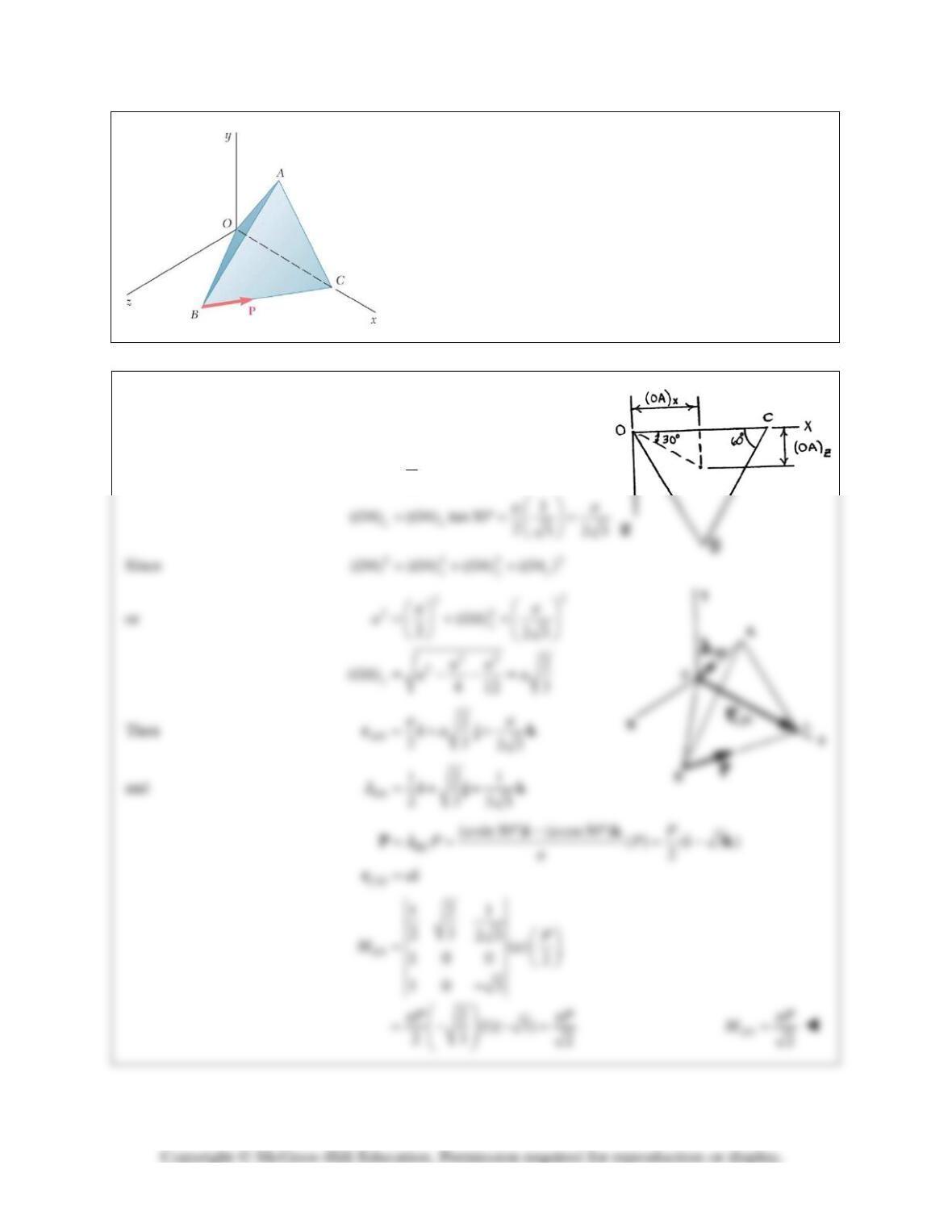
PROBLEM 3.61
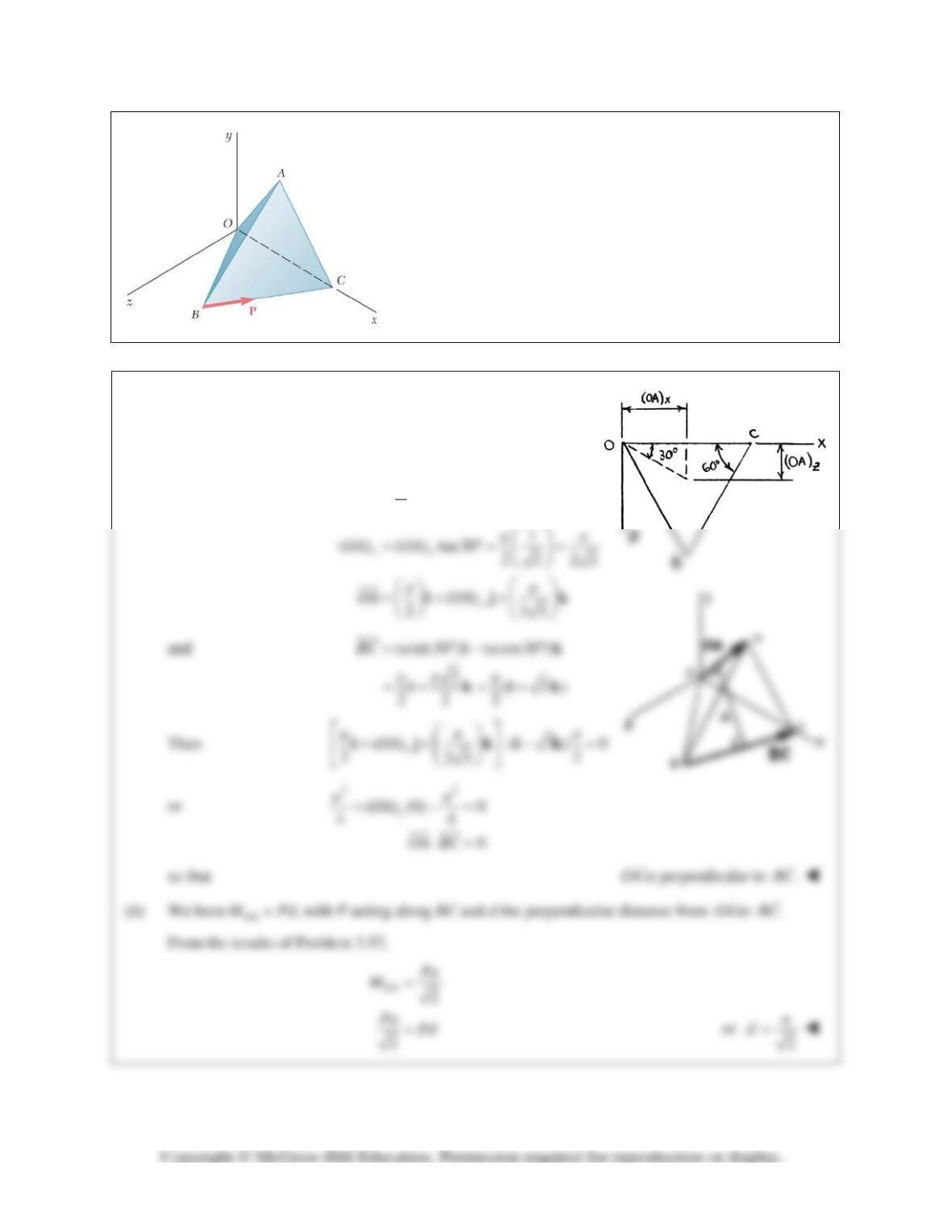
A regular tetrahedron has six edges of length a. A force P is
directed as shown along edge BC. Determine the moment of P
about edge OA.
SOLUTION
We have
/
()
OA OA C O
M=⋅×rP
λ
From triangle OBC:
PROBLEM 3.62
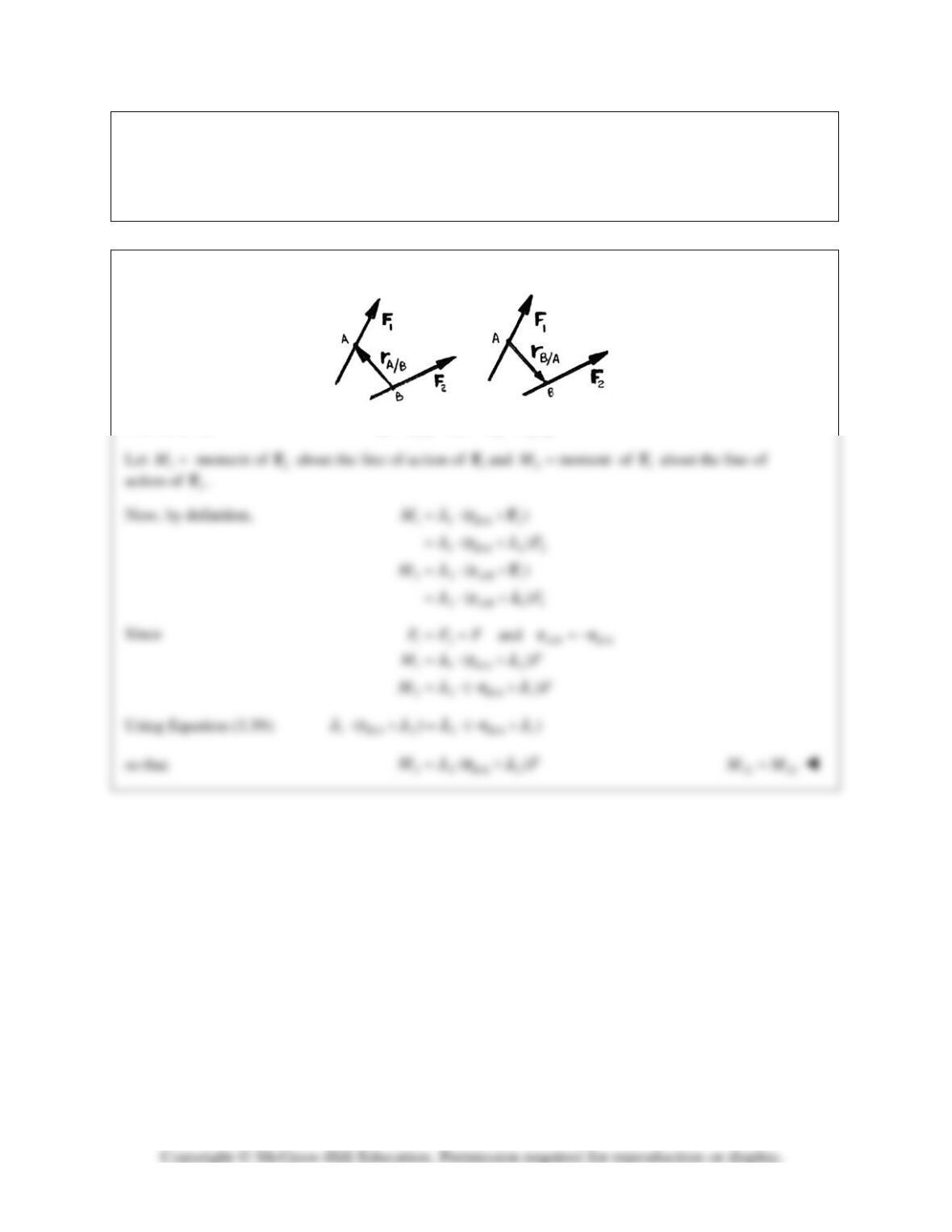
A regular tetrahedron has six edges of length a. (a) Show that
two opposite edges, such as OA and BC, are perpendicular to
each other. (b) Use this property and the result obtained in
Problem 3.61 to determine the perpendicular distance between
edges OA and BC.
SOLUTION
(a) For edge OA to be perpendicular to edge BC,
0OA BC⋅=
From triangle OBC:
PROBLEM 3.63
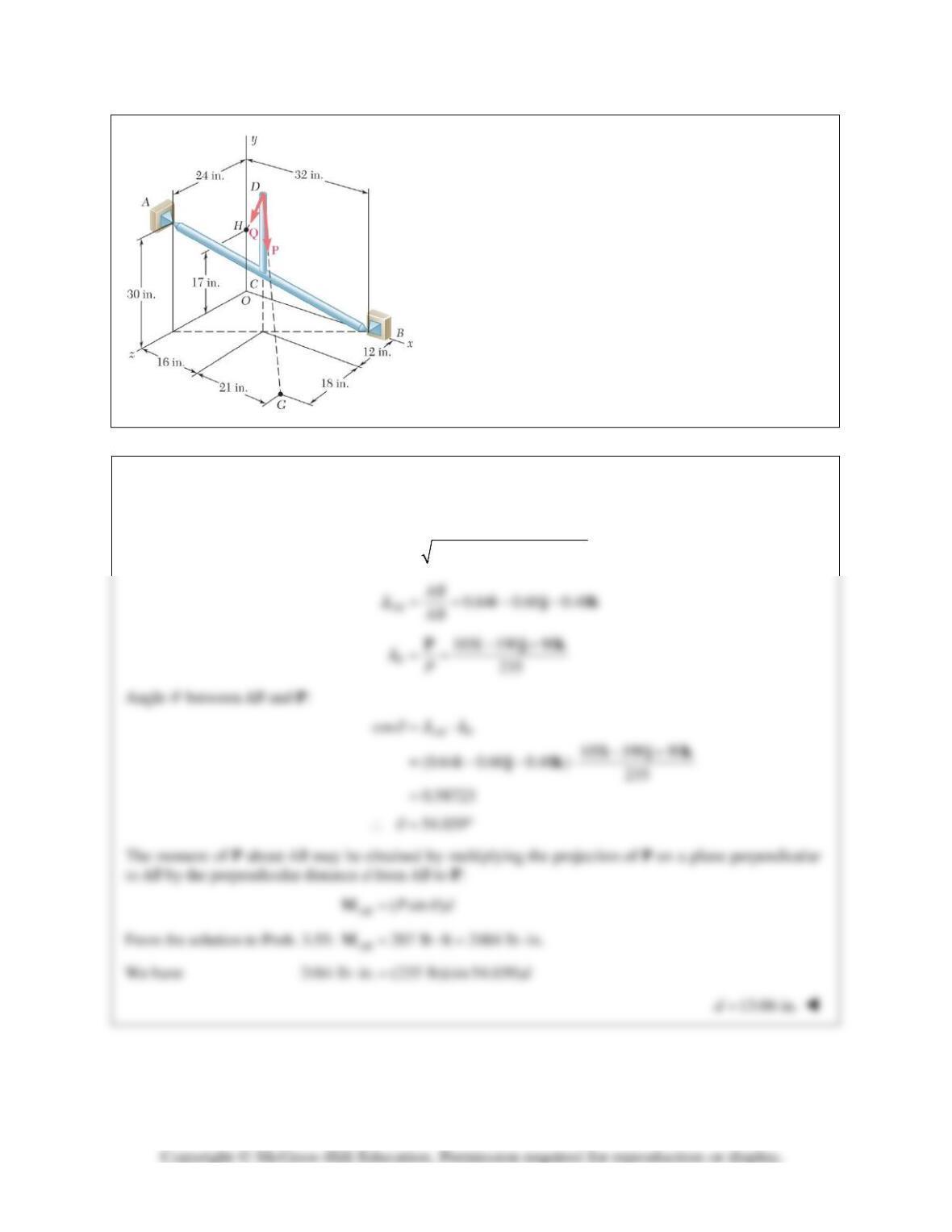
Two forces
1
F
and
2
F
in space have the same magnitude F. Prove that the moment of
1
F
about the line
of action of
2
F
is equal to the moment of
2
F
about the line of action of
1
F
.
SOLUTION
First note that
1 11 2 2 2
andFF= =FF
λλ
1
F
1
F
2
F
PROBLEM 3.64
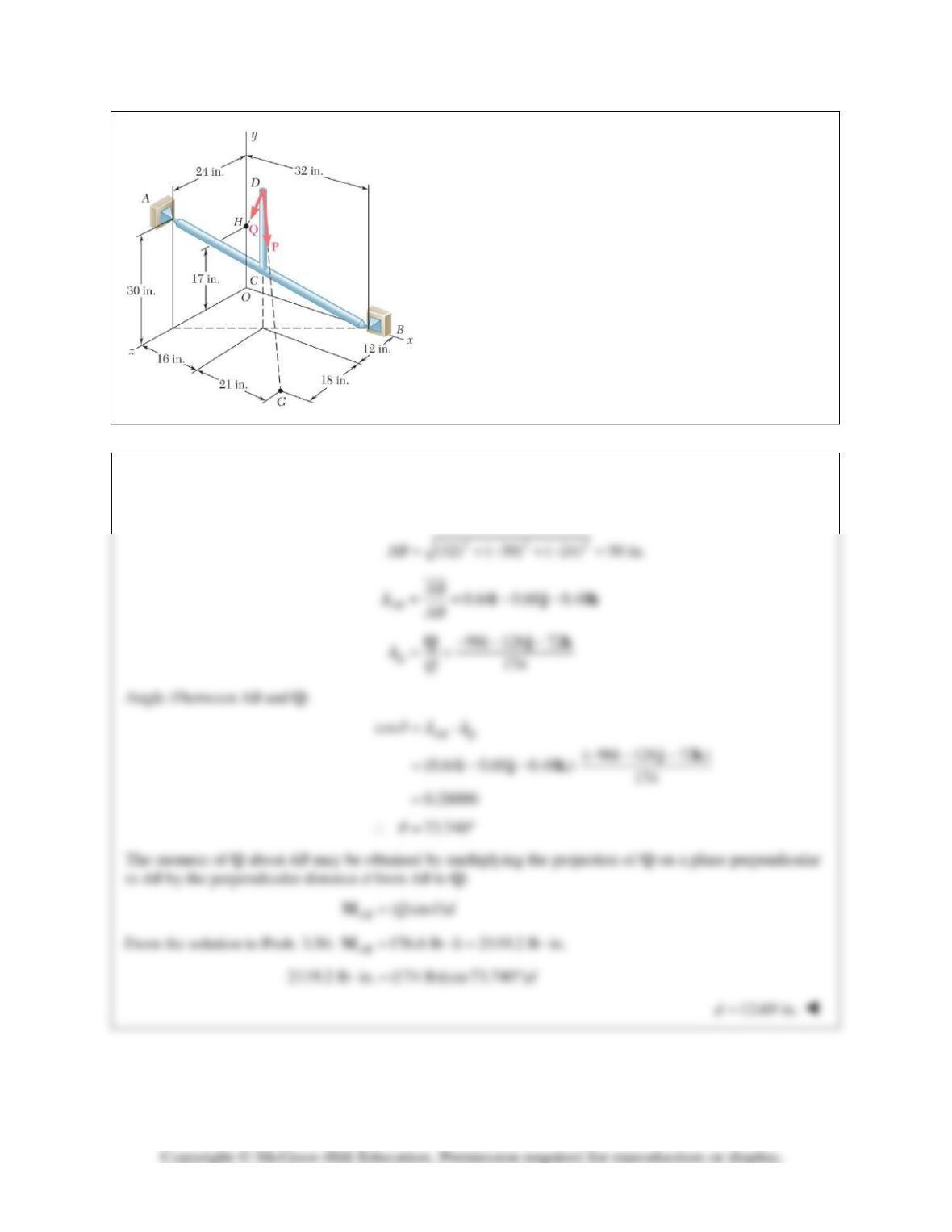
In Prob. 3.55, determine the perpendicular distance
between rod AB and the line of action of P.
PROBLEM 3.55 The 23-in. vertical rod CD is welded to
the midpoint C of the 50-in. rod AB. Determine the
moment about AB of the 235-lb force P.
SOLUTION
(32 in.) (30 in.) (24 in.)AB =−−i jk
222
(32) ( 30) ( 24) 50 in.AB = +− +− =
PROBLEM 3.65
In Prob. 3.56, determine the perpendicular distance
between rod AB and the line of action of Q.
PROBLEM 3.56 The 23-in. vertical rod CD is welded to
the midpoint C of the 50-in. rod AB. Determine the
moment about AB of the 174-lb force Q.
SOLUTION
(32 in.) (30 in.) (24 in.)AB =−−i jk
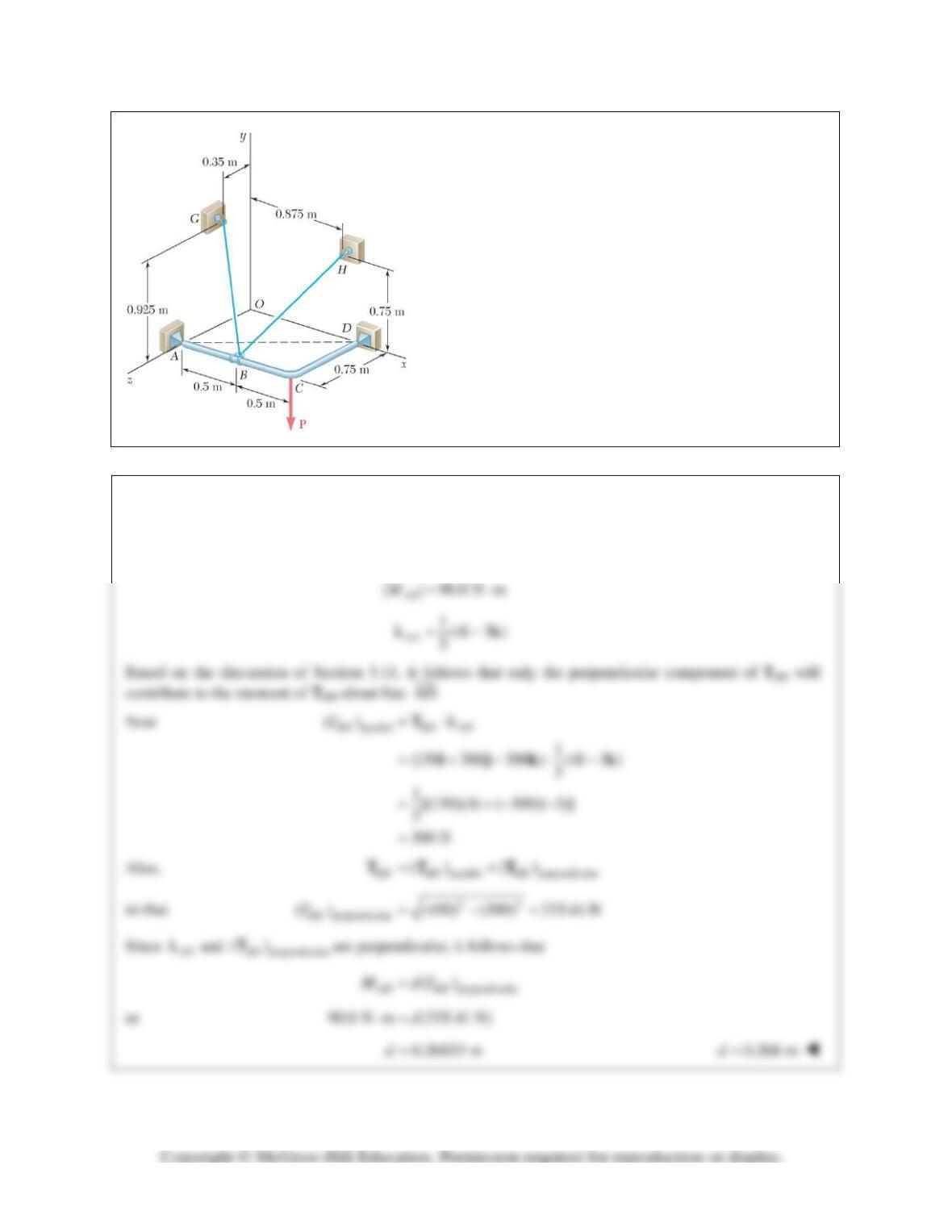
PROBLEM 3.66
In Problem 3.57, determine the perpendicular distance
between portion BH of the cable and the diagonal AD.
PROBLEM 3.57 The frame ACD is hinged at A and D
and is supported by a cable that passes through a ring at B
and is attached to hooks at G and H. Knowing that the
tension in the cable is 450 N, determine the moment about
the diagonal AD of the force exerted on the frame by
portion BH of the cable.
SOLUTION
From the solution to Problem 3.57:
450 N
(150 N) (300 N) (300 N)
BH
BH
T=
=+−T i jk
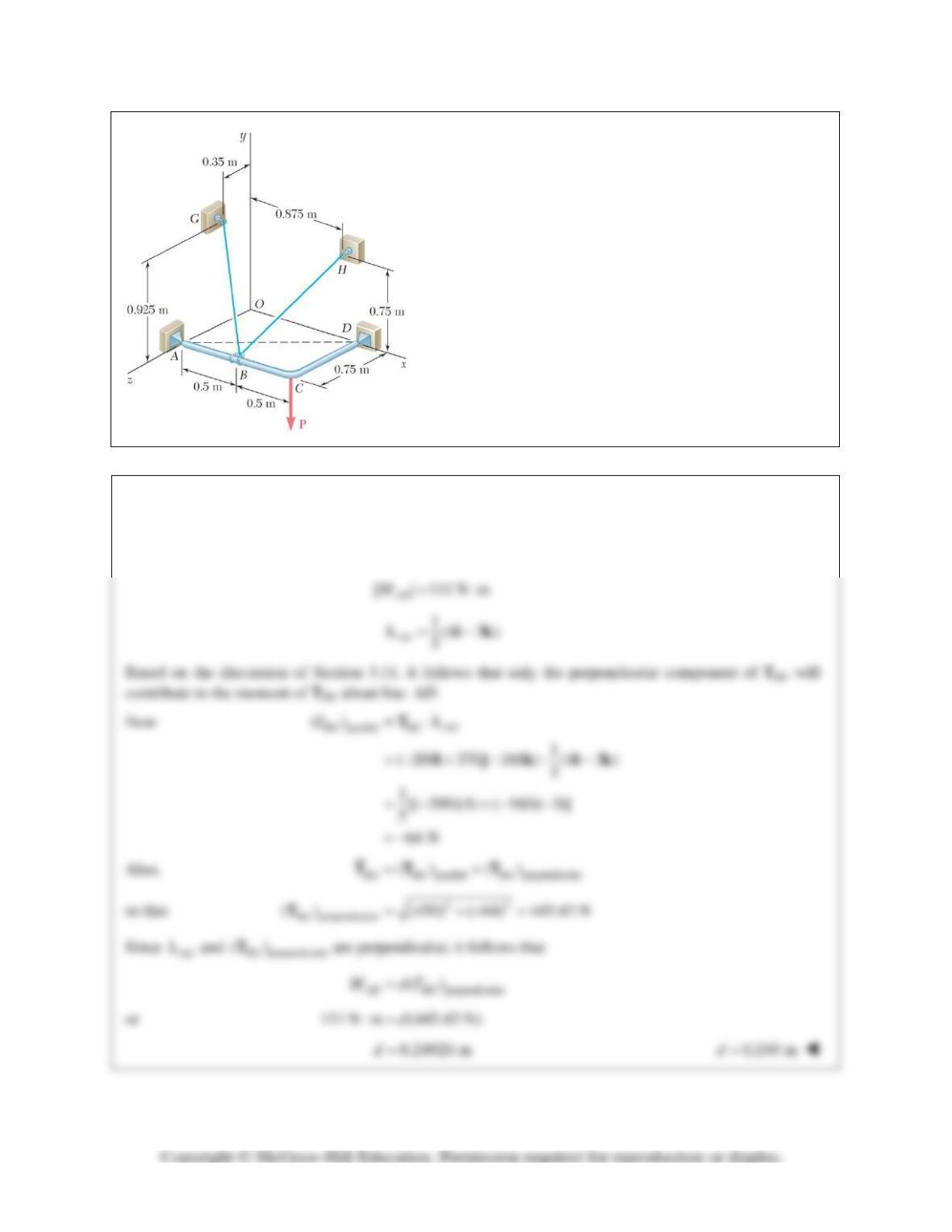
PROBLEM 3.67
In Problem 3.58, determine the perpendicular distance
between portion BG of the cable and the diagonal AD.
PROBLEM 3.58 In Problem 3.57, determine the moment
about the diagonal AD of the force exerted on the frame by
portion BG of the cable.
PROBLEM 3.57 The frame ACD is hinged at A and D
and is supported by a cable that passes through a ring at B
and is attached to hooks at G and H. Knowing that the
tension in the cable is 450 N, determine the moment about
the diagonal AD of the force exerted on the frame by
portion BH of the cable.
SOLUTION
From the solution to Problem 3.58:
450 N
(200 N) (370 N) (160 N)
BG
BG
=
=−+ −T i jk
T
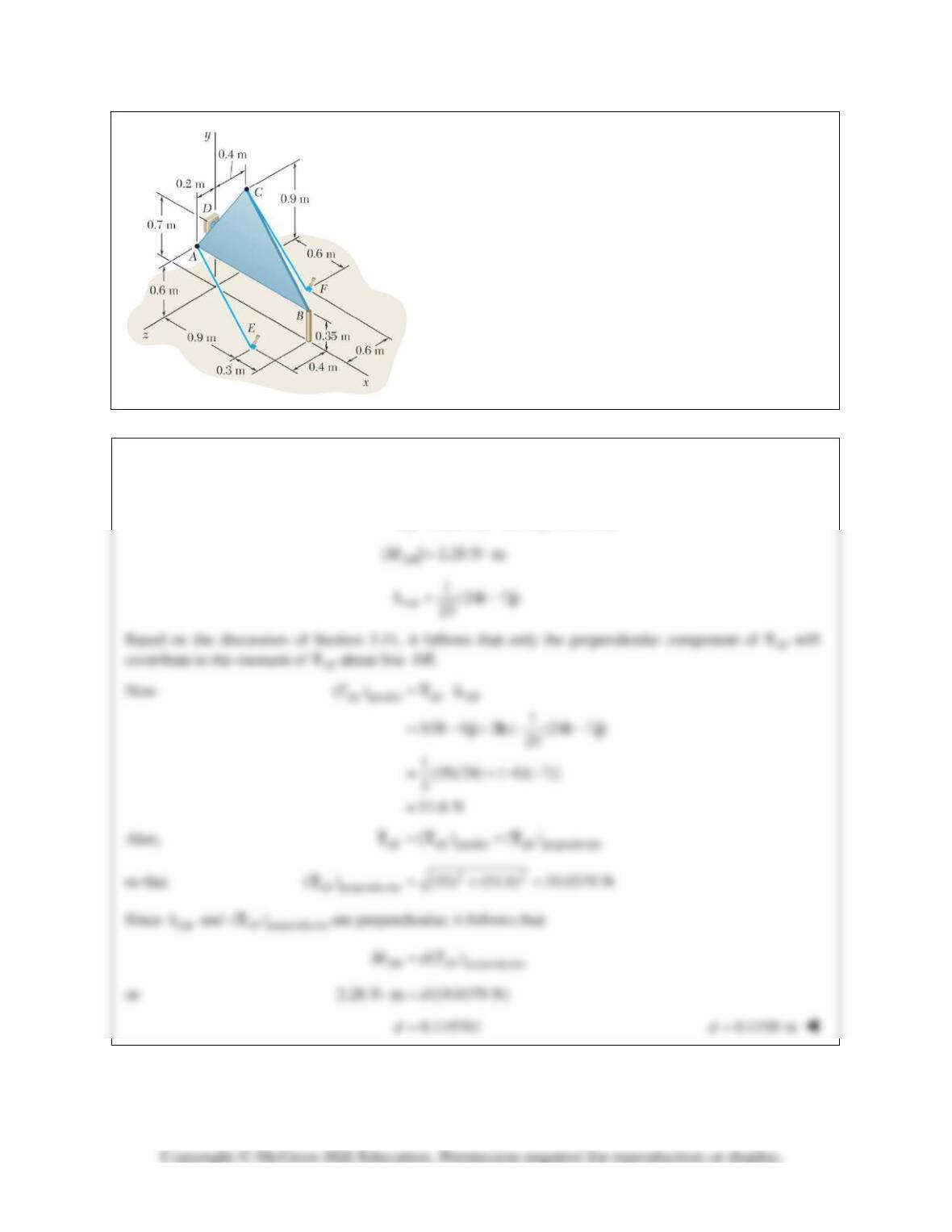
PROBLEM 3.68
In Problem 3.59, determine the perpendicular distance
between cable AE and the line joining Points D and B.
PROBLEM 3.59 The triangular plate ABC is supported by
ball–and–socket joints at B and D and is held in the position
shown by cables AE and CF. If the force exerted by cable
AE at A is 55 N, determine the moment of that force about
the line joining Points D and B.
SOLUTION
From the solution to Problem 3.59:
55 N
5[(9 N) (6 N) (2 N) ]
AE
AE
=
= −+T i jk
T
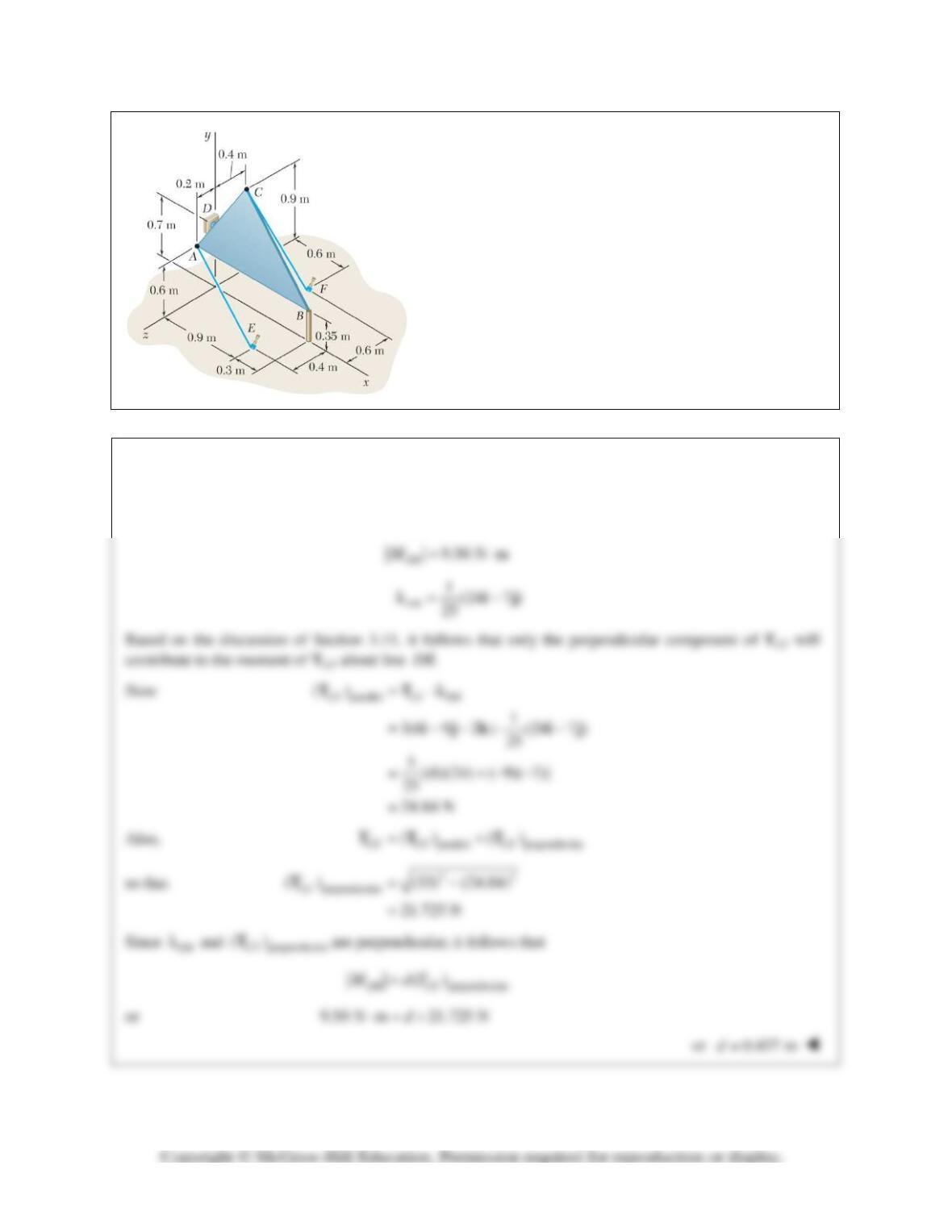
PROBLEM 3.69
In Problem 3.60, determine the perpendicular distance
between cable CF and the line joining Points D and B.
PROBLEM 3.60 The triangular plate ABC is supported by
ball–and–socket joints at B and D and is held in the position
shown by cables AE and CF. If the force exerted by cable
CF at C is 33 N, determine the moment of that force about
the line joining Points D and B.
SOLUTION
From the solution to Problem 3.60:
33 N
3[(6 N) (9 N) (2 N) ]
CF
CF
=
= −−T i jk
T
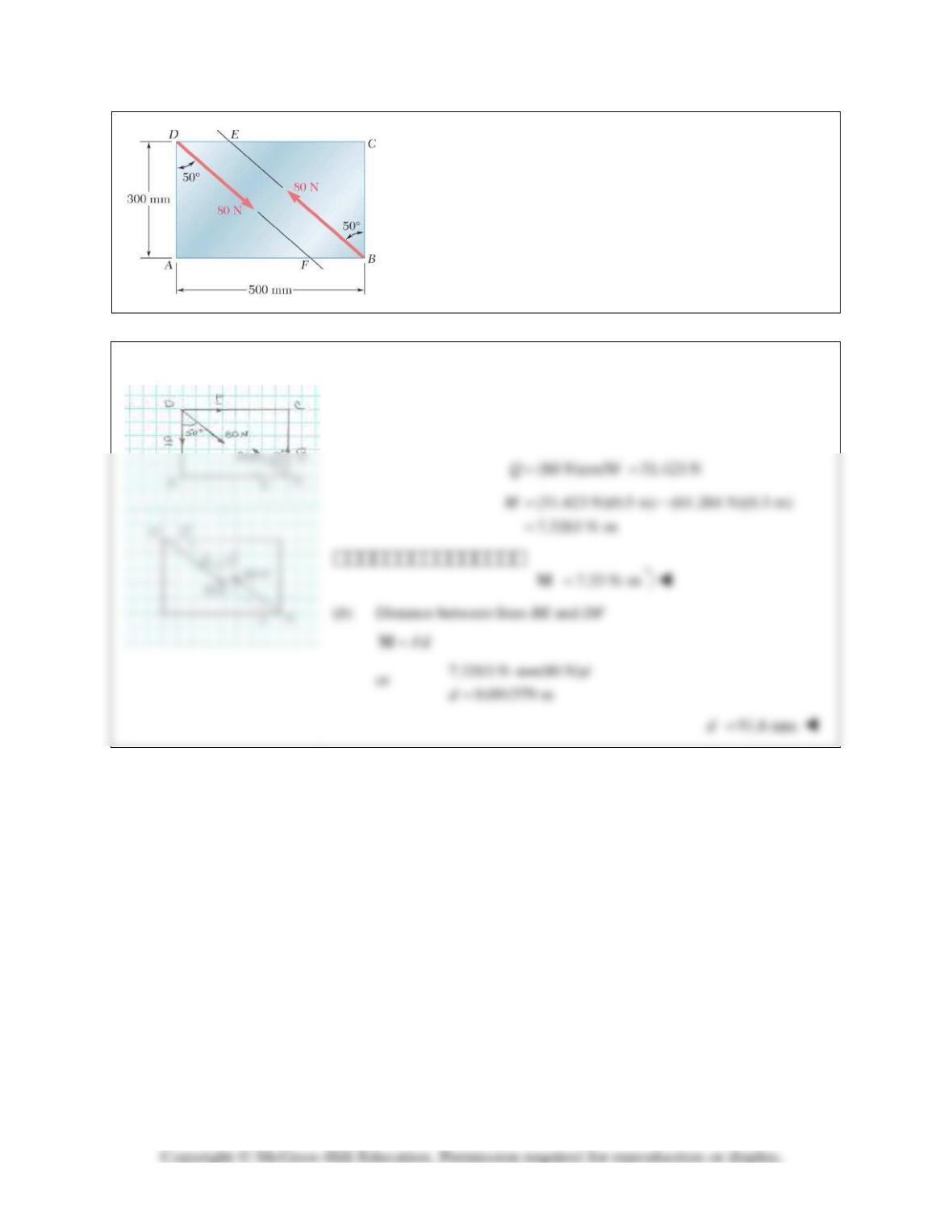
PROBLEM 3.70
Two 80–N forces are applied as shown to the corners B and D of
a rectangular plate. (a) Determine the moment of the couple
formed by the two forces by resolving each force into horizontal
and vertical components and adding the moments of the two
resulting couples. (b) Use the result obtained to determine the
perpendicular distance between lines BE and DF.
SOLUTION
(a) Resolving forces into components:
(80 N)sin 50 61.284 NP= =
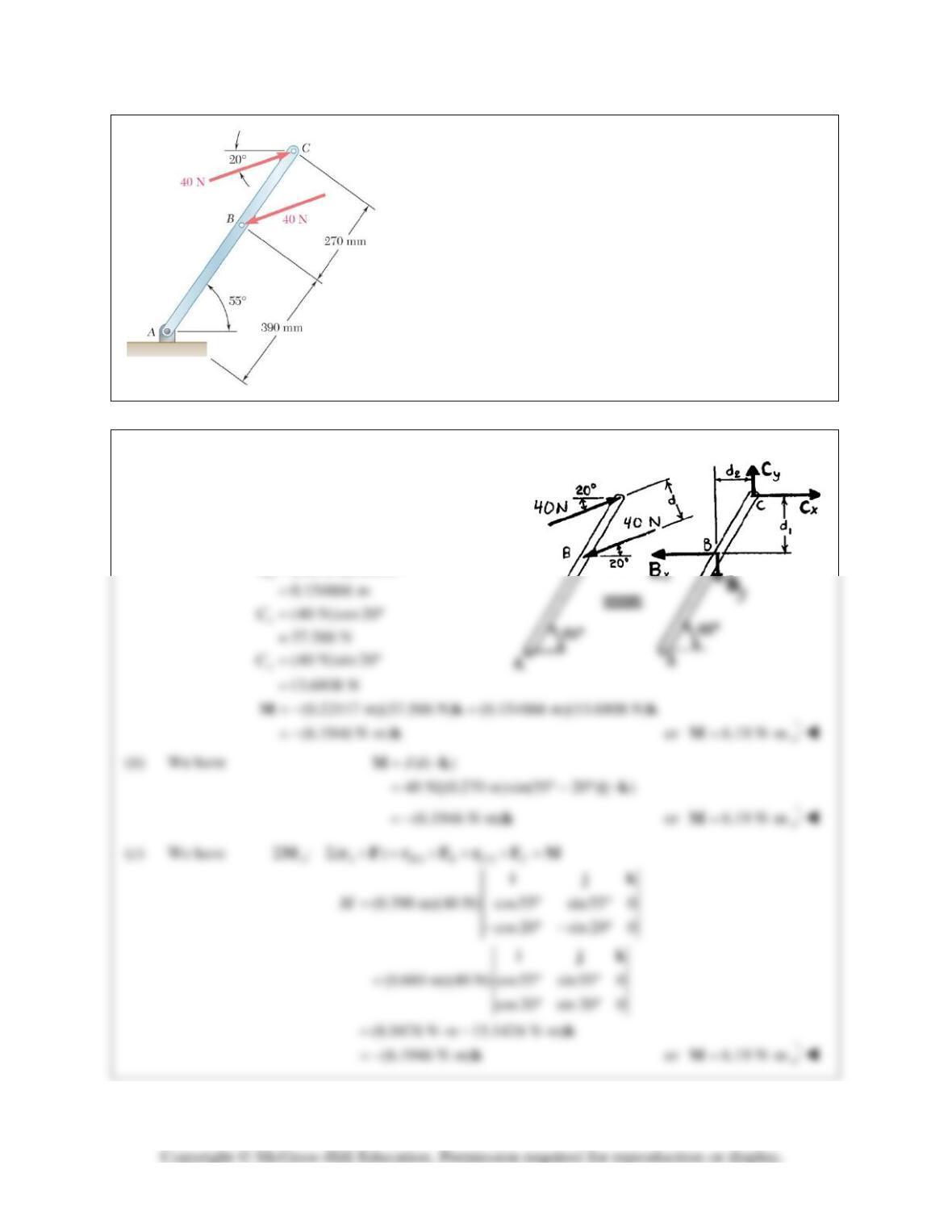
PROBLEM 3.71
Two parallel 40–N forces are applied to a lever as shown.
Determine the moment of the couple formed by the two forces
(a) by resolving each force into horizontal and vertical
components and adding the moments of the two resulting
couples, (b) by using the perpendicular distance between the
two forces, (c) by summing the moments of the two forces
about Point A.
SOLUTION
(a) We have
12
:
B xy
dC d CΣ −+ =MM
where
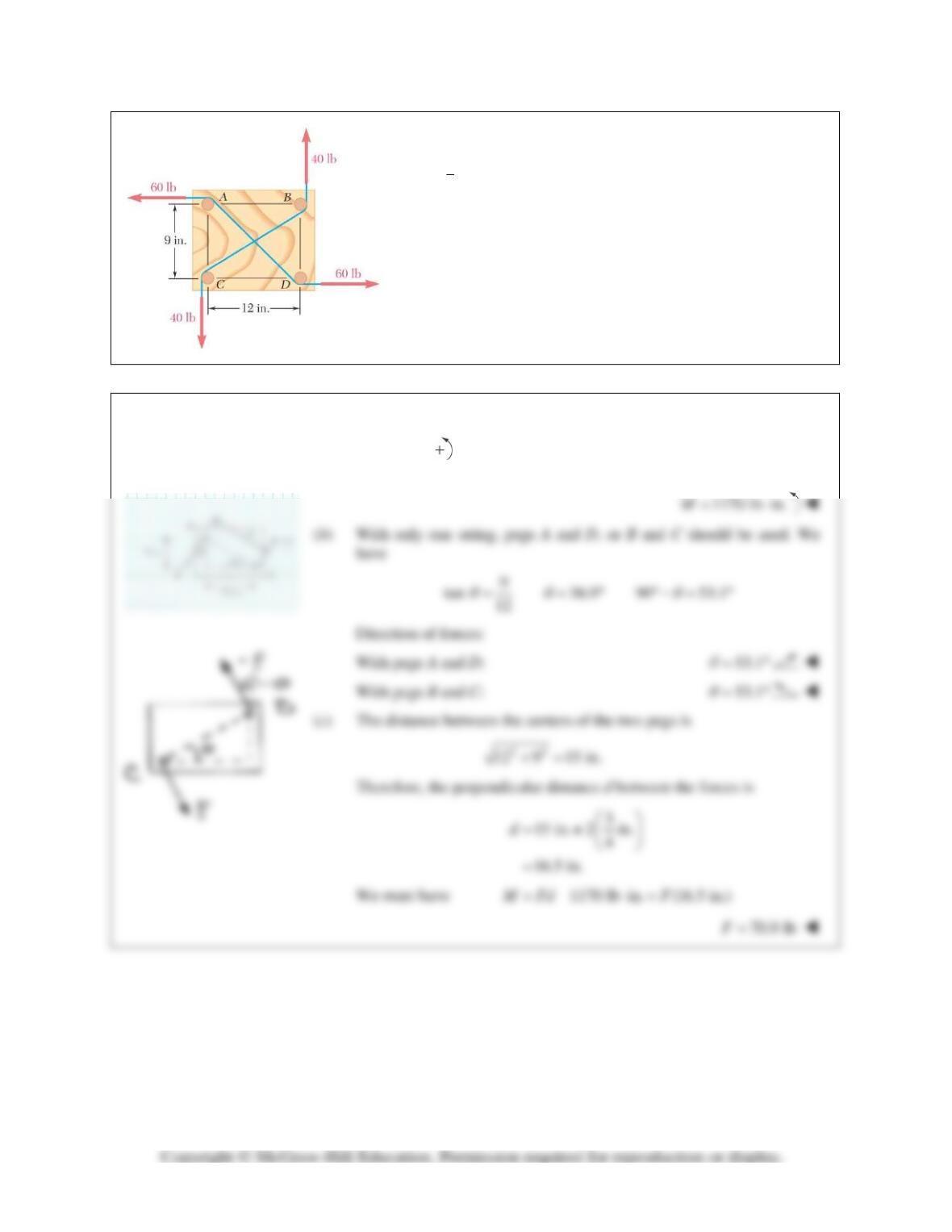
PROBLEM 3.72
Four 1
1
2
–in.–diameter pegs are attached to a board as shown.
Two strings are passed around the pegs and pulled with the
forces indicated. (a) Determine the resultant couple acting on
the board. (b) If only one string is used, around which pegs
should it pass and in what directions should it be pulled to
create the same couple with the minimum tension in the string?
(c) What is the value of that minimum tension?
SOLUTION
(a)
(60 lb)(10.5 in.) (40 lb)(13.5 in.)
630 lb in. 540 lb in.
M= +
= ⋅+ ⋅
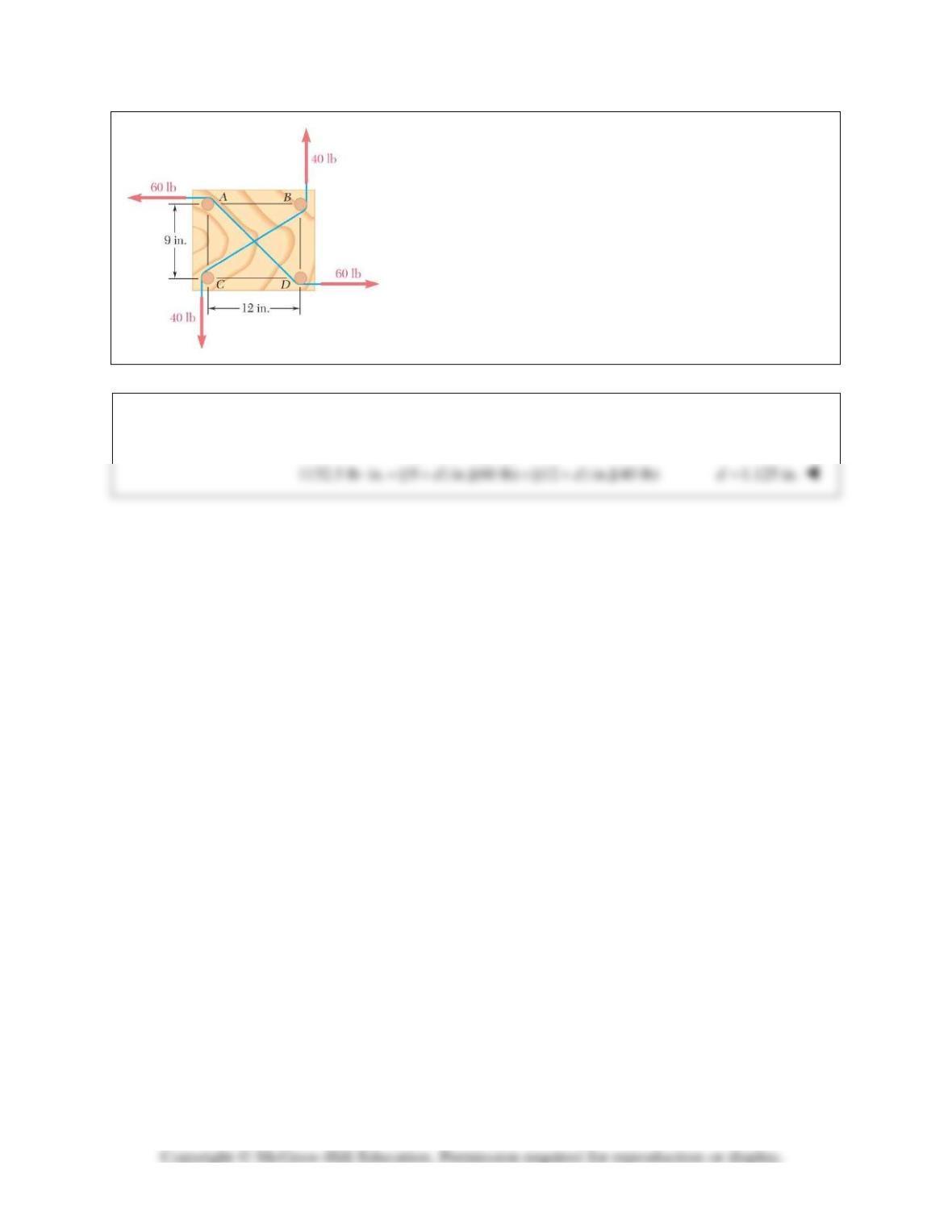
PROBLEM 3.73
Four pegs of the same diameter are attached to a board as
shown. Two strings are passed around the pegs and pulled with
the forces indicated. Determine the diameter of the pegs
knowing that the resultant couple applied to the board is
1132.5 lb·in. counterclockwise.
SOLUTION
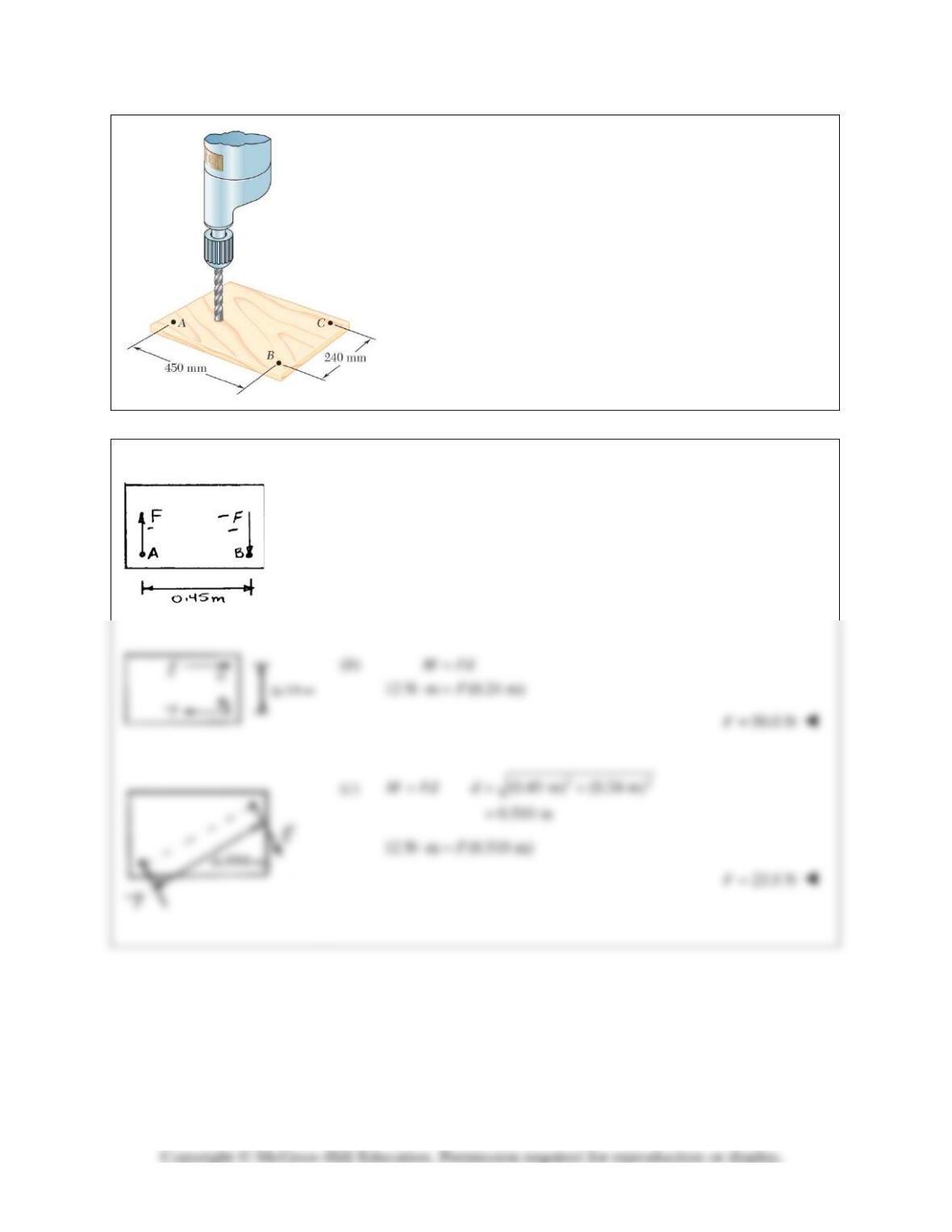
PROBLEM 3.74
A piece of plywood in which several holes are being drilled
successively has been secured to a workbench by means of two
nails. Knowing that the drill exerts a 12–N∙m couple on the
piece of plywood, determine the magnitude of the resulting
forces applied to the nails if they are located (a) at A and B,
(b) at B and C, (c) at A and C.
SOLUTION
12 N m (0.24 m)
M Fd
F
(a)
12 N m (0.45 m)
M Fd
F
=
⋅=
26.7 NF=
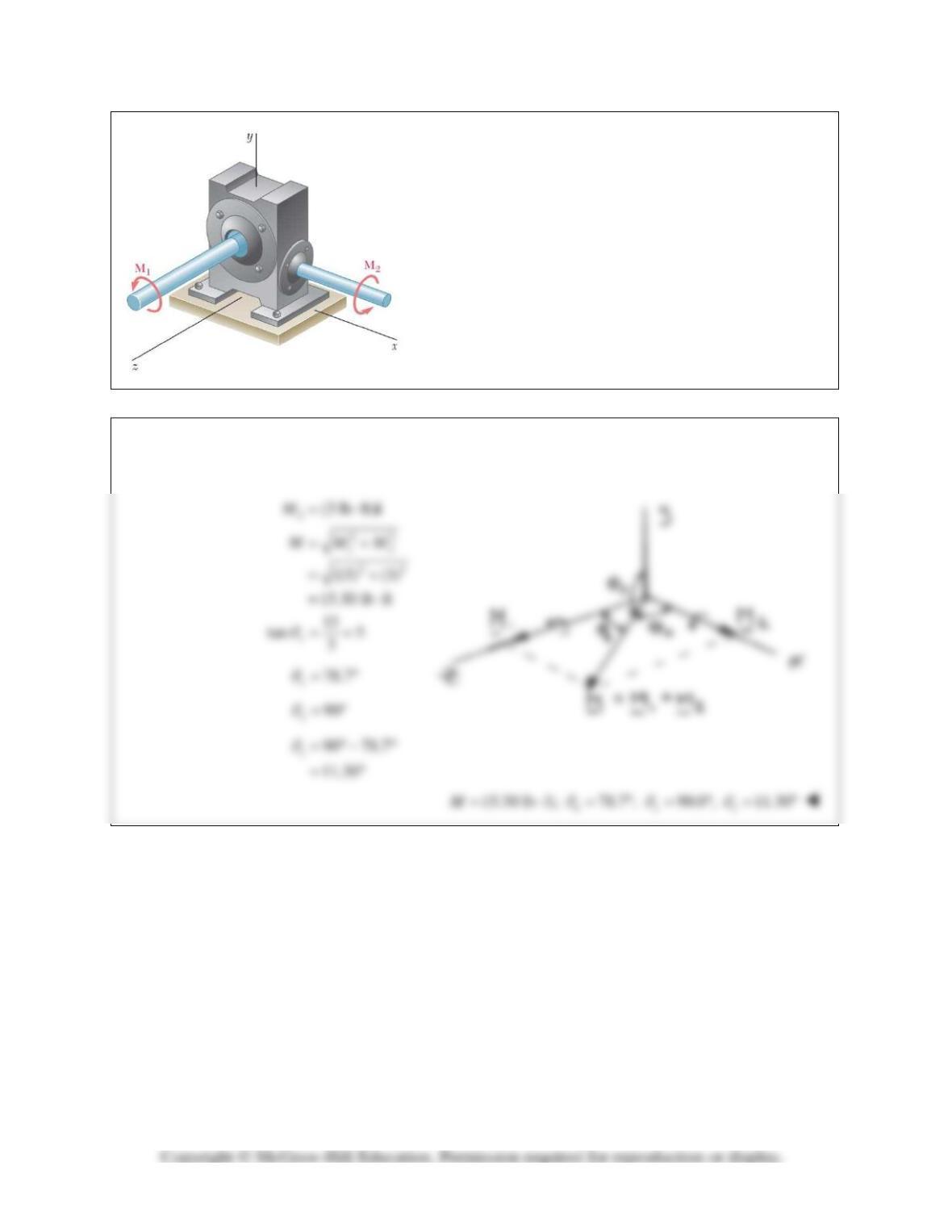
PROBLEM 3.75
The two shafts of a speed–reducer unit are subjected to
couples of magnitude M1 = 15 lb∙ft and M2 = 3 lb∙ft,
respectively. Replace the two couples with a single
equivalent couple, specifying its magnitude and the
direction of its axis.
SOLUTION
1
(15 lb ft )M= ⋅ k
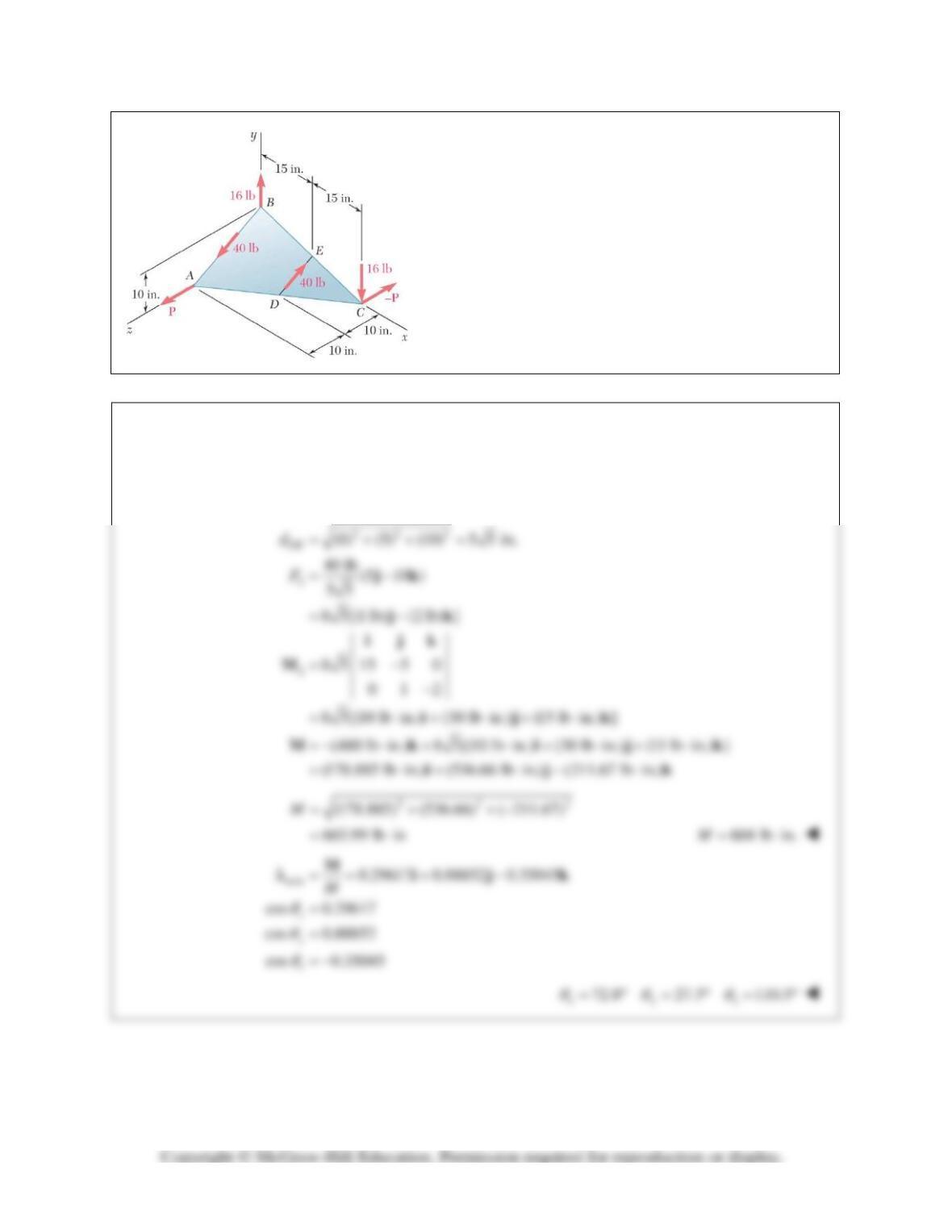
PROBLEM 3.76
If
0,P=
replace the two remaining couples with a single
equivalent couple, specifying its magnitude and the
direction of its axis.
SOLUTION
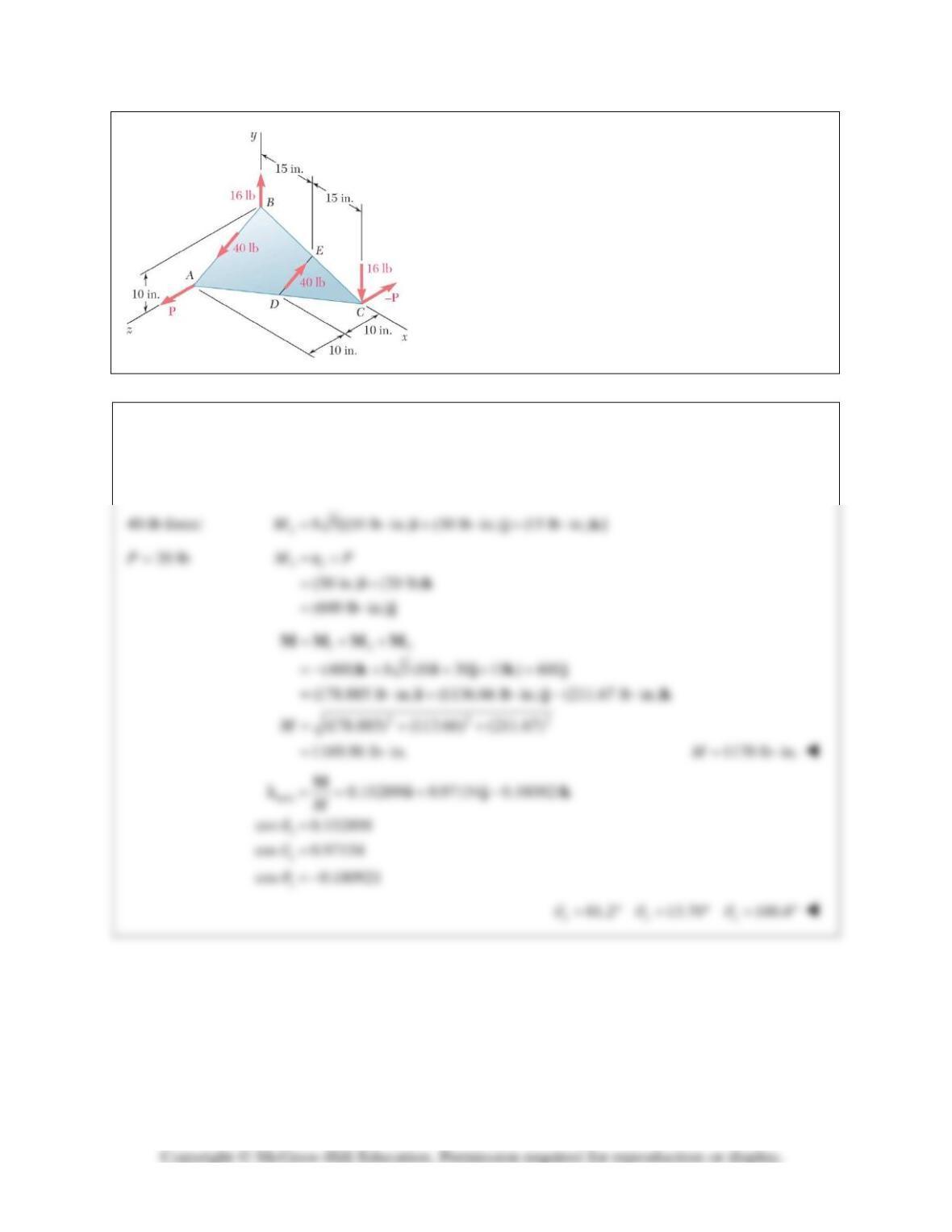
PROBLEM 3.77
If
20 lb,P=
replace the three couples with a single
equivalent couple, specifying its magnitude and the
direction of its axis.
SOLUTION
From the solution to Problem. 3.78:
16-lb force:
1
(480 lb in.)M=−⋅k