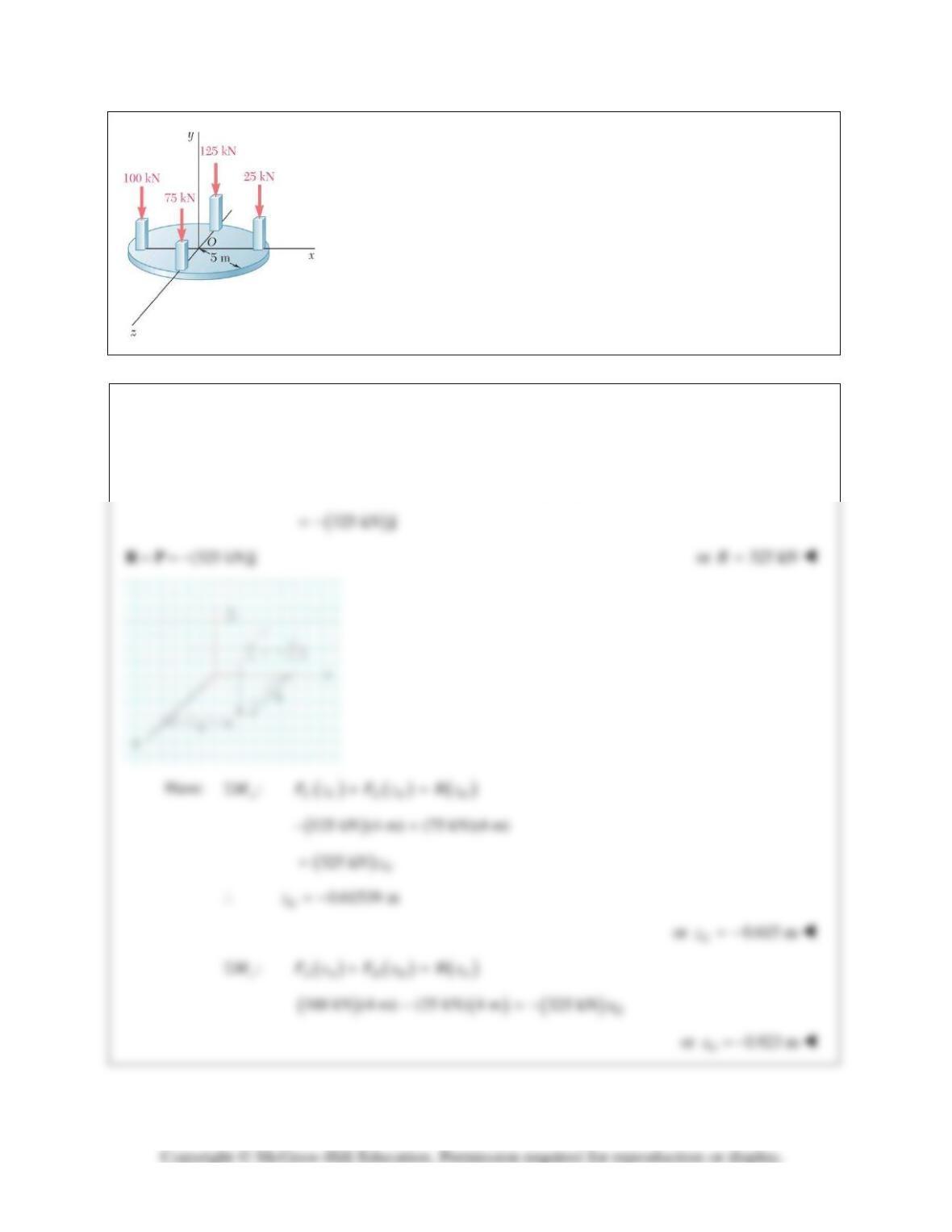
PROBLEM 3.131
A concrete foundation mat of 5-m radius supports four equally spaced
columns, each of which is located 4 m from the center of the mat.
Determine the magnitude and the point of application of the resultant of
the four loads.
SOLUTION
Have:
:
AC DE
Σ +++=F FFFF R
( ) ( ) ( ) ( )
100 kN 125 kN 25kN 75 kN=− − −−R j jjj
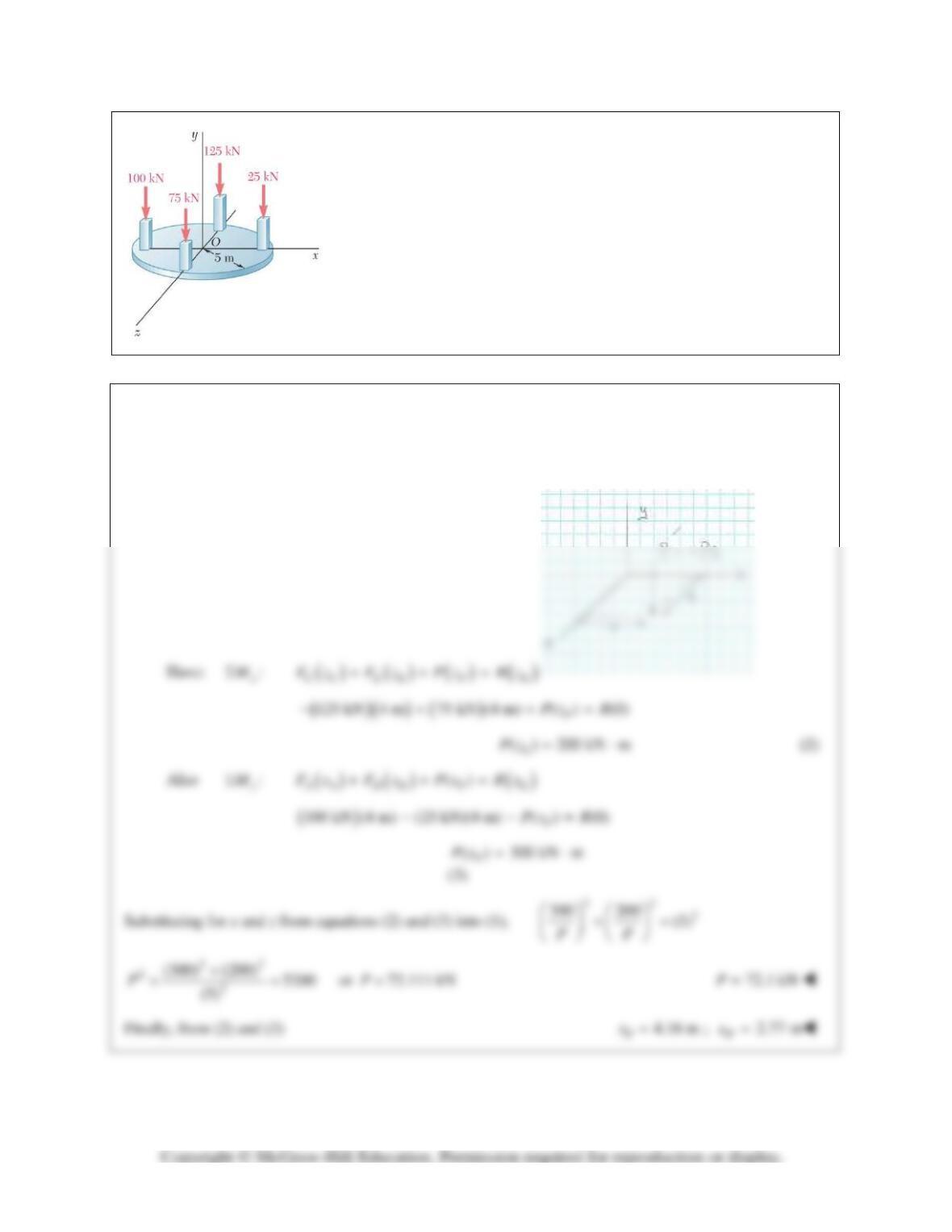
PROBLEM 3.132
Determine the magnitude and the point of application of the smallest
additional load that must be applied to the foundation mat of Prob. 3.131
if the resultant of the five loads is to pass through the center of the mat.
SOLUTION
The smallest load P will be placed on the edge of the mat at a radius of 5 m. Therefore
22 2
(5 m) (1)
PP
xz+=
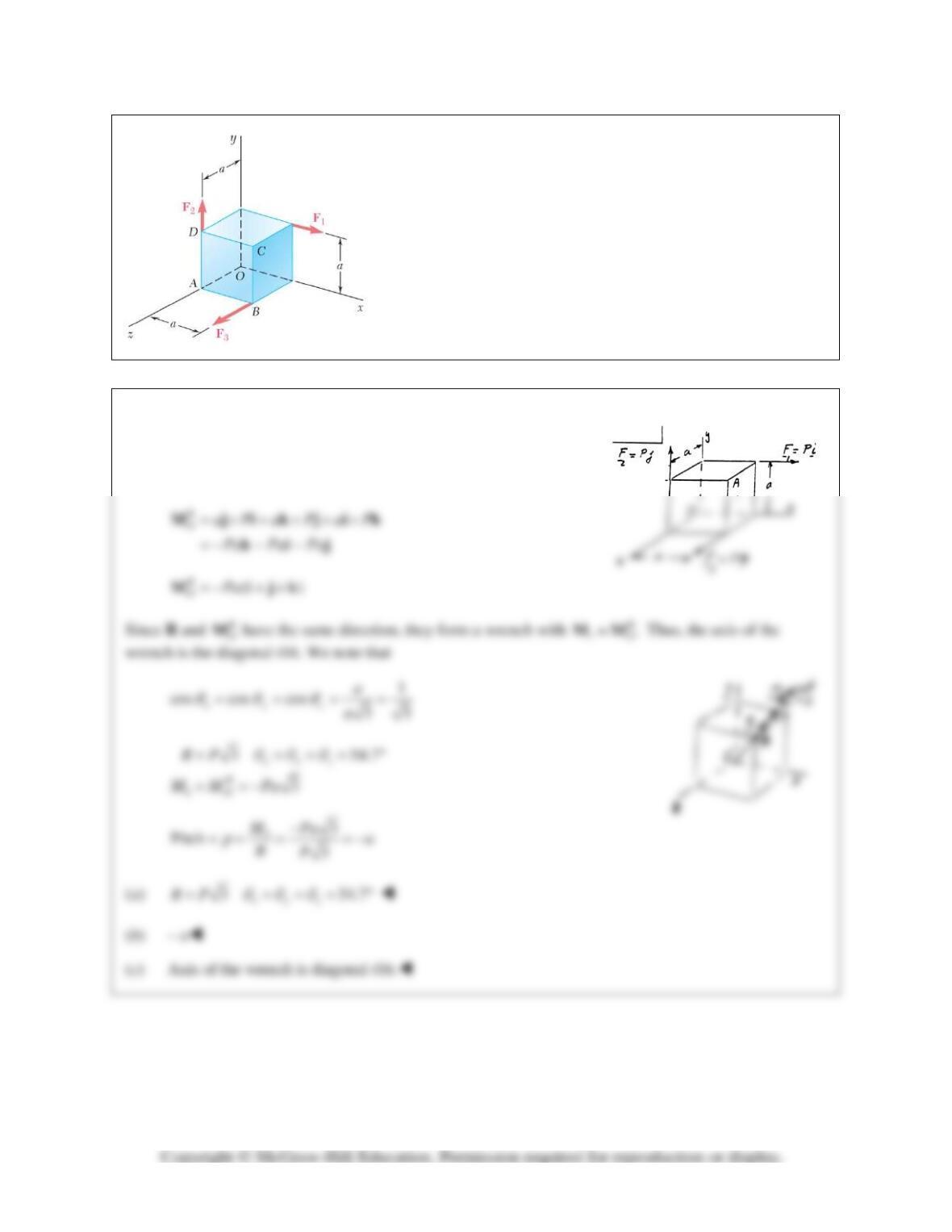
PROBLEM 3.133*
Three forces of the same magnitude P act on a cube of side a as
shown. Replace the three forces by an equivalent wrench and
determine (a) the magnitude and direction of the resultant force
R, (b) the pitch of the wrench, (c) the axis of the wrench.
SOLUTION
Force–couple system at O:
()PPP P= + + = ++R i j k i jk
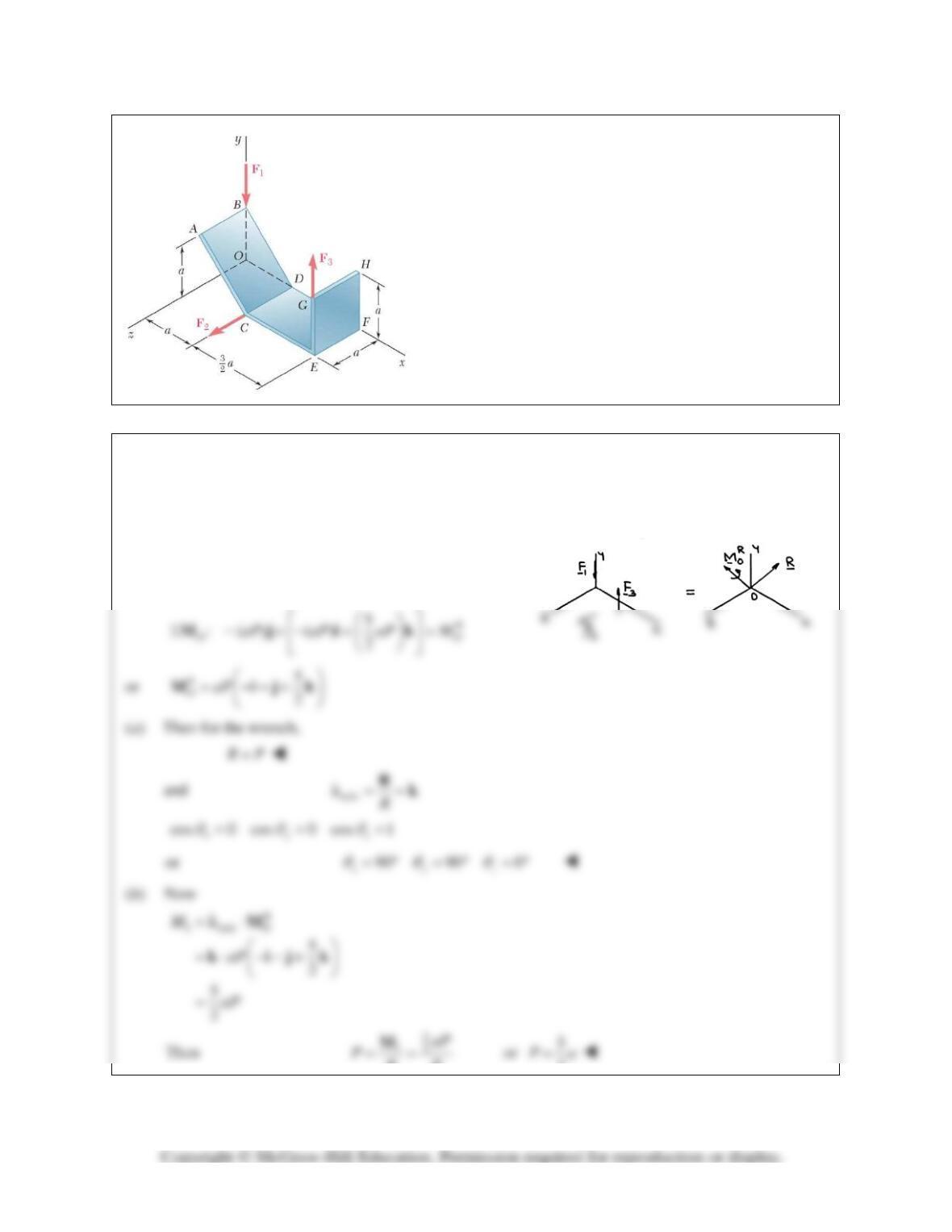
PROBLEM 3.134*
A piece of sheet metal is bent into the shape shown and is
acted upon by three forces. If the forces have the same
magnitude P, replace them with an equivalent wrench and
determine (a) the magnitude and the direction of the
resultant force R, (b) the pitch of the wrench, (c) the axis
of the wrench.
SOLUTION
First reduce the given forces to an equivalent force–couple system
( )
,
R
O
RM
at the origin.
We have
:PPP RΣ −++ =F jjk
or
P=Rk
PROBLEM 3.134* (Continued)
(c) The components of the wrench are
1
( , ),RM
where
1 1 axis
,M=Mλ
and the axis of the wrench is
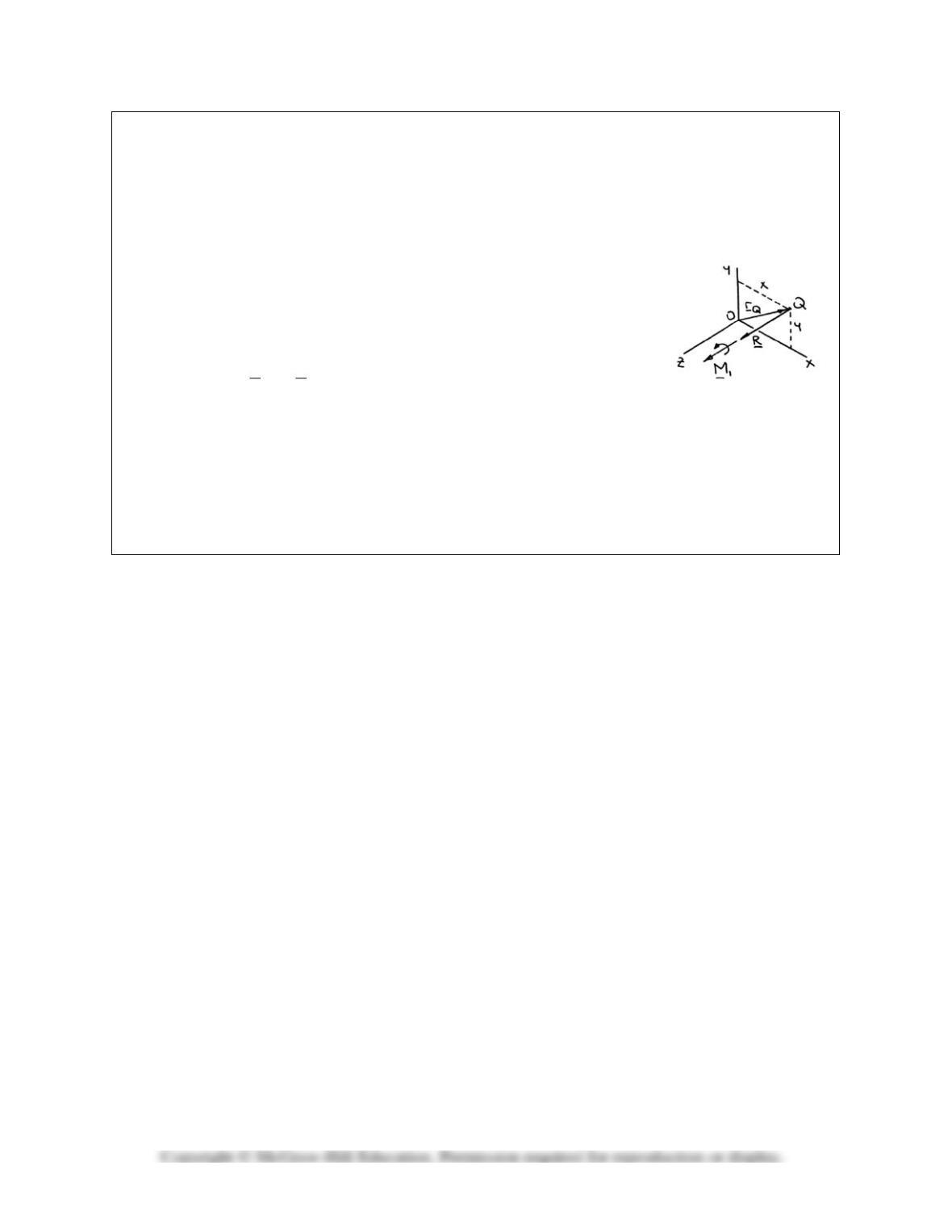
assumed to intersect the xy–plane at Point Q, whose coordinates are (x, y, 0). Thus, we require
zQ R
= ×MrR
where
1zO
= ×MMM
Then
55 ()
22
aP aP x y P
−− + − = + +
ij k k i j k
Equating coefficients:
: or
: or
aP yP y a
aP xP x a
−= =−
−=− =
i
j
The axis of the wrench is parallel to the z–axis and intersects the xy–plane at
,.x ay a= = −
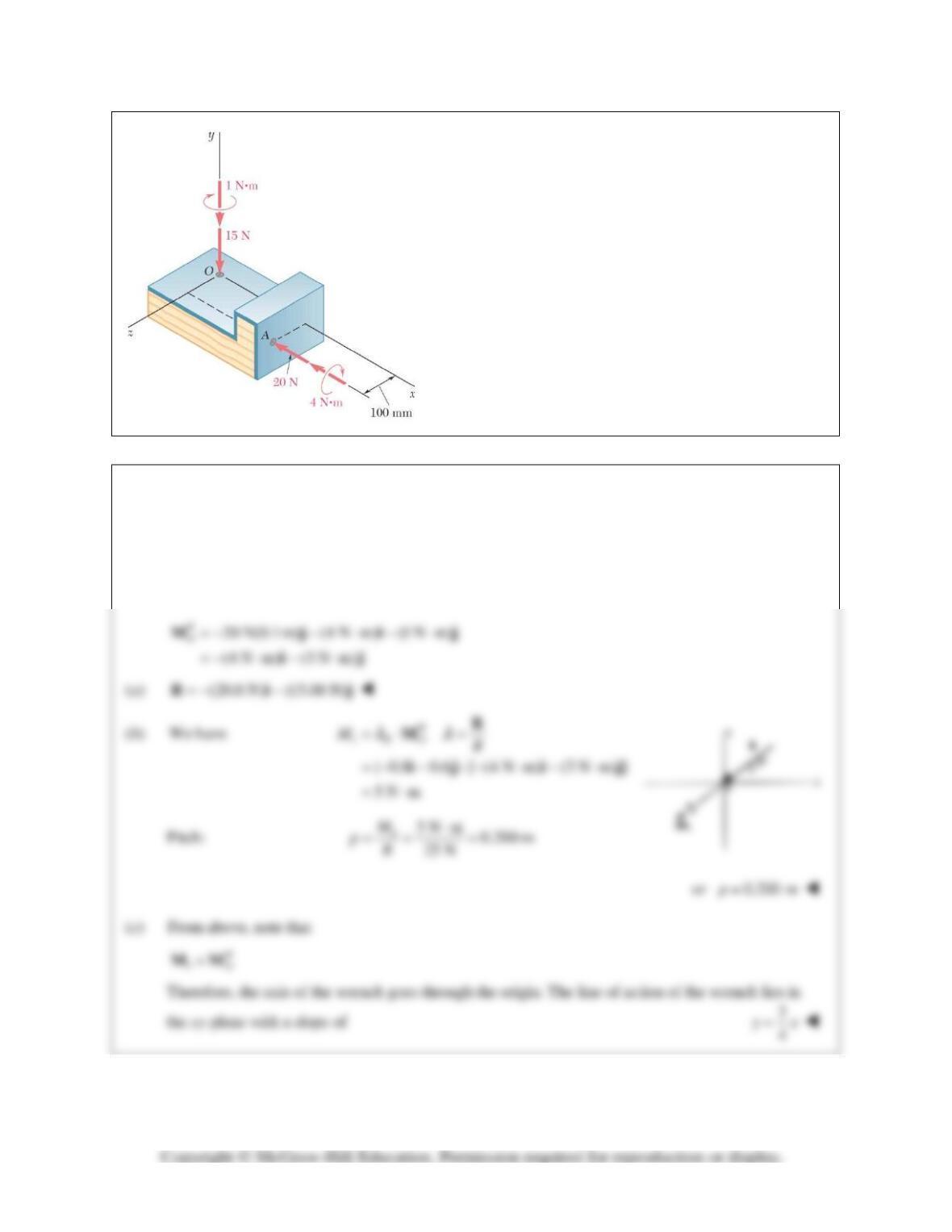
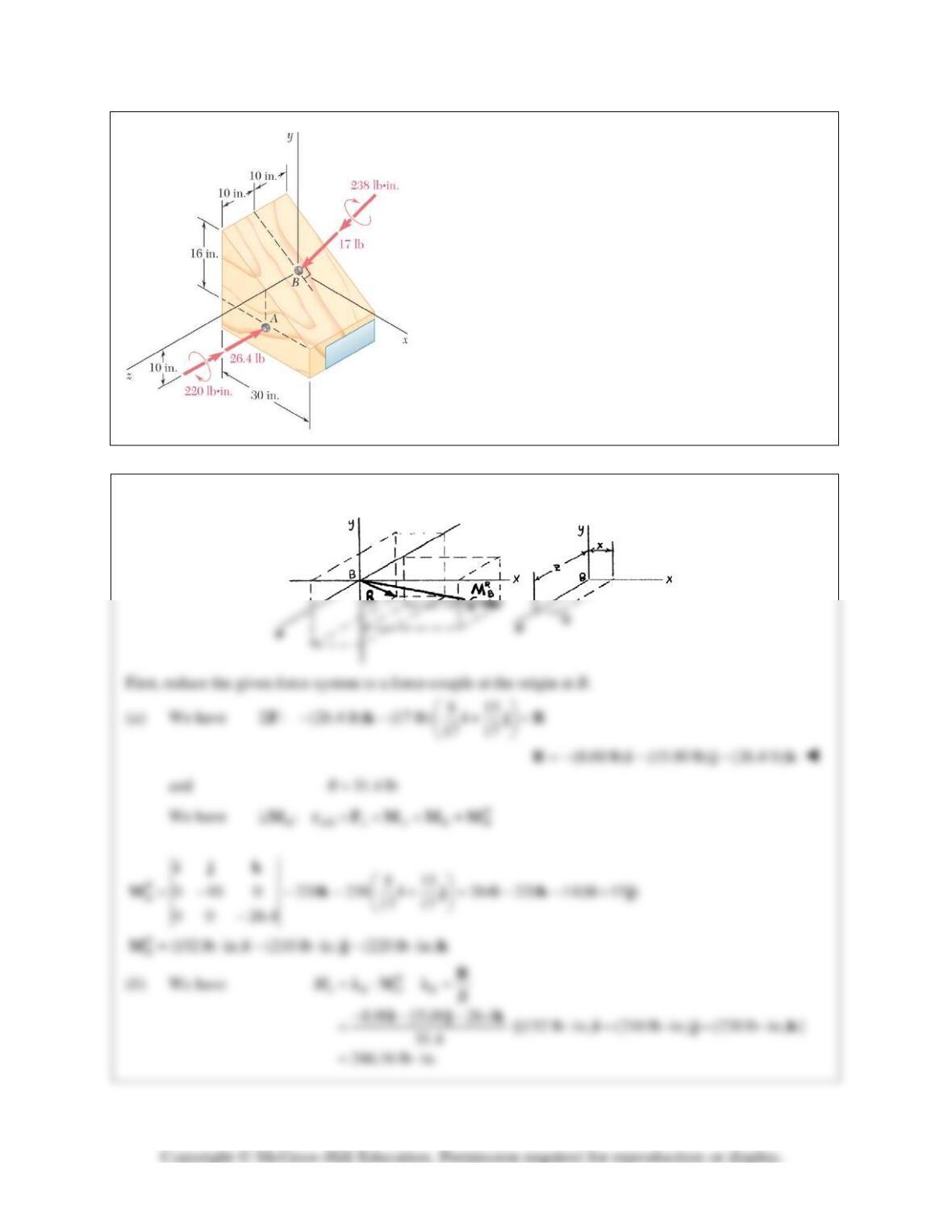
PROBLEM 3.135*
The forces and couples shown are applied to two screws
as a piece of sheet metal is fastened to a block of wood.
Reduce the forces and the couples to an equivalent
wrench and determine (a) the resultant force R, (b) the
pitch of the wrench, (c) the point where the axis of the
wrench intersects the xz–plane.
SOLUTION
First, reduce the given force system to a force–couple system.
We have
: (20 N) (15 N) 25 NRΣ− − = =F i jR
We have
:( )
R
O O CO
Σ Σ × +Σ =M rF M M
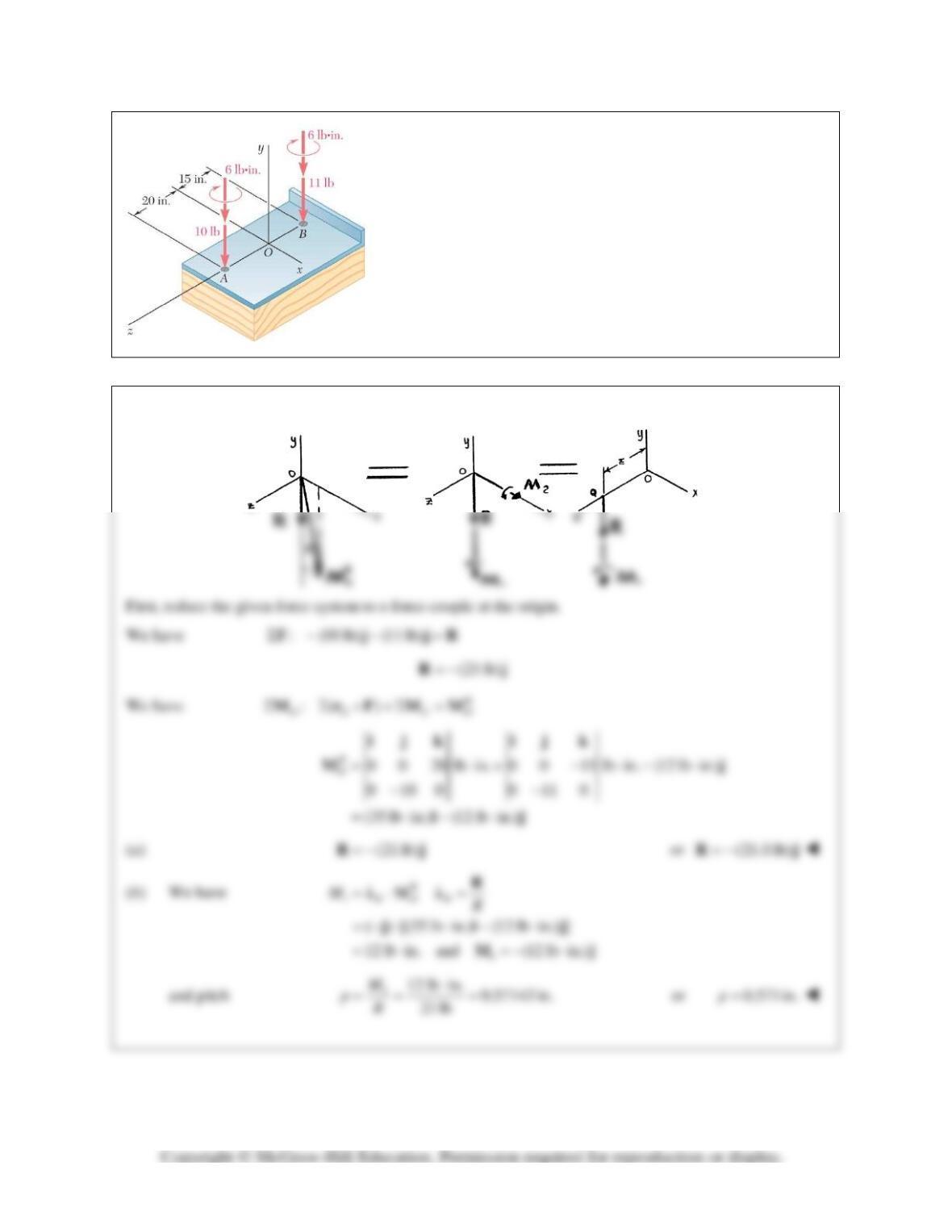
PROBLEM 3.136*
The forces and couples shown are applied to two screws as a
piece of sheet metal is fastened to a block of wood. Reduce the
forces and the couples to an equivalent wrench and determine
(a) the resultant force R, (b) the pitch of the wrench, (c) the point
where the axis of the wrench intersects the xz–plane.
SOLUTION

PROBLEM 3.136* (Continued)
(c) We have
12
21
(35 lb in.)
R
O
R
O
= +
= −= ⋅
M MM
MMM i
We require
2/
(35 lb in.) ( ) [ (21 lb) ]
35 (21 ) (21 )
QO
xz
xz
= ×
⋅ = + ×−
=−+
Mr R
i ik j
i ki
From i:
35 21
1.66667 in.
z
z
=
=
From k:
0 21
0
x
z
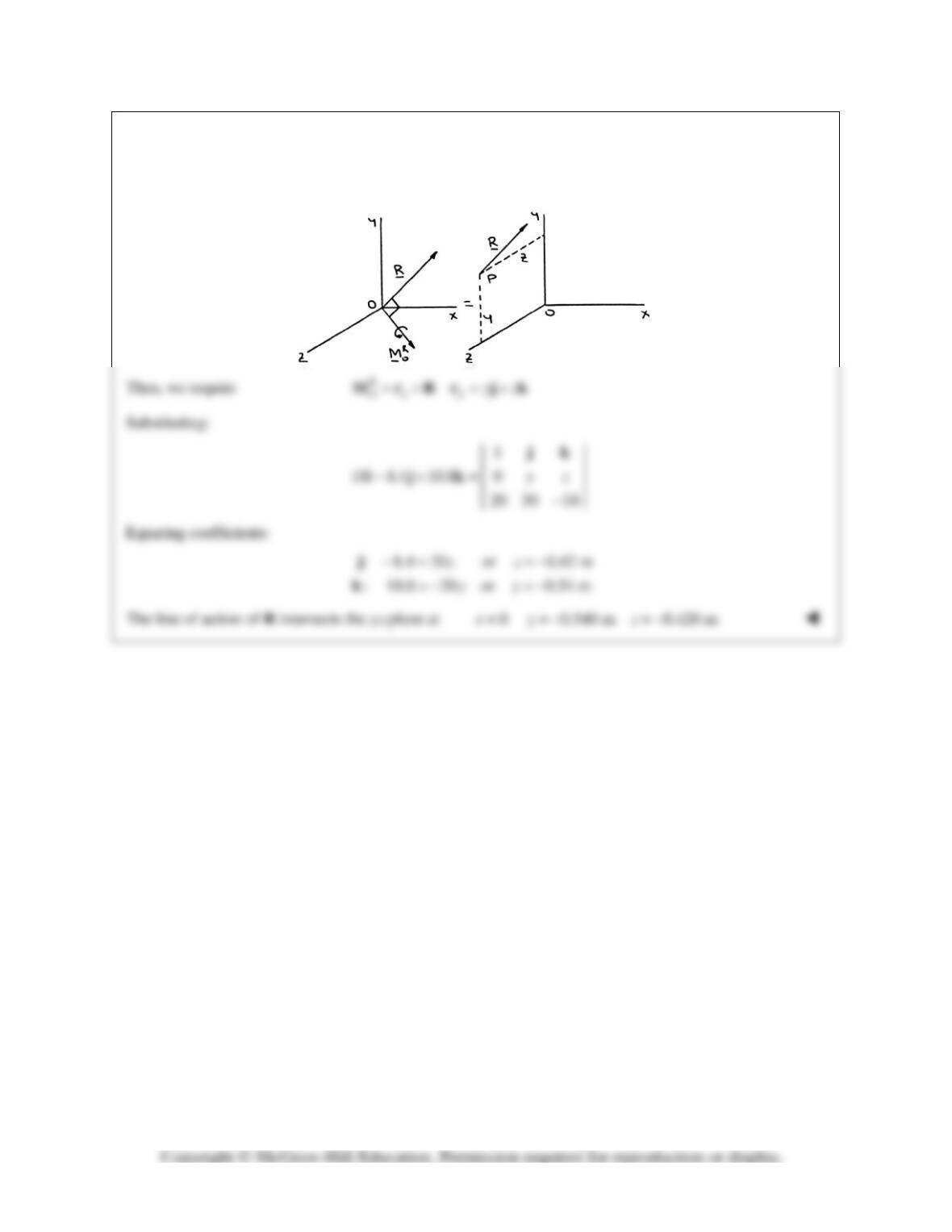
= −
=
The axis of the wrench is parallel to the y–axis and intersects the xz–plane at
0, 1.667 in.xz= =
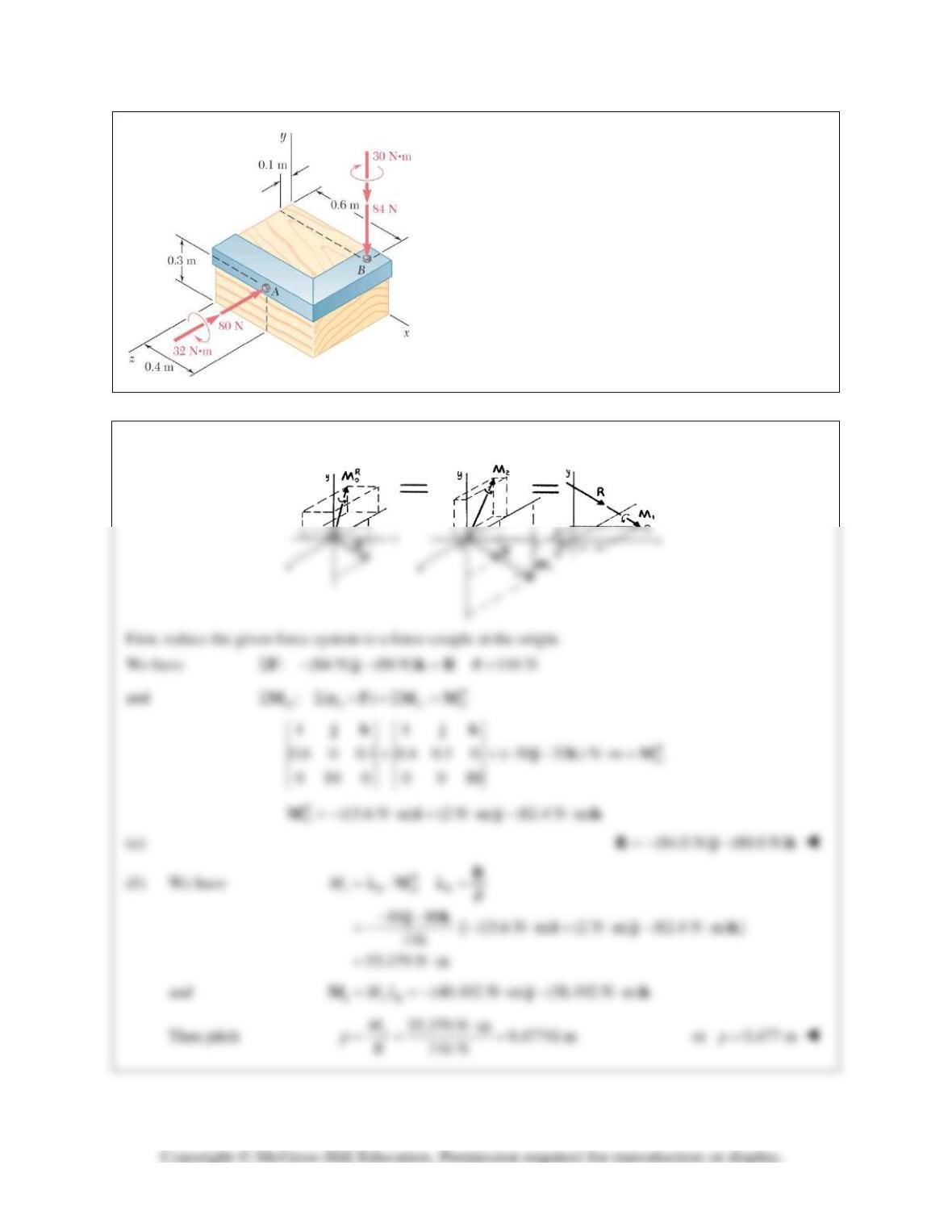
PROBLEM 3.137*
Two bolts at A and B are tightened by applying the forces
and couples shown. Replace the two wrenches with a
single equivalent wrench and determine (a) the resultant
R, (b) the pitch of the single equivalent wrench, (c) the
point where the axis of the wrench intersects the xz–plane.
SOLUTION

PROBLEM 3.137* (Continued)
(c) We have
12
21
[( 15.6 2 82.4 ) (40.102 38.192 )] N m
(15.6 N m) (42.102 N m) (44.208 N m)
R
O
R
O
= +
= − =− +− − − ⋅
=− ⋅+ ⋅− ⋅
M MM
MMM ij k j k
i jk
We require
2/
( 15.6 42.102 44.208 ) ( ) (84 80 )
(84 ) (80 ) (84 )
QO
xz
zxx
= ×
− + − =+× −
=+−
Mr R
i j k ik j k
i jk
From i:
15.6 84
0.185714 m
z
z
−=
= −
or
0.1857 mz= −
From k:
44.208 84
0.52629 m
x
x
−=−
=
or
0.526 mx=
The axis of the wrench intersects the xz–plane at
0.526 m 0 0.1857 mx yz= = = −
PROBLEM 3.138*
Two bolts at A and B are tightened by applying the forces
and couples shown. Replace the two wrenches with a single
equivalent wrench and determine (a) the resultant R,
(b) the pitch of the single equivalent wrench, (c) the point
where the axis of the wrench intersects the xz–plane.
SOLUTION
PROBLEM 3.138* (Continued)
and
11
(62.818 lb in.) (117.783 lb in.) (207.30 lb in.)
R
M
λ
= =− ⋅− ⋅− ⋅M i jk
Then pitch
1246.56 lb in. 7.8522 in.
31.4 lb
M
pR
⋅
= = =
or
7.85 in.p=
(c) We have
12
21
(152 210 220 ) ( 62.818 117.783 207.30 )
(214.82 lb in.) (92.217 lb in.) (12.7000 lb in.)
R
B
R
B
= +
= − = − − −− − −
= ⋅− ⋅− ⋅
M MM
MMM i j k i j k
ij k
We require
2/QB
= ×Mr R
214.82 92.217 12.7000 0
8 15 26.4
(15 ) (8 ) (26.4 ) (15 )
xz
zz x x
−− =
−− −
= −+ −
ij k
ij k
ij j k
From i:
214.82 15 14.3213 in.zz= =
From k:
12.7000 15 0.84667 in.xx−=− =
The axis of the wrench intersects the xz–plane at
0.847 in. 0 14.32 in.x yz= = =
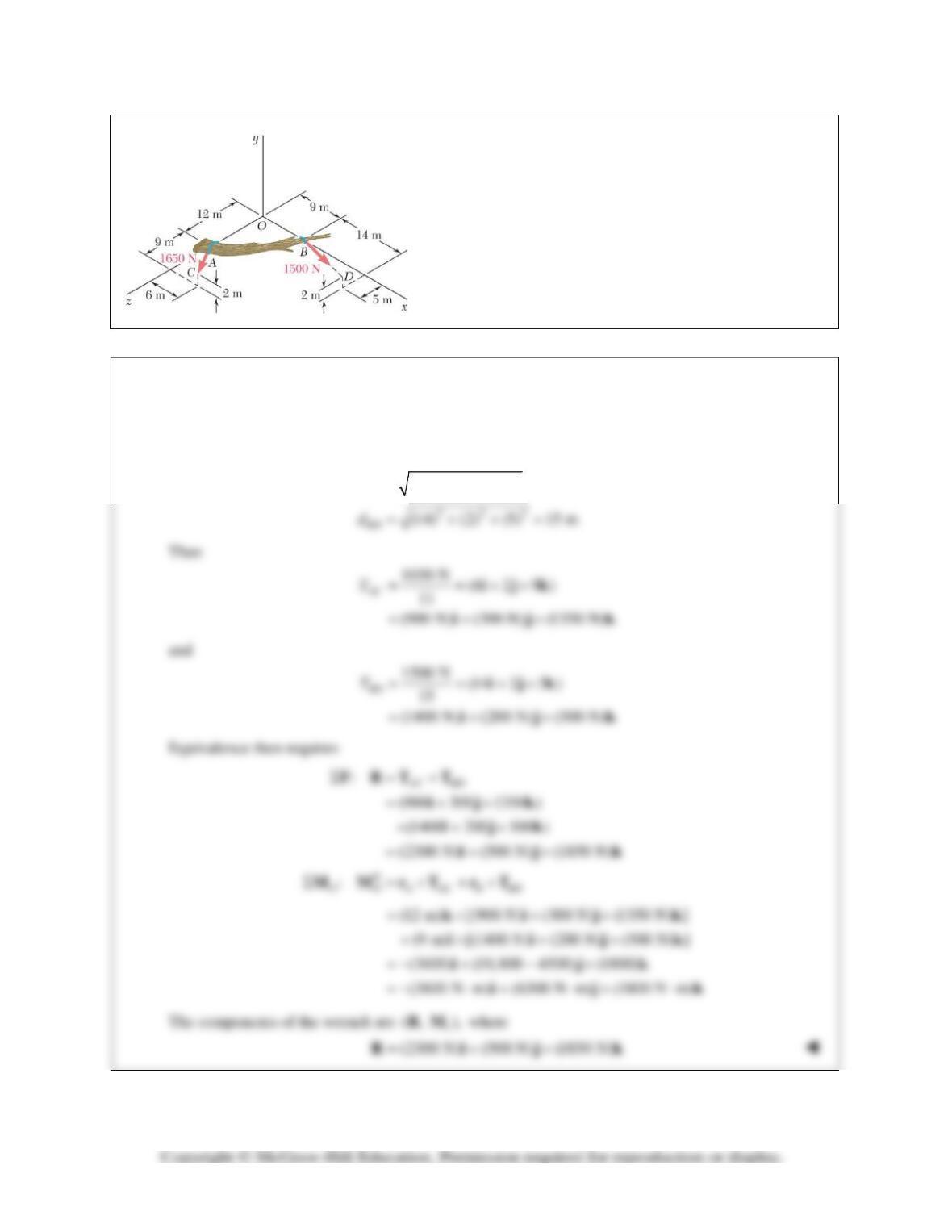
PROBLEM 3.139*
Two ropes attached at A and B are used to move the trunk
of a fallen tree. Replace the forces exerted by the ropes
with an equivalent wrench and determine (a) the resultant
force R, (b) the pitch of the wrench, (c) the point where the
axis of the wrench intersects the yz–plane.
SOLUTION
(a) First replace the given forces with an equivalent force–couple system
( )
,
R
O
RM
at the origin.
We have
PROBLEM 3.139* (Continued)
(b) We have
22 2
100 (23) (5) (18.5) 2993.7 NR= ++ =
Let
PROBLEM 3.139* (Continued)
Thus, we require
2
()
P
yz=×=+M rR r jk
Substituting:
PROBLEM 3.140*
A flagpole is guyed by three cables. If the tensions in the
cables have the same magnitude P, replace the forces
exerted on the pole with an equivalent wrench and
determine (a) the resultant force R, (b) the pitch of the
wrench, (c) the point where the axis of the wrench
intersects the xz–plane.
SOLUTION
PROBLEM 3.140* (Continued)
(b) We have
1
R
RO
M= ⋅Mλ
where
3 25 1
(2 20 ) (2 20 )
25 27 5 9 5
R
P
RP
== −− = −−
Ri jk i jk
λ
83
( 403 20 406 ) ( ) (2 20 )
675 25
3[20 ( 2 ) 20 ]
25
Pa P
xz
Pz xz x
− −− =+× −−
= ++ −
ij k ik ijk
i jk
From i:
3
8( 403) 20 1.99012
675 25
Pa P
zz a
−= =−
From k:
3
8( 406) 20 2.0049
675 25
Pa P
xx a
−=− =
The axis of the wrench intersects the xz–plane at
2.00 , 1.990x az a= = −
PROBLEM 3.141*
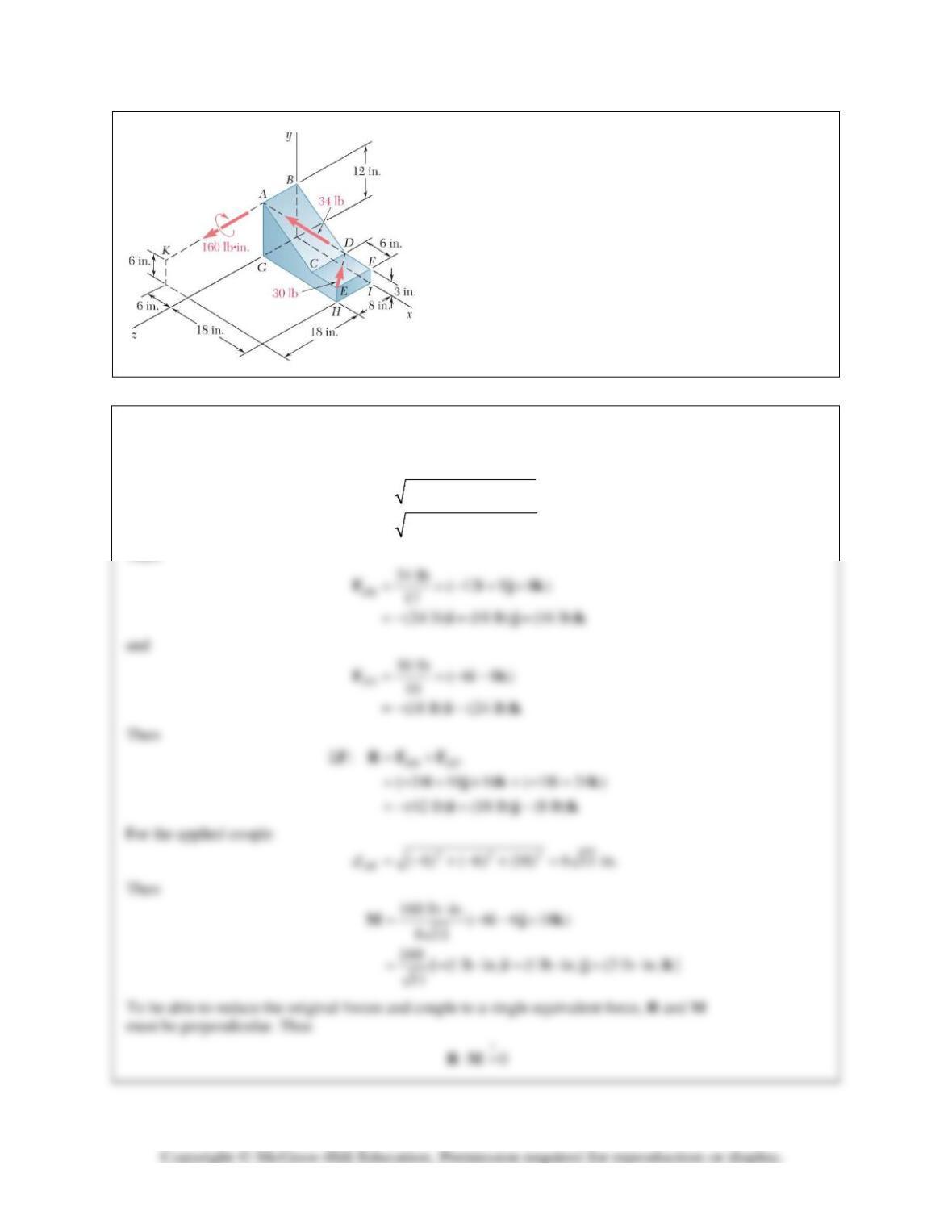
Determine whether the force–and–couple system shown can
be reduced to a single equivalent force R. If it can,
determine R and the point where the line of action of R
intersects the yz–plane. If it cannot be so reduced, replace
the given system with an equivalent wrench and determine
its resultant, its pitch, and the point where its axis intersects
the yz–plane.
SOLUTION
First, reduce the given force system to a force–couple at the origin.
We have
:
AG
Σ +=FF F R
(40 mm) (60 mm) (120 mm)
(50 N) 70 N 140 mm
(20 N) (30 N) (10 N)
+−
= +
=+−
ij k
Rk
i jk
and
37.417 NR=
PROBLEM 3.141* (Continued)
Then for equivalence,
PROBLEM 3.142*
Determine whether the force–and–couple system shown
can be reduced to a single equivalent force R. If it can,
determine R and the point where the line of action of R
intersects the yz–plane. If it cannot be so reduced, replace
the given system with an equivalent wrench and
determine its resultant, its pitch, and the point where its
axis intersects the yz–plane.
SOLUTION
First determine the resultant of the forces at D. We have
222
22 2
( 12) (9) (8) 17 in.
( 6) (0) ( 8) 10 in.
DA
ED
d
d
=−++=
= − + +− =
Then