Laboratory Investigation # 3
Enzyme Structure and Function
Description of the Lab
This lab will be time consuming, and will take all of the allotted lab time. Your
may want to divide this lab into 2 lab periods. Preparation time will take days and needs
Outline of Investigation
1. Enzyme activity with 2 types of glucose
2. Enzyme concentration and reaction speed
3. Does the structure of amylase affect its ability to digest starch?
A. Hot plate, multiwell culture plate, 2 test tubes (13 mm), 0.05%
Laboratory Materials and Equipment for Student Use
Materials and Equipment
Per
Student
Per Pair of
Students
Per Lab
Group
Per
Room
Multiwell culture plates or spot plates
1
Test tube racks (16 mm)
1
2 mL plastic transfer pipettes-either
graduated or not. Or disposable transfer
pipettes
4
Clock with second hand or stop watches
1
Hot plates/water baths
2
Reagents
1% soluble potato starch solution
Preparation of laboratory Materials and Reagents
Reagents
NOTE
Calculate a percentage solution for it is base on grams per volume with the
volume being 100 mL and the percentage being the grams.
Suggestion: Prepare the solution in milliliters rather than drops. To figure needed
volumes 20 drops equals (=) 1mL.
1% Starch solution (Total volume needed 100 mL)
1. Heat 100 mL of distilled water.
0.05% Alpha amylase solution from Bacillus (Total volume needed 100 mL)
1. Weigh 0.05 grams to 100 mL of distilled water.
Iodine solution in dropper bottles (I2KI)
75% sulfuric acid in dropper bottles
0.05M citrate phosphate buffers at pHs 3,
1. Weigh 4 grams of potassium iodine.
2. Add potassium iodine to 300 mL of distilled water.
75% Sulfuric acid solution (Caution: Sulfuric acid is highly caustic—do not get it on your
hands or clothes.) [ALWAYS ADD ACID TO WATER]
10% Sodium dodecly sulfate (SDS)
0.05M Citrate phosphate buffer
You can purchase this from Sigma (2851-100ML) OR
0.2 M Na2HPO4 (mL)
0.1 M citrate (mL)
pH
10.2
39.8
3.0
25.7
24.3
5.0
43.6
7.0
This should give the desired pHs.
Suggestion
Dilution scheme for Investigation 2A
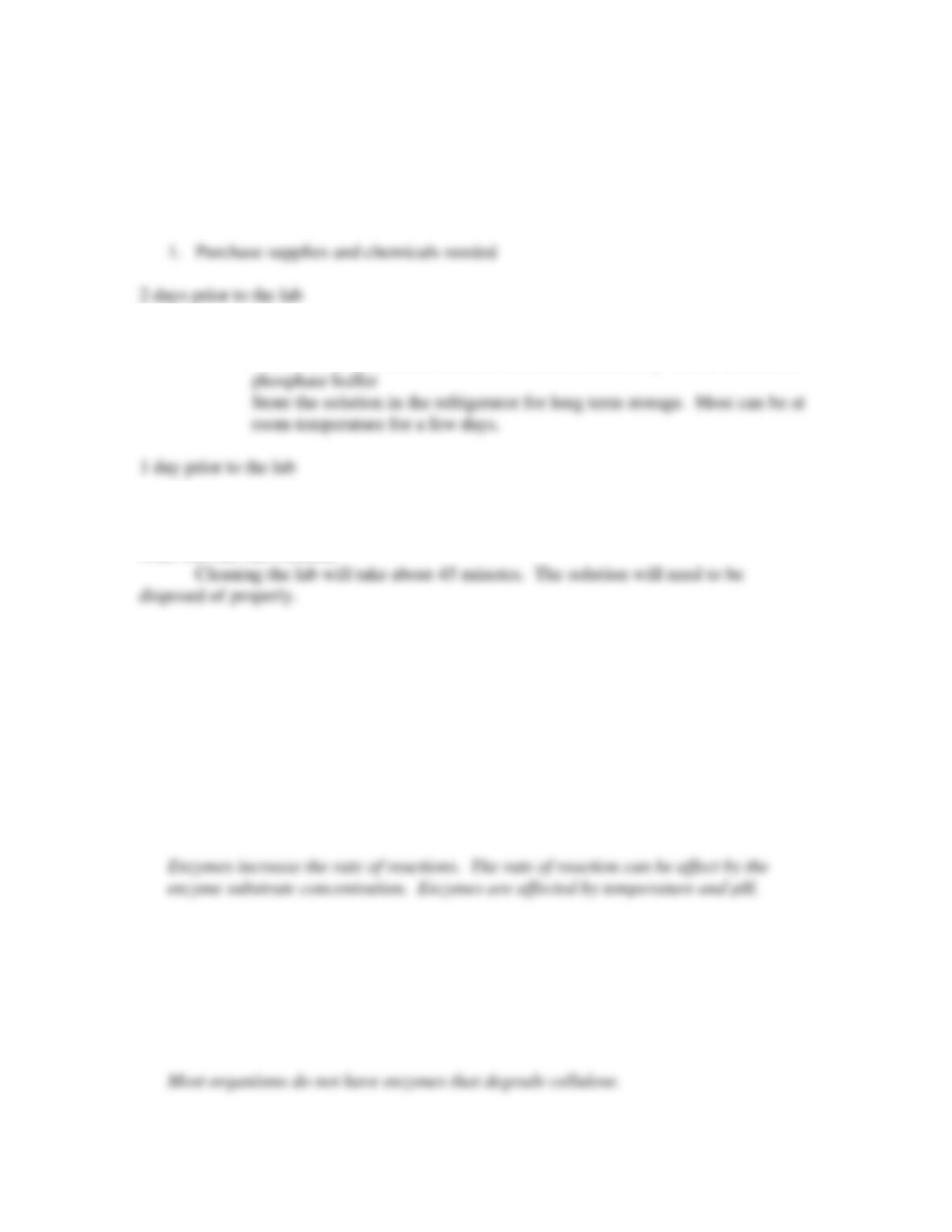
After the students are finished with the dilution they should go to part 2D which is the
next step for this investigation.
Three or four weeks prior to the lab
1. Prepared the solutions:
Starch, Amylase, Iodine, Sulfuric acid Sodium dodecly sulfate and citrate
1. Put solutions into dropper bottles.
After the Lab has finished
Questions for Lab #3 Enzyme Structure and Function
Use the knowledge you acquired in this lab exercise, along with information from your
textbook, to answer the following questions.
1. List three generalizations about enzyme activity that were illustrated by the starch-
amylase experiments.
2. Starch is a storage form of energy. Plants, animals, and fungi can degrade starch into
sugars for energy. Cellulose, in contrast, is a structural material in plant cell walls.
Plants and most animals cannot degrade starch. Based on the Enzyme Structure and
Function lab, offer a possible reason for the inability to digest cellulose.
3. Digestion (the breakdown of complex foods into simpler molecules) begins in the
mouth and continues in the stomach and small intestine. The gastric juice in the human
stomach has a pH of about 2 whereas the mouth and small intestine have less acidic pH.
Based on the results in this lab, where do you think starch digestion occurs in humans?
Explain.
4. State in your own words what serial dilutions mean. Why do serial dilution rather
than using a stock solution to make all the different concentrations?
Serial dilution is a method of sequentially diluting a solution through a series of
5. Jello and other gelatins consist of proteins, sugars, and flavoring. It is the protein
component of gelatin that produces the gel. You cannot put fresh or frozen pineapple or
papaya in Jello because it will not gel. Jello will gel if cooked pineapple or papaya is
used. Explain this based on your findings in this lab.
6. Do all enzymes have the same pH optimum as amylase? Give a reason for your
answer.
Enzymes will have different optimum pHs depending on what environmental
7. Explain why increasing concentrations of enzyme increases the rate of the reaction
based on the idea that enzyme binds to its substrate in order to produce a product.
There are more enzymes to bind to the substrate. This increase in rate will continue
8. Besides pH and enzyme concentration, temperature can also influence enzyme
activity. Design an experiment to demonstrate this using the amylase/ starch system.
Effects of Temperature on the Rate of Hydrolysis
1. From a stock solution of 2.5% starch and 1% amylase pour 20 mL of the
starch-amylase solution into each of the four test tubes; label the test tubes for
4. Add 1 mL of amylase solution to each test tube.
a. Begin with the test tube at 5o C, and note the time when you add the
enzyme to all four test tubes.
b. Immediately after adding the enzyme, mix the contents of each test