3.41: PROBLEM DEFINITION
Situation:
AtmosphericconditionsonMars.
•Temperature at the Martian surface is T=−63 ◦C=210K The pressure at
the Martian surface is p=7mbar.
Find:
Pressure at an elevation of 8 km.
Pressure at an elevation of 30 km.
Assumptions:
Assume the atmosphere is totally carbon dioxide.
Properties:
CO2(from Table A.2): the gas constant is R=189 J/kg·K.
PLAN
Derive equations for atmospheric pressure variation from first principles.
SOLUTION
A.) Elevation of 8 km.
Differential equation describing pressure variation in a hydrostatic fluid
61
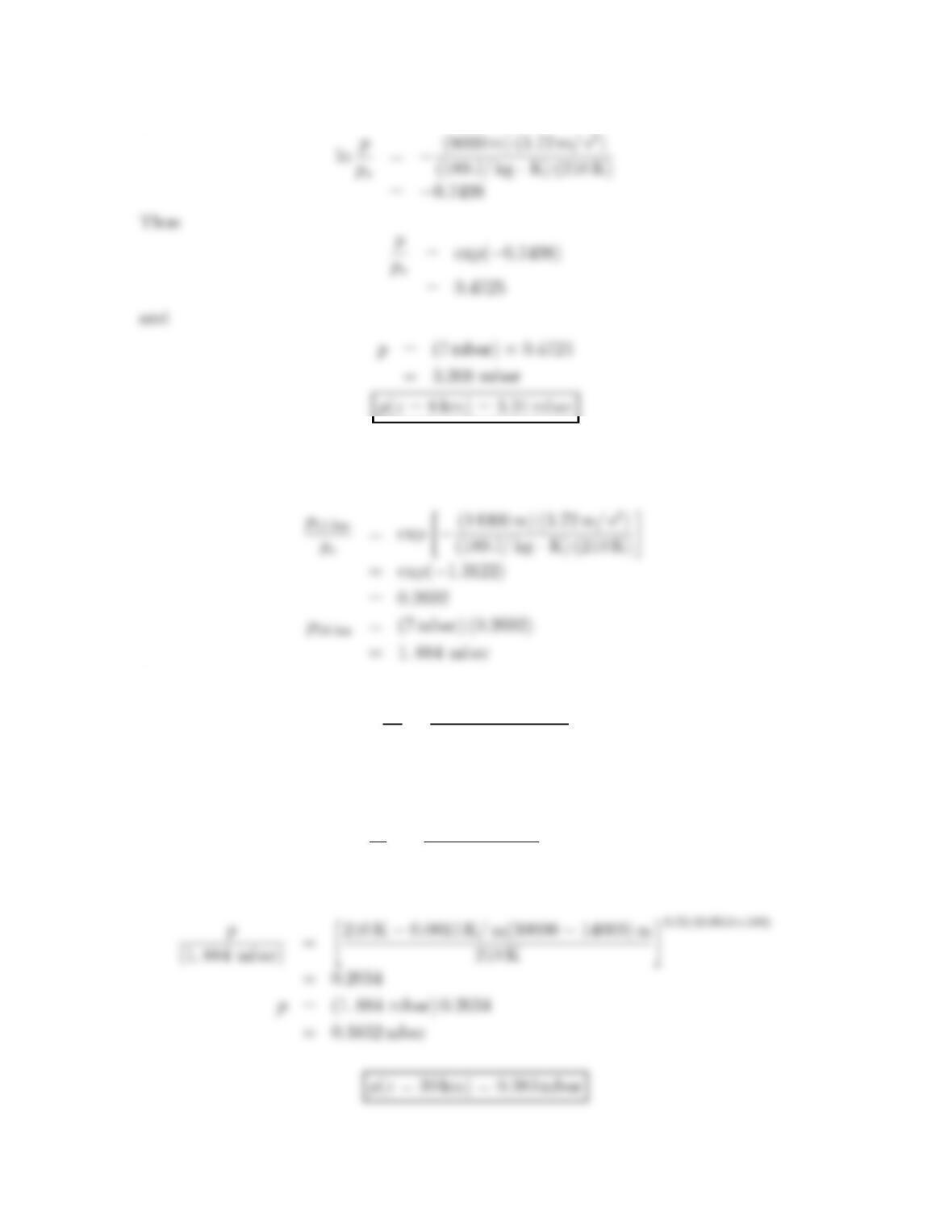
Substitute in values
B.) Elevation of 30 km.
Apply Eq. (4) to find the pressure at z=14km
In the region of varying temperature Eq. (3) becomes
dp
dz =pg
R[To+α(z−zo)]
where the subscript orefers to the conditions at 14 km and αis the lapse rate above
14 km. Integrating gives
p
po
=∙To−α(z−zo)
To¸g/αR
Calculations for z=30km.
62
3.42: PROBLEM DEFINITION
Situation:
The US standard atmosphere from 0to 30 km is described in the problem statement.
Find:
Design a computer program that calculates the pressure and density.
SOLUTION
The following are sample values obtained using computer calculations.
altitude (km) temperature (oC) pressure (kPa) density (kg/m3)
63

3.43: PROBLEM DEFINITION
Situation:
Match the following pressure-measuring devices with the correct name. The device
names are: barometer, Bourdon gage, piezometer, manometer, and pressure trans-
ducer.
a. A vertical or U-shaped tube where changes in pressure are documented by changes
in relative elevation of a liquid that is usually denser than the fluid in the system
measured; can be used to measure vacuum.
b. Typically contains a diaphragm, a sensing element, and conversion to an electric
signal.
c. A round face with a scale to measure needle deflection,wheretheneedleisdeflected
by changes in extension of a coiled hollow tube.
d. A vertical tube where a liquid rises in response to a positive gage pressure.
e. An instrument used to measure atmospheric pressure; of various designs.
SOLUTION
a. manometer
64
3.44: PROBLEM DEFINITION
Situation:
Which is the more correct way to describe the two summation (P)termsofthe
manometer equation, Eqn. 3.18, on p. 47 of §3.3?
a. Add the downs and subtract the ups.
b. Subtract the downs and add the ups.
SOLUTION
65
Problem 3.45
Using the Internet and other resources, answer the following questions:
a. What are three common types of manometers? For each type, make a sketch and
give a brief description.
•Sketches left as a exercise.
b. How would you build manometers from materials that are commonly available?
Sketch your design concept.
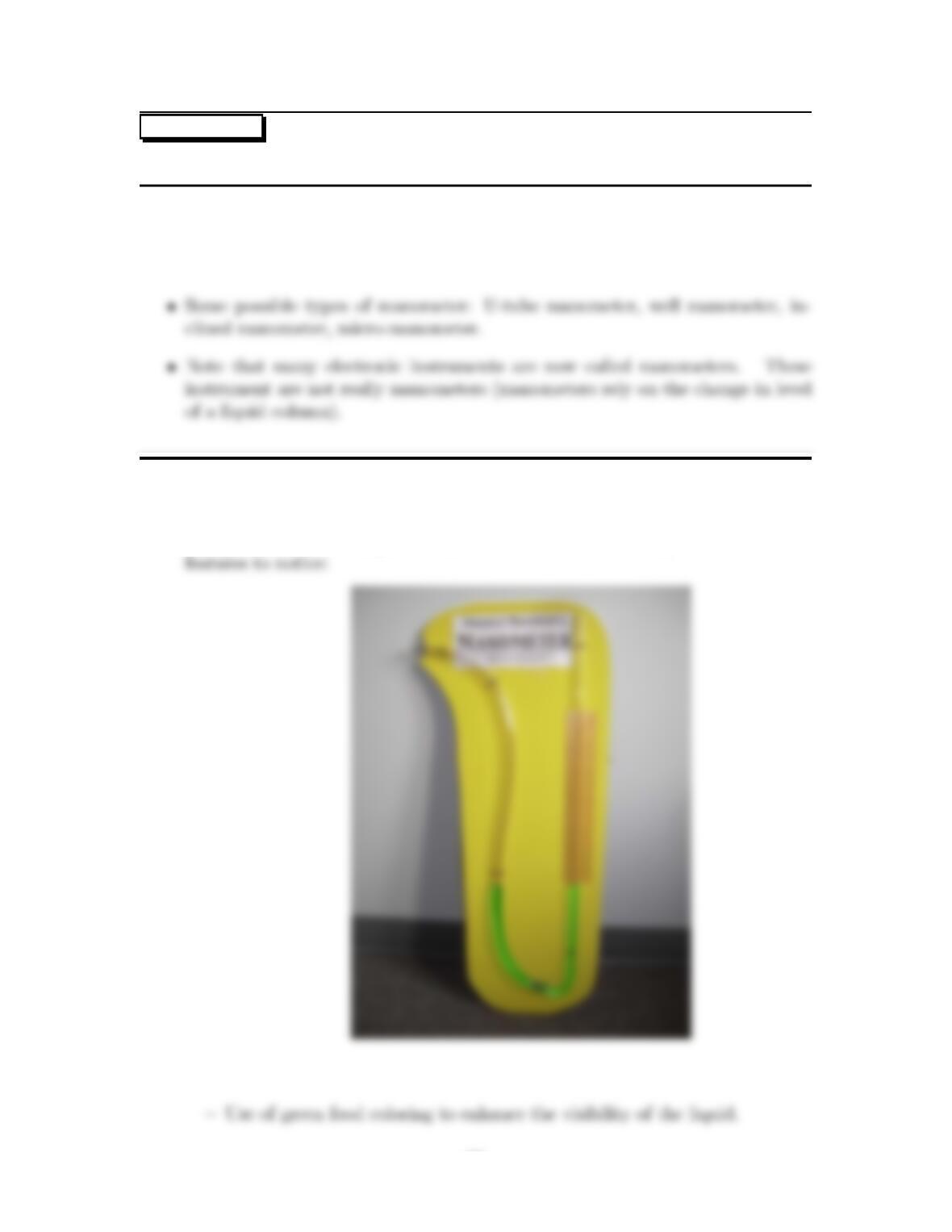
•The photo shows a design built by students at the University of Idaho. Some
66

Problem 3.46
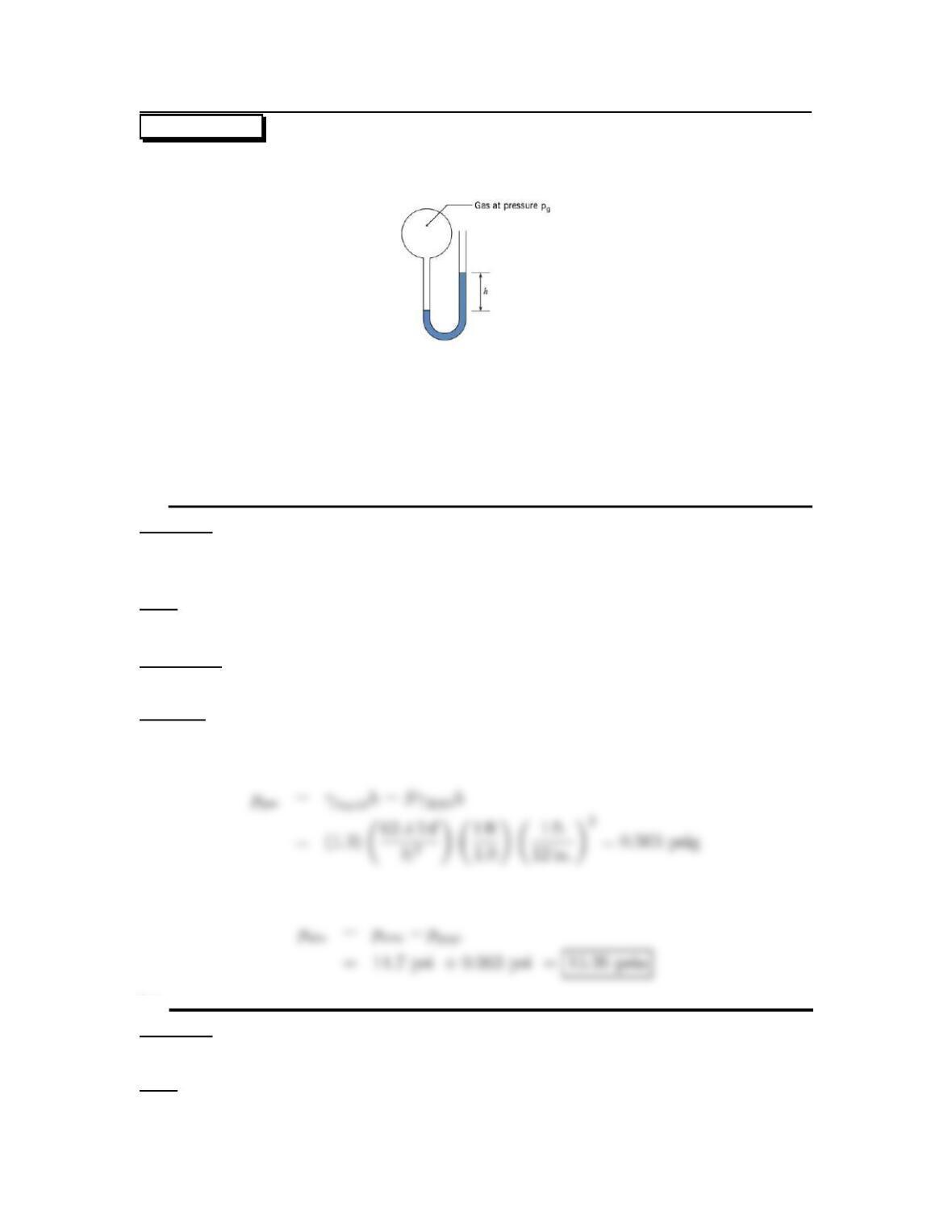
Apply the grid method to a U-tube manometer.
The working equation (i.e. the hydrostatic equation) is:
pgas =γliquidh
Note: Unit cancellations are not shown in this solution.
a.)
Situation:
Water in a manometer.
h=1ft.
Find:
Absolute pressure (psig).
Properties:
S=1.3,γ=62.4lbf/ft3.
Solution:
First, findthegagepressureinthegas:
Now, find the absolute pressure:
b.)
Situation:
Mercury in a manometer.
Find:
Column rise (mm).
68
Properties:
Table A.4, γ= 133000 N/m3.
pgas =0.25 atm,patm =101.3kN.
Solution:
b. Find column rise in mm. The manometer uses mercury (). The gas pressure is
.25 atm.
c.)
Situation:
Liquid in manometer.
h=4in.
Find:
Pressure (psfg).
Properties:
ρ=30lbm/ft3.
Solution:
d.)
Situation:
Liquid in manometer.
h=3m.
Find:
Gage pressure (bar).
Properties:
ρ=800kg/m3.
Solution:
69
3.47: PROBLEM DEFINITION
Situation:
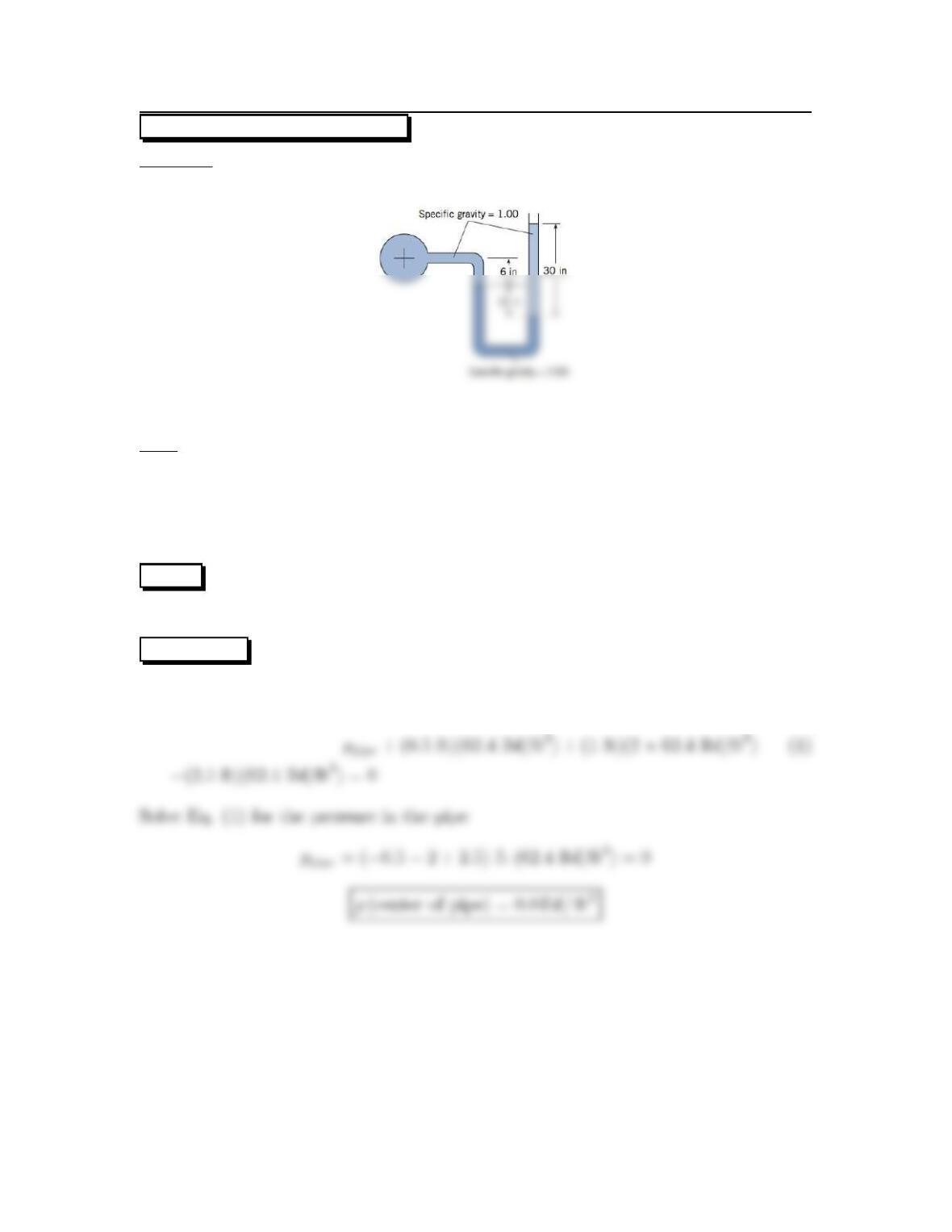
A manometer is connected to a pipe.
Find:
Determine if the gage pressure at the center of the pipe is:
(a) negative
(b) positive
(c) zero
PLAN
Apply the manometer equation and justify the solution using calculations.
SOLUTION
Manometer equation. (add up pressures from the pipe center to the open end of the
manometer)
70
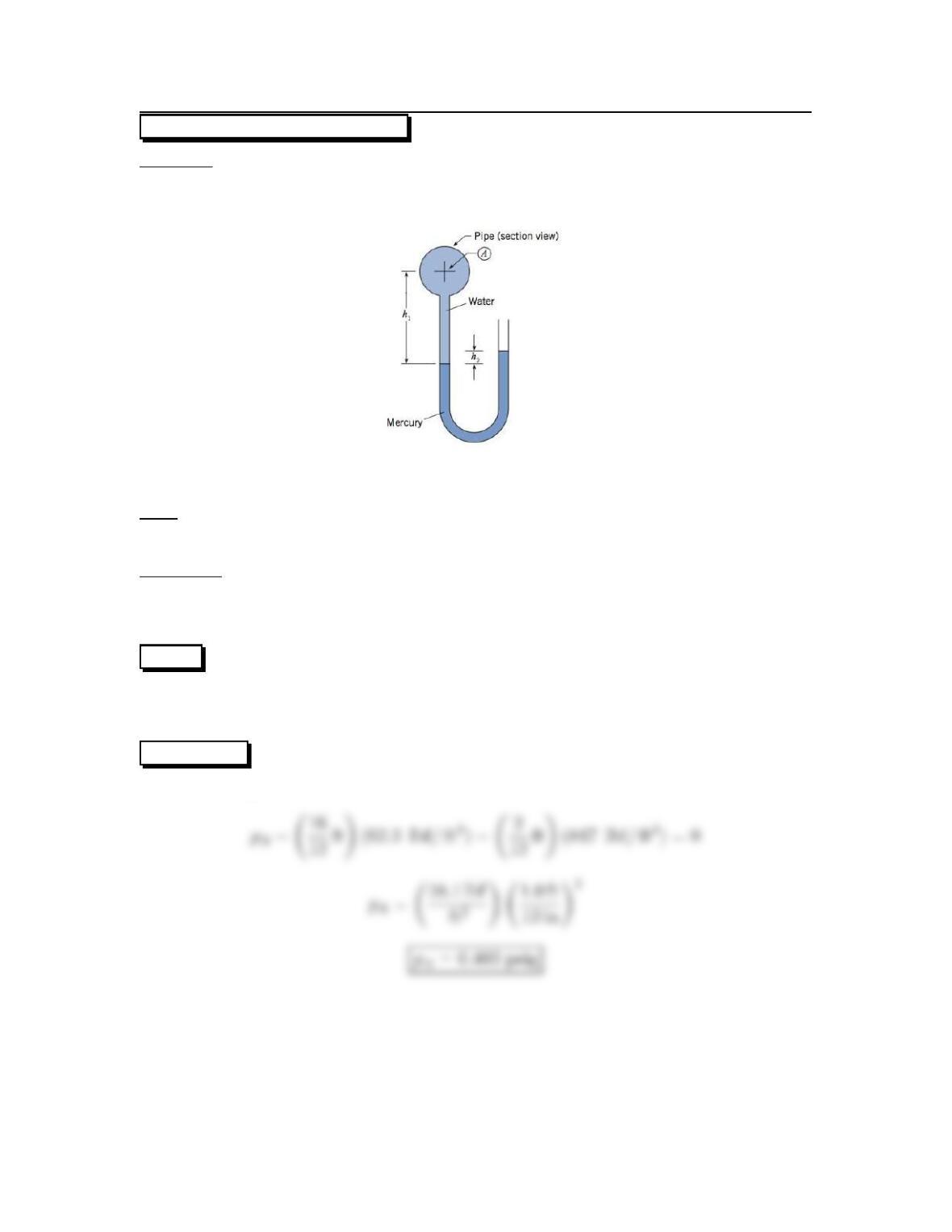
3.48: PROBLEM DEFINITION
Situation:
A manometer is connected to a pipe.
h1=16in,h
2=2in.
Find:
Gage pressure at the center of the pipe in units of psig.
Properties:
Mercury (68 ◦F), Table A.4, γHg =847lbf/ft3.
Water (70 ◦F), Table A.5, γH2O =62.3lbf/ft3.
PLAN
Find pressure (pA)by applying the manometer equation from point A to the top of
the mercury column.
SOLUTION
Manometer equation:
71
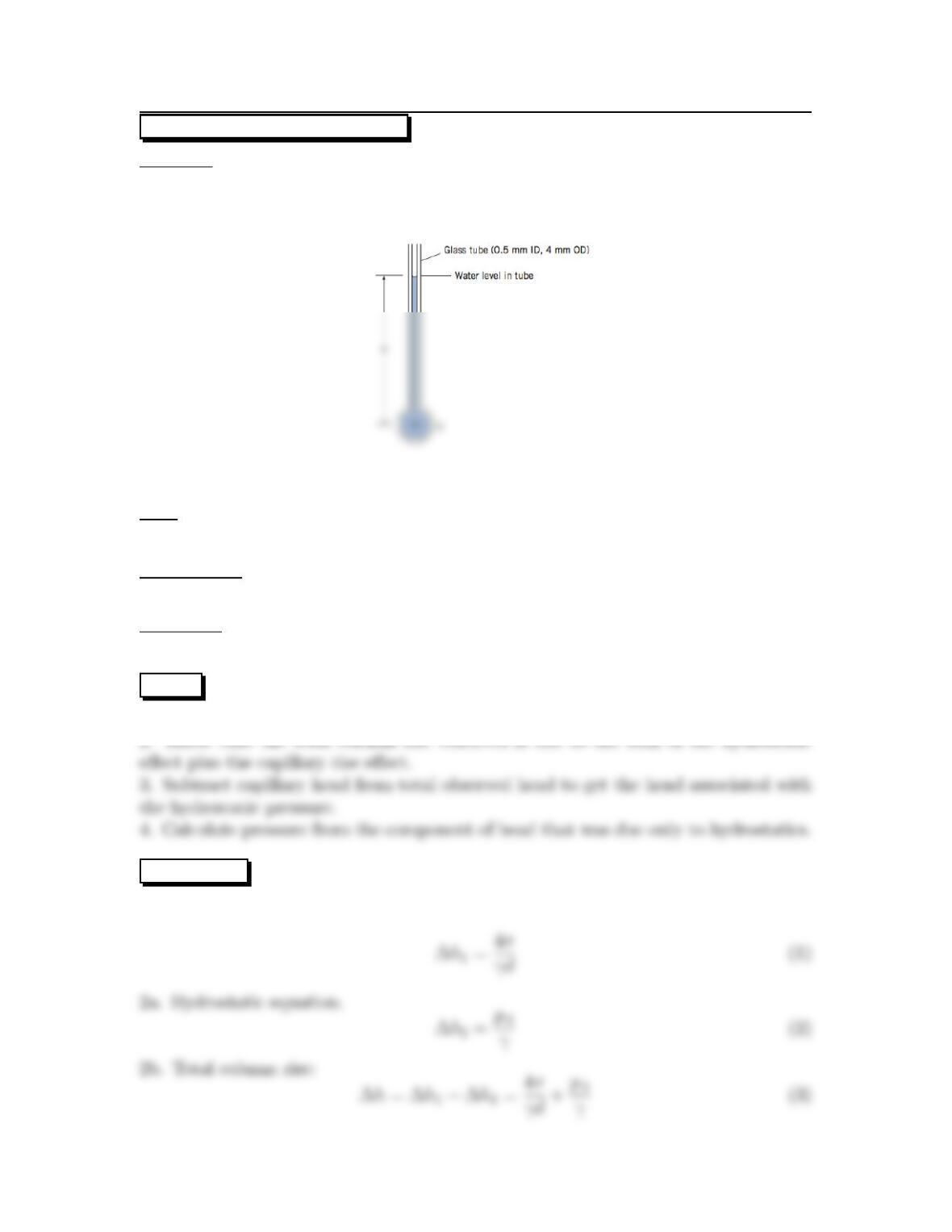
3.49: PROBLEM DEFINITION
Situation:
A glass tube (d=0.5mm) is connected to a pipe containing water.
Column rise (h=120mm) is due to pressure and surface tension.
Find:
Gage pressure at the center of the pipe (Pa-gage).
Assumptions:
Thecontactangleissmallsocos θ≈1in the capillary rise equation.
Properties:
Water (20 ◦C), Table A-5: γ=9790N/m3,σ =0.073 N/m.
PLAN
1. Find the column rise due to surface tension by applying the capillary rise equation.
SOLUTION
1. Capillary rise equation (from chapter 2):
72
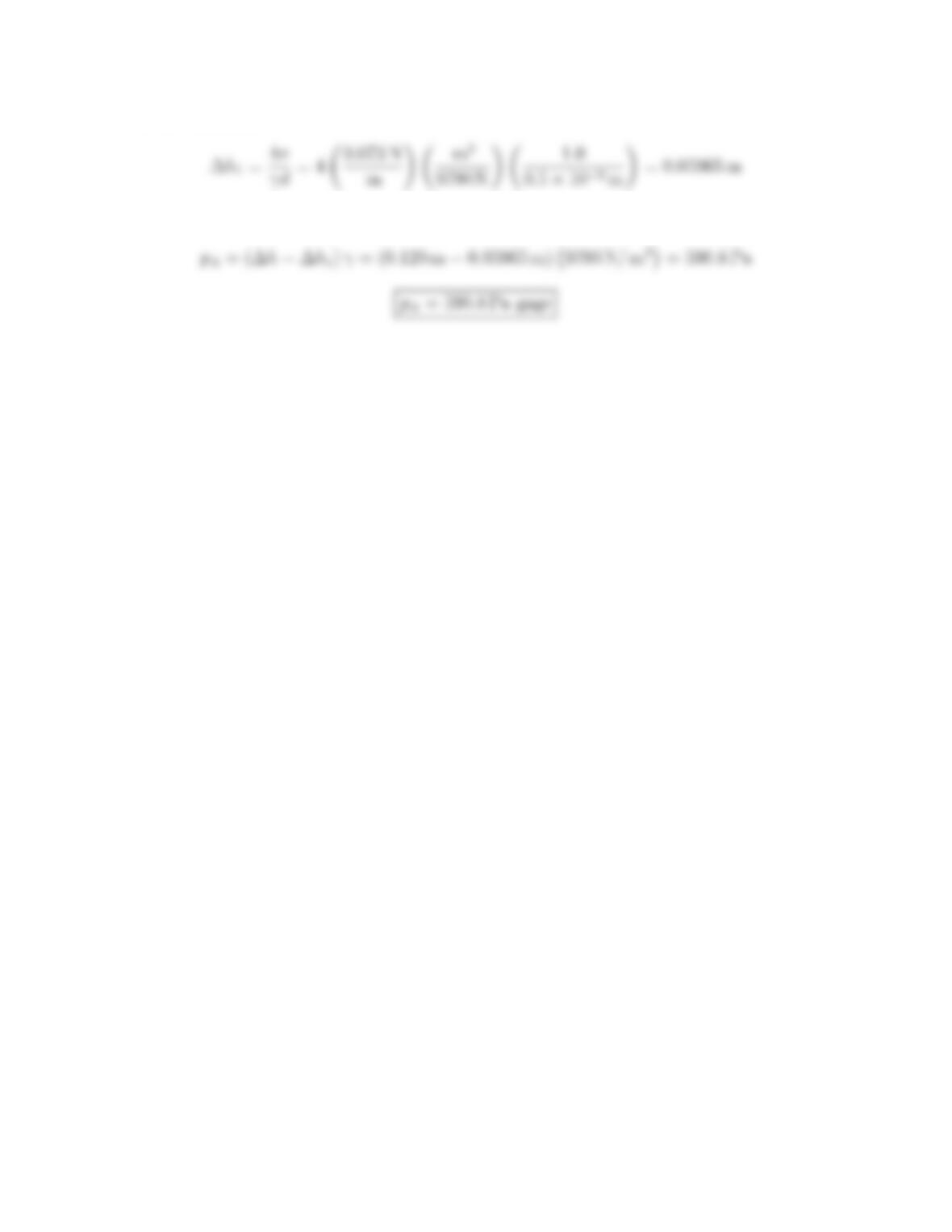
3. Subtraction:
4. Calculate pressure.
73
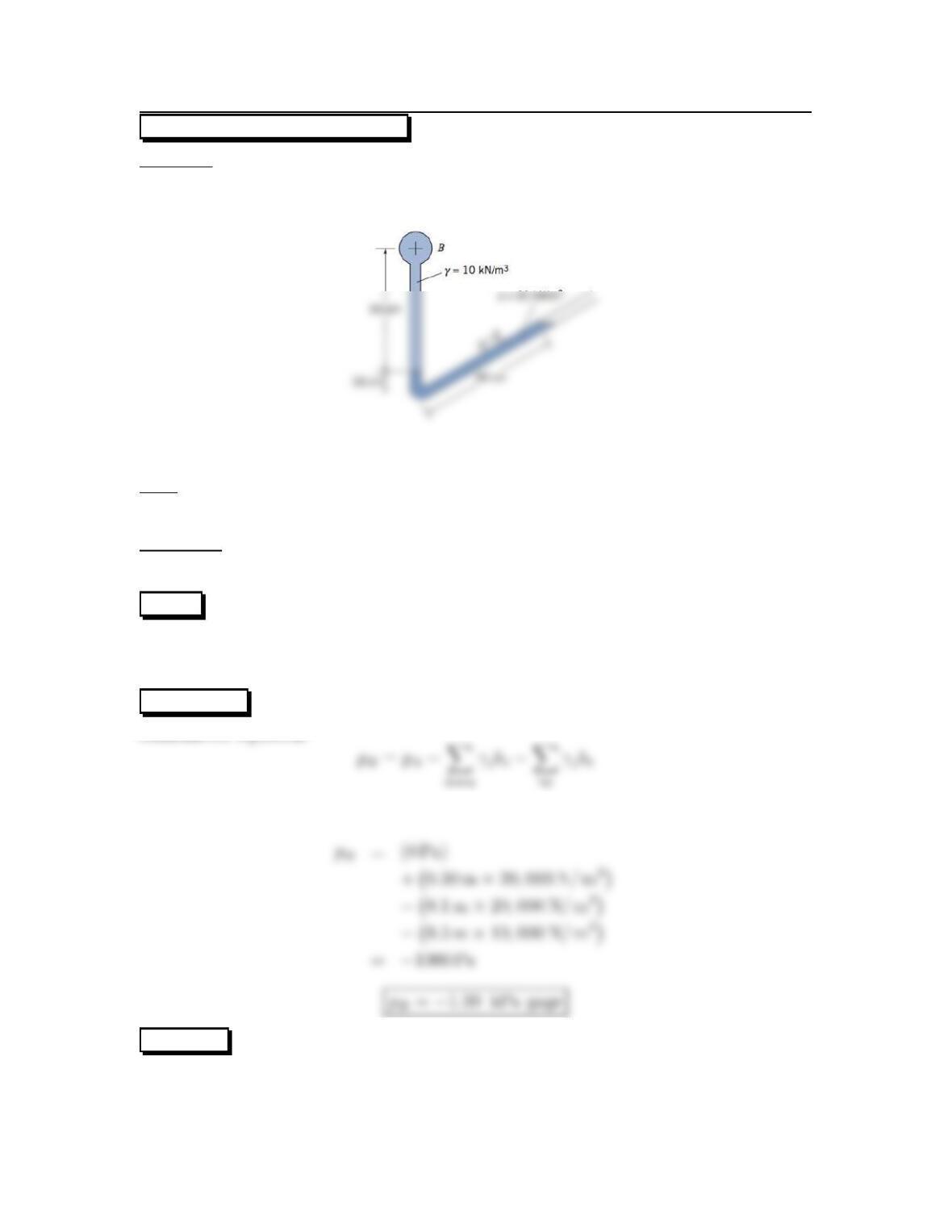
3.50: PROBLEM DEFINITION
Situation:
A tube (manometer) is connected to a pipe.
Find:
Pressure at the center of pipe B in units of kPa gage.
Properties:
γ1=10kN/m3,γ2=20kN/m3.
PLAN
Apply the manometer equation from point A (open leg of manometer) to point B
(center of pipe)
SOLUTION
Manometer equation
were hidenotes the vertical deflection in the ith section of the manometer
REVIEW
Tip! Note that a manometer that is open to atmosphere will read gage pressure.
74
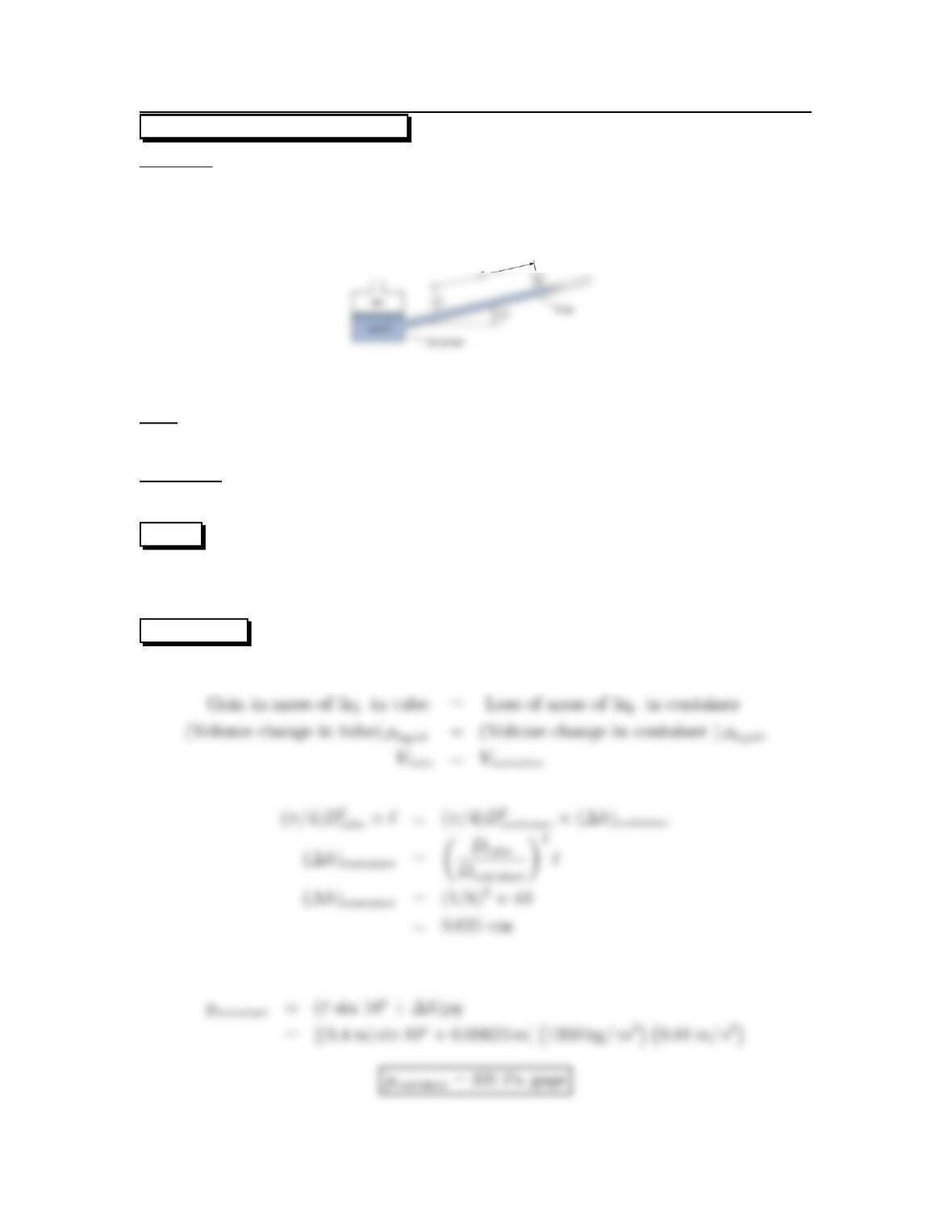
3.51: PROBLEM DEFINITION
Situation:
State 1: air at patm,liquid in tube at elevation 1.
State 2: air is pressurized; liquid at elevation 2.
=0.4m,Dcontainer =8Dtube.
Find:
Pressure in the air within the container (Pa).
Properties:
Liquid, ρ= 1200 kg/m3.
PLAN
1. Find the decrease in liquid level in the container by applying conservation of mass.
2. Find the air pressure by applying the hydrostatic equation.
SOLUTION
1. Conservation of mass (applied to liquid)
2. Hydrostatic equation
75
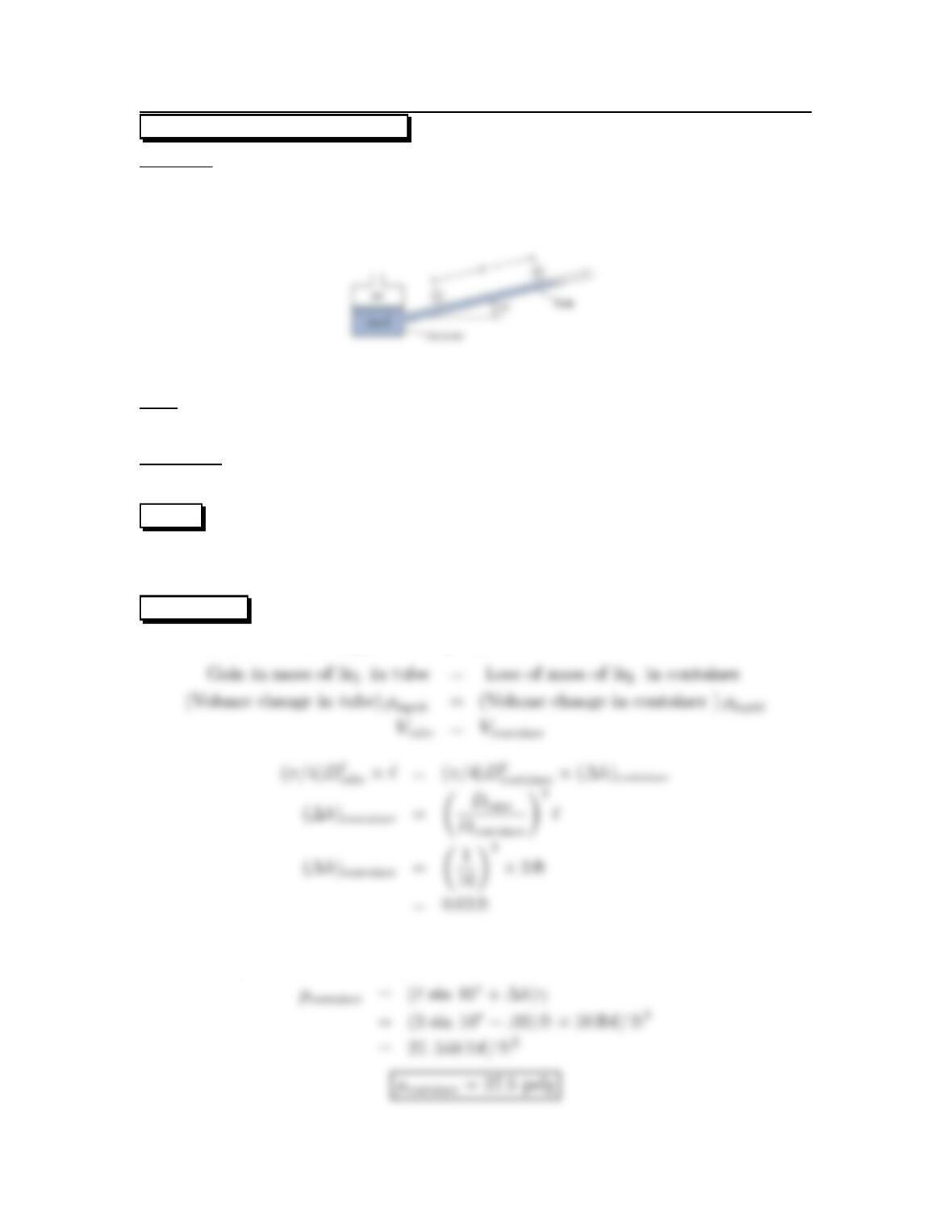
3.52: PROBLEM DEFINITION
Situation:
State 1: air at patm,liquid in tube at elevation 1.
State 2: air is pressurized; liquid at elevation 2.
Dcontainer =10Dtube,=3ft.
Find:
Pressure in the air within the container (psfg).
Properties:
liquid, γ=50lbf/ft3.
PLAN
1. Find the decrease in liquid level in the container by using conservation of mass.
2. Find the pressure in the container by apply the manometer equation.
SOLUTION
1. Conservation of mass (applied to liquid)
2. Manometer equation (point 1 = free surface of liquid in the tube; point 2 = free
surface of liquid in the container)
76
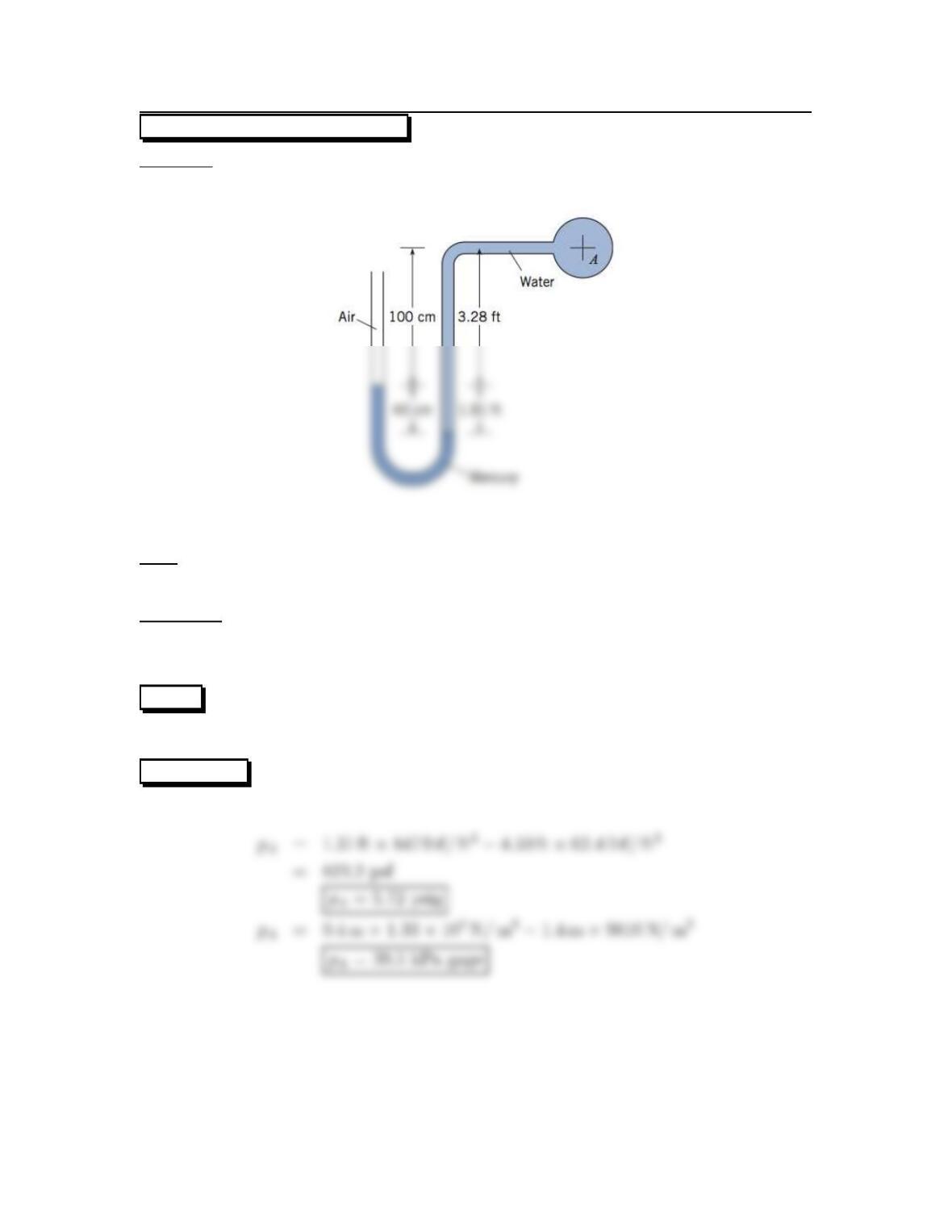
3.53: PROBLEM DEFINITION
Situation:
A pipe system has a manometer attached to it.
Find:
Gage pressure at center of pipe A (psi, kPa).
Properties:
Mercury, Table A.4: γ=1.33 ×10⁵N/m3.
Water, Table A.5: γ=9810N/m3.
PLAN
Apply the manometer equation.
SOLUTION
Manometer equation
77
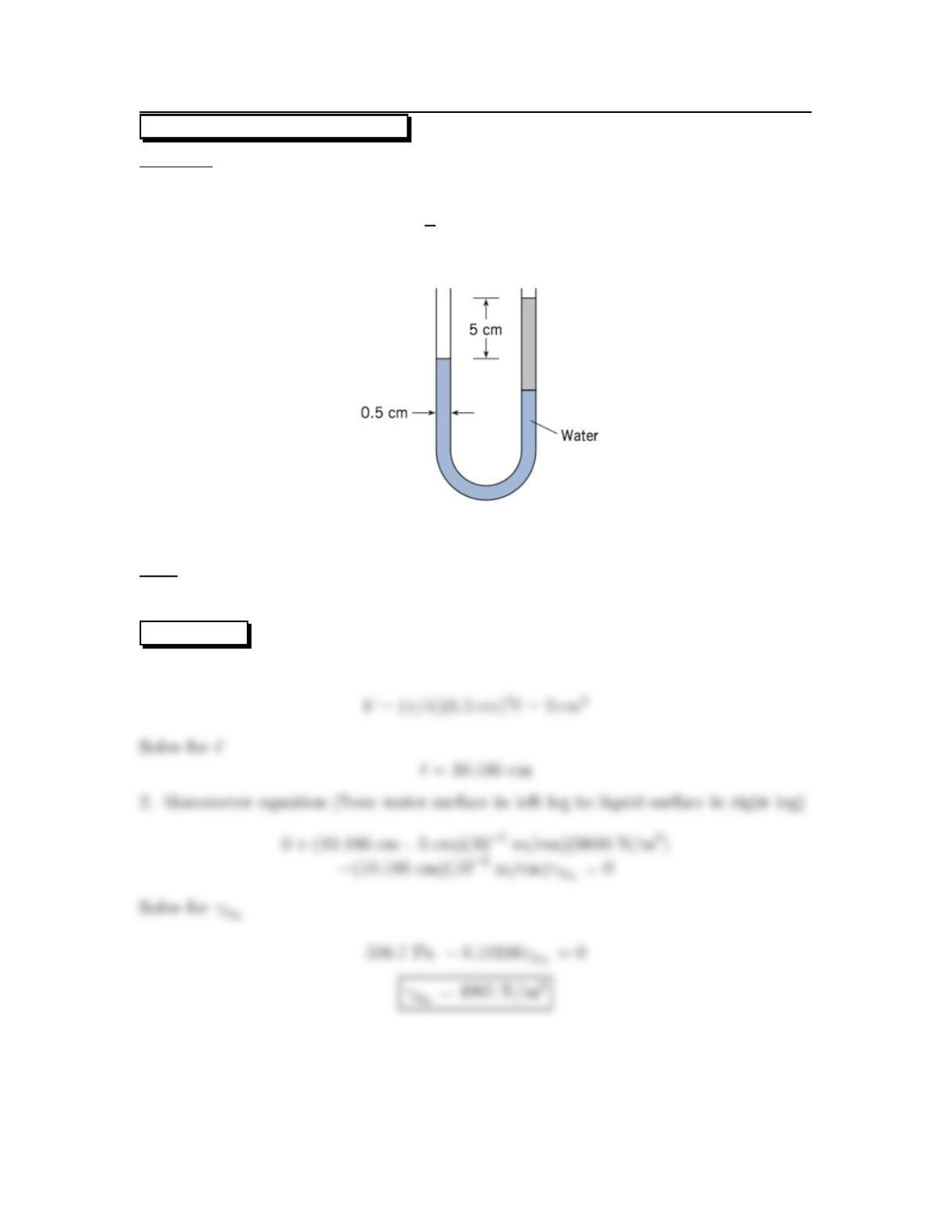
3.54: PROBLEM DEFINITION
Situation:
A U-tube manometer can be used to measure γ.
Initial state: A U-tube manometer contains water.
Final state: An unknown liquid (V=2cm
3)is added to the right leg
d=0.5cm,∆h=5cm.
Find:
Specific weight of unknown fluid (N/m3).
SOLUTION
1. Find the length of the column of the unknown liquid.
78
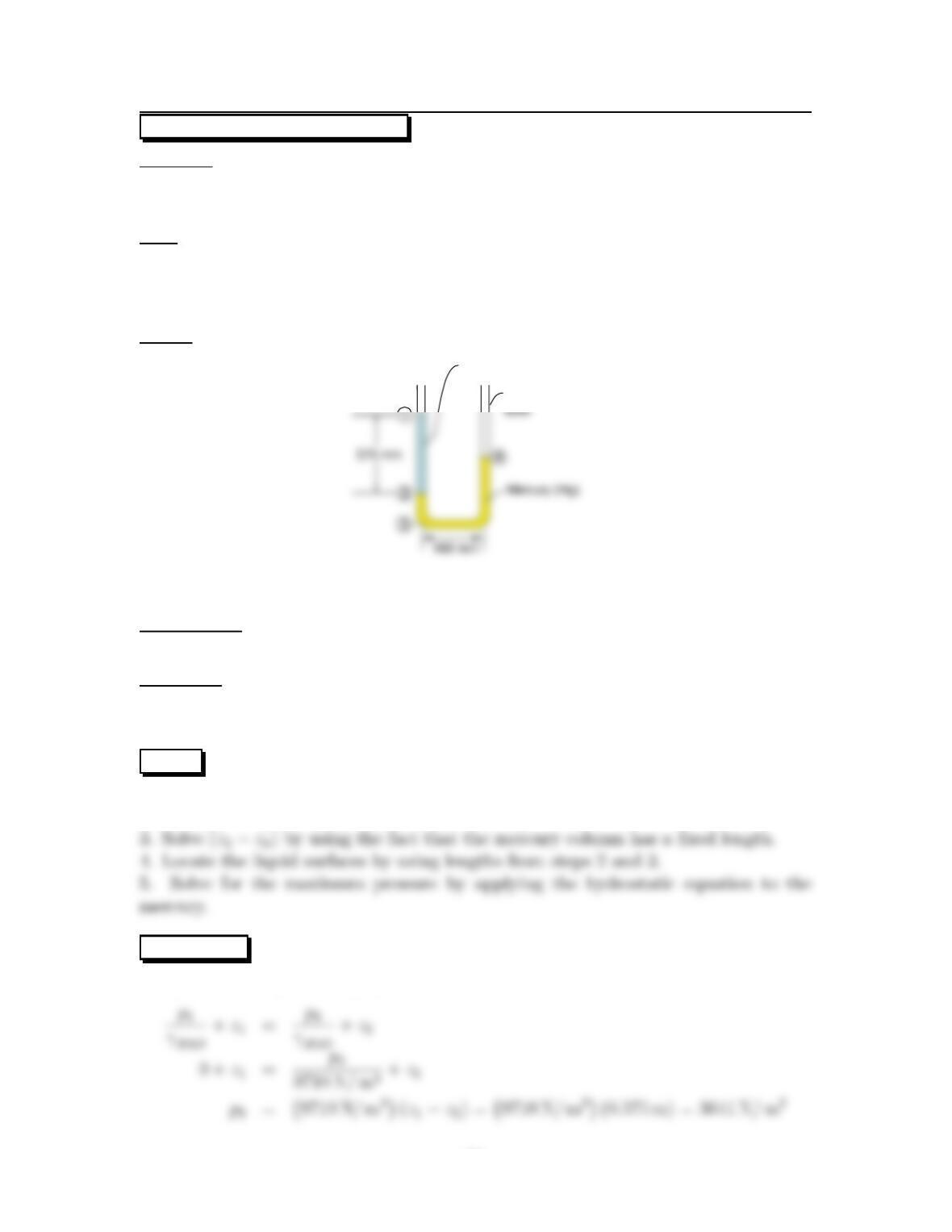
3.55: PROBLEM DEFINITION
Situation:
Mercury and water are poured into a tube.
mercury =water =375mm.
Find:
Locate the water surface (mm).
Locate the mercury surface (mm).
Find the maximum pressure in the U-tube (kPa gage).
Sketch:
Uniform diamete
r
Water (H2O)
Assumptions:
Uniform diameter tube.
Properties:
Mercury (20 ◦C), Table A.4, γHg = 133000 N/m3.
Water (20 ◦C), Table A.5, γ=9790N/m3.
PLAN
1. Find p2by applying the hydrostatic equation.
2. Find (z4−z2)by applying the hydrostatic equation.
SOLUTION
1. Hydrostatic equation (apply to water column):
79
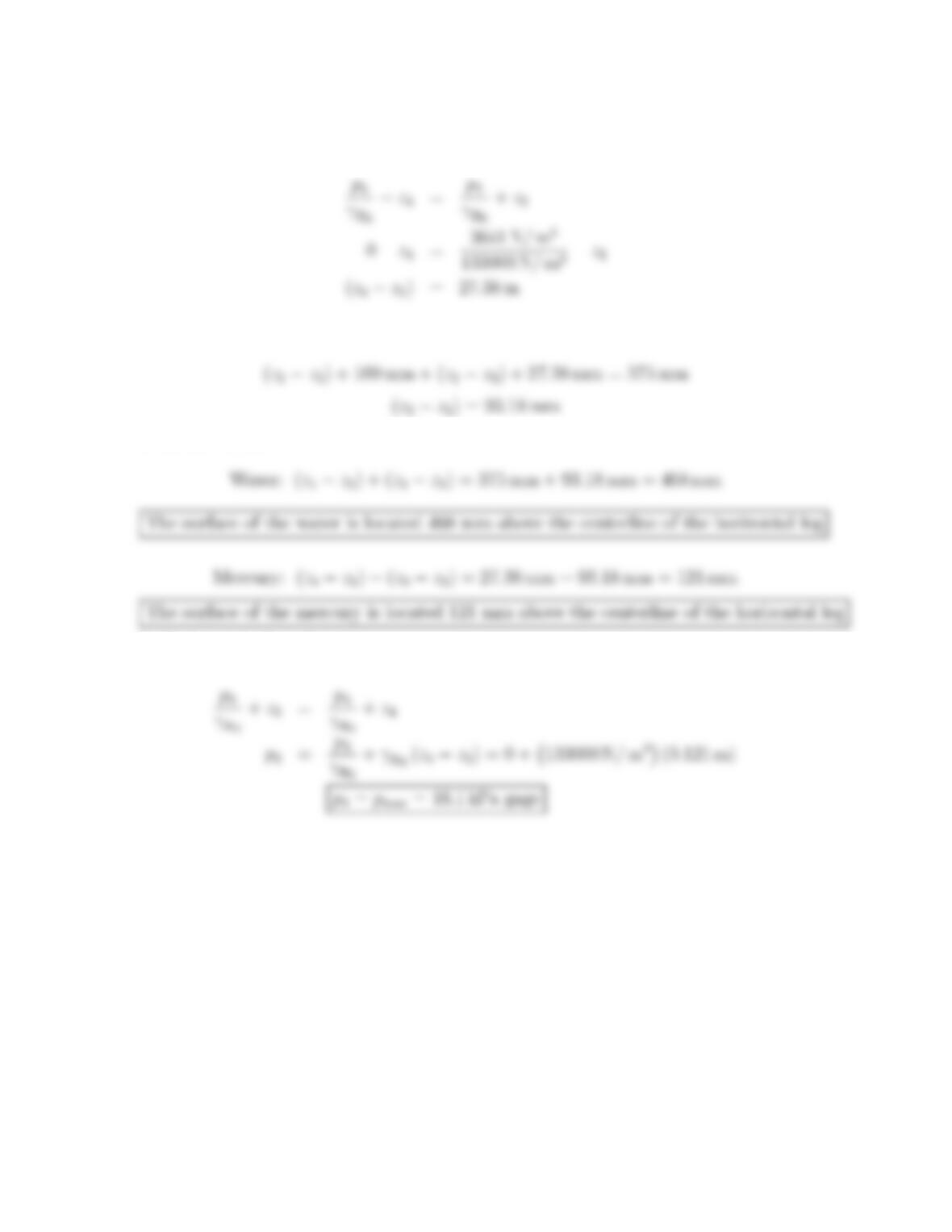
Since the pressure across the water/mercury interface is constant, p2,H2O =p2,Hg.
2. Hydrostatic equation (apply to Hg column):
3. Length constraint (length of Hg column is 375 mm):
4. Locate surfaces:
5. Hydrostatic Equation:
80