3.1: PROBLEM DEFINITION
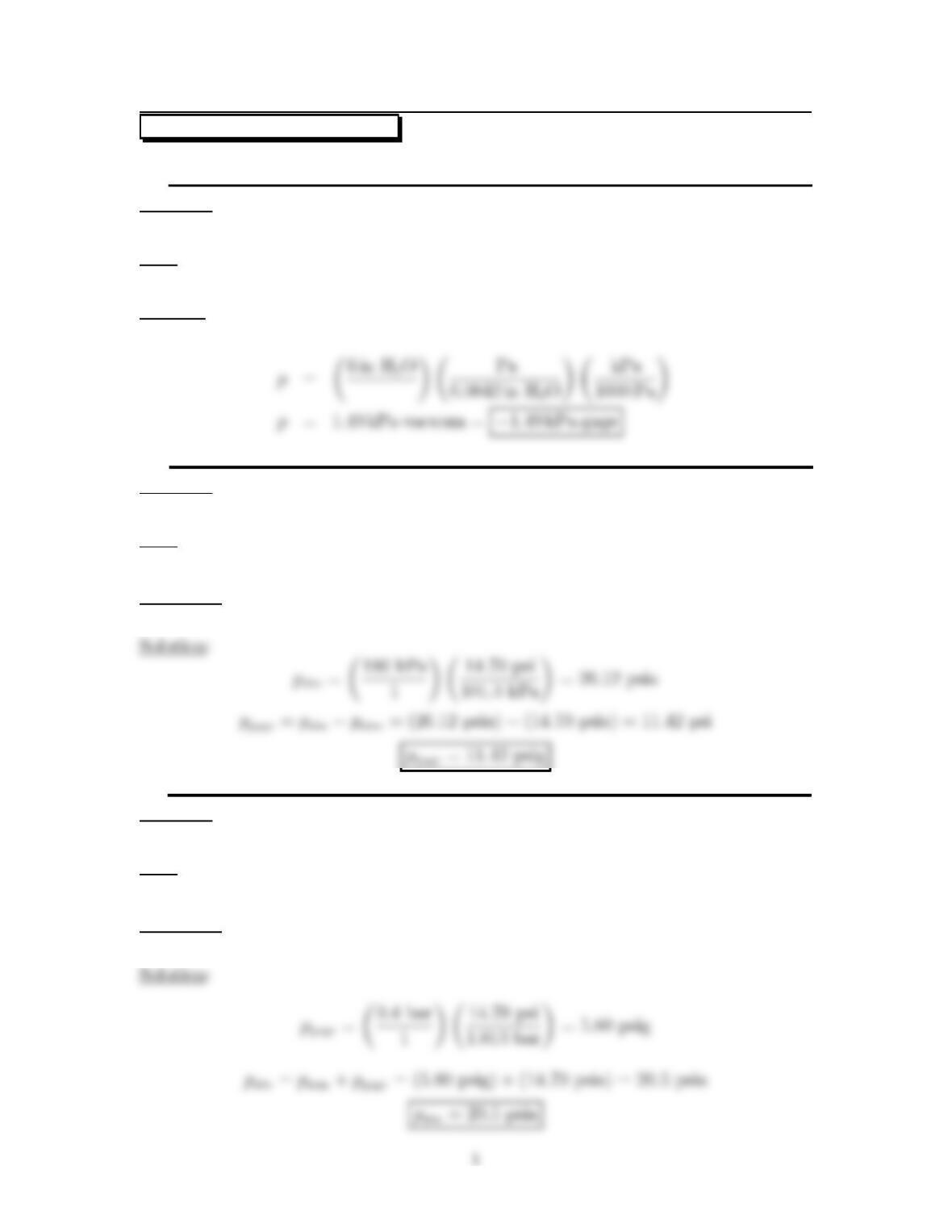
Apply the grid method to cases a, b, c and d.
a.)
Situation:
Pressure values need to be converted.
Find:
Calculate the gage pressure (kPa) corresponding to 8 in. H2O (vacuum).
Solution:
b.)
Situation:
Pressure values need to be converted.
Find:
Calculate the gage pressure (psig) corresponding to 180 kPa-abs.
Properties:
patm =14.70psi.
c.)
Situation:
Pressure values need to be converted.
Find:
Calculate the absolute pressure (psia) corresponding to a pressure of 0.4 bar (gage).
Properties:
patm =14.70psi.
d.)
Situation:
Pressure values need to be converted.
Find:
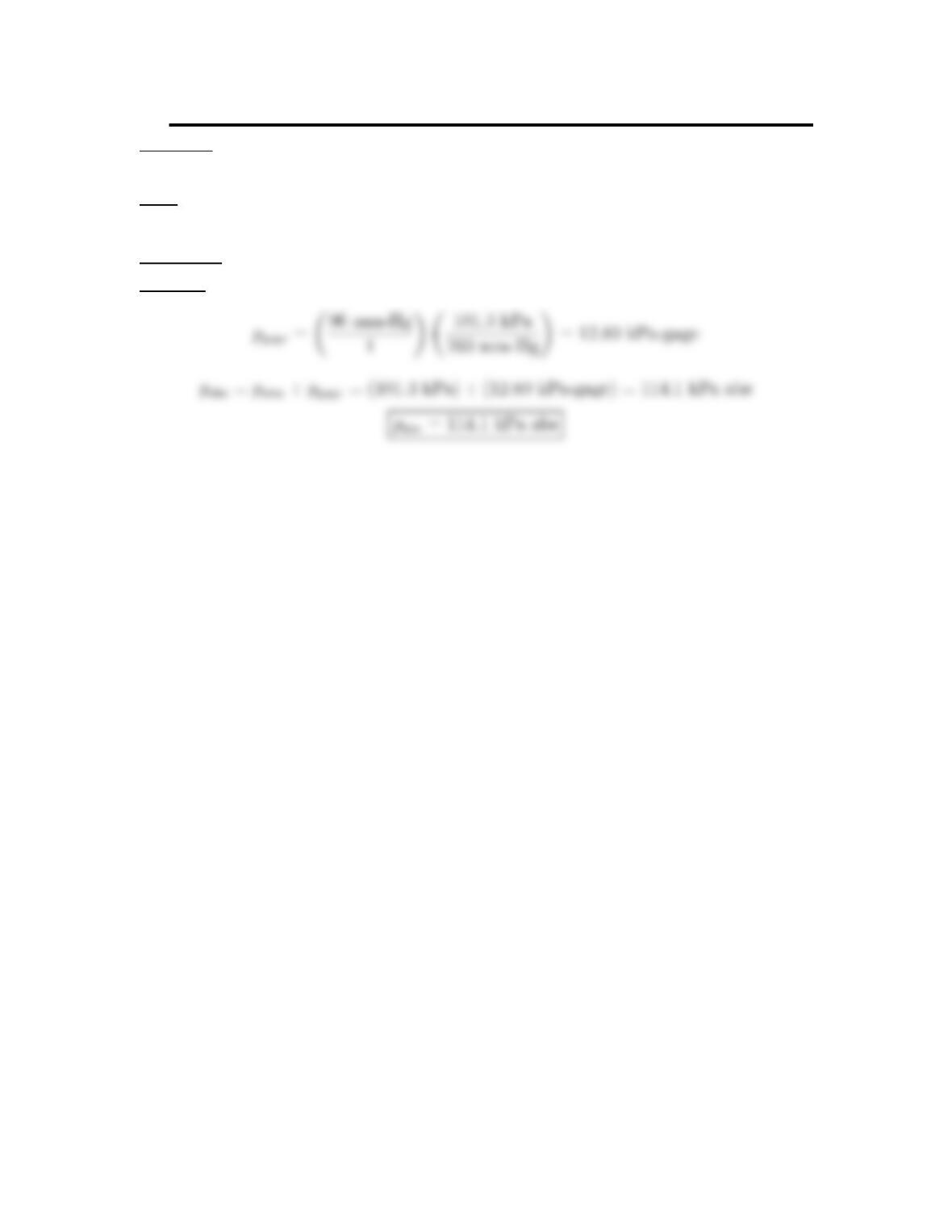
Calculate the pressure (kPa abs) corresponding to a blood pressure of 96 mm-Hg.
Properties:
Solution:
2
3.2: PROBLEM DEFINITION
Apply the grid method to:
a.)
Situation:
Aspherecontainsanidealgas.
Find:
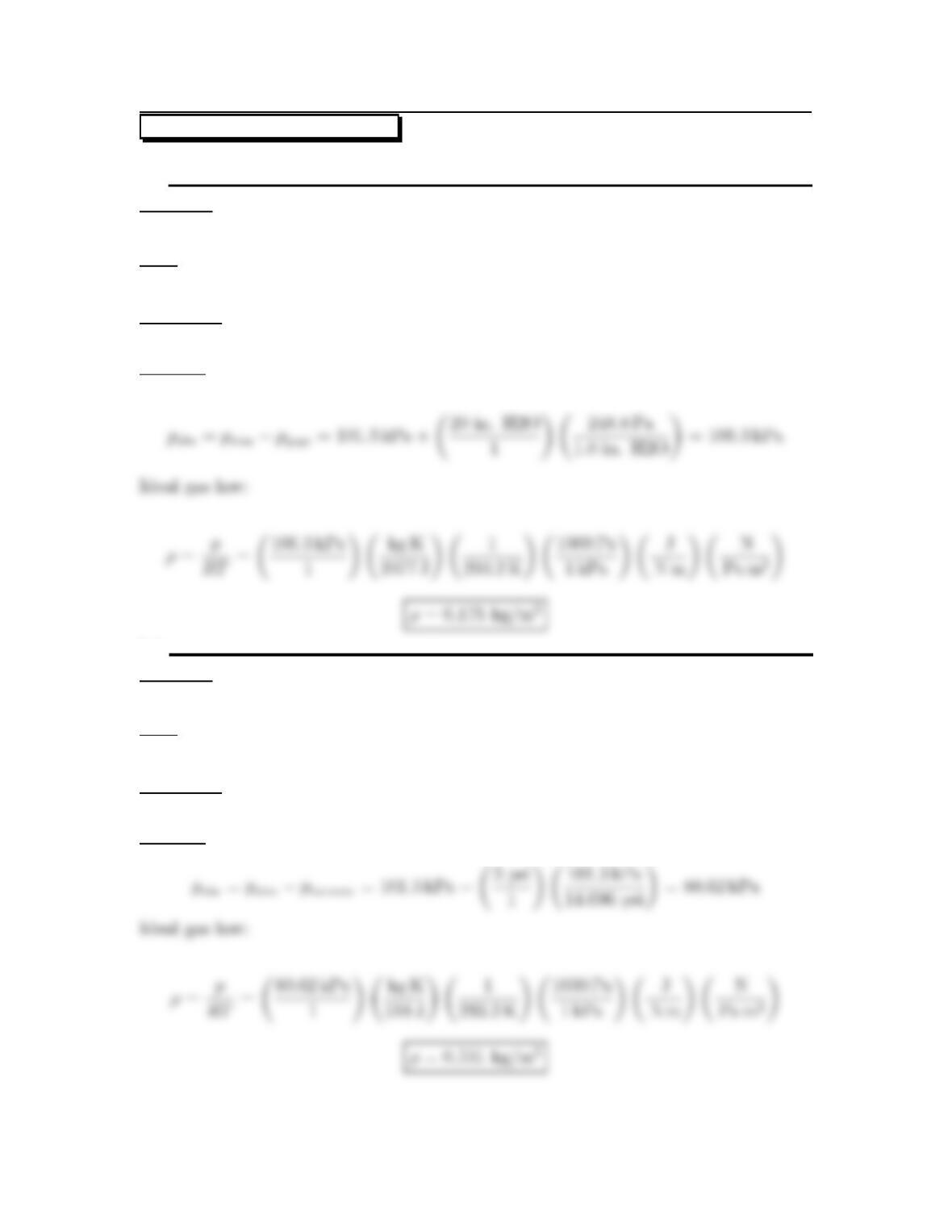
Calculate the density of helium at a gage pressure of 20 in. H2O.
Properties:
From Table A.2: Rhelium =2077J/kg ·K.
Solution:
b.)
Situation:
Aspherecontainsanidealgas.
Find:
Calculate the density of argon at a vacuum pressure of 3 psi.
Properties:
From Table A.2: Rmethane =518J/kg ·K.
Solution:
3
3.3: PROBLEM DEFINITION
Situation:
For the questions below, assume standard atmospheric pressure.
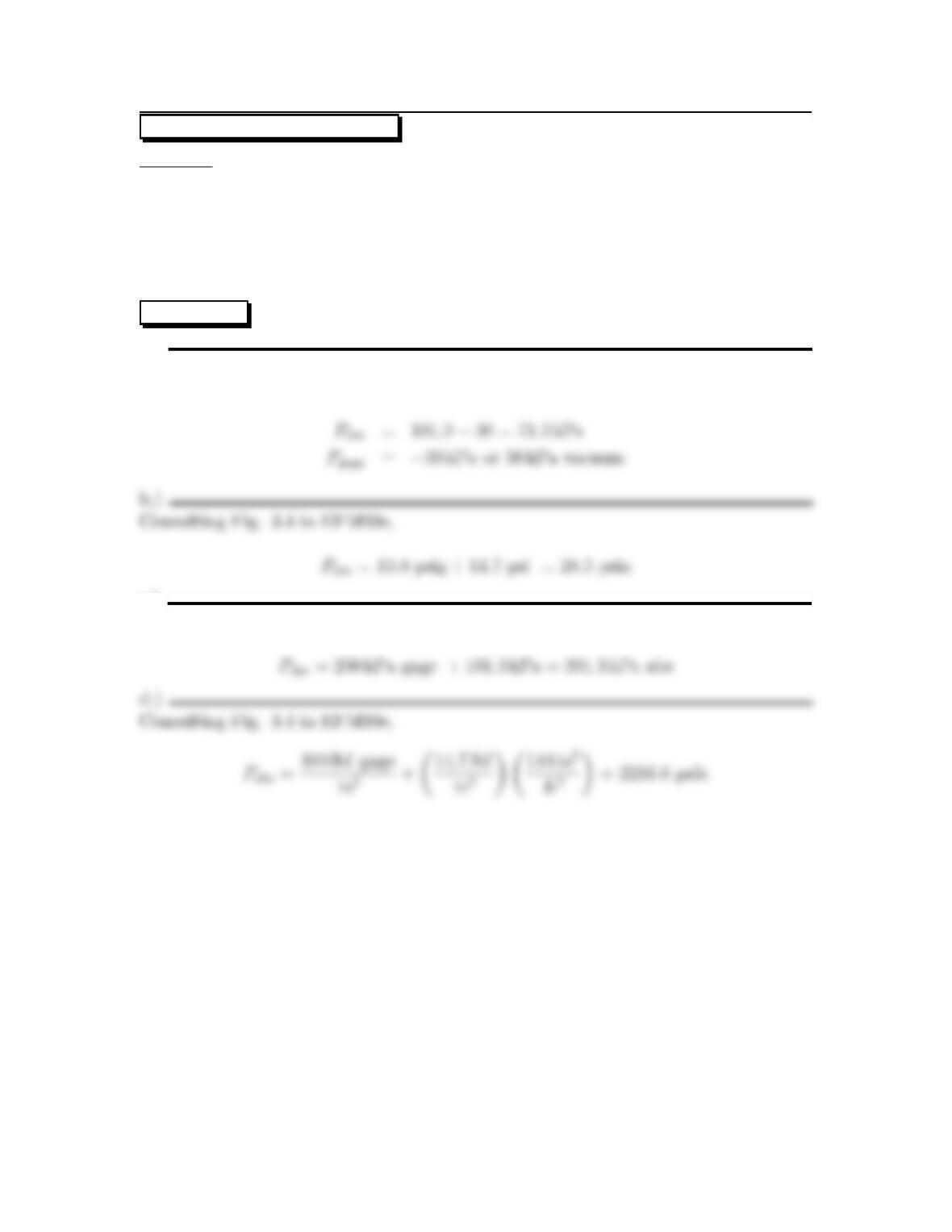
a. For a vacuum pressure of 30 kPa, what is the absolute pressure? Gage pressure?
b. For a pressure of 13.8 psig, what is the pressure in psia?
c. For a pressure of 200 kPa gage, what is the absolute pressure in kPa?
d. Give the pressure 100 psfg in psfa.
SOLUTION
a.)
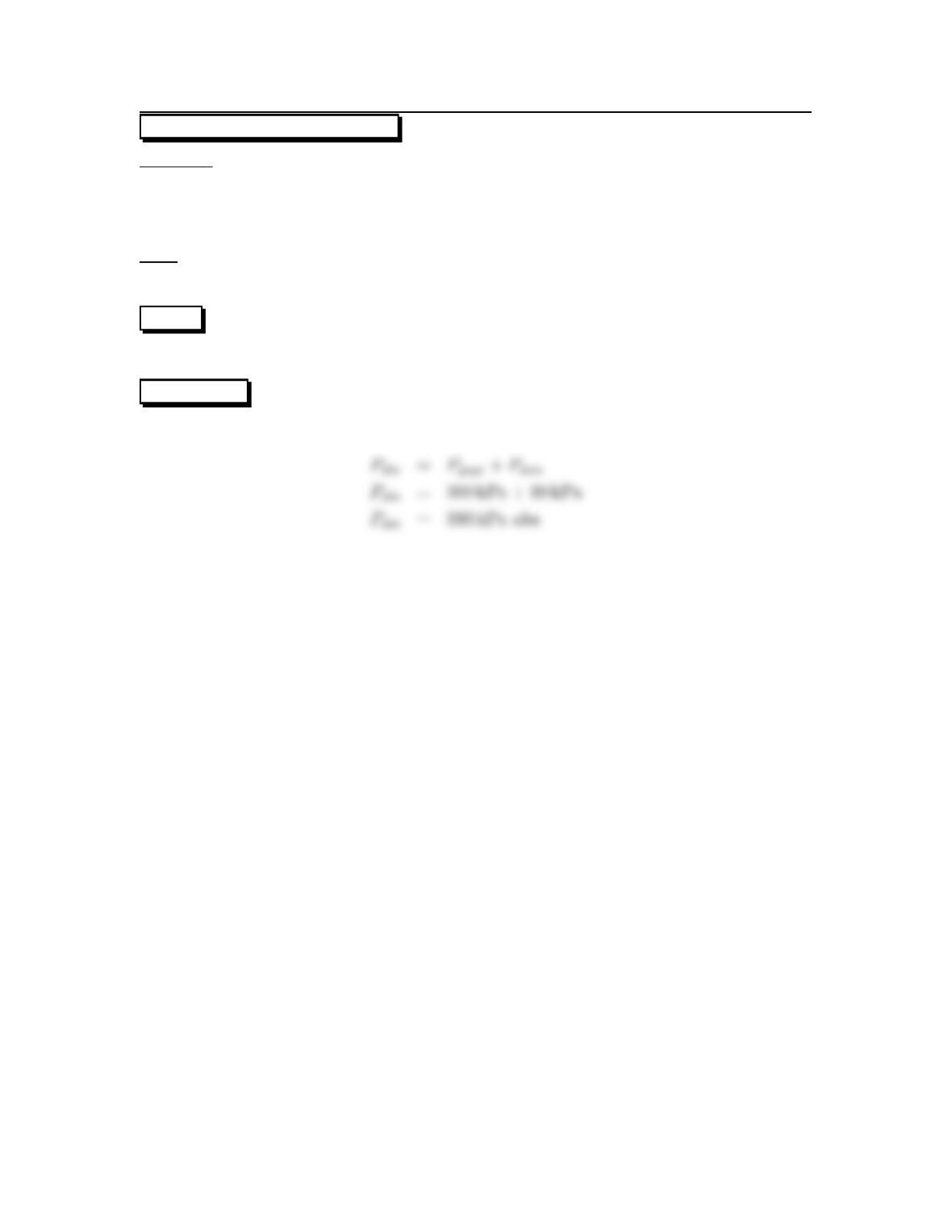
Consulting Fig. 3.4 in EFM10e,
c.)
Consulting Fig. 3.4 in EFM10e,
4
3.4: PROBLEM DEFINITION
Situation:
The local atmospheric pressure is 99.0 kPa. A gage on an oxygen tank reads a pressure
of 300 kPa gage.
Find:
What is the pressure in the tank in kPa abs?
PLAN
Consult Fig. 3.4 in EFM10e
SOLUTION
5
3.5: PROBLEM DEFINITION
Using Section 3.1 and other resources, answer the questions below. Strive for depth,
clarity, and accuracy while also combining sketches, words and equations in ways that
enhance the effectiveness of your communication.
a. What are five important facts that engineers need to know about pressure?
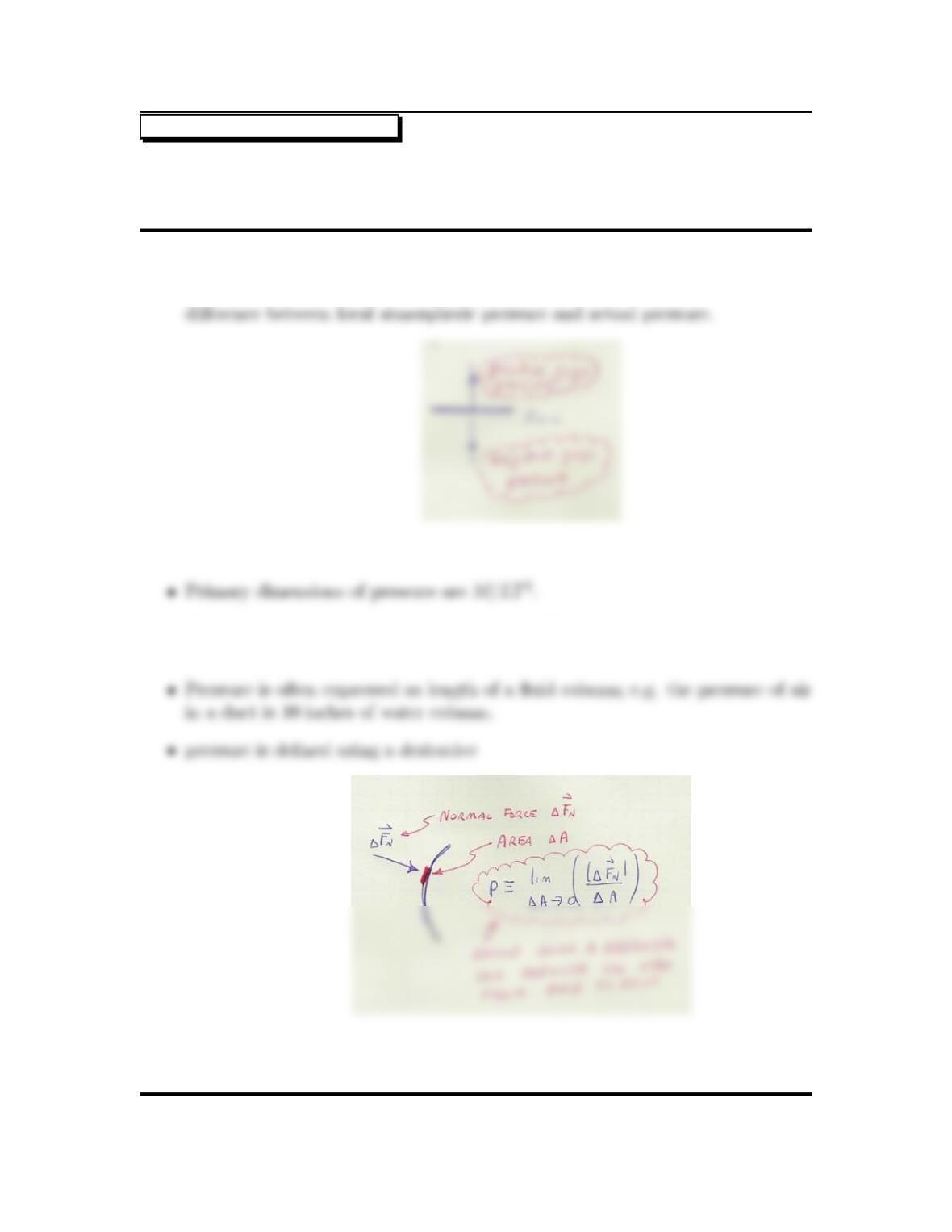
•Pressure is often expressed using “gage pressure,” where gage pressure is the
•Vacuum pressure = negative gage pressure. Negative vacuum pressure = gage
pressure.
b. What are five common instances in which people use gage pressure?
6
•car tire pressure is expressed as gage pressure.
c. What are the most common units for pressure?
•Pa,psi,psf
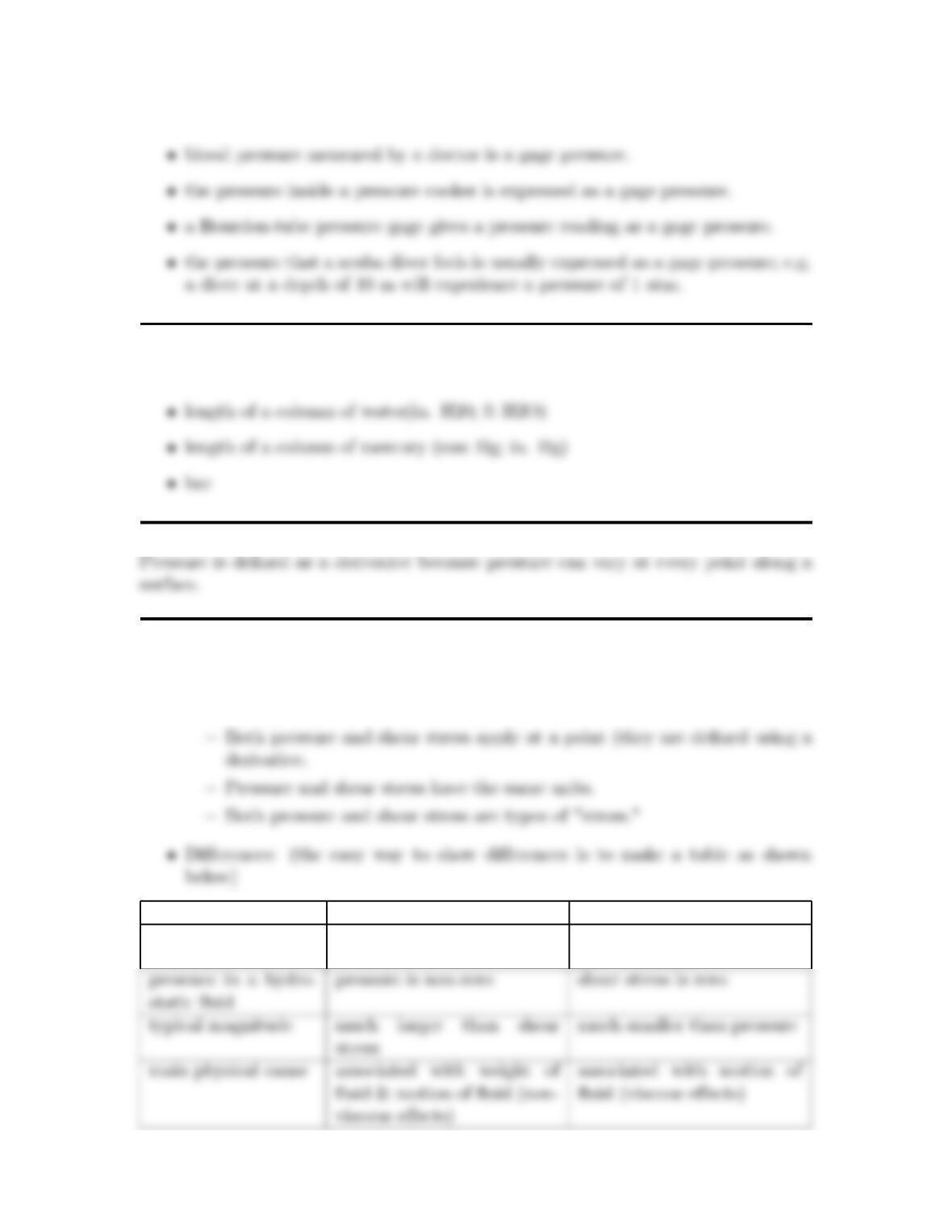
d. Why is pressure defined using a derivative?
e. How is pressure similar to shear stress? How does pressure differ from shear stress?
•Similarities
—Both pressure and shear stress give a ratio of force to area.
Attribute Pressure Shear Stress
direction of associ–
ated force
associated with force normal
to area
associated with force tan-
gent to an area
7
3.6: PROBLEM DEFINITION
Situation:
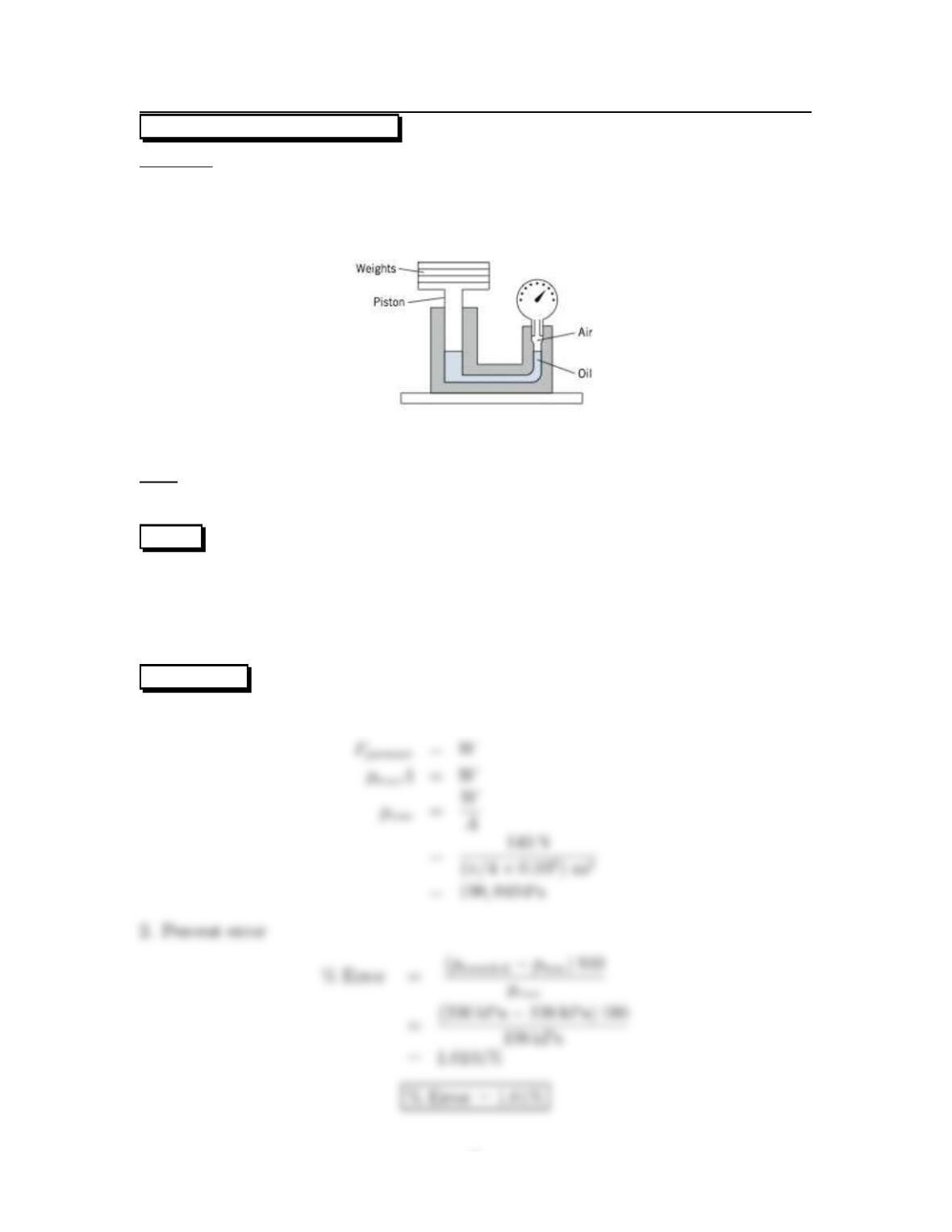
A Crosby gage tester is applied to calibrate a pressure gage.
Indicated pressure on the gage is p=200kPagage.
W= 140 N,D=0.03 m.
Find:
Percent error in gage reading.
PLAN The oil exerts an upward force on the piston to support the weights. Thus,
we can calculate the true pressure and then compare this with indicated reading to
obtain the error in the gage reading. The steps are
1. Calculate the true pressure by applying force equilibrium to the piston and weights.
2. Calculate the error in the gage reading.
SOLUTION
1. Force equilibrium (apply to piston + weights)
8
3.7: PROBLEM DEFINITION
Situation:
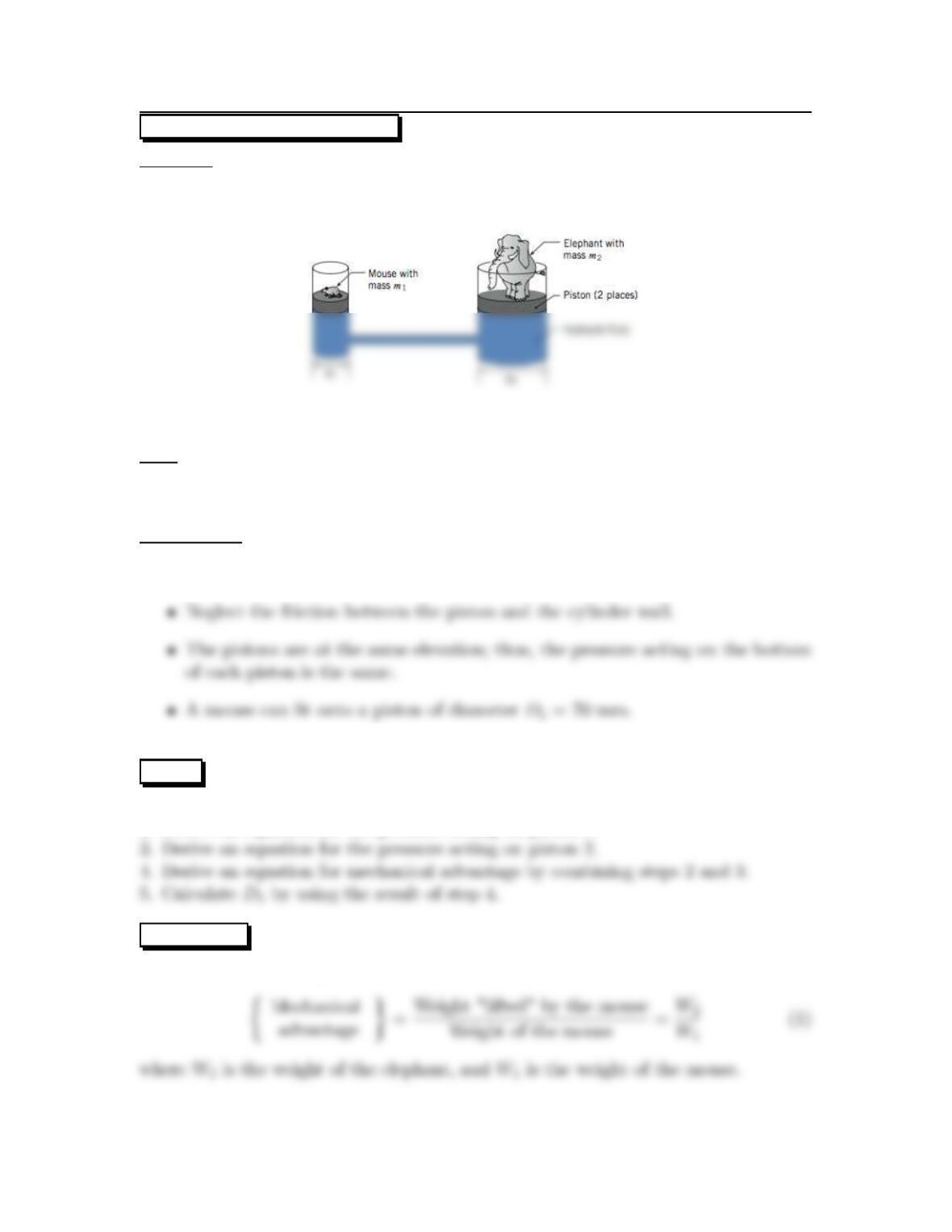
A hydraulic machine is used to provide a mechanical advantage.
m1=0.025 kg,m2=7500kg.
Find:
(a) Derive an algebraic equation for the mechanical advantage.
(b) Calculate D1and D2so the mouse can support the elephant.
Assumptions:
•Neglect the mass of the pistons.
PLAN
1. Define “mechanical advantage.“
2. Derive an equation for the pressure acting on piston 1.
SOLUTION
1. Mechanical advantage.
9
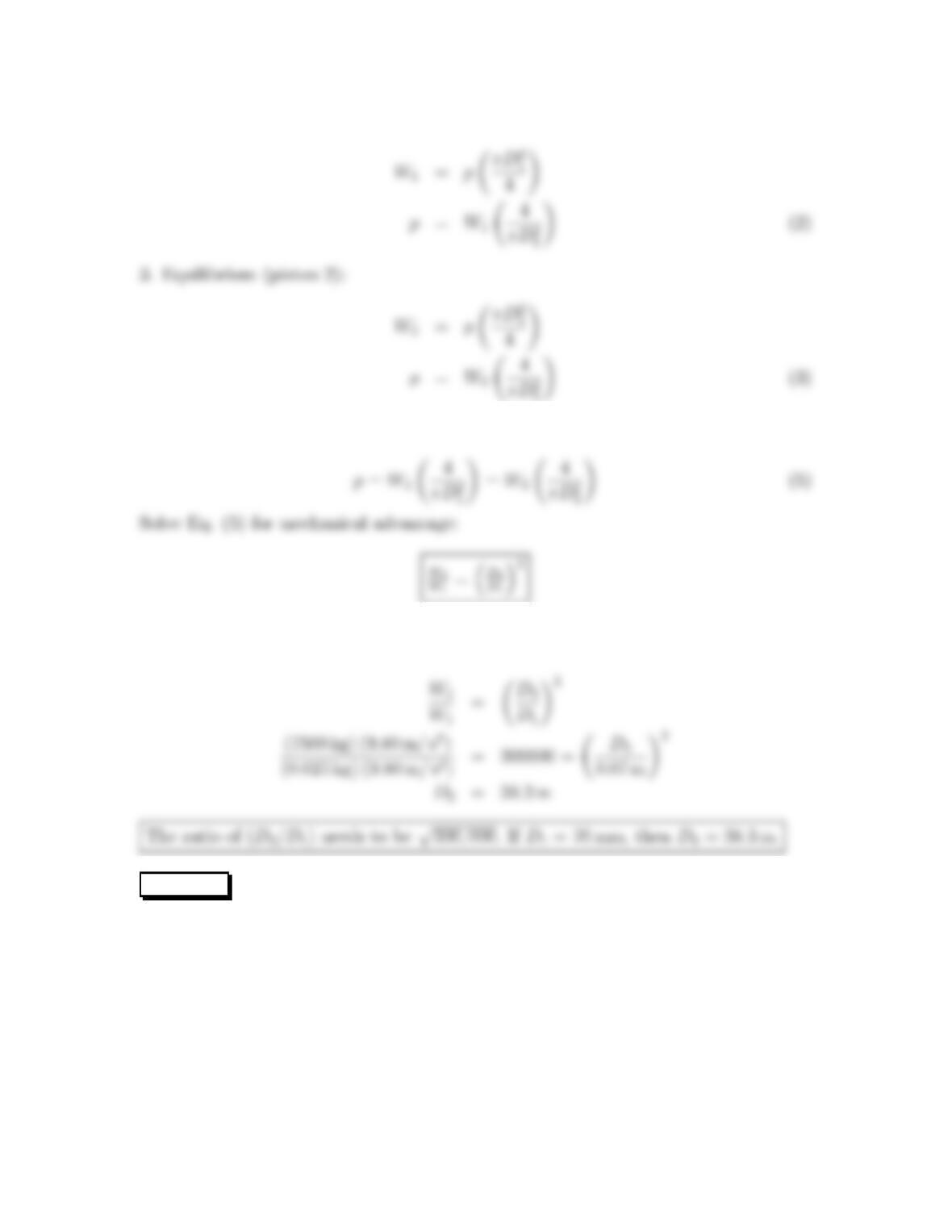
2. Equilibrium (piston 1):
4. Combine Eqs. (2) and (3):
5. Calculate D2.
REVIEW
1. Notice. The mechanical advantage varies as the diameter ratio squared.
2. The mouse needs a mechanical advantage of 300,000:1. This results in a piston
that is impractical (diameter = 38.3 m = 126 ft !).
10
3.8: PROBLEM DEFINITION
Situation:
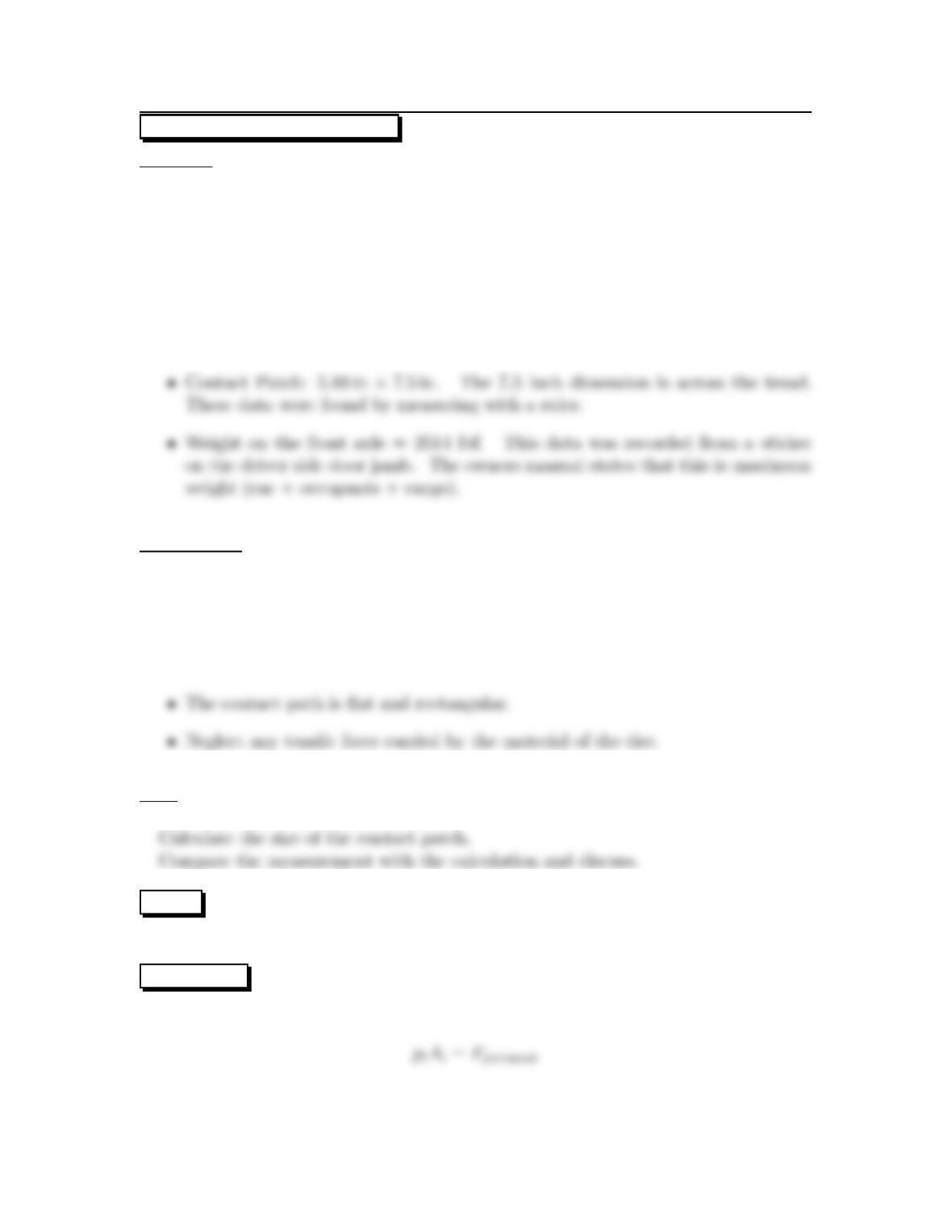
To work the problem, data was recorded from a parked vehicle. Relevant infor-
mation:
•Left front tire of a parked VW Passat 2003 GLX Wagon (with 4-motion).
•Bridgestone snow tires on the vehicle.
•Inflation pressure = 36 psig. This value was found by using a conventional
“stick-type” tire pressure gage.
Assumptions:
•Theweightonthecaraxlewithoutaloadis2000lbf. Thus,theloadacting
on the left front tire is 1000 lbf.
•Thethicknessofthetiretreadis1inch. Thethicknessofthetiresidewallis
1/2 inch.
Find:
Measure the size of the contact patch.
PLAN
To estimate the area of contact, apply equilibrium to the contact patch.
SOLUTION
Equilibrium in the vertical direction applied to a section of the car tire
11
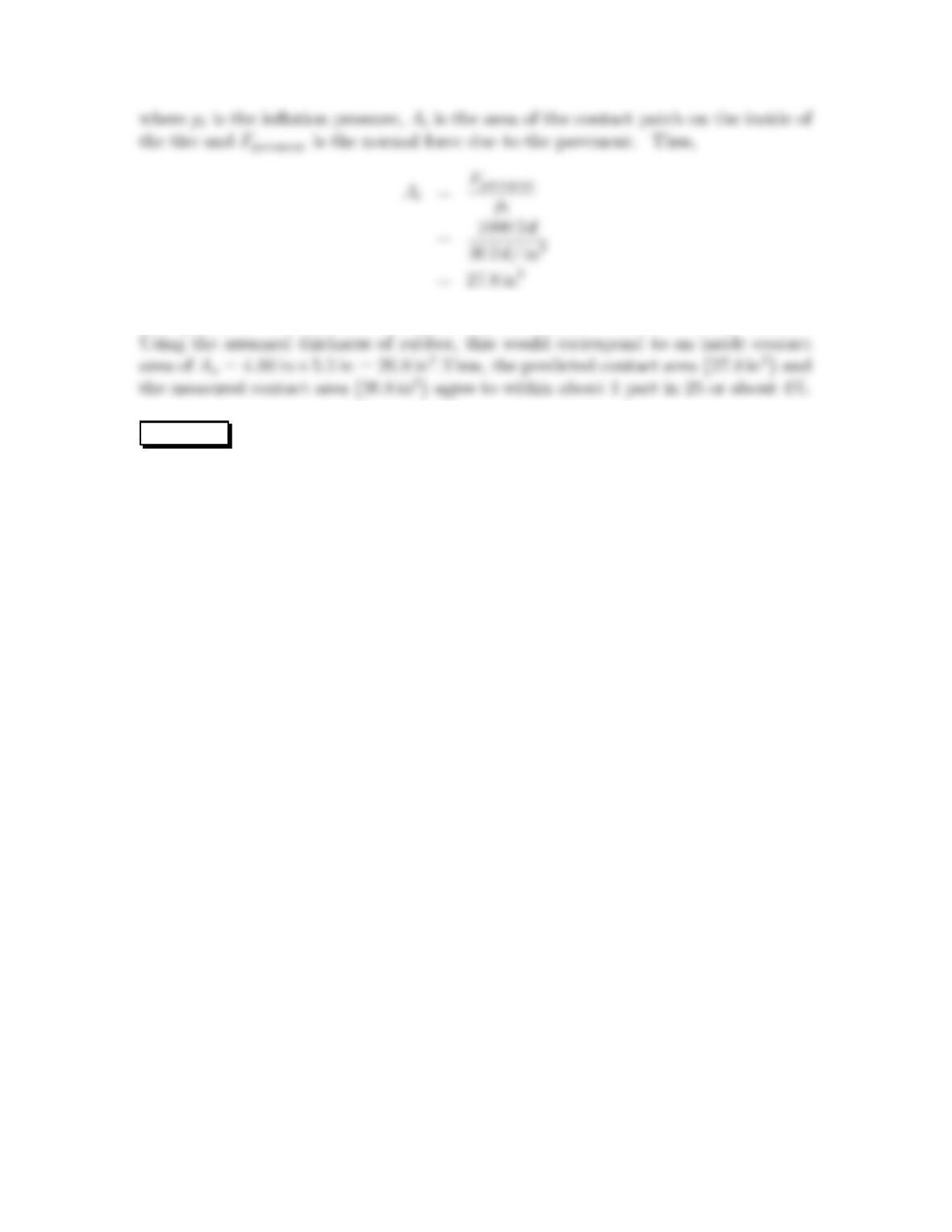
Comparison. The actual contact patch has an area Ao=5.88 in ×7.5in = 44.1in
2.
REVIEW
The comparison between predicted and measured contact area is highly dependent
on the assumptions made.
12

3.9: PROBLEM DEFINITION
Situation:
To derive the hydrostatic equation, which of the following must be assumed? (Select
all that are correct.)
a. the specific weight is constant
b. the fluid has no charged particles
c. the fluid is at equilibrium
SOLUTION
13
3.10: PROBLEM DEFINITION
Situation:
Two tanks.
Tank A is filled to depth hwith water.
Tank B is filled to depth hwith oil.
Find:
Which tank has the largest pressure?
Why?
Where in the tank does the largest pressure occur?
SOLUTION
In both tanks, pressure increases with depth, according to p=−γz.
14
3.11: PROBLEM DEFINITION
Situation:
Consider Figure 3.5 on p. 38 of §3.2.
a. Which fluid has the larger density?
b. If you graphed pressure as a function of zin these two layered liquids, in which
fluid does the pressure change more with each incremental change in z?
SOLUTION
a. Water has the larger density, and thus the larger specificweight.
15
Problem 3.12
Apply the grid method to calculations involving the hydrostatic equation:
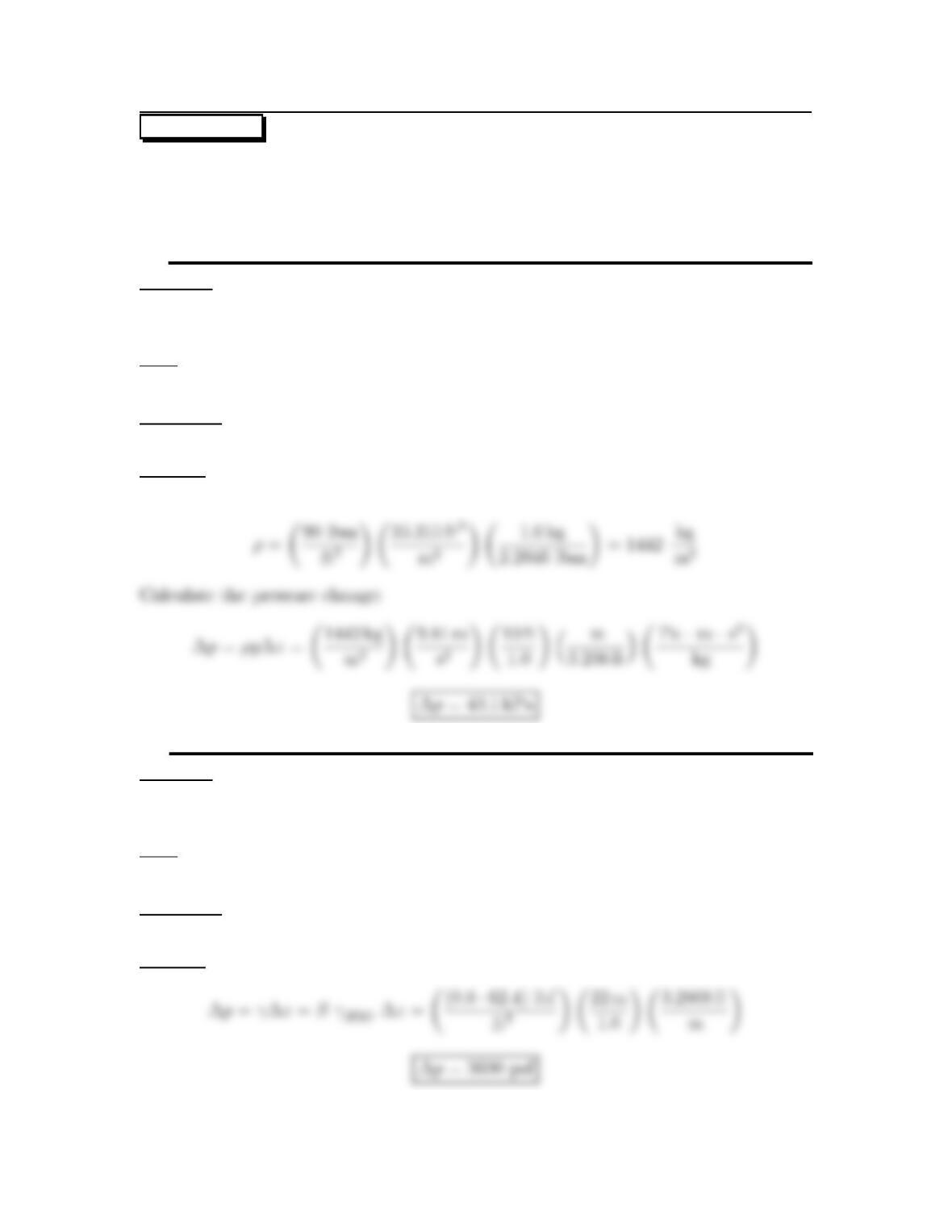
∆p=γ∆z=ρg∆z
Note: Unit cancellations are not shown in this solution.
a.)
Situation:
Pressure varies with elevation.
∆z=10ft.
Find:
Pressure change (kPa).
Properties:
ρ=90lb/ft3.
Solution:
Convert density to units of kg/m3:
b.)
Situation:
Pressure varies with elevation.
∆z=22m,S=0.8.
Find:
Pressure change (psf).
Properties:
γ=62.4lbf/ft3.
Solution:
16
c.)
Situation:
Pressure varies with elevation.
Find:
Pressure change (in H2O).
Properties:
air, ρ=1.2kg/m3.
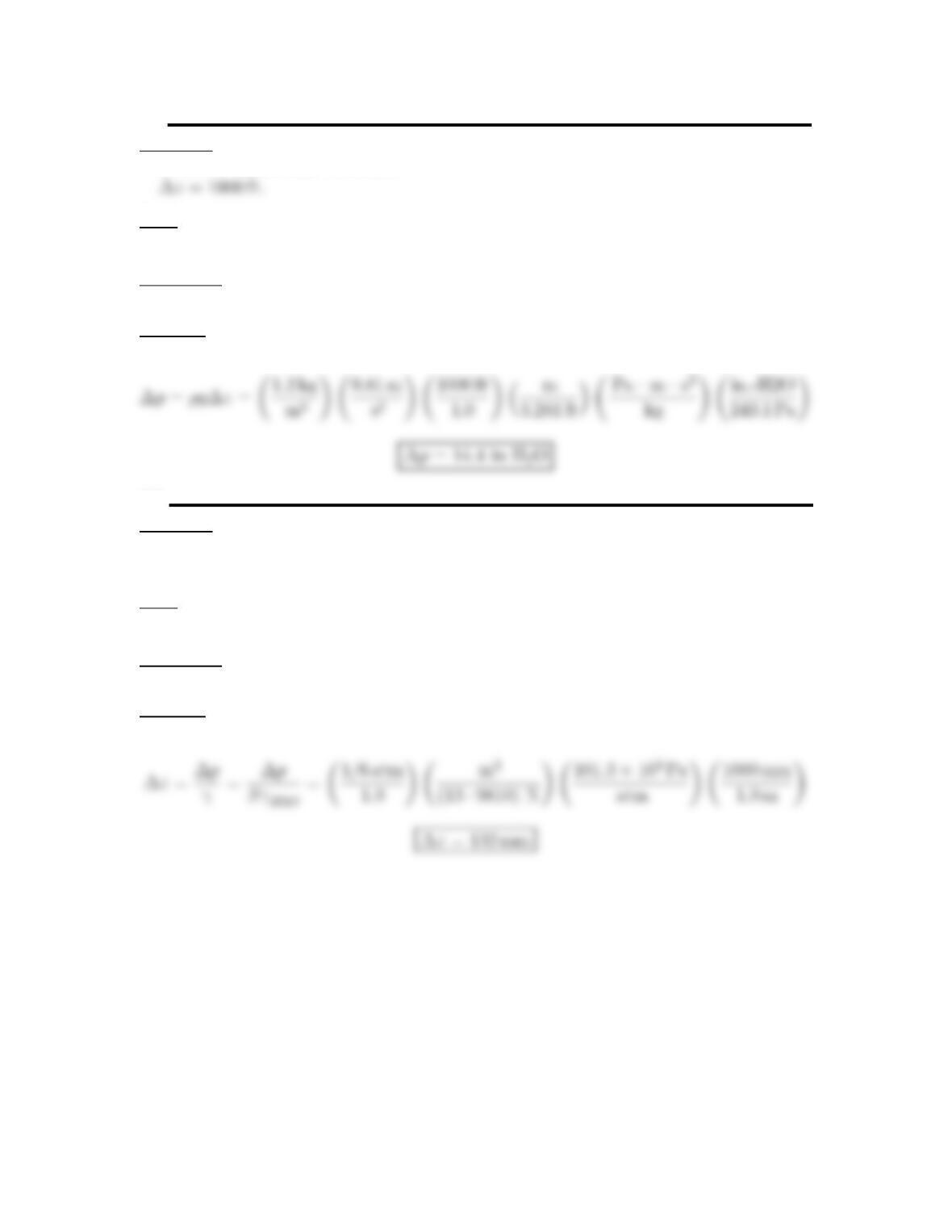
Solution:
d.)
Situation:
Pressure varies with elevation.
∆p=1/6atm,S=13.
Find:
Elevation change (mm).
Properties:
γ=9810N/m3,p
atm =101.3kPa.
Solution:
d. Calculate ∆z(mm) corresponding to S=13and ∆p=1/6atm.
17
Problem 3.13
Using Section 3.2 and other resources, answer the questions below. Strive for depth,
clarity, and accuracy while also combining sketches, words and equations in ways that
enhance the effectiveness of your communication.
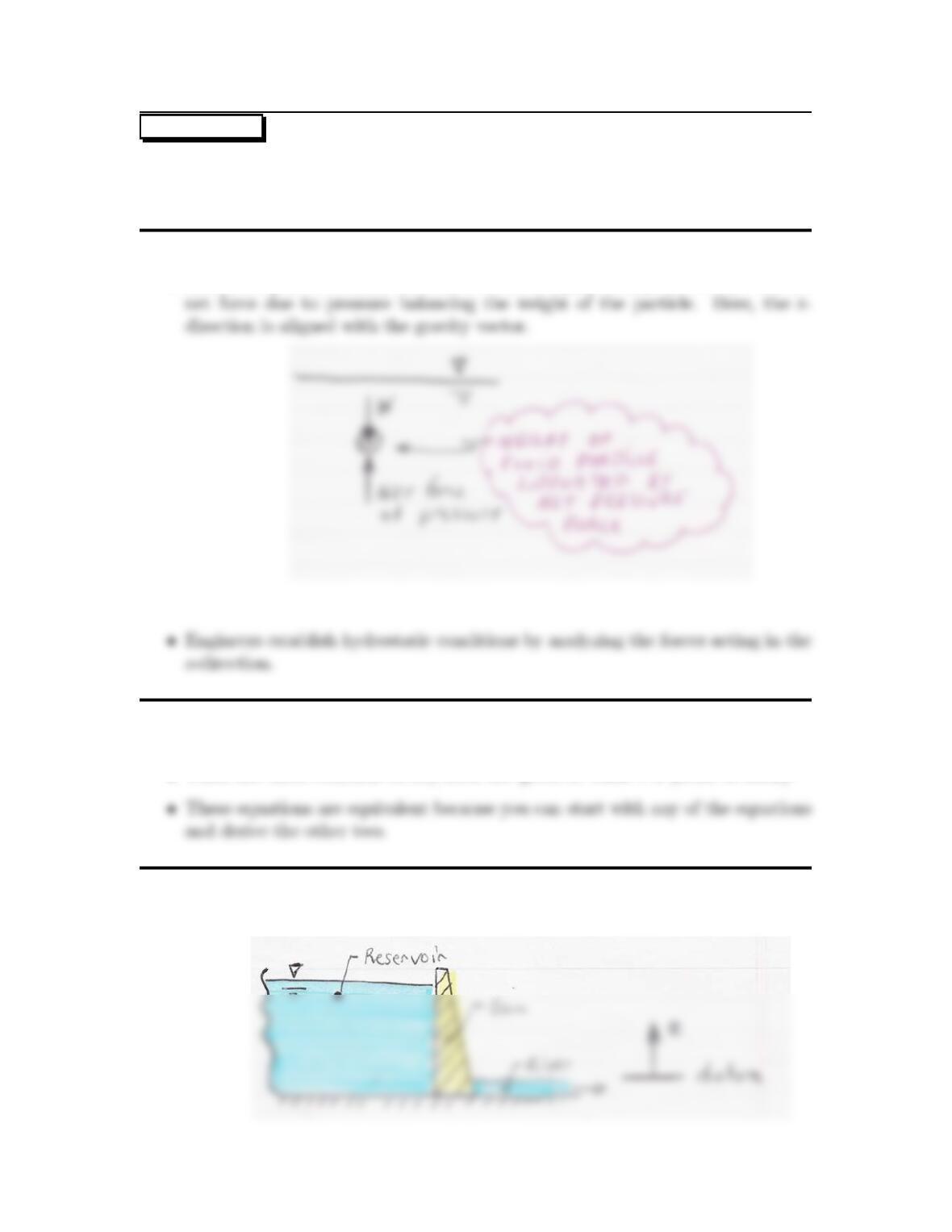
a. What does hydrostatic mean? How do engineers identify if a fluid is hydrostatic?
•Each fluid particle within the body is in force equilibrium(z-direction) with the
b. What are common forms of the hydrostatic equation? Are the forms equivalent
or are they different?
•There are three common forms; these are given in Table F.2 (front of book).
c. What is a datum? How do engineers establish a datum?
•Adatumisafixed reference point from which elevations are measured.
18
positive.
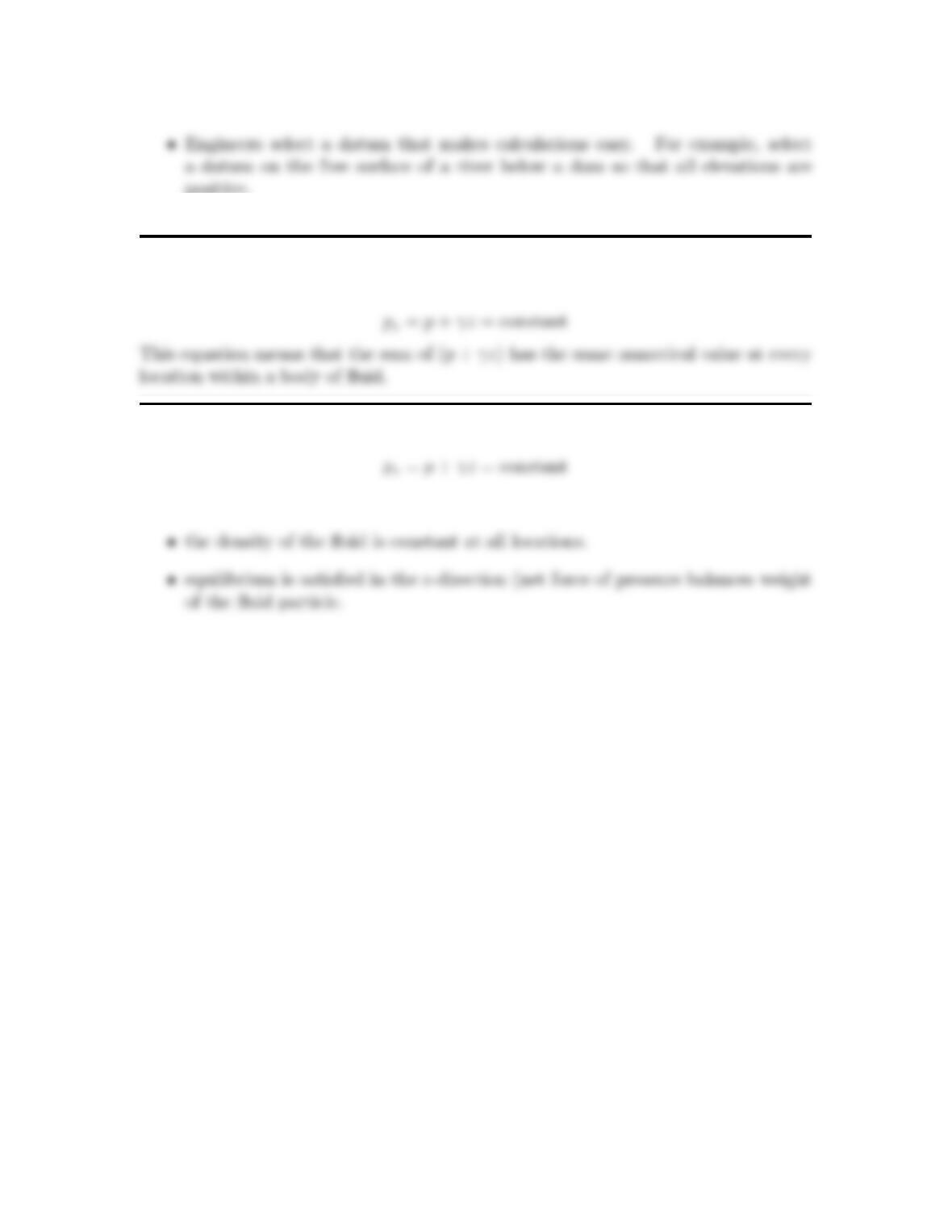
d. What are the main ideas of Eq. (3.5)? That is, what is the meaning of this
equation?
e. What assumptions need to be satisfied to apply the hydrostatic equation?
This equation is valid when
19
Problem 3.14
Apply the grid method to each situation below. Unit cancellations are not shown in
these solutions.
a.)
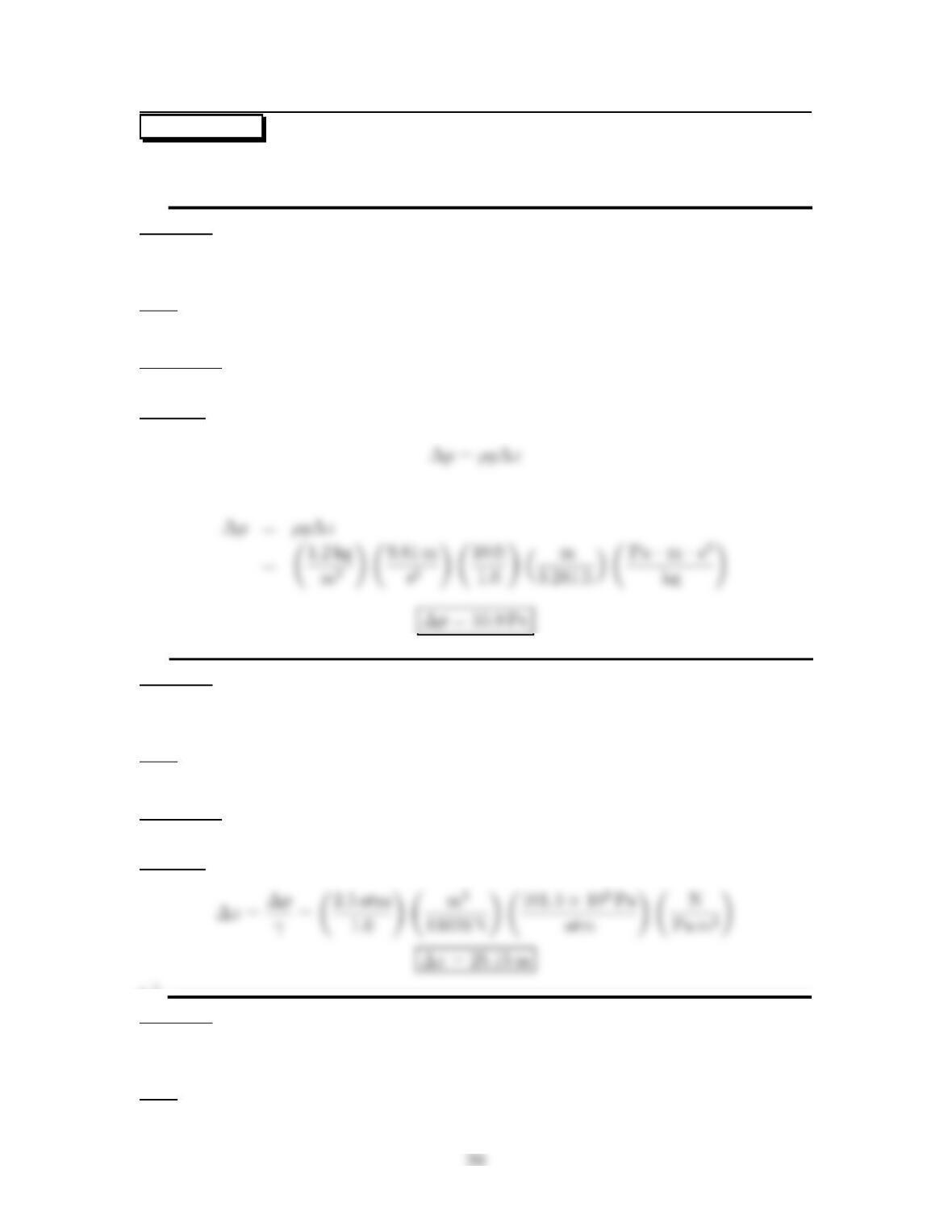
Situation:
Pressure varies with elevation.
∆z=10ft.
Find:
Pressure change (Pa).
Properties:
air, ρ=1.2kg/m3.
Solution:
b.)
Situation:
Pressure increases with depth in the ocean.
Pressure reading is 2.5 atm gage.
Find:
Water depth (m).
Properties:
Seawater, Table A.4, S=1.03,γ= 10070 N/m3.
Solution:
c.)
Situation:
Pressure decreases with elevation in the atmosphere.
∆z=1200ft.
Find:
Pressure (mbar).