CHAPTER 3
THE BALANCE SHEET AND FINANCIAL DISCLOSURES
Overview
Chapter 1 stressed the importance of the financial statements in helping investors and creditors
predict future cash flows. The balance sheet, along with accompanying disclosures, provides
Learning Objectives
LO3-1 Describe the purpose of the balance sheet and understand its usefulness and limitations.
LO3-2 Identify and describe the various balance sheet asset classifications.
LO3-3 Identify and describe the two balance sheet liability classifications.
Lecture Outline
Part A: The Balance Sheet
I. Usefulness and Limitations
A. The balance sheet, sometimes referred to as the statement of financial position, provides
II. Classification of Elements (T3-1)
A. Assets are probable future economic benefits obtained or controlled by a particular entity
as a result of past transactions or events. These are the economic resources of a company.
1. Current assets include cash and all other assets expected to become cash or be
consumed within one year or the operating cycle, whichever is longer. (T3-2) (T3-3)
3-2 Intermediate Accounting, 8/e
2. Noncurrent (or long-term) assets are those assets that are expected to provide benefits
beyond the next year (or operating cycle). (T3-4)
a. Investments
B. Liabilities are probable future sacrifices of economic benefits arising from present
obligations of a particular entity to transfer assets or provide services to other entities in
the future as a result of past transactions or events. These are the obligations of a
company. (T3-5)
1. Current liabilities, in general, are expected to be satisfied within one year or the
operating cycle, whichever is longer. (T3-6)
2. Long-term liabilities are obligations that will not be satisfied in the next year or
operating cycle, whichever is longer. (T3-7)
C. Shareholders’ equity is the residual interest in the assets of an entity that remains after
deducting liabilities. Stated another way, stockholders’ equity equals total assets minus
Part B: Financial Disclosures
I. Disclosure Notes
A. Disclosure notes include certain required notes as well as notes fashioned to suit the
II. Management Discussion and Analysis
The management discussion and analysis provides a biased but informed perspective of a
company’s (a) operations, (b) liquidity, and (c) capital resources. (T3-13)
III. Management’s Responsibilities (T3-14)
Annual reports include a management’s responsibility section which:
1. Asserts the responsibility of management for the information contained in the annual
IV. Auditors’ Report (T3-15)
A. The auditors’ report provides an independent and professional opinion about the fairness of
the representations in the financial statements and about the effectiveness of the
company’s internal control over financial reporting.
B. The standard report includes four paragraphs.
V. Compensation of Directors and Top Executives
A. The proxy statement, which must be sent each year to all shareholders, serves as an
invitation to attend the company’s annual meeting and as a means to vote on issues before
Part C: Risk Analysis
I. Using Financial Statement Information
A. Financial analysts use various techniques when analyzing financial statement information.
B. Comparative financial statements allow financial statement users to compare year–to-year
II. Liquidity Ratios (T3-16)
A. Liquidity refers to the readiness of assets to be converted to cash.
B. Working capital, the difference between current assets and current liabilities, is a popular
3-4 Intermediate Accounting, 8/e
III. Financing Ratios (T3-17)
A. Financing ratios provide some indication of the riskiness of a company with regard to its
ability to pay its long-term debts.
B. The debt to equity ratio indicates the extent of reliance on creditors, rather than owners, in
Appendix 3: Reporting Segment Information
A. Segment reporting facilitates the financial analysis of diversified companies.
B. Information is reportable for identifiable operating segments. (T3-18)
C. Only segments of a certain size (10% or more of total company revenues, assets, or net
PowerPoint Slides
A PowerPoint presentation of the chapter is available in the Connect
library.
Teaching Transparency Masters
The following can be reproduced on transparency film as they appear
3-6 Intermediate Accounting, 8/e
BALANCE SHEET CLASSIFICATIONS
Assets
=
Liabilities
+
Shareholders’
Equity
1. Current assets
1. Current liabilities
1. Paid-in capital
2. Long-term assets:
2. Long-term liabilities
2. Retained earnings
OPERATING CYCLE
➢ The operating cycle for a typical manufacturing company
refers to the period of time necessary to convert cash to raw
①
Use cash
to acquire raw
materials
Convert raw materials
Deliver product
Illustration 3-2
3-8 Intermediate Accounting, 8/e
CURRENT ASSETS
Include cash and all other assets expected to become cash or
be consumed within one year or the operating cycle,
whichever is longer.
Cash and Cash Equivalents
Cash includes:
▶ Bank drafts
Short-term Investments
Investments are classified as current if the company’s management
▶ intends to liquidate the investment in the next year or operating cycle,
Accounts Receivable
▶ Arise from the sale of goods or services on credit.
Inventories
Prepaid Expenses
▶ Arise when a cash payment creates benefits beyond the current period.
3-10 Intermediate Accounting, 8/e
NONCURRENT ASSETS
Investments
➢ Assets not used directly in the operations of the business.
➢ Examples include:
Property, Plant, and Equipment
➢ Tangible, long-lived assets used in the operations of the business.
Intangible Assets
➢ They lack physical existence.
➢ Exclusive rights to something — a product, process, etc.
Other Assets
➢ A catch-all classification that includes long-term prepaid expenses, called
3-12 Intermediate Accounting, 8/e
CURRENT LIABILITIES
Current liabilities are those obligations that are expected to be
satisfied within one year or the operating cycle, whichever is
longer.
Accounts Payable
➢ Obligations to suppliers of merchandise or services purchased on open
Notes Payable
➢ Written promises to pay cash at some future date.
Deferred Revenues
➢ Represent cash received from a customer for goods or services to be
Accrued Liabilities
➢ Obligations created when expenses have been incurred but won’t be paid
Current Maturities of Long-term Debt
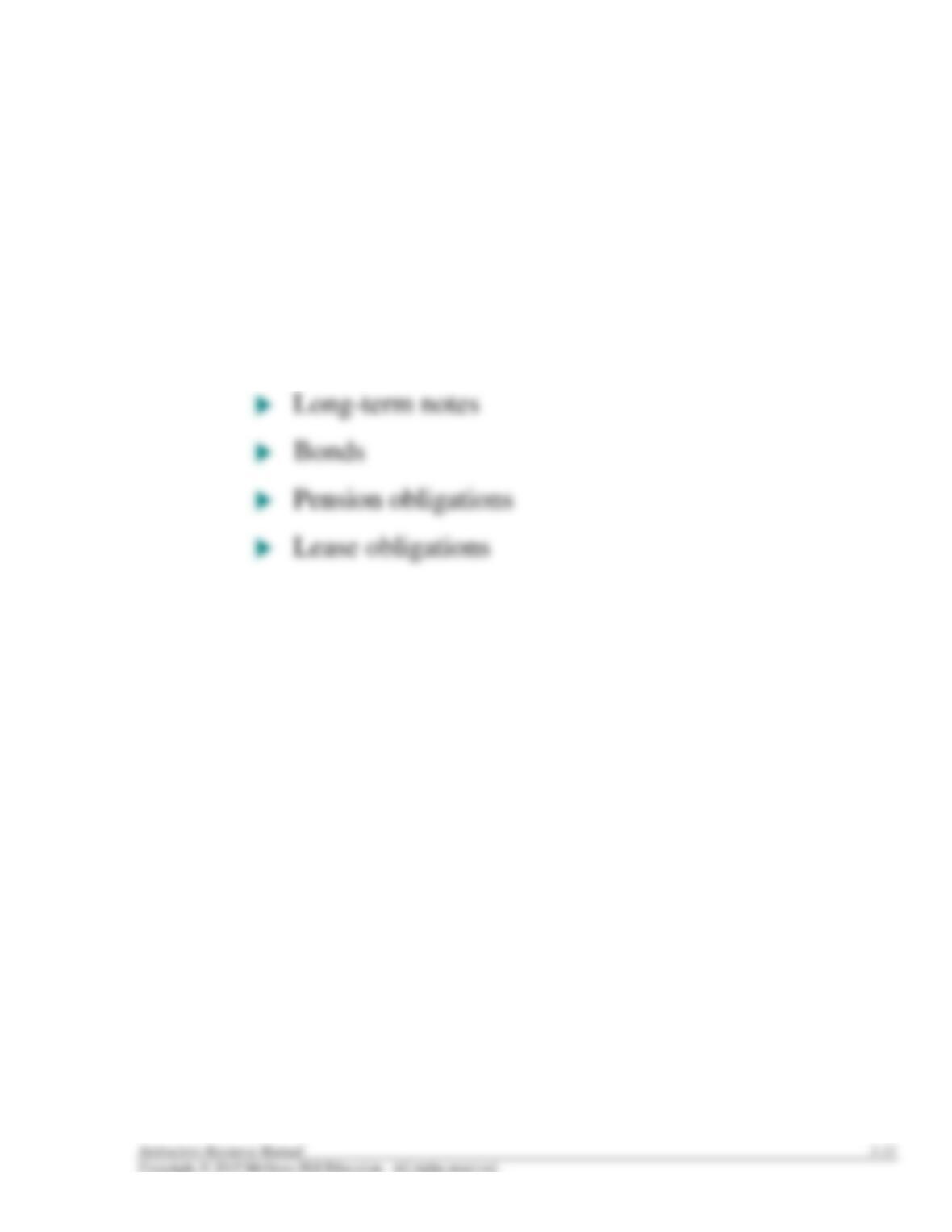
LONG-TERM LIABILITIES
Long-term liabilities are those obligations that are not
expected to be satisfied within one year or the operating
cycle, whichever is longer.
Examples include:
3-14 Intermediate Accounting, 8/e
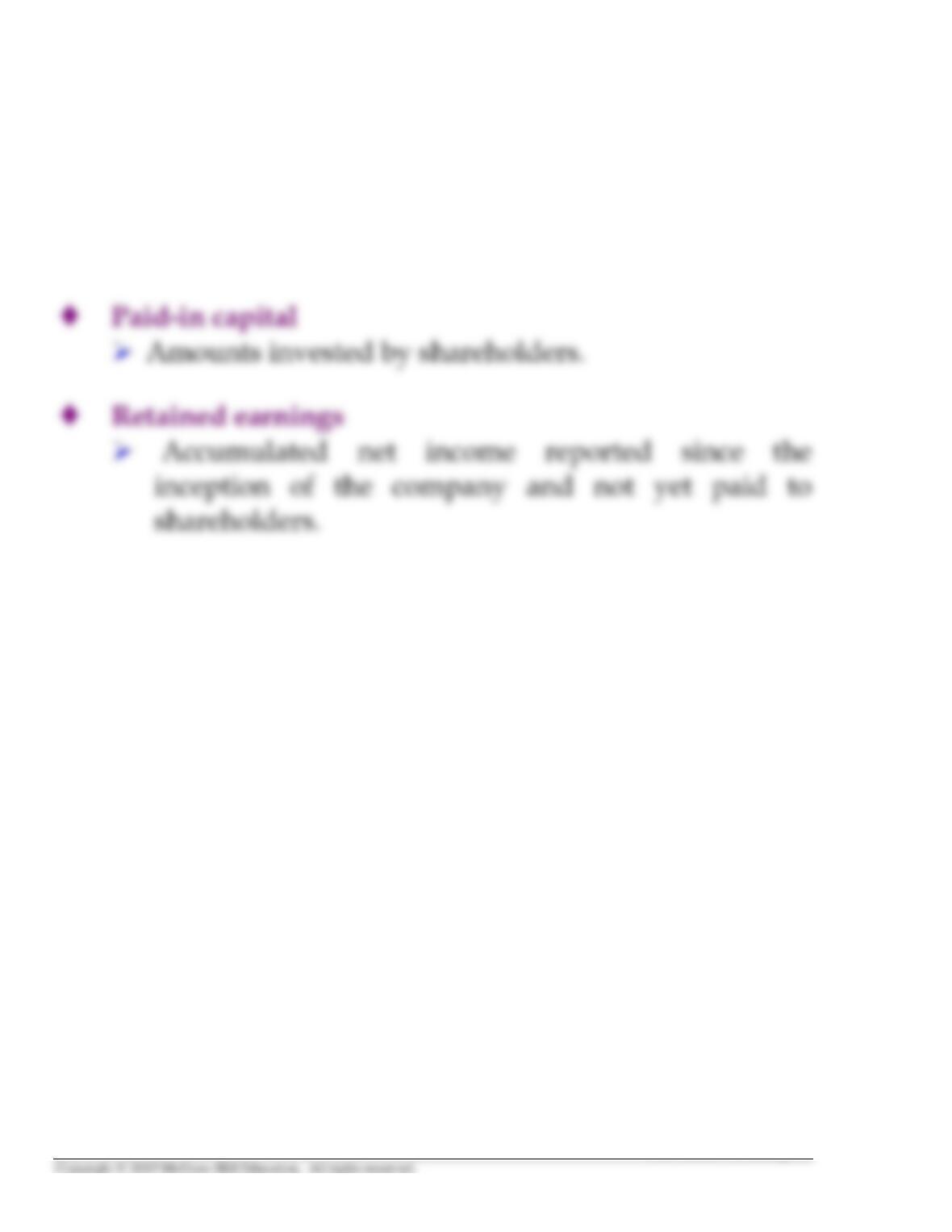
SHAREHOLDERS’ EQUITY
Shareholders’ equity is comprised of paid-in capital (invested
capital) and retained earnings (earned capital).