19-1
Jones Ironworks, Inc.
Teaching Commentary
OVERVIEW
This case, I believe, should be required for all MBAs because it forces them to confront the problem of dirty, dangerous,
low-pay work at least once in their educational career. This is a very real phenomenon in our economy, but most MBA
students have no contact with the problem and no real idea how businesses should cope with it.
The case is also a good one to emphasize the power of clear, logical thinking and to demonstrate cost analysis in
a “learning curve” situation.
ANSWERS TO ASSIGNMENT QUESTIONS
Question 1—Freddie’s Position
Agree
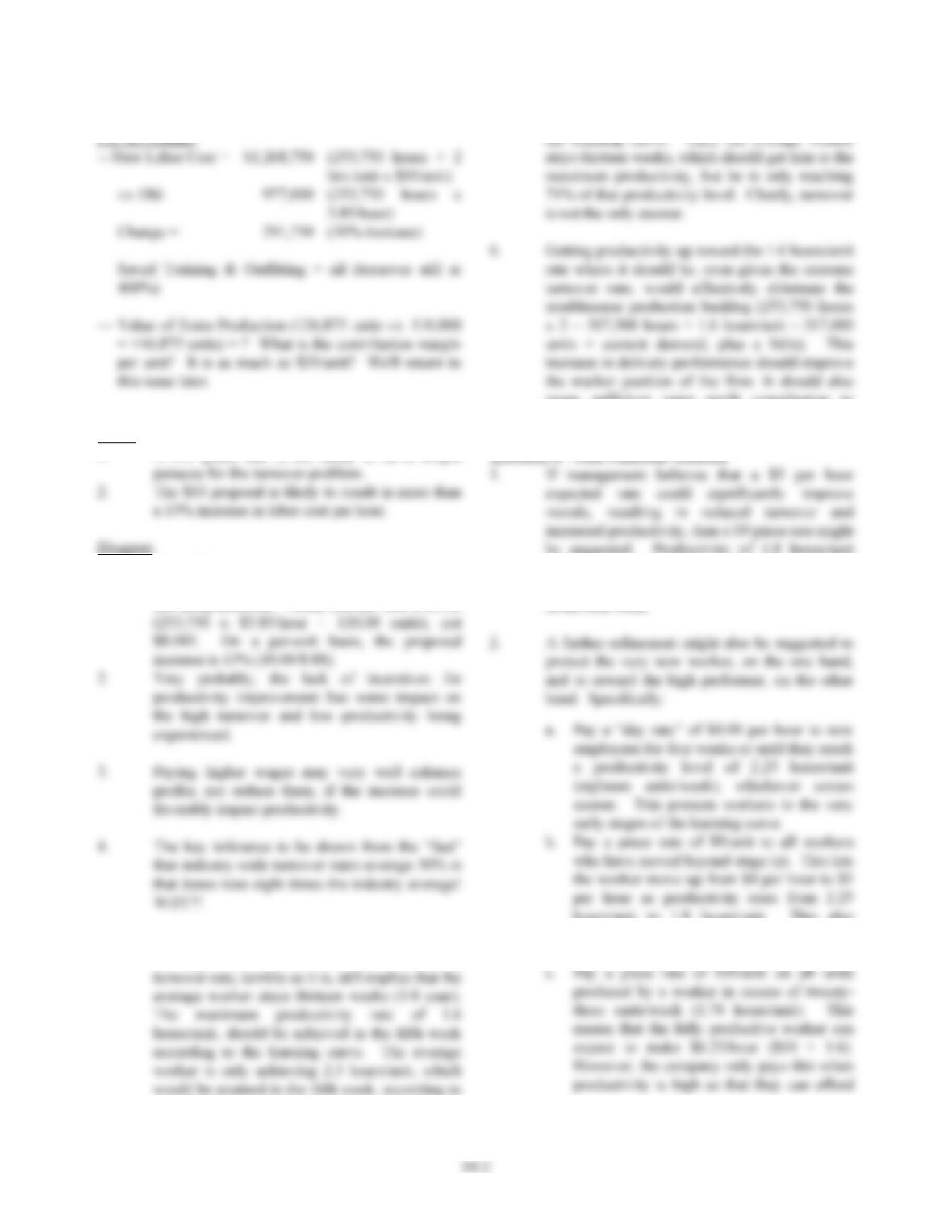
1. The current system does lack an incentive for productivity improvement.
Disagree
1. A piece rate also has some serious problems. Assuming the learning curve does apply, the first week on the job a
3. Freddie’s argument is not internally consistent.
a. If the $10 piece rate only increased productivity to 2.0 hours/unit, there will be very little savings in training and
4. A $10 piece rate with 2.0 hours/unit productivity is probably not a good trade versus the current situation:
Question 2—Dad’s Position
Agree
1. A $10 piece rate is not likely to be a simple
1. The 25% increase in standard cost per unit is
correct but irrelevant since the current standard is
not being achieved. Actual cost per unit is $8.88
5. The low productivity is not solely a function of
the high turnover, as claimed. The 400%
mean sufficient extra profit contribution to
support a wage increase as we will show below.
Question 3—One Plausible Solution
be suggested. Productivity of 1.8 hours/unit
would yield the $5 per hour target. This
productivity level should be reached, on average,
in the fifth week.
hours/unit to 1.8 hours/unit. This also
means that the worker is penalized for low
productivity, not the company.
19-3
it.
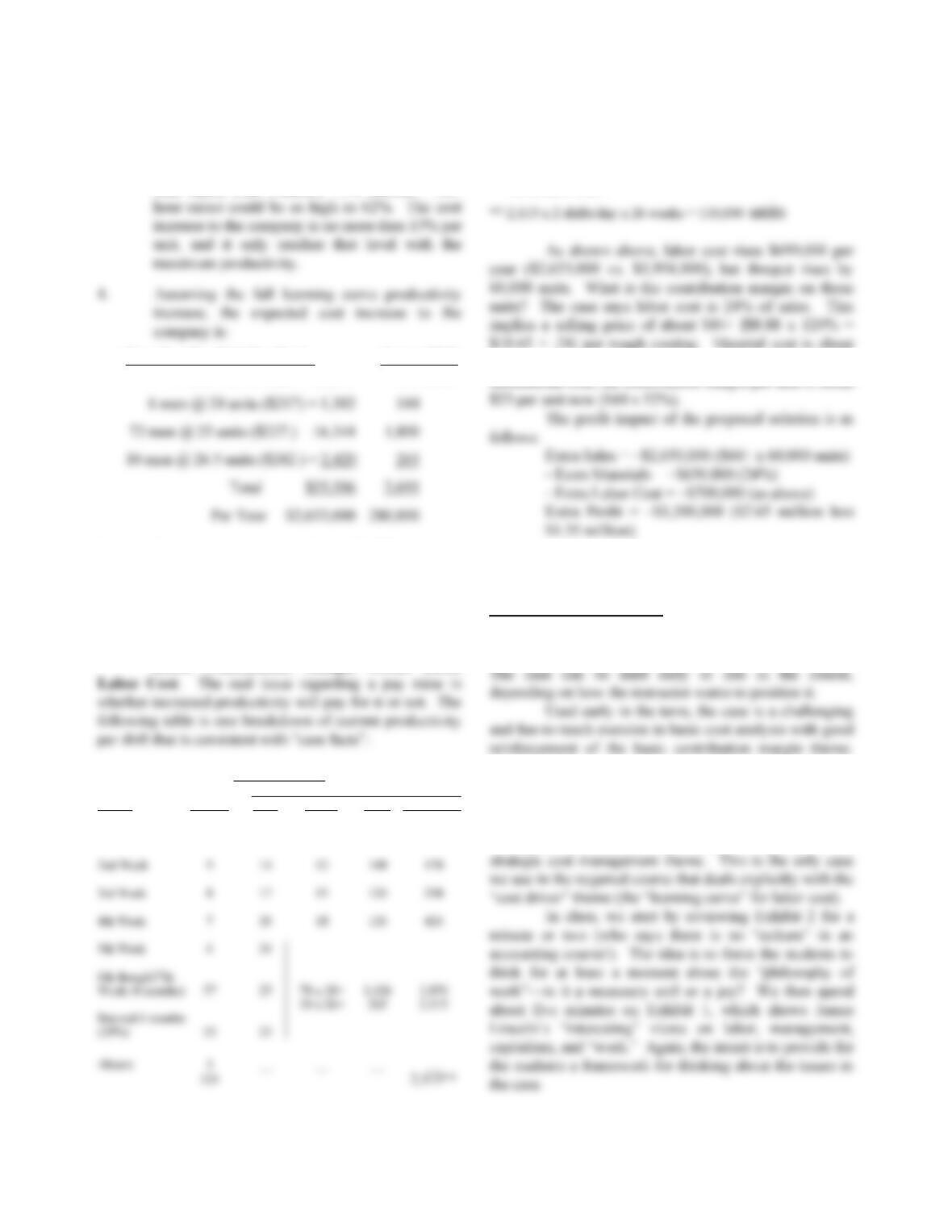
3. This system gives a much bigger raise, on a per–
hour basis, than Freddie’s 13% number. Per–
New Cost Per Shift Per Week: Output/Shift
34 men x $160/week = $5,440 482 units
5. But, since output rises from 220,000 units per
year to 280,000 units (2,691 x 2 x 52), as long as
contribution margin is greater than 11.65 per unit
the net result is higher profit (Labor Cost/Output
= $699,000/60,000 = $11.65).
Extra Contribution Margin versus Extra
Output Per Shift
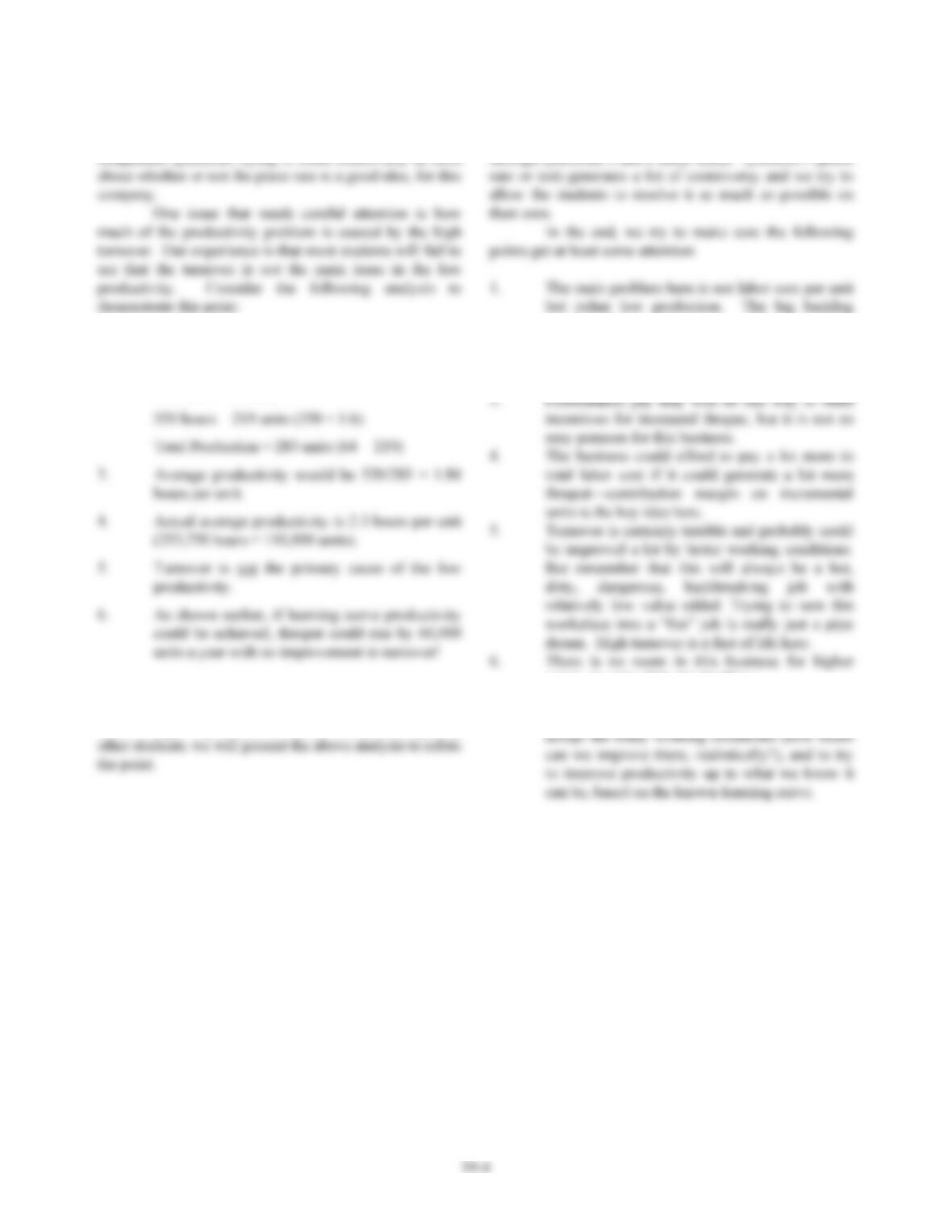
# of Output
Tenure Persons Goal Actual Total Cumulative
1st Week 10* 8 7 70 70
* 500 workers left the job in six months = 1,000 leave per year
1,000 ÷ 52 weeks = 19.2 per week = 9.6 for each of the two
shifts each week.
$10.65 ÷ .24] per rough costing. Material cost is about
equal to labor cost. Assuming only material and labor are
incremental cost, the contribution margin per unit is about
This clearly justifies the wage increase, assuming
it increases productivity to the learning curve level.
TEACHING STRATEGY
We teach this case in one ninety-minute class period near
the end of the required management accounting course.
Used later in the term, the case has two other facets.
First, it can be used to discuss “management philosophy”
about labor as a productive asset in low value-added
settings. Second, it can illustrate the learning curve
concept as part of the “cost drivers” segment of the
After discussing Exhibits 1 and 2, we follow the
assignment questions, trying to build controversy in class
1. Average tenure = 13 weeks = ~520 hours
2. If the learning curve were followed:
170 hours = 64 units
At some point in the discussion, if the students
who are arguing that turnover needs to be reduced in
order to improve productivity are not being challenged by
We find that it is usually possible to move
through Questions 1 and 2 fairly easily. Question 3 (piece
implies substantial foregone contribution margin.
2. Achieving full learning curve productivity could
increase thruput by 60,000 units per year, even
with no improvement in turnover.
prices, in spite of the big backlogs.
7. The management challenge is to accept given
price levels (and maybe even try to cut them), to