Chap. 28 Foundations on Collapsible Soils
28.1 What is a “honeycomb” structure?
Solution
A honeycomb structure is a loose, lightly cemented arrangement of the soil particles. This
Chap. 28 Foundations on Collapsible Soils
28.2 Why are collapsible soils rarely found in areas with very wet climates?
Solution
Soil collapse is triggered by water being introduced into the soil. In very we climates, the soil is
Chap. 28 Foundations on Collapsible Soils
28.3 Why is it difficult to obtain samples of gravelly soils and use them in laboratory collapse tests?
Solution
Gravels are, in general, very difficult to sample because the maximum particle size is of the same
Chap. 28 Foundations on Collapsible Soils
28.4 Would the actual collapse strain in the field be equal to that measured in the lab using a test such
as ASTM D5333? Explain.
Solution
The D5333 test is based on a certain overburden stress, a certain initial degree of saturation, and
Chap. 28 Foundations on Collapsible Soils
28.5 The soil beneath a proposed spread footing has a collapse strain potential of 5% from the ground
surface to a depth of 10 ft. The underlying soils are noncollapsible. The proposed footing will
be embedded at a depth of 2 ft. Assuming the wetting coefficient varies from 1 at the ground
surface to 0.1 at a depth of 10 ft, compute the expected hydrocollapse settlement of this footing.
Solution
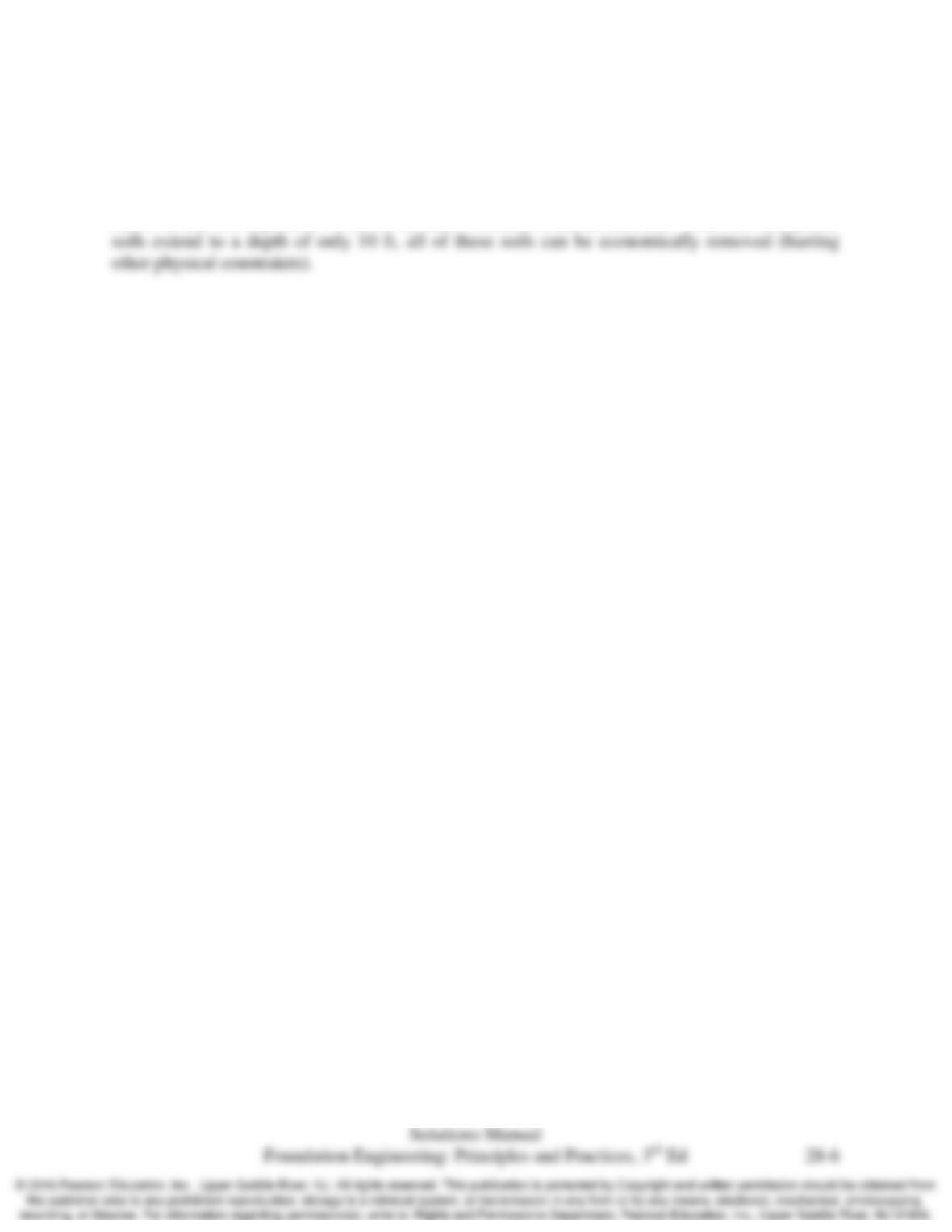
Depth (ft)
α
ε
δ
(ft)
2-4
0.73
0.036
0.072
4-6
0.55
0.027
0.054
6-8
0.37
0.018
0.036
8-10
0.19
0.010
0.020
Chap. 28 Foundations on Collapsible Soils
28.6 What preventive measures would you use to avoid settlement problems in the footing described
in Problem 28.5?
Solution
Removal and recompaction would be the most common remedial measure. Since the collapsible
Chap. 28 Foundations on Collapsible Soils
28.7 Is it possible for some soils to be expansive when the normal stress is low, and collapsible when
it is high? Explain.
Solution
Yes, this is possible. Both expansion and collapse depend on the normal stress. Thus, the