Chap. 27 Foundations on Expansive Soils
27.1 Why are lightweight structures usually more susceptible to damage from expansive soils?
Solution
It is because evidence shows that surcharge pressures suppress swelling of a soil; therefore,
27.2 What types of climates are most prone to cause problems with expansive clays?
Solution
Most of the problems with expansive soils occur in arid, semi–arid, and monsoonal areas because
Chap. 27 Foundations on Expansive Soils
27.3 How do human activities often aggravate expansive soil problems?
Solution
Human activities, especially new construction, affect soil expansion at a given site. Besides
Chap. 27 Foundations on Expansive Soils
27.4 What is the active zone?
Solution
According to Nelson et al. (2001), the active zone is the zone of soils that is contributing to
Chap. 27 Foundations on Expansive Soils
27.5 What is the swell pressure?
Solution
Chap. 27 Foundations on Expansive Soils
27.6 What are the primary sources of uncertainty in heave analyses?
Solution
A heave analysis may involve uncertainties in the input data including any testing method and
Chap. 27 Foundations on Expansive Soils
27.7 Why do the soils beneath buildings with raised floors tend to be drier than those beneath slab-on-
grade floors?
Solution
A raised floor, often supported on a drilled shaft foundation that penetrates through the active
Chap. 27 Foundations on Expansive Soils
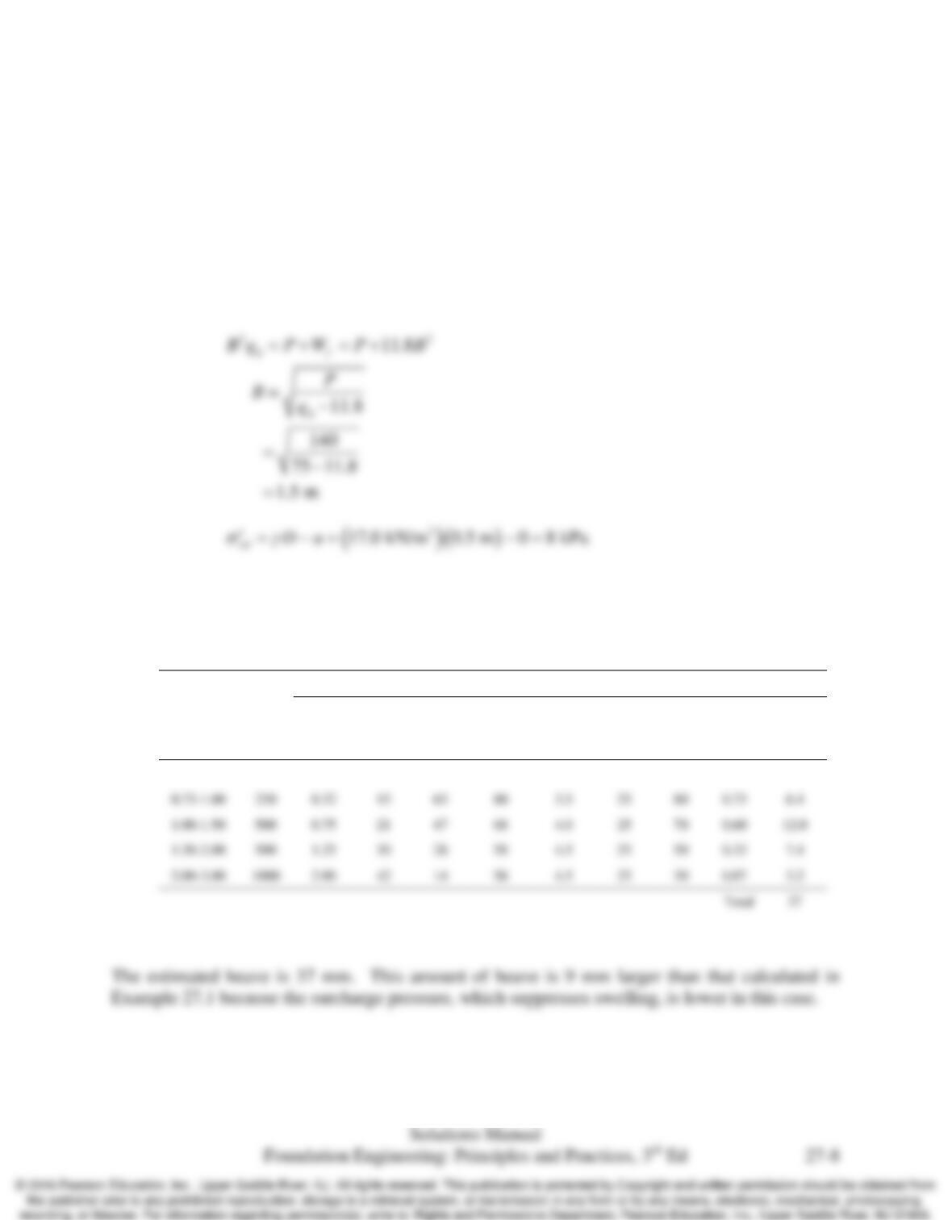
27.8 The foundation described in Example 27.1 is to be redesigned using a net allowable bearing
pressure of 75 kPa. Compute the potential heave and compare it with that computed in the
example. Discuss.
Solution
(
)
2 32
0.50 23.6 kN/m 11.8B
f
WB= =
Assume S after wetting varies from 100% at the ground surface to 25% at the bottom of the
active zone. Compute Δσz, product of (q – σʹzD) and Iσ from Equation 3.14, and add it to σz0 (the
geostatic stress) to compute σz. Find εw using the lab data, α using Equation 27.3, and δw using
Equation 27.4.
At midpoint of soil layer
Depth
(m) H
(mm) zf
(m) σz0
(kPa)
∆σz
(kPa) σz
(kPa) εw
(%) S0
(%) S
(%) α δw
(mm)
0.50-0.75 250 0.12 11 67 78 3.5 25 90 0.87 7.6
Chap. 27 Foundations on Expansive Soils
27.9 An 8 inch diameter drilled shaft will penetrate through an expansive stiff clay to a depth well
below the active zone. It will carry a downward load of 5200 lb. The undrained shear strength of
the clay is 900 psf and the active zone extends to a depth of 10 ft. Determine the following:
(a) What is the uplift skin friction load?
(b) Is a tensile failure in the shaft possible (do not forget to consider the weight of the shaft)?
(c) What is the required reinforcing steel to prevent a tensile failure (if necessary)? Use fy =
40
k/in2 and a load factor of 1.7.
Solution
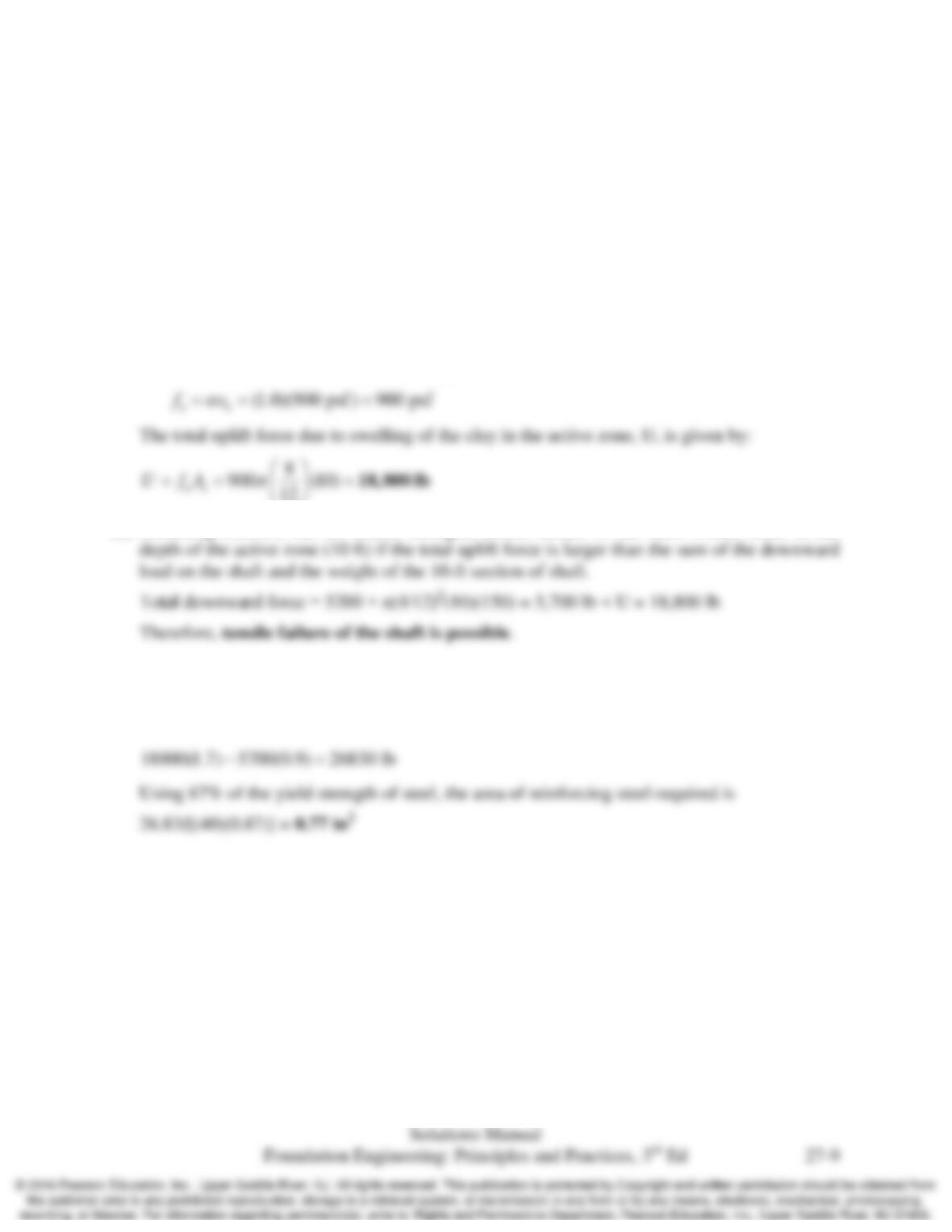
(a) The unit uplift side friction capacity fn is given by
12
18,800 lb
(b) Assuming concrete has no tensile strength, tensile failure of the shaft would occur at the
(c) Use a load factor of 1.7 for the uplift force and a load factor of 0.9 for the downward
resistance, the design tensile force that needs to be taken by the reinforcing steel is