4-1
Allied Office Products
Teaching Commentary
OVERVIEW
The topic for this case is Activity Based Costing and Activity Based Management. The setting is a company that
sells inventory management services as an add-on to the business forms business. The company’s strategy is
simple: differentiate a “commodity” product—business forms—with value-added services—forms inventory
management.
The case provides practice in ABC calculations (in a nonmanufacturing setting) as well as practice in
transitioning from ABC to ABM, and in transitioning further from ABM to an SCM perspective on the business and
the business problem.
ANSWERS TO ASSIGNMENT QUESTIONS
Question 1
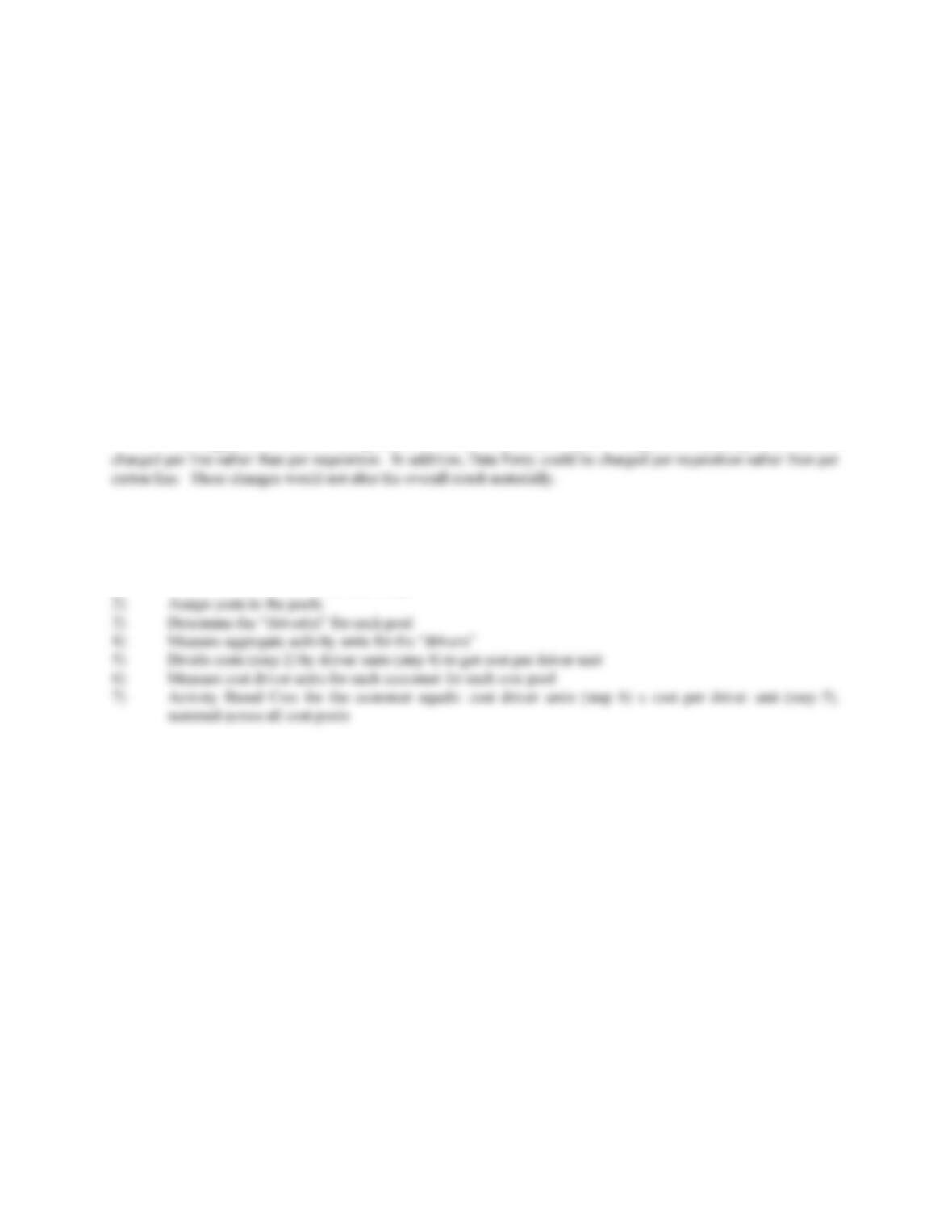
One suggested solution to the question is shown in Exhibits A and B. Requisition handling could also be
Exhibit A
ABC—Seven Steps
1) Define cost pools–the value chain steps
4-2
Exhibit B
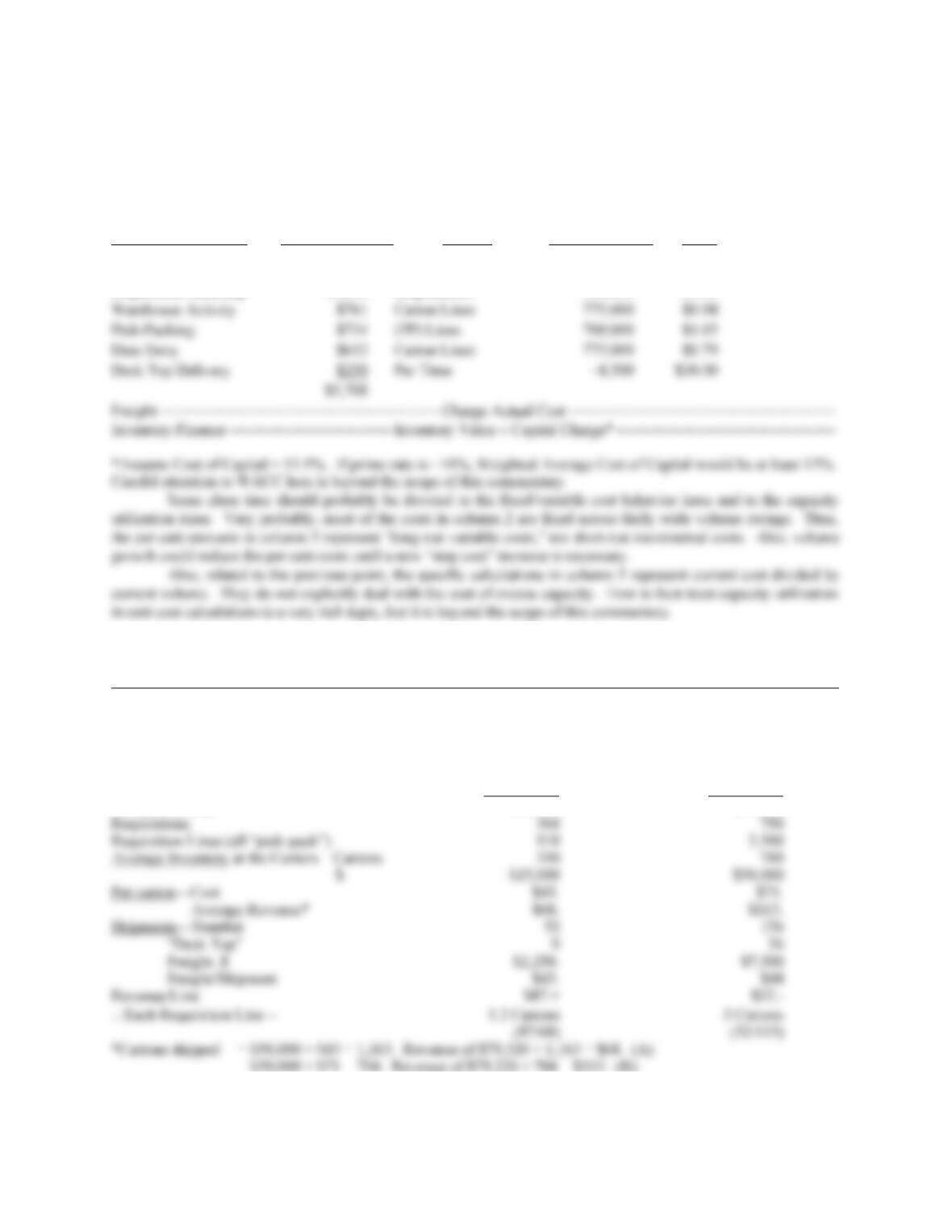
Activity Based Costs
Calculation of Service Costs
(1) (2) (3) (4) (5)
Value Added Total FY92 Expense Cost Driver Cost Driver Service
Activities Defined as: per Activity (000) Defined Units FY92 Plan Costs
Storage
$1,550
Cartons in Inventory
350,000
$0.37
per carton per
month
Requisition Handling
$1,801
Requisitions
310,000
$5.81
Question 2
One suggested solution to the question is shown in Exhibits C and D here.
Exhibit C
A Saga of Two Customers (Step 6)
Customer A Customer B
Annual Revenue $79,320 $79,320
CONCLUSION?
Data Entry
Carton Lines
775,000
$0.79
4-3
Exhibit D
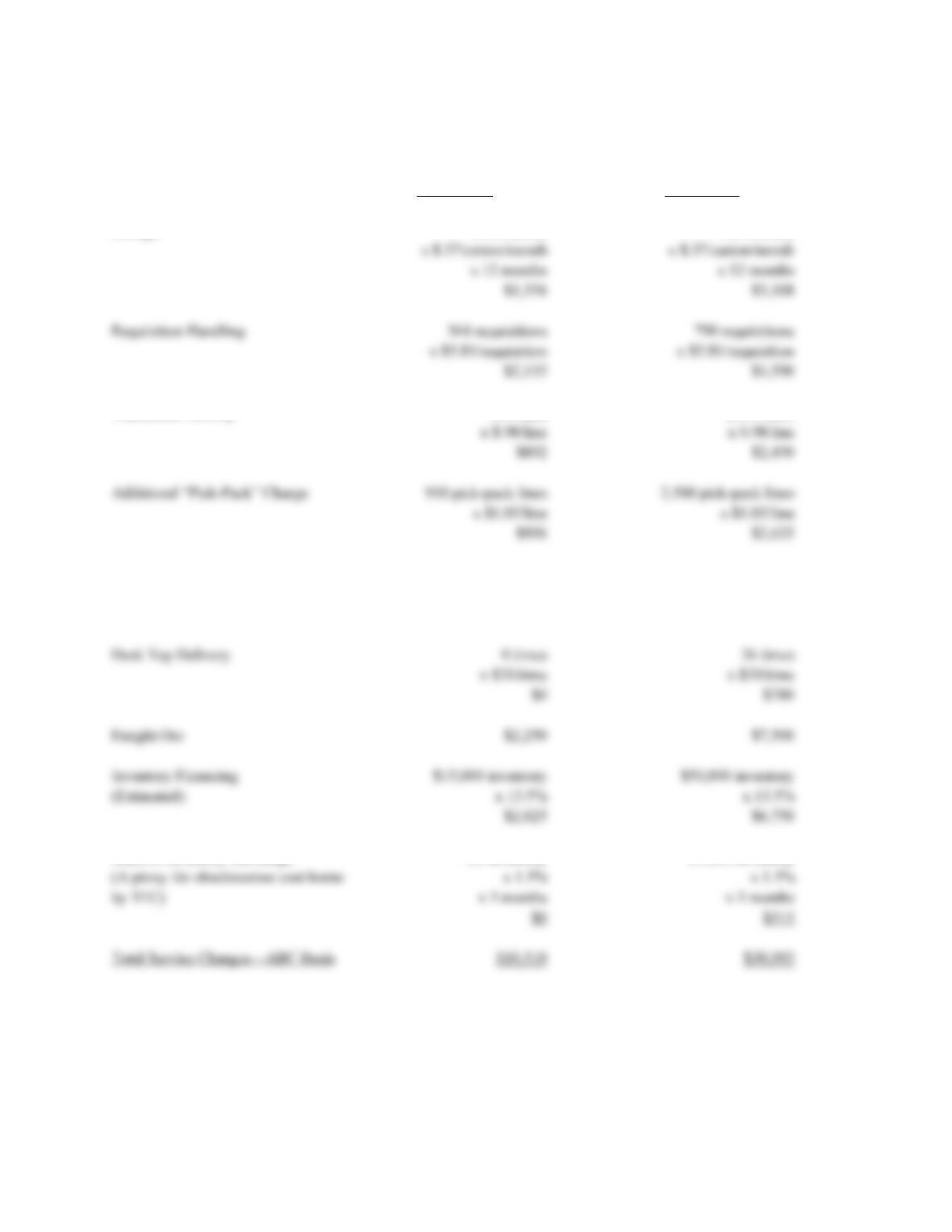
Calculation of Service Costs—ABC (Step 7)
Customer A
Customer B
Storage
350 Cartons
700 Cartons
Warehouse Activity
910 lines
2,500 lines
x $.98/line
x $.98/line
$956
$2,625
Data Entry
910 lines
2,500 lines
x $.79/line
x $.79/line
$719
$1,975
Desk Top Delivery
x $30/time
x $30/time
Freight Out
$2,250
$7,500
Inventory Financing
(Estimated)
Inactive Inventory Surcharge
$0 inventory
$7,000 inventory
(A proxy for obsolescense cost borne
by TFC)
x 3 months
x 3 months
$315
Total Service Charges—ABC Basis
The idea here is simple. One customer (A) is a light user of the services and one customer (B) is a heavy
user. Average costing camouflages this difference. ABC clearly shows the differences.
$1,554
$3,108
Requisition Handling
$2,115
$4,590
Question 3
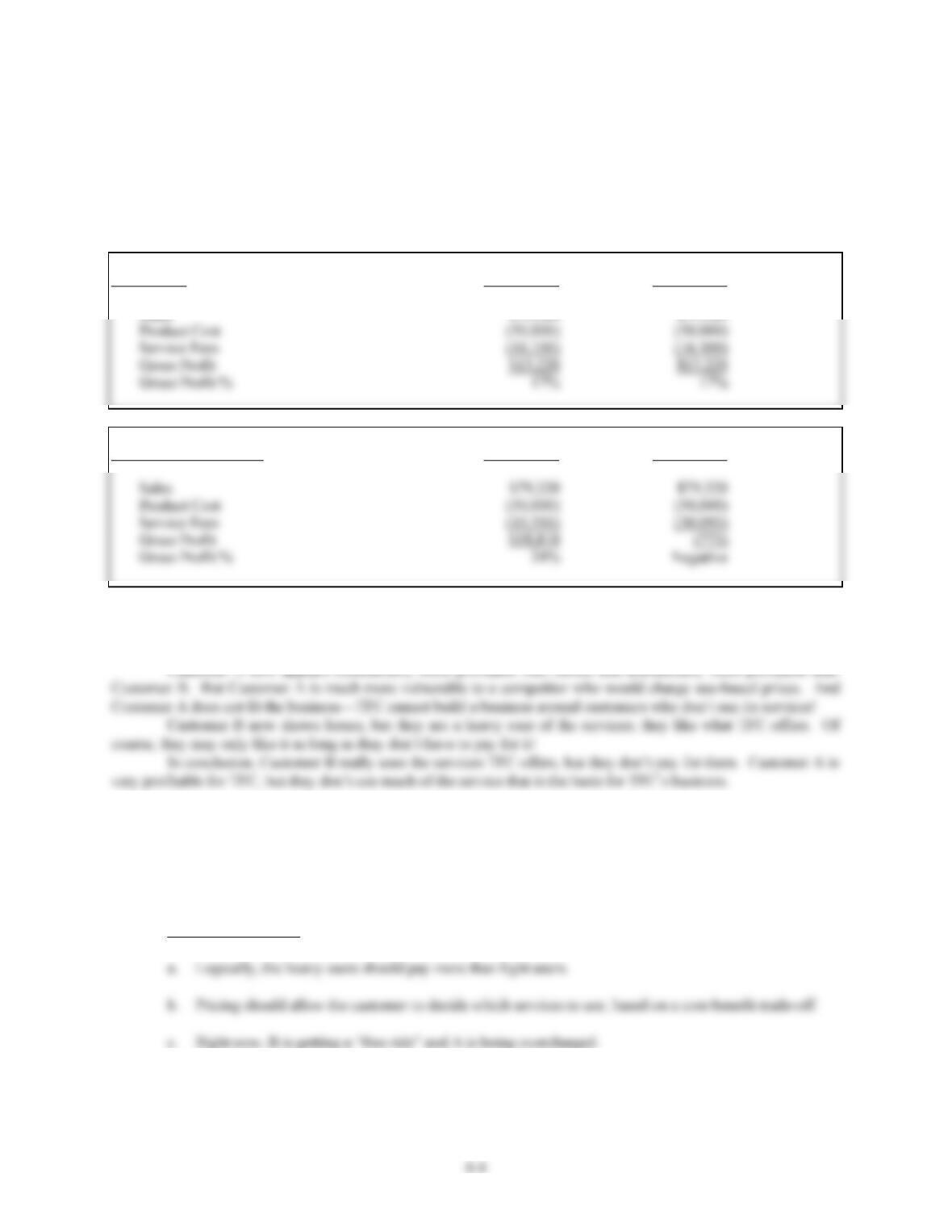
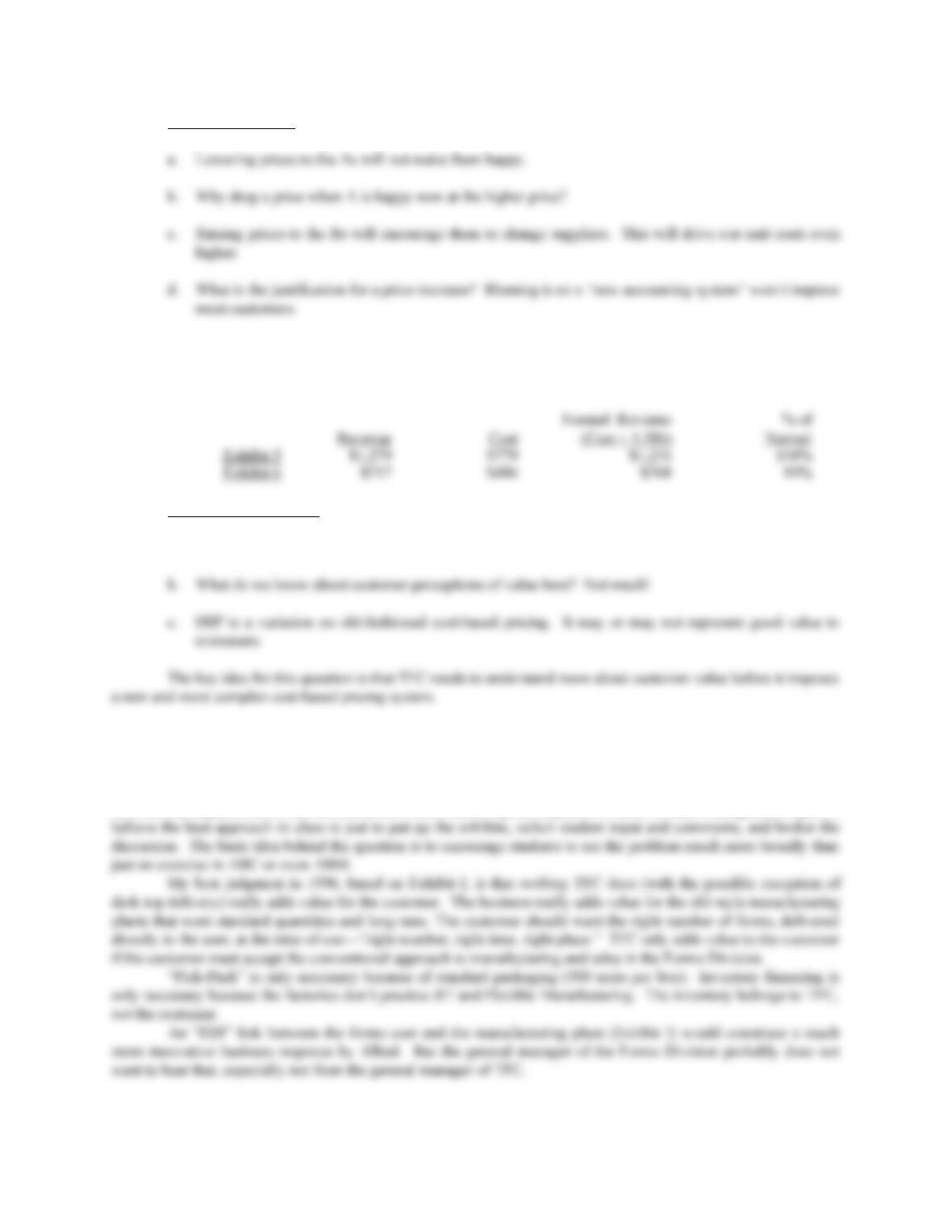
Exhibit E, below, is a summary of customer profitability under the “old” and “new” accounting systems.
The exhibit ends with the question of which is the better customer. The answer is not easy.
Exhibit E
Customer Profitability Analysis
Old Method Customer A Customer B
Sales $79,320 $79,320
Activity-Based Analysis Customer A Customer B
Which is the better customer?
Customer A now appears considerably more profitable than before and dramatically more profitable than
Question 4
This question moves the focus of the discussion from accounting issues to management decisions. Should
TFC adopt “menu pricing”?
This is a very rich question that will support at least thirty minutes of class discussion. The basic themes
are as follows:
1. Yes for menu pricing.
4-5
2. No for menu pricing.
e. Analysis of case Exhibits 5 and 6 shows that pricing is already higher than normal for the “As” and
lower than normal for the “Bs.”
3. Maybe for menu pricing.
a. The real issue is value to the customer. Cost is not directly relevant for the user; value is.
Question 5
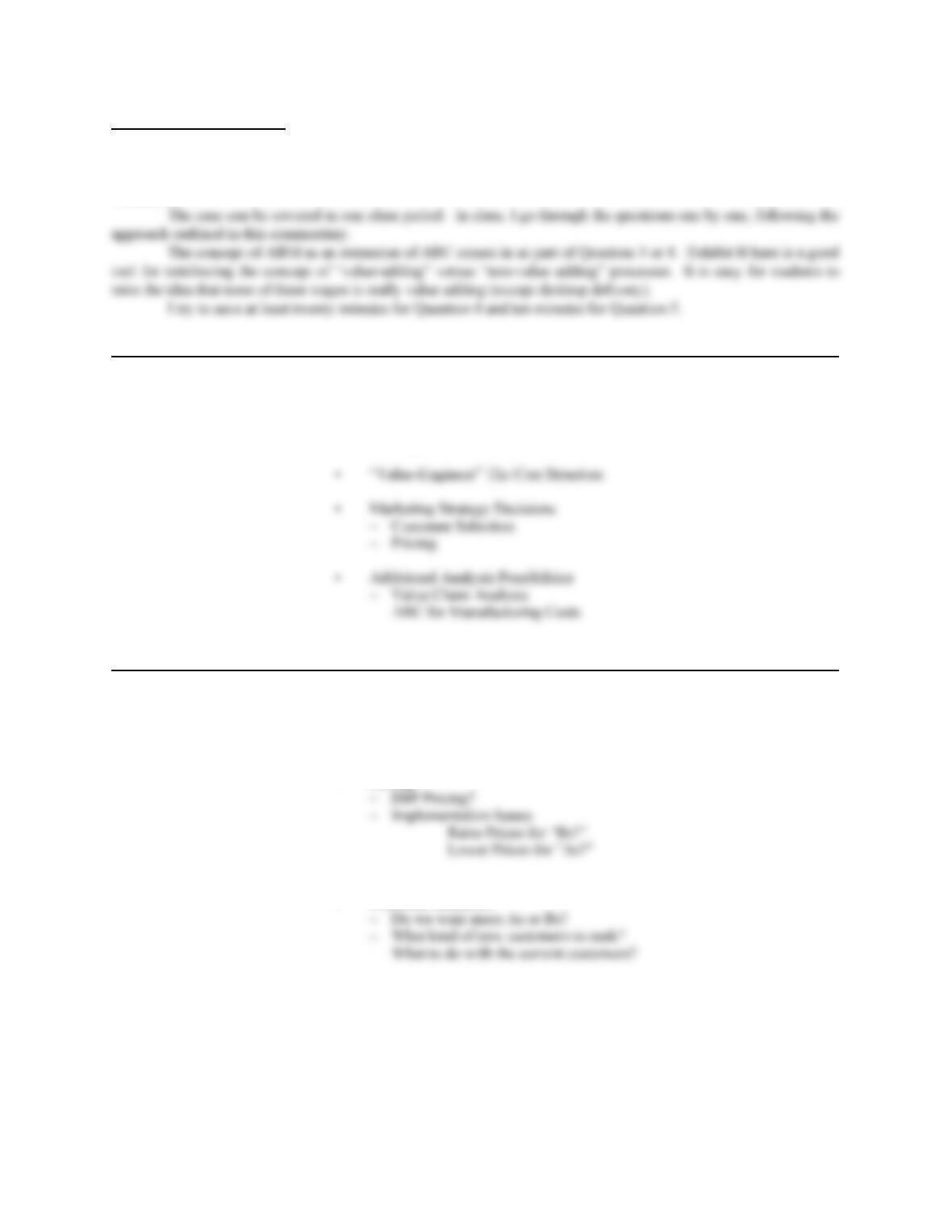
Exhibits F, G, H, and I are summaries of the managerial issues facing the senior management team of TFC.
Exhibit F is the overall summary.
Trying to describe here the richness of these issues would result in at least a book-length manuscript. Since
most accounting professors (me included) don’t have much explicit expertise in these broader management topics, I
4-6
TEACHING STRATEGY
I use this case to introduce ABC in the required managerial accounting course at Tuck. The ABC part of the case is
fairly easy for students, so it constitutes good reinforcement of the basic calculational approach summarized in
Exhibit A.
Exhibit F
Moving from Analysis to Action
Exhibit G
Marketing Strategy Decisions
• Pricing
• Customer Selection
4-7
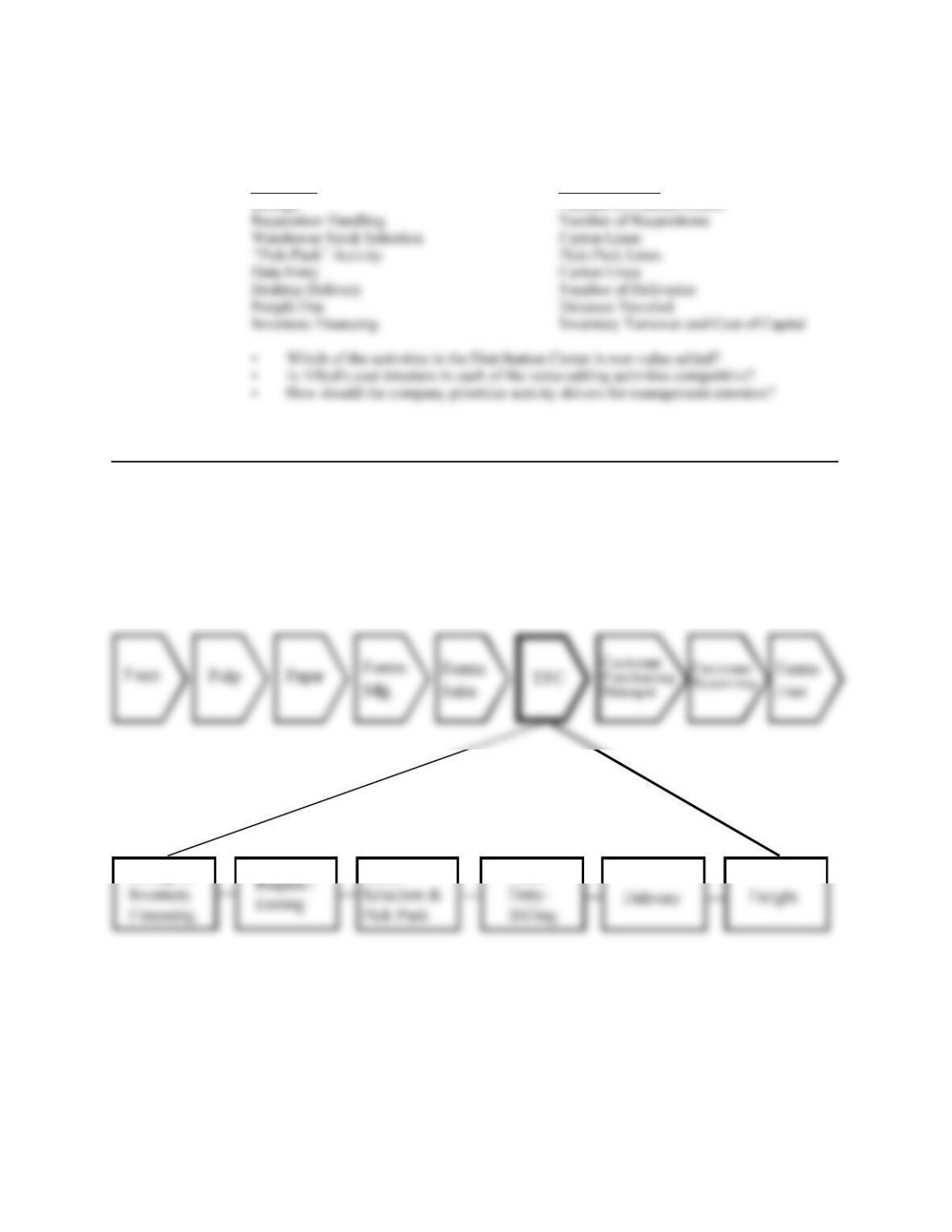
Exhibit H
“Value–Engineer” The Cost Structure
Cost Pools Activity Drivers
Storage Number of Cartons Stored
Exhibit I
The Value Chain Concept
Storage &
Stock
Order
The Business Forms Chain
The TFC Chain