CHAPTER 25
Standard Costs and Balanced Scorecard
LEARNING OBJECTIVES
1. DESCRIBE STANDARD COSTS.
2. DETERMINE DIRECT MATERIALS VARIANCES.
3. DETERMINE DIRECT LABOR AND TOTAL
MANUFACTURING OVERHEAD VARIANCES.
CHAPTER REVIEW
Standard Costs
1. (L.O. 1) In concept, standards and budgets are essentially the same. Both are predetermined
2. Standard costs offer the following advantages to an organization:
a. They facilitate management planning.
b. They promote greater economy by making employees more “cost conscious.”
Setting Standard Costs
3. Setting standards requires input from all persons who have responsibility for costs and quantities.
Direct Materials
5. The direct materials price standard is the cost per unit of direct materials that should be
incurred.
6. The direct materials quantity standard is the quantity of direct materials that should be used
per unit of finished goods.
a. This standard is expressed as a physical measure, such as pounds, barrels, or board feet.
b. This standard should include allowances of unavoidable waste and normal spoilage.
Direct Labor
8. The direct labor price standard is the rate per hour that should be incurred for direct labor.
9. The direct labor quantity standard is the time that should be required to make one unit of the
product.
10. The standard direct labor cost per unit is the standard direct labor rate times the standard
direct labor hours.
Manufacturing Overhead
11. The manufacturing overhead standard is based on a standard predetermined overhead rate.
Variances
12. A variance is the difference between total actual costs and total standard costs. An unfavorable
variance suggests that too much was paid for materials, labor, and manufacturing overhead or
Direct Materials Variances
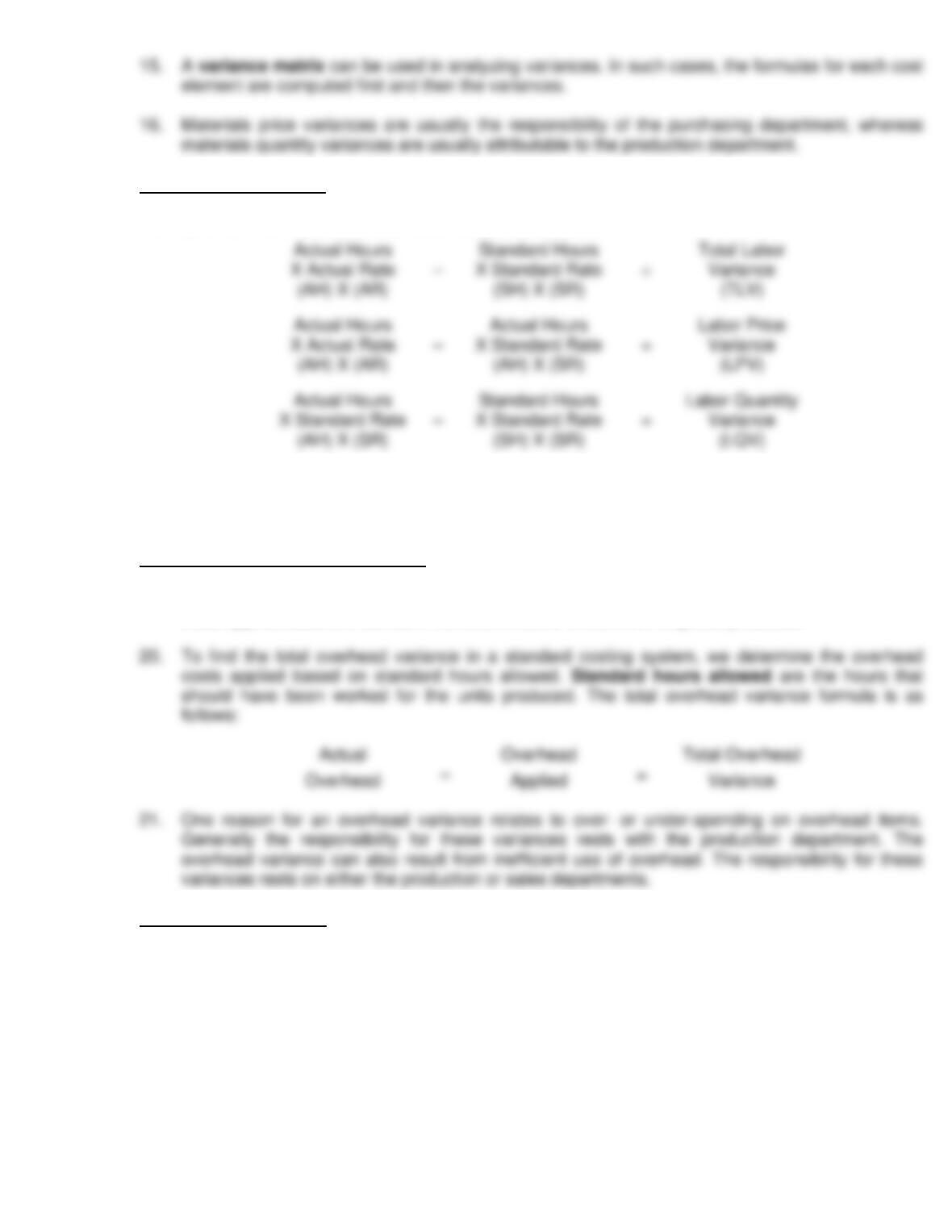
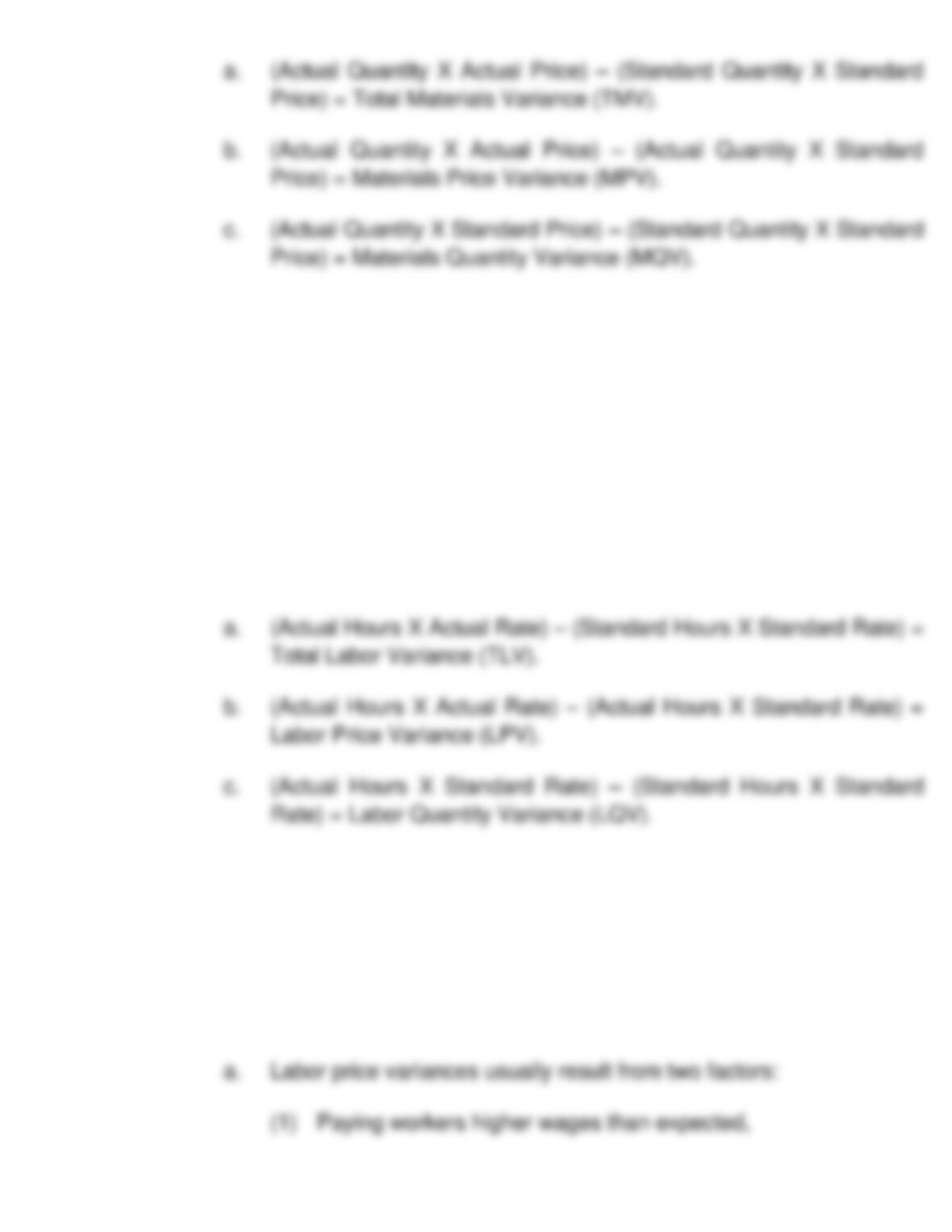
14. (L.O. 2) The formulas for the direct materials variances are:
Direct Labor Variances
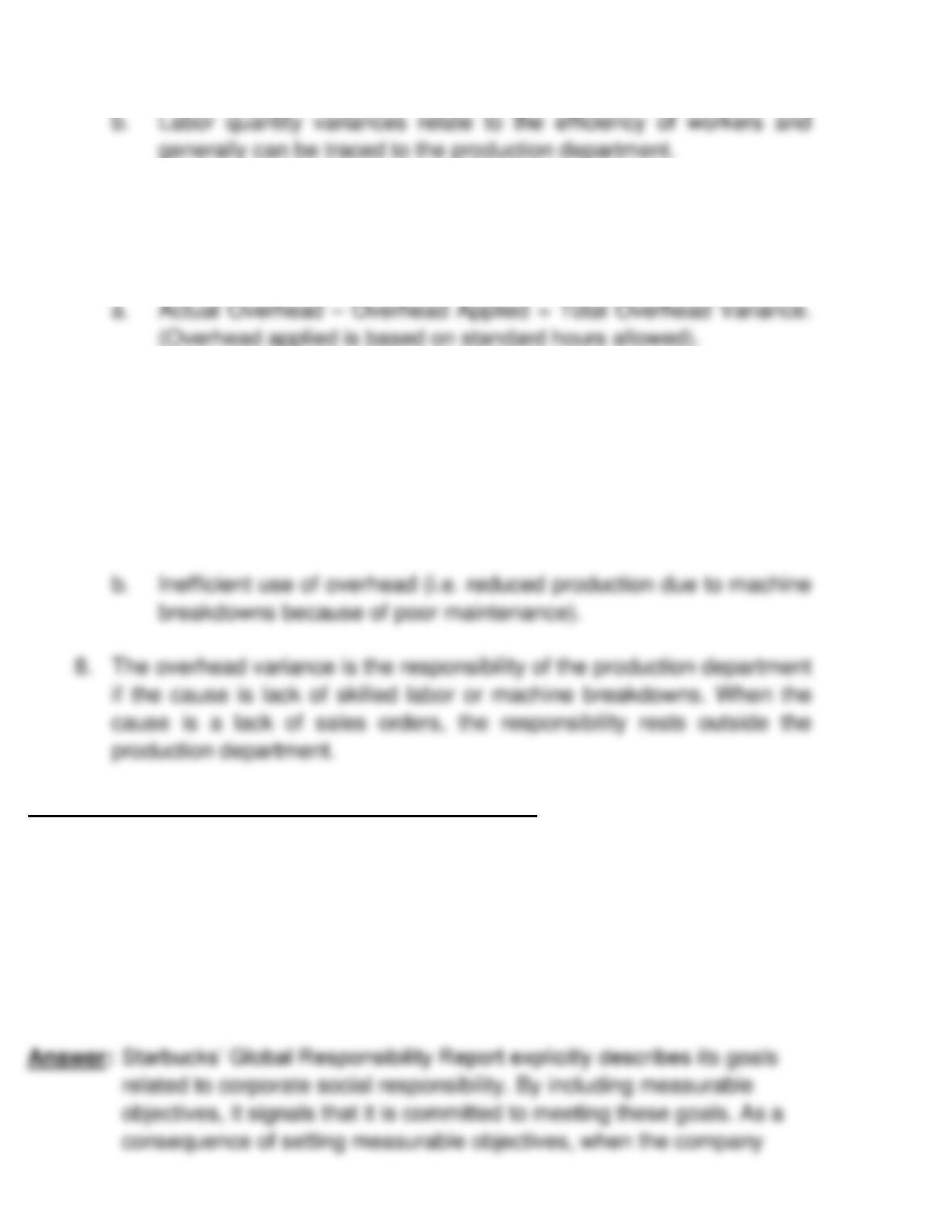
17. (L.O. 3) The formulas for the direct labor variances are:
18. Labor price variances usually result from paying workers higher wages than expected and/or
misallocation of workers. Labor quantity variances relate to the efficiency of the workers and are
generally the responsibility of the production department.
Manufacturing Overhead Variances
19. The total overhead variance is the difference between the actual overhead costs and overhead
costs applied based on standard hours allowed for the amount of goods produced.
Reporting of Variances
22. (L.O. 4) All variances should be reported to appropriate levels of management as soon as
possible. Variance reports facilitate the principle of “management by exception.” Rather than
analyze every variance, top management will normally look for significant variances.
Income Statement Presentation of Variances
23. In income statements prepared for management under a standard cost accounting system, cost of
Balanced Scorecard
25. Many companies use both financial and nonfinancial measures to evaluate performance. This
approach is known as the balanced scorecard. The four most commonly employed perspectives
are as follows:
Standard Cost Accounting System
*26. (L.O. 5) A standard cost accounting system is a double-entry system of accounting in which
standard costs are used in making entries and variances are formally recognized in the accounts.
A standard cost system may be used with either job order or process costing.
Overhead Variances
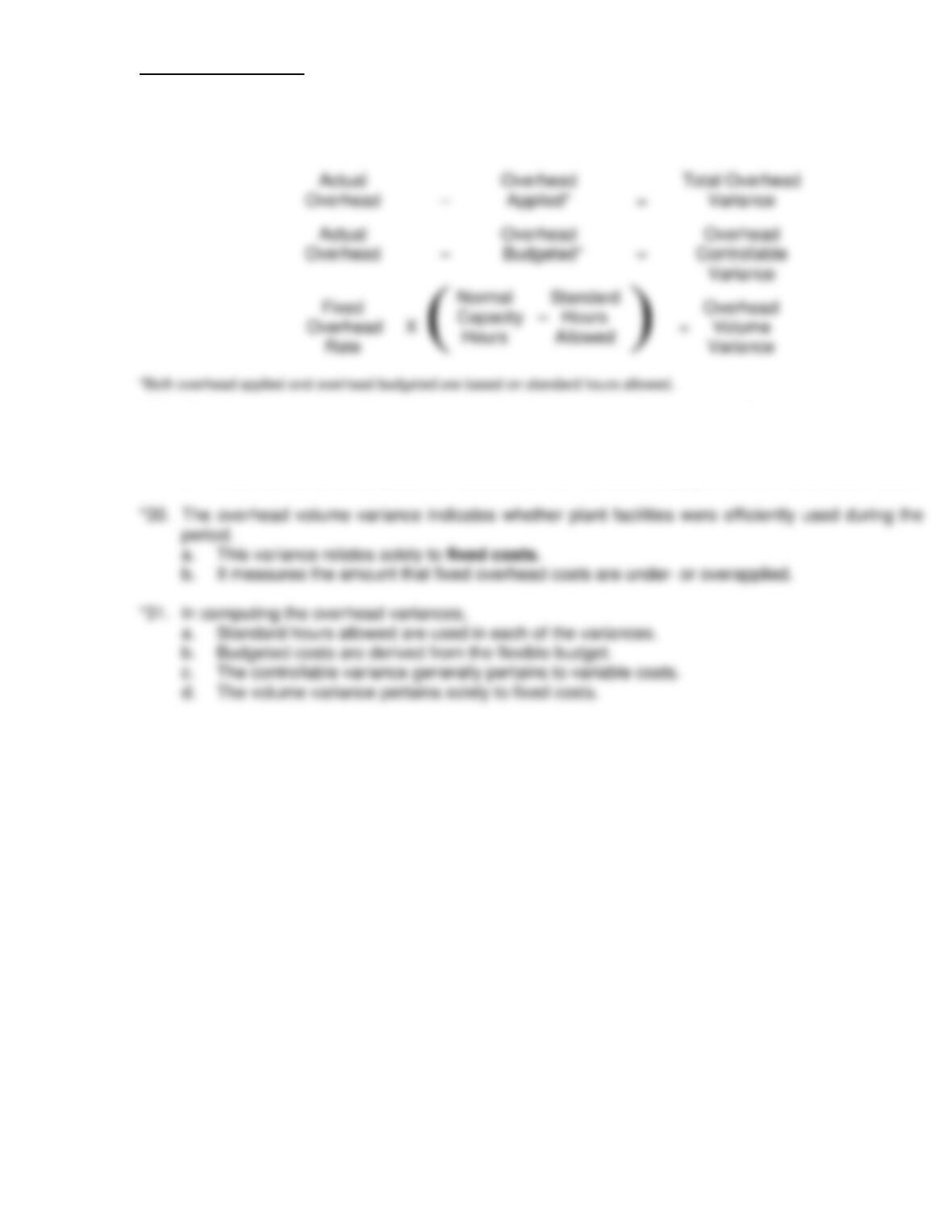
*28. (L.O. 6) The computation of the manufacturing overhead variances is conceptually the same
as the computation of the materials and labor variances. For manufacturing overhead, however,
both variable and fixed overhead must be considered. The formulas are:
*29. The overhead controllable variance shows whether overhead costs were effectively controlled.
a. Budgeted costs are determined from the flexible manufacturing overhead budget for
standard hours allowed.
b. Most controllable variances are associated with variable costs, which are controllable costs.
LECTURE OUTLINE
A. The Need for Standards.
1. Standards are common in business; those imposed by government
agencies are often called regulations.
4. Standard costs offer a number of advantages to an organization:
a. They facilitate management planning.
B. Setting Standard Costs.
1. Companies set standards at one of two levels:
ACCOUNTING ACROSS THE ORGANIZATION
Recently a number of organizations, including corporations, consultants, and
governmental agencies, agreed to share information regarding performance
standards in an effort to create a standard set of measures for thousands of
business processes. Companies that are interested in participating can go to the
group’s website and enter their information.
How will the creation of such standards help a business or organization?
6. The direct materials quantity standard should establish the required
quantity plus an allowance for unavoidable waste and normal spoilage.
9. For manufacturing overhead, a standard predetermined overhead rate is
used. It is based on an expected standard activity index such as standard
direct labor hours or standard machine hours.
C. Analyzing and Reporting Variances from Standards.
1. One of the major management uses of standard costs is to identify
variances from standards. Variances are the differences between total
actual costs and total standard costs.
2. Direct materials variances.
3. Causes of materials variances.
The investigation of a materials price variance usually begins in the pur–
chasing department. The starting point for determining the cause(s) of an
unfavorable materials quantity variance is in the production department.
4. Direct labor variances.
5. Causes of labor variances.
(2) Misallocation of workers.
6. Manufacturing overhead variance.
7. Causes of manufacturing overhead variance.
a. Higher than expected use of indirect materials, indirect labor, and
electricity, or
CORPORATE SOCIAL RESPONSIBILITY INSIGHT
In its recently published Global Responsibility Report, Starbucks described its
goals, achievements and shortcomings related to corporate social responsibility.
What implications does Starbucks’ commitment to corporate social responsibility
have for the standard cost of a cup of coffee?
D. Reporting Variances.
1. All variances should be reported to appropriate levels of management as
soon as possible.
E. Statement Presentation of Variances.
1. In income statements prepared for management under a standard cost
accounting system, cost of goods sold is stated at standard cost and the
variances are disclosed separately.
F. Balanced Scorecard.
1. The balanced scorecard incorporates financial and nonfinancial measures
in an integrated system that links performance measurement and a
company’s strategic goals.
2. The balanced scorecard evaluates company performance from four
perspectives:
a. Financial perspective—employs financial measures of performance
used by most firms.
3. Within each perspective, the balanced scorecard identifies objectives
that will contribute to attainment of strategic goals. The objectives are
linked across perspectives in order to tie performance measurement to
company goals.
ACCOUNTING ACROSS THE ORGANIZATION
Many of the benefits of a balanced scorecard approach are evident in the
improved operations at United Airlines. When Glenn Tilton took over as United’s
Chief Executive Officer he implemented an incentive program that allowed all
employees to earn a bonus if the company “exceeded its goals for on-time flight
departures and for customer intent to fly United again.”
Which of the perspectives of a balanced scorecard were the focus of United’s
CEO?
*G. Standard Cost Accounting System.
1. A standard cost accounting system is a double-entry system of accounting.
*H. Overhead Controllable and Volume Variances.
1. The total overhead variance is generally analyzed through a price
variance (controllable variance) and a quantity variance (volume
variance).
20 MINUTE QUIZ
Circle the correct answer.
True/False
1. The primary difference between standards and budgets is that a standard is a unit
amount, whereas a budget is a total amount.
True False
2. An advantage of standard costs is that standard costs facilitate management planning by
establishing expected future costs.
True False
3. Ideal standards represent an efficient level of performance that is attainable under
expected operating conditions.
True False
4. The direct labor price standard generally includes employer payroll taxes and fringe
benefits, such as paid holidays and vacations.
True False
5. (Actual Quantity X Standard Price) – (Standard Quantity X Actual Price) = Materials Price
Variance.
True False
6. (Actual Hours X Actual Rate) – (Actual Hours X Standard Rate) = Labor Price Variance.
True False
7. Standard hours allowed are the hours that should have been worked for the units produced.
True False
8. Variance reports facilitate the principle of “management by exception.”
True False
9. In income statements prepared under a standard cost accounting system, cost of goods
sold is stated at standard cost.
True False
*10. The overhead controllable variance is the difference between the actual overhead costs
incurred and the overhead applied.
True False
Multiple Choice
1. Which of the following is an advantage of standard costs?
a. Contribution to management control.
b. Promotion of greater economy and efficiency.
c. Simplification of the costing of inventories and reduction of clerical costs.
d. All of the above.
2. If the predetermined overhead rate per hour is $6 for variable and $2 for fixed overhead,
standard direct labor hours per unit is 2 hours and actual direct labor hours per unit was
1.5 hours, then the overhead standard cost per unit is
a. $4 per unit.
b. $8 per unit.
c. $16 per unit.
d. $12 per unit.
3. The formula for the labor quantity (or efficiency) variance is
a. (Actual Hours X Actual Rate) – (Actual Hours X Standard Rate).
b. (Actual Hours X Standard Rate) – (Standard Hours X Standard Rate).
c. (Standard Hours X Actual Rate) – (Standard Hours X Standard Rate).
d. none of the above.
*4. If actual overhead is $70,000, overhead applied is $67,000 and overhead budgeted for
the standard hours allowed is $78,000, then the overhead controllable variance is
a. $3,000 F.
b. $11,000 U.
c. $8,000 F.
d. $8,000 U.
*5. In a standard cost accounting system, a company purchased raw materials on account
for $46,500 when the standard cost was $44,000. The journal entry would not include a
a. debit to Raw Materials Inventory for $44,000.
b. debit to Materials Price Variance for $2,500.
c. credit to Materials Price Variance for $2,500.
d. credit to Accounts Payable for $46,500.

ANSWERS TO QUIZ
True/False
Multiple Choice