Skyview Manor
Teaching Commentary
OVERVIEW
This case is an excellent exercise in incremental cost analysis for a business, which is very familiar to students. There is
high common sense validity for the use of fixed/variable cost analysis and break-even logic for a ski lodge considering
staying open in the off-season. The case works well fairly early into an MBA-level managerial accounting course. It is
also an excellent exam case with a two-hour time limit.
The case is now almost forty years old, but there is no particular reason to update the numbers. Used as is, the
case still teaches very well and also includes a little “history lesson” on cost levels from the early 1960s.
TEACHING STRATEGY
We teach the case in one ninety-minute class period. It will easily support that level of discussion. Even though the
calculations are straightforward, the management judgments are controversial. It is important to keep things moving
along in order to save time at the end for discussing the decision. But, if things move quickly, the decision will support
ANSWERS TO ASSIGNMENT QUESTIONS
Question 1
On average, how many rooms must be rented each night in season for the hotel to break even?
Calculating the break-even occupancy level requires splitting the costs in Exhibit 1 into the fixed and variable
components:
Question 2
The hotel is full on weekends in the ski season. If all room rates were raised $5 on weekend nights, but occupancy
fell to seventy-two rooms instead of eighty, what is the revised profit before taxes for the year, per Exhibit 1?
The easiest way to make the calculation is to calculate the change in Contribution Margin (CM) since fixed costs will not
change.
Question 3
What is the incremental contribution margin per occupied room/day during the off-season?
1. Cleaning Supplies
2. Linen
3. Misc. Expenses (room supplies)
4. Revenues
Contribution Margin
30-3
Question 4
For each alternative list, the annual expenses that are incremental to that decision alternative but are not related
to the room/days occupied.
Incremental Fixed Expenses
DECISION Repair Insur- Mrs. K Adv. Pool Bubble Pool Ex. Phone Elect. Maids
ALTERNATIVE ance Dep’n Dep’n
(a) (b) (c) (d) (e) (f) (g)
Total $2,000 $500 $4,200 $4,000 $,5000 $3,000 4,200 or $720 $,3675 4,320
8,800
0 1. Status Quo
(f) Total Utility 6,360
less Phone Exp. (1,560) = [(290×4) + (50 8) = $1,560]
30-4
Question 5
For each decision alternative, calculate the occupancy rate necessary to break even on the incremental costs.
Decision Alternatives (same order as for Question 2 and Question 3)
Question 6
What decision alternative do you recommend? Why?
Yes on staying open (18% occupancy rate needed vs. 20-40 estimate)
Overall Conclusion
STUDENT A
STUDENT B
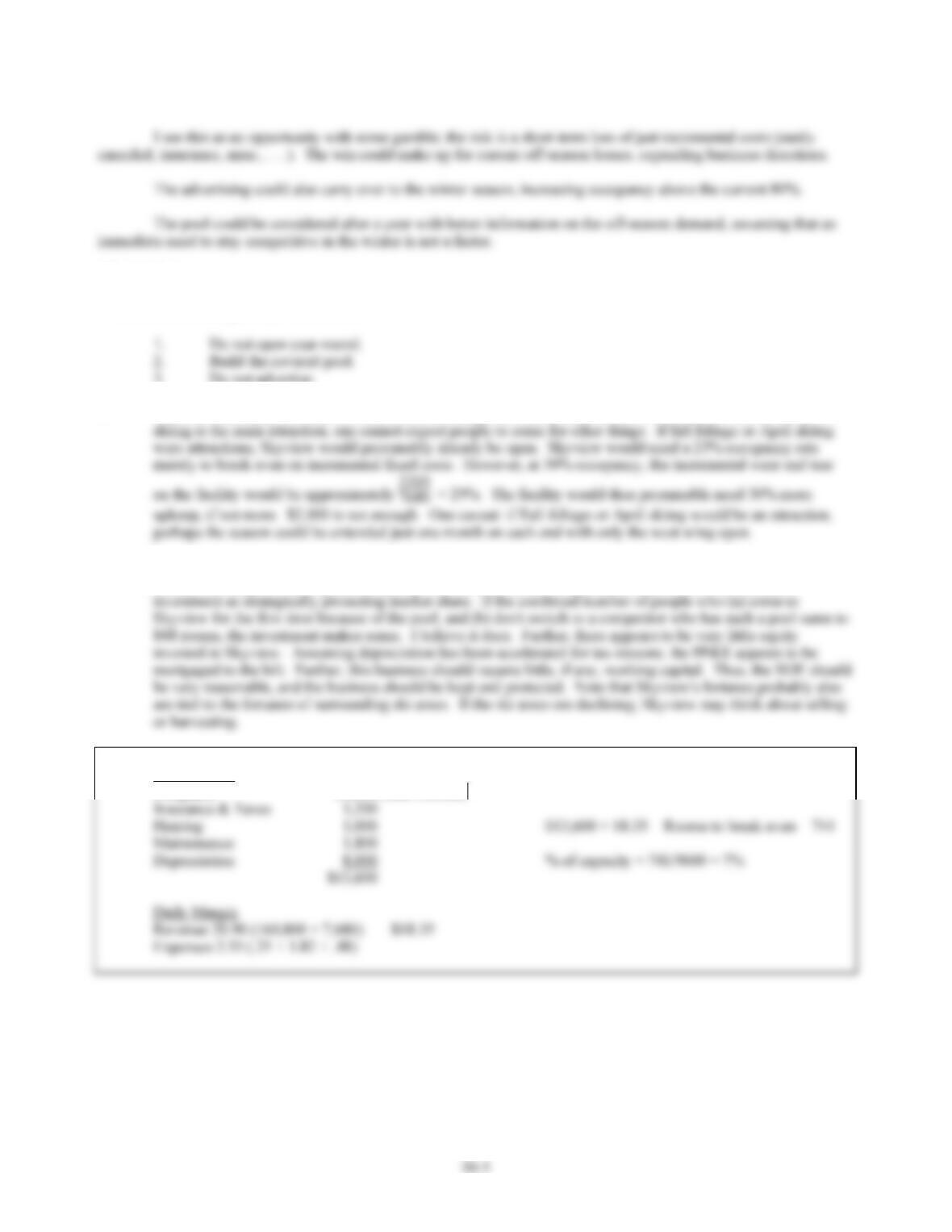
Of the alternatives explored, I recommend:
3. Do not advertise.
1. I believe it unlikely that Skyview can achieve average off-season sales of twelve to fifteen rooms or more. If
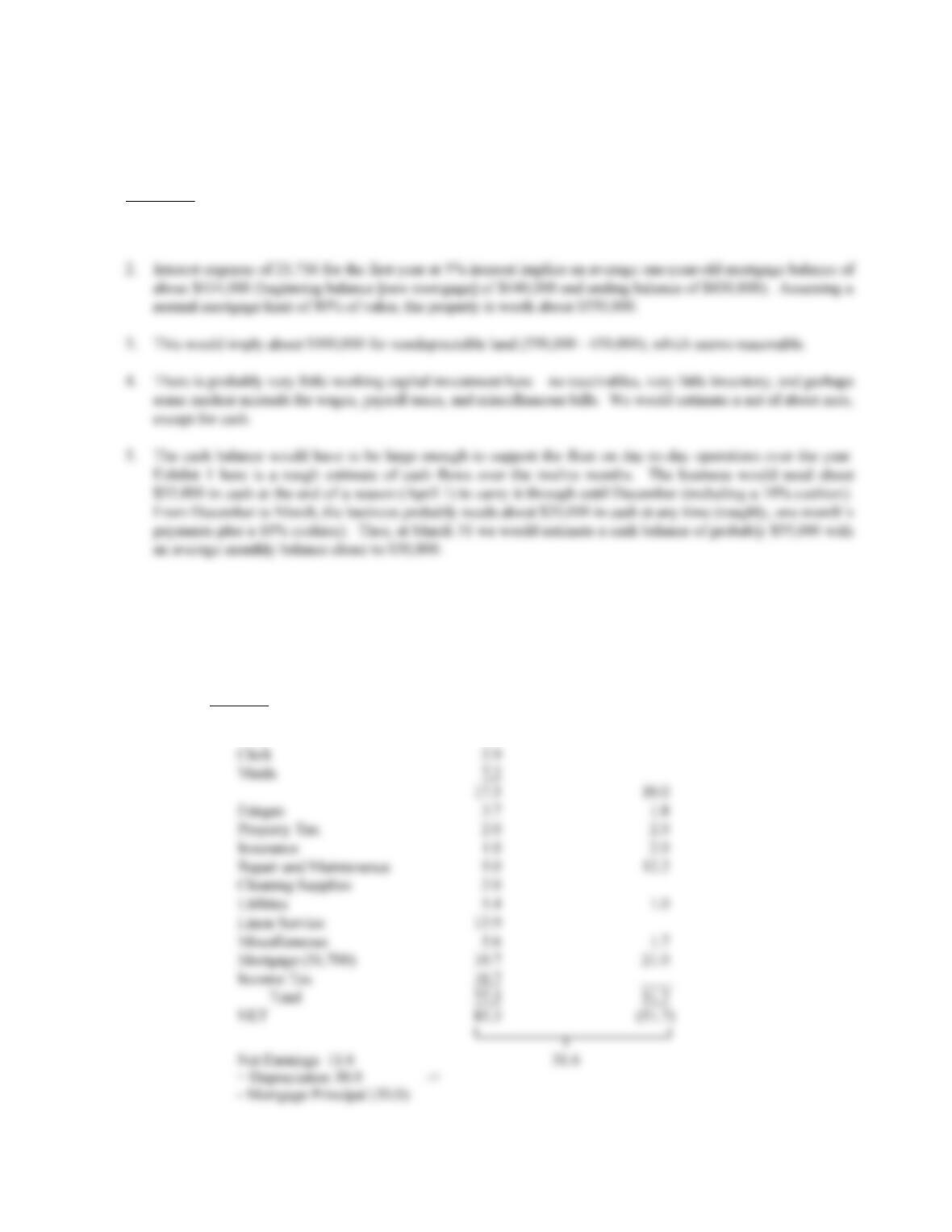
2. The incremental number of rooms to be rented during each season for the covered pool to pay for itself is 848*
rooms. Although increasing the occupancy rate from 80% to 89% appears difficult, one must see this
*Fixed Costs
Lifeguard $1,600 (four months)
30-6
Question 7
The idea here is for students to estimate the return on investment for the business.
Investment
1. Depreciation of 30,000 with a fifteen-year life implies buildings and furnishings of $450,000.
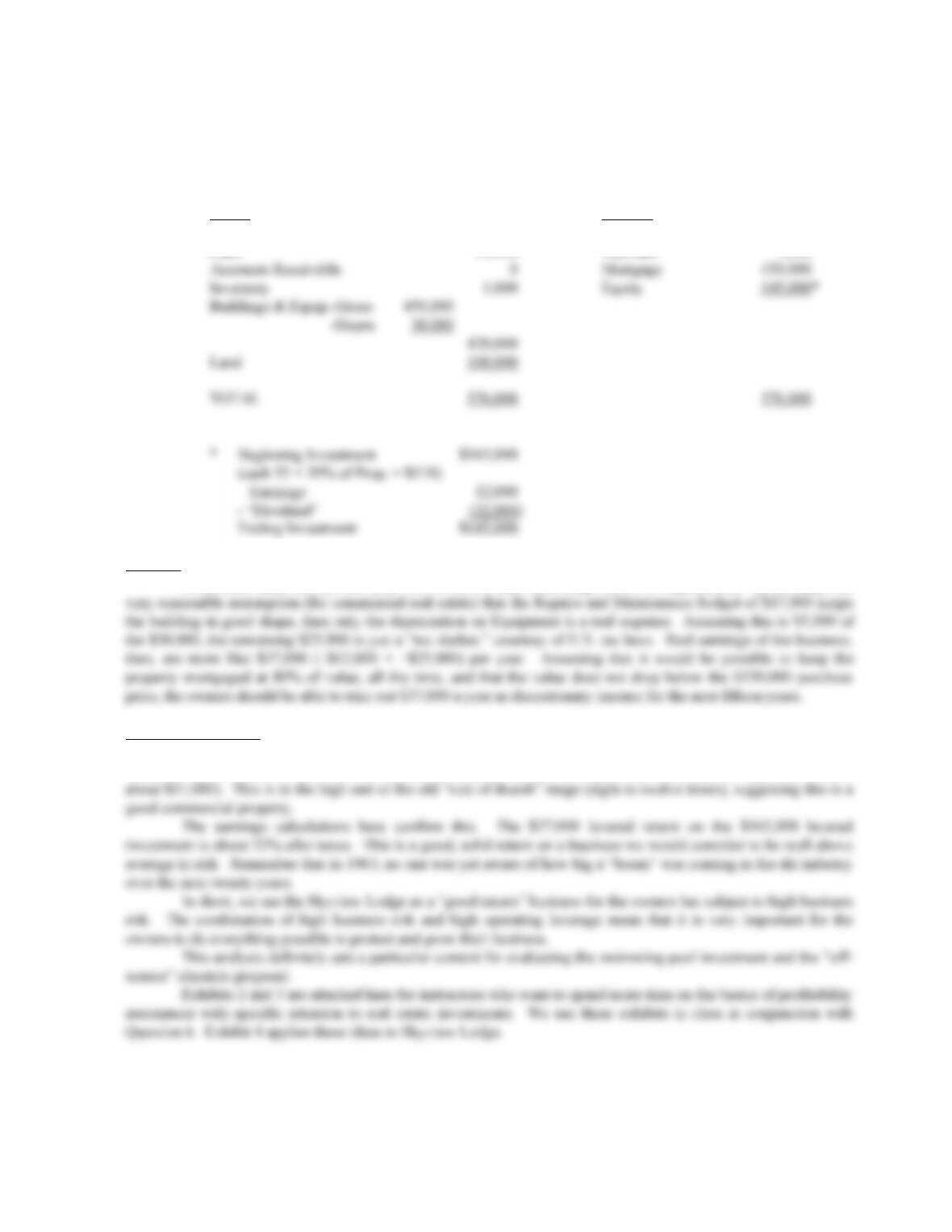
EXHIBIT 1
Estimated Cash Flows Summary
Season (Dec-March) Out of Season (April-Nov)
Revenues 160.8
Expenses
Manager 5.0 10.0
Wife 2.4
30-7
In summary, we would estimate the following 3/31/62 balance sheet, assuming the owners withdrew the excess
cash during the year:
Assets Equities
Cash 55,000 Accruals 1,000
Earnings
Profit after taxes for the first year was $11,600, after deducting 30,000 of depreciation. If we make the
Return on Investment
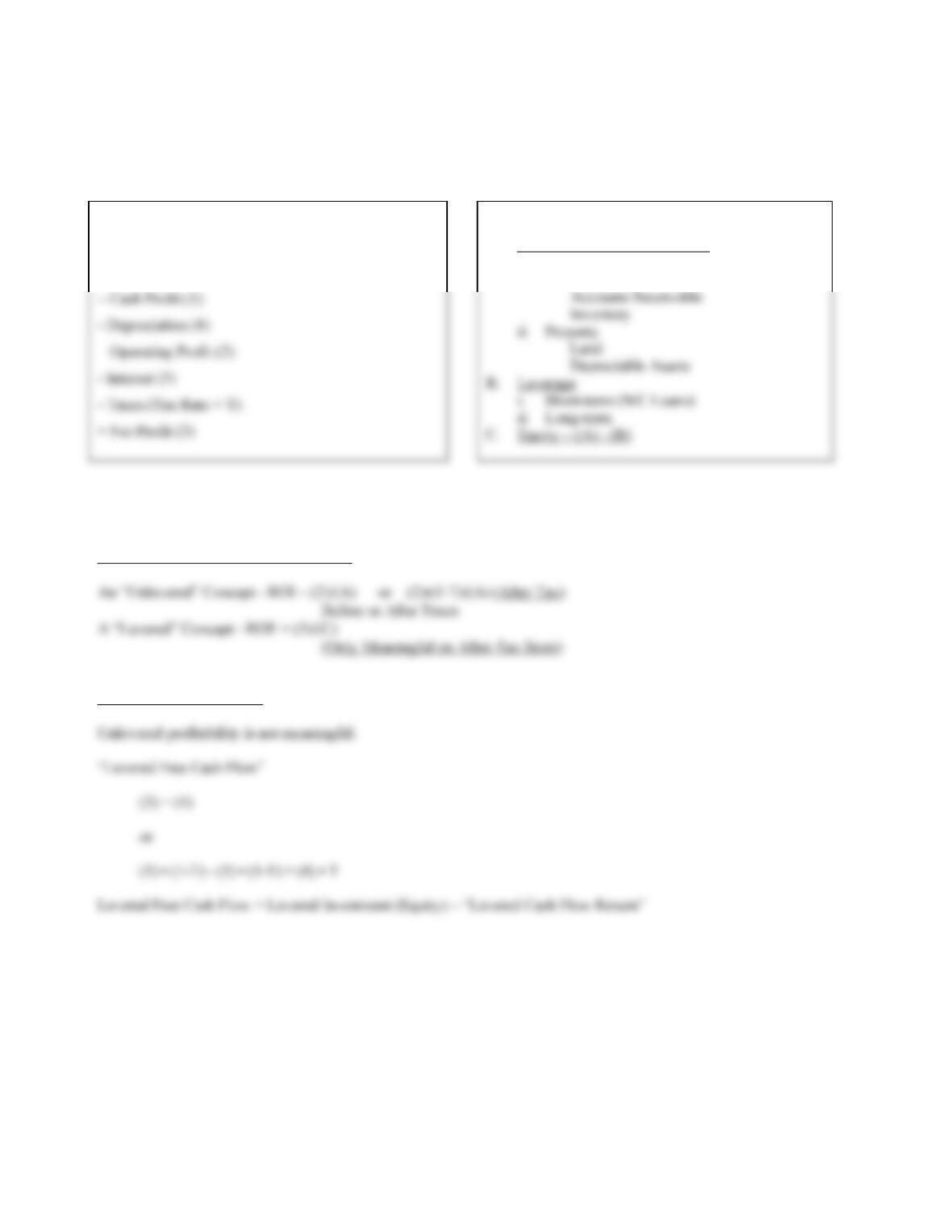
The purchase price of $550,000 represents an 11.5 multiple on the “unlevered annual free cash flow” of the
business, which is about $48,000 ($37,000 from above plus the after-tax equivalent of the interest expense, which is
30-8
EXHIBIT 2
OPERATIONS
Revenue
– Cash Costs
INVESTMENT
A. Unlevered Investment (Assets)
i. Working Capital
Cash
PROFITABILITY
For a Manufacturing or Service Business
For a Real Estate Business
30-9
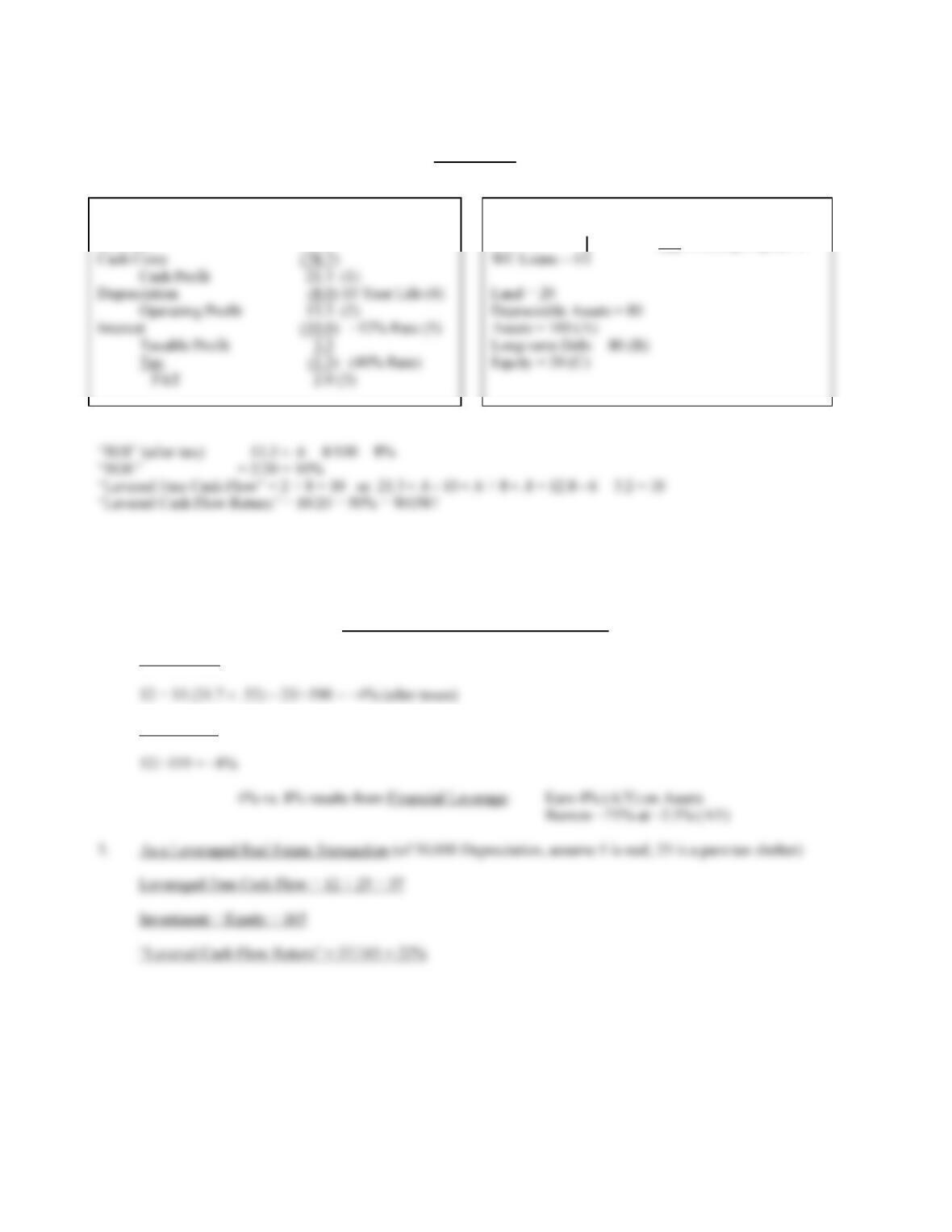
EXHIBIT 3
An Example
OPERATIONS
Revenue 100.0
INVESTMENT
WC = 0 Net Working Capital 0
EXHIBIT 4
Skyview Manor—Return on Investment
1. Simple ROA
2. Simple ROE
HOW RISKY?