CA 24-8 (Continued)
2. The company’s revenue and expenses would be reported as follows on its quarterly report
prepared for the first quarter of the 2014–2015 fiscal year:
Sales revenue ………………………………………………………………………………. $60,000,000
Cost of goods sold ………………………………………………………………………… 36,000,000
beyond the interim period in which the expenditure is made.
(b) The financial information to be disclosed to its stockholders in its quarterly reports as a minimum
include:
1. Sales revenue or gross revenues, provision for income taxes, extraordinary items and net
income.
CA 24-9
(a) Acceptable. The use of estimated gross profit rates to determine the cost of goods sold is accept-
able for interim reporting purposes as long as the method and rates utilized are reasonable. The
(c) Acceptable. Any loss in inventory value should be reported when the decline occurs. Any re–
coveries of the losses on the same inventory in later periods should be recognized as gains in the
later interim periods of the same fiscal year. However, the gains should not exceed the previously
recorded losses.
CA 24-9 (Continued)
(e) Acceptable. The annual audit fee is an expense which benefits the company’s entire year. Com-
panies are encouraged to make quarterly estimates of these items that usually result in year–end
adjustments. Therefore, this expense can be prorated over the four quarters.
(f) Not acceptable. Revenue from products sold should be recognized as earned during the interim
CA 24-10
(a) Arguments for requiring published forecasts:
1. Investment decisions are based on future expectations; therefore, information about the
(b) The purpose of a safe harbor rule is to provide protection to an enterprise that presents an
(c) An enterprise’s concerns about preparing a forecast are as follows:
1. No one can foretell the future. Therefore forecasts, while conveying an impression of precision
about the future, will inevitably be wrong.
CA 24-11
(a) The controller notes that the financial vice president is misrepresenting the financial condition of
the company by suggesting that the company has become more efficient when, in fact, the
(c) The favorable media release enhances the current stockholders’ position, as well as boosting the
image of management. Such publicity may well contribute to an increased stock price. Future inves–
tors and stockholders are harmed because the media release depicts a misleading perspective
on the financial condition of the company.
CA 24-11 (Continued)
(d) The controller is responsible for both the accuracy and the clarity of financial reporting. If the media
CA 24-12
(a) The ethical issues involved are profitability, long-term versus short-term performance, and integrity
of financial reporting.
(b) Form should not dictate substance. The bonds should be issued when the company needs the
should not delay issuance.
*CA 24-13
FINANCIAL REPORTING PROBLEM
(a) Proctor & Gamble (P&G) commented on the following items in its note
on accounting policies:
Nature of operations Cash flow presentation
Basis of presentation Cash equivalents
(b) P&G reported information for the following segments:
1. Beauty
2. Grooming
The fabric care and home care segment is the largest in net sales and
COMPARATIVE ANALYSIS CASE
THE COCA-COLA COMPANY VERSUS PEPSICO, INC.
(a) 1. Coca-Cola commented on the following list of items in its note on
accounting policies:
The Coca-Cola Company and Subsidiaries (Note 1)
• Description of Business
• Basis of Presentation
• Principles of Consolidation
• Cash Equivalents
• Short-term Investments
• Investments in Equity and Debt Securities
• Trade Accounts Receivable
• Inventories
• Derivative Instruments
2. PepsiCo commented on the following list of items in its note on
accounting policies:
PepsiCo, Inc. and Subsidiaries
Note 2—Our Significant Accounting Policies
COMPARATIVE ANALYSIS CASE (Continued)
Cash Equivalents
Software Costs
Commitments and Contingencies
Research and Development
Other Significant Accounting Policies
Recent Accounting Pronouncements
(b) Coca-Cola divided its operations into seven operating segments:
(c) Coca–Cola’s independent auditors are Ernst & Young LLP, while PepsiCo’s
independent auditors are KPMG LLP.
*FINANCIAL STATEMENT ANALYSIS CASE
RNA INC.
(a) The calculation of selected financial ratios for RNA for the fiscal year
2015 is as follows:
Times interest earned
=
Income before income taxes
and interest expense
Interest expense
*FINANCIAL STATEMENT ANALYSIS CASE (Continued)
Asset turnover
=
Net sales
Average total assets
=
Inventory turnover
=
=
(b) The analytical use of each of the six ratios presented above and what
investors can learn about RNA’s financial stability and operating
efficiency are presented below.
Current ratio
• Measures the ability to meet short-term obligations using short-
term assets.
Acid-test ratio
• Measures the ability to meet short-term debt using the most liquid
assets.
*FINANCIAL STATEMENT ANALYSIS CASE (Continued)
Times interest earned
• Measures the ability to meet interest commitments from current
Profit margin on sales
• Measures the net income generated by each dollar of sales. It pro–
Asset turnover
• Measures the efficiency of resource use; i.e., the ability to generate
sales through the use of assets.
Inventory turnover
• Measures how quickly inventory is sold, as well as how effectively
investment in inventory is used. It also provides a basis for deter–
*FINANCIAL STATEMENT ANALYSIS CASE (Continued)
(c) Limitations of ratio analysis include:
• Difficulty making comparisons among firms in the same industry
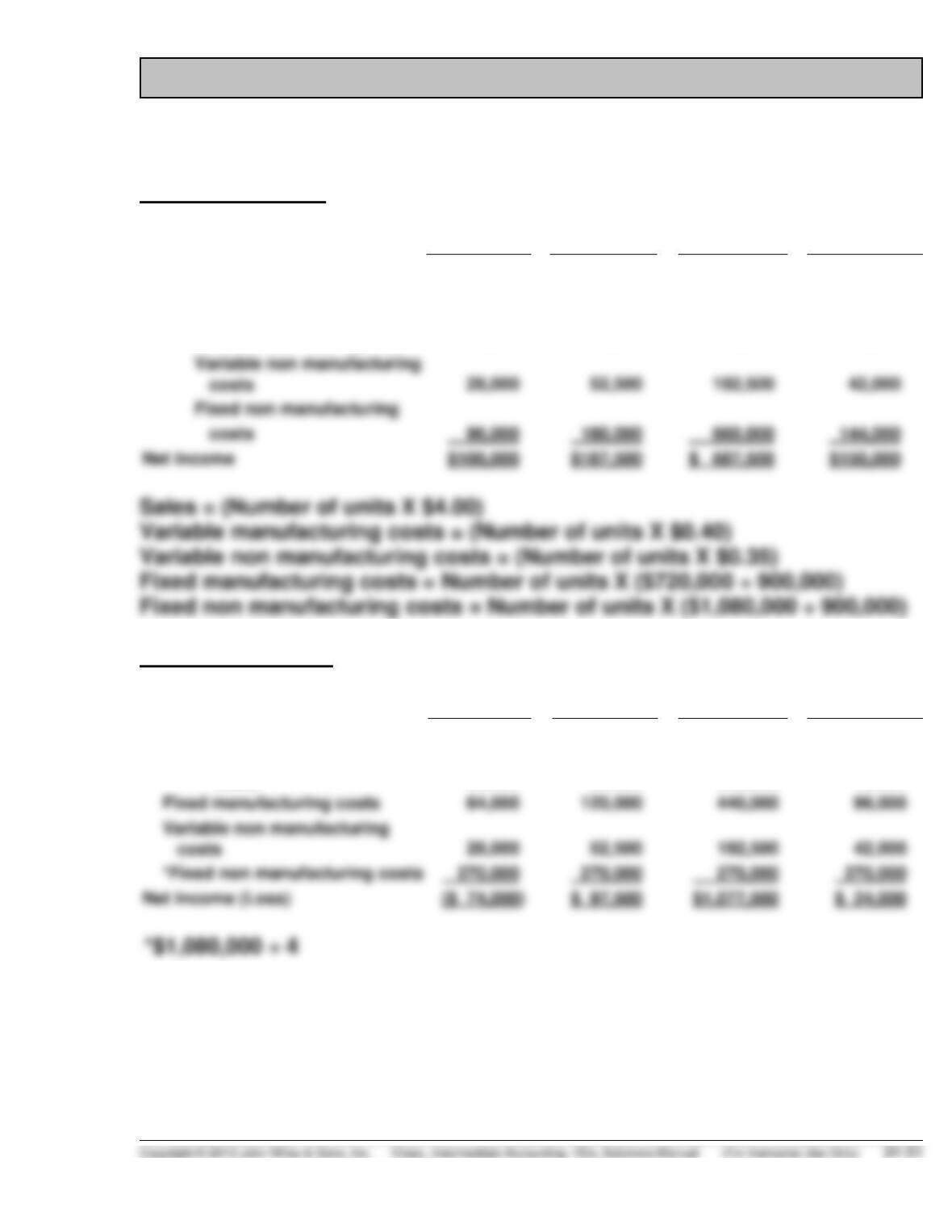
ACCOUNTING, ANALYSIS, AND PRINCIPLES
Accounting
Integral Approach
1st Quarter
2nd Quarter
3rd Quarter
4th Quarter
Sales
$320,000
$600,000
$2,200,000
$480,000
Less: Variable manufacturing
costs
32,000
60,000
220,000
48,000
Fixed manufacturing costs
64,000
120,000
440,000
96,000
Net income
$ 687,500
Discrete Approach
1st Quarter
2nd Quarter
3rd Quarter
4th Quarter
Sales
$320,000
$600,000
$2,200,000
$480,000
Less: Variable manufacturing
costs
32,000
60,000
220,000
48,000
Fixed manufacturing costs
120,000
Variable non manufacturing
costs
28,000
52,500
192,500
42,000
*Fixed non manufacturing costs
270,000
270,000
Net income (Loss)