CHAPTER 24
SOLUTIONS TO B PROBLEMS
PROBLEM 24-1B
SUGARLAND CORPORATION
Balance Sheet
December 31, 2014
Assets
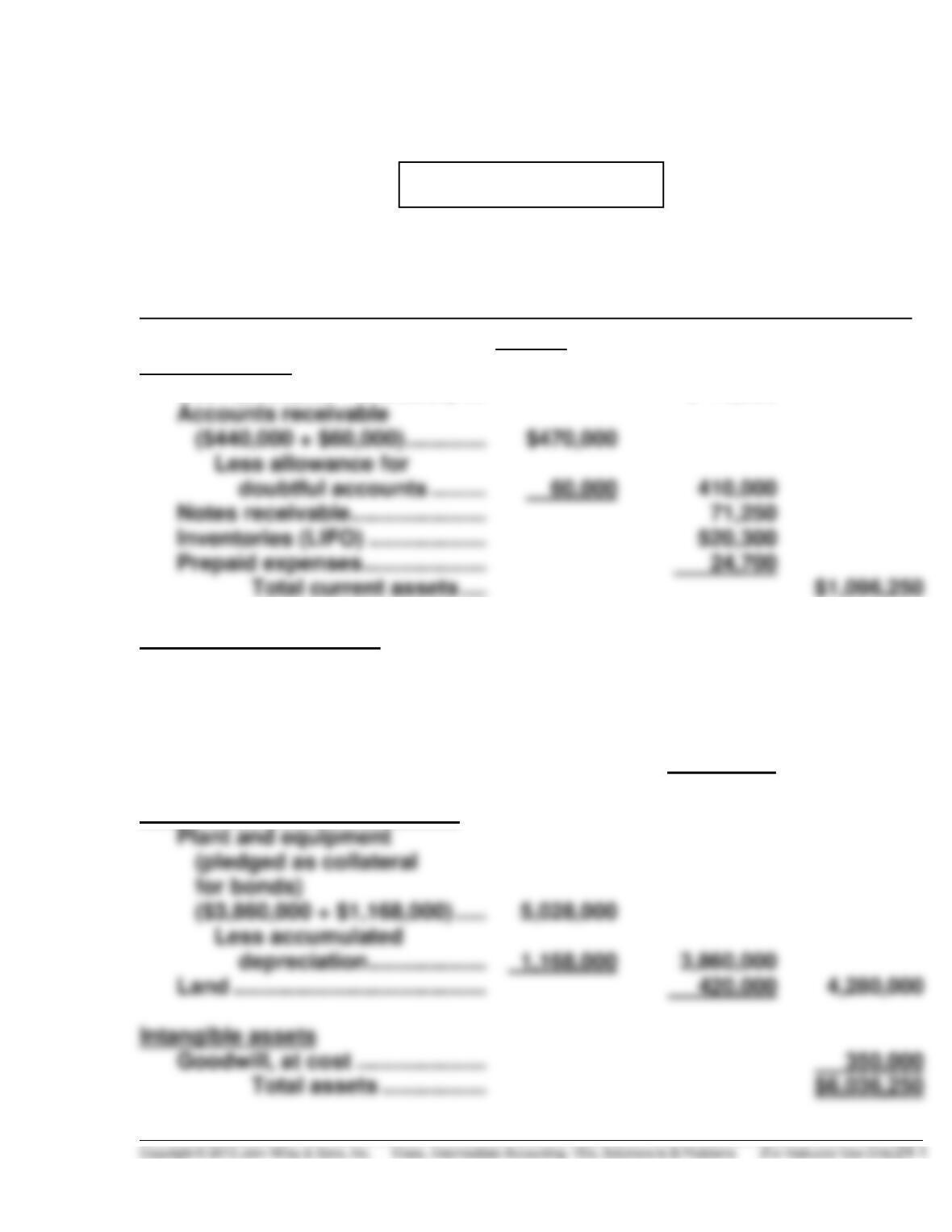
Current assets
Cash ($200,000 – $130,000) …. $ 70,000
Long-term investments
Investments in land …………….. 120,000
Cash surrender value of
life insurance policy …………. 60,000
Cash restricted for plant
expansion ……………………….. 130,000 310,000
Property, plant, and equipment
PROBLEM 24-1B (Continued)
Liabilities and Stockholders’ Equity
Current liabilities
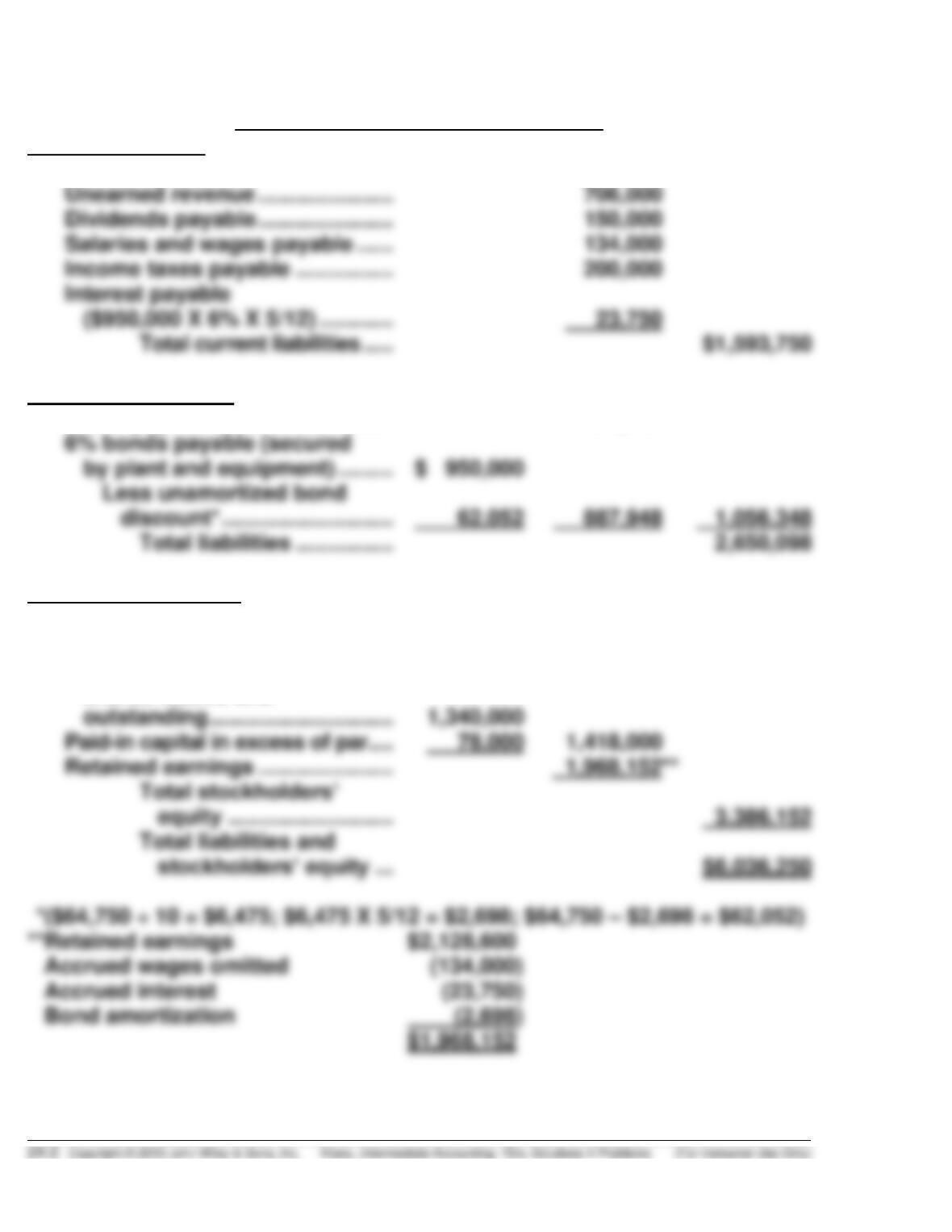
Accounts payable ………………….. $ 380,000
Long-term liabilities
Notes payable (due 2020) ………. 168,400
Stockholders’ equity
Common stock, par value
$1 per share; authorized
20,000,000 shares; 1,340,000
shares issued and
PROBLEM 24-1B (Continued)
Additional comments:
1. The information related to the competitor should be disclosed because
this innovation may have a significant effect on the company. The value
2. The pledged assets should be described in the balance sheet as indicated
or in a footnote.
6. Technically, the plant and equipment account should be separately dis-
closed and depreciation computed on each item individually. However,
the information to divide the accounts was not given in this problem.
7. Interest payable on the bonds ($750,000 X 8% X 8/12 = $40,000) was
8. Since the loss from heavy damage was caused by a tornado after the
balance sheet date, this event does not reflect conditions existing at
PROBLEM 24-2B
(a) Determination of reportable segments:
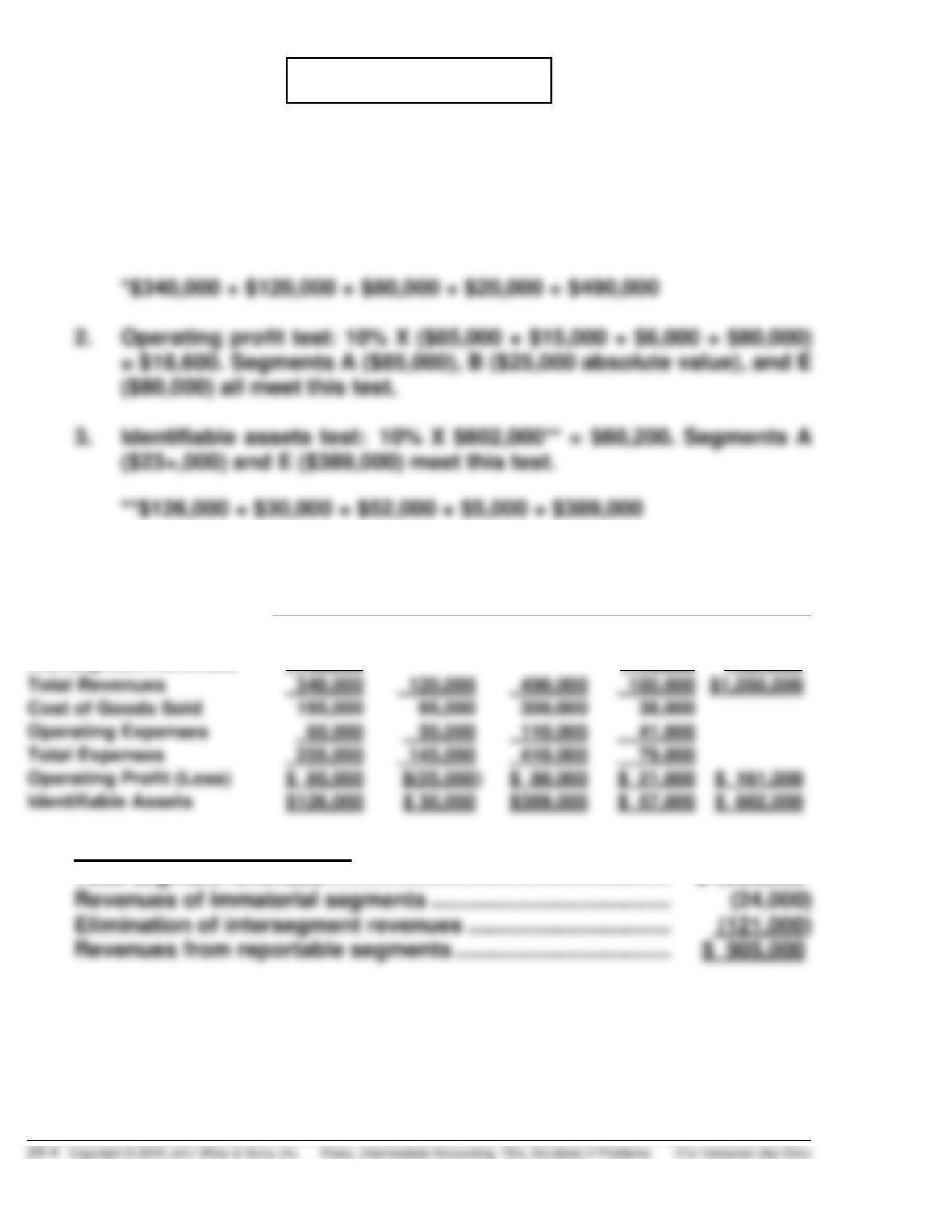
1. Revenue test: 10% X $1,050,000* = $105,000. Segments A ($340,000),
B ($120,000), and E ($490,000) all meet this test.
(b) Disclosures required by GAAP:
A
B
E
Other
Totals
External Revenues
$295,000
$ 120,000
$490,000
$ 24,000
$ 929,000
Intersegment Revenues
45,000
76,000
121,000
Total Revenues
340,000
490,000
$1,050,000
Cost of Goods Sold
Operating Expenses
110,000
Total Expenses
255,000
410,000
Operating Profit (Loss)
$ 80,000
$ 161,000
Identifiable Assets
$126,000
$389,000
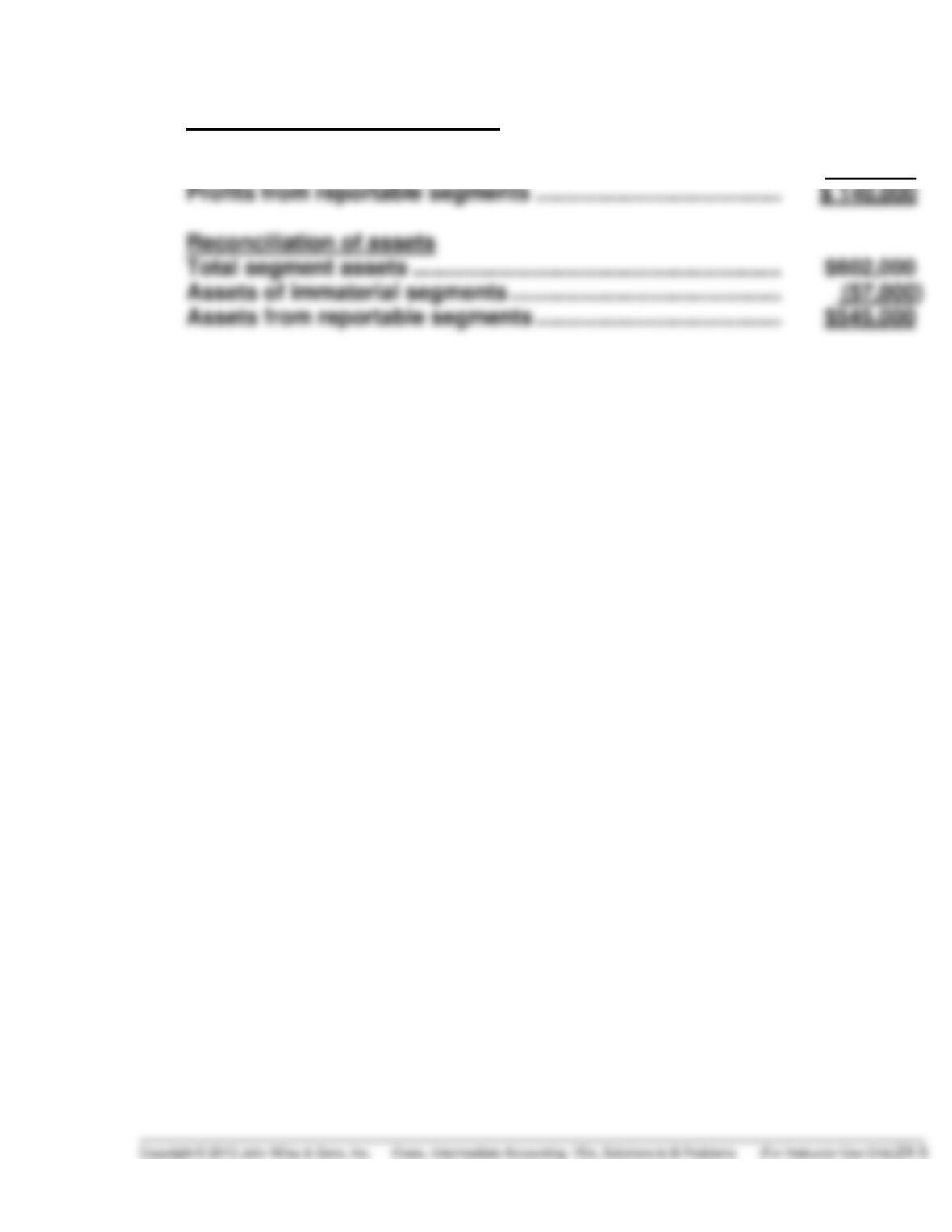
Reconciliation of revenues
Total segment revenues ……………………………………………….. $1,050,000
PROBLEM 24-2B (Continued)
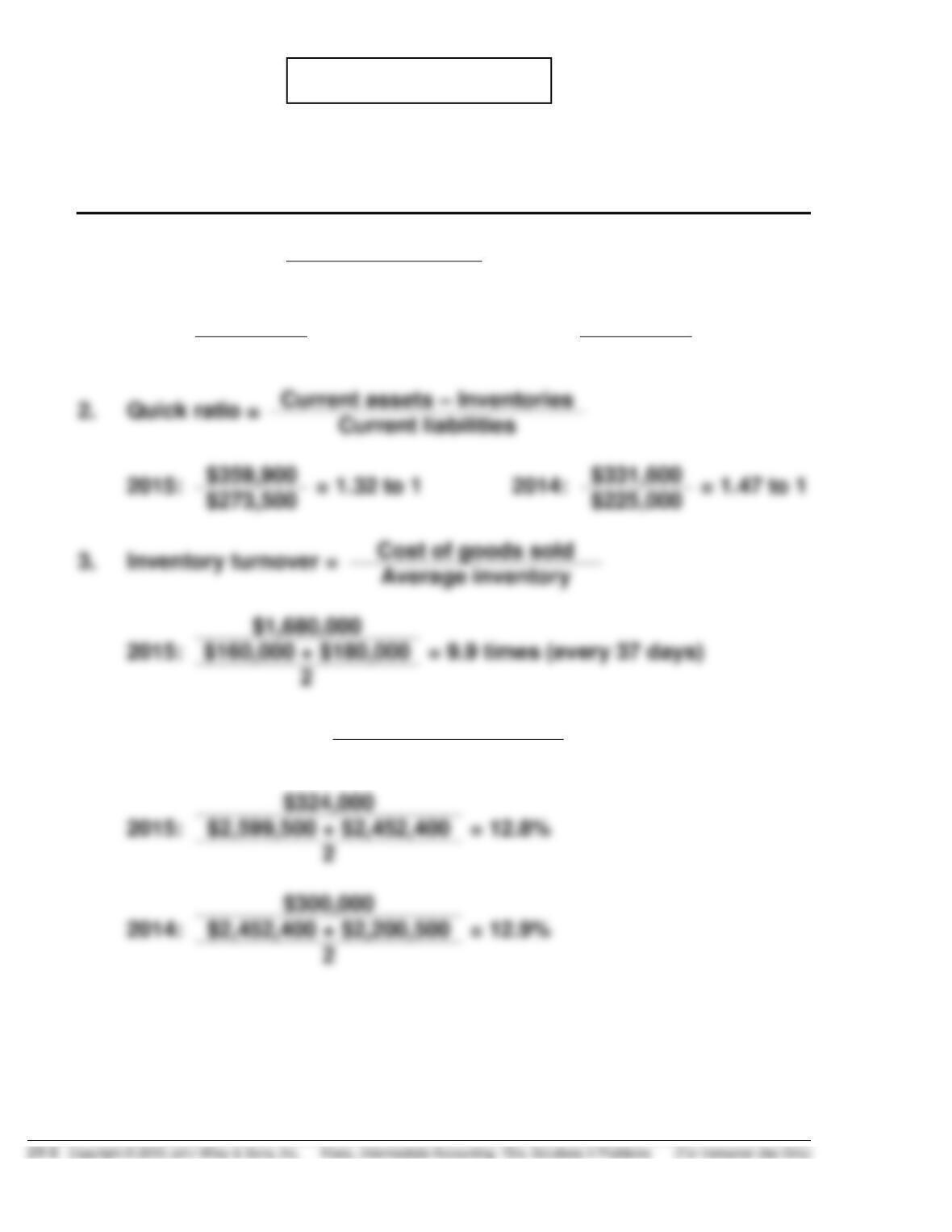
Reconciliation of profit or loss
Total segment operating profit ……………………………………… $ 161,000
Profits of immaterial segments ……………………………………… (21,000)
*PROBLEM 24-3B
(a) MONTANA CORPORATION
Financial Statistics
1.
Current ratio =
Current assets
Current liabilities
2015:
$539,900
= 1.97 to 1
2014:
$491,600
= 2.18 to 1
$273,500
$225,000
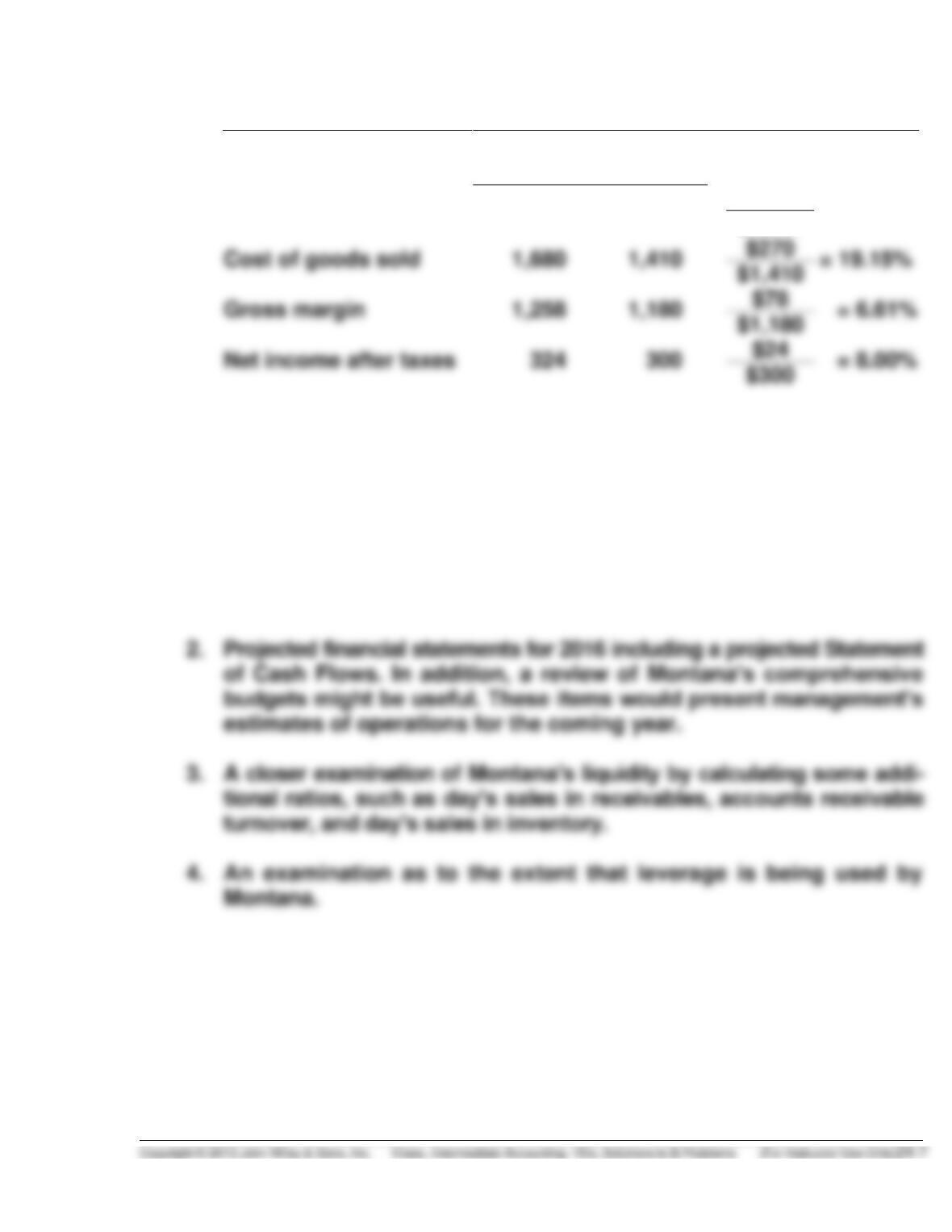
2.
Quick ratio =
2015:
$359,900
= 1.32 to 1
2014:
$331,600
= 1.47 to 1
$273,500
$225,000
3.
Inventory turnover =
4.
Return on assets =
Net income
Average total assets
*PROBLEM 24-3B (Continued)
5.
Percent Changes
Amounts
Percent Increase
(000s omitted)
2015
2014
Sales revenue
$2,938
$2,601
$337
= 12.96%
$2,601
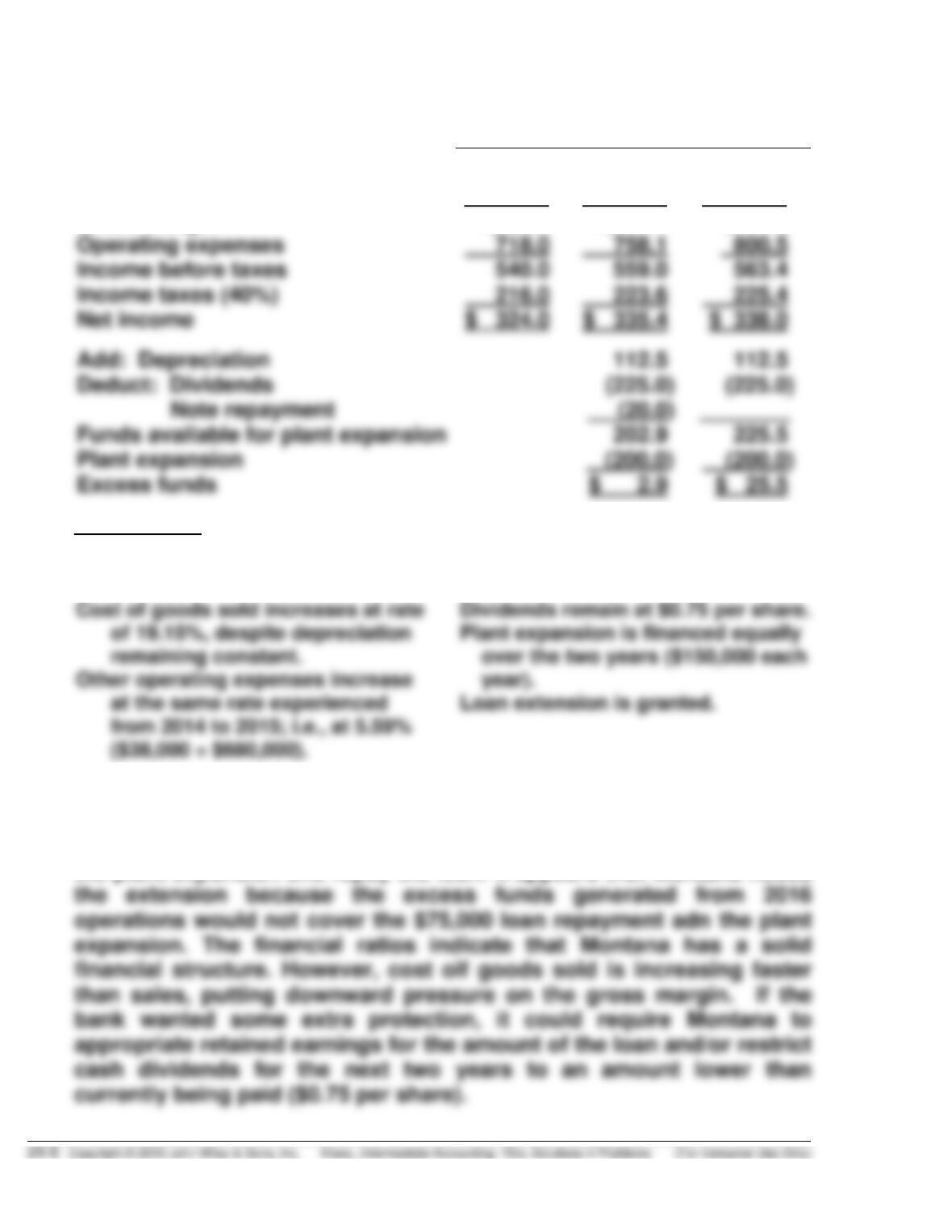
Cost of goods sold
$270
Net income after taxes
$300
(b) Other financial reports and financial analyses which might be helpful
to the commercial loan officer of Jersey National Bank include:
1. The Statement of Cash Flows would highlight the amount of cash
provided by operating activities, the other sources of cash, and the
uses of cash for the acquisition of long-term assets and long-term
debt requirement.
(c) Montana Corporation should be able to finance the plant expansion
from internally generated funds as shown in the calculations presented
on the next page. However, there is not much in excess funds after the
proposed plant expansion.
*PROBLEM 24-3B (Continued)
(000 omitted)
2015
2016
2017
Sales revenue
$2,938.0
$3,318.8
$3,748.9
Cost of goods sold
1,680.0
2,001.7
2,385.0
Gross margin
1,258.0
1,317.1
1,363.9
Operating expenses
718.0
Income before taxes
Income taxes (40%)
216.0
Net income
$ 324.0
Add: Depreciation
Deduct: Dividends
Note repayment
Funds available for plant expansion
Plant expansion
Excess funds
Assumptions:
Sales revenue increases at a rate
of 12.96%.
Depreciation remains constant at
$112,500.
(d) Jersey National Bank should probably grant the extension of the loan
because the projected cash flows for 2016 and 2017 indicate that an
adequate amount of cash will be generated from operations to finance
the plant expansion and repay the loan. It appears that Montana needs
*PROBLEM 24-4B
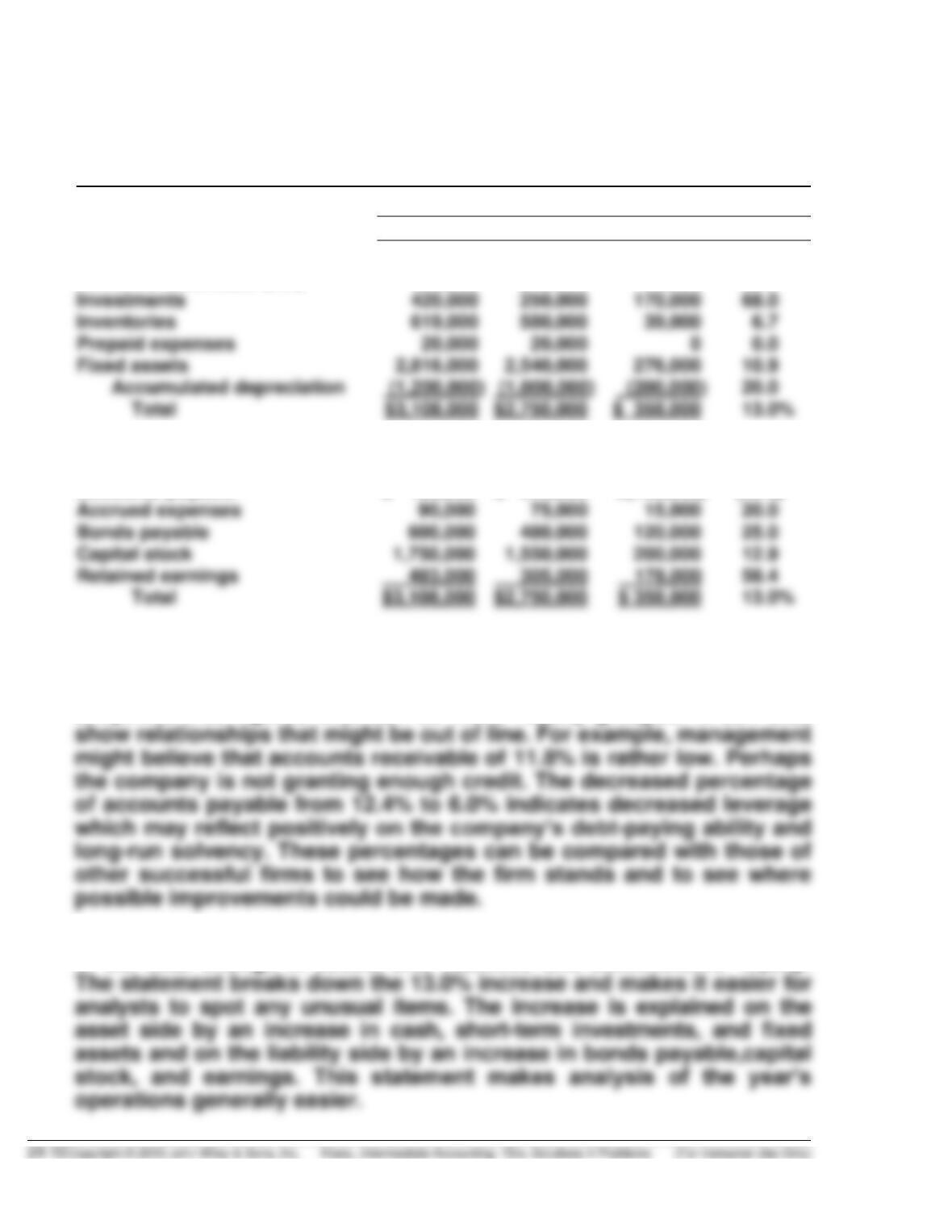
(a) JMAR COMPANY
Comparative Balance Sheet
December 31, 2015 and 2014
December 31
Assets
2015
2014
Cash
$ 65,000
2.2%
$ 42,000
1.5%
Accounts receivable (net)
368,000
11.8
318,000
11.6
Short-term Investments
420,000
13.5
250,000
9.1
Inventories
619,000
19.9
580,000
21.1
Prepaid expenses
0.6
0.7
Fixed assets
90.6
92.4
Accumulated depreciation
(1,200,000)
(38.6)
(36.4)
Total
100.0%
100.0%
Liabilities and
Stockholders’ Equity
Accounts payable
$ 185,000
6.0%
$ 340,000
12.4%
Accrued expenses
2.9
2.7
Bonds payable
600,000
19.3
17.5
Capital stock
1,750,000
56.3
56.4
Retained earnings
Total
100.0%
100.0%
*PROBLEM 24-4B (Continued)
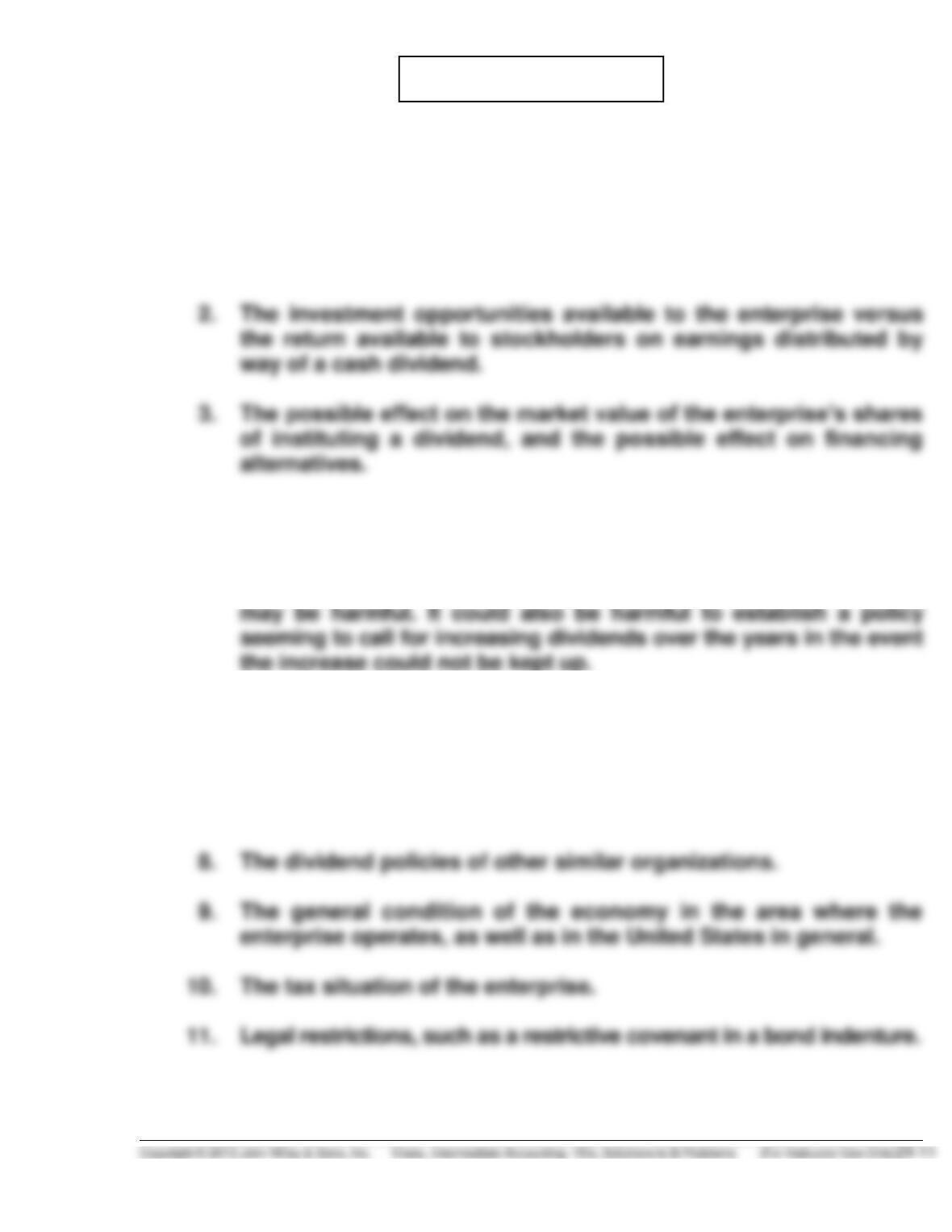
(b) JMAR COMPANY
Comparative Balance Sheet
December 31, 2015 and 2014
December 31
Increase or (Decrease)
Assets
2015
2014
$ Change
% Change
Cash
$ 65,000
$ 42,000
$ 23,000
54.7%
Accounts receivable (net)
368,000
318,000
50,000
15.7
Investments
420,000
250,000
68.0
Inventories
619,000
580,000
39,000
6.7
Prepaid expenses
0.0
Fixed assets
2,816,000
10.9
Accumulated depreciation
(1,200,000)
(1,000,000)
20.0
Total
13.0%
Liabilities and
Stockholders’ Equity
Accounts payable
$ 185,000
$ 340,000
$(155,000)
(45.6)
Accrued expenses
15,000
20.0
Bonds payable
480,000
25.0
Capital stock
1,750,000
12.9
Retained earnings
58.4
Total
13.0%
(c) The component percentage (common-size) balance sheet makes easier
analysis possible. It actually reduces total assets and total liabilities
and stockholders’ equity to a common base. Thus, the statement is
simplified into figures that can be more readily grasped. It can also
(d) A statement such as that in part (b) is a good analysis and breakdown
of the total change in assets and liabilities and stockholders’ equity.
*PROBLEM 24-5B
(a) In establishing a dividend policy, the following are factors that should
be taken into consideration:
1. The expansion plans or goals of the organization and the need for
monies to finance new activities.
4. The earnings ability and stability of the enterprise—past and future.
5. The ability of the organization to maintain a given dividend in future
years. To offer a dividend this year that cannot be maintained
6. The current position of the enterprise. Is cash available to pay the
dividend? Will working capital be decreased to a dangerous level?
7. The possibility of offering a stock dividend in addition to or rather
than a cash dividend.
*PROBLEM 24-5B (Continued)
12. Personal tax situations of stockholders if known—whether preference
for dividends or capital gains.
or preference for dividends.
(b)
2015
2014
2013
2012
2011
Rate of return on assets
$6,000
$5,600
$4,800
$3,800
$2,000
$55,000
$49,000
$46,000
$40,000
$34,000
10.9%
11.4%
10.4%
9.5%
5.9%
Profit margin on sales
$6,000
$5,600
$4,800
$3,800
$2,000
$50,000
$48,000
$42,000
$36,000
$28,000
12.0%
11.7%
11.4%
10.6%
7.1%
Earnings per share
$6,000
$5,600
$4,800
$3,800
$2,000
Price-earnings ratio
Current ratio
$20,000
$19,000
$16,000
$14,000
$11,000
$8,500*
$8,000
$7,200
$6,700
$6,000
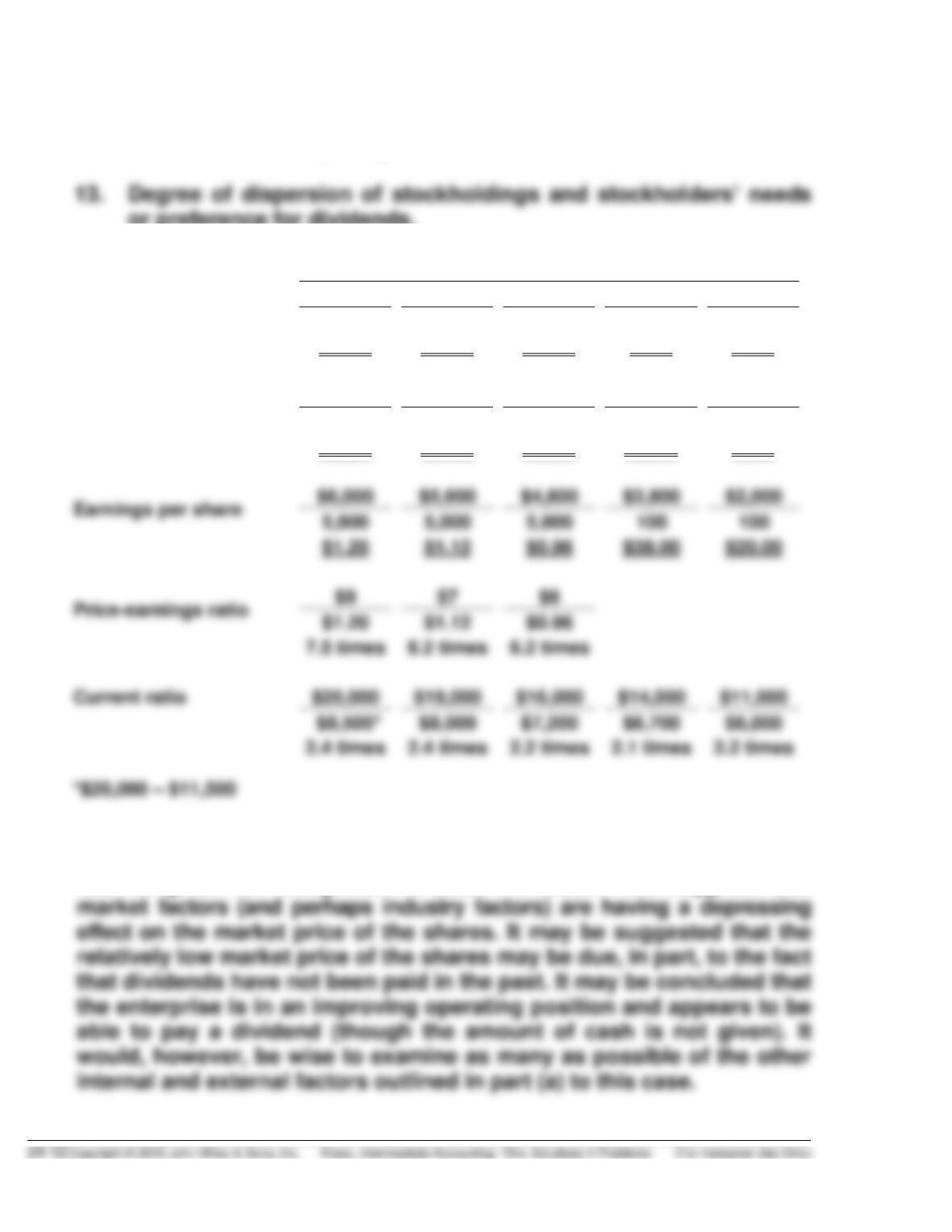
(c) While the return on assets, profit margin on sales, and earnings per
share have been generally increasing, the market price of the shares
has not given full recognition to these increases. This suggests that
*PROBLEM 24-5B (Continued)
A dividend in the range of 24¢ to 60¢ being 20% to 50% of earnings per
share for 2015, would appear to be reasonable. Cash required would be