23-1
CHAPTER 23
ACCOUNTING FOR CHANGES AND ERRORS
CONTENT ANALYSIS OF EXERCISES AND PROBLEMS
Number
Content
Time Range
(minutes)
E23-1
Identification of Changes and Errors. (Easy) Indicate how to
report various items, whether increases or decreases are to be
expected.
5-10
E23-6
Change in Inventory Method. (Moderate) LIFO to FIFO.
Journal entry. Preparation of comparative income statements
and retained earnings statements.
20-30
E23-7
Change in Accounting for Construction Contracts. (Moderate)
Completed-contract to percentage-of-completion. Income
statements, statement of retained earnings.
20-30
23-2
Number
Content
Time Range
(minutes)
E23-13
Omission of Accruals and Prepayments. (Moderate)
Computation of correct net income. Journal entries if error
discovered after one year, after two years.
15-25
P23-1
(AICPA adapted). Identification and Effects of Changes and
Errors. (Easy) Indicate how to classify, and the accounting
treatment for, 10 transactions.
10-15
P23-5
Change in Accounting for Construction Contracts.
(Challenging) Completed-contract to percentage-of-
completion. Journal entry. Comparative financial statements.
40-60
P23-6
Changes and Corrections of Depreciation. (Moderate)
Increased service life. Change in method. Error in including
residual value. Journal entries.
20-30
P23-7
(AICPA adapted). Change in Accounting for Inventory.
(Moderate) FIFO to LIFO. Computation of effect on income.
20-30
P23-12
Error Correction. Analysis of effect on income and ending
balance sheet.
30-40
P23-13
(AICPA adapted). Comprehensive. (Moderate) Change in
estimate and principle, errors. Worksheet reconciling income.
Computation of cumulative effect.
30-40
23-3
ANSWERS TO QUESTIONS
Q23-1 GAAP defines three types of changes: a change in accounting principle, a change
in accounting estimate, and a change in reporting entity. A change in accounting
principle occurs when a company adopts a generally accepted accounting
Q23-2 The three possible methods a company could use to disclose an accounting change
in the financial statements are to (1) retroactively adjust past financial statements
(prior period restatement), (2) include the cumulative effect of the change in the
income of the current period, or (3) adjust for the change prospectively. The major
Q23-3 A company could justify a change in accounting principle on the grounds that the
new principle is preferable to the old. One example would be a change from FIFO to
Q23-4 A change in accounting principle occurs when one generally accepted accounting
principle is adopted in place of the one used previously for reporting purposes. A
change in estimate results from new events occurring, more experience being
Q23-5 The four exceptions to the normal method of accounting for a change in accounting
principle are
1. When a company adopts a new accounting principle for future events and does
not change the accounting for past events of the same nature, it discloses a
2. When the cumulative effect is not determinable, a company discloses the effect
3. When a company makes an initial public sale of common stock, it retroactively
restates the financial statements for all prior periods presented.
4. When the advantages of retroactive treatment in prior periods outweigh the
disadvantages, prior period restatement (adjustment) is required. This applies to
Q23-6 The cumulative effect may not be determinable when the accounting system does
not include sufficient information; for example, when a company changes to LIFO
Q23-7 A change in depreciation method is accounted for as a change in accounting
estimate effected by a change in accounting principle. Thus, it is accounted for
Q23-8 A company only recognizes the direct effects (net of applicable income taxes) of a
change in accounting principle in determining the amount of the retrospective
Q23-9 A company accounts for the adoption of a new accounting principle for future
23-5
Q23-10 If a company makes a cumulative effect type of accounting change during the first
interim period, it includes the cumulative effect of the change on retained earnings
at the beginning of the year in the net income of the first interim period. However, if
a company makes a cumulative effect type of change in other than the first interim
Q23-11 A change in a reporting entity occurs mainly when (a) consolidated or combined
statements are presented in place of the statements of individual companies, (b)
there is a change in the specific subsidiaries that make up the group of companies
for which consolidated financial statements are presented, and (c) the companies
Q23-12 A material error of a prior period that is discovered in the current period is accounted
for as a prior period adjustment (restatement) and therefore is excluded from net
income. On the current period financial statements, the company reports the error
Q23-13 Errors that affect only a company’s balance sheet are mainly classification errors.
These include classifying a long-term note receivable as a current receivable and
failing to include the current portion of long-term debt in current liabilities.
Q23-14 Errors that affect only a company’s income statement usually result from
Q23-15 One example of an error that is counterbalanced in the following period is the failure
to accrue an interest liability in the current period when the interest is to be paid in
the next period. The effect of this error in the current period is to understate interest
expense and thus overstate net income and retained earnings, and to understate
Q23-16 One error that is not counterbalanced in the following period is the expensing of a
depreciable fixed asset in the period it is purchased. In the year of purchase,
expenses are overstated, assets are understated, depreciation expense is
Q23-17 A company corrects errors even after they have counterbalanced whenever it
Q23-18 Under IFRS, if an error is discovered and it is impracticable to restate the financial
statements for all prior periods, a company may choose to restate the financial
Q23-19 Under IFRS, the accounting for the indirect effects of a change in accounting
principle is not specified. Therefore, a company may recognize these indirect effects
ANSWERS TO MULTIPLE CHOICE
23-7
SOLUTIONS TO REVIEW EXERCISES
RE23-1
RE23-2
Cost of goods sold under LIFO, Year 1 $300,000
RE23-3
RE23-4
HELLER COMPANY
Income statements (Partial)
Year 1
Year 2 As Adjusted
RE23-5
Beginning unadjusted retained earnings $400,000
RE23-6
The change will be accounted for prospectively.
RE23-7
RE23-8
RE23-9
RE23-10
RE23-11
RE23-12
23-9
SOLUTIONS TO EXERCISES
E23-1
The cited items are reported as follows:
1. Change in accounting principle; retrospective adjustment; at the beginning of
2. Change in accounting estimate; revise periodic depreciation charge based
on current book value, estimated residual value, and new estimate of
3. Change in accounting estimate effected by a change in accounting
principle; revise periodic depreciation charge based on current book value,
4. Change in accounting estimate; charge to income in current period;
decrease income and current assets.
5. Included in income of the current period; therefore, income and assets
increase.
E23-2
The cited items are reported as follows:
1. Change in accounting principle; cumulative effect impractical to determine;
disclosure of the effect of the change on results of operations (including per
share data) for the period of change.
5. Change in accounting estimate effected by a change in accounting
principle; revise periodic depreciation charge based on current book value,
estimated residual value, and new depreciation method for current and future
periods; no effect at beginning of the period; depreciation expense is higher
E23-3
Accounting treatment for the cited events:
1. Change in accounting principle; financial statements from all prior periods are
E23-3 (continued)
3. Change in accounting estimate effected by a change in accounting
principle; revise periodic depreciation charge based on current book value,
4. Change in accounting principle; exception to general rule; the adoption of a
new principle for future events without changing the principle used for past
5. Correction of an accounting error; prior period restatement (adjustment).
(Note to Instructor: This is not discussed in Chapter 8 but Research Simulation
8-2 addresses this issue in depth.)
E23-4
1. The total increase in cost of goods sold prior to 2011 of $180,000 ($130,000 +
$50,000) decreases the reported income before income taxes and the value
2. Comparative Income Statements
2011 2010
As Adjusted
Revenues $1,750,000 $1,500,000
Expenses (1,050,000)b (950,000)a
23-12
E23-4 (continued)
3. Comparative Retained Earnings Statements
2011 2010
Beginning unadjusted retained earnings $1,540,000 $1,120,000
Less: Adjustment for the cumulative effect
on prior years’ of retrospectively applying
E23-5 (AICPA adapted solution)
A change to the LIFO method is one of the exceptions to the retrospective
application of a change in accounting principle (assuming sufficient
E23-6
1. Inventory 8,000
23-13
E23-6 (continued)
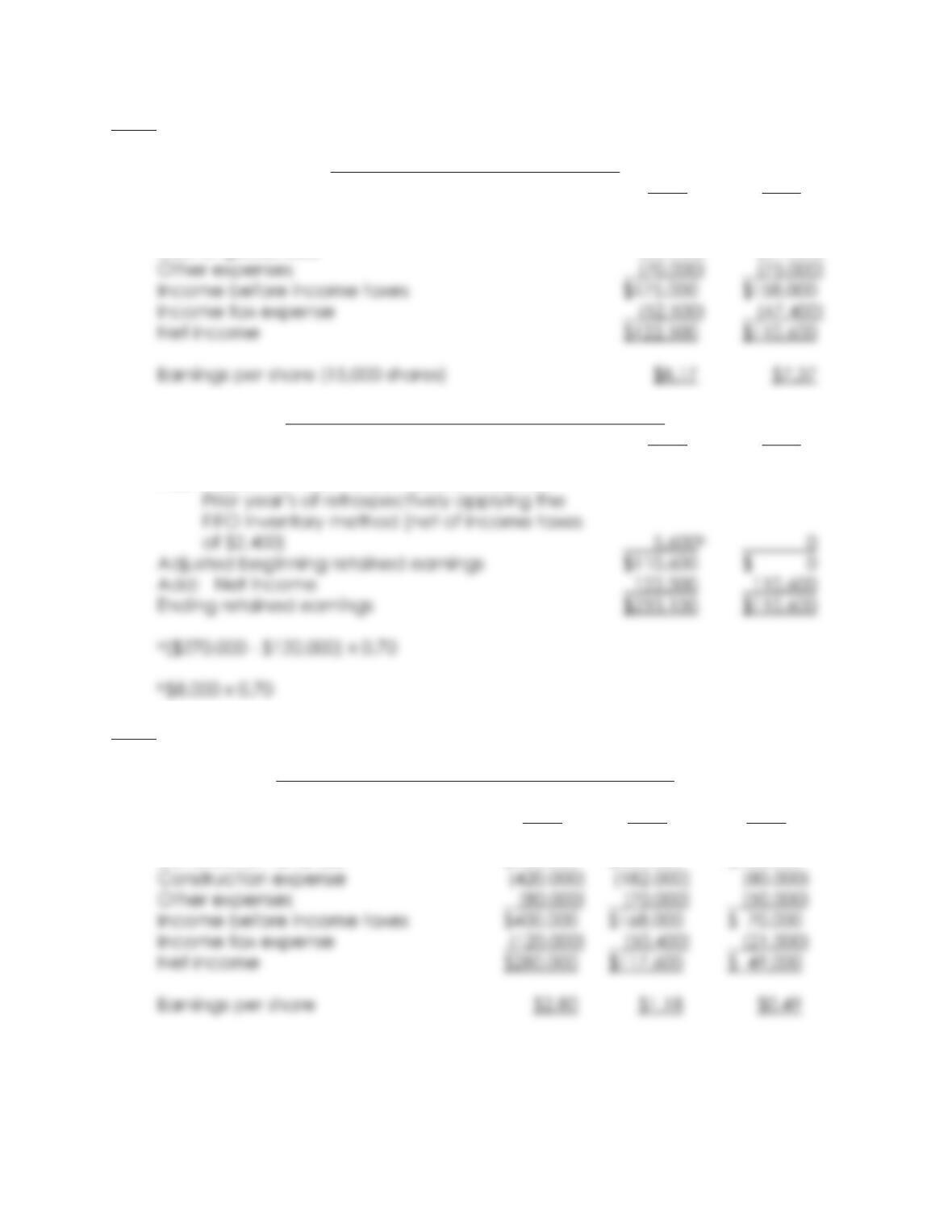
2. Comparative Income Statements
2010 2009
As adjusted
Revenues $300,000 $270,000
Cost of goods sold (55,000) (37,000)
3. Comparative Retained Earnings Statements
2010 2009
Beginning unadjusted retained earnings $105,000a $ 0
Plus: Adjustment for the cumulative effect on
E23-7
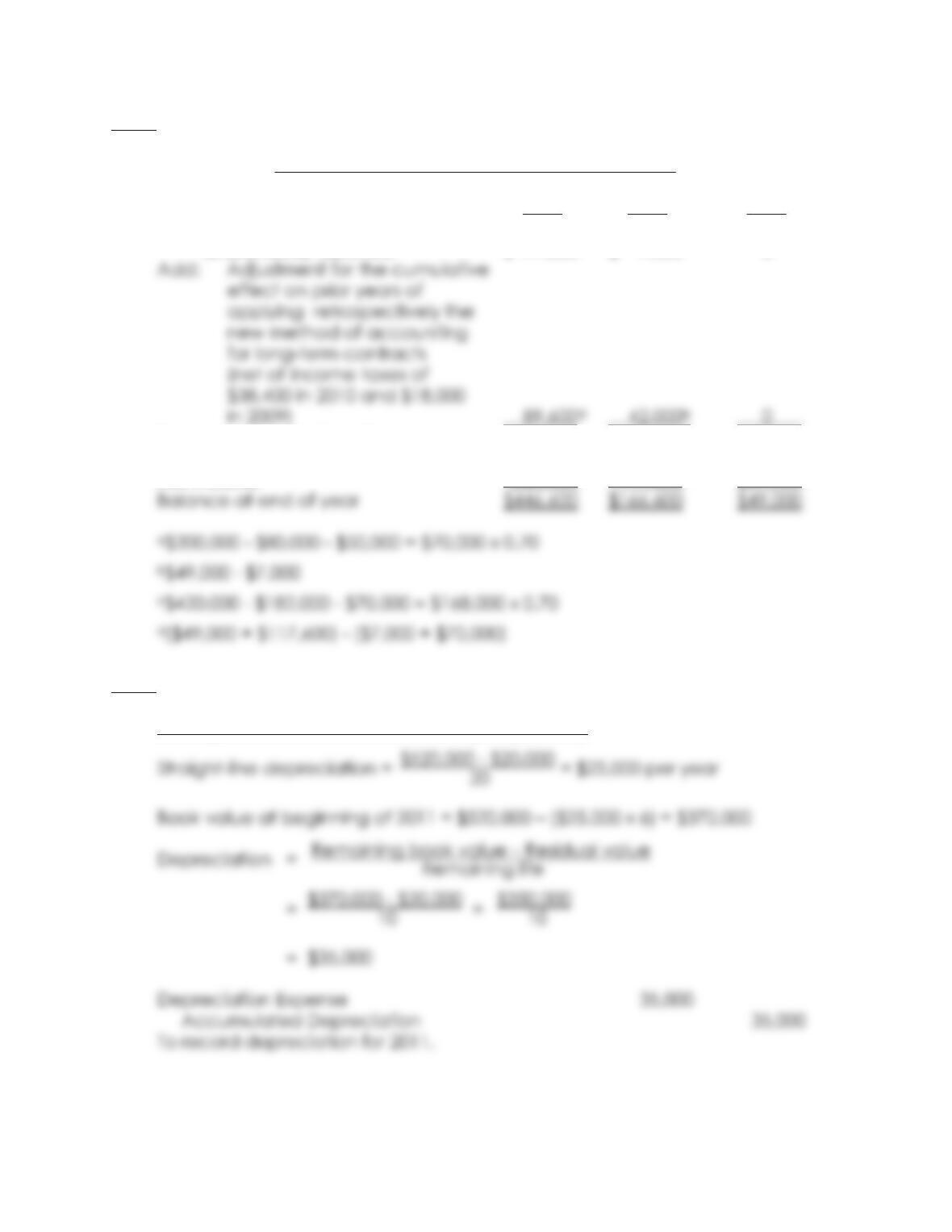
Condensed Comparative Income Statements
2010 2009 2008
As adjusted As adjusted
Construction revenue $900,000 $420,000 $200,000
23-14
E23-7 (continued)
Comparative Statements of Retained Earnings
2010 2009 2008
Balance at beginning of year,
as previously reported $ 77,000 $ 7,000 0
Balance at beginning of year,
as adjusted $166,600 $ 49,000 0
Net income 280,000 117,600c $49,000a
E23-8
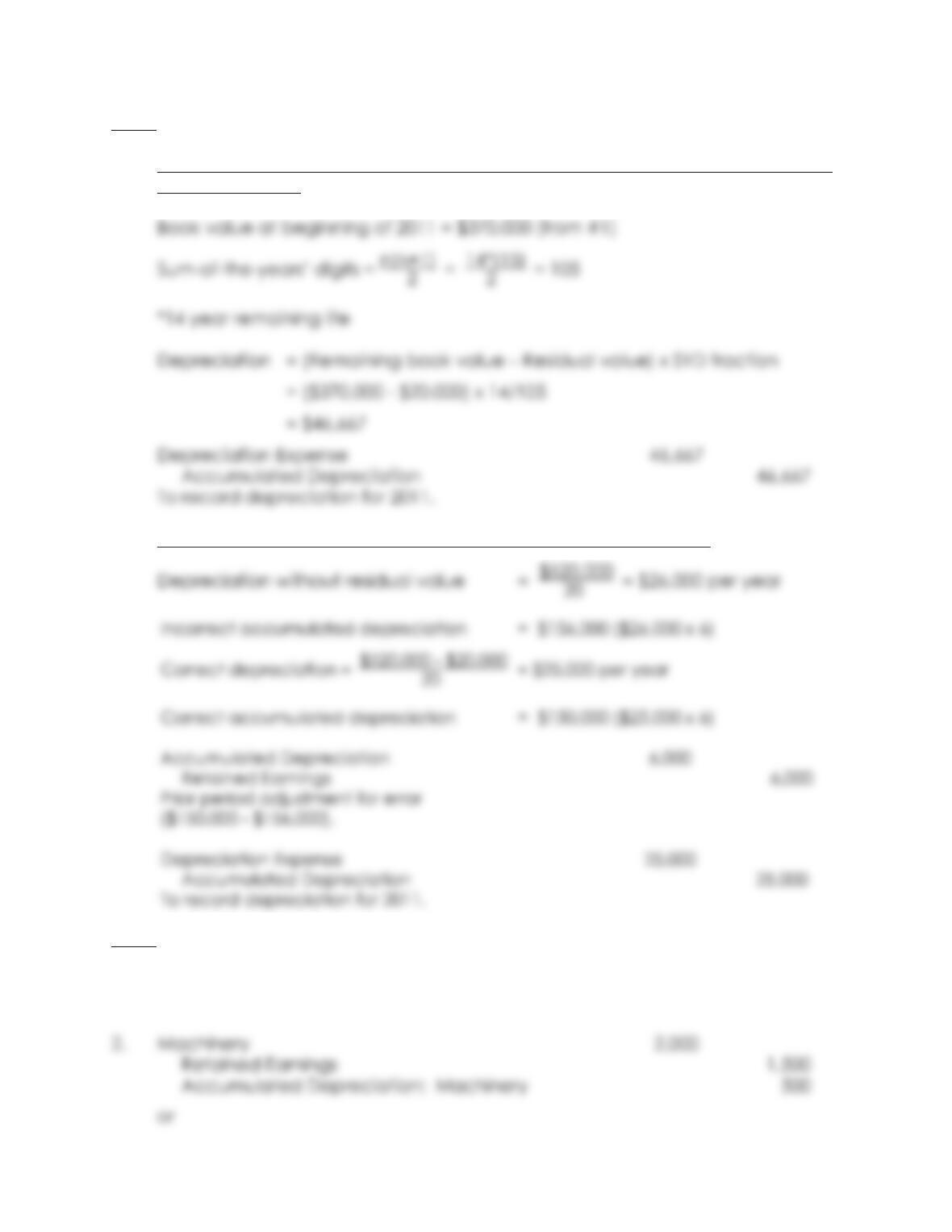
1. Change in estimate–accounted for prospectively:
23-15
E23-8 (continued)
2. Change in estimate effected by change in accounting principle—accounted
for prospectively:
3. Error—accounted for as a prior period restatement (adjustment):
E23-9
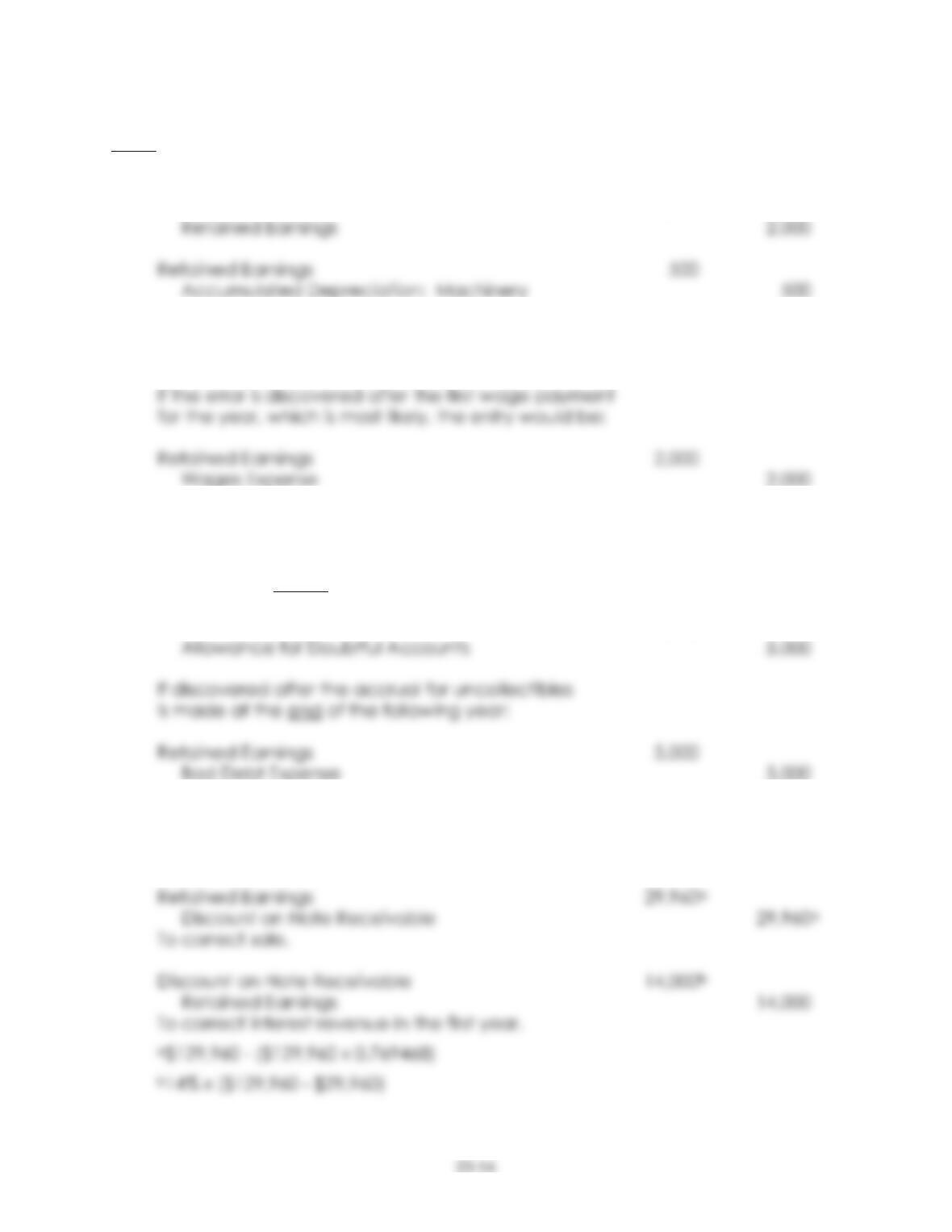
1. Purchases 10,000
Retained Earnings 10,000
E23-9 (continued)
2. (continued)
Machinery 2,000
3. Retained Earnings 2,000
Wages Payable 2,000
4. Rent Expense 4,000
Retained Earnings 4,000
5. If discovered during the following year:
Retained Earnings 5,000
6. Retained Earnings 15,960
Discount on Note Receivable 15,960
or
E23-10
1. No journal entry is needed because the error is counterbalanced after the
second year. If financial statements are presented for comparative purposes,
however, the effects of the error will have to be corrected in each of the 2
years affected.
2. Machinery 2,000
Accumulated Depreciation: Machinery 1,000
Retained Earnings 1,000
or
3. No journal entry is needed because the error is counterbalanced at the end of
4. No journal entry is needed because the error is counterbalanced at the end of
the second year. However, since rent expense is overstated for the year in
5. Assuming that an accrual for bad debts was made at the end of the previous
year, no journal entry is needed because the error is counterbalanced at the
end of the second year. However, since bad debt expense and the
23-18
E23-10 (continued)
6. No journal entry is needed because the error has been counterbalanced.
That is, the overstatement of the gain in the first year has been offset by an
E23-11
Assets Liabilities Owners’ Equity Net Income
1. – – NE NE
E23-12
1. Retained Earnings 8,100
Accumulated Depreciation: Machinery 900
2. Construction in Progress 22,000
Retained Earnings 22,000
3. Inventory 8,000a
23-19
E23-13
1. Computation of correct income:
2009 2010 2011
Reported pretax income $20,000 $25,000 $23,000
Prepaid Expenses:
2. The following individual journal entries may be used to correct the errors.
Prepaid expenses:
Prepaid Expense 1,100
Expense 1,100
E23-13 (continued)
Revenue earned but not received (accrued):
Accounts Receivable 1,200
Revenue 1,200
3. The following individual journal entries may be used to correct the errors.
Expense 1,100
Retained Earnings 1,100
Retained Earnings 950