Chapter 23
The Metabolism of Nitrogen
SUMMARY
Section 23.1
Atmospheric nitrogen (N2) is not highly reactive, but it must be converted to
ammonia or to nitrates to be biologically useful, first to plants, then to animals.
Section 23.2
Nitrogen enters the biosphere by the process of nitrogen fixation. Atmospheric
Section 23.3
Because the biosynthetic pathways for many nitrogen-containing compounds are
Section 23.4
Two of the most important classes of reactions in the biosynthesis of amino acids
Section 23.5
Humans cannot produce some amino acids in sufficient quantities to meet their
Section 23.6
The carbon skeleton has two fates in the breakdown process. Some carbon
skeletons give rise to pyruvate or oxaloacetate, which can be used in
gluconeogenesis. Others give rise to acetyl-CoA or acetoacetyl-CoA, which can
form lipids.
2 Chapter 23
Section 23.7
The growing ring system of purines is attached to ribose phosphate during the
Section 23.8
Section 23.9
The ring system of pyrimidines is assembled before it is attached to ribose
reactions of the base complete the degradation.
Section 23.10
NADPH serves as the ultimate reducing agent in a process that requires several
Section 23.11
The addition of a methyl group to uracil to produce thymine requires
LECTURE NOTES
This chapter covers both the anabolism and catabolism of nitrogen-containing
compounds. Students generally find this material interesting because of the clinical
LECTURE OUTLINE
I. Overview of nitrogen metabolism
A. Fixation
B. Nitrification
C. Denitrification
D. Metabolism of amino acids, purines, pyrimidines, and porphyrins
II. Nitrogen Fixation
A. Reduction of N2 to ammonia
The Metabolism of Nitrogen 3
B. Nitrogenase
1. Eight electrons
III. Role of feedback inhibition
IV. Amino acid biosynthesis
A. General features
B. Transamination reactions
C. One-carbon transfers and the serine family
1. Tetrahydrofolate
2. S-adenosylmethionine
V. Essential amino acids
VI. Amino acid catabolism
A. Disposition of carbon skeletons
1. Glucogenic amino acids
2. Ketogenic amino acids
B. Excretion of excess nitrogen
C. Urea cycle
1. Carbamoyl phosphate
7. Link with citric acid cycle
VII. Purine biosynthesis
A. Anabolism of inosine monophosphate
B. Conversion of IMP to AMP and GMP
C. Energy requirements
ANSWERS TO PROBLEMS
23.1 Nitrogen Metabolism: An Overview
1. Nitrogen-fixing bacteria (symbiotic organisms that form nodules on the roots of
23.2 Nitrogen Fixation
2. Nitrogen is fixed by the nitrogenase reaction, in which N2 is converted to NH4+.
Very few organisms have this enzyme, which can catalyze the breaking of the
triple bond in molecular nitrogen. The glutamate dehydrogenase reaction and the
glutamine synthase reactions assimilate nitrogen:
23.3 Feedback Inhibition in Nitrogen Metabolism
6. Pathways that use nitrogen to make amino acids, purines, and pyrimidines are
controlled by feedback inhibition. The final product, such as CTP, inhibits the first
or an early step in its synthesis.
23.4 Amino Acid Biosynthesis
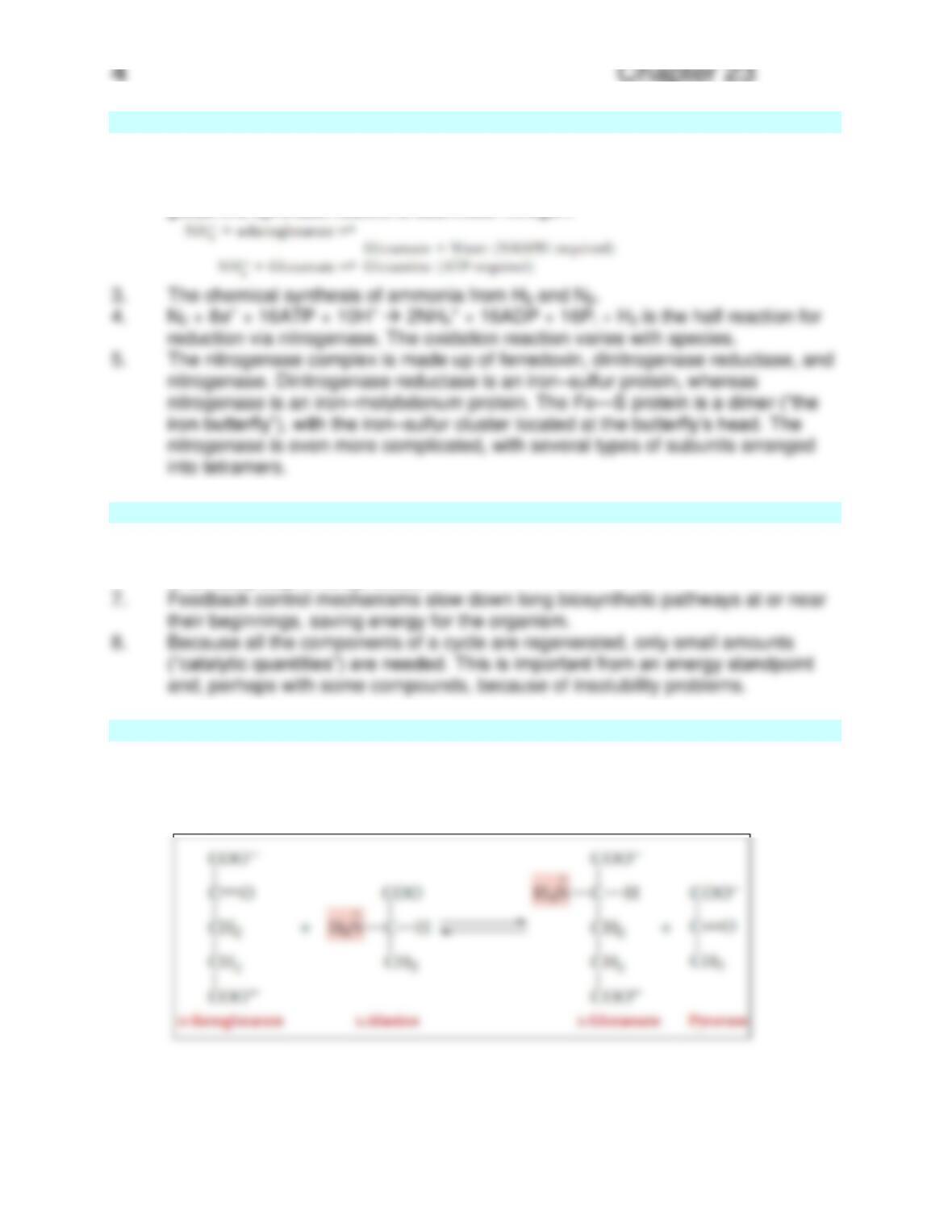
9. They are all interrelated. -Ketoglutarate can be changed to glutamate via
transamination or glutamate dehydrogenase. Glutamine synthetase makes
glutamine out of glutamate.
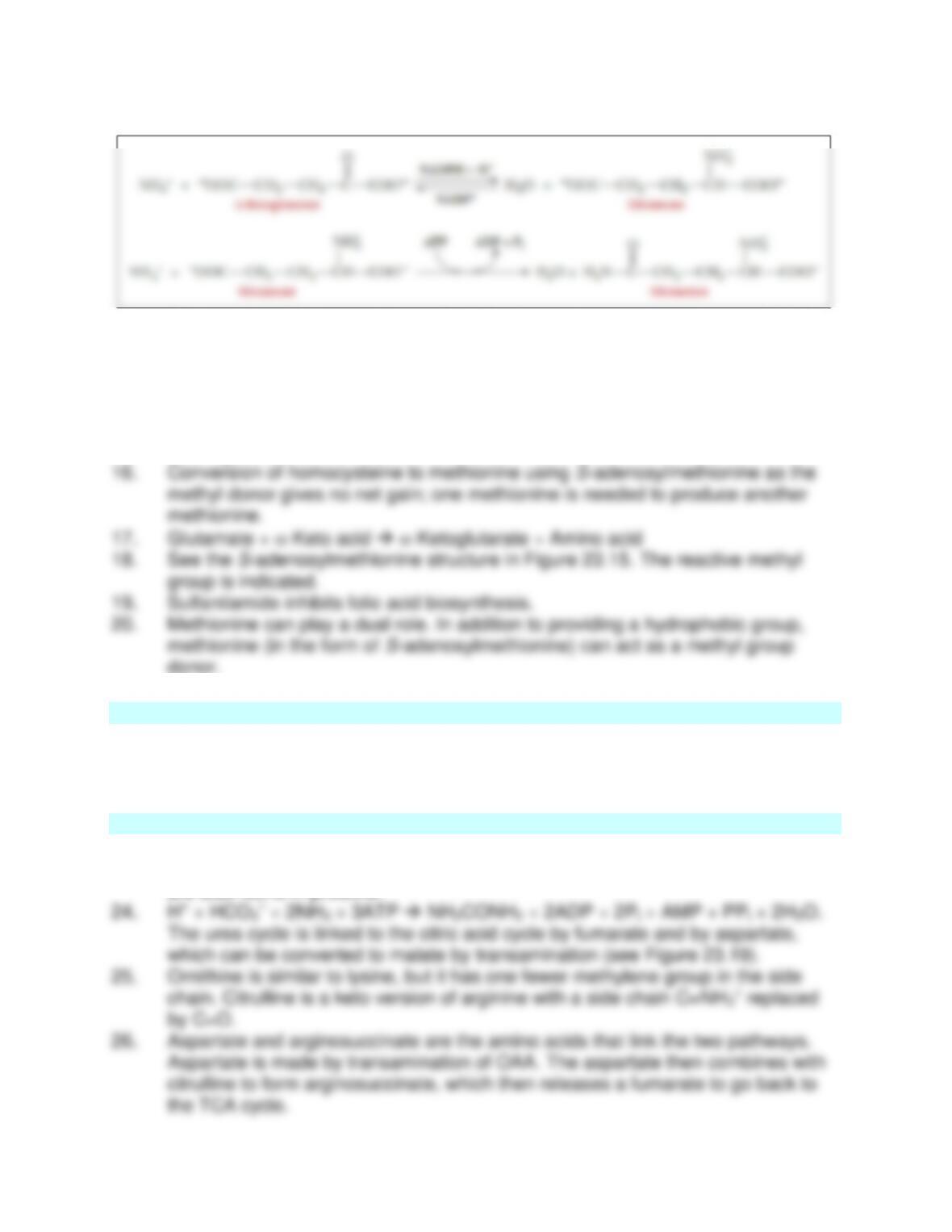
10.
The Metabolism of Nitrogen 5
11.
12. Glutamine synthetase catalyzes the following reaction and uses energy: NH4+ +
Glutamate + ATP Glutamine + ADP + Pi + H2O. Glutaminase catalyzes the
following reaction and does not use energy directly: Glutamine + H2O
Glutamate + NH4+.
13. See Figure 23.8.
14. The principal ones are tetrahydrofolate and S-adenosylmethionine.
15. See Figure 23.11.
donor.
23.5 Essential Amino Acids
21. The essential amino acids are those with branched chains, aromatic rings, or
basic side chains.
22. In both cases, the requirements are those given in Table 23.1.
23.6 Amino Acid Catabolism
23. Five -amino acids are involved directly in the urea cycle (ornithine, citrulline,
aspartate, arginosuccinate, and arginine). Of those, only aspartate and arginine
are also found in proteins.
6 Chapter 23
27. Each round of the urea cycle costs 4 ATP, two to make carbamoyl-phosphate
and effectively two (ATP 3 AMP) to make arginosuccinate.
28. It is controlled by a special effector molecule, N-acetylglutamate, which is itself
Ketogenic amino acids are degraded to acetyl-CoA or acetoacetyl-CoA.
32.
(a) Glucogenic
(f) Ketogenic
33. Fish excrete excess nitrogen as ammonia, and birds excrete it as uric acid.
Mammals excrete it as urea.
34. Because ostriches don’t fly, one could argue that they would excrete their excess
nitrogen as urea. On the other hand, they are birds, and as such probably have
the same metabolism of their lighter counterparts, and might likely excrete it as
greater thirst and need for water.
38. Several enzymes, resulting from mutations, are needed for the urea cycle. Most
mutations tend to be lost unless they provide some survival value. It seems
improbable that all the mutations needed for all the enzymes of the cycle would
23.7 Purine Biosynthesis
39. Since folic acid is critical to the formation of purines, antagonists of folic acid
metabolism are used as chemotherapy drugs to inhibit nucleic acid synthesis and
The Metabolism of Nitrogen 7
40. All four nitrogen atoms of the purine ring are derived from amino acids: two from
41. In inosine, carbon-6 of the ring is a ketone group; in adenosine, carbon-6 is
bound to an amino group.
42. Tetrahydrofolate is a carrier of carbon groups. Two of the carbons in the purine
ring are donated by tetrahydrofolate.
43. The conversion of IMP to GMP produces one NADH and uses the equivalent of 2
44. There is a complicated system of feedback inhibition for the production of purine–
containing nucleotides. The final products, ATP and GTP, feed back to inhibit the
23.8 Purine Catabolism
45. The purine salvage reaction that produces GMP requires the equivalent of 2
ATP. The pathway to IMP and then to GMP requires the equivalent of 8 ATP.
46. In most mammals, uric acid is converted to allantoic acid, which is much more
water soluble than uric acid.
23.9 Pyrimidine Biosynthesis and Catabolism
47. In purine nucleotide biosynthesis, the growing purine ring is covalently bonded to
ribose; the ribose is added after the ring is synthesized in pyrimidine nucleotide
biosynthesis.
48. Purines break down to various products, depending on the species. These
products are then excreted, representing a major means of nitrogen excretion for
23.10 Conversion of Ribonucleotides to Deoxyribonucleotides
49. Both thioredoxin and thioredoxin reductase are proteins involved in the
23.11 Conversion of dUTP to dTTP
50. Fluorouracil substitutes for thymine in DNA synthesis. In rapidly dividing cells,
8 Chapter 23
51. The DNA of fast-growing cells, such as those of the hair follicles, is damaged by
chemotherapeutic agents.