23–61
SOLUTIONS TO CONCEPTS FOR ANALYSIS
CA 23-1
(a) The main purpose of the statement of cash flows is to show the change in cash from one period to
the next. Another objective of a statement of the type shown is to summarize the financing and
investing activities of the entity, including the extent to which the enterprise has generated cash or
(b) The following are weaknesses in form and format of Maloney Corporation’s Statement of Sources
and Application of Cash:
1. The title of the statement should be Statement of Cash Flows.
2. The statement should add back to (or deduct from) net income certain items that did not use
(or provide) cash during the period. The resulting total should be described as net cash provided
3. The format used should separate the cash flows into investing, financing, and operating
activities. Noncash investing and financing activities, if significant, should be shown in a separate
schedule or note.
4. Individual items should not be grouped together, as was the case for the $14,000 item.
(c) 1. (i) The $25,000 option plan wage and salary expense should be included in the statement as
an amount added back to net income, an expense not requiring the outlay of cash during
the period.
(ii) Since the statement balances and no reference is made to the $25,000 payroll expense, it
appears the expense was not recorded or that there is an offsetting error elsewhere in the
statement.
4. The issuance of the 16,000 shares of common stock in exchange for the preferred stock
should be shown as a noncash financing activity. Since these transactions significantly change
the corporation’s capital structure, they should be disclosed.
5. The presentation of the combined total of depreciation and depletion is probably acceptable.
The general rule is that related items should be shown separately in proximity when the result
23–62
CA 23-1 (Continued)
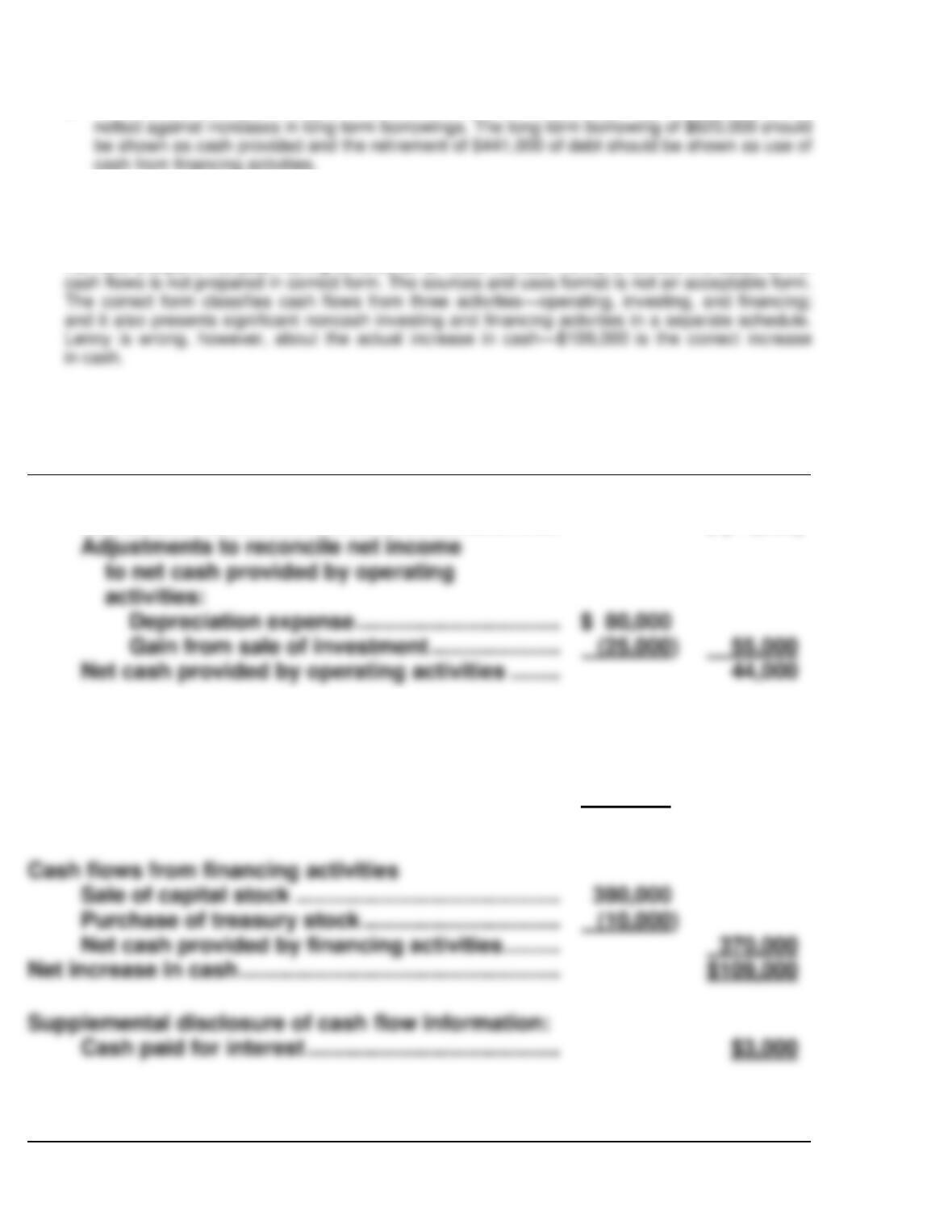
6. The details of changes in long-term debt should be shown separately. Payments should not be
CA 23-2
(a) From the information given, it appears that from an operating standpoint Pacific Clothing Store did
not have a superb first year, having suffered an $11,000 net loss. Lenny is correct; the statement of
(b) PACIFIC CLOTHING STORE
Statement of Cash Flows
For the Year Ended January 31, 2012
Cash flows from operating activities
Net loss ……………………………………………………….
$ (11,000)*
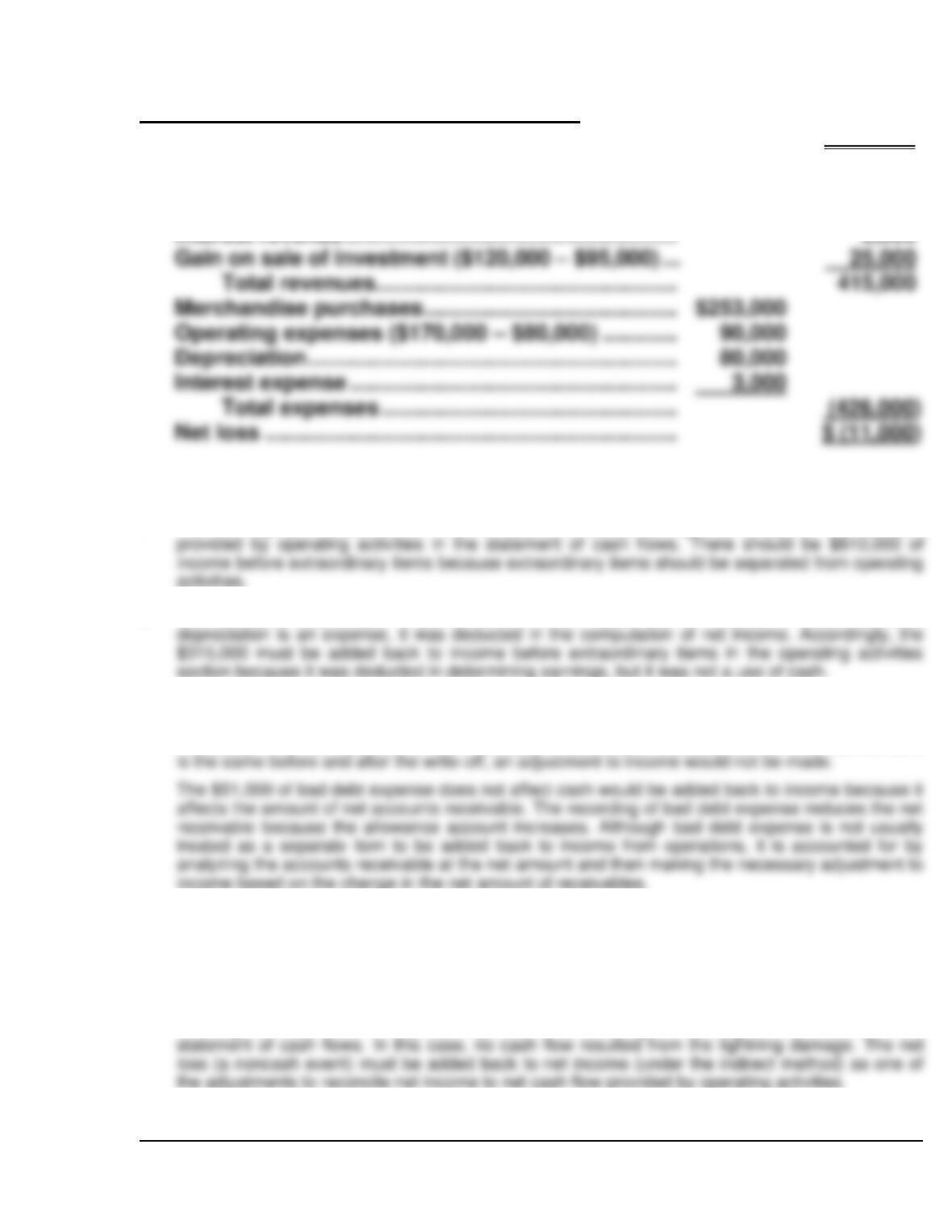
Adjustments to reconcile net income
to net cash provided by operating
activities:
Depreciation expense …………………………...
Gain from sale of investment …………………
(25,000)
Net cash provided by operating activities ……..
Cash flows from investing activities
Sale of investment ……………………………………….
120,000
Purchase of fixtures and equipment ……………..
(330,000)
Purchase of investment ……………………………….
(95,000)
Net cash used by investing activities …………….
(305,000)
Cash flows from financing activities
Sale of capital stock …………………………………….
380,000
Purchase of treasury stock …………………………..
(10,000)
Net cash provided by financing activities ………
Supplemental disclosure of cash flow information:
23–63
CA 23-2 (Continued)
Noncash investing and financing activities
Issuance of note for truck ………………………………..
$ 30,000
*Computation of net income (loss)
Sales of merchandise ………………………………………
$382,000
Interest revenue ………………………………………………
8,000
CA 23-3
1. The earnings are treated as an inflow of cash and should be reported as part of the net cash
2. The $315,000 depreciation expense is neither an inflow nor an outflow of cash. Because
3. The write-off of uncollectible accounts receivable against the allowance account has no effect on
cash because the net accounts receivable remain unchanged. An adjustment to income is only
necessary if the net receivable amount increases or decreases. Because the net receivable amount
4. The $6,000 gain realized on the sale of the machine is an ordinary gain, not an extraordinary gain,
for accounting purposes. This $6,000 gain must be deducted from net income to arrive at net
cash provided by operating activities. The proceeds of $36,000 ($30,000 + $6,000) are shown as a
cash inflow from investing activities.
5. Generally, extraordinary items are investing or financing activities and the cash inflow or outflow
resulting from such events should be reported in the investing or financing activities section of the
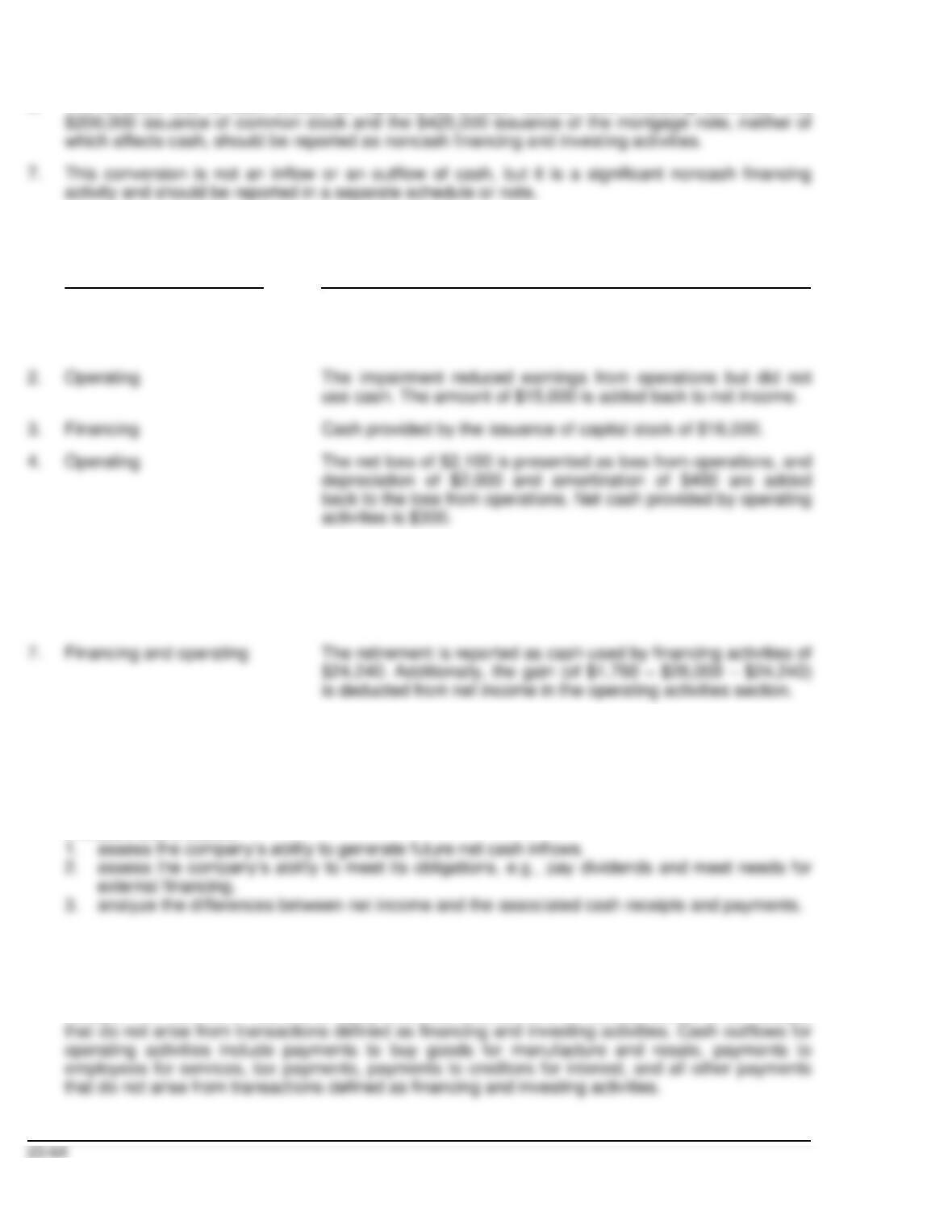
25,000
Total revenues………………………………………….
Merchandise purchases …………………………………..
Depreciation ……………………………………………………
Total expenses …………………………………………
Net loss ………………………………………………………….
CA 23-3 (Continued)
6. The $75,000 use of cash should be reported as a cash outflow from investing activities. The
CA 23-4
Where to Present
How to Present
1.
Investing and operating
Cash provided by sale of fixed assets, $4,750 as an investing
activity. In addition, the loss of $2,250 [($20,000 x 31/2) ÷ 10] –
$4,750 on the sale would be added back to net income.
3.
Financing
Cash provided by the issuance of capital stock of $16,000.
depreciation of $2,000 and amortization of $400 are added
back to the loss from operations. Net cash provided by operating
activities is $300.
5.
Not reported in statement.
6.
Investing and operating
Cash provided by the sale of the investment, $10,600 as an
investing activity. The loss of $1,400 is added back to net
income.
7.
Financing and operating
The retirement is reported as cash used by financing activities of
$24,240. Additionally, the gain (of $1,760 = $26,000 – $24,240)
is deducted from net income in the operating activities section.
CA 23-5
(a) The primary purpose of the statement of cash flows is to provide information concerning the cash
receipts and cash payments of a company during a period. The information contained in the
statement of cash flows, together with related disclosures in other financial statements, may help
investors and creditors
(b) The statement of cash flows classifies cash inflows and outflows as those resulting from operating
activities, investing activities, and financing activities.
Cash inflows from operating activities include receipts from the sale of goods and services,
receipts from returns on loans and equity securities (interest and dividends), and all other receipts
23–65
CA 23-5 (Continued)
Cash inflows from investing activities include receipts from collections or sales of debt instruments
of other companies, from the sale of the investments in those stocks, and from sales of various
productive fixed assets. Cash outflows for investing activities include payments for stocks of other
companies, purchase of productive fixed assets, and debt instruments of other companies.
(d) Noncash investing and financing transactions are to be reported in the related disclosures, either
in a narrative form or summarized within a schedule. Examples of noncash transactions are the
conversion of debt to equity, acquiring assets by assuming directly related liabilities, and ex–
changing noncash assets or liabilities for other noncash assets or liabilities. For transactions that
are part cash and part noncash, only the cash portion should be reported in the statement of cash
flows.
CA 23-6
(a) It is true that selling current assets, such as receivables and notes to factors, will generate cash
flows for the company, but this practice does not cure the systemic cash problems for the
organization. In short, it may be a bad business practice to liquidate assets, incurring expenses
and losses, in order to “window dress” the cash flow statement.
(b) Barbara Brockman should be told that if she executes her plan, the company may not survive.
While the factoring of receivables and the liquidation of inventory will indeed generate cash, the
actual amount of cash the company receives will be less than the carrying value of the receivables
and the raw materials. In addition, the company would still have the future expenditure of
replenishing its raw materials inventories, at a cost higher than the sales price.
23–66
FINANCIAL REPORTING PROBLEM
(b) The most significant item in the investing activities section is the
$3,238 million that P&G spent on “capital expenditures.” The most sig–
nificant item in the financing activities section is the $6,370 million
that P&G paid to purchase treasury stock.
23–67
COMPARATIVE ANALYSIS CASE
(a) Both Coca-Cola and PepsiCo use the indirect method of computing and
reporting net cash provided by operating activities in 2007–2009.
(b) The most significant investing activities items in 2009:
Coca-Cola
Purchase of other investments $2,152 million
Cash dividends paid $2,732 million
(c) The Coca-Cola Company has increased net cash provided by operating
activities from 2007 to 2009 by $1,036 million or 14.5%. PepsiCo, Inc.
has decreased net cash provided by operating activities by $138 million
or 2.0%. Only Coca-Cola has a favorable trend in the generation of
internal funds from operations. PepsiCo’s trend is relatively flat.
23–68
COMPARATIVE ANALYSIS CASE (Continued)
2.
Cash debt
$8,186
= 0.38:1
$6,796
= 0.30:1
coverage
($23,325 + $19,657)
($22,406 + $23,412)
2
2
(f) The current cash debt coverage ratio uses cash generated from
operations during the period and provides a better representation of
liquidity on an average day. PepsiCo’s ratio of $0.77 of cash flow from
2
23–69
FINANCIAL STATEMENT ANALYSIS CASE
VERMONT TEDDY BEAR CO.
(a) Even though prior year income exceeded the current year income by
$821,432 ($838,955 – $17,523), the current year cash flow from
operations exceeded prior year’s cash flow from operations by
$937,437 [$236,480 – ($700,957).]. This apparent paradox can be
explained by evaluating the components of cash from operating
(b) Liquidity: current cash debt coverage ratio (net cash provided by
operating activities ÷ average current liabilities)
$236,480 ÷ (($4,055,465 + $1,995,600) ÷ 2) = .078:1
Solvency: cash debt coverage ratio (net cash provided by operating
activities ÷ average total liabilities)
23–70
ACCOUNTING, ANALYSIS, AND PRINCIPLES
Accounting
LASKOWSKI COMPANY
Statement of Cash Flows
For the Year Ended December 31, 2012
Cash flows from operating activities
Net income …………………………………………………… $ 430,000
Cash flows from investing activities
Sale of machinery …………………………………………. 270,000
Purchase of machinery………………………………….. (750,000)
Net cash used by investing activities ……………… (480,000)
Analysis
Laskowski’s free cash flow is:
Net cash provided by operating activities …… $1,222,000
Less: Purchase of machinery ……………………. 750,000
Dividends ……………………………………….. 200,000
Free cash flow ………………………………………….. $ 272,000
23–71
ACCOUNTING, ANALYSIS, AND PRINCIPLES (Continued)
Principles
According to Statement of Financial Accounting Concepts No. 1, paragraph
37, “Financial reporting should provide information to help present and
potential investors and creditors and other users in assessing the
amounts, timing, and uncertainty of prospective cash receipts from
By reporting cash provided by operations, and the inflows and outflows of
cash from investing and financing decisions, the statement of cash flows
provides information relevant to assessing a company’s future cash flows.
PROFESSIONAL RESEARCH
(a) According to FASB ASC 230-10–10 (Statement of Cash Flows/Overall/
Objectives):
10-1 The primary objective of a statement of cash flows is to provide
relevant information about the cash receipts and cash payments
of an entity during a period.
As indicated in the glossary at this same section (230–10-20), cash
includes not only currency on hand but demand deposits with banks or
(b) See FASB ASC 230-10-10 (Statement of Cash Flows—Objectives)
10-2 The information provided in a statement of cash flows, if used
with related disclosures and information in the other financial
statements, should help investors, creditors, and others (including
donors) to do all of the following: