PROFESSIONAL RESEARCH (Continued)
d. Assess the effects on an entity’s financial position of both its
45–16 All of the following are cash inflows for operating activities:
a. Cash receipts from sales of goods or services, including
receipts from collection or sale of accounts and both short–
b. Cash receipts from returns on loans, other debt instruments of
other entities, and equity securities—interest and dividends.
c. All other cash receipts that do not stem from transactions
45–17 All of the following are cash outflows for operating activities:
a. Cash payments to acquire materials for manufacture or goods
for resale, including principal payments on accounts and both
b. Cash payments to other suppliers and employees for other
goods or services.
PROFESSIONAL RESEARCH (Continued)
c. Cash payments to governments for taxes, duties, fines, and
other fees or penalties and the cash that would have been paid
for income taxes if increases in the value of equity instruments
d. Cash payments to lenders and other creditors for interest.
e. Cash payment made to settle an asset retirement obligation.
PROFESSIONAL SIMULATION
Note: This assignment is available on the Kieso website.
Financial Statements
ELLWOOD HOUSE, INC.
Statement of Cash Flows
For the Year Ended December 31, 2015
Cash flows from operating activities
Net income …………………………………………………… $42,000
Adjustments to reconcile net income to net
Cash flows from investing activities
Purchase of land (c) ……………………………………… (5,500)
Sale of investments (d)………………………………….. 15,500
Net cash provided by investing activities ……….. 10,000
Noncash investing and financing activities
Issuance of bonds for equipment …………………… $32,000
PROFESSIONAL SIMULATION (Continued)
Explanation
Dear Mr. Brauer:
Enclosed is your statement of cash flows for the year ending December 31,
2015. I would like to take this opportunity to explain the changes which
occurred in your business as a result of cash activities during 2015.
(Please refer to the attached statement of cash flows.)
The second category, cash flows from investing activities, results from
the acquisition/disposal of long-term assets including the purchase of
another entity’s debt or equity securities. Your purchase of land (item c)
as well as the sale of your investment portfolio (item d) represent your
investing activities during 2015, the purchase being a $5,500 outflow
and the sale being a $15,500 inflow.
Sincerely,
IFRS CONCEPTS AND APPLICATION
IFRS23-1
IAS 7, “Cash Flow Statements,” provides the overall IFRS requirements for
cash flow information.
IFRS23-2
As in U.S. GAAP, the statement of cash flows is a required statement for
Other similarities include: (1) Companies preparing financial statements
under IFRS must prepare a statement of cash flows as an integral part;
(2) Both IFRS and U.S. GAAP require that the statement of cash flows should
Notable differences are (1) IFRS encourages companies to disclose the
aggregate amount of cash flows that are attributable to the increase in
operating capacity separately from those cash flows that are required to
maintain operating capacity; (2) The definition of cash equivalents used in
IFRS is not the same as that used in U.S. GAAP. A major difference is that in
certain situations bank overdrafts are considered part of cash and cash
IFRS23-3
Presently, the FASB and the IASB are involved in a joint project on the
presentation and organization of information in the financial statements. The
FASB favors presentation of operating cash flows using the direct method
IFRS23-4
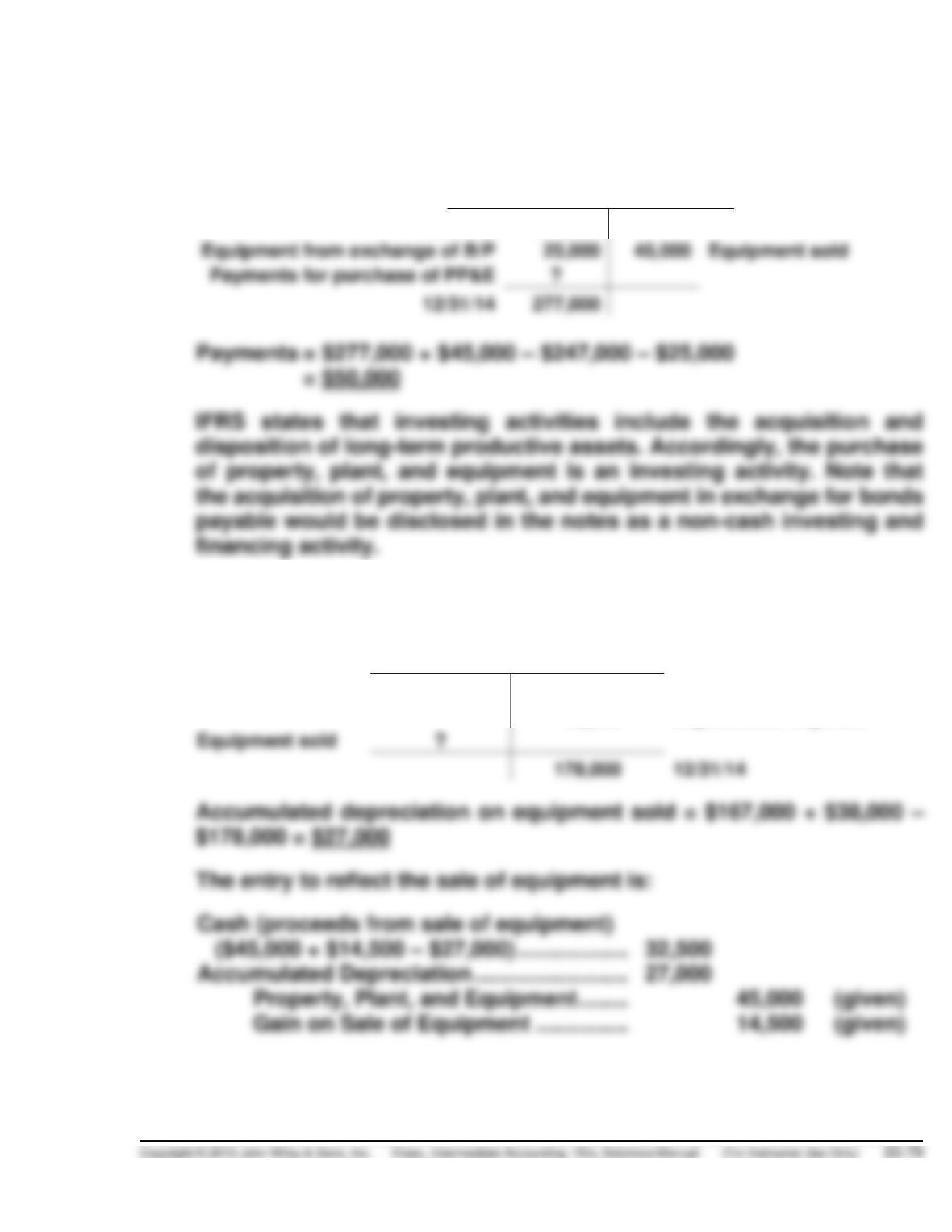
Examples of non-cash transactions are: (1) issuance of shares for non-cash
IFRS23-5
(a) Operating—add to net income.
(b) Financing activity.
(c) Investing activity.
IFRS23-6
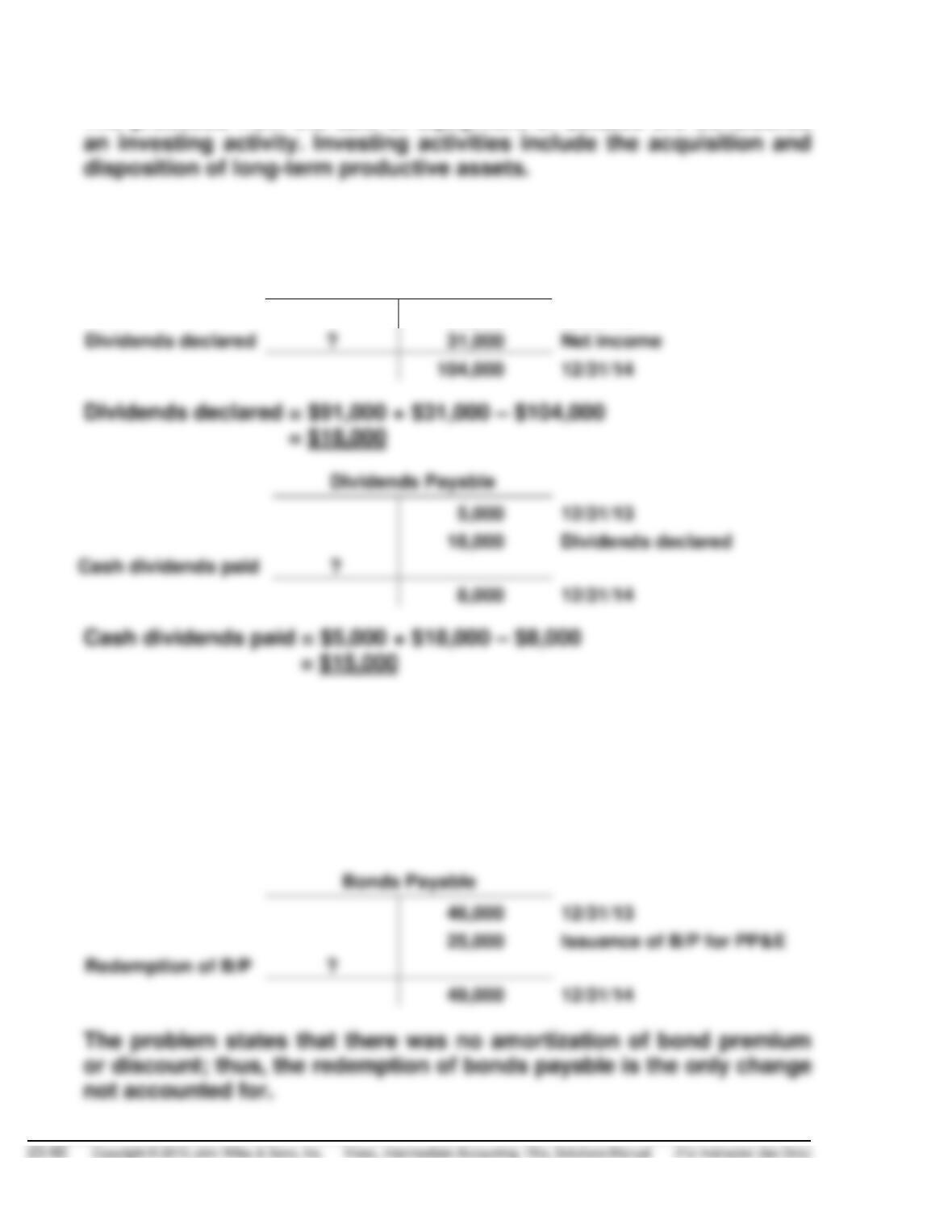
(a) The solution can be determined through use of a T-account for
Property, Plant, and Equipment.
Property, Plant & Equipment
12/31/13
247,000
Equipment sold
12/31/14
277,000
(b) The solution can be determined through use of a T-account for Accu-
mulated Depreciation.
Accumulated Depreciation
167,000
12/31/13
38,000
Depreciation expense
Equipment sold
178,000
12/31/14
IFRS23-6 (Continued)
The proceeds from the sale of equipment of $32,500 are considered
(c) The cash dividends paid can be determined by analyzing T-accounts
for Retained Earnings and Dividends Payable.
Retained Earnings
91,000
12/31/13
Dividends declared
31,000
Net income
12/31/14
12/31/13
18,000
Dividends declared
12/31/14
Financing activities include all cash flows involving liabilities and equity
other than operating items. Payment of cash dividends is thus a
financing activity.
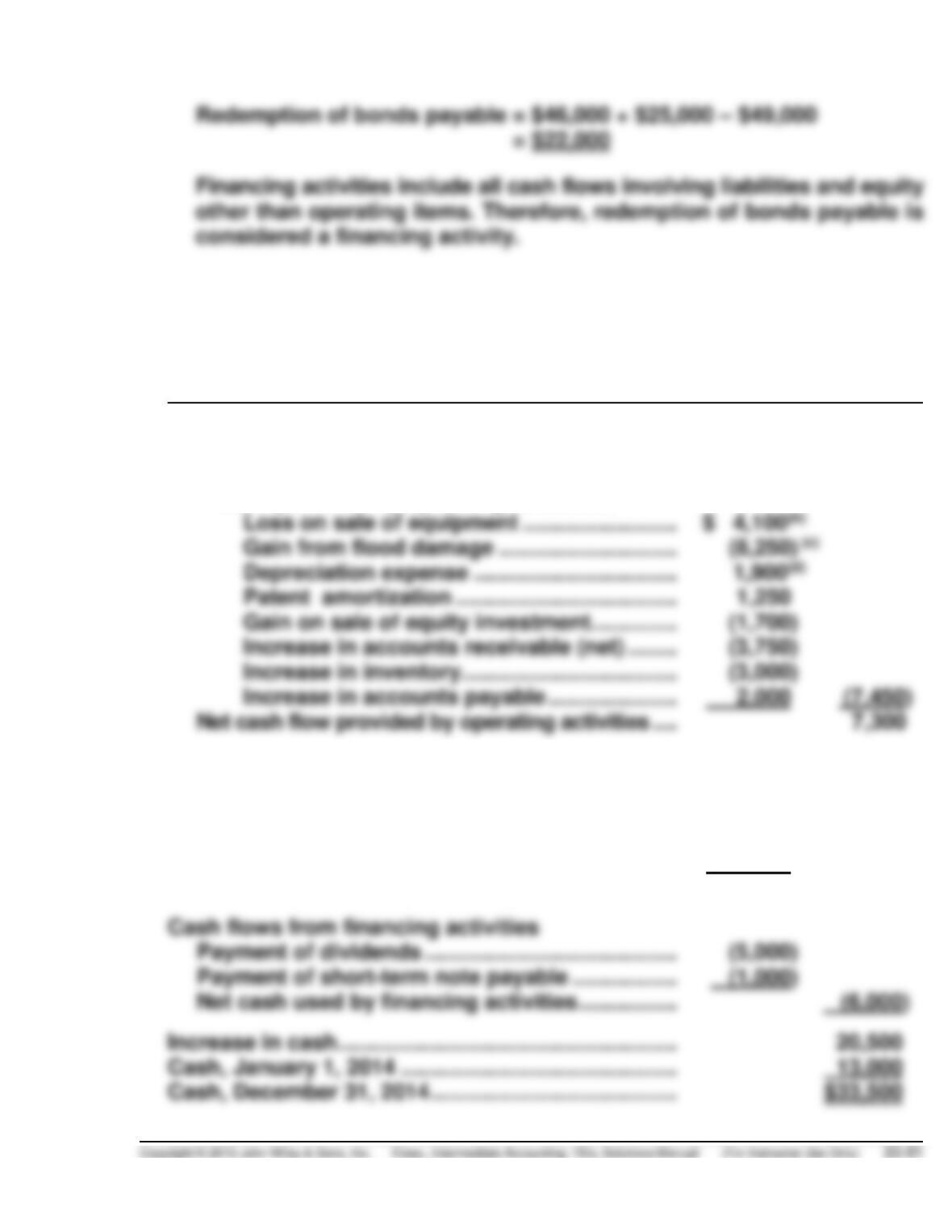
(d) The redemption of bonds payable amount is determined by setting up
a T-account for Bonds Payable.
46,000
12/31/13
25,000
Issuance of B/P for PP&E
Redemption of B/P
49,000
12/31/14
IFRS23-6 (Continued)
IFRS23-7
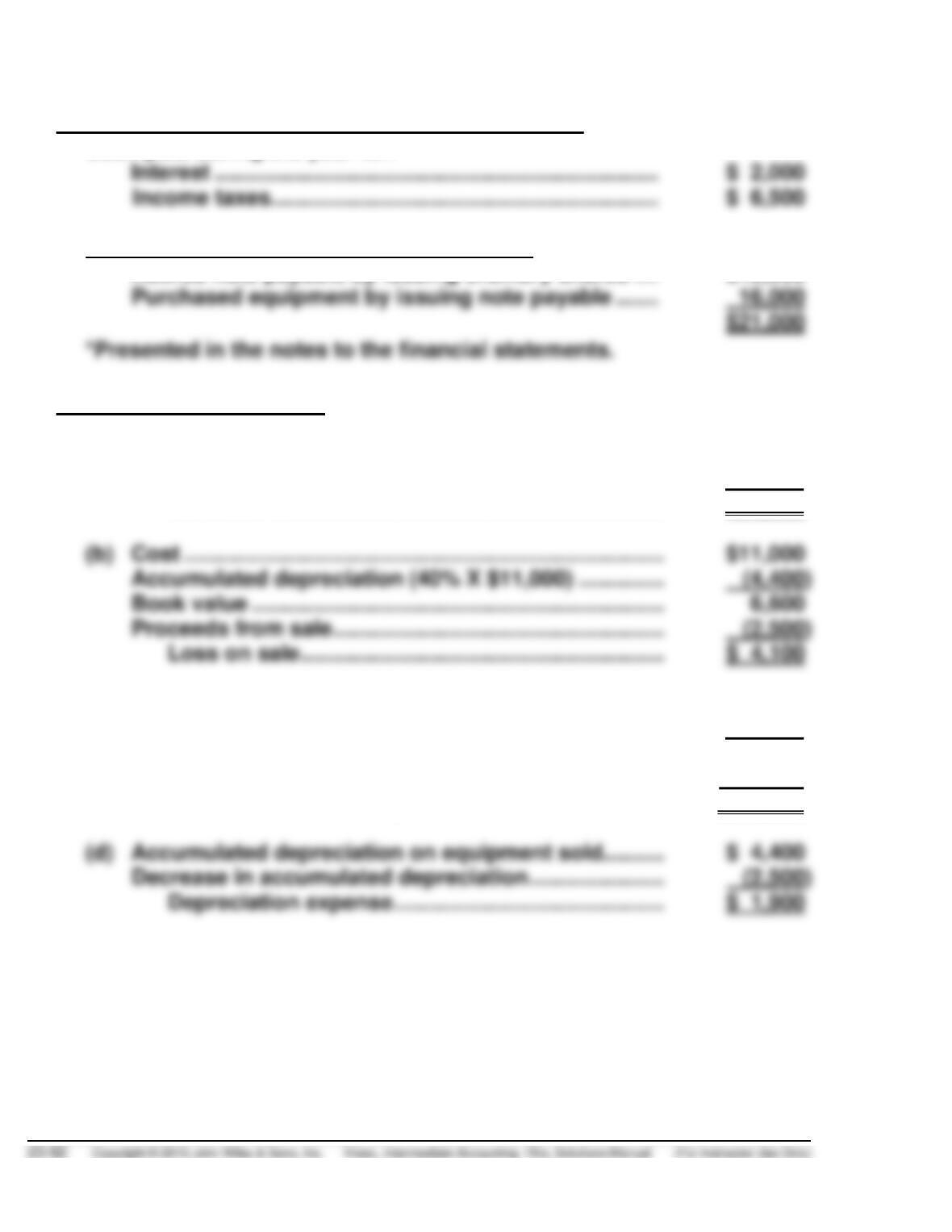
DINGEL CORPORATION
Statement of Cash Flows
For the Year Ended December 31, 2014
Cash flows from operating activities
Net income………………………………………………….. $14,750(a)
Adjustments to reconcile net income to net
cash provided by operating activities:
Cash flows from investing activities
Sale of equity investments …………………………... 4,700
Sale of equipment ……………………………………….. 2,500
Purchase of equipment (cash) ……………………… (20,000)
Proceeds from flood damage to building ………. 32,000
Net cash provided by investing activities ……… 19,200
IFRS23-7 (Continued)
Supplemental disclosures of cash flow information:
Cash paid during the year for:
Non-cash investing and financing activities:*
Retired note payable by issuing ordinary shares …. $10,000
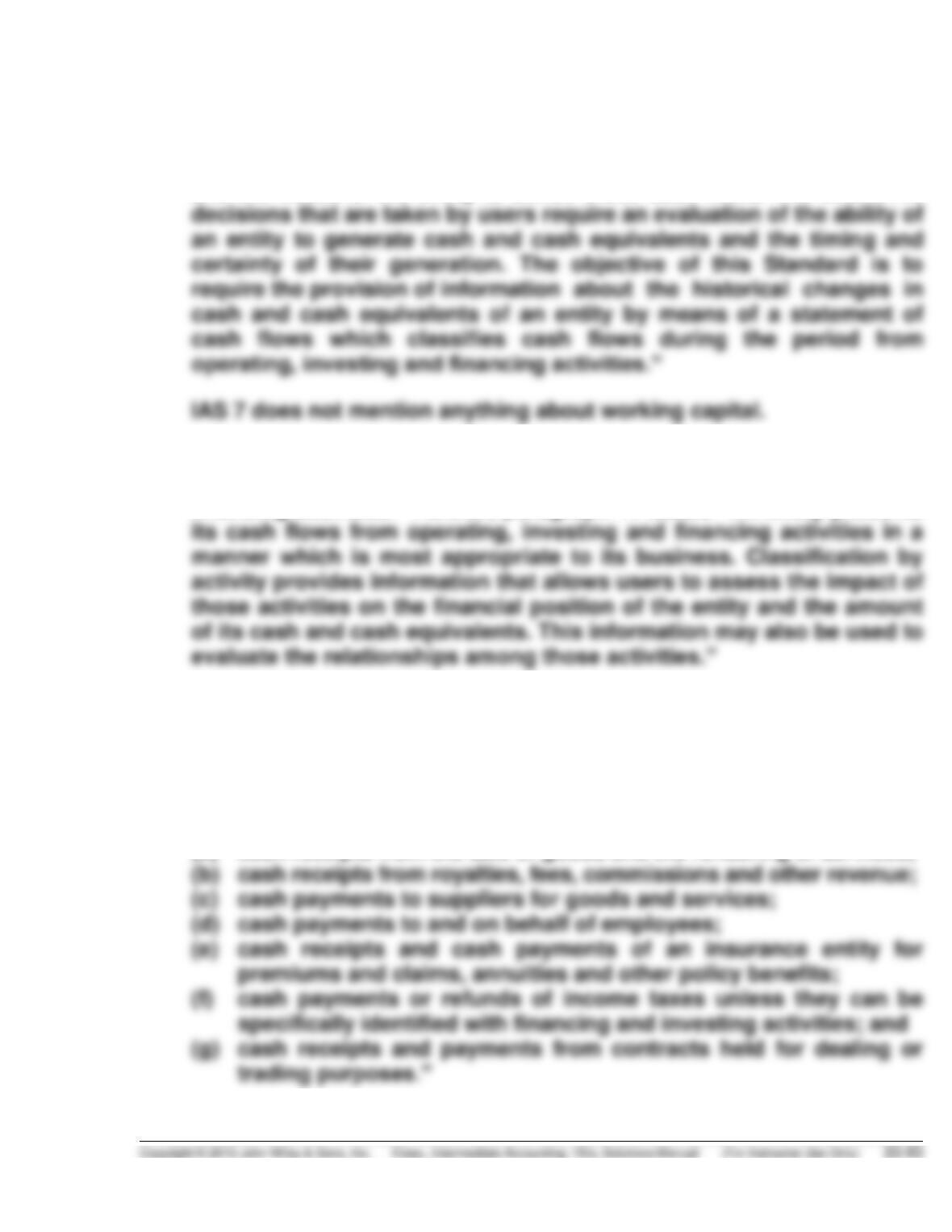
Supporting Computations:
(a) Ending retained earnings ……………………………………. $20,750
Beginning retained earnings ………………………………. (6,000)
Net income ……………………………………………………. $14,750
(c) Cost …………………………………………………………………… $29,750
Accumulated depreciation …………………………………… (6,000)
Book value …………………………………………………………. 23,750
Proceeds from insurance …………………………………….. (32,000)
Gain from flood damage …………………………………. ($ 8,250)
IFRS23-8
(a) According to IAS 7, “Information about the cash flows of an entity is
useful in providing users of financial statements with a basis to
assess the ability of the entity to generate cash and cash equivalents
and the needs of the entity to utilise those cash flows. The economic
(b) According to paragraph 10, “The statement of cash flows shall report
cash flows during the period classified by operating, investing and
financing activities.” Further, paragraph 11 states “An entity presents
(c) According to paragraph 14, “Cash flows from operating activities are
primarily derived from the principal revenue-producing activities of
the entity. Therefore, they generally result from the transactions and
other events that enter into the determination of profit or loss. Examples
of cash flows from operating activities are:
(a) cash receipts from the sale of goods and the rendering of services;
IFRS23-9
(a) M&S uses the indirect method to compute and report net cash
(b) The most significant item in the investing activities section is the
£564.3 million that M&S spent on “property, plant and equipment.” The
most significant item in the financing activities section is redemption
of medium-term notes (£307.6 million).