CHAPTER 23
Statement of Cash Flows
ASSIGNMENT CLASSIFICATION TABLE (BY TOPIC)
Topics
Questions
Brief
Exercises
Exercises
Problems
Concepts
for Analysis
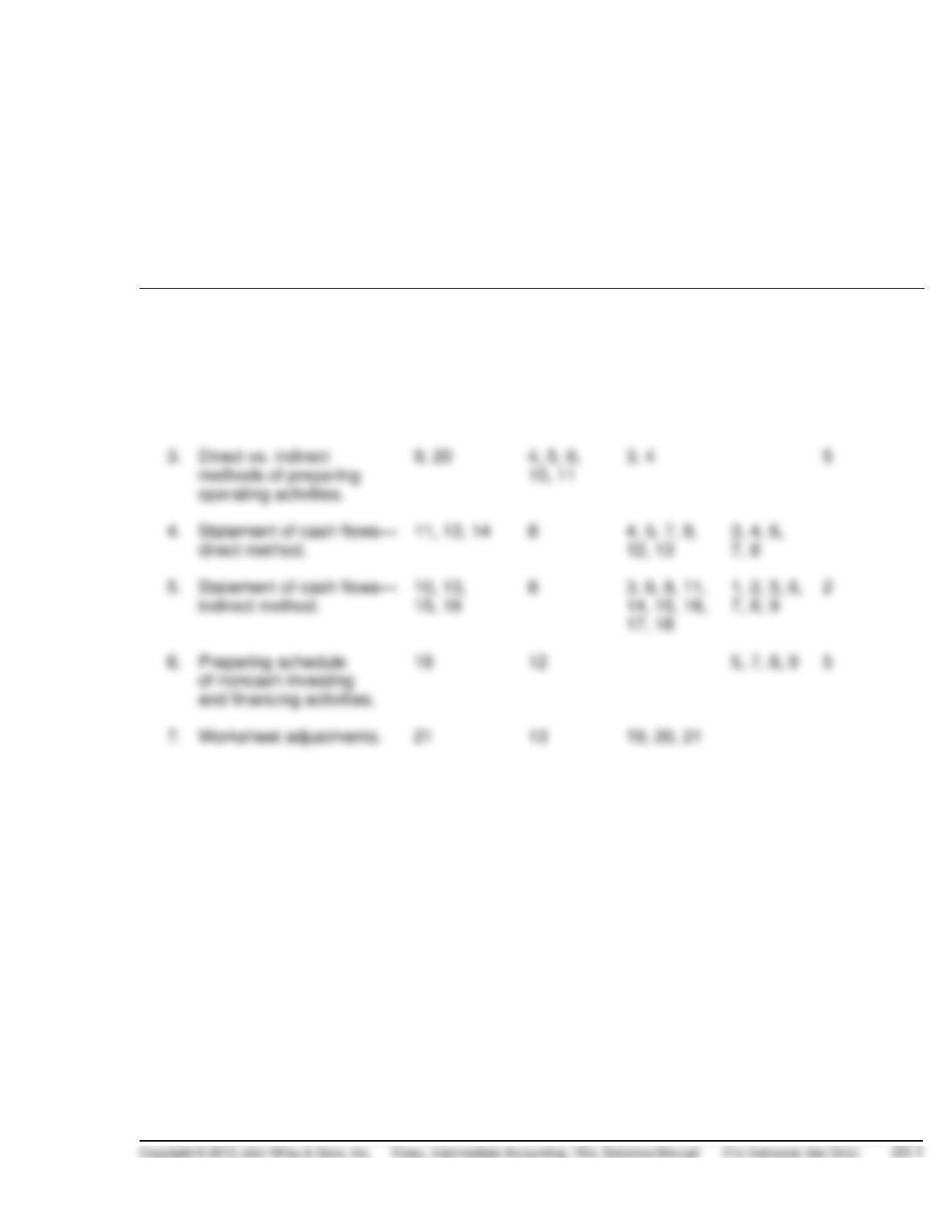
1.
Format, objectives
purpose, and source
of statement.
1, 2, 7,
8, 12
1, 2, 5, 6
2.
Classifying investing,
financing, and operating
activities.
3, 4, 5, 6,
16, 17, 19
1, 2, 3,
6, 7,
8, 12
1, 2, 10, 16
1, 3, 4, 5
3.
Direct vs. indirect
methods of preparing
operating activities.
9, 20
4, 5, 9,
10, 11
3, 4
5
Statement of cash flows—
direct method.
11, 13, 14
8
4, 5, 7, 9,
12, 13
3, 4, 6,
7, 8
5.
Statement of cash flows—
indirect method.
10, 13,
15, 16
8
3, 6, 8, 11,
14, 15, 16,
17, 18
1, 2, 5, 6,
7, 8, 9
2
6.
Preparing schedule
of noncash investing
and financing activities.
5, 7, 8, 9
5
Worksheet adjustments.
19, 20, 21
ASSIGNMENT CLASSIFICATION TABLE (BY LEARNING OBJECTIVE)
Learning Objectives
Questions
Brief
Exercises
Exercises
Problems
Concepts for
Analysis
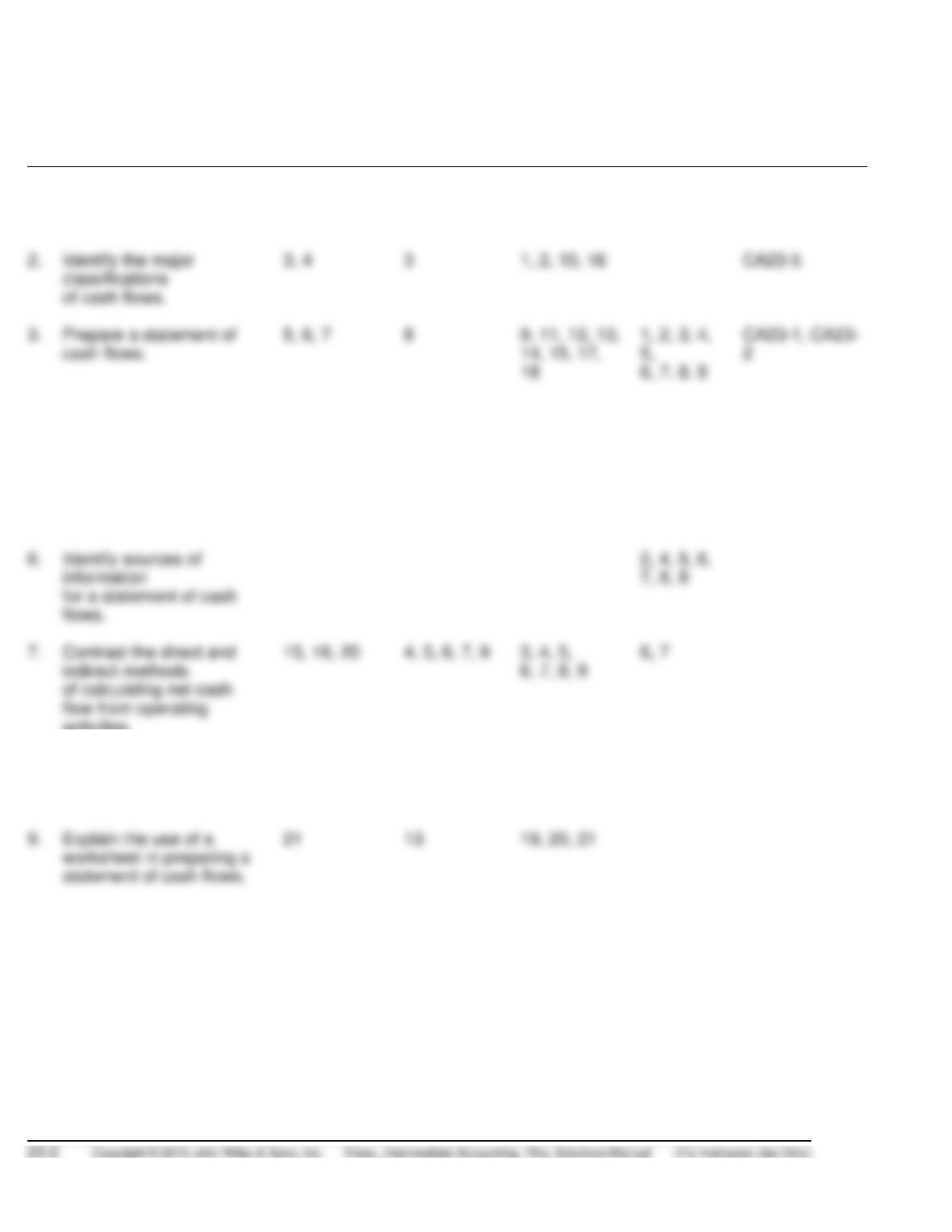
1. Describe the purpose of
the statement
of cash flows.
1, 2
CA23-5
2. Identify the major
classifications
of cash flows.
3, 4
3
1, 2, 10, 16
CA23-5
3. Prepare a statement of
cash flows.
5, 6, 7
8
9, 11, 12, 13,
14, 15, 17,
1, 2, 3, 4,
5,
CA23-1, CA23-
2
4. Differentiate between net
income and net cash flow
from operating activities.
8, 9, 10, 11,
12
4, 5, 9, 10,
11
2, 4, 5, 6, 7,
8, 11, 16
1
CA23-3
5. Determine net cash flows
from investing and
financing activities.
13, 14
1, 2
16
CA23-4
for a statement of cash
flows.
7, 8, 9
flow from operating
activities.
8. Discuss special problems
in preparing
a statement of cash flows.
17, 18, 19
12
10, 18
1, 2, 4, 5,
6, 7, 8, 9
CA23-6
9. Explain the use of a
worksheet in preparing a
statement of cash flows.
21
13
19, 20, 21
ASSIGNMENT CHARACTERISTICS TABLE
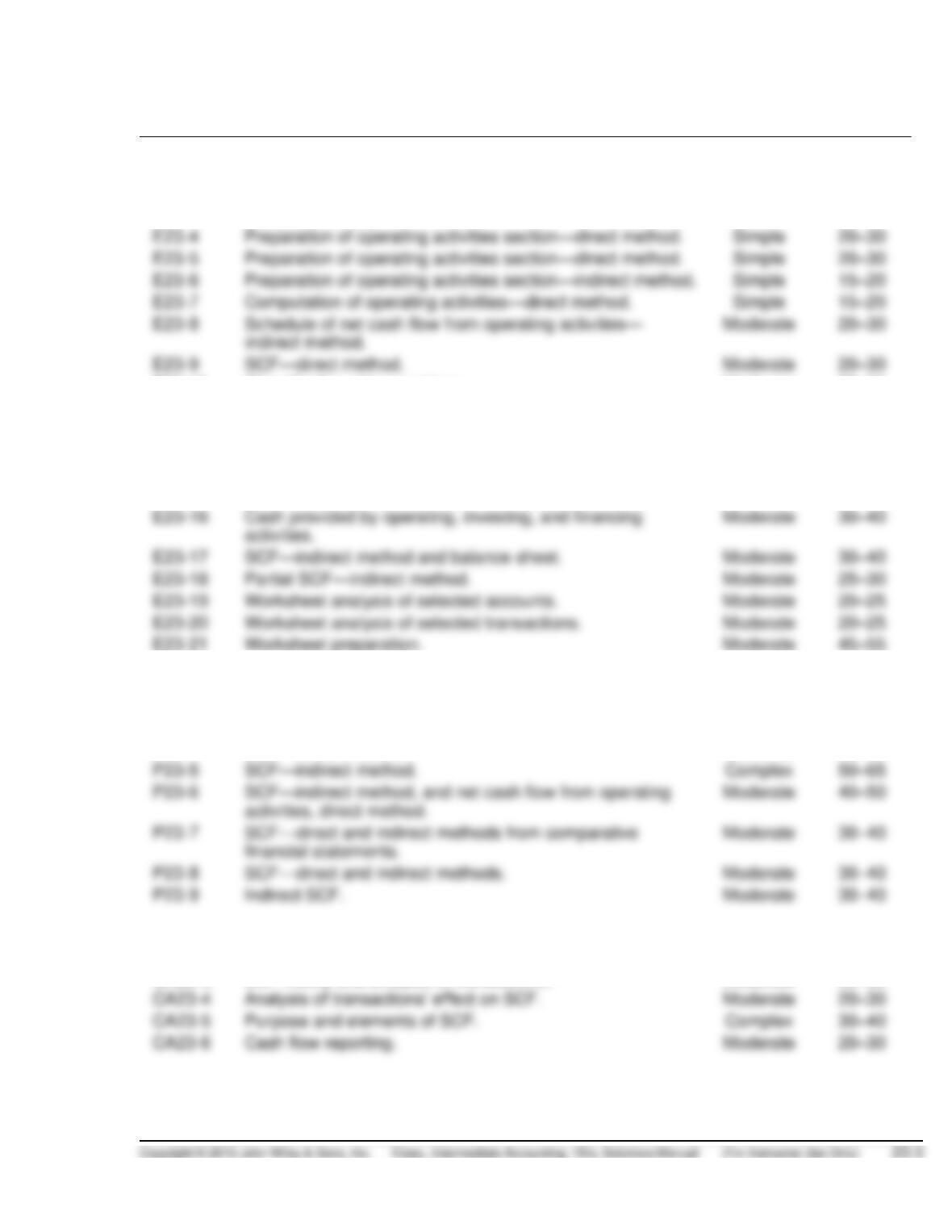
Item
Description
Level of
Difficulty
Time
(minutes)
E23-1
Classification of transactions.
Simple
10–15
E23-2
Statement presentation of transactions—indirect method.
Moderate
20–30
E23-3
Preparation of operating activities section—indirect method,
periodic inventory.
Simple
15–25
E23-4
Preparation of operating activities section—direct method.
Simple
20–30
E23-5
Preparation of operating activities section—direct method.
Simple
20–30
E23-6
Preparation of operating activities section—indirect method.
Simple
15–20
E23-7
Computation of operating activities—direct method.
Simple
15–20
E23-8
Schedule of net cash flow from operating activities—
indirect method.
20–30
E23-9
SCF—direct method.
Moderate
20–30
E23-10
Classification of transactions.
Moderate
25–35
E23-11
SCF—indirect method.
Moderate
30–35
E23-12
SCF—direct method.
Moderate
20–30
E23-13
SCF—direct method.
Moderate
30–40
E23-14
SCF—indirect method.
Moderate
30–40
E23-15
SCF—indirect method.
Moderate
25–35
E23-16
Cash provided by operating, investing, and financing
activities.
30–40
E23-17
SCF—indirect method and balance sheet.
Moderate
30–40
E23-18
Partial SCF—indirect method.
Moderate
25–30
E23-19
Worksheet analysis of selected accounts.
Moderate
20–25
E23-20
Worksheet analysis of selected transactions.
Moderate
20–25
P23-1
SCF—indirect method.
Moderate
40–45
P23-2
SCF—indirect method.
Moderate
50–60
P23-3
SCF—direct method.
Complex
50–60
P23-4
SCF—direct method.
Moderate
45–60
P23-5
SCF—indirect method.
Complex
50–65
P23-6
activities, direct method.
40–50
P23-7
financial statements.
30–40
P23-8
SCF—direct and indirect methods.
Moderate
30–40
P23-9
Indirect SCF.
Moderate
30–40
CA23-1
Analysis of improper SCF.
Moderate
30–35
CA23-2
SCF theory and analysis of improper SCF.
Moderate
30–35
CA23-3
SCF theory and analysis of transactions.
Moderate
30–35
CA23-4
Moderate
20–30
CA23-5
Purpose and elements of SCF.
Complex
30–40
CA23-6
Cash flow reporting.
Moderate
20–30
CE23-1
Master Glossary
(a) Cash equivalents are short-term, highly liquid investments that have both of the following
characteristics:
1. Readily convertible to known amounts of cash
2. So near their maturity that they present insignificant risk of changes in value because of
changes in interest rates.
Generally, only investments with original maturities of three months or less qualify under that
(b) Financing activities include obtaining resources from owners and providing them with a return
on, and a return of, their investment; receiving restricted resources that by donor stipulation must
(c) Investing activities include making and collecting loans and acquiring and disposing of debt or
equity instruments and property, plant, and equipment and other productive assets, that is,
(d) Operating activities include all transactions and other events that are not defined as investing or
financing activities (see paragraphs 230–10–45-12 through 45-15). Operating activities generally
CE23-2
According to FASB ASC 230-10–45-14 (Statement of Cash Flow—Other Presentation Matters—Cash
Flows from Financing Activities):
All of the following are cash inflows from financing activities:
(a) Proceeds from issuing equity instruments.
(b) Proceeds from issuing bonds, mortgages, notes, and from other short- or long-term borrowing.
CE23-2 (Continued)
(c) Receipts from contributions and investment income that by donor stipulation are restricted for the
purposes of acquiring, constructing, or improving property, plant, equipment, or other long-lived
CE23-3
According to FASB ASC 230-10–45-11 (Statement of Cash Flows—Other Presentation Matters—Cash
CE23-4
According to FASB ASC 230-10–50-3 (Statement of Cash Flows—Disclosure—Noncash Investing and
Financing Activities):
Information about all investing and financing activities of an entity during a period that affect recognized
ANSWERS TO QUESTIONS
1. The main purpose of the statement of cash flows is to provide information about a company’s cash
2. Some uses of this statement are:
Assessing future cash flows: Income data when augmented with current cash flow data provide a
better basis for assessing future cash flows.
Assessing reasons for differences between income and net cash flow from operation:
3. Investing activities generally involve long-term assets and include (1) lending money and collecting
on those loans and (2) acquiring and disposing of investments and productive long-lived assets.
4. Examples of sources of cash in a statement of cash flows include cash from operating activities,
issuance of debt, issuance of capital stock, sale of investments, and the sale of property, plant,
5. Preparing the statement of cash flows involves three major steps:
(1) Determine the change in cash. This is simply the difference between the beginning and ending
cash balances.
6. Purchase of land—investing;
Payment of dividends—financing;
Cash sales—operating;
Purchase of treasury stock—financing.
7. Comparative balance sheets, a current income statement, and certain transaction data all provide
information necessary for preparation of the statement of cash flows. Comparative balance sheets
Questions Chapter 23 (Continued)
8. It is necessary to convert accrual-based net income to a cash basis because net income includes
items that do not provide or use cash. An example would be an increase in accounts receivable.
9. Net cash flow from operating activities under the direct method is the difference between cash
revenues and cash expenses. The direct method adjusts the revenues and expenses directly to
10. Net cash flow from operating activities is $3,820,000. Using the indirect method, the solution is:
Net income …………………………………………………………………….. $3,500,000
11. Accrual basis sales ……………………………………………………. $100,000
Less: Increase in accounts receivable …………………………. 30,000
70,000
Less: Write-off of accounts receivable …………………………. 2,000
Cash sales ……………………………………………………………….. $ 68,000
12. A number of factors could have caused an increase in cash despite the net loss. These are: (1) high
13. Declared dividends ……………………………………………………. $260,000
Add: Dividends payable (beginning of year) ………………….. 85,000
345,000
Deduct: Dividends payable (end of year) ……………………… 90,000
Cash paid in dividends during the year …………………………. $255,000
14. To determine cash payments to suppliers, it is first necessary to find purchases for the year. To
find purchases, cost of goods sold is adjusted for the change in inventory (increased when
15. Cash flows from operating activities
Net income ……………………………………………………………… $320,000
Adjustments to reconcile net income to net cash
Questions Chapter 23 (Continued)
16. (a) Cash flows from operating activities
Net income …………………………………………………………………… XXXX
Adjustments to reconcile net income to net
cash provided by operating activities:
Loss on sale of plant assets
17. (a) Operating activity. (g) Operating activity.
(b) Financing activity. (h) Financing activity.
18. Examples of noncash transactions are: (1) issuance of stock for noncash assets, (2) issuance of stock
to liquidate debt, (3) issuance of bonds or notes for noncash assets, and (4) noncash exchanges of
property, plant, and equipment.
19. Cash flows from operating activities
Net income………………………………………………………………………….. XXXX
20. Arguments for the indirect or reconciliation method are:
(a) By providing a reconciliation between net income and net cash provided by operating
Questions Chapter 23 (Continued)
(c) There is some question as to whether the direct method is cost/benefit-justified as this
method would probably lead to additional preparation cost because the financial records are
not maintained on a cash basis.
21. A worksheet is desirable because it allows the orderly accumulation and classification of data that
SOLUTIONS TO BRIEF EXERCISES
BRIEF EXERCISE 23-1
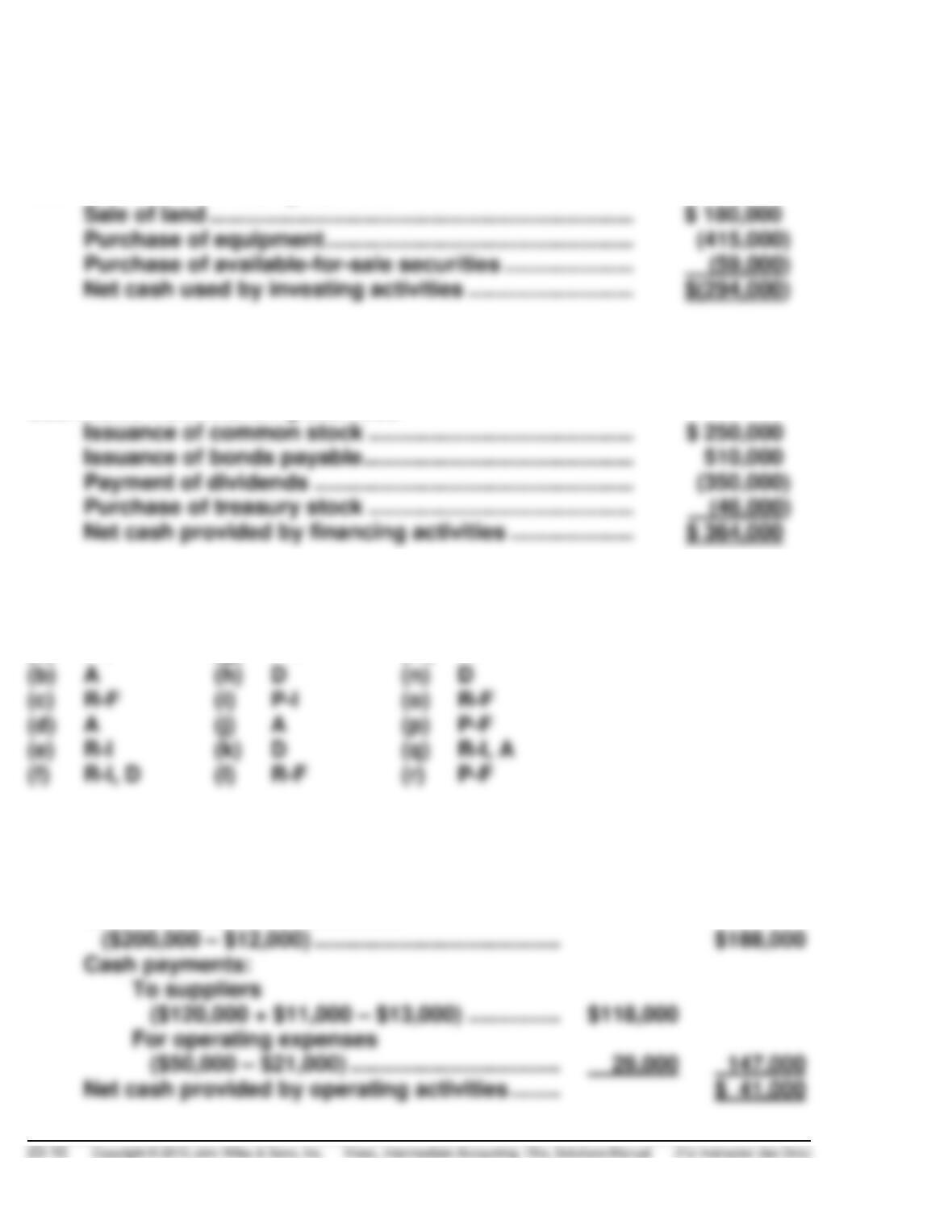
Cash flows from investing activities
Sale of land ……………………………………………………………
Purchase of equipment …………………………………………..
Purchase of available-for-sale securities …………………
BRIEF EXERCISE 23-2
Cash flows from financing activities
Issuance of common stock …………………………………….
Issuance of bonds payable ……………………………………..
Payment of dividends …………………………………………….
Purchase of treasury stock …………………………………….
BRIEF EXERCISE 23-3
(a)
P-I
(g)
P-F
(m)
N
(b)
A
(h)
D
(n)
D
(c)
R-F
(i)
P-I
(o)
R-F
(d)
A
(j)
A
(p)
P-F
(e)
R-I
(k)
D
(q)
R-I, A
R-I, D
(l)
R-F
(r)
P-F
BRIEF EXERCISE 23-4
Cash flows from operating activities
Cash received from customers
($200,000 – $12,000) …………………………………..
Cash payments:
To suppliers
($120,000 + $11,000 – $13,000) …………….
For operating expenses
BRIEF EXERCISE 23-5
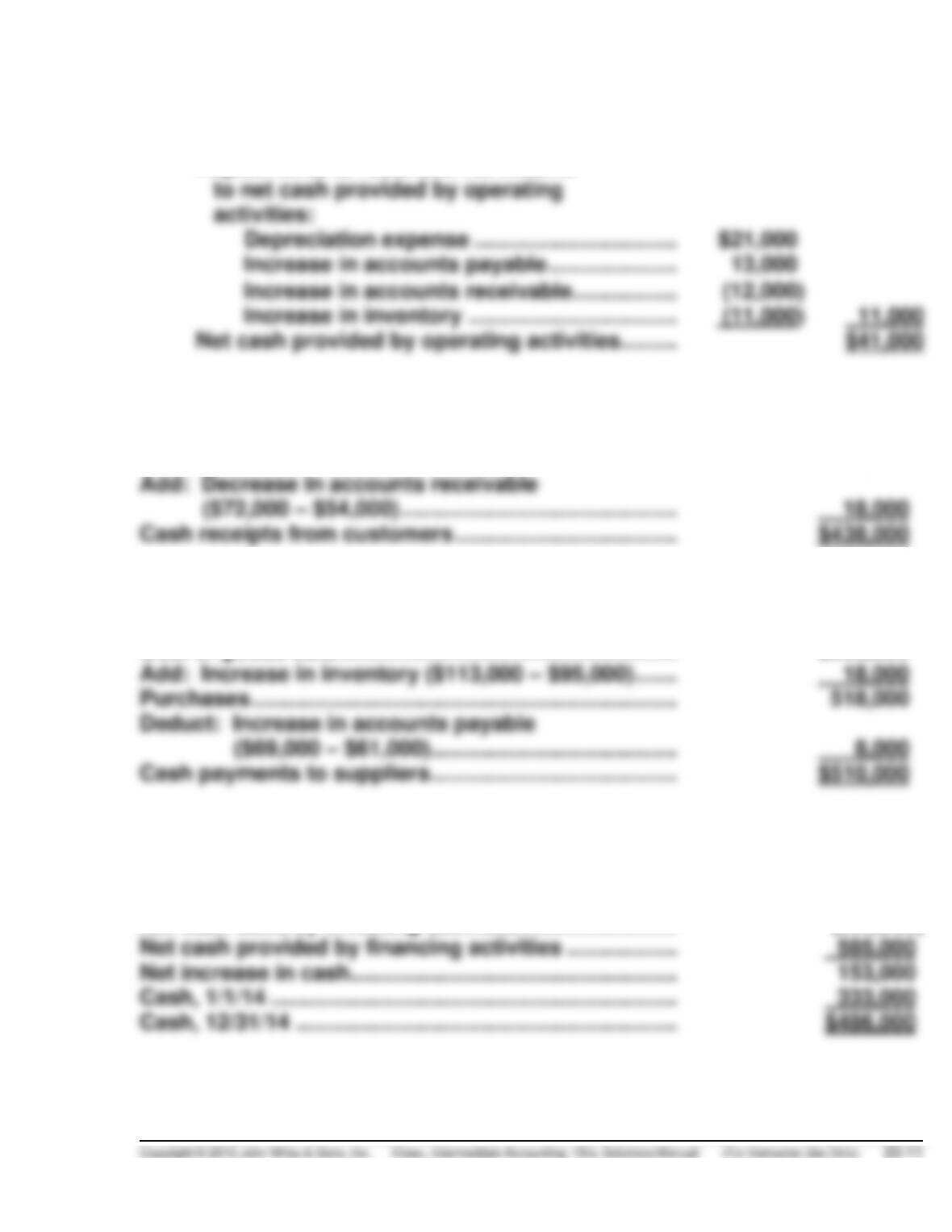
Cash flows from operating activities
Net income …………………………………………………..
$30,000
Adjustments to reconcile net income
to net cash provided by operating
activities:
Depreciation expense …………………………...
Increase in accounts receivable ……………..
Increase in inventory …………………………….
BRIEF EXERCISE 23-6
Sales revenue ………………………………………………………
$420,000
Cash receipts from customers ………………………………
$438,000
BRIEF EXERCISE 23-7
Cost of goods sold ……………………………………………….
$500,000
Add: Increase in inventory ($113,000 – $95,000) …….
18,000
Purchases ……………………………………………………………
518,000
Cash payments to suppliers ………………………………….
$510,000
BRIEF EXERCISE 23-8
Net cash provided by operating activities ……………………
$531,000
Net cash used by investing activities ………………………….
(963,000)
Net cash provided by financing activities ……………………
Net increase in cash …………………………………………………..
Cash, 1/1/14 ………………………………………………………………
BRIEF EXERCISE 23-9
(a)
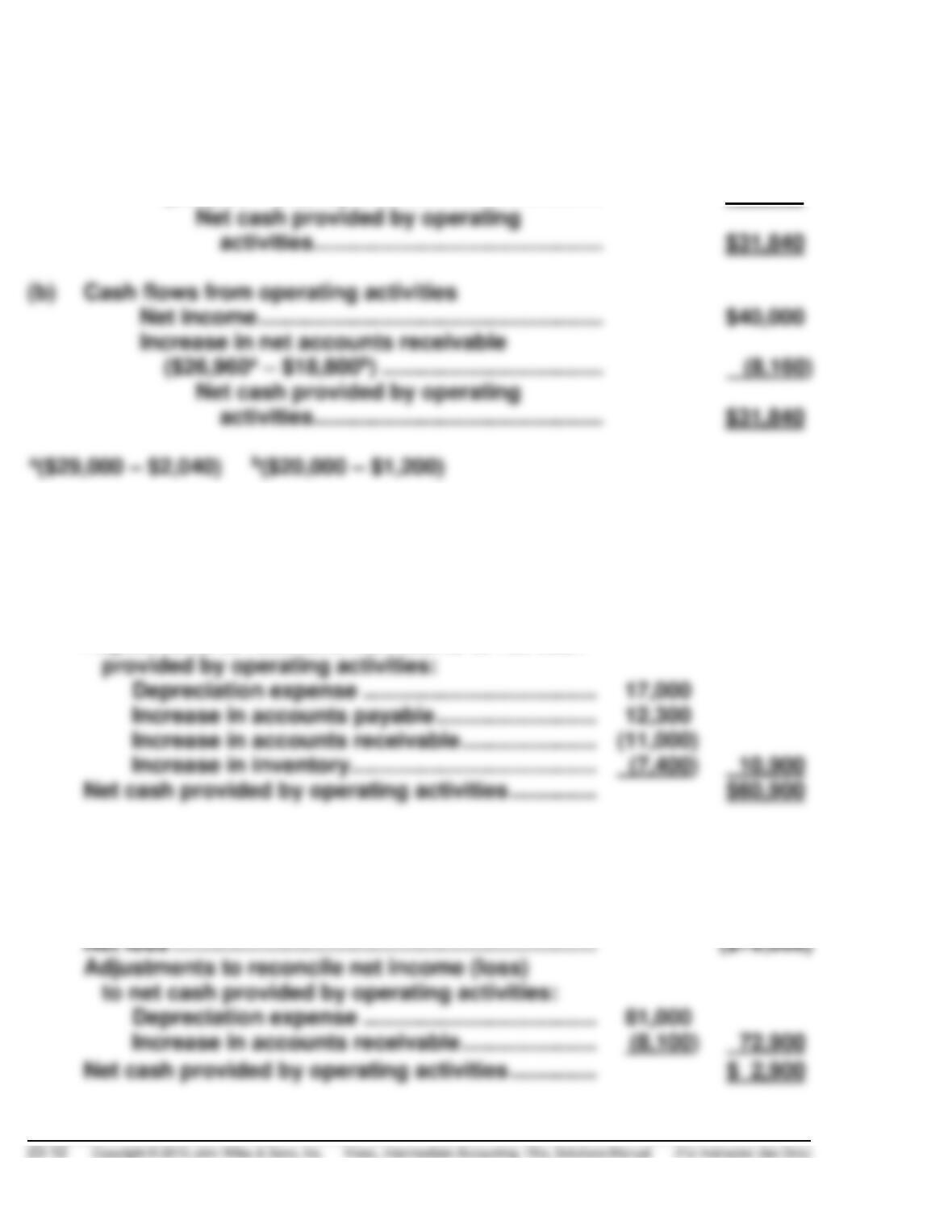
Cash flows from operating activities
Cash received from customers …………………………..
$90,000
Cash payments for expenses
($60,000 – $1,840) …………………………………………..
58,160
Net cash provided by operating
(b)
Cash flows from operating activities
Net income ……………………………………………………….
Net cash provided by operating
activities ………………………………………………..
BRIEF EXERCISE 23-10
Cash flows from operating activities
Net income ……………………………………………………….
$50,000
Adjustments to reconcile net income to net cash
provided by operating activities:
Depreciation expense ………………………………..
Increase in accounts payable ……………………..
Increase in accounts receivable ………………….
Increase in inventory ………………………………….
BRIEF EXERCISE 23-11
Cash flows from operating activities:
Net loss ……………………………………………………………
Adjustments to reconcile net income (loss)
to net cash provided by operating activities:
Depreciation expense ………………………………..
BRIEF EXERCISE 23-12
(a)
Land ……………………………………………………….……………..
40,000
Common Stock ……………………………………………….
10,000
Paid-in Capital in Excess of Par—
Common Stock …………………………………………..
30,000
(b)
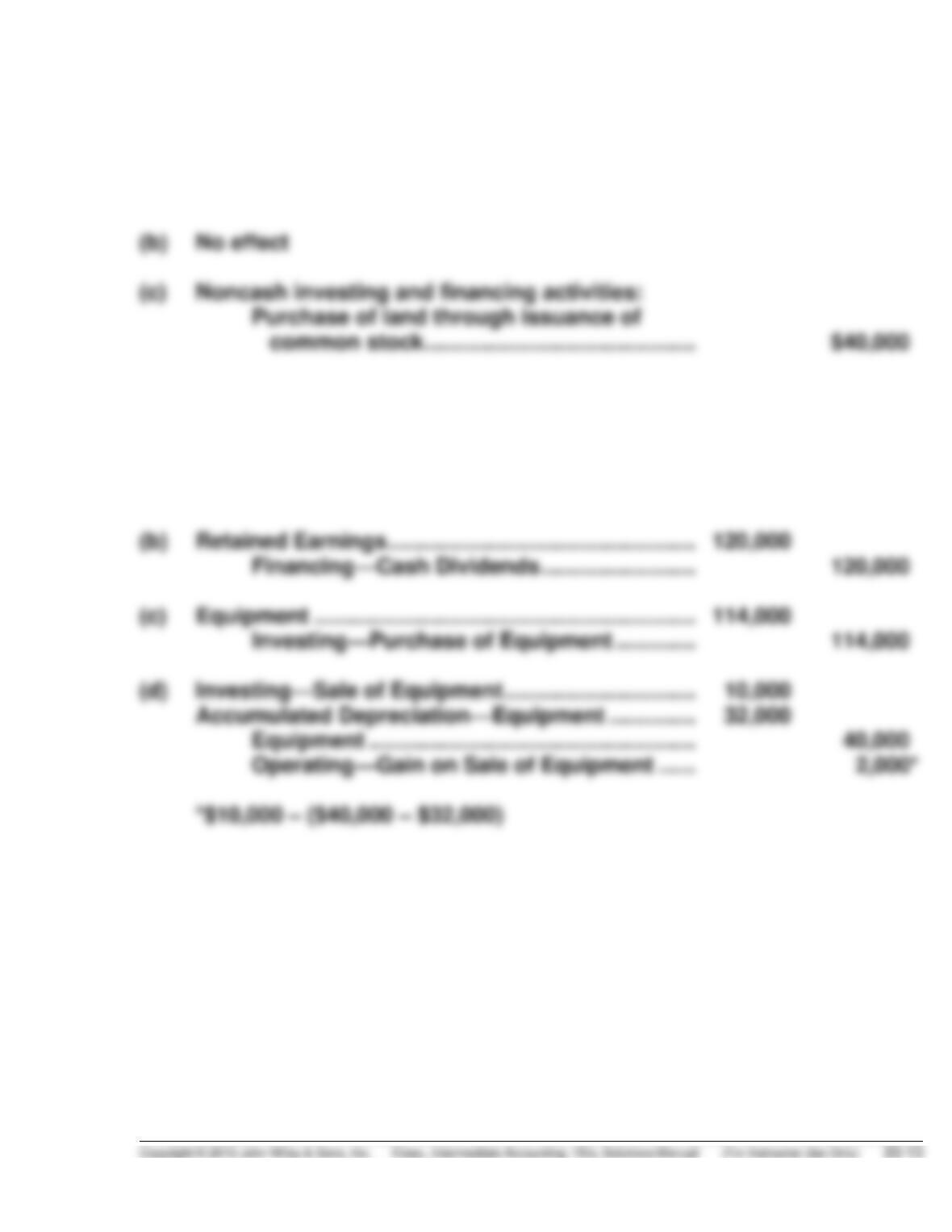
No effect
(c)
Noncash investing and financing activities:
Purchase of land through issuance of
common stock …………………………..…………………
BRIEF EXERCISE 23-13
(a)
Operating—Net Income …………………………………………..
317,000
Retained Earnings …………………………………………..
317,000
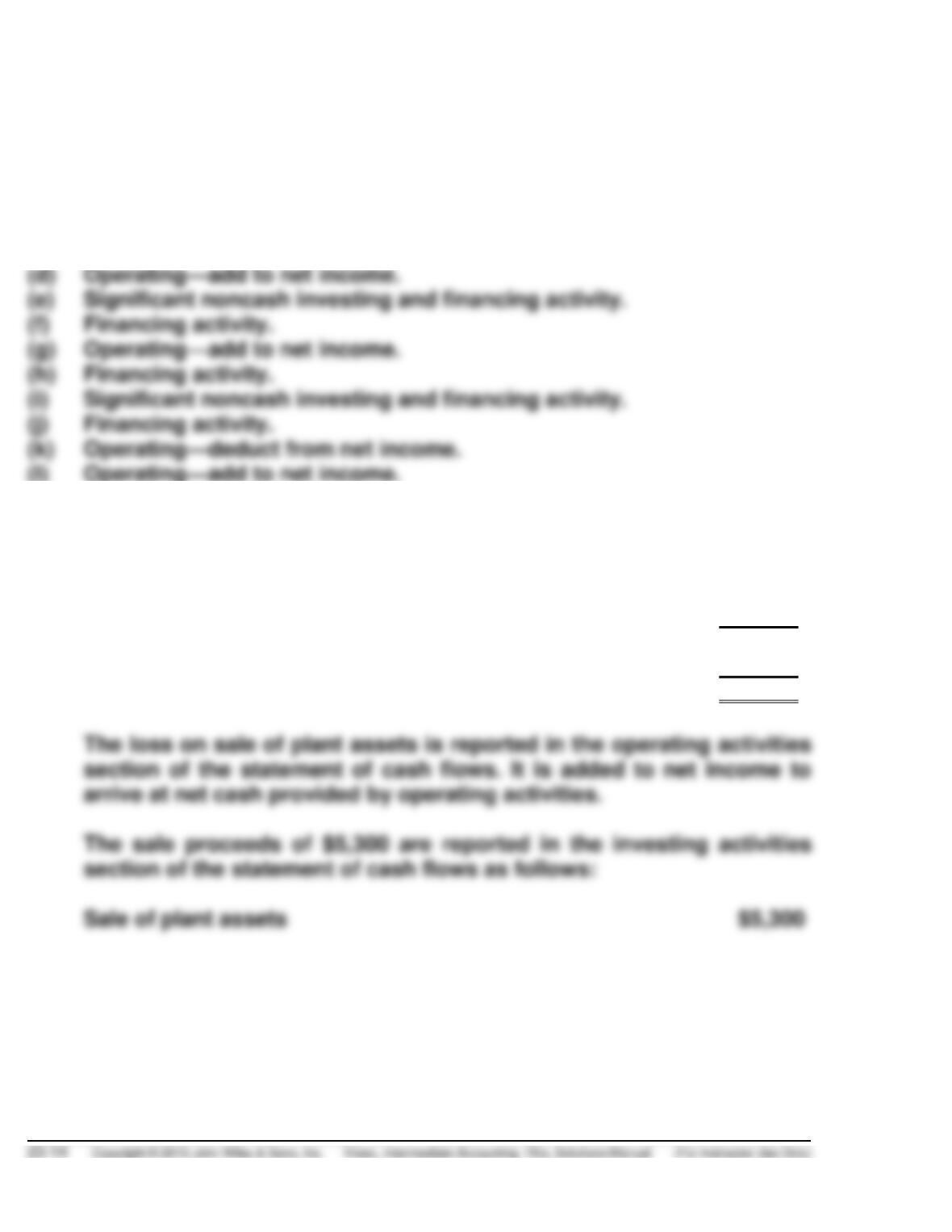
(b)
Retained Earnings …………………………………………………..
120,000
Financing—Cash Dividends …………………………..
120,000
(c)
Equipment ……………………………………………………….
114,000
Investing—Purchase of Equipment ………………….
(d)
Investing—Sale of Equipment …………………………..
Equipment ……………………………………………………..
40,000
Operating—Gain on Sale of Equipment ……………
SOLUTIONS TO EXERCISES
EXERCISE 23-1 (10–15 minutes)
(a) Investing activity.
(b) Financing activity.
(c) Investing activity.
EXERCISE 23-2 (20–30 minutes)
(a)
Plant assets (cost)
$20,000)
Accumulated depreciation ([$20,000 10] X 6)
12,000)
Book value at date of sale
8,000)
Sale proceeds
(5,300)
Loss on sale
$ 2,700)
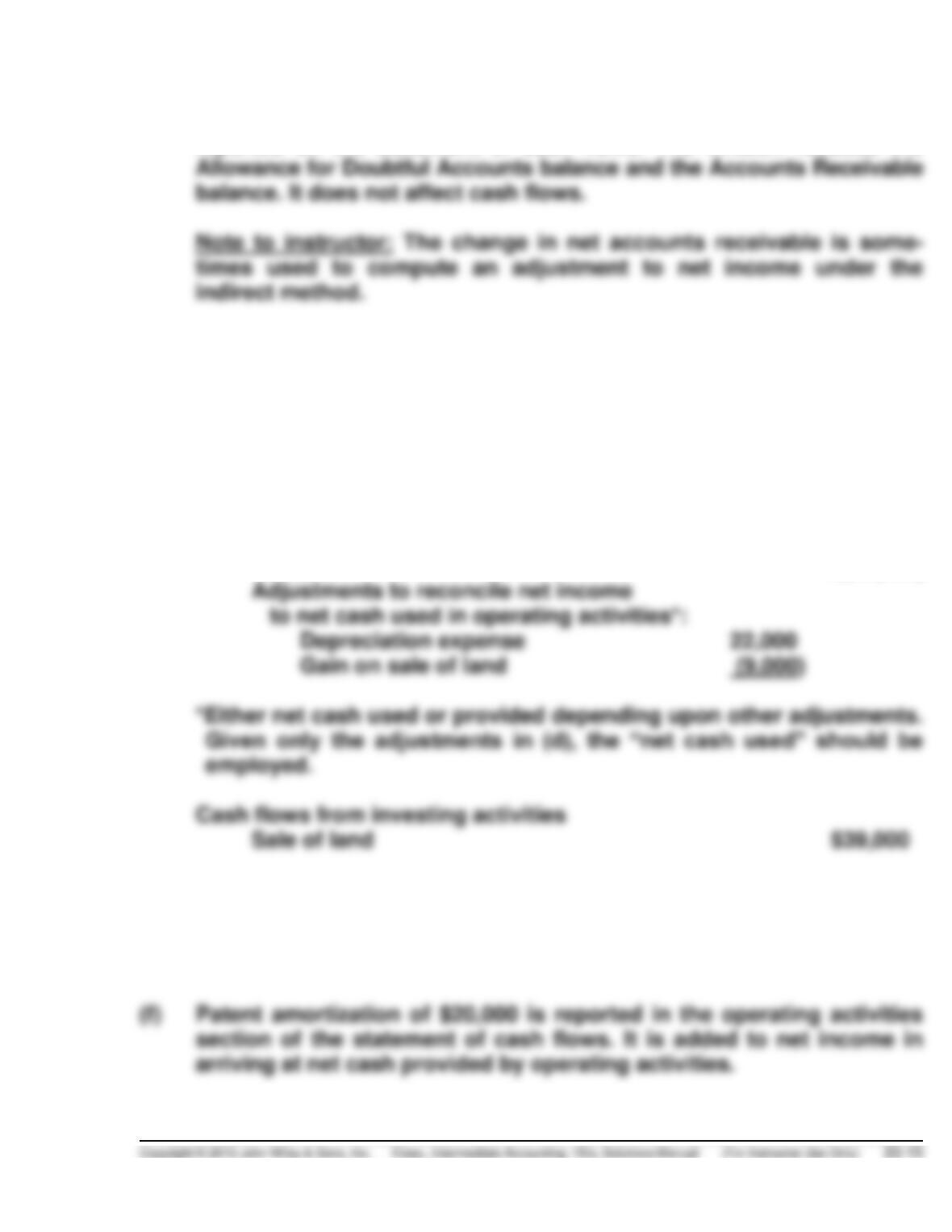
(b)
Shown in the financing activities section of a statement of cash
flows as follows:
Sale of common stock
$430,000
EXERCISE 23-2 (Continued)
(c) The writeoff of the uncollectible accounts receivable of $27,000 is not
reported on the statement of cash flows. The writeoff reduces the
(d) The net loss of $50,000 should be reported in the operating activities
section of the statement of cash flows. Depreciation of $22,000 is
reported in the operating activities section of the statement of cash
flows. The gain on sale of land also appears in the operating activities
section of the statement of cash flows. The proceeds from the sale of
land of $39,000 are reported in the investing activities section of the
statement of cash flows. These four items might be reported as follows:
Cash flows from operating activities
Net loss
$(50,000)
Adjustments to reconcile net income
to net cash used in operating activities*:
Gain on sale of land
Cash flows from investing activities
Sale of land
(e) The purchase of the U.S. Treasury bill is not reported in the statement
of cash flows. This instrument is considered a cash equivalent and
therefore cash and cash equivalents have not changed as a result of
this transaction.
EXERCISE 23-2 (Continued)
(g) The exchange of common stock for an investment in Tabasco is
reported as a “noncash investing and financing activity.” It is shown
EXERCISE 23-3 (15–25 minutes)
VINCE GILL COMPANY
Partial Statement of Cash Flows
For the Year Ended December 31, 2014
Cash flows from operating activities
Net income
$1,050,000
Adjustments to reconcile net income
to net cash provided by operating activities:
Depreciation expense
Decrease in accounts receivable
Decrease in inventory
Increase in prepaid expenses
Decrease in accounts payable
Decrease in accrued expenses payable
EXERCISE 23-4 (20–30 minutes)
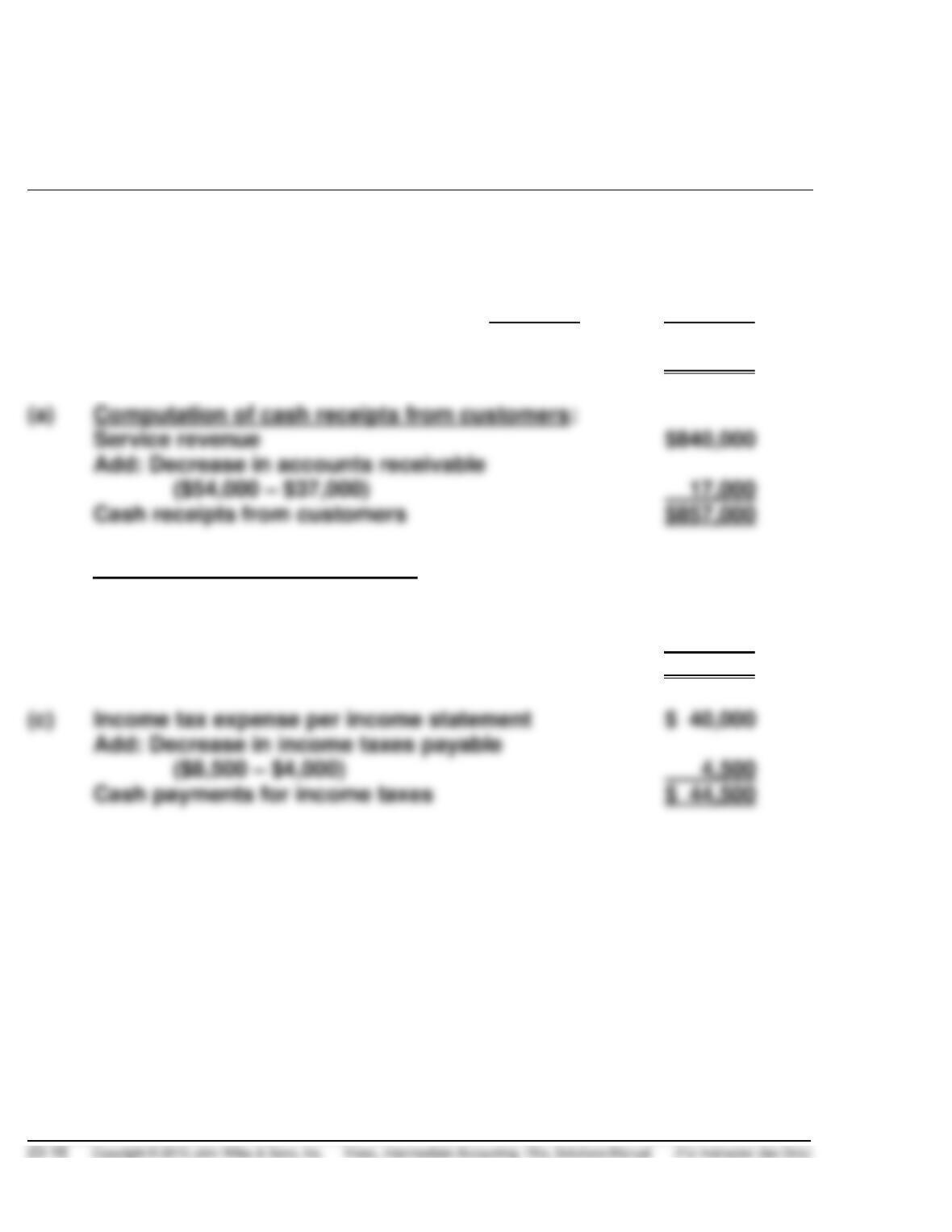
VINCE GILL COMPANY
Partial Statement of Cash Flows
For the Year Ended December 31, 2014
Cash flows from operating activities
Cash receipts from customers
$7,260,000
(a)
Cash payments:
To suppliers
$4,675,000
(b)
For operating expenses
(c)
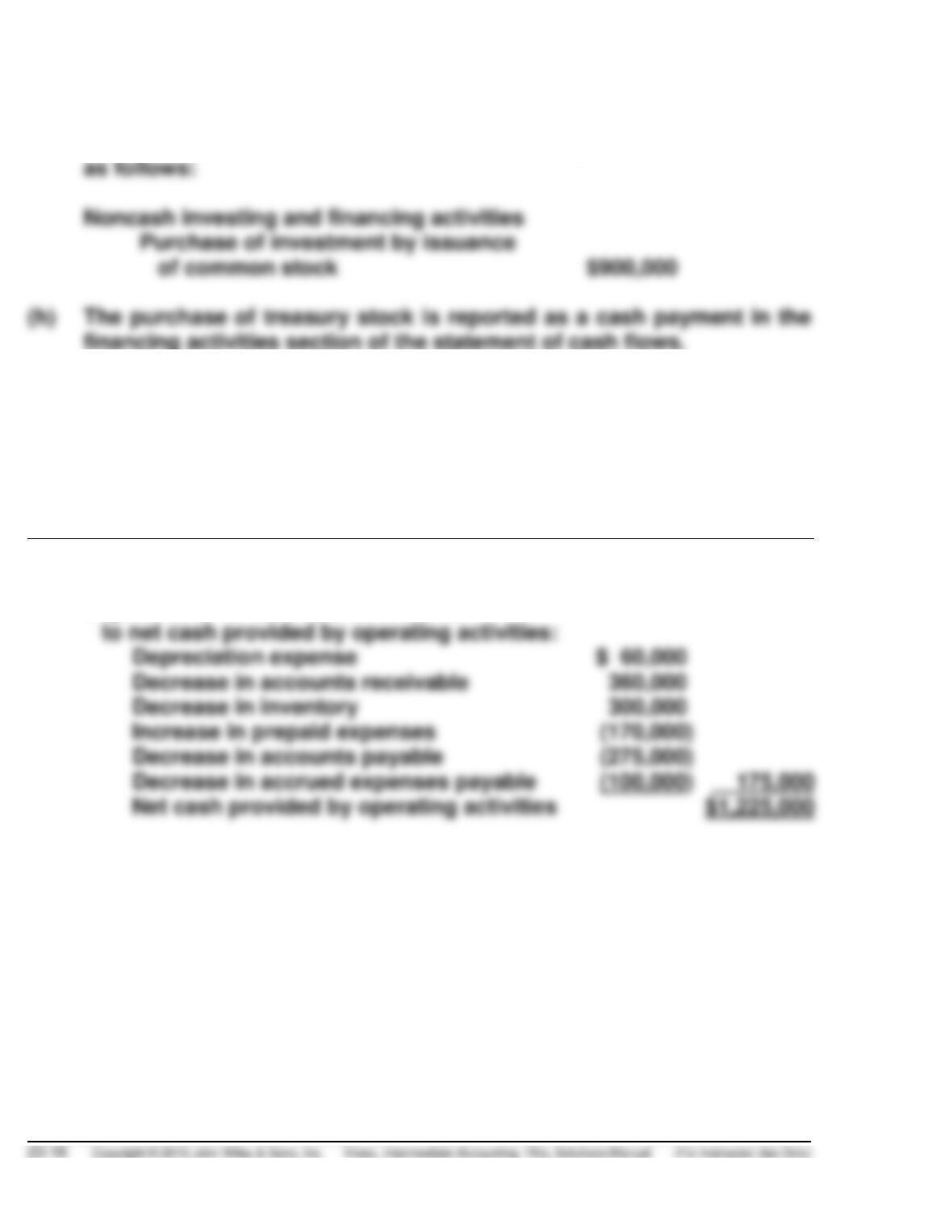
Net cash provided by operating
activities
$1,225,000
Computations:
(a)
Cash receipts from customers
Sales revenue
$6,900,000
Add: Decrease in accounts
Add: receivable
360,000
Cash receipts from customers
$7,260,000
(b)
Cash payments to suppliers
Cost of goods sold
$4,700,000
Deduct: Decrease in inventories
300,000
Purchases
Add: Decrease in accounts
Add: payable
275,000
Cash payments to suppliers
$4,675,000
(c)
Cash payments for operating
expenses
Operating expenses, exclusive
of depreciation
$1,090,000*
Add: Increase in prepaid
Add: Decrease in accrued
Add: expenses payable
270,000
Cash payments for operating
expenses
$1,360,000
EXERCISE 23-5 (20–30 minutes)
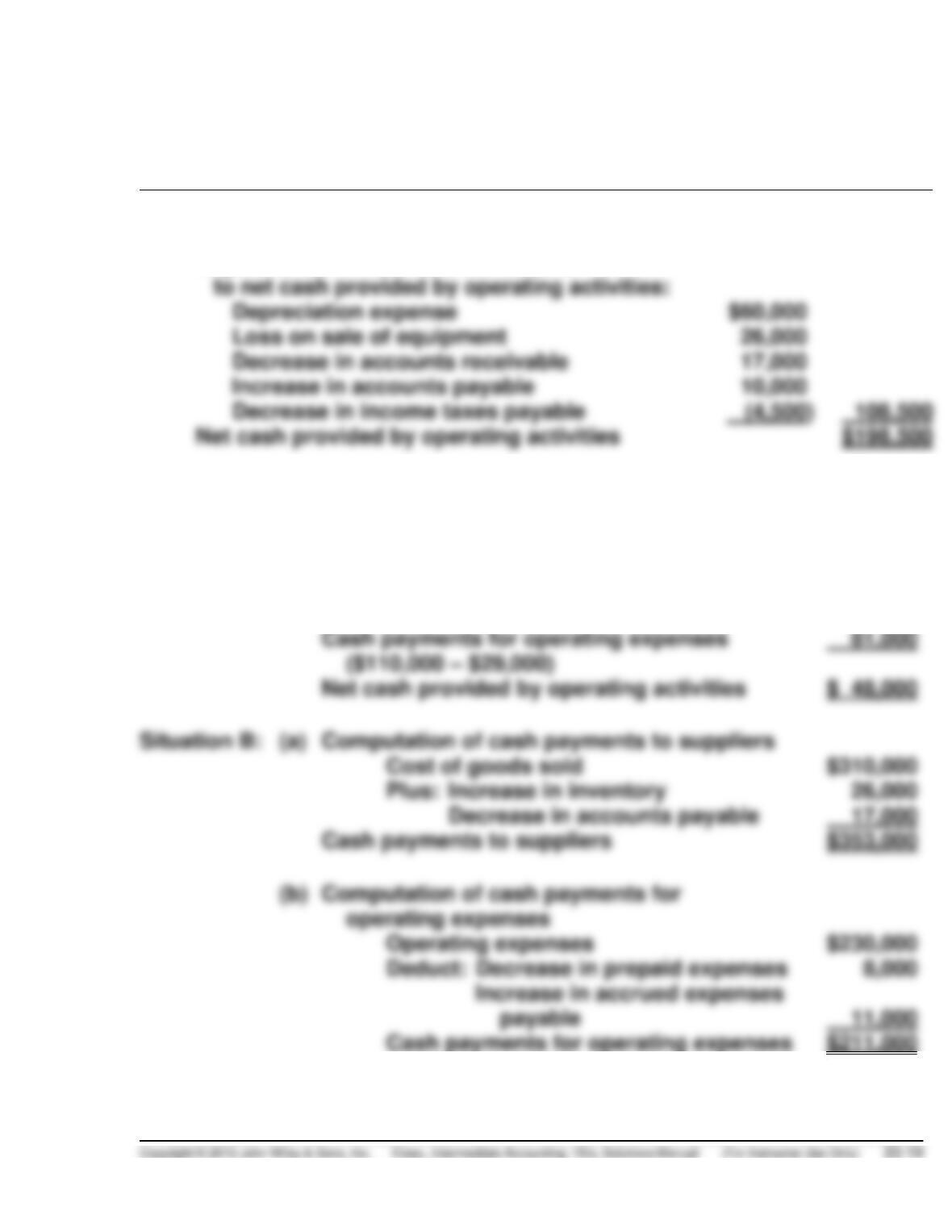
KRAUSS COMPANY
Partial Statement of Cash Flows
For the Year Ended December 31, 2014
Cash flows from operating activities
Cash receipts from customers
$857,000
(a)
Cash payments:
For operating expenses
$614,000
(b)
For income taxes
44,500
(c)
658,500
Net cash provided by operating
activities
$198,500
(a)
Computation of cash receipts from customers:
Service revenue
$840,000
Add: Decrease in accounts receivable
17,000
Cash receipts from customers
$857,000
(b)
Computation of cash payments:
Operating expenses per income statement
$624,000
Deduct: Increase in accounts payable
Deduct: ($41,000 – $31,000)
10,000
Cash payments for operating expenses
$614,000
(c)
Income tax expense per income statement
$ 40,000
Add: Decrease in income taxes payable
4,500
Cash payments for income taxes
$ 44,500
EXERCISE 23-6 (15–20 minutes)
KRAUSS COMPANY
Partial Statement of Cash Flows
For the Year Ended December 31, 2014
Cash flows from operating activities
Net income
$90,000
Adjustments to reconcile net income
to net cash provided by operating activities:
Depreciation expense
Loss on sale of equipment
Decrease in accounts receivable
Increase in accounts payable
Decrease in income taxes payable
EXERCISE 23-7 (15–20 minutes)
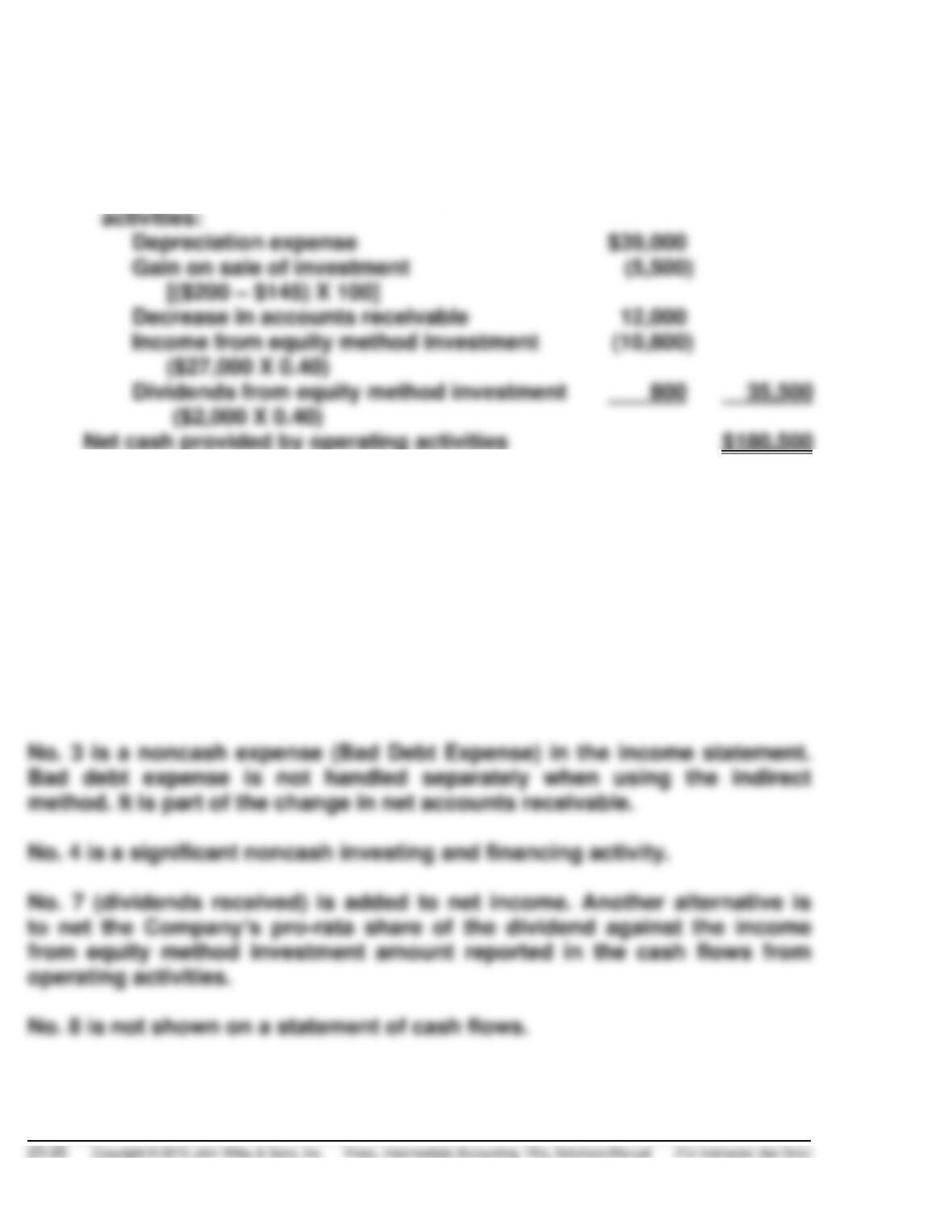
Situation A:
Cash flows from operating activities
Cash receipts from customers
($200,000 – $71,000)
$129,000
($110,000 – $29,000)
Situation B:
(a)
Computation of cash payments to suppliers
Cost of goods sold
Plus: Increase in inventory
Decrease in accounts payable
Operating expenses
Deduct: Decrease in prepaid expenses
Increase in accrued expenses
payable
EXERCISE 23-8 (20–30 minutes)
Cash flows from operating activities
$145,000
Net income
Adjustments to reconcile net income
to net cash provided by operating
activities:
Depreciation expense
Decrease in accounts receivable
Other comments:
No. 1 is shown as a cash inflow from the issuance of treasury stock and
cash outflow for the purchase of treasury stock, both financing activities.
No. 2 is shown as a cash inflow from investing activities of $20,000 and
the gain of $5,500 is deducted from net income in the operating activities
section.