22-61
Note to Instructor: There are no interest and dividends collected and no other operating receipts.
Since salaries expense information is not given, no breakdown of payments to employees is possible.
The selling and administrative expenses are used to determine the other operating expenses and payments.
FARRELL COMPANY
Worksheet for Statement of Cash Flows
For Year Ended December 31, 2010
12/31/09 Post-Closing
Trial Balance
12/31/10 Adjusted
Trial Balance
Change
Worksheet Entries
Accounts Debit Credit Debit Credit Debit Credit Debit Credit
Cash
Accounts receivable
Inventory
Investment in Hall
Land
Plant and equipment
Accumulated depreciation
180,000
305,000
431,000
60,000
200,000
606,000
107,000
225,000
295,000
549,000
73,000
350,000
624,000
139,000
45,000
118,000
13,000
150,000
18,000
10,000
32,000
(t)
(k)
(g)
(r-2)
(q)
(h)
45,000
118,000
13,000
150,000
63,000
21,000
(j)
(h)
(d)
10,000
45,000
53,000
P22-16
22-61
21-62
P21-16
Worksheet Entries
Debit Credit
Cash Flows From Operating Activities
Collections from customers
Payments to suppliers
Other operating payments
Payments of interest
(a)
(j)
(l)
1,950,000
10,000
41,000
(b)
(k)
(c)
(f)
1,150,000
118,000
505,000
15,000
22-62
P22-16 (continued)
22-63
P22-16 (continued)
FARRELL COMPANY
Statement of Cash Flows
For Year Ended December 31, 2010
Cash Flows From Operating Activities
Cash Inflows:
Collections from customers $ 1,960,000
Cash inflows from operating activities $ 1,960,000
Cash Flows From Investing Activities
Proceeds from sale of equipment $ 19,000
Payment for purchase of equipment (63,000)
Net cash used for investing activities (44,000)
Cash Flows From Financing Activities
Proceeds from sale of common stock $ 23,000
21-
64
ADAIR COMPANY
Worksheet for Statement of Cash Flows
For Year Ended December 31, 2010
12/31/09 Post-Closing
Trial Balance
12/31/10 Adjusted
Trial Balance
Change
Worksheet Entries
Accounts Debit Credit Debit Credit Debit Credit Debit Credit
Cash
Accounts receivable
Inventory
Investment in bonds
2,700
7,300
8,100
10,000
3,300
6,200
9,900
18,600
600
1,800
8,600
1,100
(s)
(j)
(n)
600
1,800
8,600
(i)
1,100
P22-17
P21-17
Worksheet Entries
Debit Credit
Cash Flows From Operating Activities
Collections from customers
Interest and dividends collected
(a)
(i)
(b)
89,000
1,100
1,200
P22-17 (continued)
2. ADAIR COMPANY
Statement of Cash Flows
For Year Ended December 31, 2010
Cash Flows From Operating Activities
Cash Inflows:
Collections from customers $ 90,100
Interest collected 1,200
Cash inflows from operating activities $ 91,300
Cash Outflows:
22-
67
HEINZ COMPANY
Worksheet for Statement of Cash Flows
For Year Ended December 31, 2010
12/31/09 Post-Closing
Trial Balance
12/31/10 Adjusted
Trial Balance
Change
Worksheet Entries
Accounts Debit Credit Debit Credit Debit Credit Debit Credit
Cash
Accounts receivable
Inventories
Prepaid items
2,700
5,900
15,300
1,400
3,520
6,215
15,530
1,000
820
315
230
400
(y)
(k)
(l)
820
315
230
(m)
400
P22-18
22-68
Worksheet Entries
Debit Credit
Cash Flows From Operating Activities
Collections from customers
Interest and dividends collected
Other operating receipts
Payments to suppliers
(a)
(b)
(n)
49,550
790
295
(k)
(c)
315
23,800
P22-18 (continued)
ANSWERS TO CASES
C22-1
An outline of the general format of the statement of cash flows (indirect method) is as
follows:
XYZ COMPANY
Statement of Cash Flows
For Year Ended December 31, 2010
Net Cash Flow From Operating Activities
Net income $X
Adjustments for differences between income flows
Cash Flows From Investing Activities
Proceeds from collections of notes receivable X
Cash Flows From Financing Activities
Proceeds from issuance of stocks X
Proceeds from issuance of bonds X
22-70
C22-1 (continued)
If a company engages in investing and financing activities not affecting cash, then the
results of these activities are reported in a schedule that accompanies the statement of
cash flows.
The income statement reports the results of a company’s income-producing activities for
the accounting period. It discloses whether or not revenues for the period exceeded the
expenses of generating these revenues, computed on an accrual basis.
C22-2
A statement of cash flows is a financial statement that shows a company’s cash inflows,
cash outflows, and net change in cash from its operating, investing, and financing
activities during an accounting period, in a manner that reconciles the beginning and
ending cash balances. A statement of cash flows is useful in providing information about a
C22-2 (continued)
Cash inflows from financing activities include, for instance, cash receipts from the issuance
of equity securities, from bonds, from mortgages, from notes, and from other short- or long-
term borrowings. Cash outflows for financing activities include, for instance, payments for
C22-3
A company’s operating activities include all its transactions and other events that are not
investing and financing activities. These include transactions involving acquiring, selling,
and delivering goods for sale, as well as providing services. Cash inflows from operating
activities include, for instance, cash receipts from the sale of goods or services and
22-72
C22-4
Under the worksheet method, a worksheet (spreadsheet) is prepared first, before preparing
a company’s statement of cash flows. In this approach, the cash flow effects of operating,
Step 1: Prepare the column headings on a worksheet. Then enter the account title Cash
on the first line of the account titles column and list the beginning balance, ending
balance, and change in cash in the respective columns.
Step 2: Enter the titles of all the remaining accounts from the balance sheets on the
Step 3: Directly below these accounts add the following headings:
A. Net Cash Flow From Operating Activities
Step 4: Account for all the changes in the noncash accounts that occurred during the
current period. Reconstruct the journal entries that caused the changes in the noncash
accounts directly on the worksheet, making certain modifications to show the cash
receipts and payments related to operating, investing, and financing activities.
C22-4 (continued)
B. Account for the changes in the current asset (except cash) and current liability accounts.
(addition)] to net income.
C. Account for the changes in the noncurrent accounts. Review each noncurrent account
and determine the journal entry responsible for its change. Identify whether the
transaction involves an operating, investing, or financing activity. If the transaction
involved an investing or financing activity, make the entry on the worksheet with the
following changes:
(1) If the entry affects cash, replace a debit to cash with either an investing or financing
cash inflow caption, and list the item as a debit (receipt) under the proper heading
of the worksheet. Replace a credit to cash with a proper cash outflow caption, and
list the item as a credit (payment) under the proper heading of the worksheet.
Step 5: Make a final worksheet entry to record the change in cash. The worksheet entries
Step 6: Prepare the statement of cash flows and accompanying schedule. Use the
information developed in the lower part of the worksheet (and the beginning and ending
C22-5
The two methods of calculating and reporting a company’s net cash provided by (or used
in) operating activities are the direct and the indirect methods.
Under the direct method, on the statement of cash flows, the operating cash outflows are
deducted from the operating cash inflows to determine the net cash flow from operating
activities. The calculations necessary to determine the three types of cash inflows are:
The calculations necessary to determine the five types of cash outflows are:
1. Payments to suppliers: Cost of goods sold, plus increase in inventory or minus
decrease in inventory, plus decrease in accounts payable or minus increase in
accounts payable.
Under the indirect method, on the statement of cash flows, net income is converted to the
net cash flow from operating activities. To do so, net income is listed first and then
adjustments (additions or subtractions) are made to net income:
1. To eliminate certain amounts that are included in net income but did not involve a
22-75
C22-5 (continued)
2. To include any changes in the current assets and current liabilities involved in the
C22-6 (AICPA adapted solution)
1. Financing and investing activities not involving cash are transactions that technically do
not increase or decrease cash but that represent significant financing and investing
2. Two types of financing and investing activities not involving cash are:
3. The effects and procedural considerations of the seven items on the preparation of a
statement of cash flows are as follows:
a. Accounts Receivable are generated as a result of credit sales. A balance in
b. Inventory is a component part of cost of goods sold. The net change in inventory
balances affects the cash used for cost of goods sold. An increase in ending
C22-6 (continued)
3. (continued)
c. Depreciation represents a systematic allocation of the cost of a fixed asset to the
method.
d. Deferred tax liability is the difference between income taxes matched against
earnings and the actual amount paid or payable for the period. If the balance of
e. The purchase of a building by issuing long-term debt obviously does not involve an
f. The payment of the current portion of debt represents an outflow of cash.
g. In the sale of a fixed asset, there are two parts to be considered in the transaction:
(1) recovery of book value and (2) resultant gain or loss on the transaction. Only the
resultant gain or loss is reflected in net earnings, and the gain or loss is not the result of
C22-7 (AICPA adapted solution)
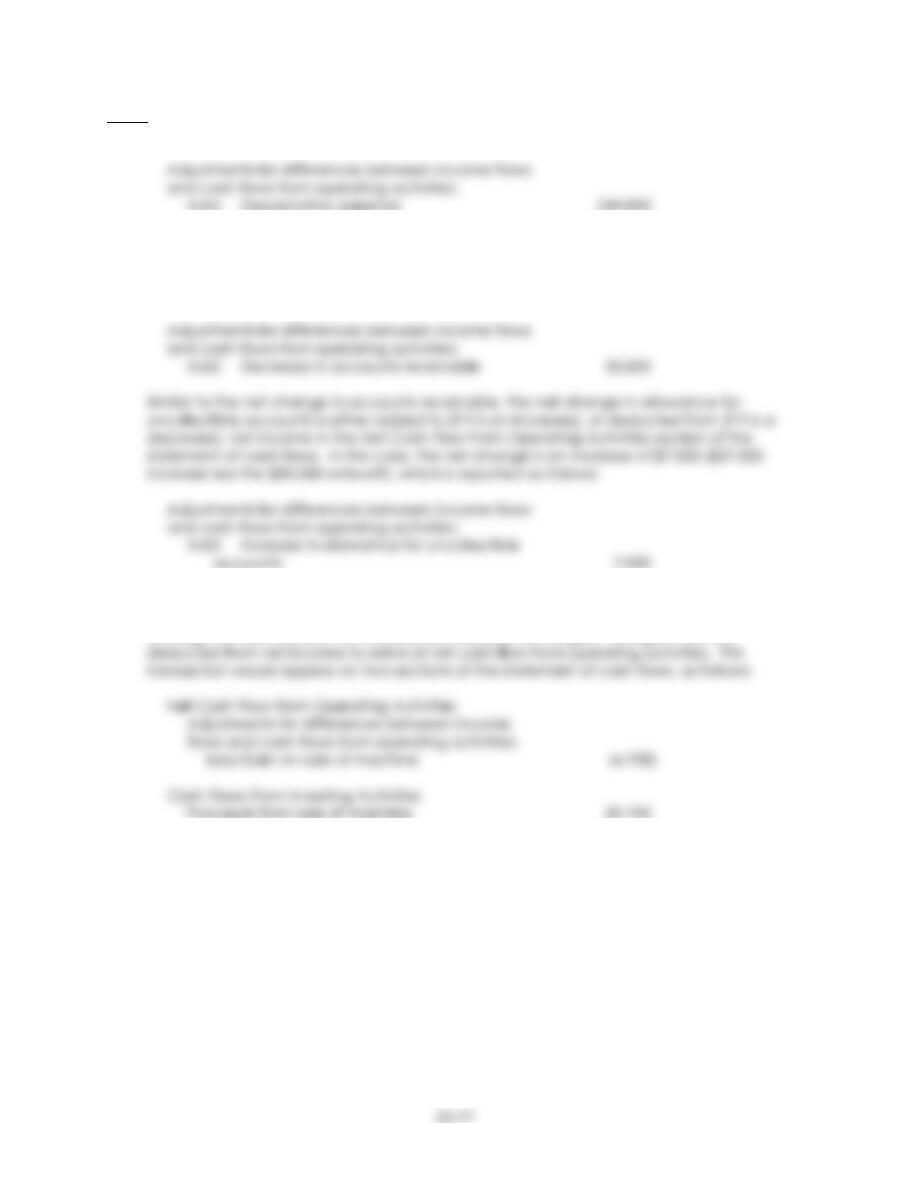
1. The reported earnings of Alfred Engineering should be reported as an inflow of cash in the
following manner.
C22-7 (continued)
2. (continued)
3. The write-off of $30,000 of accounts receivable does not specifically appear on the
statement of cash flows. Rather, the net change from the previous year’s balance is
reported. If the total change in accounts receivable was the $30,000 write-off, it would be
reported as follows:
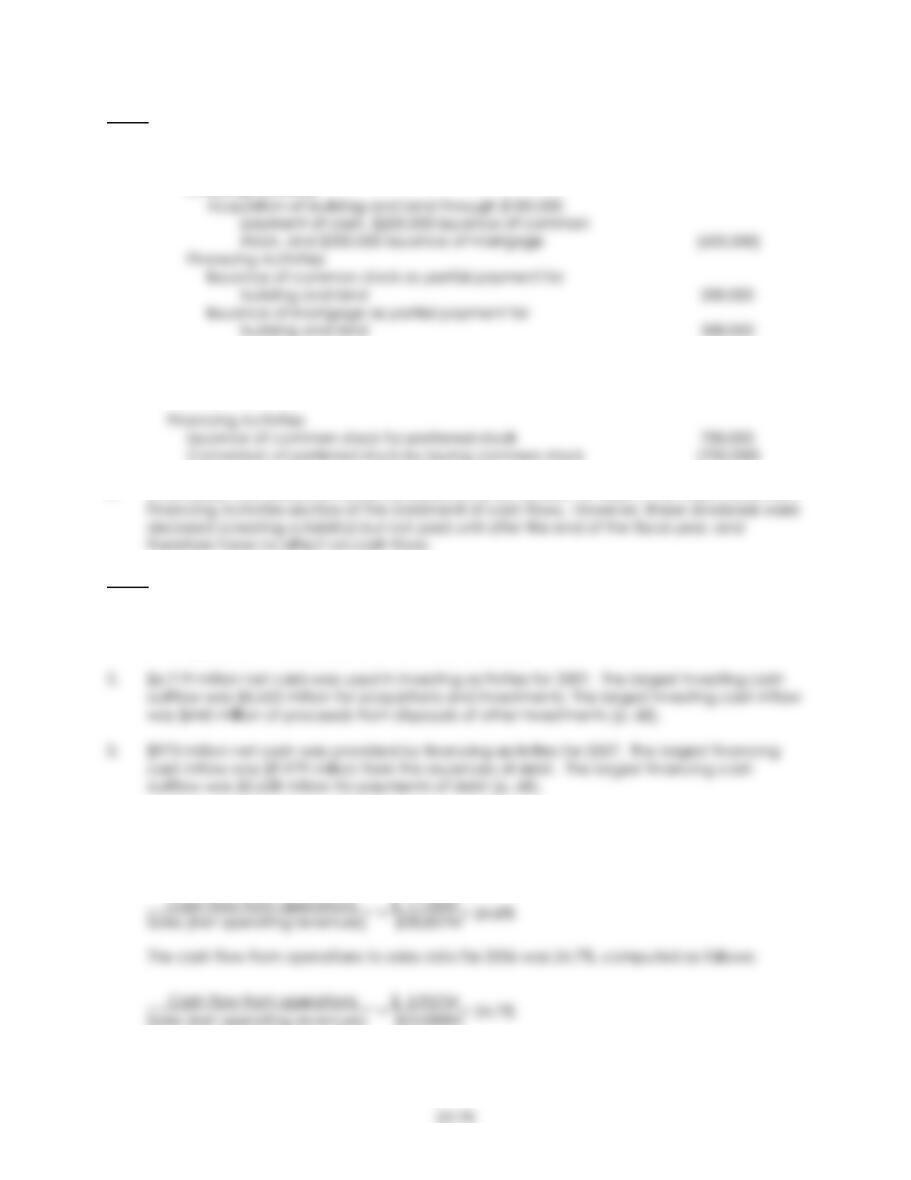
4. The $29,700 ($25,000 book value plus $4,700 gain) proceeds from the sale of the machine
are an inflow of cash. However, net income was increased by the amount of the gain,
although no cash flowed into the business because of this gain. The gain must be
5. This is a complex transaction related to the statement of cash flows. Both the issuance of
stock and the issuance of the mortgage do not affect cash, but are reported in a separate
schedule of investing and financing activities not affecting cash flows as follows:
C22-7 (continued)
5. (continued)
Investing and Financing Activities Not Affecting Cash Flows
Investing Activities
6. This is another transaction that does not affect cash, but is included in the schedule of
investing and financing activities not affecting cash flows, as follows:
7. When paid, the dividends would be reported as an outflow of cash in the Cash Flows From
C22-8
1. $7,150 million net cash was provided by operating activities for 2007. The indirect method
was used to determine this amount. $1,163 million of depreciation and amortization was
the largest positive adjustment to net income (p. 68).
4. $405 million of interest was paid in 2007 (Note 9, p. 88). $1,596 million of income taxes was
paid in 2007 (Note 17, p. 112).
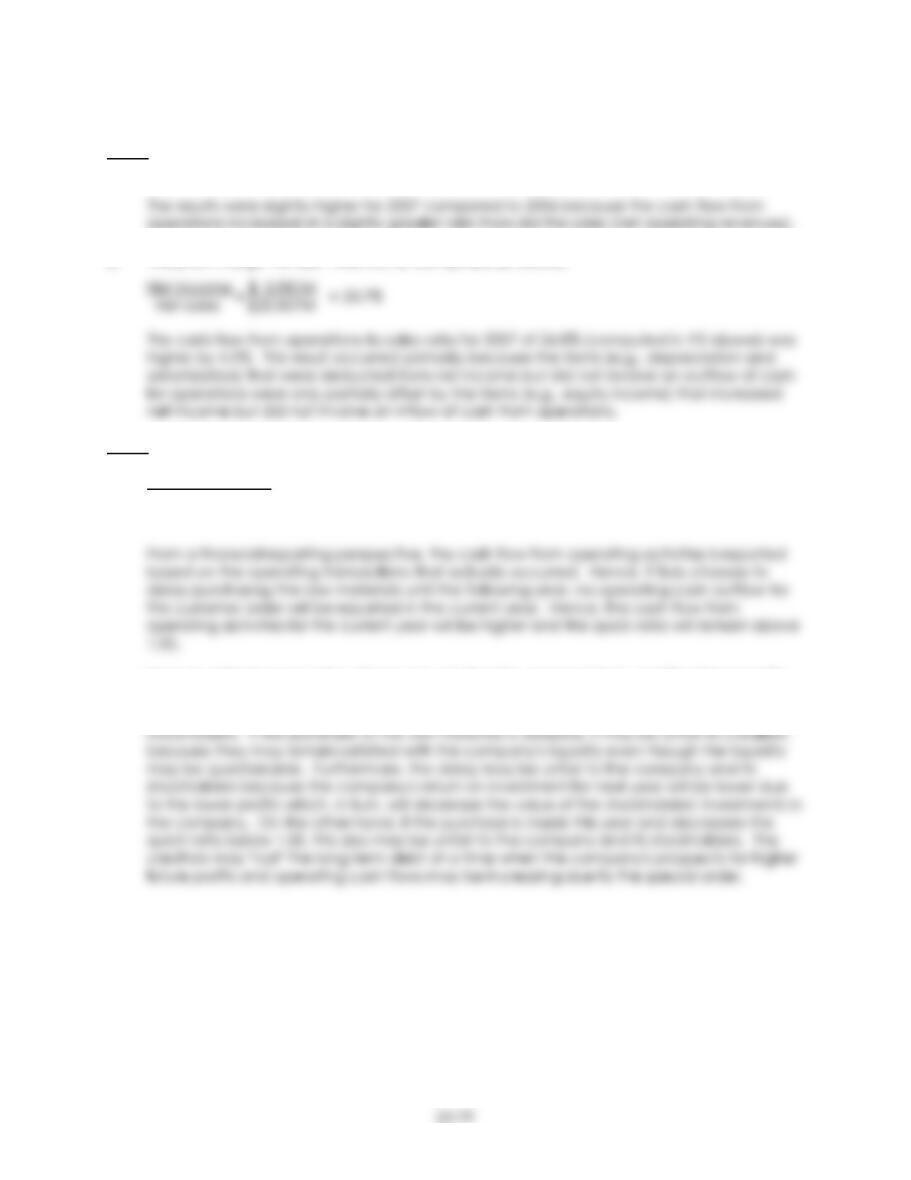
5. The cash flow from operations to sales ratio for 2007 was 24.8%, computed as follows:
C22-8 (continued)
5. (continued)
6. The profit margin for 2007 was 20.7%, computed as follows:
C22-9
Note to Instructor: This case does not have a definitive answer. From a financial reporting
perspective, GAAP is identified and discussed. From an ethical perspective, various issues
are raised for discussion purposes.
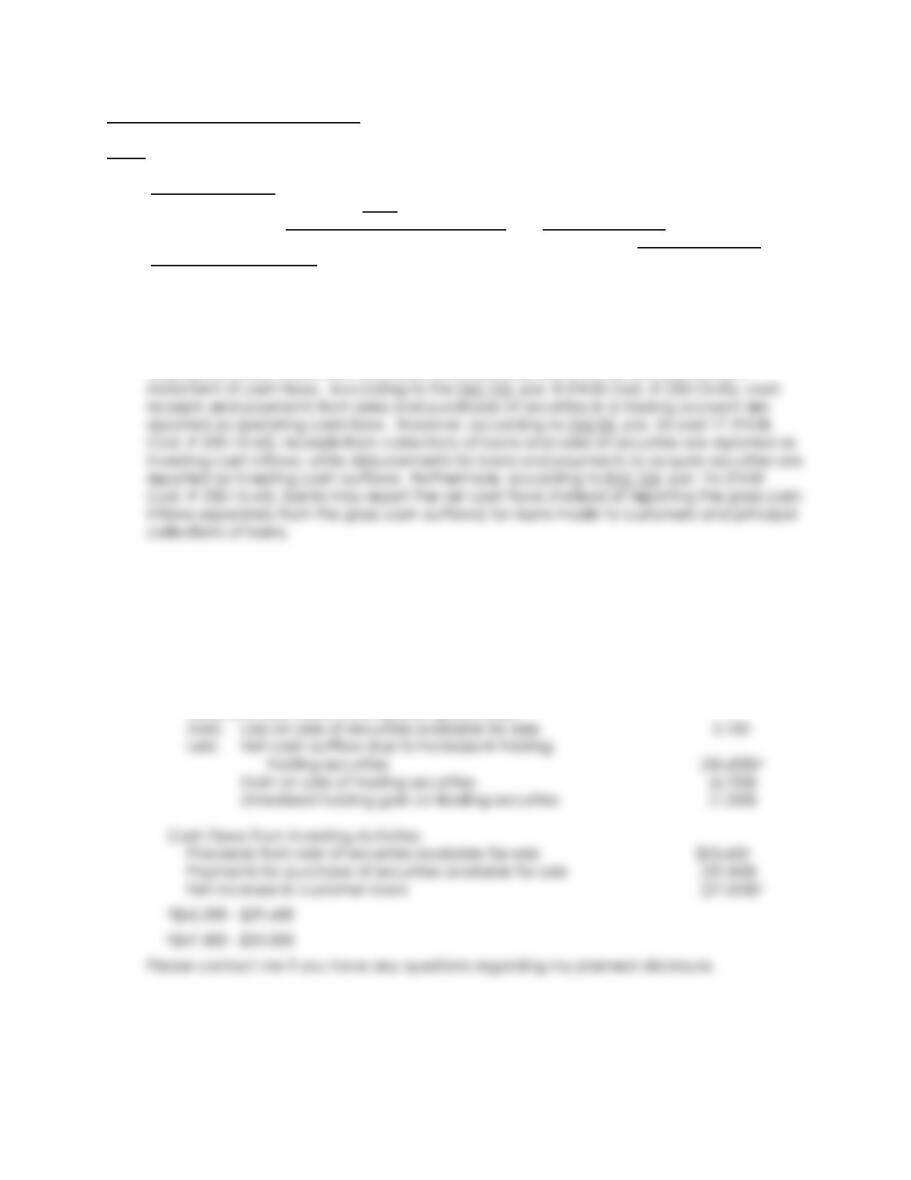
From an ethical perspective, the issue is whether it is appropriate to sacrifice future profits
and report lower future operating cash flows in order to report a higher current quick ratio
and operating cash flows. The stakeholders include the company, its creditors, and its
22-80
ANSWER TO RESEARCH SIMULATION
R22-1
Note to Instructor: Students are expected to cite references to GAAP in their research of
this issue. They might use the FARS electronic database, pronouncements listed on the
FASB web site, the FASB Original Pronouncements, the FASB Current text, or other primary
sources of GAAP to obtain these references. They may also use the FASB Accounting
Standards Codification which is cited in parentheses.
To: Auditors of 12th National Bank
From: Accountant for 12th National Bank
I have researched the issue of how to report the cash flows from transactions involving
trading securities, investment securities, and customer loans on the company’s 2010
Based on these accounting standards, I plan to report the cash flows of 12th National Bank
pertaining to trading securities, securities available for sale, and loans to customers, along
with net income and the related gains and losses on the bank’s 2010 statement of cash
flows as follows:
Net Cash Flow From Operating Activities
Net Income $75,800
Adjustments for differences between income
flows and cash flows from operating activities: