CHAPTER 22
LEARNING OBJECTIVES
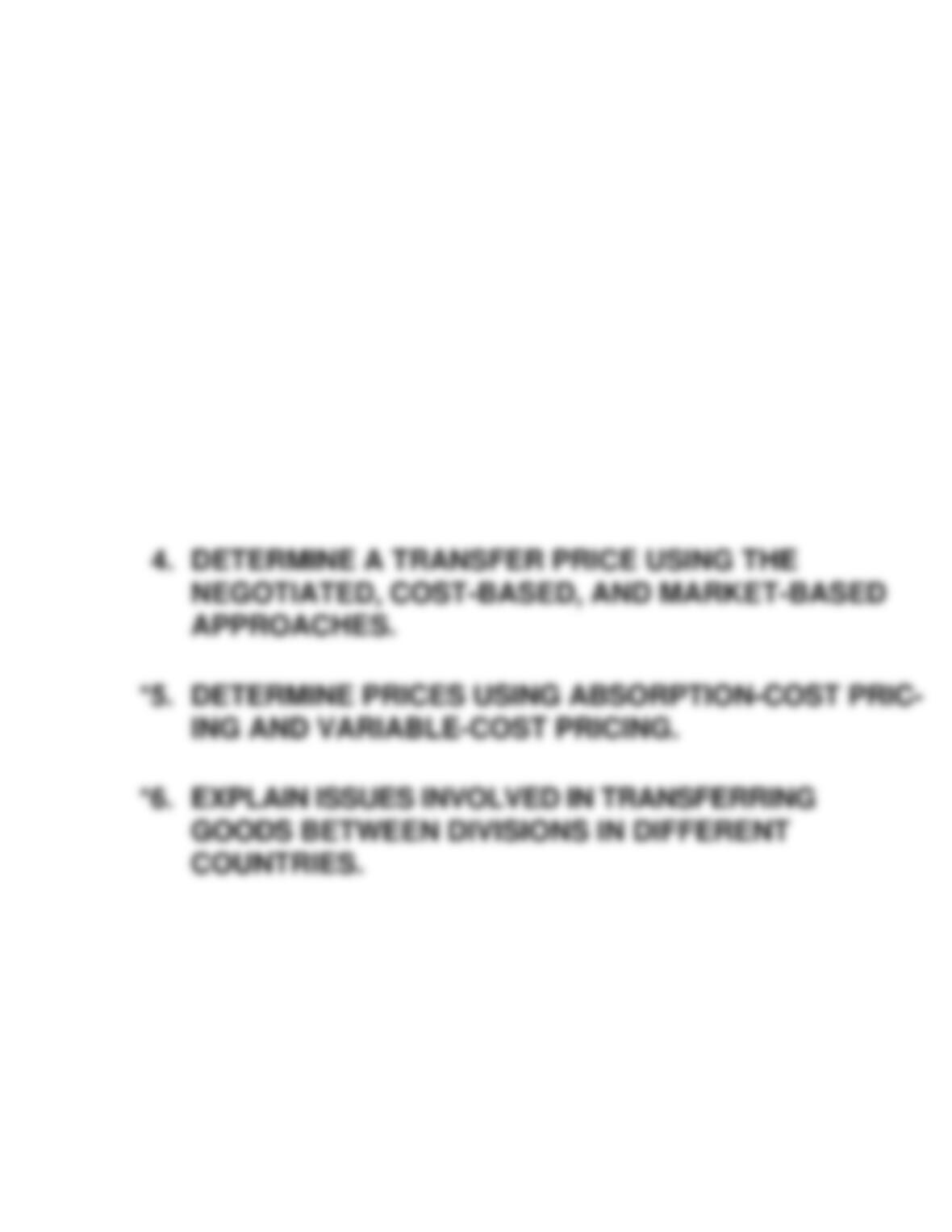
1. COMPUTE A TARGET COST WHEN THE MARKET
DETERMINES A PRODUCT PRICE.
2. COMPUTE A TARGET SELLING PRICE USING COST-
PLUS PRICING.
3. USE TIME-AND-MATERIAL PRICING TO DETERMINE
THE COST OF SERVICES PROVIDED.
CHAPTER REVIEW
External Sales
1. (L.O. 1) Some of the many factors that can affect pricing decisions include:
a. Pricing Objectives
• Gain market share
• Achieve a target rate of return
b. Environment
2. In most cases, a company does not set prices. Instead the price is set by the competitive market
(laws of supply and demand). These companies are called price takers and price taking often
happens when the product is not easily differentiated from competing products, such as farm
products (corn or wheat) or minerals (coal or sand).
Target Costing
4. Once a company has identified its segment of the market, it does market research to determine
Cost-Plus Pricing
5. (L.O. 2) When the price is set by the company, price is commonly a function of the product or
service. Cost-plus pricing involves establishing a cost base and adding to this cost base a
6. The cost-plus approach has a major advantage: it is simple to compute. However, the cost model
does not give consideration to the demand side—that is, will the customers pay the price. In
7. Instead of using both fixed and variable costs to set prices, some companies simply add a markup
Time-and-Material Pricing
The per-hour labor charge typically includes the direct labor cost of an employee, selling,
administrative, and similar overhead costs, and an allowance for a desired profit per hour of
employee time. The charge for materials typically includes the invoice price of any materials used
on the job plus a material loading charge. The charges for any particular job are then a result of
(1) the labor charge, (2) the direct charge for materials, and (3) the material loading charge.
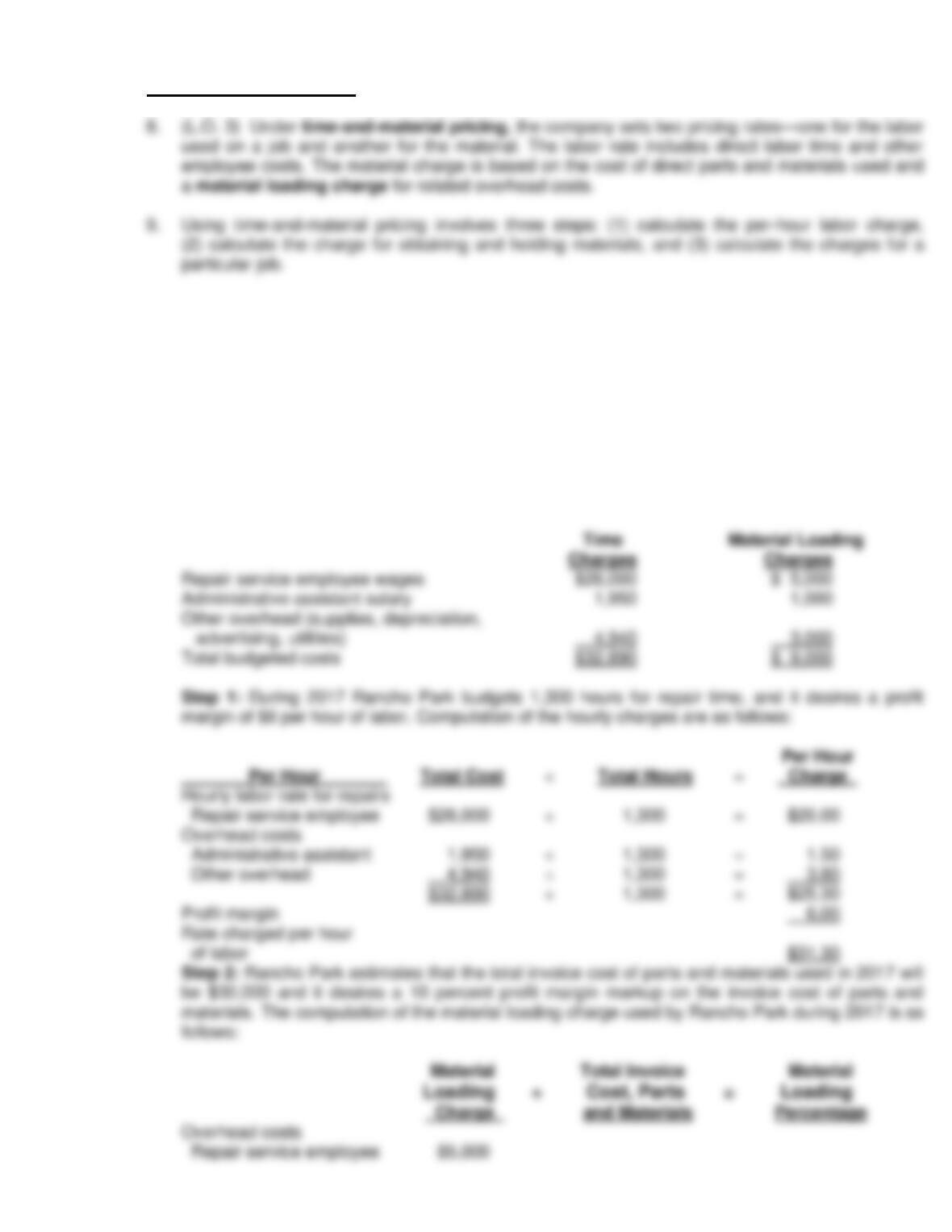
10. To illustrate a time-and-material pricing situation, assume the following data for Rancho Park Golf
Club Repair Service:
Rancho Park Golf Club Repair Service
Budgeted Costs for the Year 2017
Internal Sales
Negotiated Transfer Prices
12. The negotiated transfer price is determined through agreement of division managers. Using the
Cost-Based Transfer Prices
13. Another method of determining transfer prices is to base the transfer price on the costs incurred
Market-Based Transfer Prices
14. The market-based transfer price is based on existing market prices of competing goods or
Transfers Between Divisions in Different Countries
*Absorption Cost Pricing
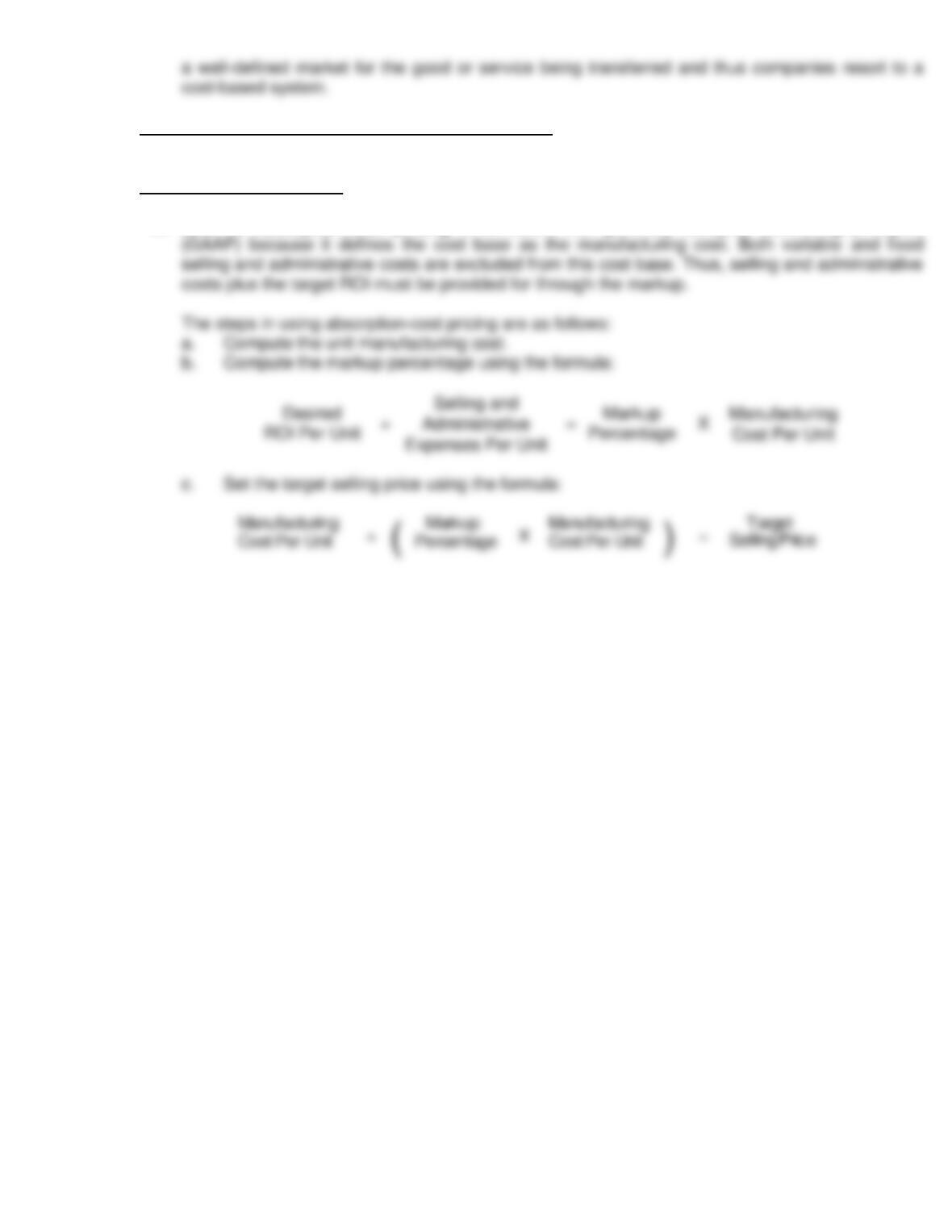
*15. (L.O. 5) Absorption-cost pricing is consistent with generally accepted accounting principles
*Variable-Cost Pricing
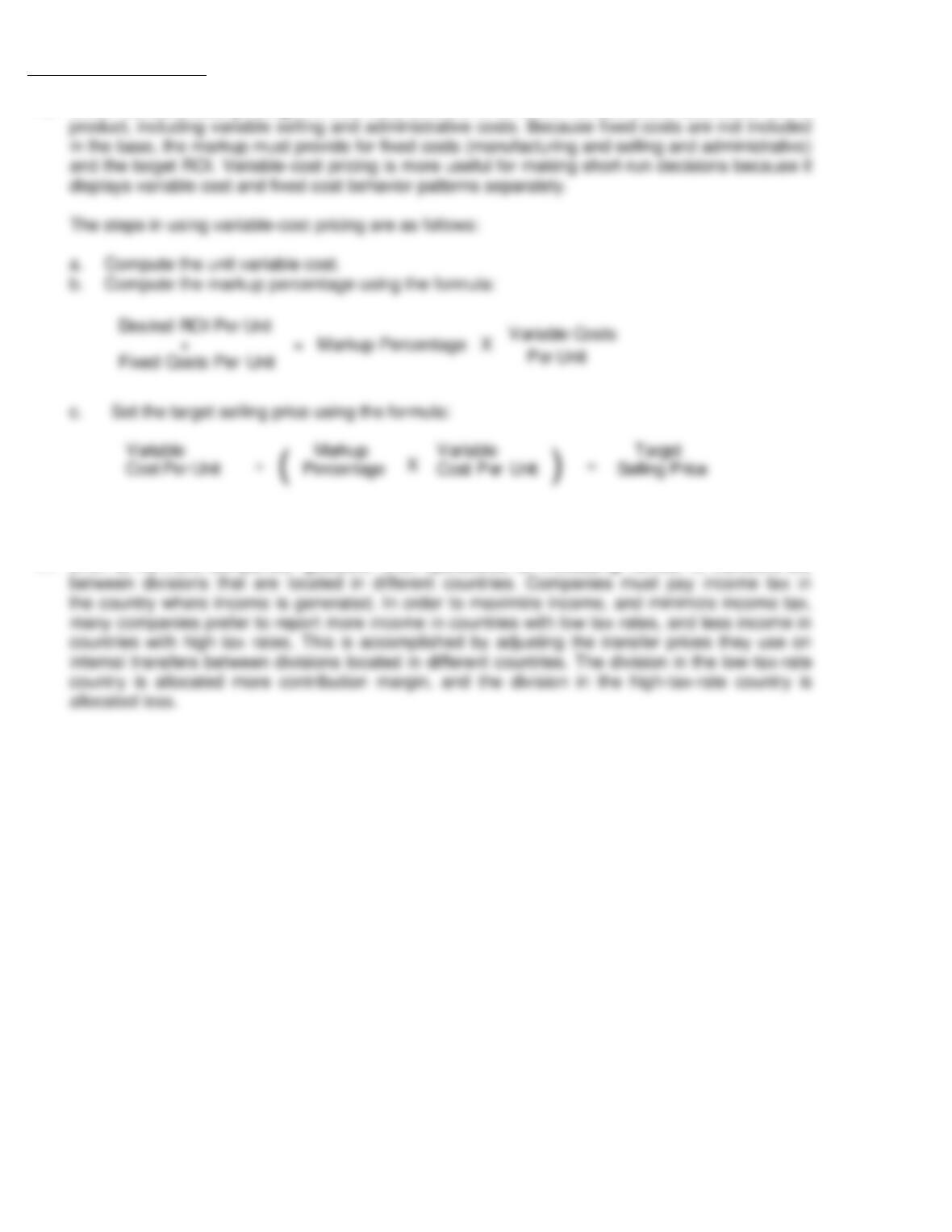
*16. Under variable-cost pricing, the cost base consists of all of the variable costs associated with a
*17. (L.O. 6) As more companies “globalize” their operations, an increasing number of transfers are
LECTURE OUTLINE
A. External Sales.
1. Establishing the price for any good or service is affected by the following
factors: pricing objectives, environment, demand, and cost considerations.
MANAGEMENT INSIGHT
At one time, Apple’s iPad represented 75% of tablets being sold. And, about
50% of consumers read newspapers and magazines on their tablets. This
commanding share of the market made Apple feel like it had publishers right
where it wanted them. However, when Apple announced that it would charge
publishers a fee of 30% of subscription revenue for subscriptions sold through
Apple’s App store, Google announced it would only charge a fee of about 10% of
subscription revenue for users of its Android system.
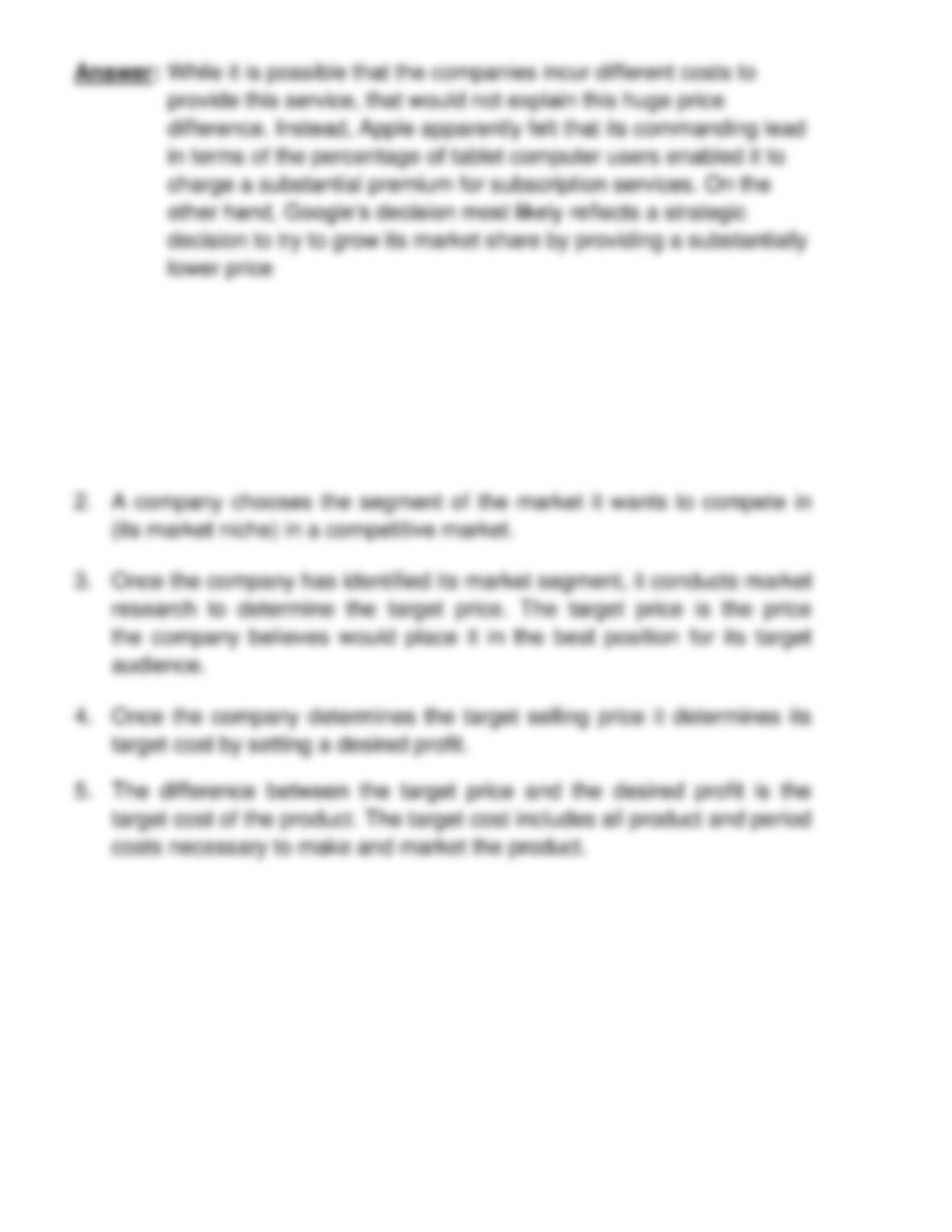
Do the substantially different prices that Apple and Google charge for a similar
service reflect different costs incurred by each company, or is the price difference
due to something else?
B. Target Costing.
1. In a competitive market, the price of a product is greatly affected by
supply and demand. No company in the market can affect the price to a
significant degree.
MANAGEMENT INSIGHT
Wal-Mart told jean maker Levi Strauss “the price should be $19 per pair of jeans
instead of $23.” Wal-Mart often sets the price, and the manufacturer has to find
out how to make a profit at that price. Levi Strauss revamped its distribution and
production to improve its overall record of timely deliveries. The chief executive
of Levi Strauss stated “we had to change people and practice.”
What are some issues that Levi Strauss should consider in deciding whether it
should agree to meet Wal-Mart’s target price?
C. Cost-Plus Pricing.
1. In a noncompetitive environment, the company is faced with the task of
setting its own price, which is commonly a function of the cost of the
product.
4. The cost-plus pricing formula is expressed as follows:
MANAGEMENT INSIGHT
For nearly 90 years Parker Hannifin calculated the production cost, then added
on a percentage of the cost to arrive at the price. If Parker reduced its production
costs, it also cut the price for the product. This approach made it difficult for the
company to ever substantially increase its profit margins. So the company’s CEO
decided to implement strategic pricing schemes similar to other retailers. It
decided to charge a higher markup for about a third of its products because it
had a competitive advantage.
What kind of help might the sales staff need in implementing this new approach?
D. Time-and-Material Pricing.
1. Under time-and-material pricing, the company sets two pricing rates—
one for the labor used on a job and another for the material.
5. The charge for materials typically includes a material loading charge
which covers the costs of purchasing, receiving, handling, and storing
materials, plus any desired profit margin on the materials themselves.
6. The material loading charge is expressed as a percentage of the total
estimated costs of parts and materials for the year. The company
determines this percentage by doing the following:
7. The charges for any particular job are the sum of the
a. Labor charge,
SERVICE COMPANY INSIGHT
For many decades, professionals in most service industries have used some
form of hourly based price, regardless of the outcome. Many customers are now
demanding that the bill be tied to actual performance instead of the amount of
hours of work provided.
What implications does this have for a service company’s need for managerial
accounting?
E. Internal Sales.
1. The transfer of goods between divisions of the same company is called
internal sales. Divisions within vertically integrated companies normally
sell goods to other company divisions as well as to outside customers.
F. Negotiated Transfer Prices.
1. The negotiated transfer price is determined through agreement of
division managers. It will range between the external purchase price per
unit and the sum of the unit variable cost plus unit opportunity cost.
5. When the selling division has excess capacity, it will receive a positive
contribution margin from any transfer price above its variable cost while
the buying division will benefit from any price below the outside price.
8. Companies often do not use negotiated transfer pricing because:
a. Market price information is sometimes not easily obtainable.
G. Cost-Based Transfer Prices.
1. One method of determining transfer prices is to base the transfer price
on the costs incurred by the division producing the goods.
H. Market-Based Transfer Prices.
1. The market-based transfer price is based on existing market prices of
competing goods. This system is often considered the best approach
because it is objective and generally provides the proper economic
incentives.
*I. Absorption-Cost Pricing.
1. Absorption-cost pricing uses total manufacturing cost as the cost base
and provides for selling/administrative costs plus the target ROI through
the markup.
5. Most companies that use cost-plus pricing use either absorption cost or
full cost as the basis because:
a. Absorption–cost information is most readily provided by a company’s
cost accounting system.
*J. Variable-Cost Pricing.
1. Variable-cost pricing uses all of the variable costs, including selling and
administrative costs, as the cost base and provides for fixed costs and
target ROI through the markup.
4. The markup percentage is computed by dividing the sum of the desired
ROI per unit and fixed costs per unit by the variable cost per unit.
*K. Transfers Between Divisions in Different Countries.
1. An increasing number of transfers are between divisions that are located
in different countries. Differences in tax rates across countries can
complicate the determination of the appropriate transfer price.
20 MINUTE QUIZ
Circle the correct answer.
True/False
1. Once a company has determined the target price, it can determine its target cost by setting a desired profit.
True False
2. In a competitive, common-product environment the company must set a target selling price using cost-plus
pricing.
True False
3. Under cost-plus pricing, the markup percentage is computed by dividing desired ROI per unit by variable
cost per unit.
True False
4. The labor charge includes the direct labor cost of employees, selling, administrative, and similar overhead
costs; and an allowance for a desired profit per hour.
True False
5. The charges for any particular job are the sum of the labor charge, the materials charge, and the material
loading charge.
True False
6. An appropriate transfer price should assist the company in making proper purchasing decisions.
True False
7. An advantage of the cost–based transfer price approach is that it can increase a division manager’s control
over the division’s performance.
True False
8. The market-based transfer price approach provides a fairer allocation of the company’s contribution margin
to each division than the cost-based approach.
True False
9. In order to maximize income, and minimize income tax, companies can adjust the transfer prices they use
on transfers between divisions located in different countries.
True False
*10. Absorption cost pricing is more consistent with cost–volume-profit analysis used to measure the profit
implications of changes in price and volume.
True False
Multiple Choice
1. The target cost of a product
a. includes product costs but not period costs.
b. is determined before the target price is established.
c. is the difference between the target price and the desired profit.
d. is determined by the target audience.
2. In the cost-plus pricing approach, the markup percentage is computed by dividing the
a. desired ROI/unit by variable cost/unit.
b. desired ROI/unit by total unit cost.
c. total unit cost by desired ROI/unit.
d. selling price/unit by desired ROI/unit.
3. All of the following are steps in the time-and-material pricing approach except calculating the
a. labor charge.
b. material loading charge.
c. manufacturing overhead charge.
d. charges for a particular job.
4. The total contribution margin to a company in the market-based transfer price approach is
a. greater than in the cost-based approach.
b. less than in the cost-based approach.
c. the same as in the cost-based approach.
d. either greater than or less than in the cost-based approach.
*5. Absorption-cost pricing
a. includes all variable costs in the cost base.
b. excludes fixed manufacturing overhead from the cost base.
c. provides the data needed for pricing special orders.
d. uses a markup percentage that covers the desired ROI and the selling and
administrative expenses.

ANSWERS TO QUIZ
True/False
Multiple Choice