FINANCIAL REPORTING PROBLEM
(a) New Pronouncements and Reclassifications
P&G reported the following changes in accounting principles:
FAIR VALUE MEASUREMENTS
2009. The Company believes that the adoption of the new guidance
applicable to non-financial assets and liabilities will not have a material
effect on its financial position, results of operations or cash flows.
DISCLOSURES ABOUT DERIVATIVE INSTRUMENTS AND HEDGING
ACTIVITIES
FINANCIAL REPORTING PROBLEM (Continued)
BUSINESS COMBINATIONS AND NONCONTROLLING INTERESTS IN
CONSOLIDATED FINANCIAL STATEMENTS
In December 2007, the Financial Accounting Standards Board issued
new accounting guidance on business combinations and noncontrolling
interests in consolidated financial statements. The new Guidance
(b) Use of Estimates
Preparation of financial statements in conformity with accounting
principles generally accepted in the United States of America (U.S.
GAAP) requires management to make estimates and assumptions that
affect the amounts reported in the Consolidated Financial Statements
and accompanying disclosures. These estimates are based on manage-
individual year. However, in regard to ongoing impairment testing of
goodwill and indefinite-lived intangible assets, significant deterioration
in future cash flow projections or other assumptions used in valuation
models, versus those anticipated at the time of the initial valuations,
could result in impairment charges that may materially affect the
financial statements in a given year.
COMPARATIVE ANALYSIS CASE
THE COCA-COLA COMPANY VS. PEPSICO, INC.
(a) and (c) for Coca-Cola Company:
NOTE 1: SUMMARY OF SIGNIFICANT ACCOUNTING POLICIES
Principles of Consolidation
whether an entity is a VIE. Under the new guidance, a VIE must be
consolidated if the enterprise has both (a) the power to direct the activities
of the VIE that most significantly impact the entity’s economic
performance, and (b) the obligation to absorb losses or the right to receive
benefits from the VIE that could potentially be significant to the VIE.
Beginning January 1, 2010, we deconsolidated certain entities as a result of
this change in accounting policy. These entities are primarily bottling
operations and had previously been consolidated due to certain loan
guarantees and/or other financial support given by the Company. These
financial arrangements, although not significant to our consolidated
COMPARATIVE ANALYSIS CASE (Continued)
change in accounting policy, the Company deconsolidated the majority of
these VIEs. The deconsolidation of these entities will not have a material
impact on our consolidated financial statements.
In December 2007, the FASB amended its guidance on accounting for
business combinations. The new accounting guidance resulted in a change
in our accounting policy effective January 1, 2009, and is being applied
prospectively to all business combinations subsequent to the effective
In December 2007, the FASB issued new accounting and disclosure
guidance related to noncontrolling interests in subsidiaries (previously
referred to as ‘‘minority interests’’), which resulted in a change in our
COMPARATIVE ANALYSIS CASE (Continued)
In December 2007, the FASB issued new accounting guidance that defines
collaborative arrangements and establishes reporting requirements for
transactions between participants in a collaborative arrangement and
between participants in the arrangement and third parties. It also establishes
In February 2007, the FASB issued new accounting guidance that permits
entities to choose to measure many financial instruments and certain other
items at fair value. Unrealized gains and losses on items for which the fair
value option has been elected will be recognized in earnings at each
subsequent reporting date. This new accounting guidance was effective for
our Company on January 1, 2008. The Company did not elect the fair value
option for any financial instruments or other items permitted under this
guidance; therefore, its adoption had no impact on our consolidated
financial statements.
COMPARATIVE ANALYSIS CASE (Continued)
(b) and (c) for PepsiCo, Inc.: Reported one accounting change:
Recent Accounting Pronouncements
In December 2007, the FASB amended its guidance on accounting for
business combinations to improve, simplify and converge internationally
the accounting for business combinations. The new accounting guidance
continues the movement toward the greater use of fair value in financial
In December 2007, the FASB issued new accounting and disclosure guidance
on noncontrolling interests in consolidated financial statements. This
guidance amends the accounting literature to establish new standards that
will govern the accounting for and reporting of (1) noncontrolling interests
In June 2009, the FASB amended its accounting guidance on the
consolidation of VIEs. Among other things, the new guidance requires a
qualitative rather than a quantitative assessment to determine the primary
beneficiary of a VIE based on whether the entity (1) has the power to direct
matters that most significantly impact the activities of the VIE and (2) has
the obligation to absorb losses or the right to receive benefits of the VIE
that could potentially be significant to the VIE. In addition, the amended
ACCOUNTING, ANALYSIS, AND PRINCIPLES
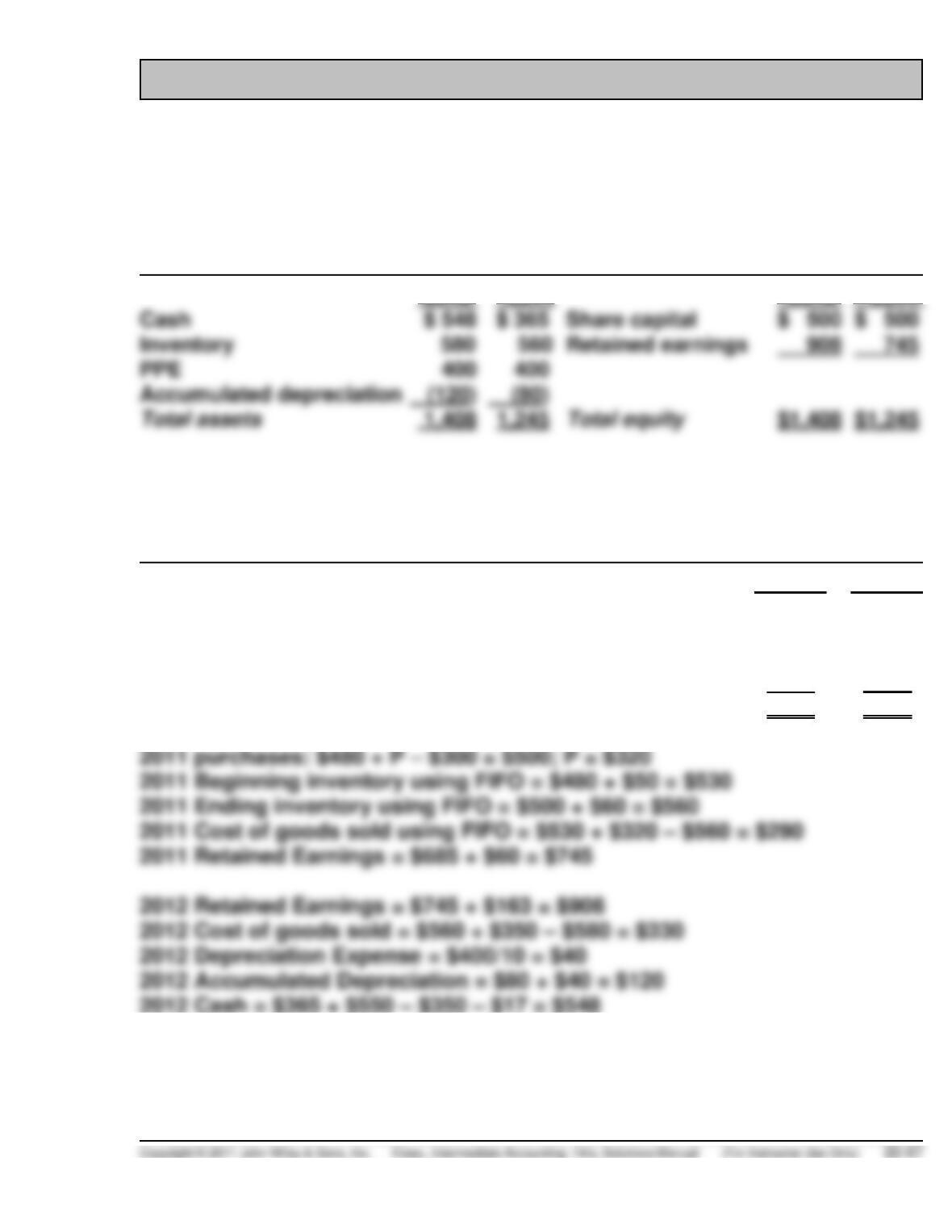
Accounting
ABC CO.
Statement of Financial Position
at December 31
2012 2011 2012 2011
ABC CO.
Income Statement
for the Year Ended December 31,
2012 2011
Sales ……………………………………………………………………… $550 $500
Cost of goods sold …………………………………………………. 330 290
Depreciation expense …………………………………………….. 40 40
Compensation expense ………………………………………….. 17 15
Net income …………………………………………………………….. $163 $155
ACCOUNTING, ANALYSIS, AND PRINCIPLES (Continued)
Analysis
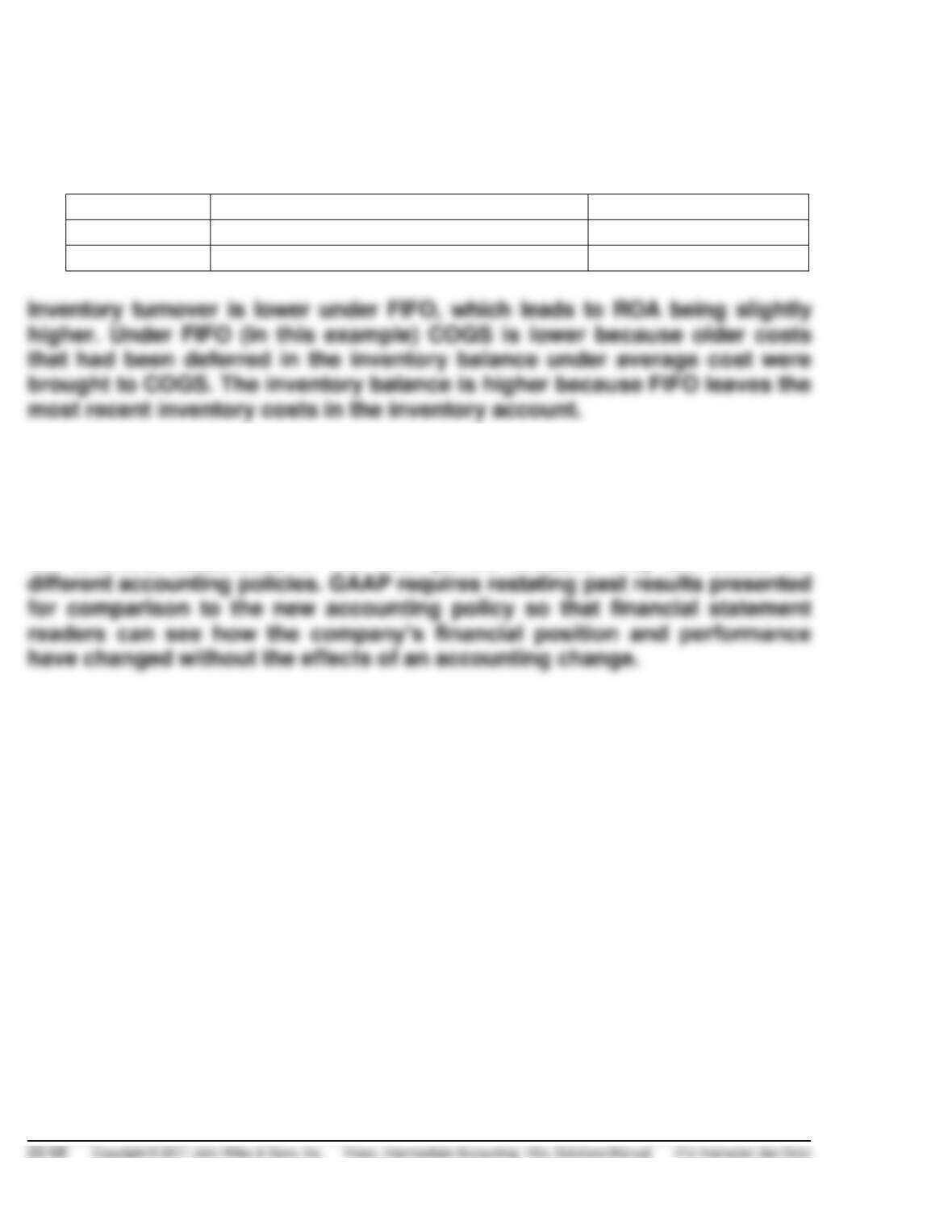
Inventory turnover:
2012
2011
LIFO
N/A LIFO information not available
$300 ÷ $490 = 0.61
FIFO
$330 ÷ $570 = 0.58
$290 ÷ $545 = 0.53
Principles
The issue is consistency across time. When a company changes accounting
policies, financial statements from one period are not really comparable to
the financial statements of the next period because they are based on
PROFESSIONAL RESEARCH
(a) According to FASB ASC 250-10-20 (Glossary), a change in accounting
estimate that is inseparable from the effect of a related change in
Under FASB ASC 250-10–45
45–17, A change in accounting estimate shall be accounted for in the
period of change if the change affects that period only or in the
45–19 Like other changes in accounting principle, a change in
accounting estimate that is effected by a change in accounting
principle may be made only if the new accounting principle is
justifiable on the basis that it is preferable. For example, an entity
that concludes that the pattern of consumption of the expected
(b) According to FASB ASC 250-10–45-18, distinguishing between a change
in an accounting principle and a change in an accounting estimate is
sometimes difficult. In some cases, a change in accounting estimate is
effected by a change in accounting principle. One example of this type
PROFESSIONAL RESEARCH (Continued)
applying it, may be inseparable from the effect of the change in
(c) According to FASB ASC 250–10-S50—Disclosure of the Impact that
Recently Issued Accounting Standards Will Have on the Financial
Statements of the Registrant when Adopted in a Future Period
S50-1 See paragraph 250-10–S99-5, SAB Topic 11.M, for SEC Staff
views regarding disclosure of the impact of recently issued
S99-5 The following is the text of SAB Topic 11.M, Disclosure of the
Impact that Recently Issued Accounting Standards Will Have on
the Financial Statements of the Registrant when Adopted in a
Future Period.
Facts: An accounting standard has been issued that does not
require adoption until some future date. A registrant is required
to include financial statements in fillings with the Commission
after the Issuance of the standard but before it is adopted by the
registrant.5
PROFESSIONAL RESEARCH (Continued)
Interpretive Response: Yes. The commission addressed a
similar issue with respect to Statement 52 and concluded that
“The Commission also believes that registrants that have not yet
adopted Statement 52 should discuss the potential effects of
of presently known material changes, trends and uncertainties
that have had or that the registrant reasonably expects will have
a material impact on future sales, revenues or income from
continuing operations. The staff believes that disclosure of
impending accounting changes is necessary to inform the
change. The staff believes that recently issued accounting
standards may constitute material matters and, therefore,
disclosure in the financial statements should also be considered
in situations where the change to the new accounting standard
will be accounted for in financial statements of future periods,
prospectively or with a cumulative catch-up adjustment.
PROFESSIONAL RESEARCH (Continued)
– 6FRR 6, Section 2.
Question 2: Does the staff have a view on the types of
disclosure that would be meaningful and appropriate when a
new accounting standard has been issued but not yet adopted
by the registrant?
Interpretive Response: The staff believes that the registrant
should evaluate each new accounting standard to determine the
appropriate disclosure and recognizes that the level of information
The following disclosures should generally be considered by the
registrant:
– A brief description of the new standard, the date that
adoption is required and the date that the registrant plans to
adopt, if earlier.
PROFESSIONAL RESEARCH (Continued)
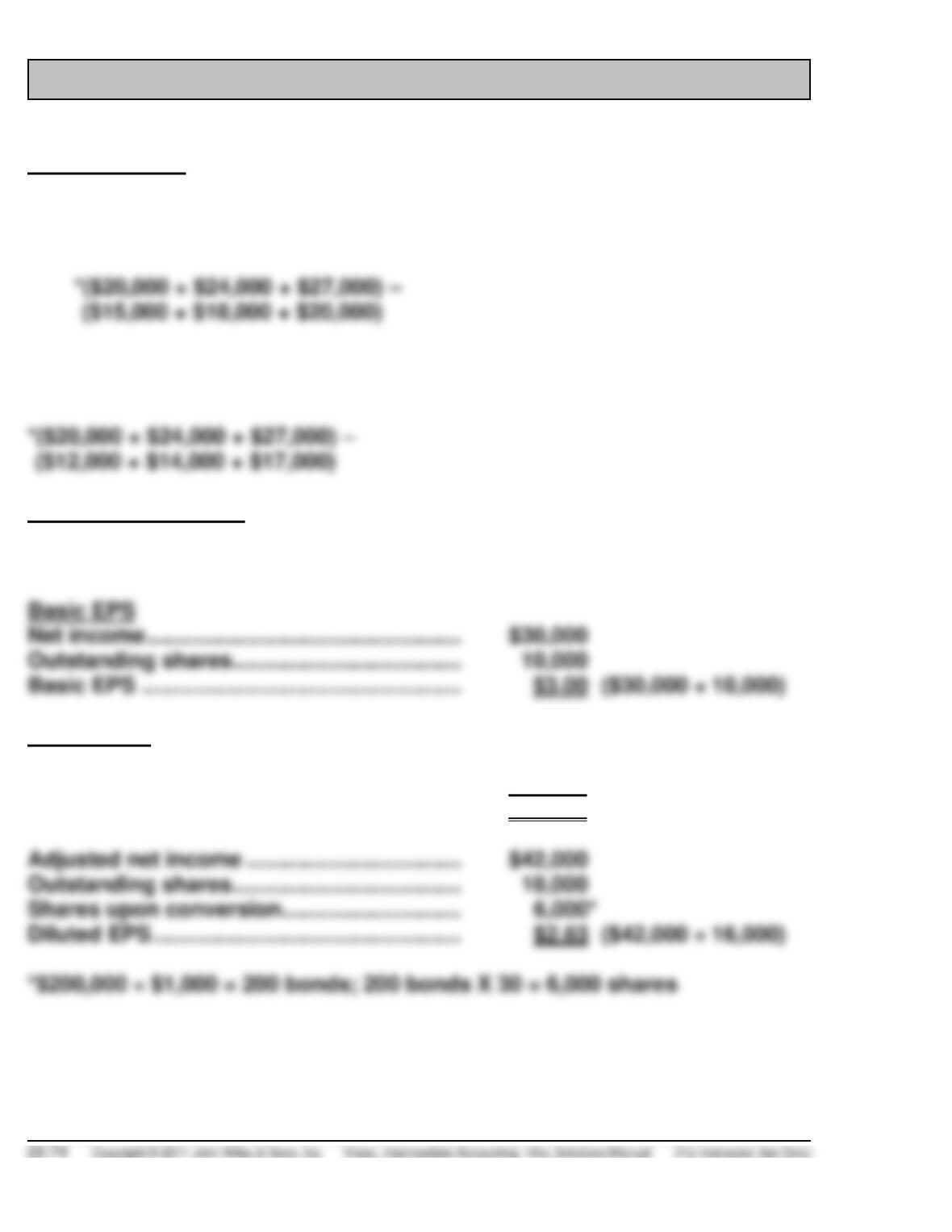
– A discussion of the impact that adoption of the standard is
expected to have on the financial statements of the
registrant, unless not known or reasonably estimable. In
that case, a statement to that effect may be made.
PROFESSIONAL SIMULATION
Journal Entries
(a) Inventory ………………………………………………… 18,000*
Retained Earnings …………………………….. 18,000
(b) Inventory ………………………………………………… 28,000*
Retained Earnings …………………………….. 28,000
Financial Statements
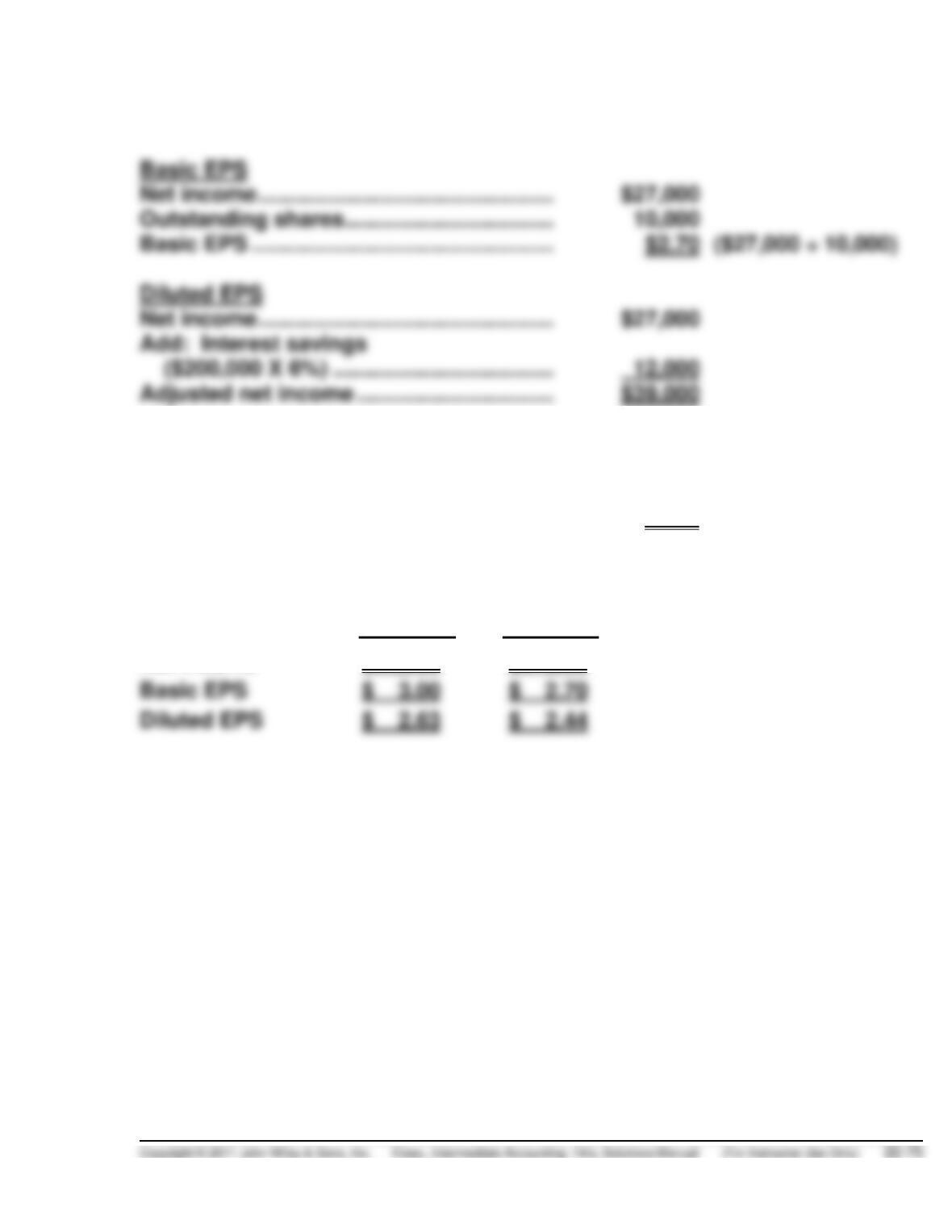
Computation of EPS for 2013
Diluted EPS
Net income …………………………………………… $30,000
Add: Interest savings ($200,000 X 6%)…… 12,000
Adjusted net income …………………………….. $42,000
PROFESSIONAL SIMULATION (Continued)
Computation of EPS for 2012
Adjusted net income ………………………….. $39,000
Outstanding shares ………………………….... 10,000
Shares upon conversion …………………….. 6,000
Diluted EPS ……………………………………….. $2.44 ($39,000 ÷ 16,000)
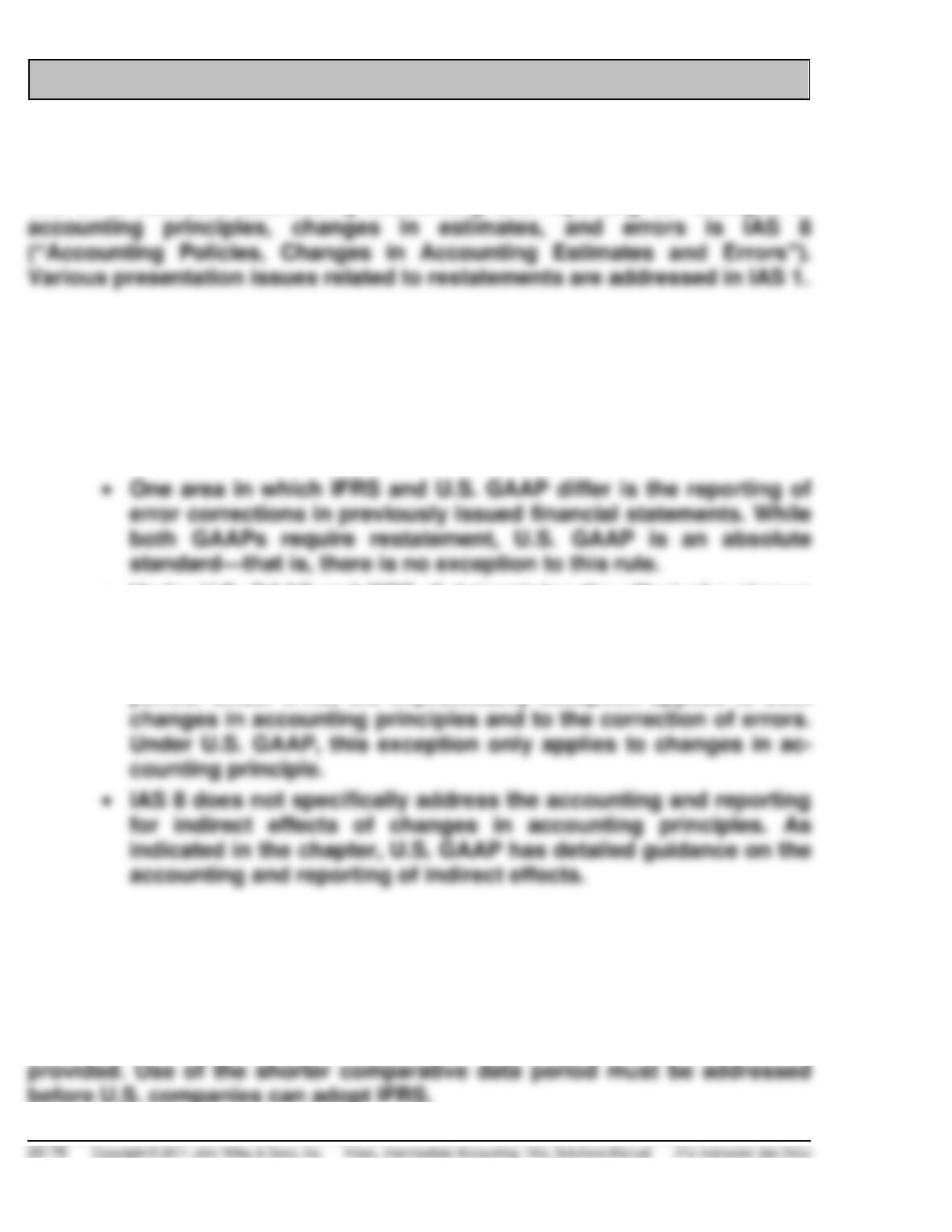
EPS Presentation
2013
2012
Net income
$30,000
$27,000
Diluted EPS
$ 2.63
IFRS CONCEPTS AND APPLICATION
IFRS22-1
The IFRS standard addressing accounting and reporting for changes in
IFRS22-2
FASB has issued guidance on changes in accounting principles, changes
in estimates, and corrections of errors, which essentially converges U.S.
GAAP to IAS 8. Key remaining differences are as follows.
• Under U.S. GAAP and IFRS, if determining the effect of a change
in accounting principle is considered impracticable, then a
company should report the effect of the change in the period in
which it believes it practicable to do so, which may be the current
period. Under IFRS, the impracticality exception applies to both
IFRS22-3
Currently, under U.S. GAAP, when a company prepares financial
statements on a new basis, comparative information must be provided for a
three-year period. Under IFRS, up to two years of comparative data must be
IFRS22-4
The indirect effect of a change in accounting policy reflects any changes in
current or future cash flows resulting from a change in accounting policy
IFRS22-5
The company prospectively applies the new accounting policy as of the
earliest date it is practicable to do so.
IFRS22-6
(a) 1. Uncollectible Accounts Receivable. This is a change in account–
ing estimate. Restatement of prior periods is not appropriate.
3. Mathematical Error. This is a correction of an error and prior
period adjustment treatment would be in order.
IFRS22-6 (Continued)
5. FIFO to Average-Cost Change. This is a change in accounting
policy. Restatement of December 31, 2011 retained earnings is
6. Percentage–of–Completion. This is a change in accounting policy.
Retained earnings should be adjusted.
(b) The adjustment to the December 31, 2011 retained earnings balance
would be computed as follows:
IFRS22-7
(a) The guidelines for reporting a change in accounting principle related to
depreciation methods can be found in IAS 8, paragraphs 32-38, under
the heading “Changes in accounting estimates.”
(b) According to paragraph 14, “An entity shall change an accounting policy
only if the change:
IFRS22-8
(a) The following IFRSs, IFRIC interpretations and amendments have been
adopted in the financial statements for the first time in this financial
period:
– IAS 1 (Revised) – ‘Presentation of Financial Statements’ is effective
for the year ended 3 April 2010. The standard requires a change in
the format and presentation of the Group’s primary statements but
has had no impact on reported profits or equity.
(b) The estimates M&S discussed in 2008 were impairment of goodwill;
impairment of property, plant, and equipment and computer software;
depreciation of property, plant, and equipment and amortization of
computer software; post-retirement benefits; and refunds and loyalty
scheme accruals.