22
Lesson Plans for
Delirium and Dementia
CHAPTER LESSON PLANS & OBJECTIVES
Lesson 22.1:
2. Describe the subtypes of mild and major NCDs.
4. Explain the differences between delirium nd dementia.
6. Discuss nursing assessment and interventions related to delirium and dementia.
CHAPTER TEACHING FOCUS
• In this chapter, students will be introduced to the concepts of delirium and dementia, including the
differences between the two, and related nursing assessment and interventions. Students will also
have the opportunity to examine the causes of acute confusion.
CONCEPTS
The following conceptual themes and specific concepts match those presented in Giddens, J. R. (2013).
Concepts for nursing practice. St. Louis: Elsevier. The specific exemplars chosen and listed below for
each concept have been tailored specifically to correspond to the Linton textbook.
THEME: Cognitive Function
• Concept: Cognition
• Exemplar: Delirium, p. 336
• Box 22-1: Systemic and Central Nervous System Causes of Delirium, p. 337
• Exemplar: Major Neurocognitive Disorder (Dementia), p. 338

2 Chapter 22 Delirium and Dementia __________________________________________________________
Introduction to Medical-Surgical Nursing, 6th ed.
CHAPTER PRETEST
Have the students answer these questions prior to covering this chapter to understand where they stand
in relation to the content.
1) A short-term state of confusion is best defined as __________.
a) delirium
b) dementia c) transient
d) inorganic
2) Dementia is best characterized as __________.
a) short-term
b) improving at night c) chronic
d) infectious
3) A systemic condition commonly associated with delirium would be __________.
a) Alzheimer’s disease
b) cerebrovascular accident c) Parkinson disease
d) electrolyte imbalance
4) Medications commonly associated with confusion would be __________.
a) vitamin B
b) calcium c) antibiotics
d) antihypertensives
5) A central nervous system condition commonly associated with dementia is __________.
a) folic acid deficiency
b) Huntington disease c) traumatic brain injury
d) elevated potassium
6) A confused patient is at risk for injury because of __________.
a) lack of adequate sleep
b) inability to eat properly c) attempts to leave the setting
d) self-care deficit
7) A confused patient may attempt to climb out of bed because of __________.
a) fatigue
b) need to use the bathroom c) activity intolerance
d) lack of restraints
8) A best item to assist in reorienting the confused patient would be __________.
a) a daily newspaper
b) a daily cable television news show
c) a clock with AM and PM settings
d) eating the same breakfast every morning
9) An assessment for the acute onset of confusion would include __________.
a) any changes in medication
b) date of most recent vacation c) changes in bedtime routine
d) signs and symptoms of constipation
10) A nursing intervention based upon the cognitive developmental approach (CDA) would be
__________.
a) daily orientation reminders
b) teaching the patient how to use the nurse call light
c) use of incontinence briefs throughout the day and night
d) encouragement of appropriate self-care by offering simple decisions
__________________________________________________________ Chapter 22 Delirium and Dementia 3
Introduction to Medical-Surgical Nursing, 6th ed.
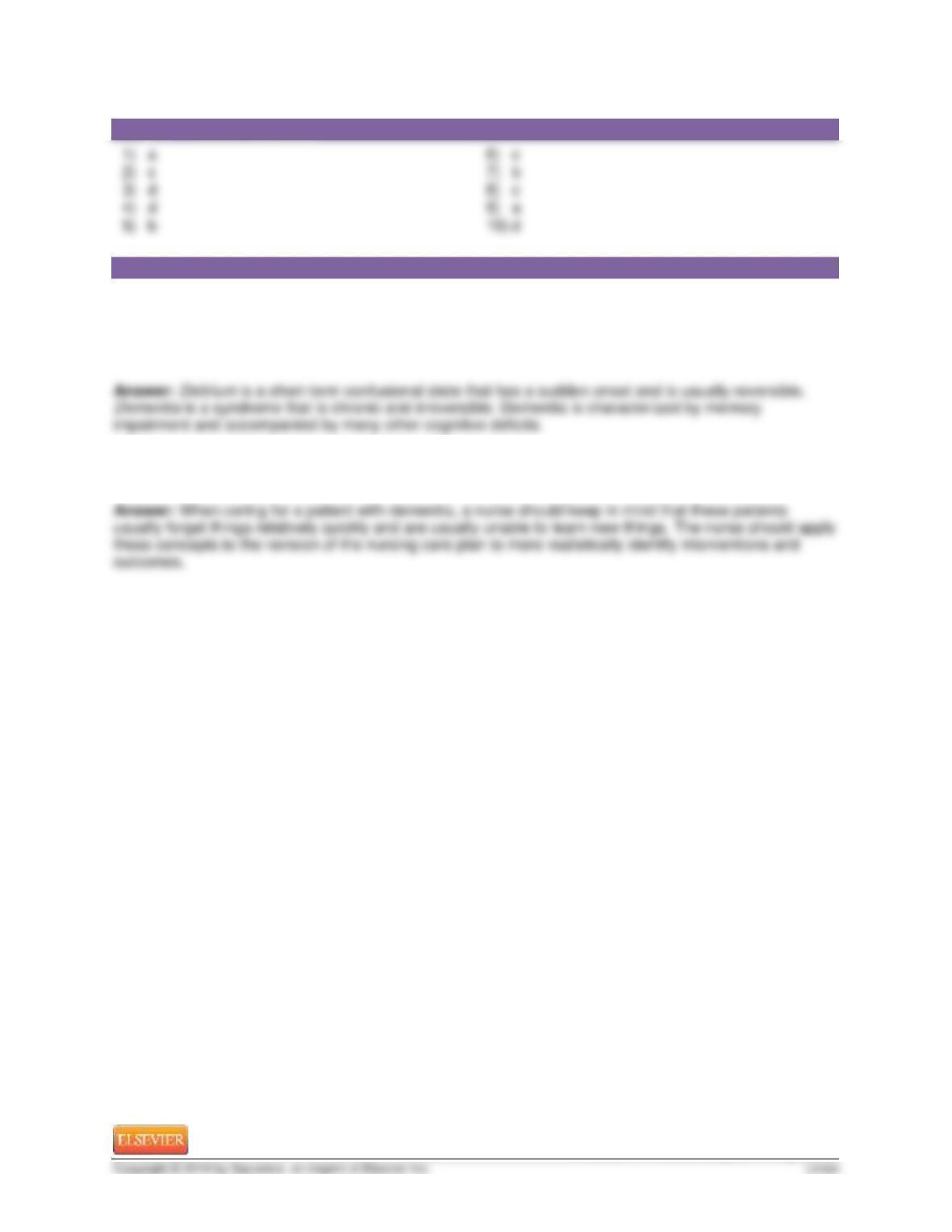
Chapter Pretest Answers
CHAPTER BACKGROUND ASSESSMENT
Discuss these questions with your students prior to covering this chapter to understand where they stand
in relation to the content.
Question: What is delirium? What is dementia?
Question: What two important concepts should a nurse keep in mind when caring for patients with
dementia?
4 Chapter 22 Delirium and Dementia __________________________________________________________
Introduction to Medical-Surgical Nursing, 6th ed.
LESSON 22.1
Instructor Preparation
Textbook Objectives Covered
1. Describe the neurocognitive disorders (NCDs): delirium, mild NCD, and major NCD.
3. Identify the common causes of derlirium.
5. Identify drugs used to treat delirium and dementia.
6. Discuss nursing assessment and interventions related to delirium and dementia.
Lesson Preparation Checklist
• Prepare lecture from TEACH lecture slides available on Evolve.
• Student performance evaluation of all entry-level skills required for student comprehension of
principles underlying delirium and dementia in patients, including:
• Delirium and dementia and their differences
• The causes of acute confusion
• Nursing assessment and intervention
• Assemble materials and supplies needed for each lesson as indicated below.
Materials and Supplies
• computer and PowerPoint
projector
• drug references
Key Terms
• delirium (p. 336)
• dementia (p. 338)
Student Preparation
Assignments 2 hours
1
READ – Textbook (pp. 336-339)
ANSWER – Study Guide
• Part IA: 1-3 (p. 127)
2
• Table 22-1: Major Neurocognitive Disorder Subtypes (p. 338)
READ – Textbook (pp. 338-339)
REVIEW
ANSWER – Text
• Review Questions for the NCLEX Examination: 7 (p. 346)
3
READ – Textbook (pp. 336-338)
REVIEW
• Box 22-1: Systemic and central nervous system causes of delirium (p. 337)
ANSWER – Study Guide
• Part IIB: 8-10, 13 (pp. 128-129)
__________________________________________________________ Chapter 22 Delirium and Dementia 5
Introduction to Medical-Surgical Nursing, 6th ed.
LESSON 22.1
4
READ – Textbook (pp. 336-340)
REVIEW
• Table 22-2: Clinical Features in Delirium and Dementia (p. 340)
ANSWER – Text
• Review Questions for the NCLEX Examination: 1 (p. 345)
5
READ – Textbook (pp. 337-339)
ANSWER – Text
• Review Questions for the NCLEX Examination: 8, 9, 10 (p. 346)
6
READ – Textbook (pp. 339-345)
REVIEW
• Figure 22-1: Presence of a family member may help calm a confused patient (p. 341)
ANSWER – Text
• Review Questions for the NCLEX Examination: 2, 3, 4, 5, 6 (p. 346)
ANSWER – Study Guide
• Part IIB: 1-7, 11, 12 (pp. 128-129)
• Part IIIC: 1-6 (p. 129)
• Part IIID: 1-5 (p. 130)
Lecture Outline 20 minutes
Slide 1
Chapter 22
Delirium and Dementia
1
&
2
Slide 2
Delirium
• Definition: short-term confusional state with sudden onset; typically reversible
• Characterized by disturbances in consciousness that impair a person’s awareness of the
environment
• May have difficulty focusing or paying attention, so easily distracted
TALKING POINTS:
6 Chapter 22 Delirium and Dementia __________________________________________________________
Introduction to Medical-Surgical Nursing, 6th ed.
LESSON 22.1
Slide 3
Delirium (cont.)
• May be difficult to engage in a conversation, and questions often must be repeated
several times
• Impaired recent memory is common, along with disorientation and language problems
TALKING POINTS:
• What is an example of how a person may misinterpret what is going on in the
environment?
Slide 4
• Other symptoms: anxiety, depression, irritability, anger, apathy, or euphoria
Delirium (cont.)
• May alternate between hyperactivity and hypoactivity
• May fluctuate from drowsiness to stupor or coma
TALKING POINTS:
• If the underlying cause is not identified and treated, delirium can become a permanent
condition, especially in older adults.
• What factors may contribute to delirium?
3
Slide 5
Causes of Delirium
• Certain medical conditions
• Substance intoxication
• Substance withdrawal
• Toxins
TALKING POINTS:
• Medical conditions such as liver failure, kidney failure, and hypoxia can lead to delirium.
• Withdrawal from substances such as barbiturates can lead to delirium.
2
Mild Neurocognitive Disorder
• Modest decline in cognitive function
• Inidividual functions well enough to live independently
__________________________________________________________ Chapter 22 Delirium and Dementia 7
Introduction to Medical-Surgical Nursing, 6th ed.
LESSON 22.1
2
&
4
Slide 7
Major Neurocognitive Disorder (Dementia)
• Chronic and irreversible (as opposed to delirium, which is short-term and reversible)
• Memory impairment and many other cognitive deficits
• Impaired intellectual function, problem-solving ability, judgment, memory and orientation,
and inappropriate behavior
TALKING POINTS:
• The cause of Alzheimer’s disease is unknown, but characteristic changes in the brain
include deposits of amyloid, neurofibrillary tangles, and a deficiency of acetylcholine.
• Why does vascular dementia occur?
Slide 8
Major Neurocognitive Disorder (Dementia) (cont.)
• Other conditions associated with dementia
• Normal pressure hydrocephalus, subdural hematoma, brain tumors, neurosyphilis,
and acquired immunodeficiency syndrome (AIDS)
TALKING POINTS:
• What are the two most prevalent types of dementia?
5
Slide 9
Medications Used to Treat NCDs
• Aricept
• Exelon
• Razadine
• Namenda
• None of these medications are curative
• Antidepressants and antipsychotics may be used as well
6
Assessment
• Observe behavior and collect data about orientation, memory, and sleep habits
• Family may provide information if patient cannot
TALKING POINTS:
• What drugs most often cause confusion?
8 Chapter 22 Delirium and Dementia __________________________________________________________
Introduction to Medical-Surgical Nursing, 6th ed.
LESSON 22.1
Slide 11
Disturbed Thought Processes
• Private room with continual supervision
• Room quiet and uncluttered to avoid agitation caused by extraneous stimuli
• Lighting soft and diffuse to avoid shadows that may be misinterpreted and add to patient’s
fears
TALKING POINTS:
• Patients who normally wear hearing aids and glasses should be encouraged to use them.
• A clock and calendar may help orient a patient with delirium; however, they must be in a
place where they can be seen easily. In addition, patients with sensory impairments
should wear their glasses and/or hearing aids, if possible.
Slide 12
Disturbed Thought Processes (cont.)
• Communication with a confused patient should be simple and direct
• Anyone dealing with a patient with a cognitive disorder should be calm, warm, and
reassuring
• It is helpful if the same personnel are assigned to care for the patient
• Avoid sudden movements, and handle the patient gently during procedures or turning
• Keep choices to a minimum
• Simple, direct statements better than questions
Disturbed Thought Processes (cont.)
• Hallucinating patients need one-to-one nursing observation and repeated verbal
Slide 14
Disturbed Sleep Pattern
• Sleep deprivation can cause or contribute to disorientation and confusion
• A backrub, glass of warm milk, and a soothing conversation may help the patient relax
and fall asleep
• Schedule medications or treatments at times that do not interrupt nighttime sleep
• Presence of a family member may help calm an agitated and confused patient
Slide 15
Risk for Injury
• Patient may pull on tubes, try to get out of bed unassisted, or attempt to leave the setting
• Avoid physical restraints: increase anxiety and agitation in confused patients; can result in
injuries
TALKING POINTS:
• It can be challenging to protect the patient from harm without imposing excessive
restrictions.
• What nursing interventions may be helpful to avoid the use of restraints?
• If there is no reason that confused patients need to stay in bed, try sitting them in chairs or
even “visiting” the nurses’ station in a wheelchair. Avoid arguing with cognitively impaired
patients.
__________________________________________________________ Chapter 22 Delirium and Dementia 9
Introduction to Medical-Surgical Nursing, 6th ed.
LESSON 22.1
Slide 16
Self-Care Deficit
• Patients with dementia may be incontinent of urine and feces
• If constipation cannot be managed with diet, fluids, and exercise, a bulk-forming stool
softener may be needed
TALKING POINTS:
• What is the goal for patients with dementia?
Slide 17
• Group meals may be helpful because patients often imitate behaviors of others
• Offer fluids frequently during the day
Imbalanced Nutrition: Less Than Body Requirements
• Assist with meals: cutting food or total feeding
• Foods that can be managed with a single utensil may facilitate self-feeding
• Finger-foods high in protein and carbohydrates allow patients to feed themselves more
Slide 18
Disturbed Sleep Pattern
• Sleep and awakening are often reversed
• Try to keep them awake during the day and get them to sleep at night
• Tests and treatments can be scheduled during the morning and early afternoon to allow
the patients time to wind down by bedtime
• Some caregivers have found that a quiet hour in the afternoon with soft music promotes
sleep at night
• Patients who awaken during the night and become confused and agitated should be
reassured in a soft, soothing manner
Risk for Injury
• A safe, structured environment is essential for a person with dementia
Slide 20
Disturbed Thought Processes/Impaired Verbal Communication
• Communication should be simple and direct
• Patients must be approached gently, calmly, and quietly
• Nonverbal communication is extremely important
TALKING POINTS:
• Patients with dementia are disoriented, and their thinking ability is impaired.
• How can confrontations with confused patients be avoided?
10 Chapter 22 Delirium and Dementia __________________________________________________________
Introduction to Medical-Surgical Nursing, 6th ed.
LESSON 22.1
Slide 21
learn new things.
Nursing Care
• Guidelines for working with patients with dementia
• They usually forget things relatively quickly
• They are usually unable to learn new things
• You can be creative in the care of patients with dementia by using these two concepts
• Sometimes agitation indicates pain, hunger, stress, fear, or the need for toileting
TALKING POINTS:
• What nursing interventions may be helpful for a patient with dementia who is becoming
restless, anxious, or agitated?
Nursing Care (cont.)
• Cognitive developmental approach (CDA)
CDA: Principles
• Accept that the patient may no longer be able to make adult decisions and behave as a
healthy adult would. Offer limited choices to simplify decision-making
Slide 24
CDA: Principles (cont.)
• Recognize irrational fears and arrange alternative ways to give personal care
• In advanced dementia, patient behaviors and thinking are not typical of a healthy adult.
Some strategies that work with children often work with patients with dementia
Slide 25
Question 1
• ___________ is a syndrome that is chronic and generally considered irreversible. It is
characterized by impairment in memory accompanied by many other cognitive deficits
and leading to impaired activities of daily living.
A. Delirium
B. Confusion
C. Dementia
D. Hallucination
TALKING POINTS:
__________________________________________________________ Chapter 22 Delirium and Dementia 11
Introduction to Medical-Surgical Nursing, 6th ed.
LESSON 22.1
Slide 26
Question 2
• Characteristic changes in the brain of a person with Alzheimer’s dementia (AD) include all
of the following EXCEPT __________.
A. deposits of the protein amyloid
B. neurofibrillary tangles associated with altered tau protein
C. a deficiency of acetylcholine
D. inadequate blood supply to brain
TALKING POINTS:
Activities
Classroom Choose from below to make 30 minutes
Online
1
ASSESS BASELINE
• Have the class complete the Pretest. Collect
their work and use the results to guide how
you teach the class.
DISCUSS
• Discuss students’ personal experiences with
family members who were diagnosed with
delirium or dementia. How did the symptoms
affect their relationships?
• Label two columns on the board: one
delirium and one dementia. Ask the students
ASSESS BASELINE
• Post the Pretest and the Background
Assessment online and have your class
complete them. Use the results to guide how
you teach the class.

12 Chapter 22 Delirium and Dementia __________________________________________________________
Introduction to Medical-Surgical Nursing, 6th ed.
LESSON 22.1
2
present its findings to the class.
DISCUSS
• Discuss the nurse’s role in helping the
patient and family cope with the cognitive
deficits of dementia.
• Divide the class into several groups. Assign
each group one of the drug classes listed in
Box 22-1. For its assigned drug class, have
each group refer to a drug handbook and
POST AND COMMENT
• Post the following discussion topic online
and have students comment. Discuss
community resources that are available
where you live for the patient diagnosed with
an NCD.
3
other student acts as the family member.
DISCUSS
• Discuss the nurse’s role in engaging the
family to help assess a patient who is
confused. How might a family member’s own
feelings about the patient’s circumstances
affect the family member’s participation and
objectivity?
• Divide the class into small groups. Have
each group identify questions to ask family
POST AND COMMENT
• Post the following discussion topic online
and have students comment. Create a table
listing five common causes of delirium and
how these causes might be avoided.
4
DISCUSS
• Discuss the major differences in delirium
and dementia. Explain that dementia is long-
term and irreversible while delirium is short-
term and reversible.
POST AND COMMENT
• Post the following discussion topic online
and have students comment. Create a table
that delineates key differences between
delirium and dementia.
5
uses, and side effects of each drug.
effects.
DISCUSS
• Divide the class into small groups. Assign
each group a list of drugs used in the
POST AND COMMENT
• Post the following discussion topic online
and have students comment. Create a table
__________________________________________________________ Chapter 22 Delirium and Dementia 13
Introduction to Medical-Surgical Nursing, 6th ed.
LESSON 22.1
6
DISCUSS
• Divide the class into small groups, and
assign each group one of the following
situations:
• A patient who has had a myocardial
infarction and develops delirium
• A patient with an electrolyte imbalance
who develops delirium
• A patient with heat stroke who develops
delirium
POST AND COMMENT
• Post the following discussion topic online
and have students comment. Discuss how
nursing care might be more effective than
drugs in managing confusion for some
patients.
Critical Thinking Question
A 74-year-old woman who has Parkinson disease had a left knee replacement. Two days
later, the patient was unable to state the time and place, could not recall her surgery, and
was agitated with the male nurse assigned to her care. As the patient began to eat her
breakfast, the nurse made sure the bedside rails were up and the call light was available as
he left to talk to the charge nurse. When the nurse looked up from the nurses’ station, the
patient was walking with her walker in the hall, dragging her indwelling urinary catheter
behind her. She had dislodged her intravenous line and was placing full weight on her
operated knee. She said she was going home, “because you people are trying to kill me.”
How should the nurse intervene in this situation?
Discussion Guidelines: The nurse was correct to contact the charge nurse after taking immediate
Instructor Notes/Student Feedback
14 Chapter 22 Delirium and Dementia __________________________________________________________
Introduction to Medical-Surgical Nursing, 6th ed.
22
Assessments for
Delirium and Dementia
CHAPTER OBJECTIVES
Lesson 22.1:
2. Describe the subtypes of mild and major NCDs.
4. Explain the differences between delirium nd dementia.
6. Discuss nursing assessment and interventions related to delirium and dementia.
Assessments by Lesson & Objective
Lesson 22.1
1
Study Guide
• Part IA: 1-3 (p. 127)
Evolve Instructor Resources
Evolve Student Resources
• NCLEX Review: 1
2
Evolve Instructor Resources
• Test Bank: 9, 16, 20, 27
Evolve Student Resources
• NCLEX Review: 2
Study Guide
Evolve Instructor Resources
• Test Bank: 12, 28
4
Evolve Instructor Resources
• Test Bank: 13, 17, 19
Evolve Student Resources
__________________________________________________________ Chapter 22 Delirium and Dementia 15
Introduction to Medical-Surgical Nursing, 6th ed.
Assessments by Lesson & Objective
6
Study Guide
• Part IIB: 1-7, 11, 12 (pp. 128-129)
• Part IIIC: 1-6 (p. 129)
• Part IIID: 1-5 (p. 130)
Evolve Instructor Resources
Instructor’s Notes/Student Feedback