22-1
CHAPTER 22
THE STATEMENT OF CASH FLOWS
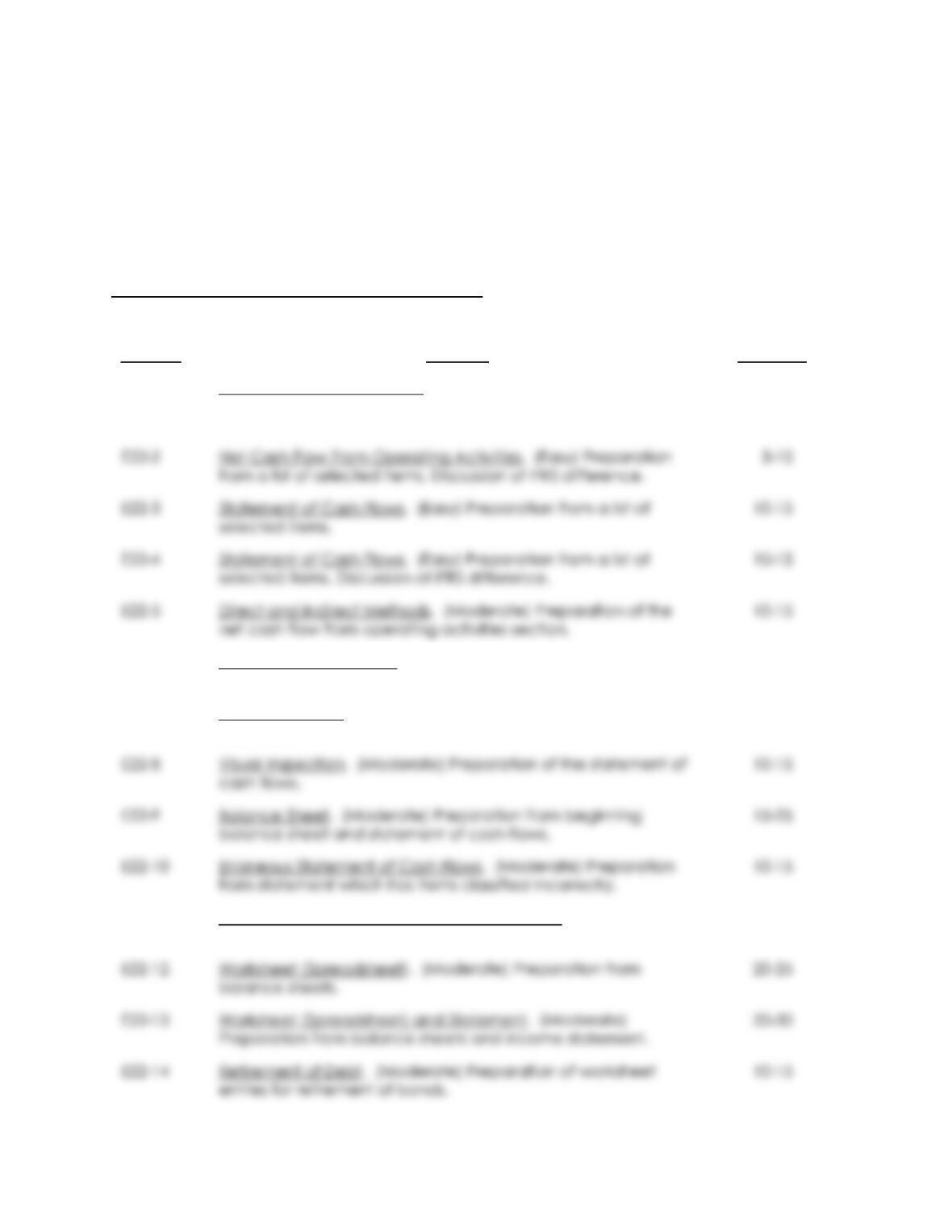
CONTENT ANALYSIS OF EXERCISES AND PROBLEMS
Number
Content
Time Range
(minutes)
E22-1
Classification of Cash Flows. (Easy) Determination of the proper
section and of the direction of cash flow for various items.
Discussion of IFRS difference.
5-15
E22-6
Fixed Asset Transactions. (Moderate) Analysis of accounts used
when preparing the statement of cash flows.
10-15
E22-7
Visual Inspection. (Moderate) Preparation of the statement of
cash flows.
10-15
E22-11
Partially Completed Worksheet (Spreadsheet). (Moderate)
Completion of worksheet.
15-20
22-2
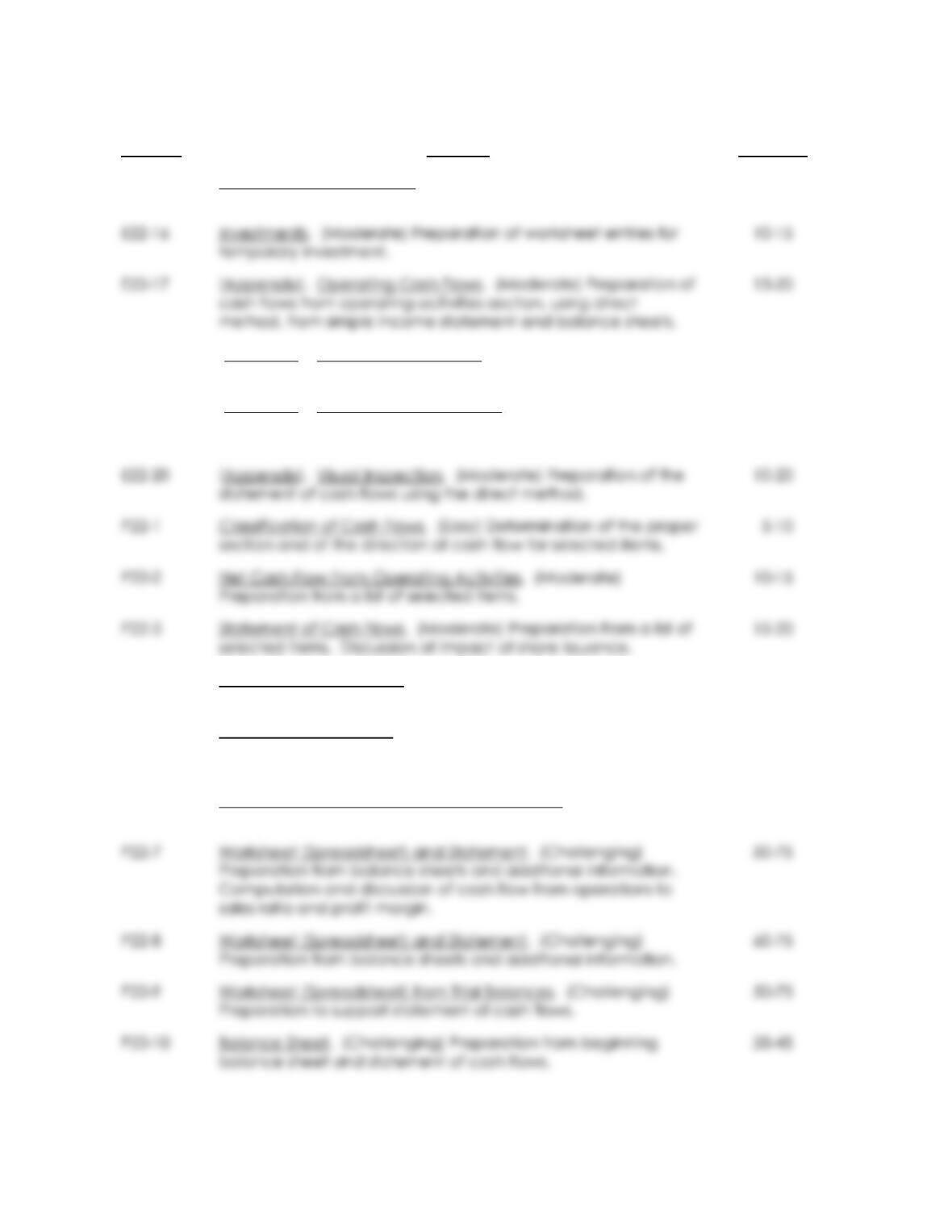
Number
Content
Time Range
(minutes)
E22-15
Interest and Income Taxes. (Easy) Computation of amounts of
interest and income taxes paid. Discussion of IFRS differences.
10-20
E22-18
(Appendix). Operating Cash Flows. (Moderate) Preparation of
cash flows from operating activities using the direct method.
10-15
E22-19
(Appendix). Statement of Cash Flows. (Easy) Preparation,
using direct method, from a list of selected items. Discussion of
IFRS differences.
10-15
P22-4
Statement of Cash Flows. (Moderate) Preparation from a list of
selected items. Discussion of impact of share issuance.
15-20
P22-5
Infrequent Transactions. (Challenging) Analysis of various items
and how the transactions would be reported on work-papers
to support the statement of cash flows.
20-30
P22-6
Partially Completed Worksheet (Spreadsheet). (Moderate)
Completion of worksheet.
30-45
Number
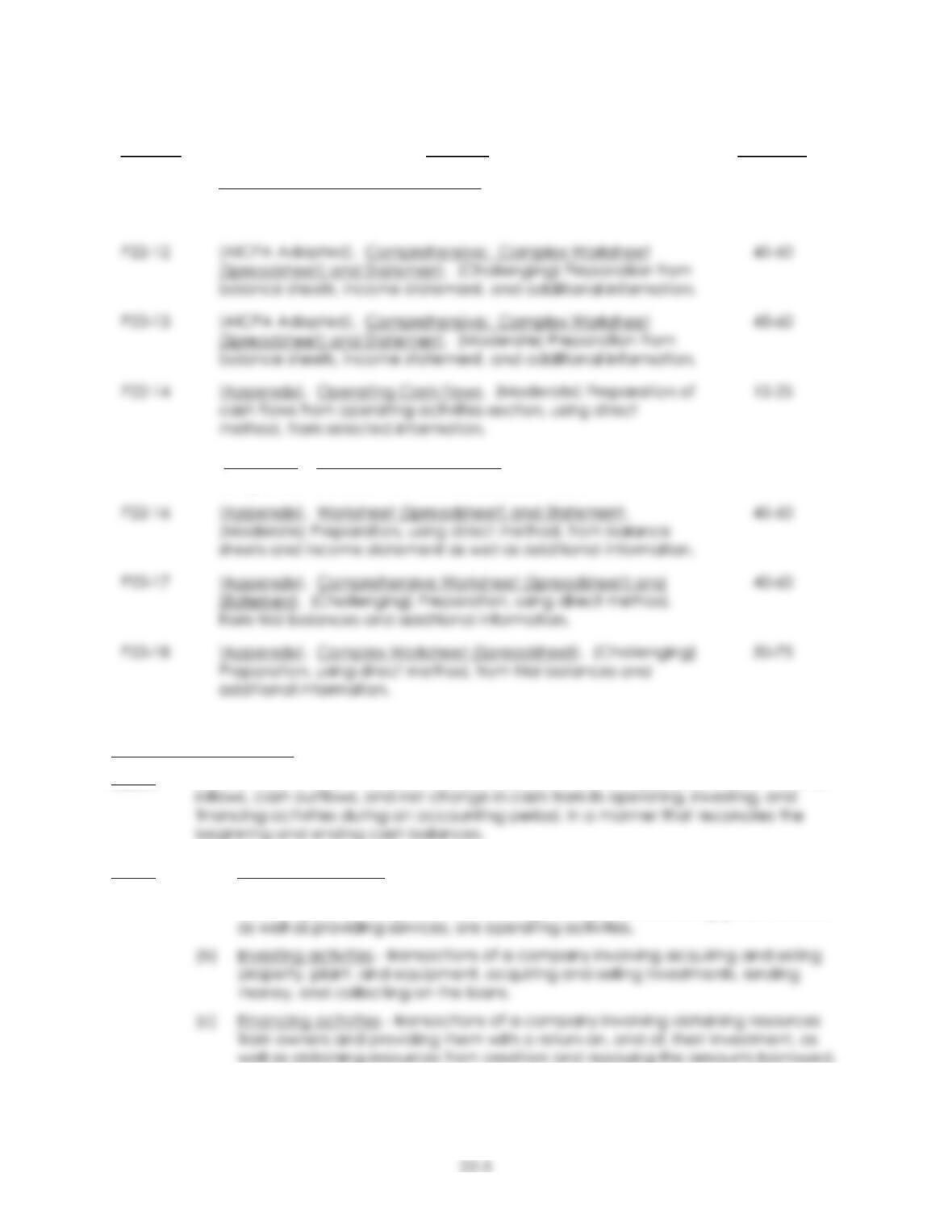
Content
Time Range
(minutes)
P22-11
Erroneous Statement of Cash Flows. (Moderate) Preparation of
corrected statement from statement which has items
incorrectly classified.
20-30
P22-15
(Appendix). Statement of Cash Flows. (Easy) Preparation,
using direct method, from a list of selected items.
15-20
ANSWERS TO QUESTIONS
Q22-1 A statement of cash flows is a financial statement of a company that shows the cash
Q22-2 (a) Operating activities – include all transactions and other events of a company
that are not investing and financing activities. Transactions that involve
acquiring (purchasing or manufacturing), selling, and delivering goods for sale,
22-4
Q22-3 The information in a statement of cash flows helps external users to assess a
company’s ability to generate positive future net cash flows, a company‘s ability to
Q22-4 The five items shown in a company’s statement of cash flows for an accounting
period are:
1. The cash provided by or used in its operating activities,
2. The cash provided by or used in its investing activities,
Q22-5 Cash equivalents are short-term, highly liquid investments, such as treasury bills,
Q22-6 The three categories of a company’s inflows of cash are:
1. Decreases in assets other than cash
The three categories of a company’s outflows of cash are:
22-5
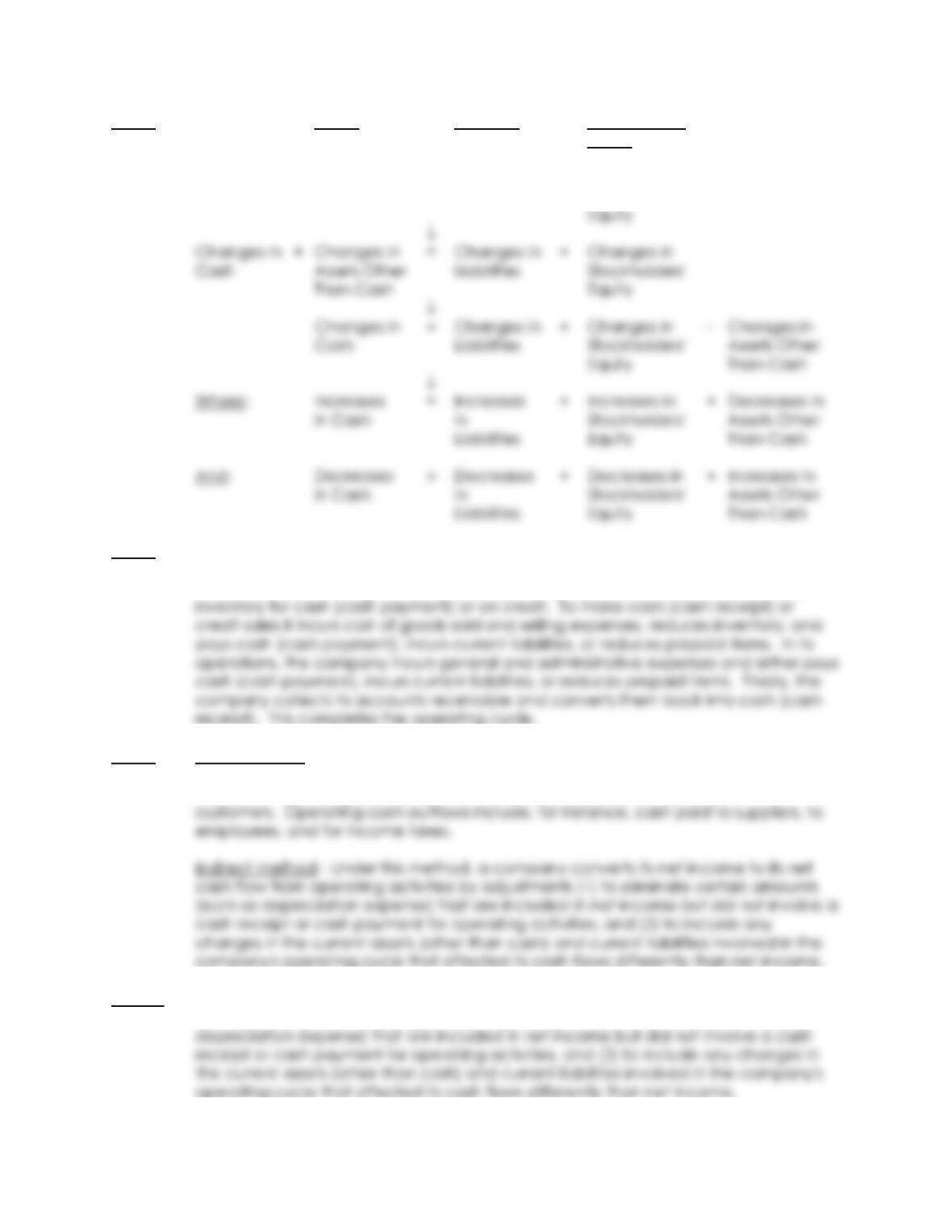
Q22-7 Assets = Liabilities + Stockholders’
Equity
↓
Changes in = Changes in + Changes in
Assets Liabilities Stockholders’
Q22-8 A retail company’s operating cycle is the average time it takes to spend cash for
inventory, sell the inventory, and collect the accounts receivable, converting them
back into cash. To begin a company’s operating cycle, the company purchases
Q22-9 Direct method – Under this method, a company deducts its operating cash outflows
from its operating cash inflows to determine its net cash flow from operating
activities. Operating cash inflows include, for instance, cash received from
Q22-10 Under the indirect method, a company converts its net income to its net cash flow
from operating activities by adjustments (1) to eliminate certain amounts (such as
22-6
Q22-10 (continued)
The adjustments that are added to net income include, for example, depreciation
expense, increases in current liability accounts related to operating activities (e.g.,
Q22-11 (a) Cash inflows from investing activities
(b) Cash outflows for investing activities
1. Payment for purchase of land, building, or equipment
Q22-12 (a) Cash inflows from financing activities
1. Proceeds from issuance of common or preferred stock
(b) Cash outflows from financing activities
Q22-13 1. Issuance of common stock for land
Q22-14 Under the visual inspection method, you review a company’s financial statements
and prepare its statement of cash flows without the use of a worksheet.
Steps:
1. Prepare the heading for the statement of cash flows and list the three major
sections: (a) net cash flow from operating activities, (b) cash flows from investing
22-7
Q22-14 (continued)
2. Calculate the net change in cash that occurred during the accounting period.
6. If no cash flow occurred in Step 5, then determine whether the increase or
decrease in each balance sheet account (except cash) was the result of a
noncash income statement item or a simultaneous investing and financing
transaction.
Q22-15 Under the worksheet method, a worksheet (spreadsheet) is prepared first, before
preparing a company’s statement of cash flows and accompanying schedule of
investing and financing activities not affecting cash. In this approach, the changes
Q22-16 A company computes the interest that it paid during the year as follows:
Q22-17 If a company uses the indirect method of reporting the net cash flow from operating
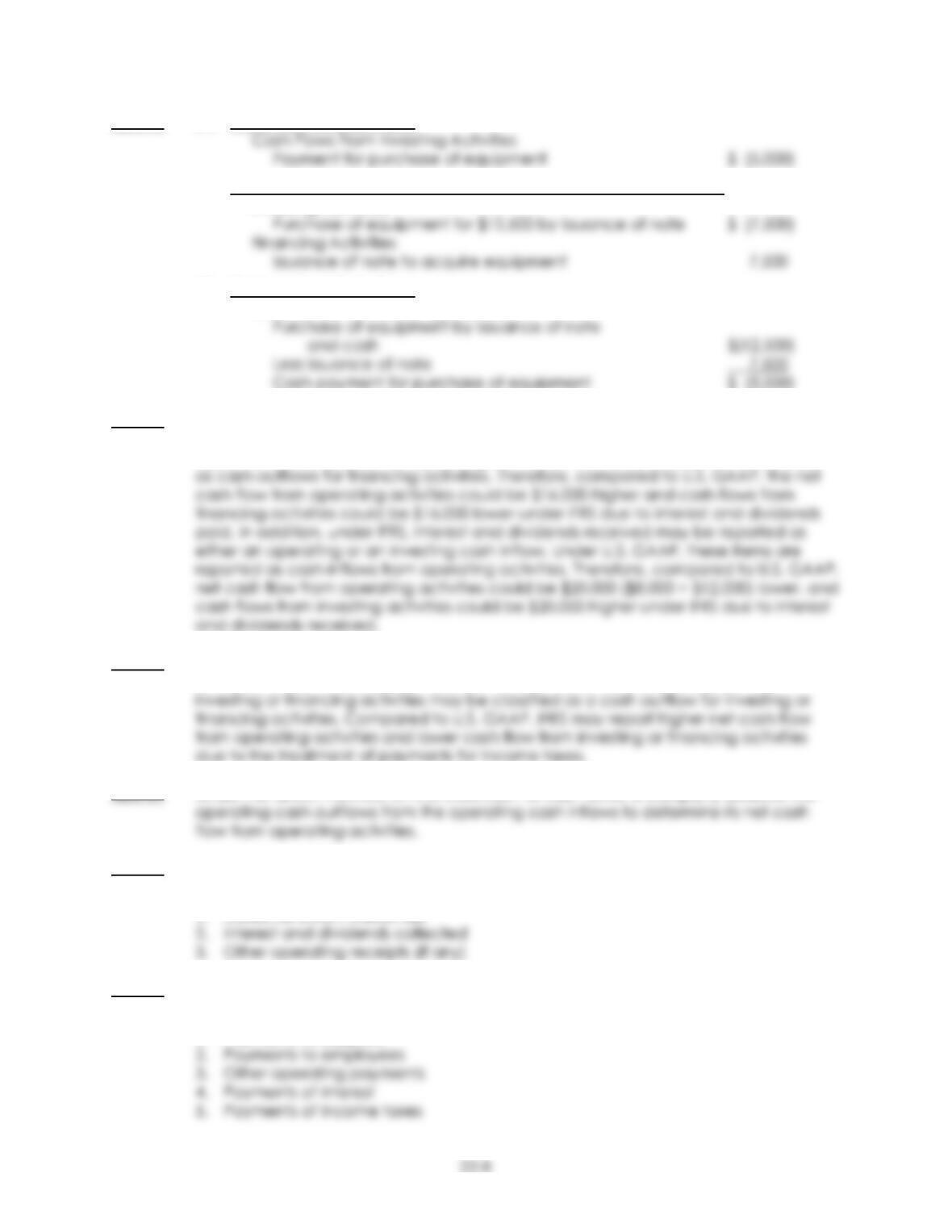
Q22-18 (1) Statement of Cash Flows
Schedule 1: Investing and Financing Activities Not Affecting Cash
Investing Activities
(2) Statement of Cash Flows
Cash Flows From Investing Activities
Q22-19 Under IFRS, the company may report interest and dividends paid as either an
operating cash outflow or a financing cash outflow. Under U.S. GAAP, interest paid is
reported as cash outflow for operating activities, while dividends paid are reported
Q22-20 Under U.S. GAAP, income taxes paid is reported as a cash outflow from operating
activities. Under IFRS, any payments for income taxes that are associated with
Q22-21 Under the direct method, on the statement of cash flows, a company deducts the
Q22-22 The three operating cash inflows that a company reports under the direct method
are:
1. Collections from customers
Q22-23 The five operating cash outflows that a company reports under the direct method
are:
1. Payments to suppliers
22-9
Q22-24 The methods for determining each of the three cash inflows under the direct method
are:
1. Collections from customers: Sales revenue, plus decrease in accounts receivable
The methods for determining each of the five outflows are:
1. Payments to suppliers: Cost of goods sold, plus increase in inventory or minus
decrease in inventory, plus decrease in accounts payable or minus increase in
accounts payable.
be made for a change in a deferred tax asset).
ANSWERS TO MULTIPLE CHOICE
SOLUTIONS TO REVIEW EXERCISES
RE22-1
S Increase in inventory
A Decrease in accounts receivable
RE22-2
(a) I
RE22-3
Cash Flows from Operating Activities
Cash Inflows:
RE22-4
Net Cash Flows from Operating Activities
Net Income $ 35,000
22-11
RE22-5
Cash Flows From Investing Activities
RE22-6
Cash Flows From Financing Activities
RE22-7
Cash Flows From Investing Activities:
RE22-8
Bonds Payable 300,000
RE22-9
Note to Instructor: Simultaneous investing and financing activities are not
reported on the statement of cash flows. They are reported in a separate
RE22-10
Bond interest expense $ 5,000
RE22-11
RE22-12
Sales revenue $80,000
RE22-13
Cost of goods sold $50,000
RE22-14
SOLUTIONS TO EXERCISES
E22-1
1.
A. Cash flows from financing activities; inflow (addition)
B. Cash flows from investing activities; outflow (subtraction)
C. Net cash flow from operating activities; inflow (addition)
2. Under IFRS, the payment of dividends may be classified as either a net cash
E22-2
HYDE COMPANY
Statement of Cash Flows (Partial)
For Year Ended December 31, 2010
Net Cash Flow From Operating Activities
Net income $10,800
22-14
E22-3
LOMBARDO COMPANY
Statement of Cash Flows
For Year Ended December 31, 2010
Net Cash Flow From Operating Activities
Net income $ 7,900
Adjustments for differences between income
Net Increase in Cash (see Schedule 1) $ 4,500
Cash, January 1, 2010 9,400a
Cash, December 31, 2010 $13,900
Schedule 1: Investing and Financing Activities Not Affecting Cash
22-15
E22-4
1. WITTS COMPANY
Statement of Cash Flows
For Year Ended December 31, 2010
Net Cash Flow From Operating Activities
Net income $13,500
Receipt from sale of equipment $ 2,700
Payment for purchase of building (29,000)
Net cash used for investing activities (26,300)
Schedule 1: Investing and Financing Activities Not Affecting Cash
Investing Activities
Acquisition of land by issuance of common stock $ (6,900)
Financing Activities
Issuance of common stock for land 6,900
2. Under IFRS, the payment of dividends may be classified as either a cash outflow
for operating activities or a cash outflow for financing activities. If it is classified
22-16
E22-5
1. DAUVE COMPANY
Statement of Cash Flows (Partial)
For Year Ended December 31, 2010
Net Cash Flow From Operating Activities
2. DAUVE COMPANY
Statement of Cash Flows (Partial)
For Year Ended December 31, 2010
Net Cash Flow From Operating Activities
Cash Inflows:
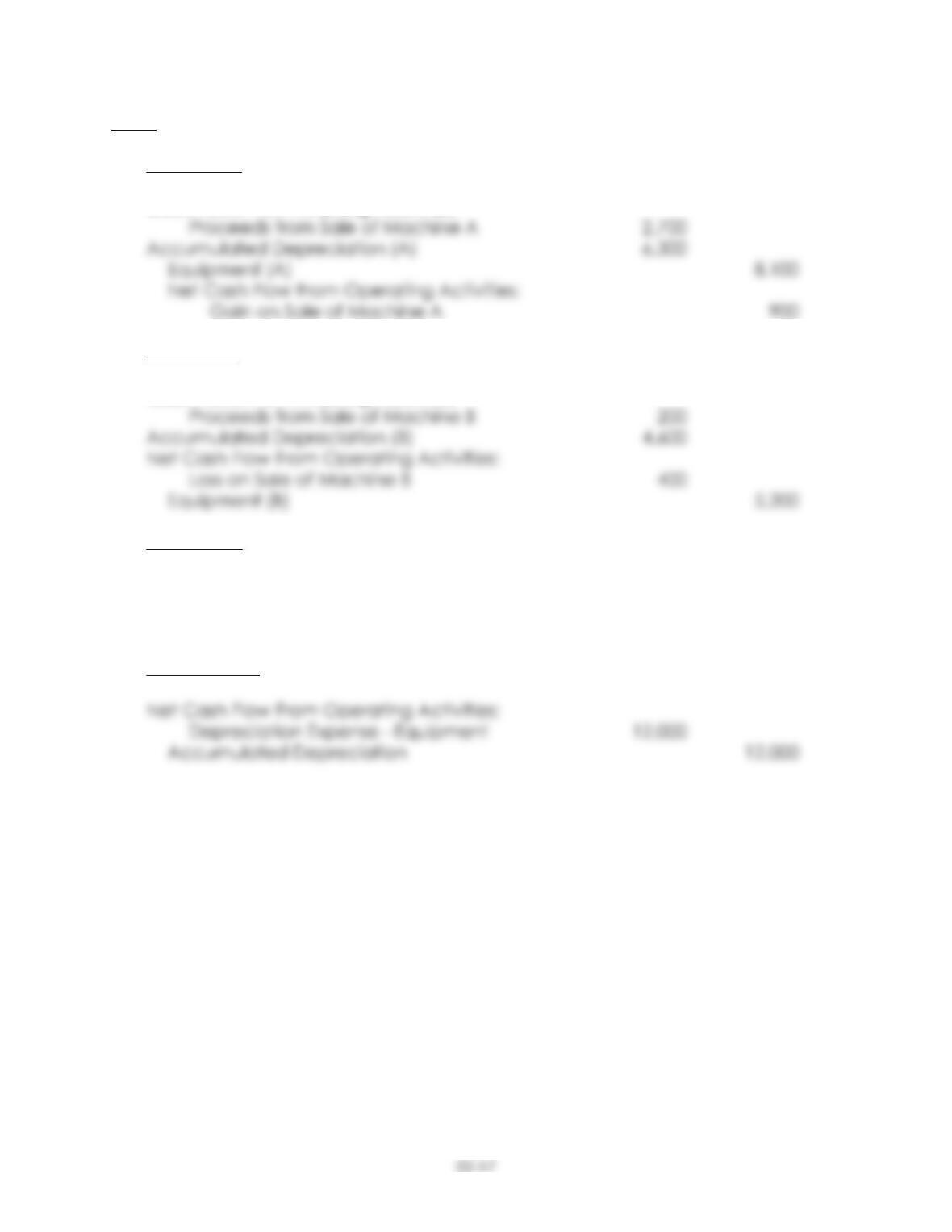
E22-6
Machine A:
Cash Flows From Investing Activities:
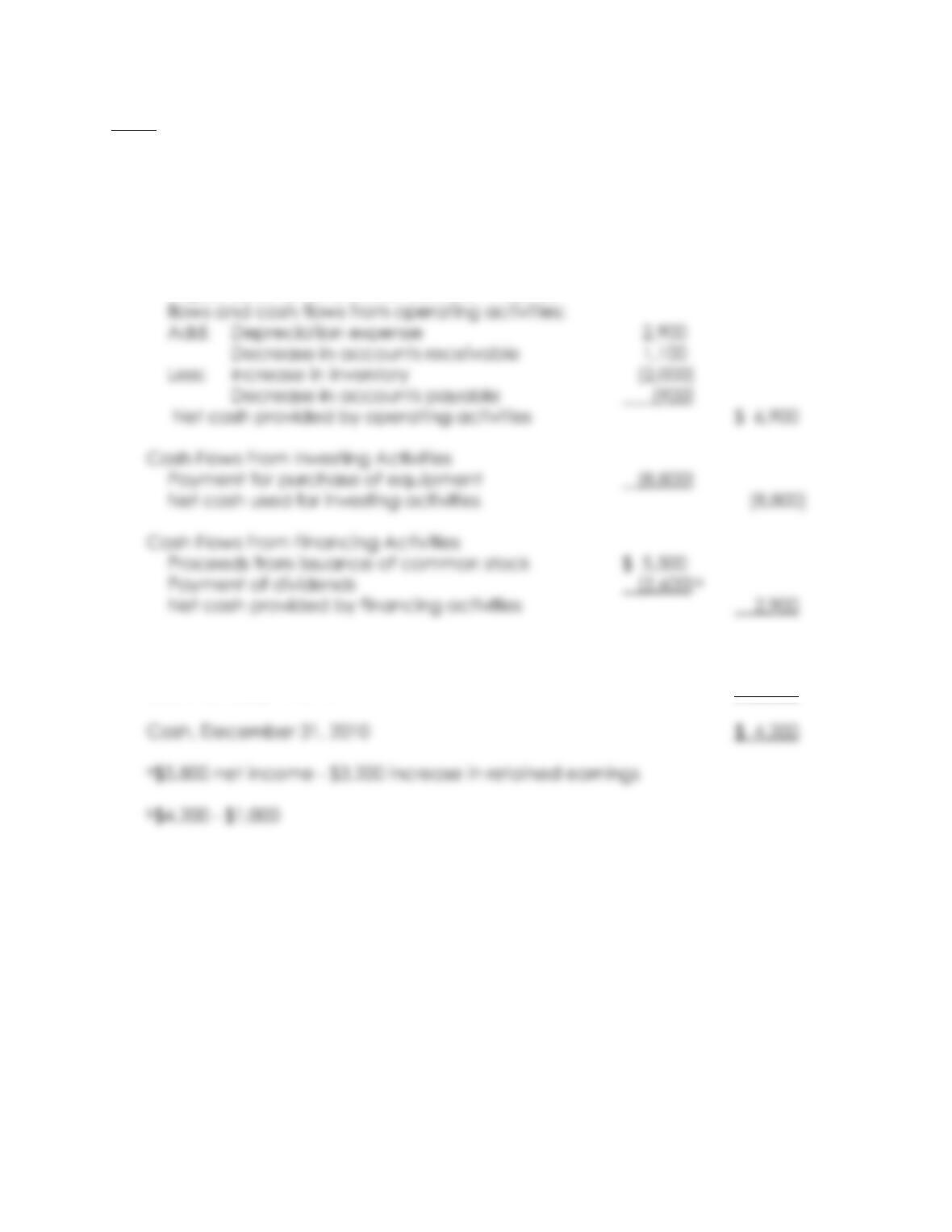
Machine B:
Cash Flows From Investing Activities:
Machine C:
Equipment (C) 25,000
Cash Flows From Investing Activities:
Payment for Purchase of Machine C 25,000
Depreciation:
22-18
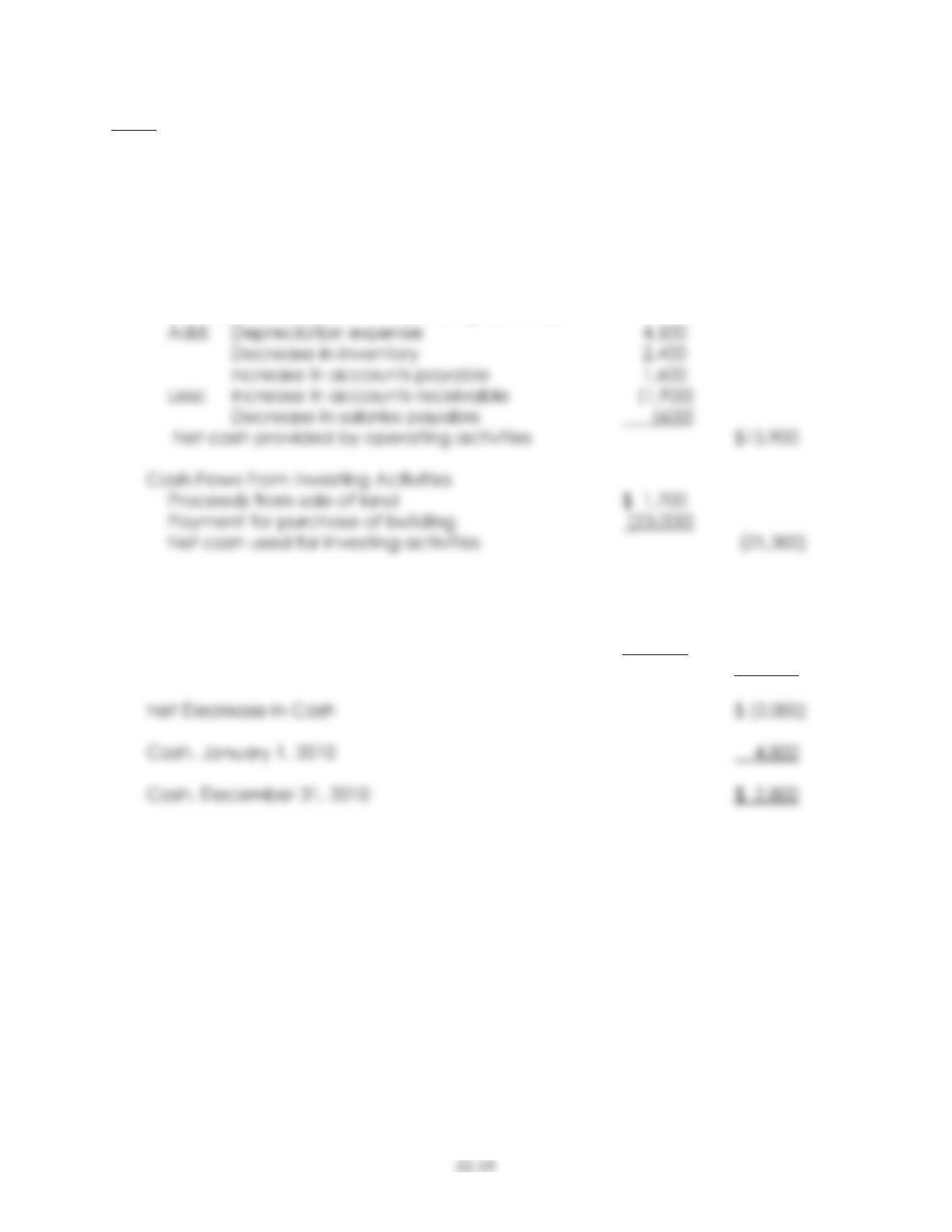
E22-7
GORDON COMPANY
Statement of Cash Flows
For Year Ended December 31, 2010
Net Cash Flow From Operating Activities
Net income $ 5,800
Adjustments for differences between income
Net Increase in Cash $ 1,000
Cash, January 1, 2010 3,200b
E22-8
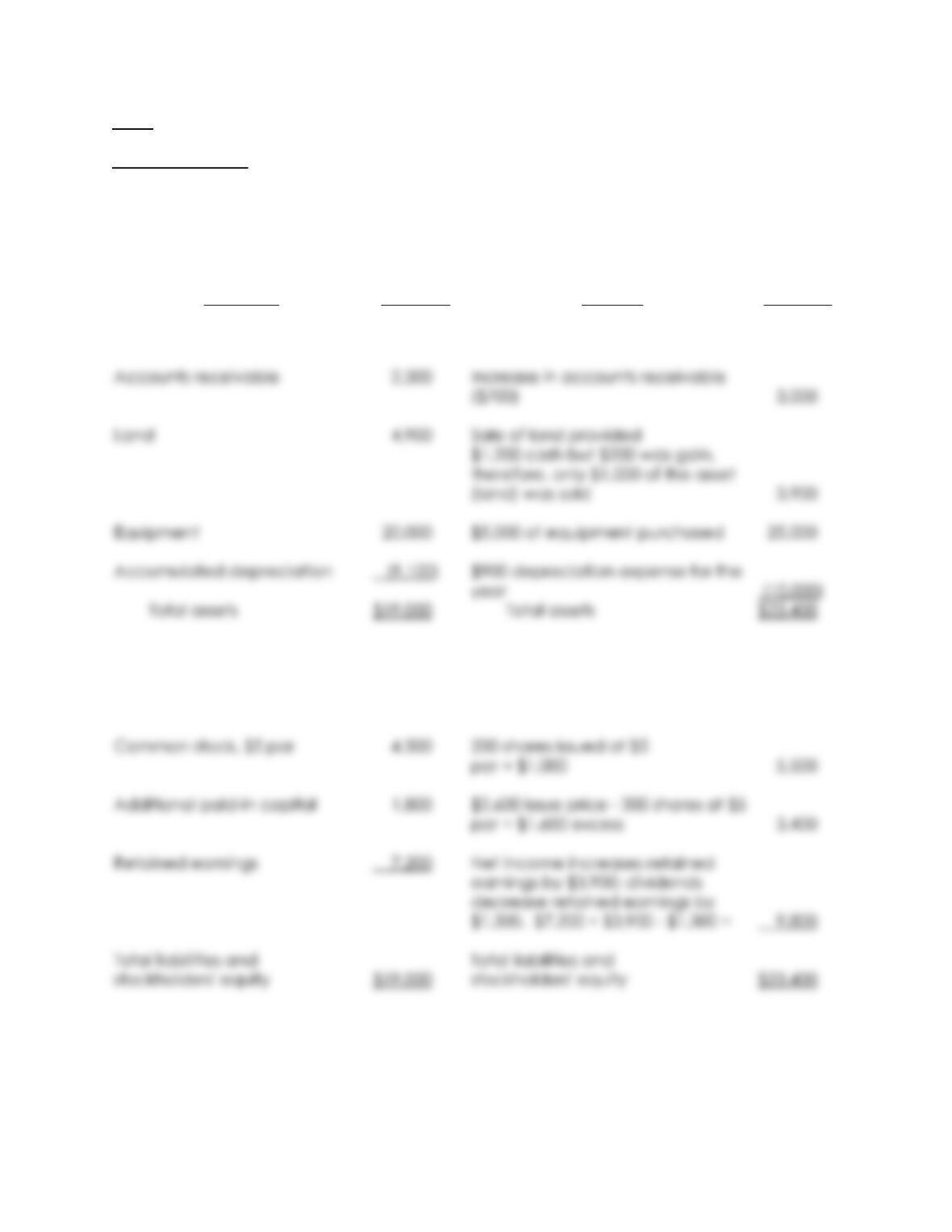
NOBLE COMPANY
Statement of Cash Flows
For Year Ended December 31, 2010
Net Cash Flow From Operating Activities
Net income $ 9,900
Adjustments for differences between income
flows and cash flows from operating activities:
Cash Flows From Financing Activities
Proceeds from issuance of bonds $ 5,000
Proceeds from issuance of common stock 3,000
Payment of dividends (4,600)
Net cash provided by financing activities 3,400
22-20
E22-9
Note to Instructor: This exercise requires the student to utilize the January 1, 2010 balance
sheet and the statement of cash flows in order to determine the December 31, 2010
balance sheet. The exercise indicates the logical relationship that exists between the two
financial statements by requiring the student to trace this relationship in order to arrive at
the solution.
Accounts
Balance,
01/01/10
Analysis
Balance,
12/31/10
Cash
Accounts payable
Notes payable
$ 900
$ 1,600
3,900
$600 net increase in cash and
$1,500 ending cash balance
Increase in account payable
($100)
$900 long-term note paid
$ 1,500
$ 1,700
3,000