FINANCIAL REPORTING PROBLEM
(a) New Accounting Pronouncements and Policies
Derivative Instruments and Hedging Activites
On January 1, 2009 we adopted new accounting guidance on
disclosures about derivative instruments and hedging activities. The
Business Combinations
On July 1, 2009, we adopted new accounting guidance on business
combinations. The new guidance revised the method of accounting
for a number of aspects of business combinations including
acquisition costs, contingencies (including contingent assets,
contingent liabilities and contingent purchase price) and post–
acquisition exit activities of acquired businesses.
Noncontrolling Interests in Cosolidated Financial Statements
On July 1, 2009, we adopted new accounting guidance on
FINANCIAL REPORTING PROBLEM (Continued)
(b) Use of Estimates
Preparation of financial statements in conformity with accounting
principles generally accepted in the United States of America (U.S.
GAAP) requires management to make estimates and assumptions
that affect the amounts reported in the Consolidated Financial
Statements and accompanying disclosures. These estimates are
based on management’s best knowledge of current events and
actions the Company may undertake in the future. Estimates are used
COMPARATIVE ANALYSIS CASE
THE COCA-COLA COMPANY VS. PEPSICO, INC.
(a) and (c) for Coca-Cola Company:
NOTE 1: SUMMARY OF SIGNIFICANT ACCOUNTING POLICIES
Recently Issued Accounting Guidance
As previously discussed, in June 2009, the FASB amended its guidance on
accounting for VIEs. Please refer to the heading “Principles of
Consolidation” above.
(b) and (c) for Pepsi:
Recent Accounting Pronouncements
In June 2009, the Financial Accounting Standards Board (FASB) amended
its accounting guidance on the consolidation of variable interest entities
(VIE). Among other things, the new guidance requires a qualitative rather
COMPARATIVE ANALYSIS CASE (Continued)
In the second quarter of 2010, the Patient Protection and Affordable Care
Act (PPACA) was signed into law. The provisions of the PPACA required us
to record the effect of this tax law change beginning in our second quarter
of 2010, and consequently we recorded a onetime related tax charge of $41
million in the second quarter of 2010.
In September 2011, the FASB issued new accounting guidance that permits
an entity to first assess qualitative factors of whether it is more likely than
not that a reporting unit’s fair value is less than its carrying amount before
applying the two- step goodwill impairment test. We are currently
evaluating the impact of the new guidance on our financial statements.
In December 2011, the FASB issued new disclosure requirements that are
intended to enhance current disclosures on offsetting financial assets and
liabilities. We are currently evaluating the impact of the new guidance on
our financial statements.
COMPARATIVE ANALYSIS CASE (Continued)
In addition, the change from the LIFO method to the average cost method
will enhance the comparability of QFNA’s financial results with our other
food businesses, as well as with peer companies where the average cost
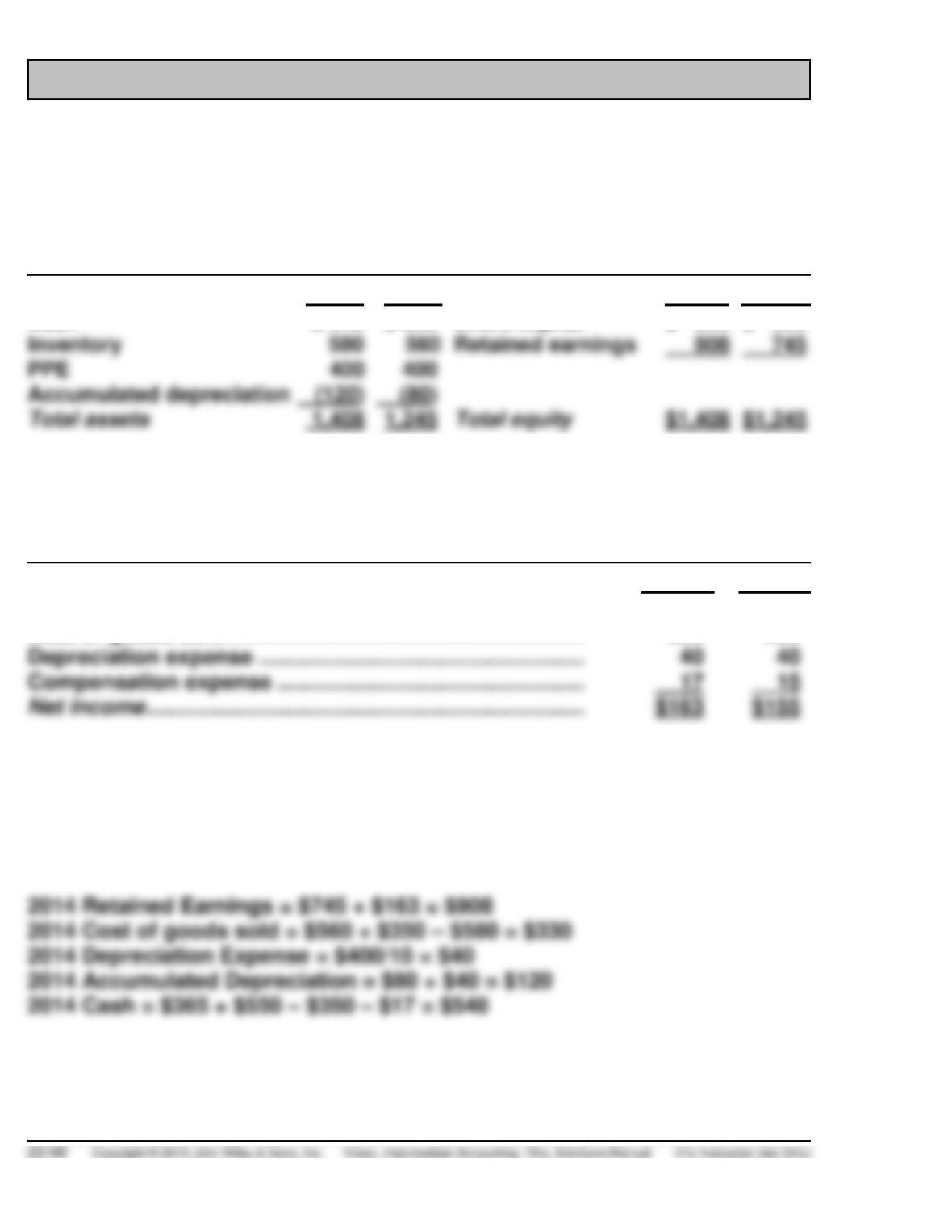
ACCOUNTING, ANALYSIS, AND PRINCIPLES
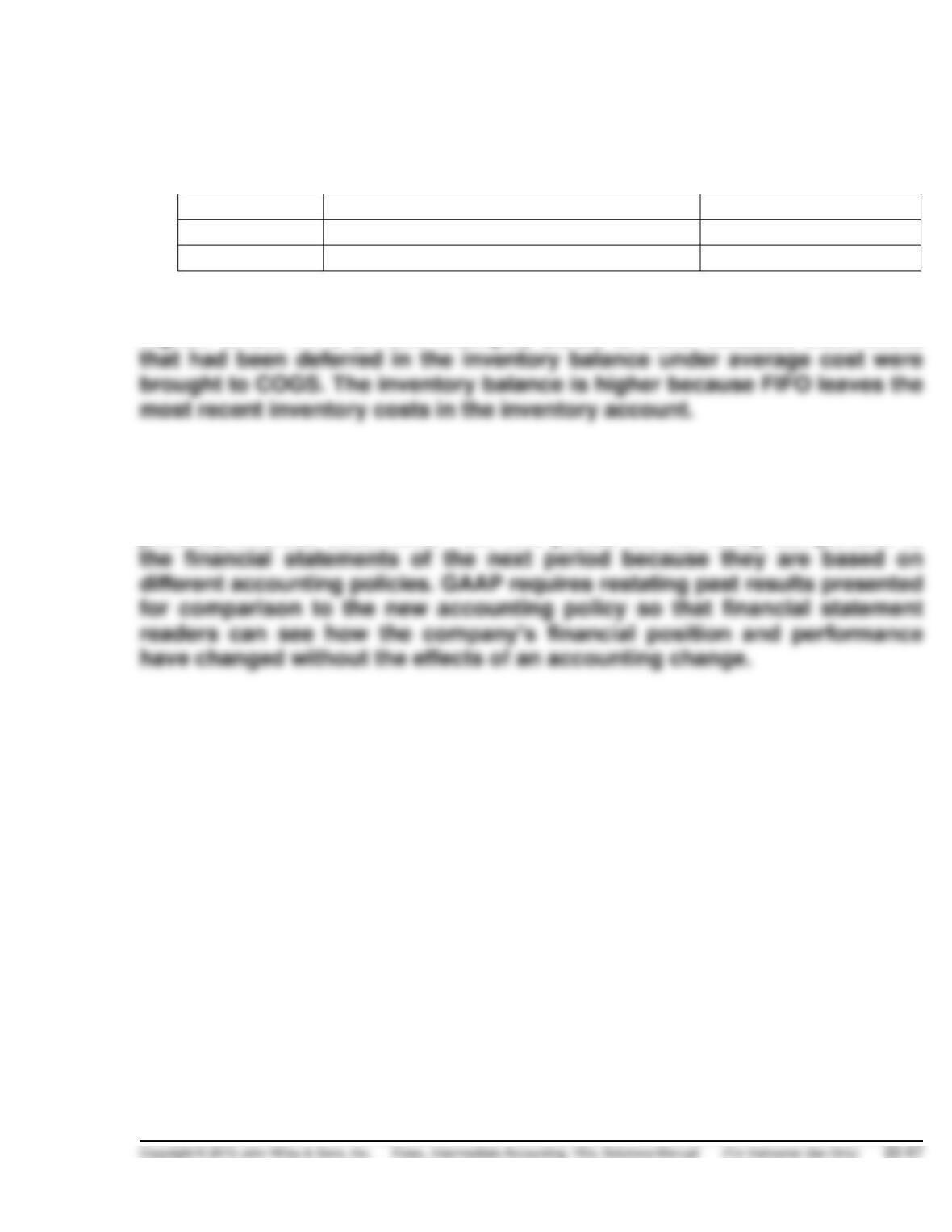
Accounting
ABC CO.
Statement of Financial Position
at December 31
2014 2013 2014 2013
Cash $ 548 $ 365 Share capital $ 500 $ 500
ABC CO.
Income Statement
for the Year Ended December 31,
2014 2013
Sales ……………………………………………………………………… $550 $500
Cost of goods sold …………………………………………………. 330 290
2013 purchases: $480 + P – $300 = $500; P = $320
2013 Beginning inventory using FIFO = $480 + $50 = $530
2013 Ending inventory using FIFO = $500 + $60 = $560
2013 Cost of goods sold using FIFO = $530 + $320 – $560 = $290
2013 Retained Earnings = $685 + $60 = $745
ACCOUNTING, ANALYSIS, AND PRINCIPLES (Continued)
Analysis
Inventory turnover:
2014
2013
LIFO
N/A LIFO information not available
$300 ÷ $490 = 0.61
FIFO
$330 ÷ $570 = 0.58
$290 ÷ $545 = 0.53
Inventory turnover is lower under FIFO, which leads to ROA being slightly
higher. Under FIFO (in this example) COGS is lower because older costs
Principles
The issue is consistency across time. When a company changes accounting
policies, financial statements from one period are not really comparable to
PROFESSIONAL RESEARCH
(a) According to FASB ASC 250-10–20 (Glossary), a change in accounting
estimate that is inseparable from the effect of a related change in
Under FASB ASC 250-10–45
45–17, A change in accounting estimate shall be accounted for in the
period of change if the change affects that period only or in the
45–19 Like other changes in accounting principle, a change in
accounting estimate that is effected by a change in accounting
principle may be made only if the new accounting principle is
(b) According to FASB ASC 250-10–45–18, distinguishing between a change
in an accounting principle and a change in an accounting estimate is
sometimes difficult. In some cases, a change in accounting estimate is
effected by a change in accounting principle. One example of this type
The effect of the change in accounting principle, or the method of
PROFESSIONAL RESEARCH (Continued)
applying it, may be inseparable from the effect of the change in
(c) According to FASB ASC 250-10-S50—Disclosure of the Impact that
Recently Issued Accounting Standards Will Have on the Financial
Statements of the Registrant when Adopted in a Future Period
S50-1 See paragraph 250-10–S99-5, SAB Topic 11.M, for SEC Staff
views regarding disclosure of the impact of recently issued
accounting standards.
S99-5 The following is the text of SAB Topic 11.M, Disclosure of the
Impact that Recently Issued Accounting Standards Will Have on
the Financial Statements of the Registrant when Adopted in a
Future Period.
Facts: An accounting standard has been issued that does not
Question 1: Does the staff believe that these filings should
include disclosure of the impact that the recently issued
accounting standard will have on the financial position and
results of operations of the registrant when such standard is
adopted in a future period?
PROFESSIONAL RESEARCH (Continued)
Interpretive Response: Yes. The commission addressed a
similar issue with respect to Statement 52 and concluded that
“The Commission also believes that registrants that have not yet
reported in the future and, therefore, should be disclosed in
accordance with the existing MD&A requirements. With respect to
financial statement disclosure, GAAS9 specifically address the
need for the auditor to consider the adequacy of the disclosure
of impending changes in accounting principles if (a) the financial
statements have been prepared on the basis of accounting
principles that were acceptable at the financial statement date
but that will not be acceptable in the future and (b) the financial
PROFESSIONAL RESEARCH (Continued)
– 6FRR 6, Section 2.
– 7In those instances where a recently issued standard will
Question 2: Does the staff have a view on the types of
disclosure that would be meaningful and appropriate when a
new accounting standard has been issued but not yet adopted
by the registrant?
Interpretive Response: The staff believes that the registrant
should evaluate each new accounting standard to determine the
The following disclosures should generally be considered by the
registrant:
– A brief description of the new standard, the date that
adoption is required and the date that the registrant plans to
adopt, if earlier.
PROFESSIONAL RESEARCH (Continued)
– A discussion of the impact that adoption of the standard is
expected to have on the financial statements of the
registrant, unless not known or reasonably estimable. In
PROFESSIONAL SIMULATION
Note: This assignment is available on the Kieso website.
Journal Entries
(a) Inventory …………………………..……………………. 18,000*
Retained Earnings …………………………….. 18,000
(b) Inventory ………………………………………………… 28,000*
Retained Earnings …………………………….. 28,000
Financial Statements
Computation of EPS for 2015
Basic EPS
Net income …………………………………………… $30,000
Diluted EPS
Net income …………………………………………… $30,000
Add: Interest savings ($200,000 X 6%) ….. 12,000
Adjusted net income …………………………….. $42,000
PROFESSIONAL SIMULATION (Continued)
Computation of EPS for 2014
Basic EPS
Net income ………………………………………… $27,000
Diluted EPS
Net income ………………………………………… $27,000
Add: Interest savings
EPS Presentation
2015
2014
Net income
$30,000
$27,000
Diluted EPS
$ 2.63
$ 2.44
IFRS CONCEPTS AND APPLICATION
IFRS22-1
The IFRS standard addressing accounting and reporting for changes in
IFRS22-2
FASB has issued guidance on changes in accounting principles, changes
in estimates, and corrections of errors, which essentially converges U.S.
GAAP to IAS 8. Key remaining differences are as follows.
• One area in which IFRS and U.S. GAAP differ is the reporting of
error corrections in previously issued financial statements. While
both GAAPs require restatement, U.S. GAAP is an absolute
standard—that is, there is no exception to this rule.
• Under U.S. GAAP and IFRS, if determining the effect of a change
in accounting principle is considered impracticable, then a
IFRS22-3
Currently, under U.S. GAAP, when a company prepares financial
statements on a new basis, comparative information must be provided for a
IFRS22-4
The indirect effect of a change in accounting policy reflects any changes in
current or future cash flows resulting from a change in accounting policy
IFRS22-5
The company prospectively applies the new accounting policy as of the
earliest date it is practicable to do so.
IFRS22-6
(a) 1. Uncollectible Accounts Receivable. This is a change in account-
ing estimate. Restatement of prior periods is not appropriate.
2. Depreciation.
a. This is a change in accounting estimate. Restatement of
3. Mathematical Error. This is a correction of an error and prior
period adjustment treatment would be in order.
4. Preproduction Costs—Furniture Division. This should probably
be construed as an inseparability situation in that the change in
IFRS22-6 (Continued)
5. FIFO to Average-Cost Change. This is a change in accounting
policy. Restatement of December 31, 2013 retained earnings is
6. Percentage–of–Completion. This is a change in accounting policy.
Retained earnings should be adjusted.
(b) The adjustment to the December 31, 2013 retained earnings balance
would be computed as follows:
IFRS22-7
(a) The guidelines for reporting a change in accounting principle related to
(b) According to paragraph 14, “An entity shall change an accounting policy
only if the change:
(1) is required by an IFRS; or
IFRS22-8
(a) There are no IFRS or IFRS IC interpretations that are effective for the
first time in this financial period that have had a material impact on
the Group. The following IFRS, IFRS IC interpretations and
(b) Critical accounting estimates and judgements
The preparation of consolidated financial statements requires the
Group to make estimates and assumptions that affect the application
of policies and reported amounts. Estimates and judgements are
which have a significant risk of causing a material adjustment to the
carrying amount of assets and liabilities are:
A. Impairment of goodwill and brands – The Group is required to
test, at least annually, whether the goodwill or brands have
suffered any impairment. The recoverable amount is determined
based on value in use calculations. The use of this method
IFRS22-8 (Continued)
B. Impairment of property, plant and equipment and computer
software – Property, plant and equipment and computer
software are reviewed for impairment if events or changes in
C. Depreciation of property, plant and equipment and amortisation
of computer software – Depreciation and amortisation is
provided so as to write down the assets to their residual values
over their estimated useful lives as set out above. The selection
of these residual values and estimated lives requires the
exercise of management judgement. See notes 14 and 15 for
further details.
D. Post-retirement benefits – The determination of the pension cost
and defined benefit obligation of the Group’s defined benefit
pension schemes depends on the selection of certain
E. Refunds and loyalty scheme accruals – Accruals for sales
returns and loyalty scheme redemptions are estimated on the
basis of historical returns and redemptions and these are