17-1
Golden Bear Markets
Teaching Commentary
OVERVIEW
This case uses a retail grocery setting to give students some practice in applying several important cost management
concepts:
Activity-based costing for grocery products (called Direct Product Profit (DPP) in the case)
The case is very rich. Most students find it challenging but not impossible. All the information in the case is “live”
as of the mid-1980s, but the setting is disguised. The case is drawn from a McKinsey and Company consulting
assignment. The author, and not the McKinsey staff, developed the analysis here.
ANSWERS TO ASSIGNMENT QUESTIONS
Question 1
See Exhibit TC–1.
Question 2
See Exhibit TC-2. For the bread category, calculating DPP requires going beyond gross margin to assign
Question 3
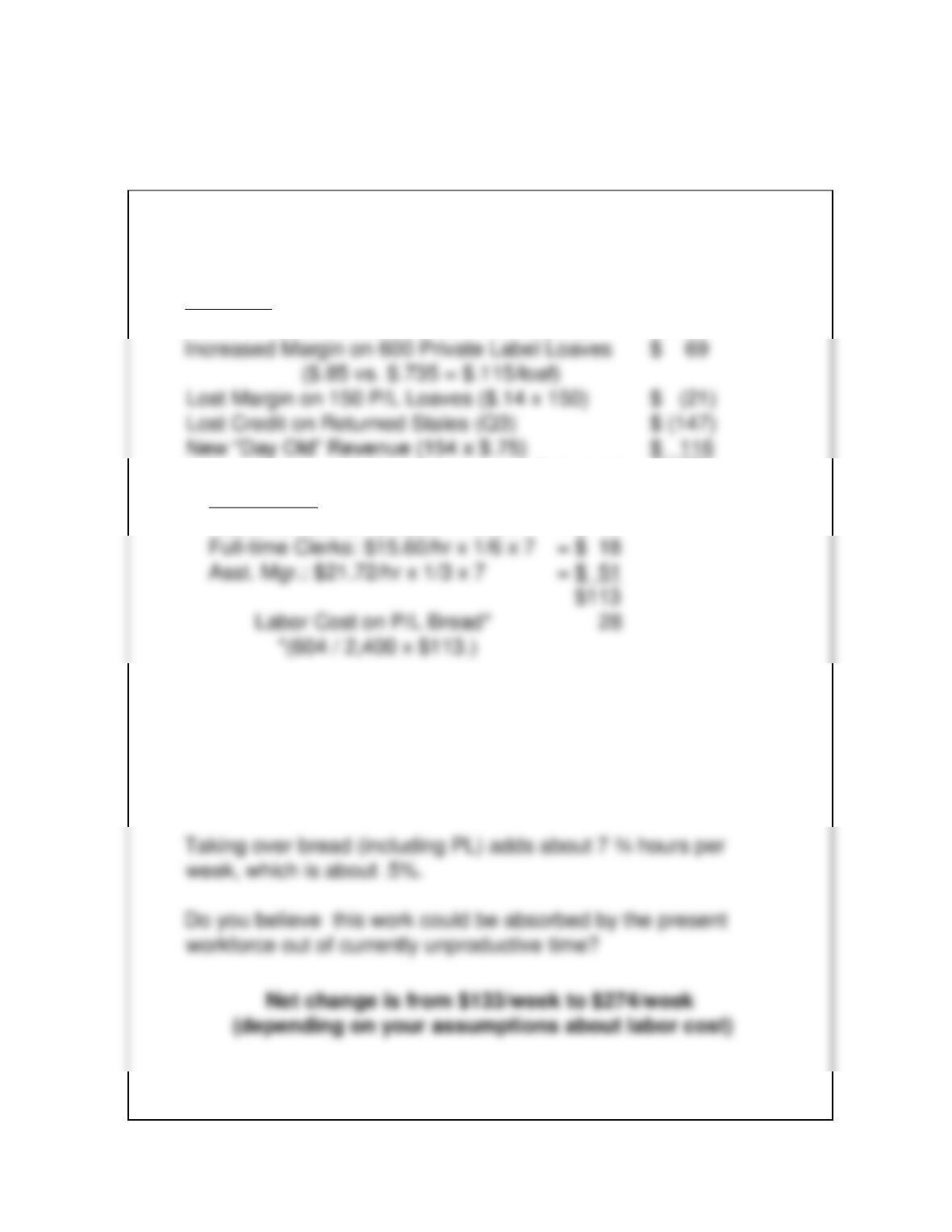
Exhibit TC-4 summarizes the profit impact of the proposed supply chain change for the bread vendor,
1) Should the analysis be charged full manufacturing cost or only variable cost for the extra production
volume resulting from gaining the private label (P/L) business for Store #5?
2) Does Flowers see the proposed change as a way to reduce delivery cost for the same overall sales
volume, or as a way to increase sales volume for the same overall delivery cost? This is a strategic
17-2
Question 4
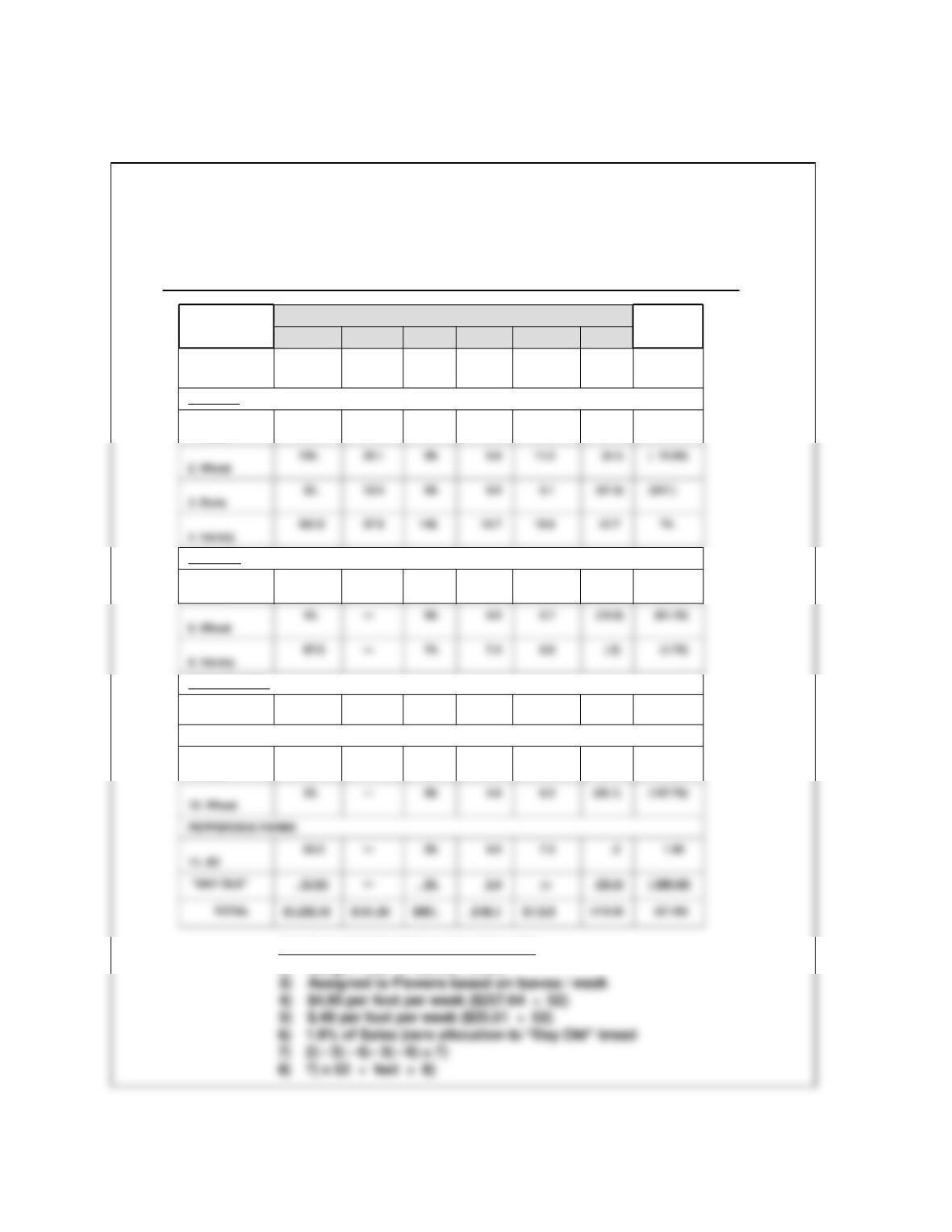
Exhibit TC-5 summarizes the profit impact of the proposed supply chain change for Store #5. As in
Question 3, the analysis requires careful “thinking” about the various elements of the proposal. Typically, students
find the “thinking” harder than the actual calculations.
The main conceptual issue in the calculation is whether store-level labor productivity is tightly enough
Question 5
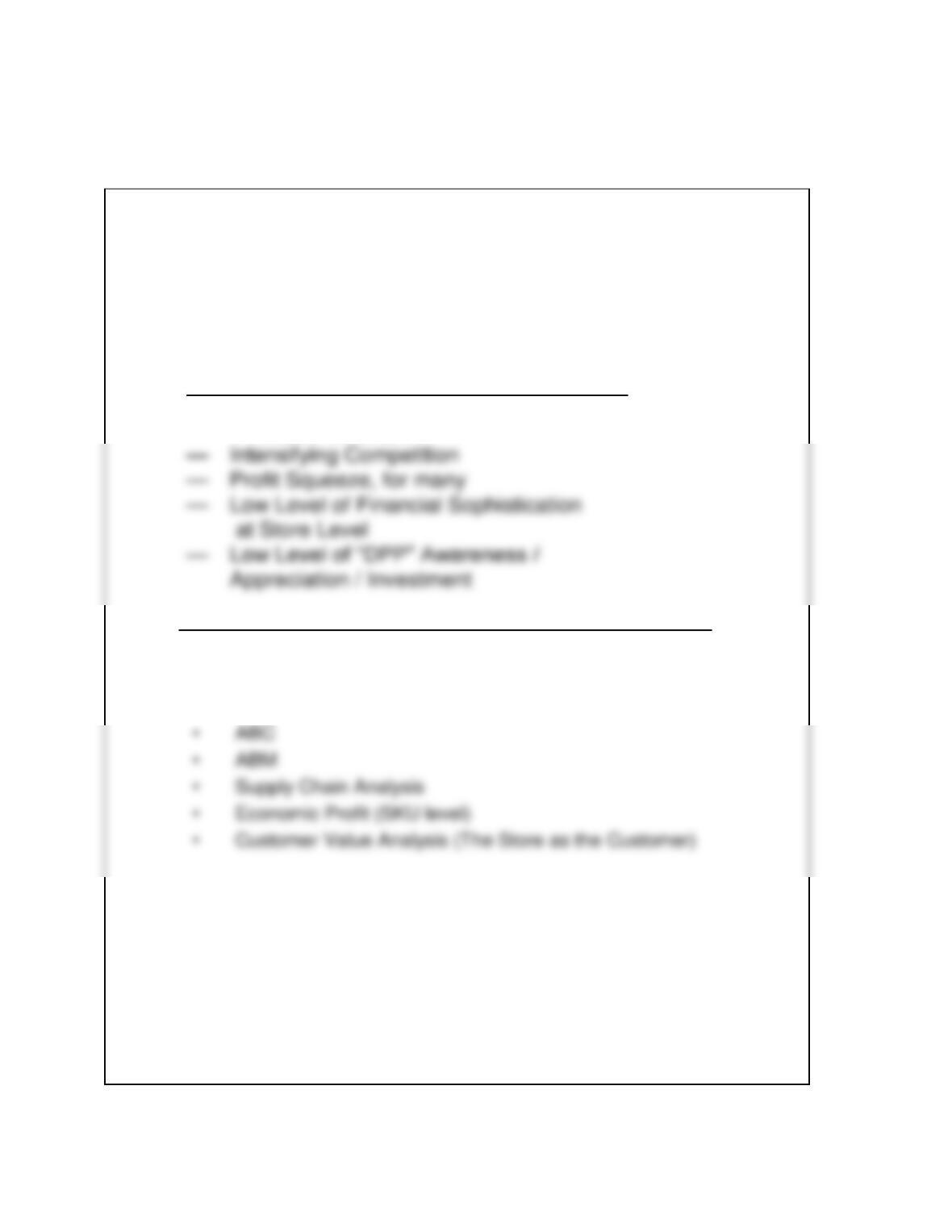
The calculations for Question 5 are summarized in Exhibit TC-6. Inferences based on these calculations are
summarized here in Question 7. An Excel spreadsheet is very helpful to students in tackling this question.
Question 6
Package size efficiency became a big issue in supermarket management in the late 1980s. As the concept of
“profit per unit of space used” began to gain wider acceptance, the cost of “wasted space” took on more prominence.
Retailers (such as Wal-mart) and vendors (such as P&G and J&J) began to consider package redesign seriously as a
This is a 3%+ increase in store profit ($23,000 / $700,000) from a fairly simple change in product design.
Question 7
Some key inferences derived from the analysis for Question 5 are as follows:
17-3
Flowers Buns $(247.00)
• Too much shelf space allocated, unless can get a better price from Flowers. Gross margin is
Wonder Bread – white $(151.10)
– wheat $(187.70)
“Day Old” Bread $(342.20)
• This is a “non–starter” for Golden Bear. The five feet of shelf space should be worth $2,875
per year in gross margin to the store (at average margins) (575 x 5= 2875).
Six overall insights about the case that derive from the cost analysis for Questions 1 through 6 are presented here:
1. Overall, bread is currently a big loser in the store, in spite of zero labor, transportation, and
warehouse cost and very high turnover. The space cost and capital charge allocation more
than offset the gross margin. Some action is probably necessary now that Bower understands
how bad the current situation is.
2. At a very broad level, why does a product with four-day (three to five) shelf life and daily
delivery by bread vendors require a four–day supply on hand? Does a “large” bread section
3. Converting from DSD to the new hybrid delivery system for Flowers seems like a good idea.
It could perhaps be even better for the store if Bower could get a bigger price concession to
equalize more nearly the profit increase for the store and the vendor. This is an issue in
“negotiating skill.”
17-4
twenty-five square foot shelf allocation. The DPP loss is so large that DSD is not the whole
problem.
6. Working with other grocersto get bakers to change the “cube” of each loaf is also an excellent
profit improvement opportunity. Since the benefits to any one store are small in relation to
TEACHING STRATEGY
Because this case represents a fairly broad review of several cost management concepts, I use it as a “review” case
at or near the end of the course. I have also used it successfully as a final exam case. Exhibit TC–7 can be used at
the beginning of class as an overview of the issues to be considered. I think this is a good way to start the discussion.
Direct Store Delivery (DSD) has been an important issue in supply chain management for the grocery
industry for a long time. It is very common for products such as bread, milk, and ice cream. Firms such as Coca–
17-5
GBM/TC-1
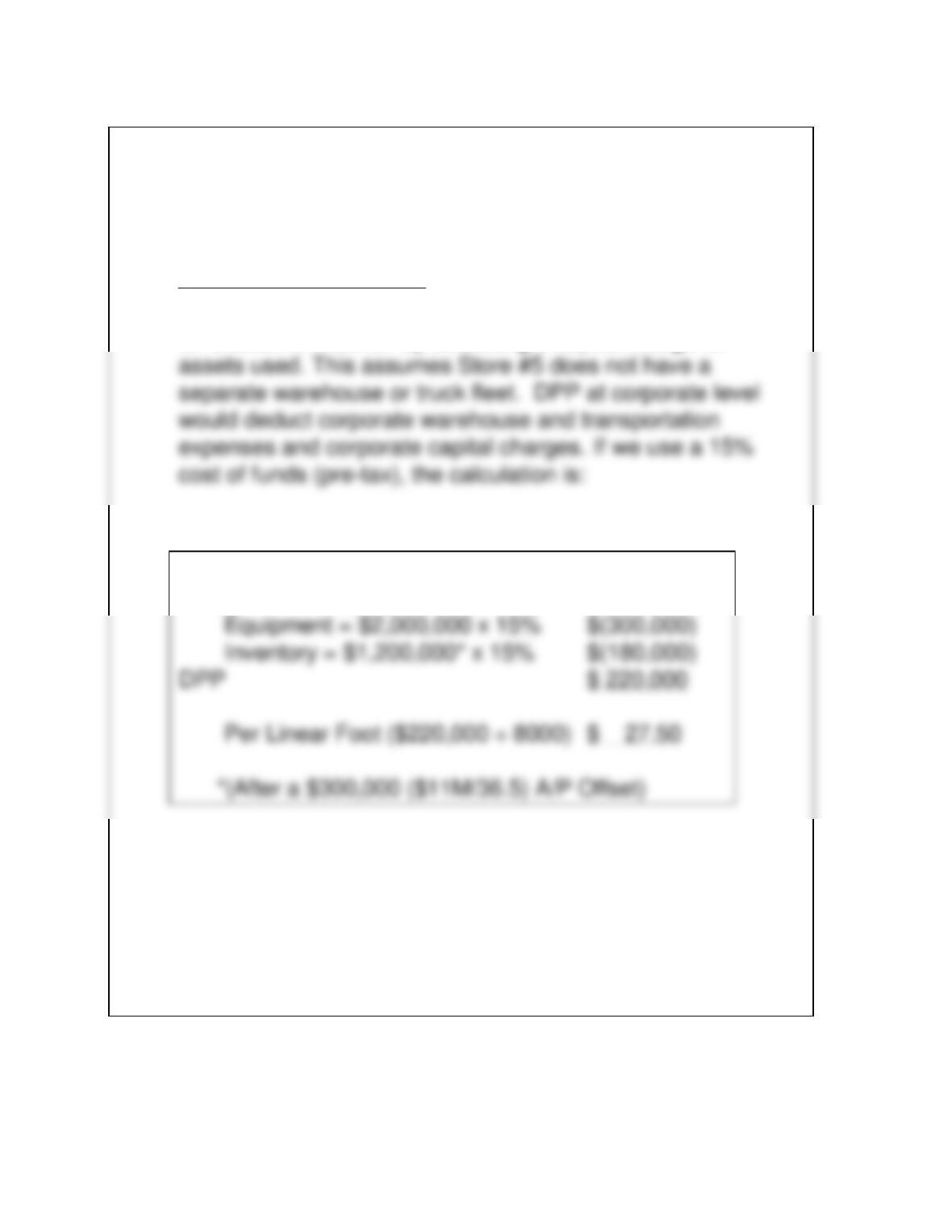
Annual DPP for Store #5
For Store #5 as a whole, DPP just converts store profit
to “economic income” by deducting a capital charge for
Store profit $ 700,000
Cost of funds employed:
Exhibit TC-1
17-6
GBM/TC-2
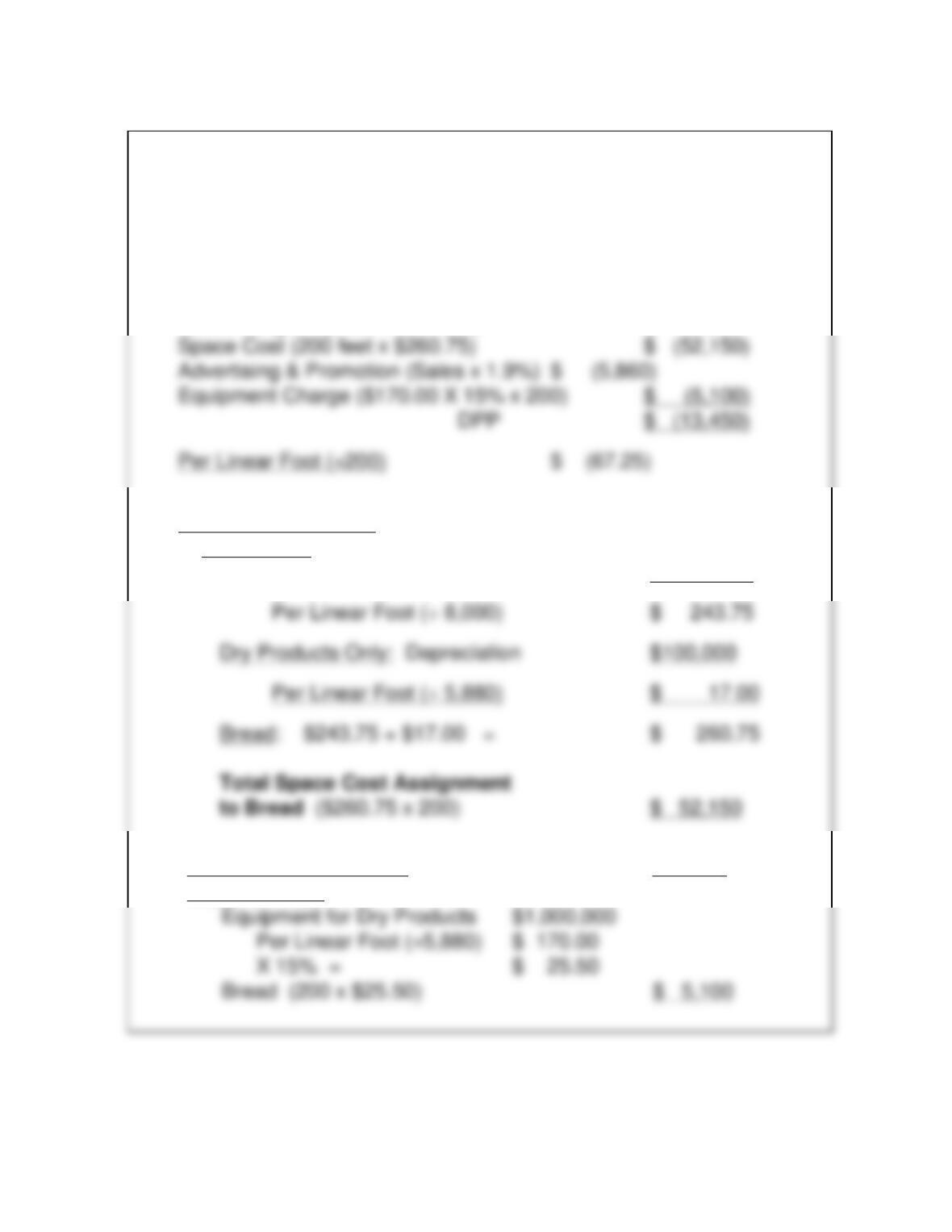
The calculation is:
Gross Margin ($955/week X 52) $ 49,660
Exhibit TC-2
Space Cost for Bread
All Products:
Rent, Light, Heat, Insurance, Water $1,950,000
Advertising & Promotion (Sales x 1.9%) $ 5,860
Capital Charge
17-7
GBM/TC-3
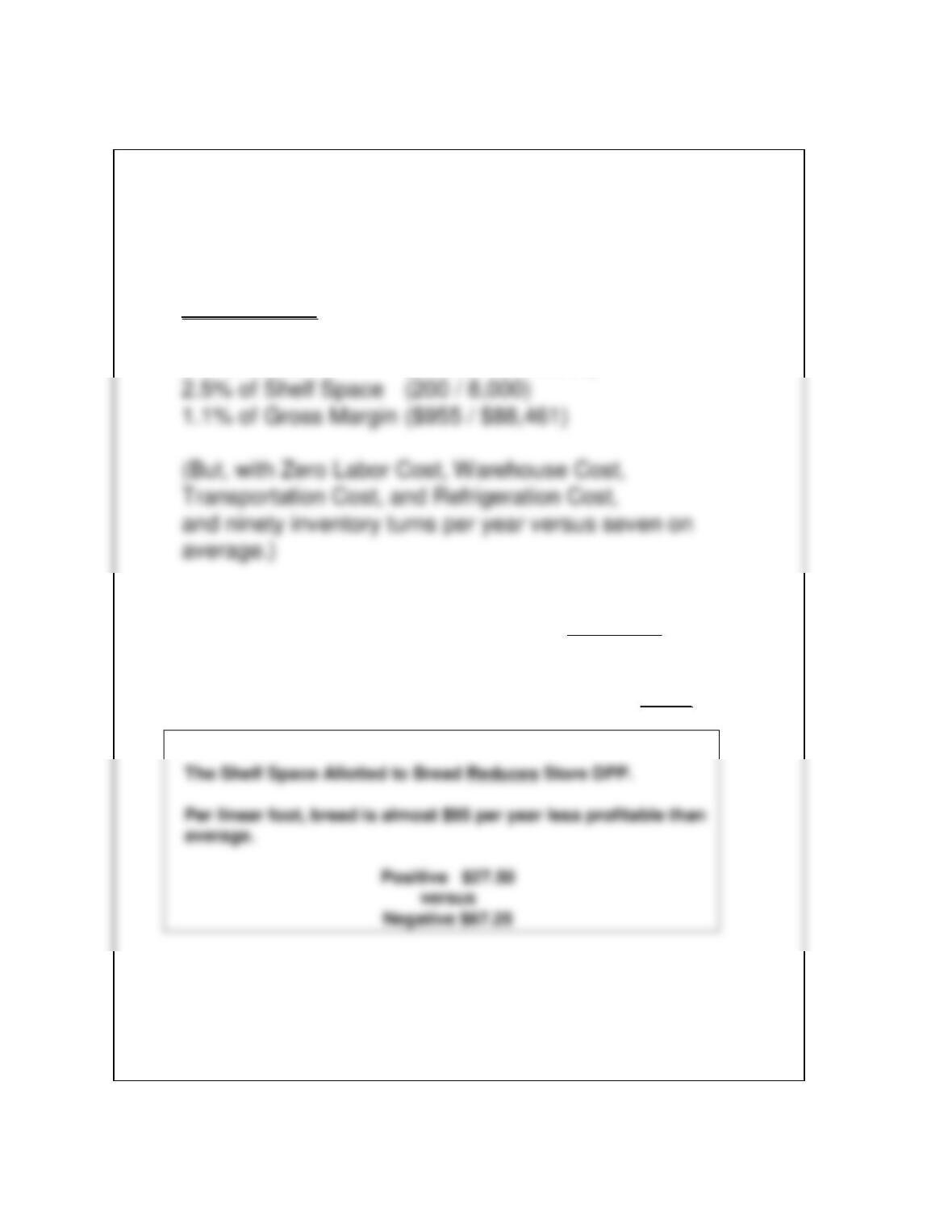
Bread is:
2% of Sales ($5,930 / $300,000)
With the conventional analysis available to him, Bower
would conclude that Bread is “OK” for a necessary
product.
BUT, the DPP analysis shows bread as a big Loser!
Exhibit TC-3
17-8
GBM/TC-4
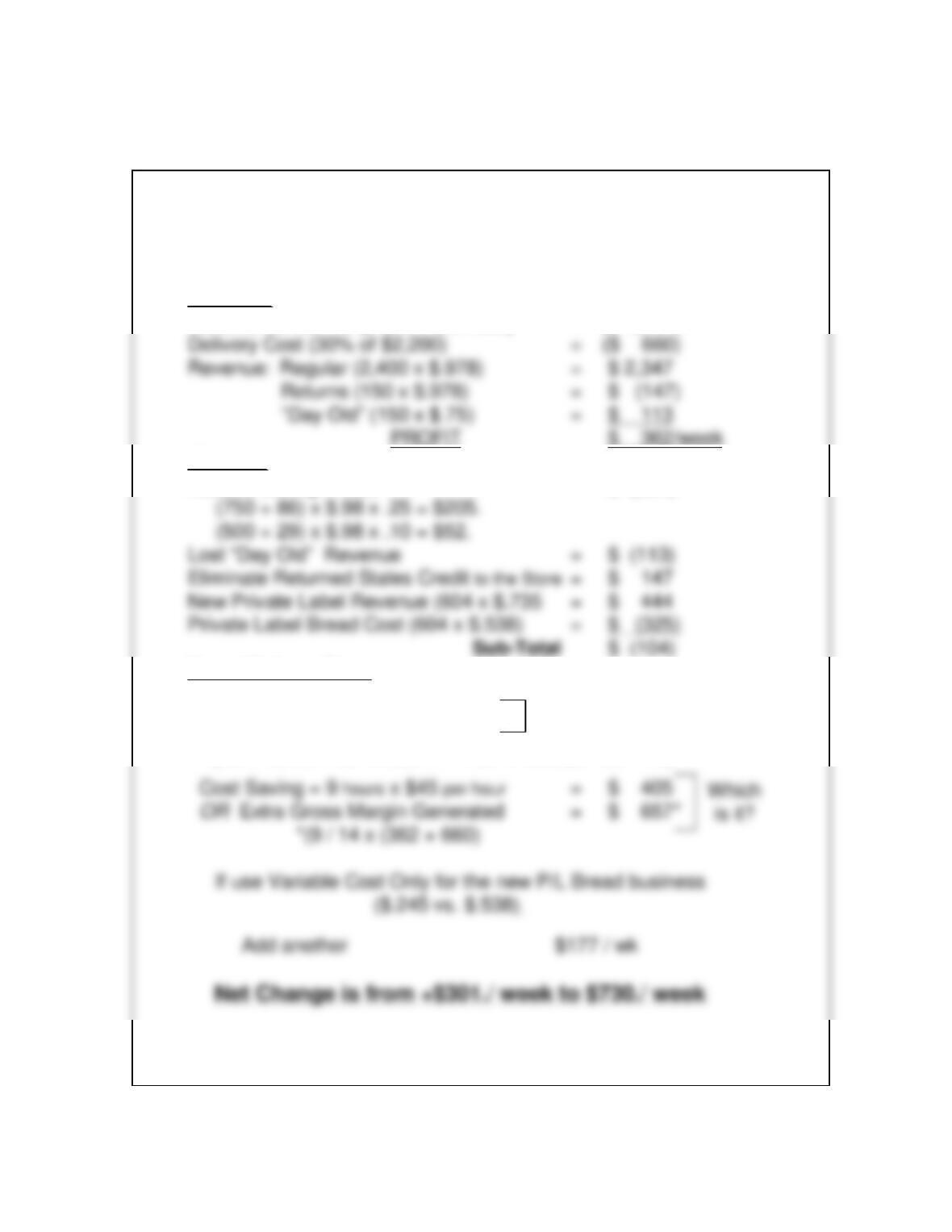
Currently
Make 2,400 loaves @ $.538 (full cost) = ($ 1,291)
Changes
Reduce Selling Prices $ (257)
Saved Delivery Time:
Save 9.9 hrs/wk
New P/L Delivery time = .9 hrs. wk*
*(604 / 2,400 x 30 minutes x 7 ÷ 60 minutes per hour = .9)
Exhibit TC-4
9 hrs. wk.
17-9
GBM/TC-5
Changes (Weekly)
Lower Prices on White & Wheat Bread (Q3) $ 257
Sub-total $ 274
Labor Cost
Part-time Clerks: $7.50/hr x 5/6 x 7 = $ 44
The labor cost impact per week ranges from $0 to $141,
depending on current assumptions about “labor productivity.”
Store labor (excluding asst. managers) is now 1,469 hours
per week (25 x 40 + 25 x 18 ¾ =1469).
Exhibit TC-5
17–10
GBM/TC-6
Weekly
(151.10)(43.6)12.27.474.—50.
9. White
CONTINENTAL
11.204.311.59.899.28.4153.7. FLOWERS
PRIVATE LABEL
(8.70)( 2.5)11.17.474.—90.
5. White
SUNSHINE
$ 32.10$ 24.7$16.4$19.6$198.$ 37.55$ 296.25
1. White
FLOWERS
Annual
DPP / footDPP
Adv. &
Promo.
Equip.
Charge
Space
Cost
Labor
CostGMSKU
87654321
DPP by SKU for Bread (After the Flowers Delivery Change)
Exhibit TC-6
CALCULATIONS FOR EACH COLUMN:
2) Margin / loaf x loaves / week
17–11
GBM/TC-7
Golden Bear Markets
•One Key Topic — “DSD” (Direct Store Delivery)
•SRM Themes —
Context —US Supermarkets (mid-1980s)
—Product Proliferation
Exhibit TC-7