CHAPTER 21
Accounting for Leases
ASSIGNMENT CLASSIFICATION TABLE (BY TOPIC)
Topics
Questions
Brief
Exercises
Exercises
Problems
Concepts
for Analysis
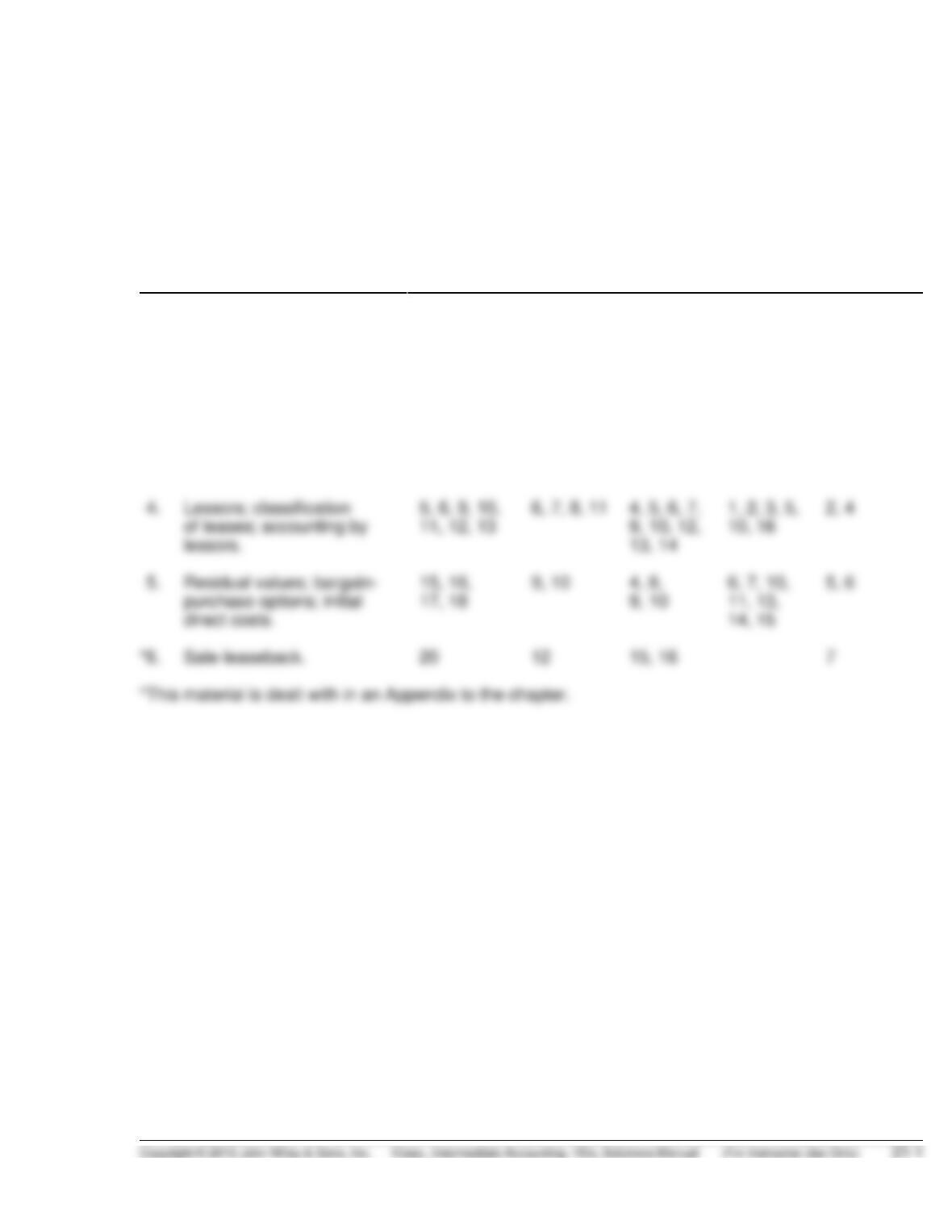
*1. Rationale for leasing.
1, 2, 4
1, 2
*2. Lessees; classification
of leases; accounting by
lessees.
3, 5, 7,
8, 14
1, 2, 3,
4, 5
1, 2, 3,
5, 7, 8,
11, 12,
13, 14
1, 2, 3, 4,
6, 7, 8, 9,
11, 12, 14,
15, 16
1, 2, 3,
4, 5, 6
*3. Disclosure of leases.
19
2, 4, 5,
7, 8
2, 3, 5
9, 10, 12,
13, 14
10, 16
9, 10
11, 13,
14, 15
15, 16
7
ASSIGNMENT CLASSIFICATION TABLE (BY LEARNING OBJECTIVE)
Learning Objectives
Questions
Brief
Exercises
Exercises
Problems
Concepts
for
Analysis
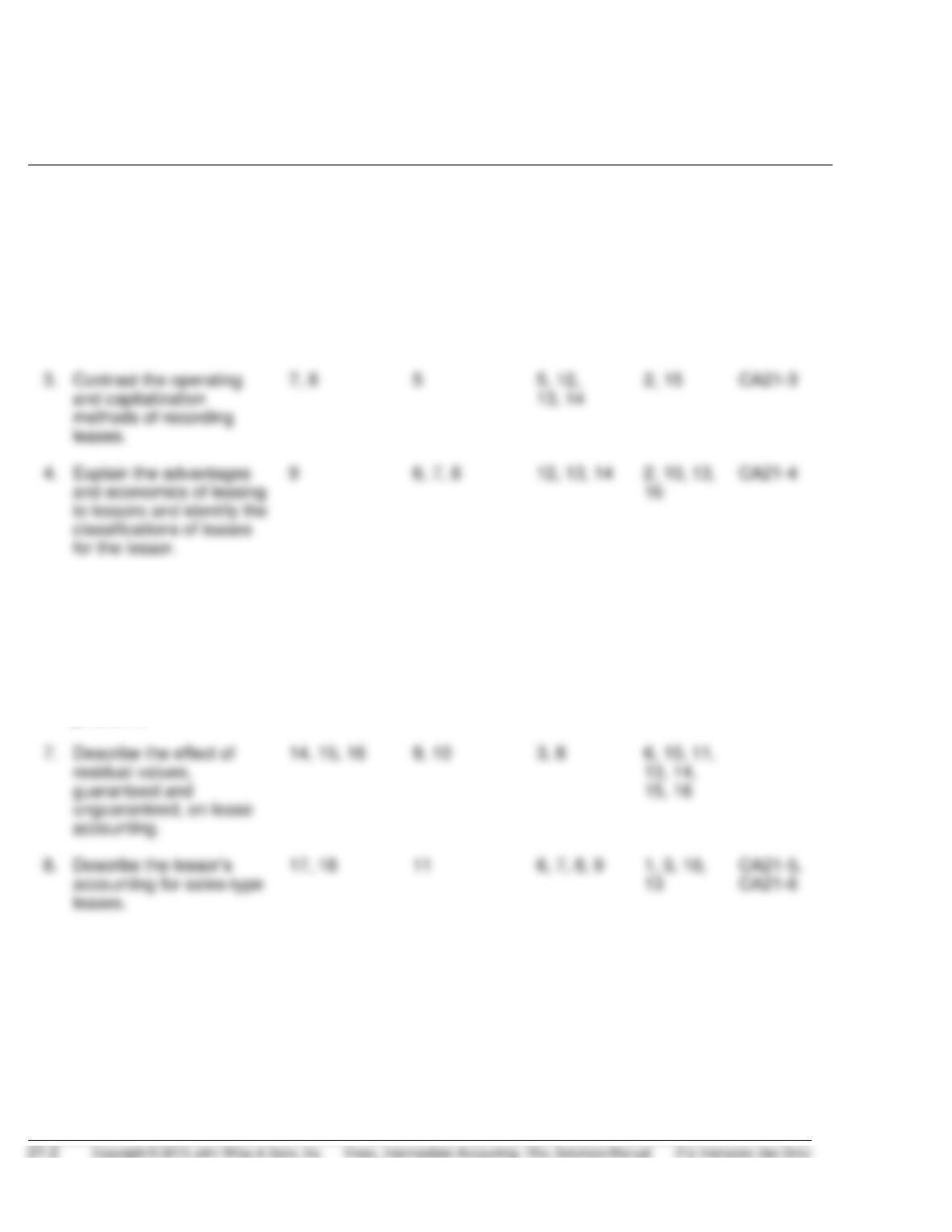
1. Explain the nature,
economic substance, and
advantages of lease
transactions.
1, 2
2. Describe the accounting
criteria and procedures
for capitalizing leases by
the lessee.
3, 4, 5, 6
1, 2, 3, 4
1, 2, 3,
5, 11
1, 3, 4, 6,
7, 8, 9,
11, 12,
14, 15, 16
CA21-1,
CA21-2
to lessors and identify the
classifications of leases
for the lessor.
5. Describe the lessor’s
accounting for direct-
financing leases.
10
6, 7
4, 10
5
6. Identify special features of
lease arrangements that
cause unique accounting
problems.
11, 12, 13
9, 10
8, 9
4, 9, 11,
12
guaranteed and
unguaranteed, on lease
accounting.
13, 14,
15, 16
9. List the disclosure
requirements for leases.
19
3, 4, 5, 7,
8
CA2–12
*10. Describe the lessee’s
accounting for sale-
leaseback transactions.
20
12
15, 16
CA21-7
ASSIGNMENT CHARACTERISTICS TABLE
Item
Description
Level of
Difficulty
Time
(minutes)
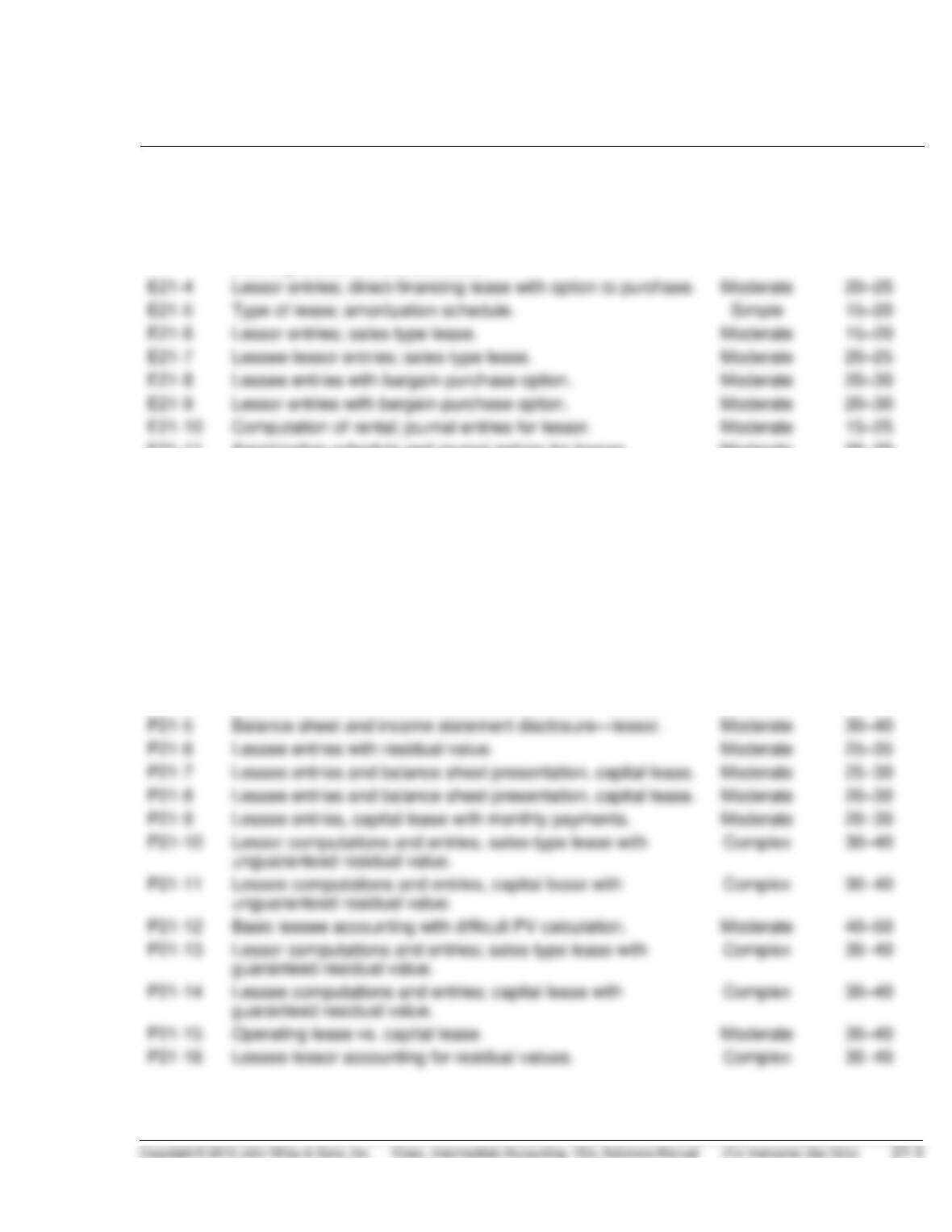
E21-1
Lessee entries; capital lease with unguaranteed
residual value.
Moderate
15–20
E21-2
Lessee computations and entries; capital lease
with guaranteed residual value.
Moderate
20–25
E21-3
Lessee entries; capital lease with executory costs
and unguaranteed residual value.
Moderate
20–30
E21-4
Lessor entries; direct-financing lease with option to purchase.
Moderate
20–25
E21-5
Type of lease; amortization schedule.
Simple
15–20
E21-6
Lessor entries; sales-type lease.
Moderate
15–20
E21-7
Lessee-lessor entries; sales-type lease.
Moderate
20–25
E21-8
Lessee entries with bargain-purchase option.
Moderate
20–30
E21-9
Lessor entries with bargain-purchase option.
Moderate
20–30
E21-10
Computation of rental; journal entries for lessor.
Moderate
15–25
E21-11
Amortization schedule and journal entries for lessee.
Moderate
20–30
E21-12
Accounting for an operating lease.
Simple
10–20
E21-13
Accounting for an operating lease.
Simple
15–20
E21-14
Operating lease for lessee and lessor.
Simple
15–20
*E21-15
Sale-leaseback.
Moderate
20–30
*E21-16
Lessee-lessor, sale-leaseback.
Moderate
20–30
P21-1
Lessee-lessor entries-sales-type lease.
Simple
20–25
P21-2
Lessee-lessor entries; operating lease.
Simple
20–30
P21-3
Lessee-lessor entries; balance sheet presentation;
sales-type lease.
Moderate
35–45
P21-4
Balance sheet and income statement disclosure—lessee.
Moderate
30–40
P21-5
Balance sheet and income statement disclosure—lessor.
Moderate
30–40
P21-6
Lessee entries with residual value.
Moderate
25–35
P21-7
Lessee entries and balance sheet presentation, capital lease.
Moderate
25–30
P21-8
Lessee entries and balance sheet presentation, capital lease.
Moderate
20–30
P21-9
Lessee entries, capital lease with monthly payments.
Moderate
20–30
P21-10
Lessor computations and entries, sales-type lease with
unguaranteed residual value.
30–40
P21-12
Basic lessee accounting with difficult PV calculation.
Moderate
40–50
P21-13
Lessor computations and entries; sales-type lease with
guaranteed residual value.
30–40
P21-14
Lessee computations and entries; capital lease with
guaranteed residual value.
30–40
P21-15
Operating lease vs. capital lease.
Moderate
30–40
P21-16
Lessee-lessor accounting for residual values.
30–40
ASSIGNMENT CHARACTERISTICS TABLE (Continued)
Item
Description
Level of
Difficulty
Time
(minutes)
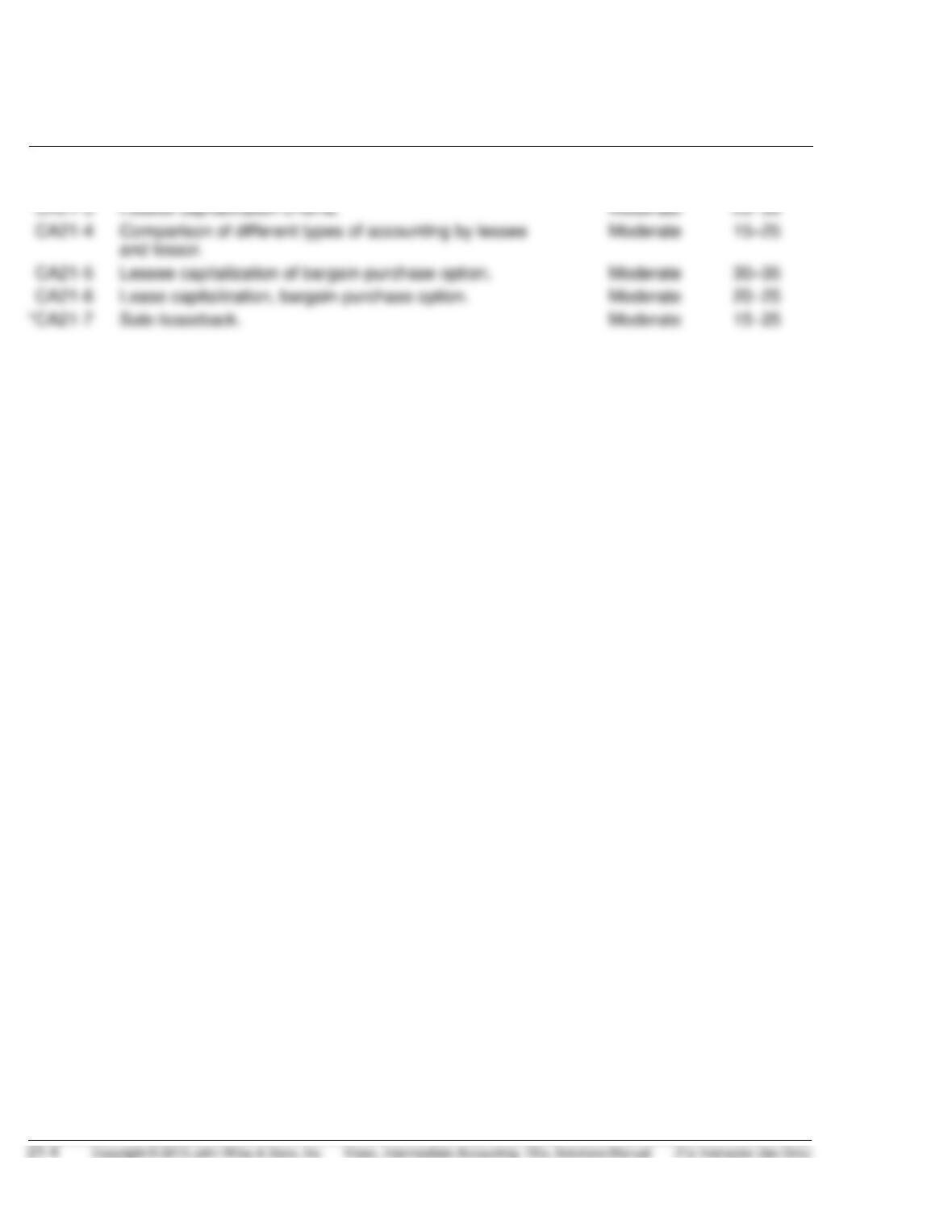
CA21-1
Lessee accounting and reporting.
Moderate
15–25
CA21-2
Lessor and lessee accounting and disclosure.
Moderate
25–35
CA21-3
Lessee capitalization criteria.
Moderate
20–30
and lessor.
CA21-5
Moderate
30–35
CA21-6
Lease capitalization, bargain-purchase option.
Moderate
20–25
*CA21-7
Sale-leaseback.
Moderate
15–25
SOLUTIONS TO CODIFICATION EXERCISES
CE21-1
Master Glossary
(a) A bargain-purchase option is a provision allowing the lessee, at his option, to purchase the
leased property for a price that is sufficiently lower than the expected fair value of the property at
the date the option becomes exercisable that exercise of the option appears, at lease inception, to
be reasonably assured.
CE21-2
According to FASB ASC 840-10–25-5 (Leases—Recognition):
For a lessee, minimum lease payments comprise the payments that the lessee is obligated to make or
can be required to make in connection with the leased property, excluding both of the following:
CE21-3
According to FASB ASC 840-30–50-1 (Capital Leases—Disclosure):
CE21-3 (Continued)
(b) Future minimum lease payments as of the date of the latest balance sheet presented, in the
aggregate and for each of the five succeeding fiscal years, with separate deductions from the total
for the amount representing executory costs, including any profit thereon, included in the
CE21-4
According to FASB ASC 840-30–30-6 (Capital Leases—Initial Measurement):
The lessor shall measure the gross investment in either a sales-type lease or direct financing lease
initially as the sum of the following amounts:
(a) The minimum lease payments net of amounts, if any, included therein with respect to executory
ANSWERS TO QUESTIONS
**1. The major lessor groups in the United States are banks, captives, and independents. Captives
have the point of sale advantage in finding leasing customers; that is, as soon as a parent receives
**2. (a) Possible advantages of leasing:
1. Leasing permits the write-off of the full cost of the assets (including any land and residual
value), thus providing a possible tax advantage.
(b) Possible disadvantages of leasing:
1. In an ever-increasing inflationary economy, retaining title to assets may be desirable as
(c) Since a long-term noncancelable lease which is used as a financing device generally results
in the capitalization of the leased assets and recognition of the lease commitment in the
**3. Lessees have available two lease accounting methods: (a) the operating method and (b) the
capital-lease method. Under the operating method, the leased asset remains the property of the
Questions Chapter 21 (Continued)
**4. Ballard Company’s rental of warehousing space on a short-term and sporadic basis is seldom
construed as the acquisition of an asset or even a financing arrangement. The contract consists
mainly of services which are to be performed proportionately by the lessor and the lessee—the
**5. Minimum rental payments are the periodic payments made by the lessee and received by the
lessor. These payments may include executory costs such as maintenance, taxes, and insurance.
**6. The distinction between a direct-financing lease and a sales-type lease is the presence or absence
**7. Under the operating method, rent expense (and a compensating liability) accrues day by day to
**8. Under the capital-lease method, the lessee treats the lease transactions as if the asset were
being purchased on an installment basis: a financial transaction in which an asset is acquired and
an liability is created. The asset and the liability are stated in the lessee’s balance sheet at the
lower of: (1) the present value of the minimum lease payments (excluding executory costs) during
**9. From the standpoint of the lessor, leases may be classified for accounting purposes as: (a) operating
leases, (b) direct-financing leases, and (c) sales-type leases.
From the standpoint of lessors, a capital lease meets one or more of the following four criteria:
1. The lease transfers ownership,
Questions Chapter 21 (Continued)
*10. If the lease transaction satisfies the necessary criteria to be classified as a direct-financing lease,
the lessor records a “lease receivable” for the leased asset. The lease receivable is the present
*11. Under the operating method, each rental receipt of the lessor is recorded as rent revenue on the
use of an item carried as a fixed asset. The fixed asset is depreciated in the normal manner, with
*12. Walker Company can use the sales-type lease method if at the inception of the lease a
manufacturer’s or dealer’s profit (or loss) exists and the lease meets one or more of the following
four criteria:
*13. Metheny Corporation should recognize the difference between the fair value (normal sales price)
of the leased property at the inception of the lease and its cost or carrying amount (book value) as
*14. The lease agreement between Alice Foyle, M.D. and Brownback Realty, Inc. appears to be in
substance a purchase of property. Because the lease has a bargain-purchase option which
*15. (a) (1) The lessee’s accounting for a lease with an unguaranteed residual value is the same as
the accounting for a lease with no residual value in terms of the computation of the minimum
lease payments and the capitalized value of the leased asset and the lease liability.
That is, unguaranteed residual values are not included in the lessee’s minimum lease
payments.
Questions Chapter 21 (Continued)
(2) A guaranteed residual value affects the lessee’s computation of the minimum lease
payments and the capitalized amount of the leased asset and the lease liability.
*16. If the estimate of the residual value declines, the lessor must recognize a loss to the extent of the
decline in the period of the decline. Taken literally, the accounting for the entire transaction must
be revised by the lessor using the changed estimate. The lease receivable is reduced by the
amount of the decline in the estimated residual value. Upward adjustments of the estimated
residual value are not made.
*17. If a bargain-purchase option exists, the lessee must increase the present value of the minimum
lease payments by the present value of the option price. A bargain purchase option also affects
*18. Initial direct costs are the incremental costs incurred by the lessor that are directly associated with
negotiating, consummating and initially processing leasing transactions. For operating leases, the
*19. Lessees and lessors should disclose the future minimum rental payments required as of the
date of the latest balance sheet presented, in the aggregate, and for each of the five succeeding
fiscal years.
*20. The term “sale–leaseback” describes a transaction in which the owner of property sells such
property to another and immediately leases it back from the new owner. The property is sold
generally at a price equal to or less than current fair value and leased back for a term
approximating the property’s useful life for lease payments sufficient to repay the buyer for the
SOLUTIONS TO BRIEF EXERCISES
BRIEF EXERCISE 21-1
The lease does not meet the transfer of ownership test, the bargain purchase
test, or the economic life test [(5 years ÷ 8 years) < 75%]. However, it does
BRIEF EXERCISE 21-2
BRIEF EXERCISE 21-3
Interest Expense …………………………………………………… 29,530
Interest Payable [($300,000 – $53,920) X 12%] …… 29,530
BRIEF EXERCISE 21-4
BRIEF EXERCISE 21-5
Rent Expense ……………………………………………………….. 35,000
Cash ………………………………………………………………. 35,000
BRIEF EXERCISE 21-6
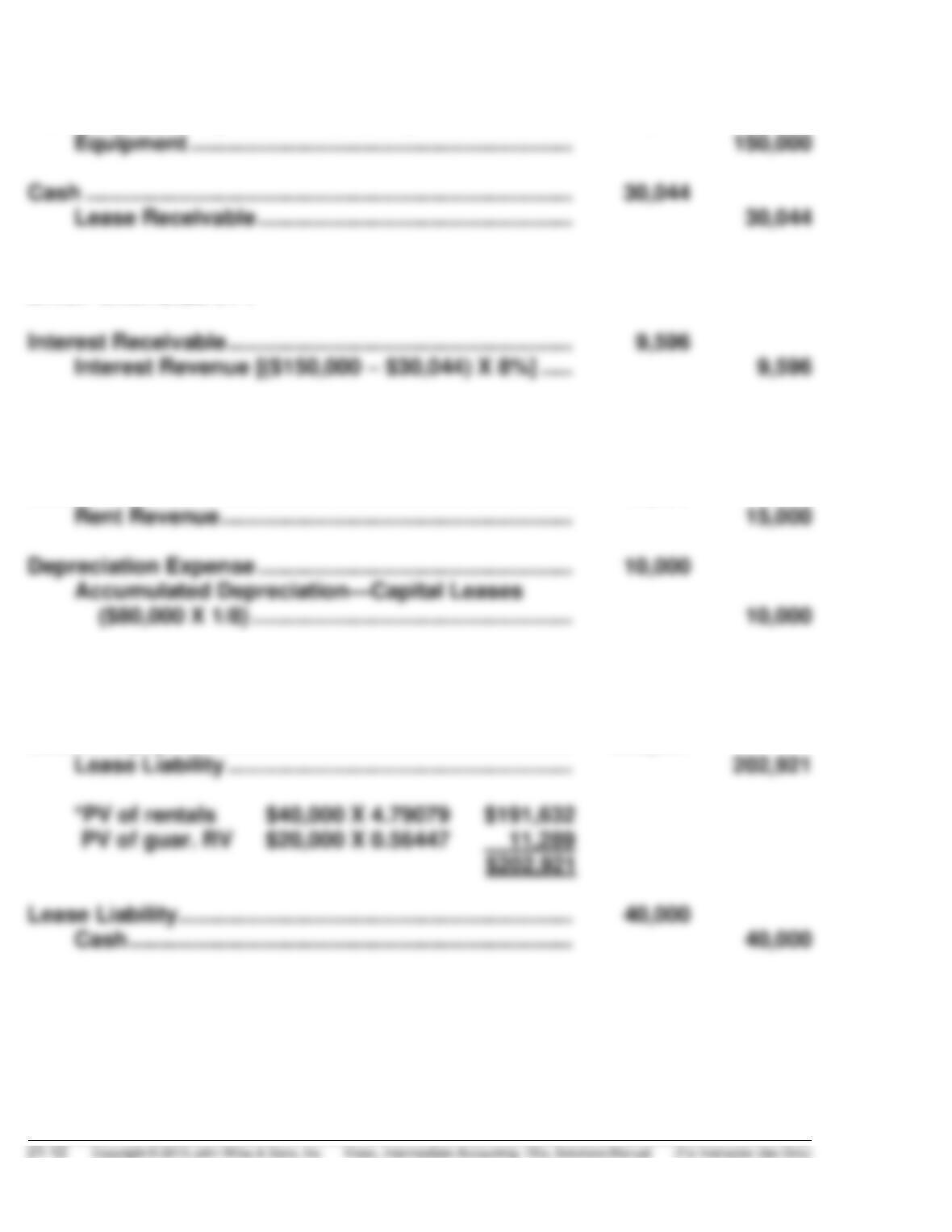
Lease Receivable (4.99271 X $30,044) ……………………. 150,000
BRIEF EXERCISE 21-7
BRIEF EXERCISE 21-8
Cash ……………………………………………………………………. 15,000
BRIEF EXERCISE 21-9
Leased Equipment …………………………..……………………. 202,921*
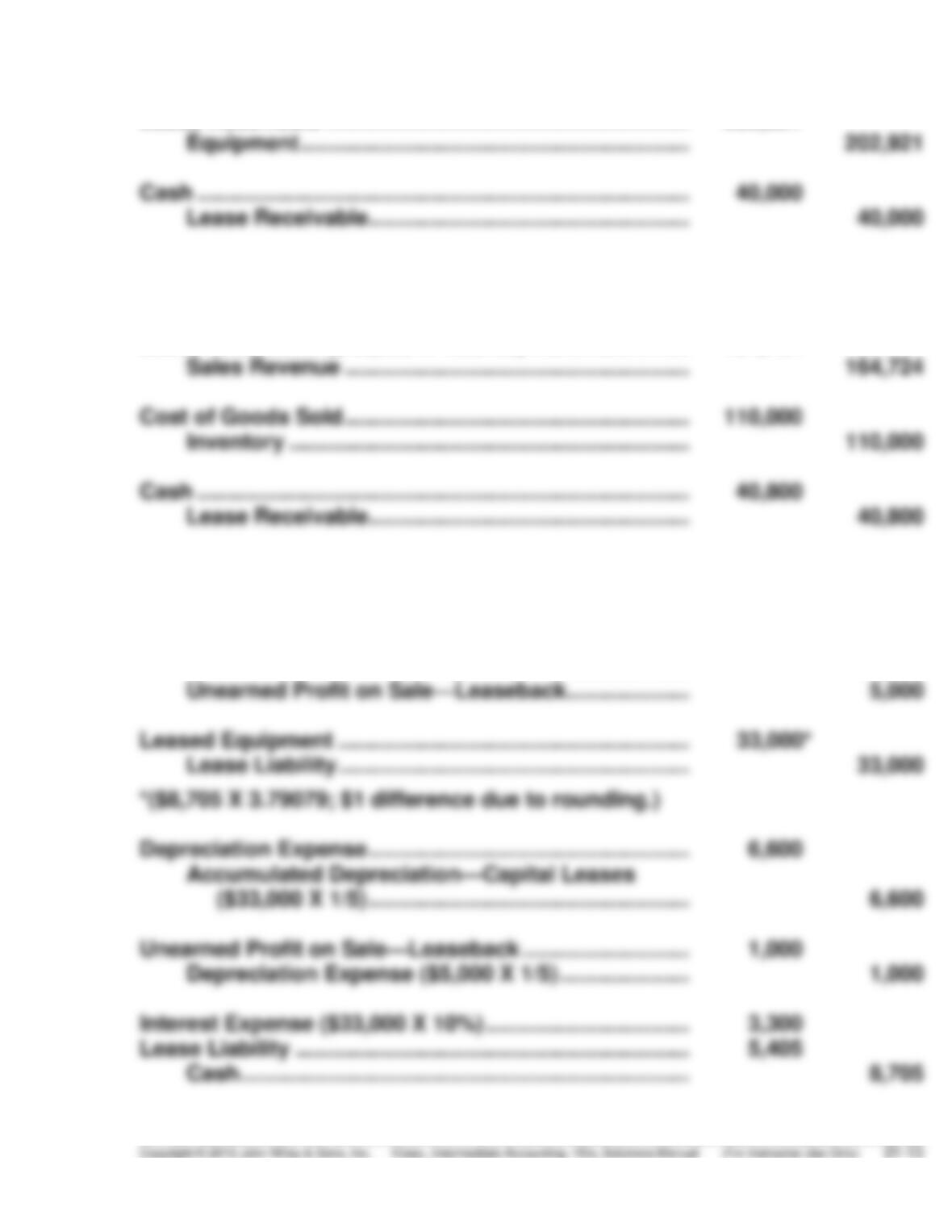
BRIEF EXERCISE 21-10
Lease Receivable ………………………………………………….. 202,921
BRIEF EXERCISE 21-11
Lease Receivable ($40,800 X 4.03735) …………………….. 164,724
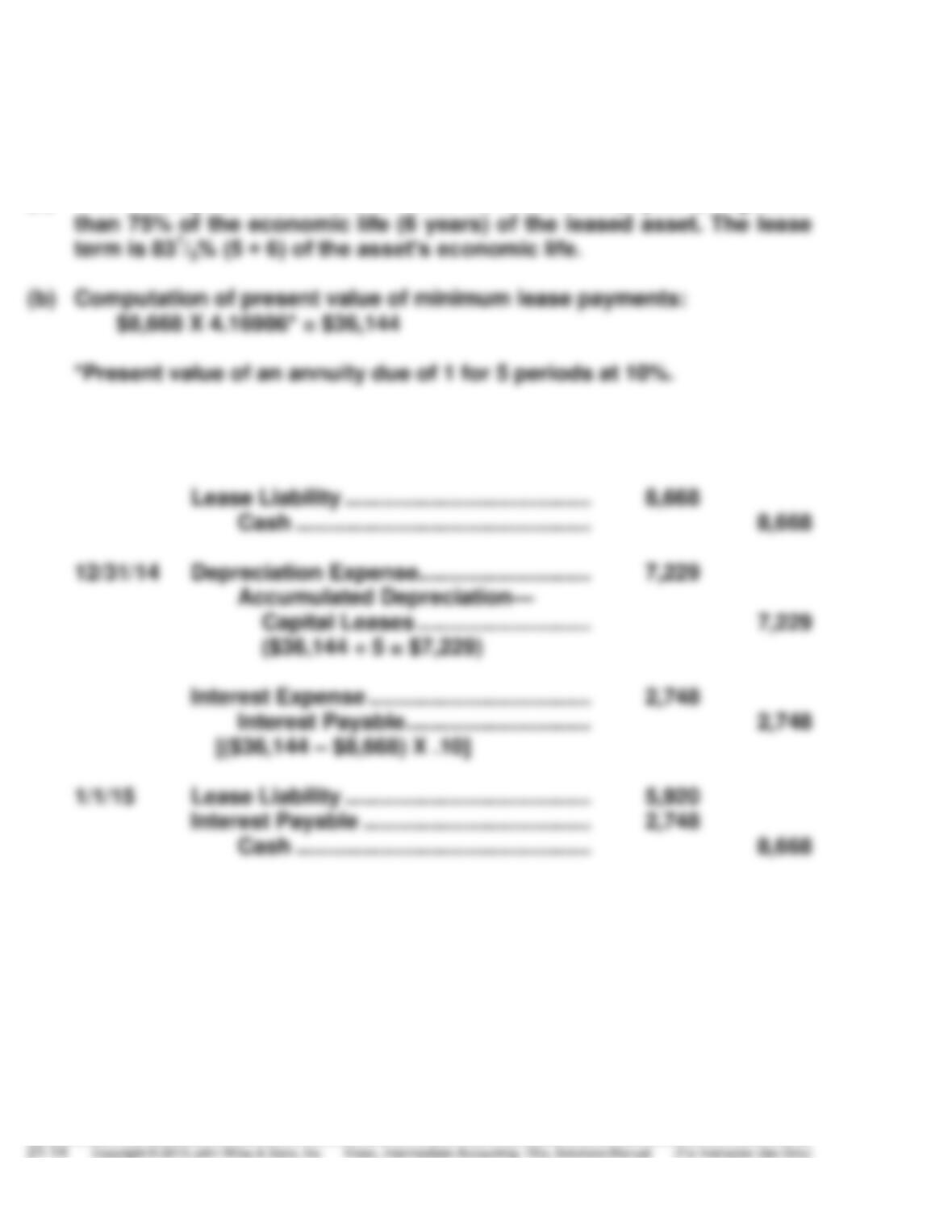
*BRIEF EXERCISE 21-12
Cash …………………………………………………………………….. 33,000
Trucks ……………………………………………………………. 28,000
SOLUTIONS TO EXERCISES
EXERCISE 21-1 (15–20 minutes)
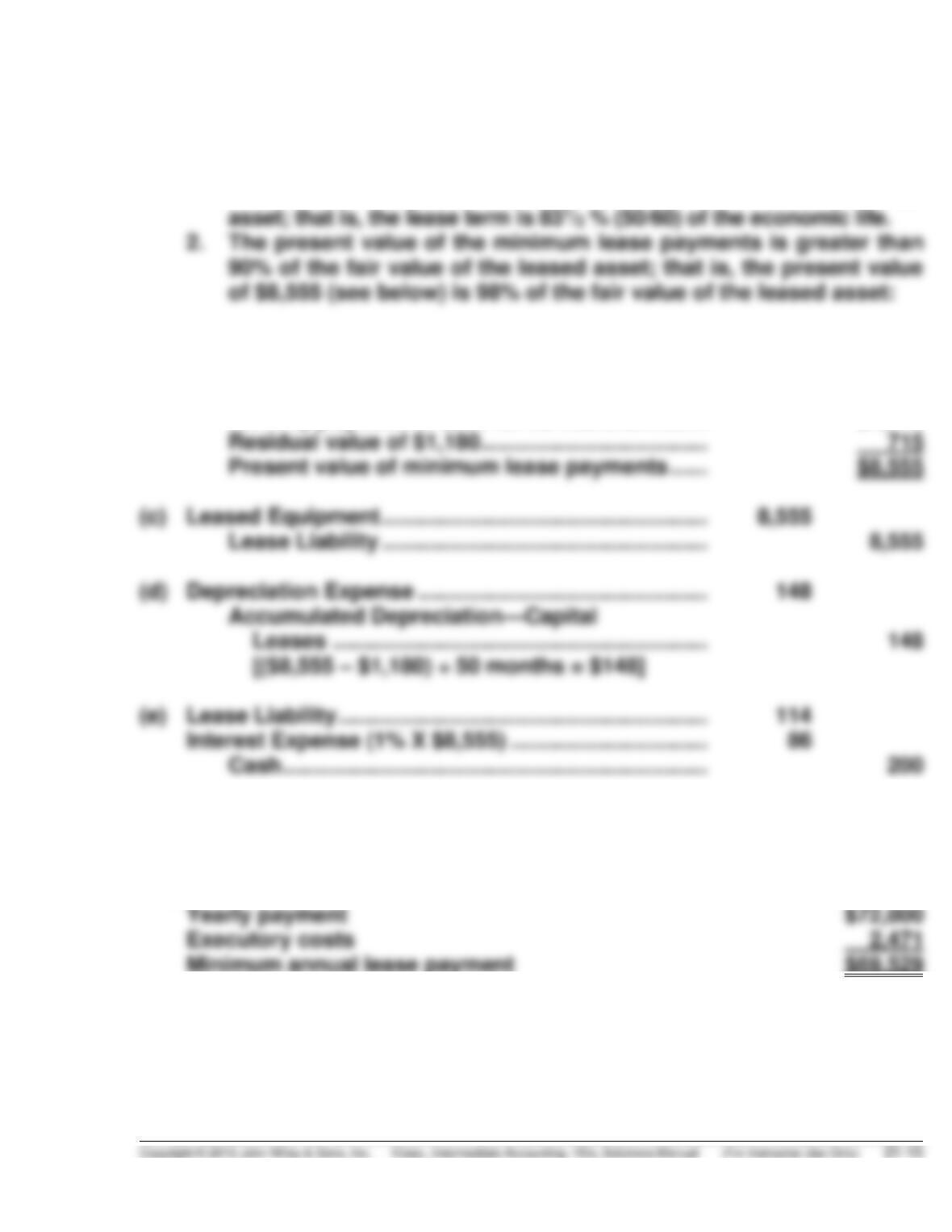
(a) This is a capital lease to Burke since the lease term (5 years) is greater
(c) 1/1/14 Leased Equipment …………………………... 36,144
Lease Liability…………………………... 36,144
EXERCISE 21-2 (20–25 minutes)
(a) To Delaney, the lessee, this lease is a capital lease because the terms
satisfy the following criteria:
1. The lease term is greater than 75% of the economic life of the leased
(b) The minimum lease payments in the case of a guaranteed residual
value by the lessee include the guaranteed residual value. The present
value therefore is:
Monthly payment of $200 for 50 months ……….. $7,840
EXERCISE 21-3 (20–30 minutes)
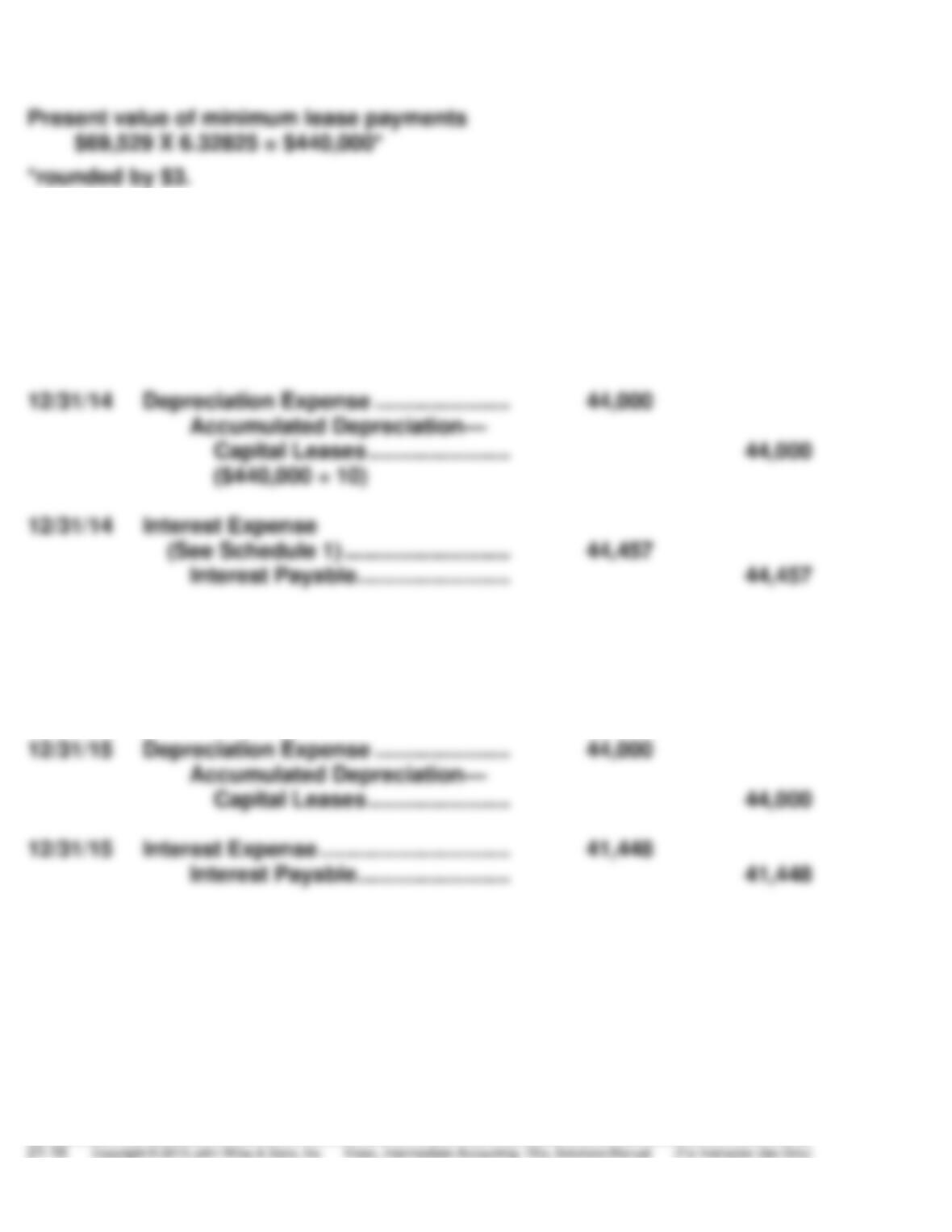
Capitalized amount of the lease:
EXERCISE 21-3 (Continued)
1/1/14 Leased Buildings ………………………… 440,000
Lease Liability ……………………… 440,000
1/1/14 Executory Costs …………………………... 2,471
Lease Liability …………………………….. 69,529
Cash ……………………………………. 72,000
1/1/15 Executory Costs ………………………………. 2,471
Interest Payable ………………………….. 44,457
Lease Liability …………………………….. 25,072
Cash ……………………………………. 72,000
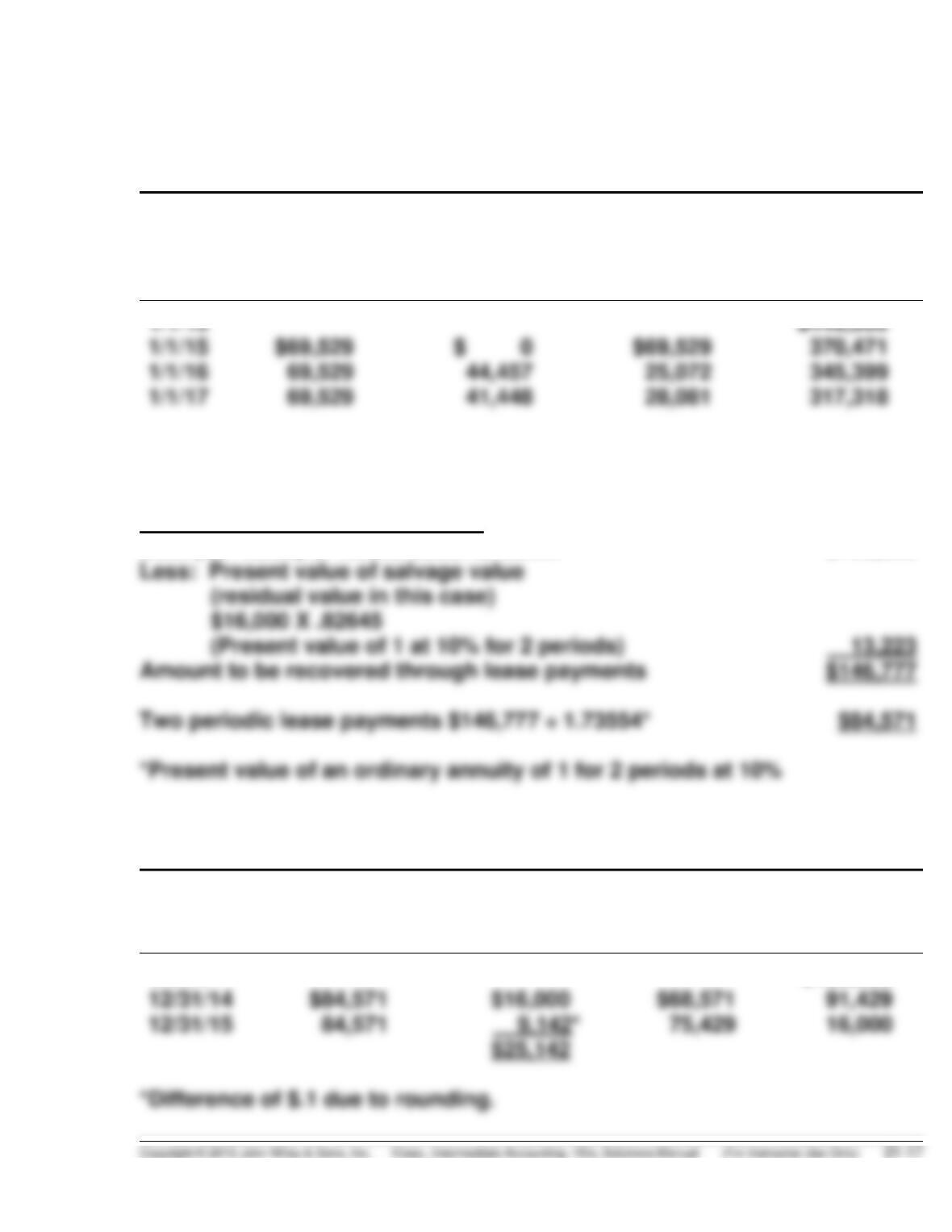
EXERCISE 21-3 (Continued)
Schedule 1 KIMBERLY-CLARK CORP.
Lease Amortization Schedule
(Lessee)
Date
Annual
Payment Less
Executory
Costs
Interest (12%)
on Liability
Reduction
of Lease
Liability
Lease Liability
EXERCISE 21-4 (20–25 minutes)
Computation of annual payments
Cost (fair value) of leased asset to lessor $160,000
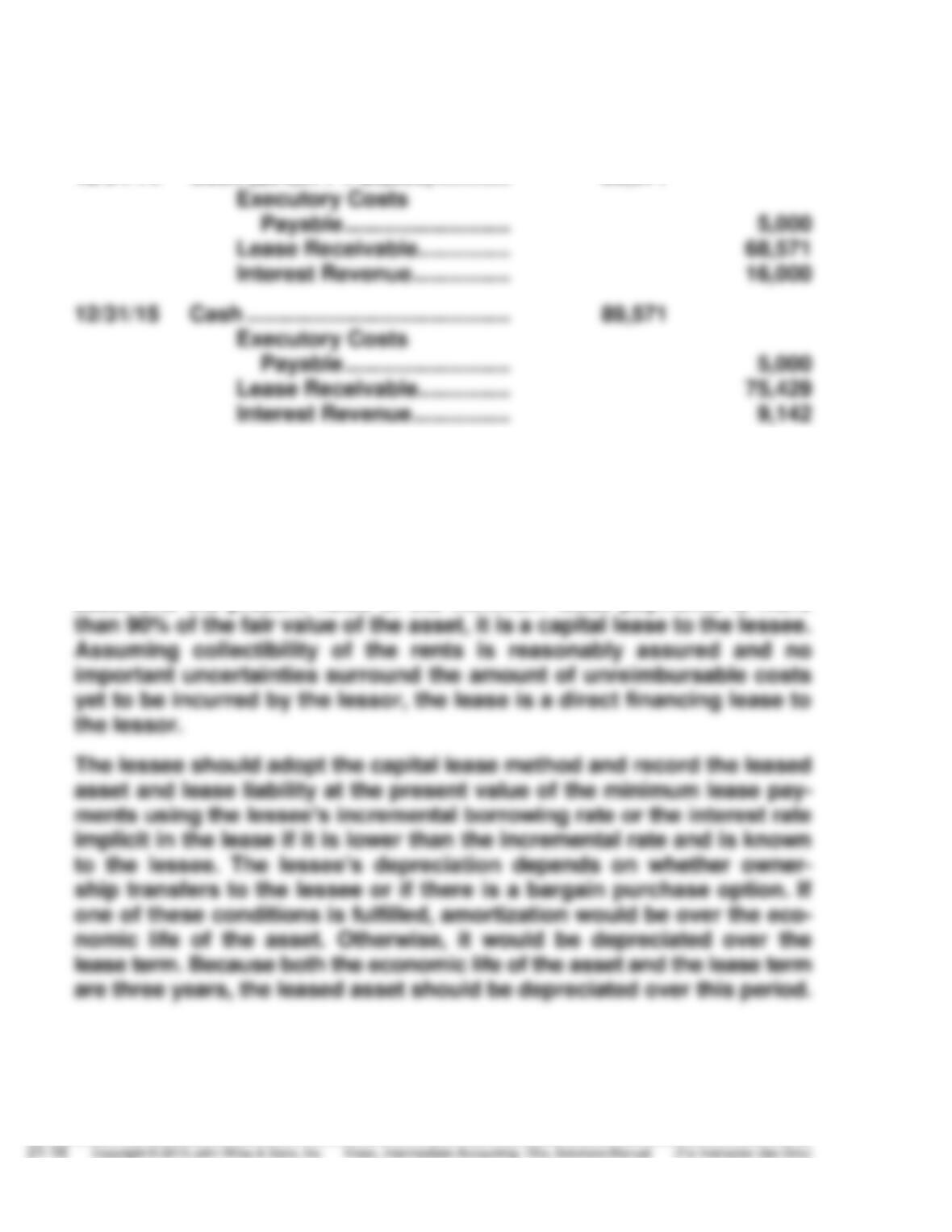
CASTLE LEASING COMPANY (Lessor)
Lease Amortization Schedule
Date
Annual Payment
Less Executory
Costs
Interest
on Lease
Receivable
Recovery
of Lease
Receivable
Lease
Receivable
1/1/14
$160,000
EXERCISE 21-4 (Continued)
(a) 1/1/14 Lease Receivable …………………. 160,000
Equipment …………………….. 160,000
12/31/14 Cash ($84,571 + $5,000) ………… 89,571
(b) 12/31/15 Cash ……………………………………. 16,000
Lease Receivable …………… 16,000
EXERCISE 21-5 (15–20 minutes)
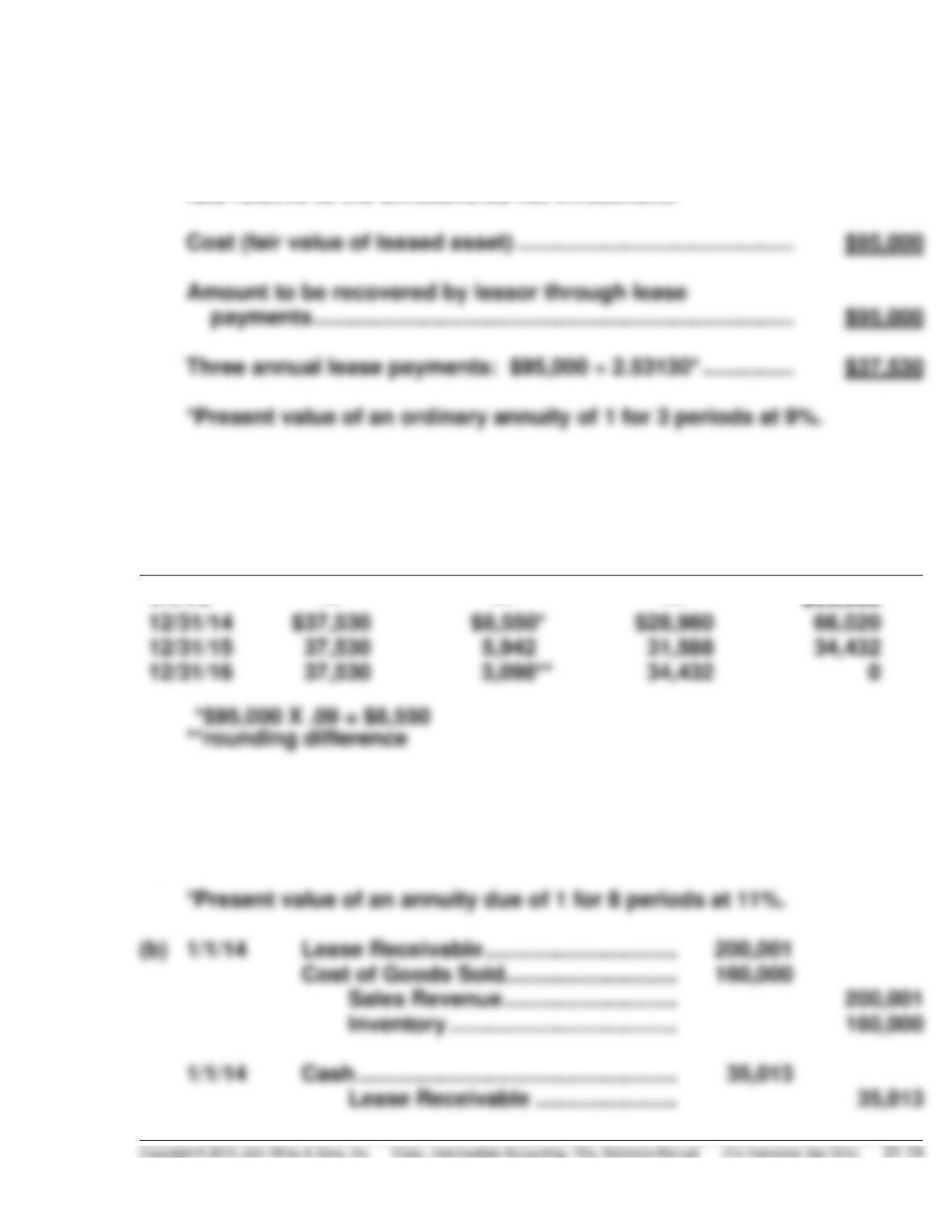
(a) Because the lease term is longer than 75% of the economic life of the
asset and the present value of the minimum lease payments is more
EXERCISE 21-5 (Continued)
The lessor should adopt the direct-financing lease method and replace
the asset cost of $95,000 with Lease Receivable of $95,000. (See
schedule below.) Interest would be recognized annually at a constant
rate relative to the unrecovered net investment.
(b) Schedule of Interest and Amortization
Rent Receipt/
Payment
Interest
Revenue/
Expense
Reduction of
Principal
Receivable/
Liability
EXERCISE 21-6 (15–20 minutes)
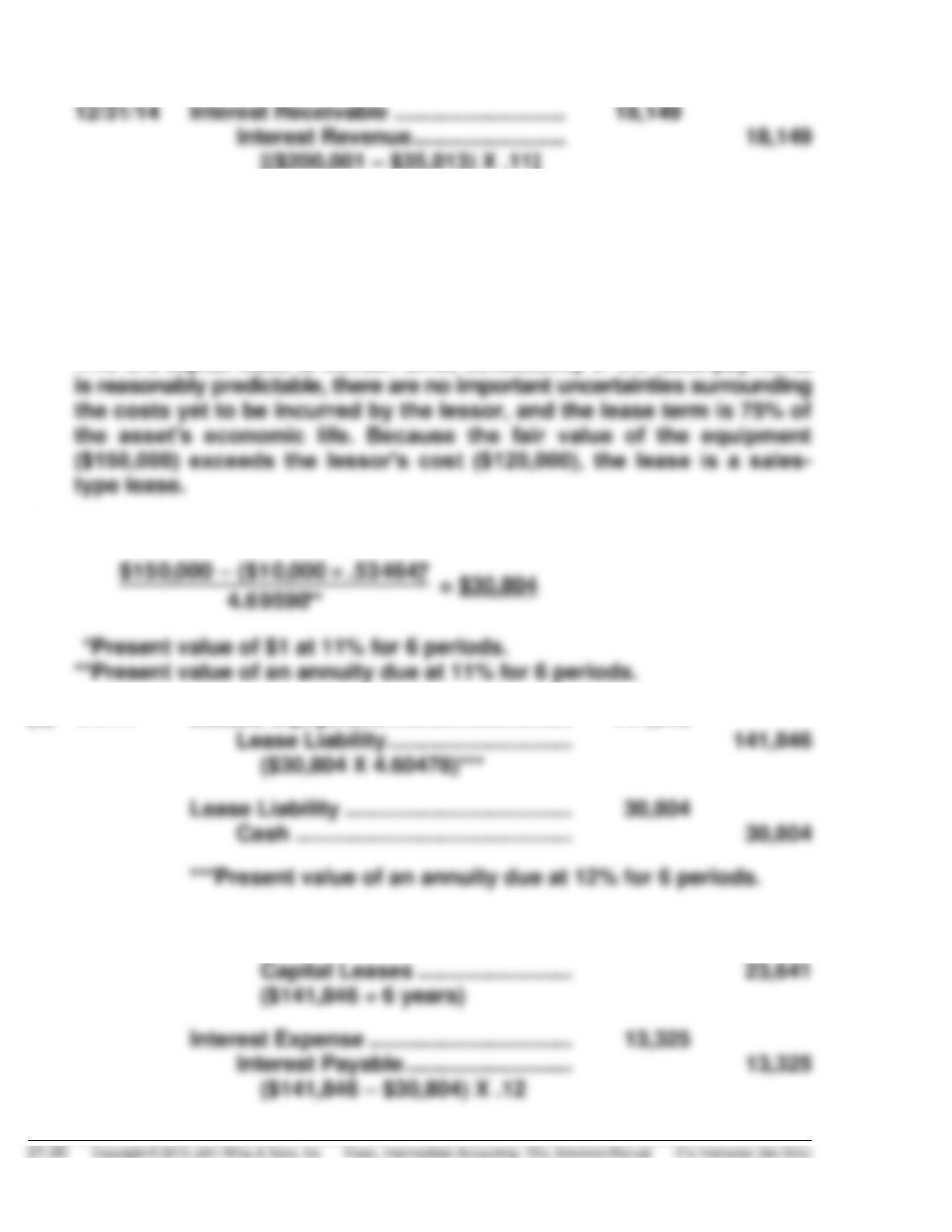
(a) $35,013 X 5.7122* = $200,001
EXERCISE 21-6 (Continued)
EXERCISE 21-7 (20–25 minutes)
(a) This is a capital lease to Flynn since the lease term is 75% (6 ÷ 8) of the
asset’s economic life. In addition, the present value of the minimum
lease payments is more than 90% of the fair value of the asset.
This is a capital lease to Bensen since collectibility of the lease payments
(b) Computation of annual rental payment:
(c) 1/1/14 Leased Equipment ………………………… 141,846
12/31/14 Depreciation Expense ……………………. 23,641
Accumulated Depreciation—