PROBLEM 21-12 (Continued)
Partial Amortization Schedule
(Annuity-Due Basis)
Date
Lease
Payment
Executory
Costs
Interest
(6%) on
Lease
Liability
Reduction
of Lease
Liability
Lease
Liability
1/1/14
$ 0
$ 0
$ 0
$ 0
$7,600,000
1/1/14
948,000
148,000
0
800,000
6,800,000
1/1/15
948,000
148,000
408,000
392,000
6,408,000
1/1/17
948,000
148,000
359,549
440,451
5,552,029
(2) (12/31/16)
Depreciation Expense …………………………………….. 190,000
Note: The leased asset is depreciated over its economic life because a
bargain-purchase option is available at the end of the lease term.
(3) (12/31/16)
Interest Expense …………………………………………….. 359,549
PROBLEM 21-13
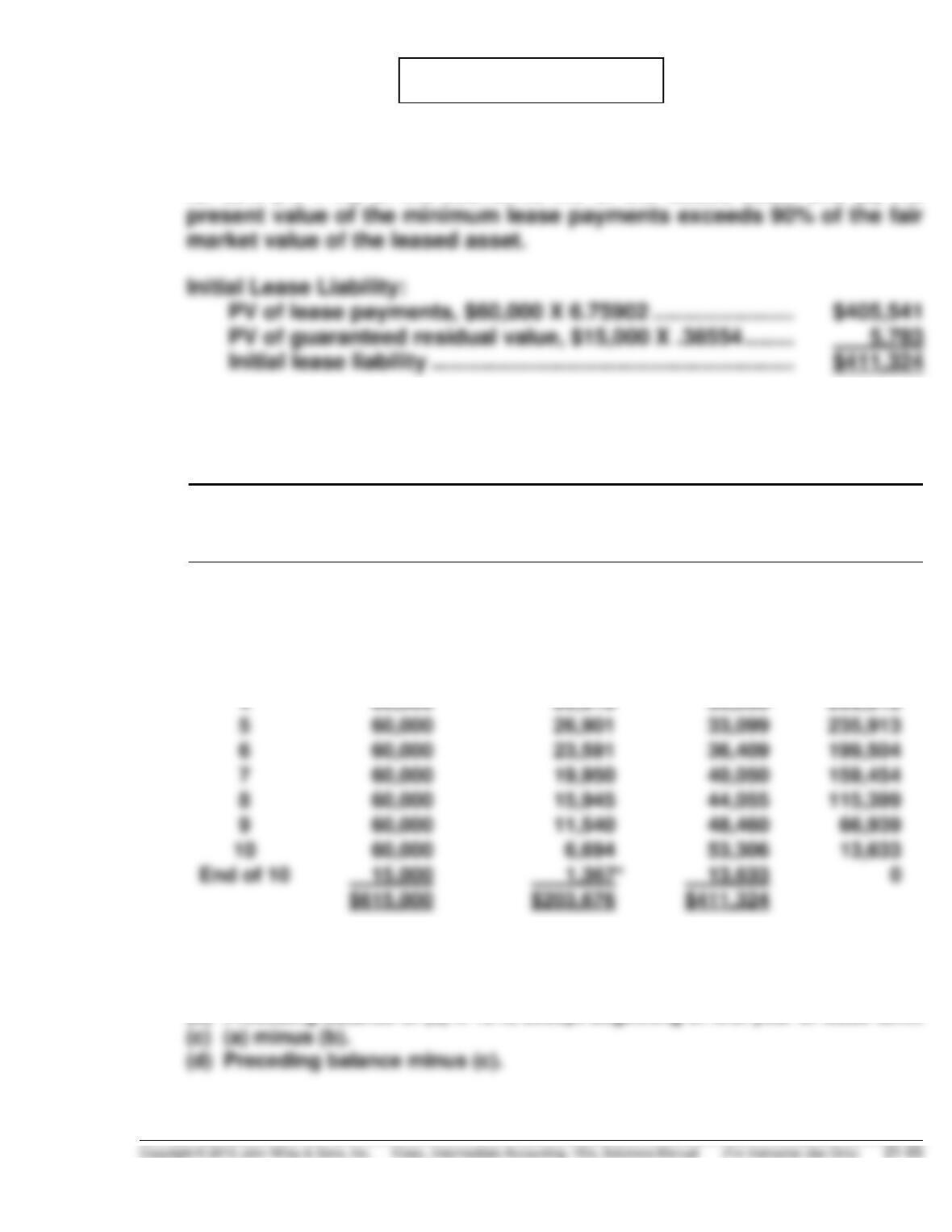
(a) The noncancelable lease is a sales-type capital lease because: (1) the
lease term is for 83% (10 ÷ 12) of the economic life of the leased asset,
1. Lease Receivable:
Present value of annual payments of $60,000
2. Sales price is the same as the present value of
minimum lease payments ………………………………………. $411,324
PROBLEM 21-13 (Continued)
(b) AMIRANTE INC. (Lessor)
Lease Amortization Schedule
(Annuity due basis, guaranteed residual value)
Beginning
of Year
Annual Lease
Payment Plus
Residual Value
Interest (10%)
on Lease
Receivable
Recovery
of Lease
Receivable
Lease
Receivable
(a)
(b)
(c)
(d)
Initial PV
—
—
—
$411,324
1
$ 60,000
—
$ 60,000
351,324
2
60,000
$ 35,132
24,868
326,456
3
60,000
32,646
27,354
299,102
4
269,012
5
60,000
33,099
235,913
6
199,504
7
159,454
8
60,000
44,055
115,399
9
$615,000
$411,324
*Rounding error is $4.00.
(a) Annual lease payment required by lease contract.
(b) Preceding balance of (d) X 10%, except beginning of first year of lease term.
(c) Lessor’s journal entries:
Beginning of the Year
Lease Receivable ……………………………………………. 411,324
PROBLEM 21-13 (Continued)
Cash ………………………………………………………………… 60,000
Lease Receivable ……………………………………….. 60,000
PROBLEM 21-14
(a) The noncancelable lease is a capital lease because: (1) the lease term is
for 83% (10 ÷ 12) of the economic life of the leased asset and (2) the
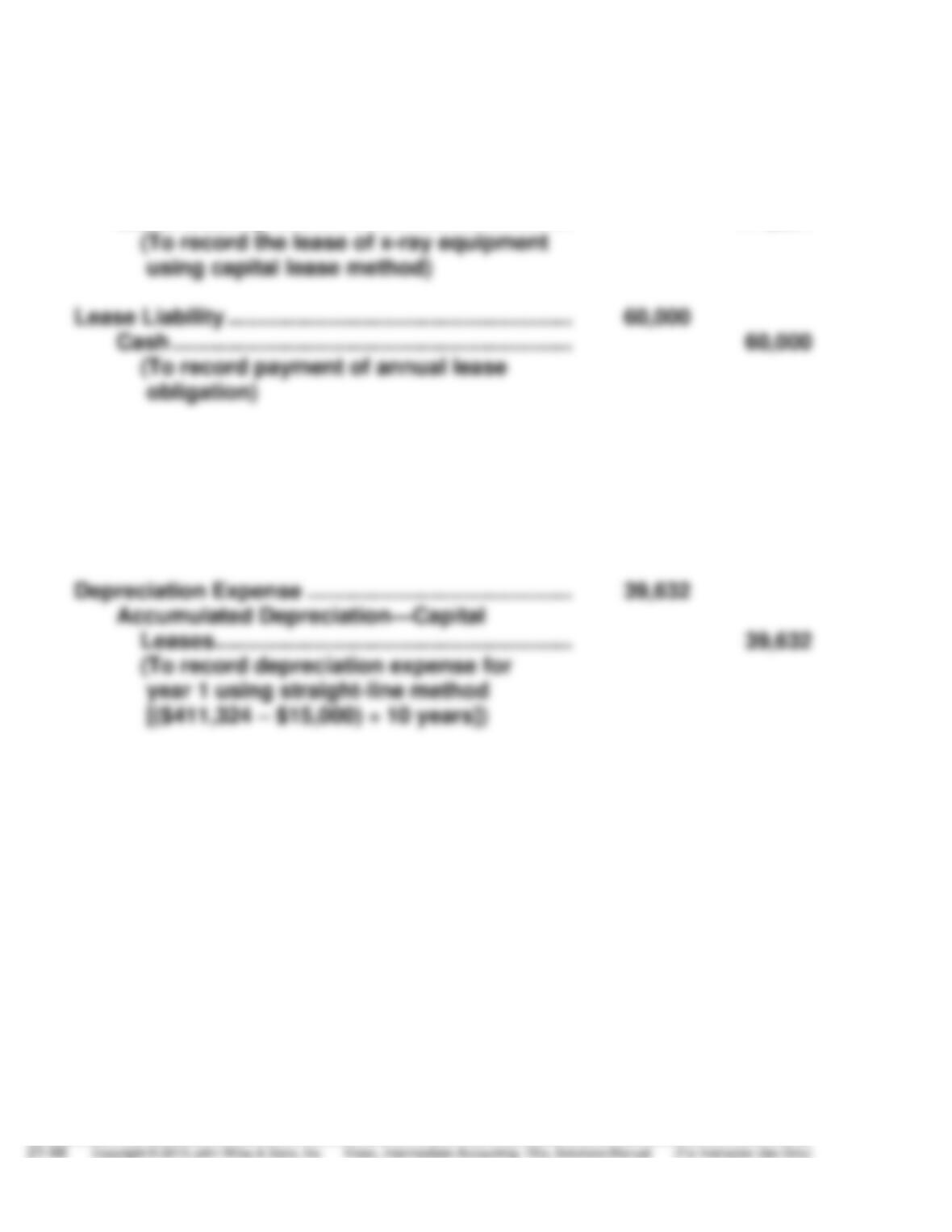
(b) CHAMBERS MEDICAL (Lessee)
Lease Amortization Schedule
(Annuity-Due Basis, GRV)
Beginning
of Year
Annual Lease
Payment Plus
GRV
Interest (10%)
on Unpaid
Liability
Reduction
of Lease
Liability
Lease
Liability
(a)
(b)
(c)
(d)
Initial PV
$ 0
$ 0
$ 0
$411,324
1
60,000
0
60,000
351,324
2
60,000
35,132
24,868
326,456
3
60,000
32,646
27,354
299,102
4
30,090
269,012
5
33,099
235,913
6
60,000
23,591
36,409
199,504
7
40,050
159,454
8
44,055
115,399
9
60,000
11,540
48,460
53,306
*Rounding error is $4.
(a) Annual lease payment required by lease contract.
(b) Preceding balance of (d) X 10%, except beginning of first year of lease term.
PROBLEM 21-14 (Continued)
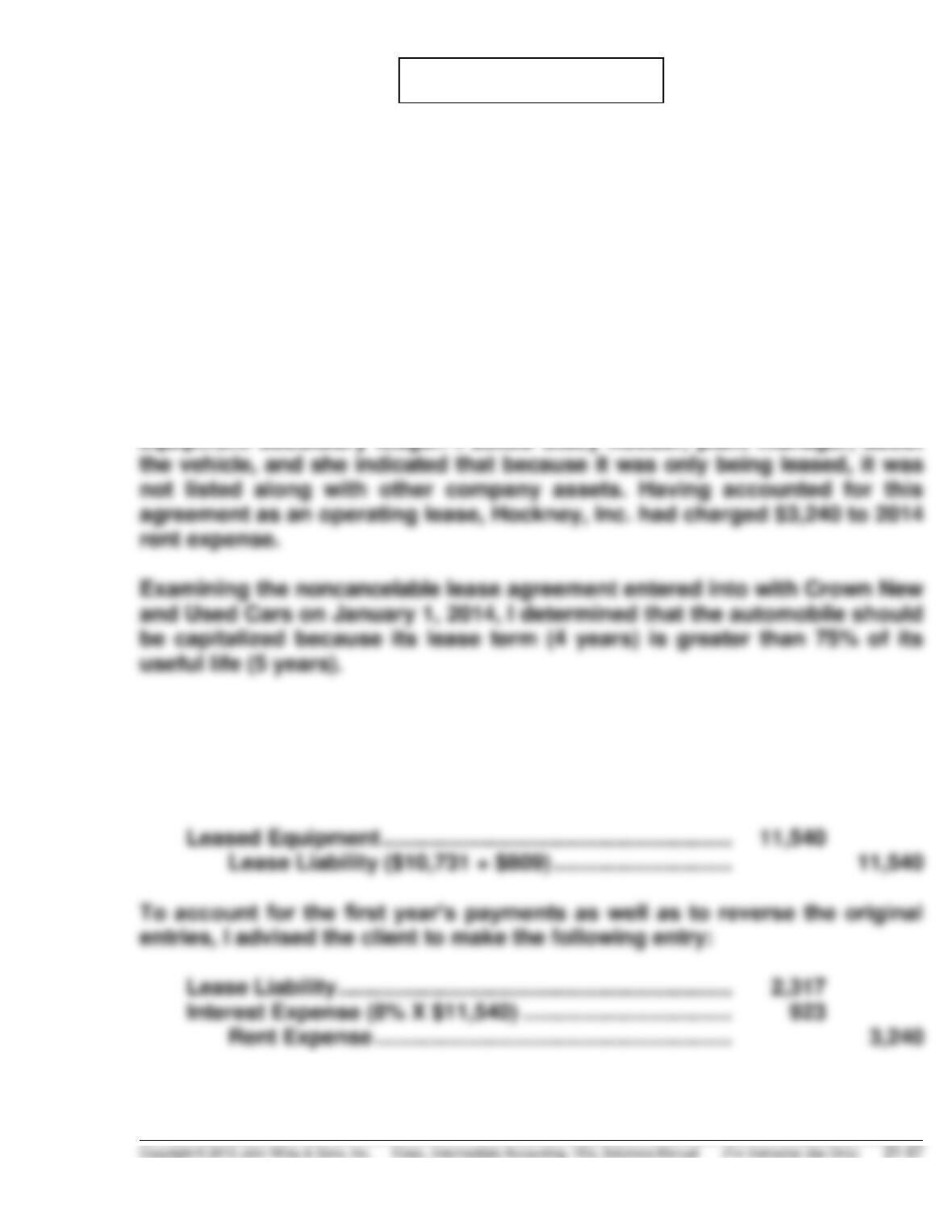
(c) Lessee’s journal entries:
Beginning of the Year
Leased Equipment …………………………………………. 411,324
Lease Liability …………………………………………. 411,324
End of the Year
Interest Expense ……………………………………………. 35,132
Interest Payable ………………………………………. 35,132
(To record accrual of annual interest on
lease obligation)
PROBLEM 21-15
Memorandum Prepared by: (Your Initials)
Date:
HOCKNEY, INC.
December 31, 2014
Reclassification of Leased Auto
As a Capital Lease
While performing a routine inspection of the client’s garage, I found a used
automobile which was not listed among the company’s assets in the
equipment subsidiary ledger. I asked Stacy Reeder, plant manager, about
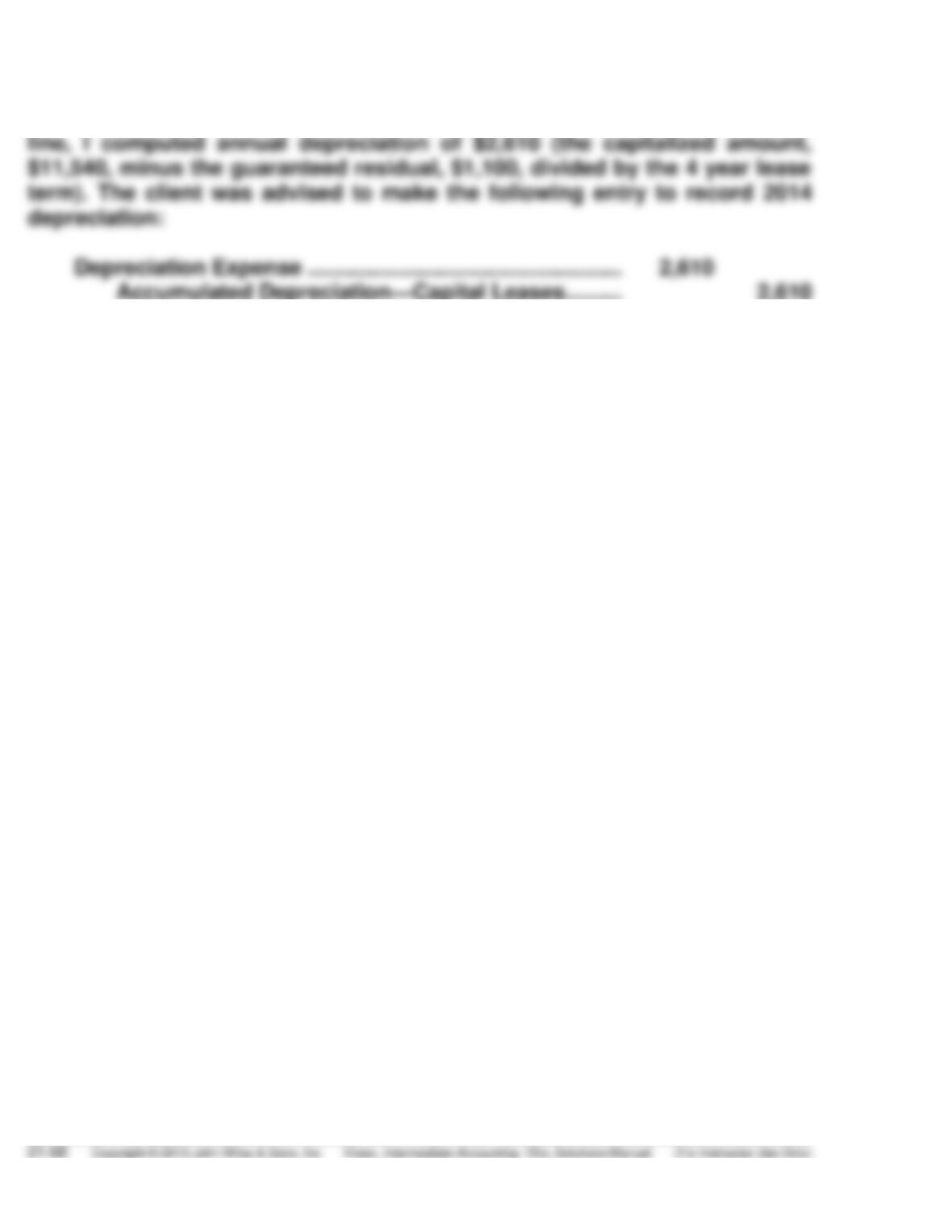
I advised the client to capitalize this lease at the present value of its minimum
lease payments: $10,731 (the present value of the monthly payments), plus
$809 (the present value of the guaranteed residual). The following journal
entry was suggested:
PROBLEM 21-15 (Continued)
Finally, this vehicle must be depreciated over its lease term. Using straight–
PROBLEM 21-16
(a) The lease agreement satisfies both the 75% of useful life and 90% of
fair value requirements, collectibility is reasonably predictable, and there
(b) January 1, 2014
Lessee:
Leased Equipment ………………………………………….. 220,404
Lease Liability ………………………………………….. 220,404
($30,300 X 6.99525 = $211,956)
($20,000 X .42241 = 8,448)
= $220,404)
December 31, 2014
Lessee:
Interest Expense …………………………………………….. 17,109
Interest Payable
[($220,404 – $30,300) X .09] ……………………. 17,109
PROBLEM 21-16 (Continued)
December 31, 2014
Lessor:
Interest Receivable …………………………………………… 17,109
Interest Revenue ………………………………………… 17,109
(c) (1) and (2) are both $211,956, as the lessee has no obligation to pay the
residual value.
TIME AND PURPOSE OF CONCEPTS FOR ANALYSIS
CA 21-1 (Time 15–25 minutes)
Purpose—to provide the student with an understanding of the theoretical reasons for requiring certain
CA 21-2 (Time 25–35 minutes)
Purpose—to provide an understanding of the factors underlying the accounting for a leasing arrangement
from the point of view of both the lessee and lessor. The student is required to determine the classifica–
tion of this leasing arrangement, the appropriate accounting treatment which should be accorded this
lease, and the financial statement disclosure requirements for both the lessee and lessor.
CA 21-3 (Time 20–30 minutes)
Purpose—to provide the student with an understanding of the classification of three leases. The student
CA 21-4 (Time 15–25 minutes)
CA 21-5 (Time 30–35 minutes)
Purpose—to provide the student with a lease situation containing a bargain-purchase option and both
CA 21-6 (Time 20–25 minutes)
Purpose—to provide the student with a lease arrangement with a bargain-purchase option in order to
examine the ethical issues of lease accounting.
*CA 21-7 (Time 15–25 minutes)
SOLUTIONS TO CONCEPTS FOR ANALYSIS
CA 21-1
(b) Evans should account for this lease at its inception as an asset and an obligation at an amount
should be the machine’s fair value.
(c) Evans will incur interest expense equal to the interest rate used to capitalize the lease at its
inception multiplied by the appropriate net carrying value of the liability at the beginning of the
period.
(d) The asset recorded under the capital lease and the accumulated depreciation should be classified
on Evans’ December 31, 2014, balance sheet as noncurrent and should be separately identified
CA 21-2
(2) Since the given facts state that Sylvan (lessee) does not have access to information that
would enable determination of Breton Leasing Corporation’s (lessor) implicit rate for this
(3) The amount recorded as an asset on Sylvan’s books should be shown in the fixed assets
section of the balance sheet as “Leased Equipment” or another similar title. Of course, at
the same time as the asset is recorded, a corresponding liability (“Lease Liability” or similar
CA 21-2 (Continued)
(4) For this lease, Sylvan must disclose the future minimum lease payments in the aggregate
(b) (1) Based on the given facts, Breton has entered into a direct-financing lease. There is no
dealer or manufacturer profit included in the transaction, the discounted present value of the
(2) Breton should record a Lease Receivable for the present value of the minimum lease
payments and the present value of the residual value. It should also remove the machine
from the books by a credit to the applicable asset account.
(3) During the life of the lease, Breton will record payments received as a reduction in the
receivable. Interest is recognized as interest revenue by applying the implicit interest rate to
(4) Breton must make the following disclosures with respect to this lease:
(a) The components of the lease receivable in direct-financing leases, which are (1) the
CA 21-3
(a) A lease should be classified as a capital lease when it transfers substantially all of the benefits
and risks inherent to the ownership of property by meeting any one of the four criteria established
CA 21-3 (Continued)
(b) For Lease L, Santiago Company should record as a liability at the inception of the lease an
amount equal to the present value at the beginning of the lease term of the minimum lease
payments during the lease term. This amount excludes that portion of the payments representing
(c) For Lease L, Santiago Company should allocate each minimum lease payment between a reduc–
tion of the liability and interest expense so as to produce a constant periodic rate of interest on
the remaining balance of the liability.
CA 21-4
Part 1
(a) A lessee would account for a capital lease as an asset and a liability at the inception of the lease.
Rental payments during the year would be allocated between a reduction in the liability and
interest expense. The asset would be amortized in a manner consistent with the lessee’s normal
Part 2
(a) The lease receivable in the lease is the same for both a sales-type and a direct-financing lease.
The lease receivable is the present value of the minimum lease payments (net of amounts, if any,
included therein for executory costs such as maintenance, taxes, and insurance to be paid by the
CA 21-4 (Continued)
(c) In a sales-type lease, the excess of the sales price over the carrying amount of the leased
CA 21-5
(a) The appropriate amount for the leased aircraft on Albertsen Corporation’s balance sheet after the
lease is signed is $1,000,000, the fair value of the plane. In this case, fair value is less than the
present value of the net rental payments plus purchase option ($1,022,226). When this occurs,
the asset is recorded at the fair value.
(b) The leased aircraft will be reflected on Albertsen Corporation’s balance sheet as follows:
Noncurrent assets
Leased equipment …………………………………………………………………….. $1,000,000
Less: Accumulated depreciation—capital leases …………………………….. 61,667
$ 938,333
Note A
The company leases a Viking turboprop aircraft under a capital lease. The lease runs until
December 31, 2023. The annual lease payment is paid in advance on January 1 and amounts to
$141,780, of which $4,000 is for insurance and property taxes. The aircraft is being depreciated on
CA 21-5 (Continued)
Computations
Depreciation expense:
Capitalized amount ……………………………………………………….…. $1,000,000
CA 21-6
(a) The ethical issues are fairness and integrity of financial reporting versus profits and possibly
misleading financial statements. On one hand, if Buchanan can substantiate her position, it is
(b) If Buchanan has no particular expertise in copier technology, she has no rational case for her
suggestion. If she has expertise, then her suggestion may be rational and would not be merely a
means to manipulate the balance sheet to avoid recording a liability.
further research regarding copier technology before reaching a decision.
*CA 21-7
(a) The economic effect of a long-term capital lease on the lessee is similar to that of an installment
purchase. Such a lease transfers substantially all of the benefits and risks incident to the ownership
of property to the lessee. Therefore, the lease should be capitalized.
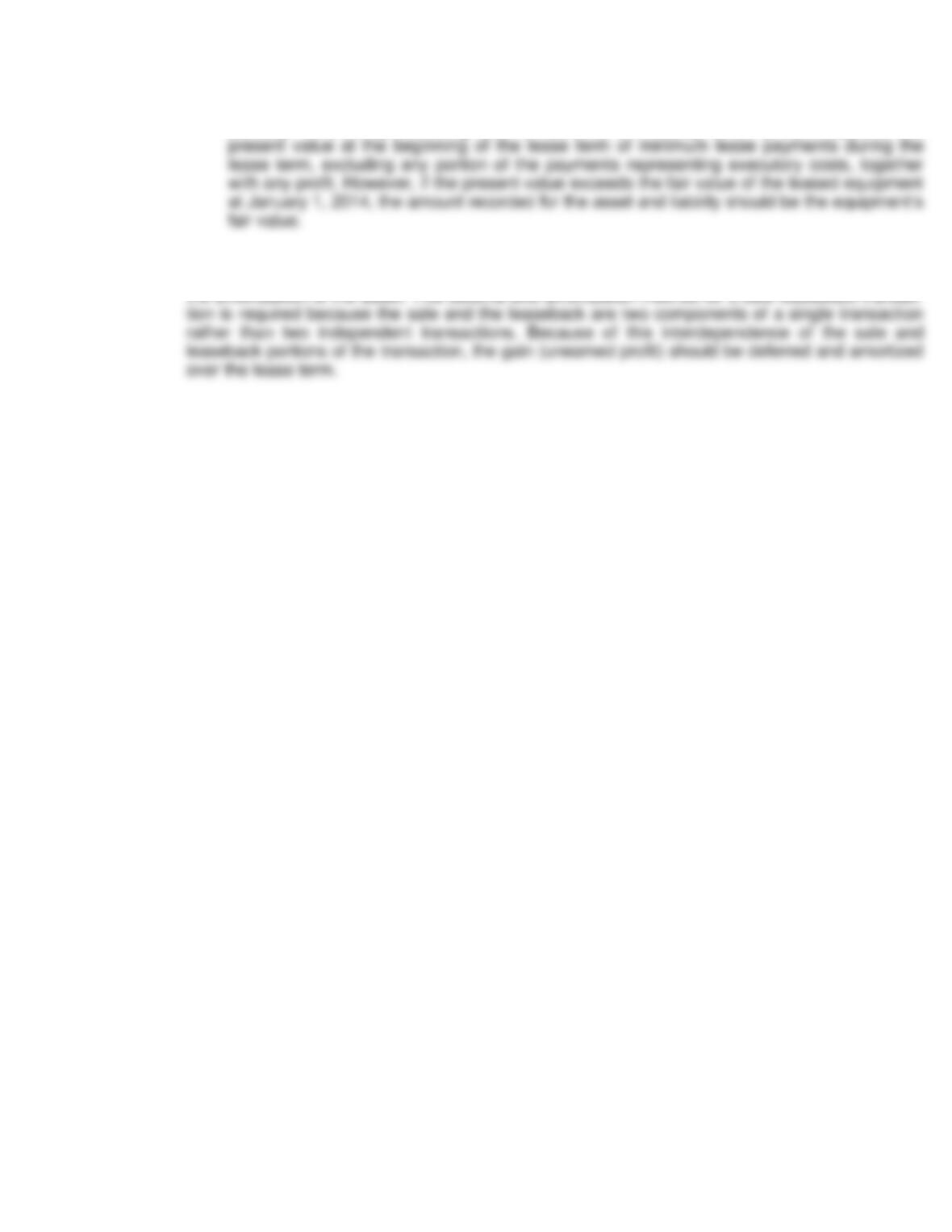
(b) (1) Perriman should account for the sale portion of the sale-leaseback transaction at January 1,
Copyright © 2013 John Wiley & Sons, Inc. Kieso, Intermediate Accounting, 15/e, Solutions Manual (For Instructor Use Only) 21–77
*CA 21-7 (Continued)
(2) Perriman should account for the leaseback portion of the sale-leaseback transaction at
January 1, 2014, by recording both an asset and a liability at an amount equal to the
(c) The deferred gain should be amortized over the lease term or life of the asset, whichever is
appropriate. During the first year of the lease, the amortization will be an amount proportionate to
FINANCIAL REPORTING PROBLEM
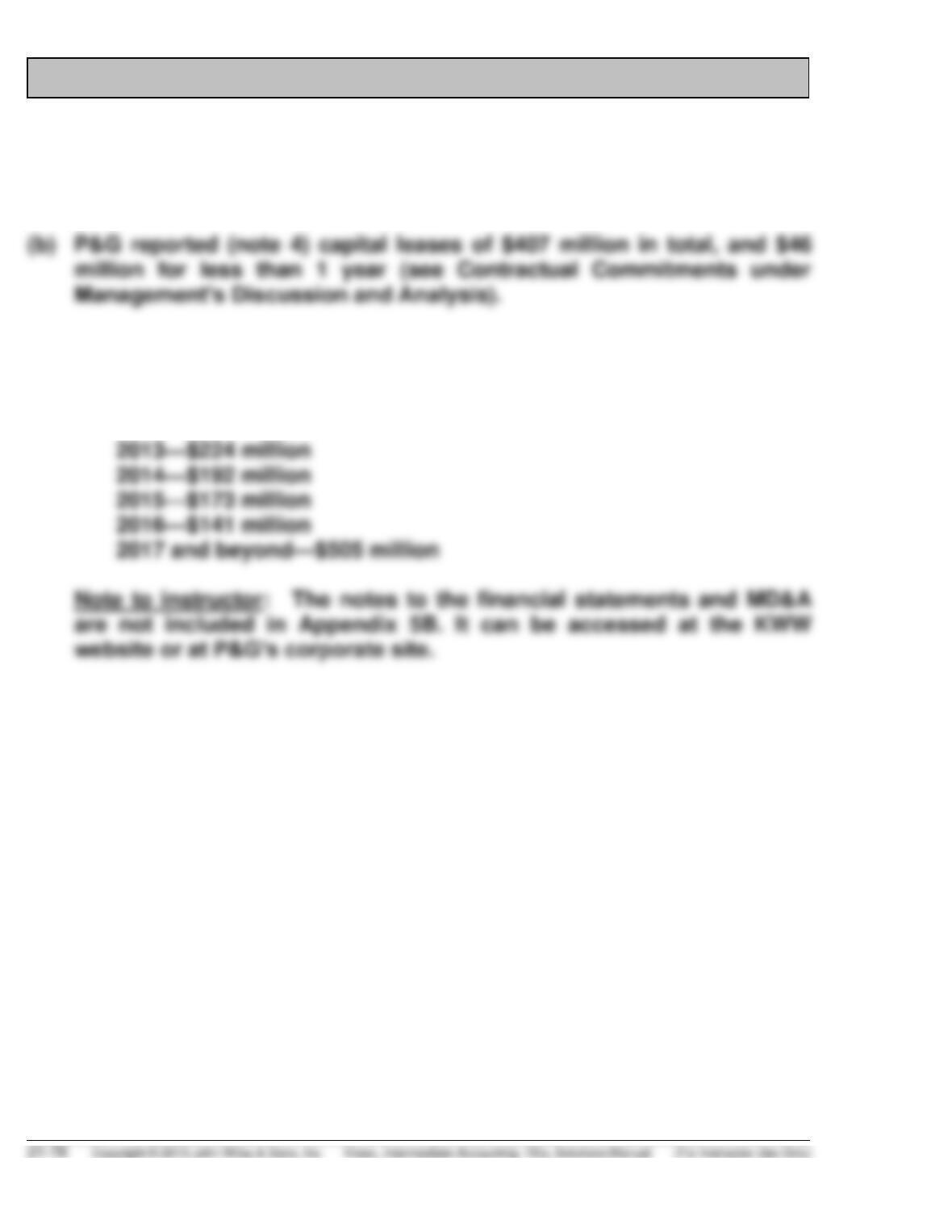
(a) In P&G’s Management’s Discussion and Analysis (under Contractual
Commitments), both capital leases and operating leases are disclosed.
(c) P&G disclosed future minimum rental commitments under noncancelable
operating leases in excess of one year as of June 30, 2011, of:
2012—$264 million
COMPARATIVE ANALYSIS CASE
(a) Southwest uses both capital leases and long-term operating leases.
Southwest primarily leases aircraft and terminal space.
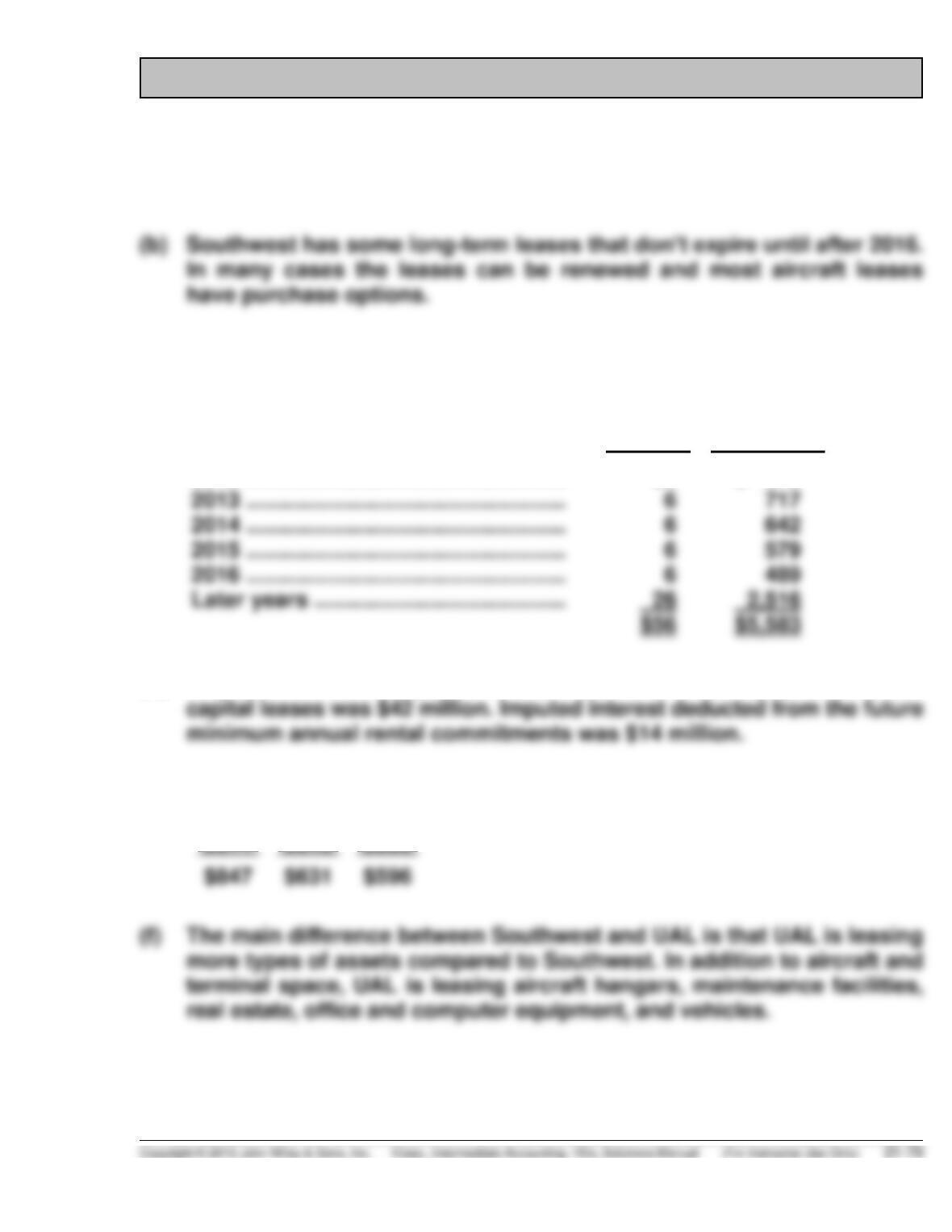
(c) Future minimum commitments under noncancelable leases are set forth
below (in millions):
Capital
Operating
2012 …………………………………………….
$6
$ 640
2014 …………………………………………….
(d) At year-end 2011, the present value of minimum lease payments under
(e) The details of rental expense are set forth below:
2011
2010
2009