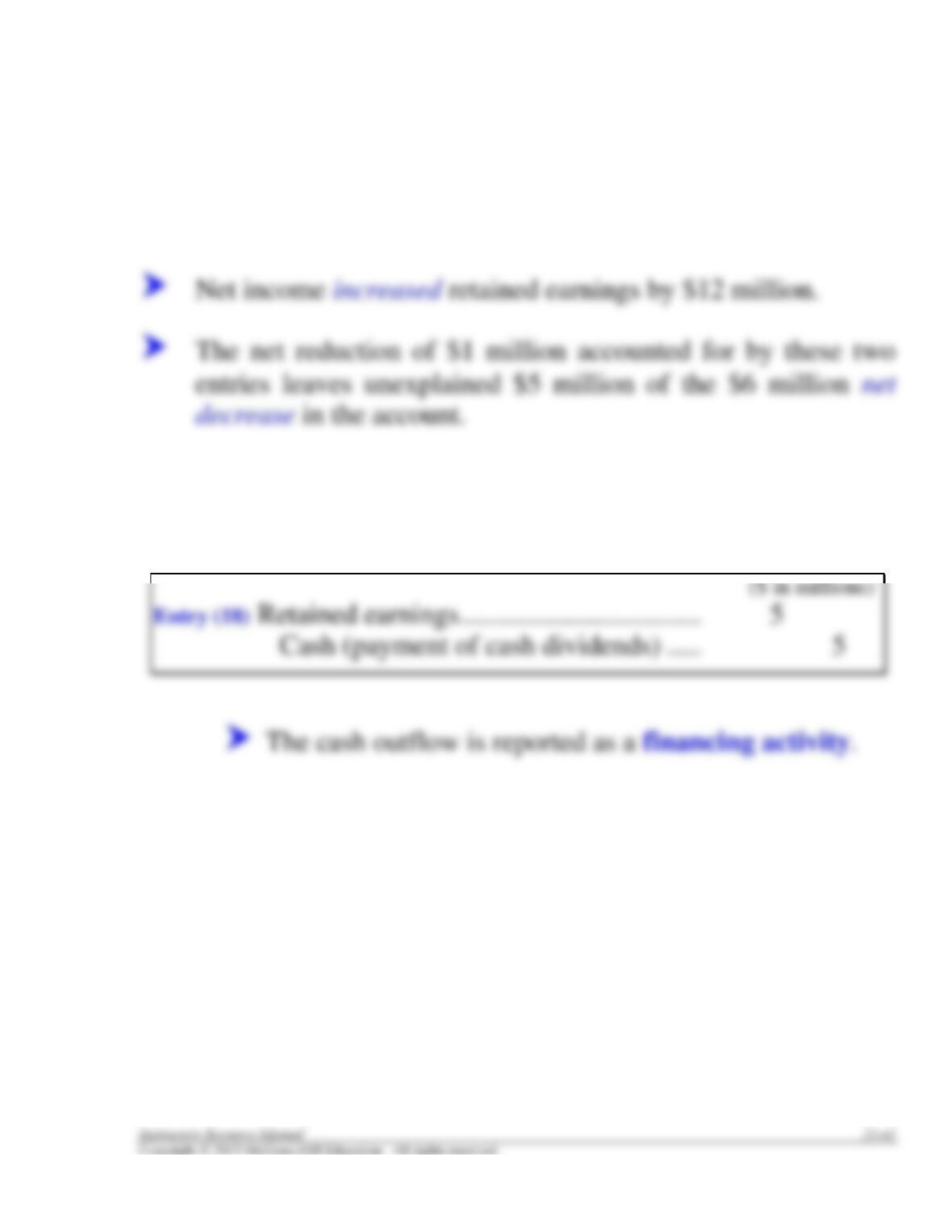
RETAINED EARNINGS
The stock dividend caused a $13 million reduction of retained
earnings.
The $5 million decrease was due to a $5 million cash
dividend. The summary entry is:
T21–30
21-42 Intermediate Accounting, 8/e
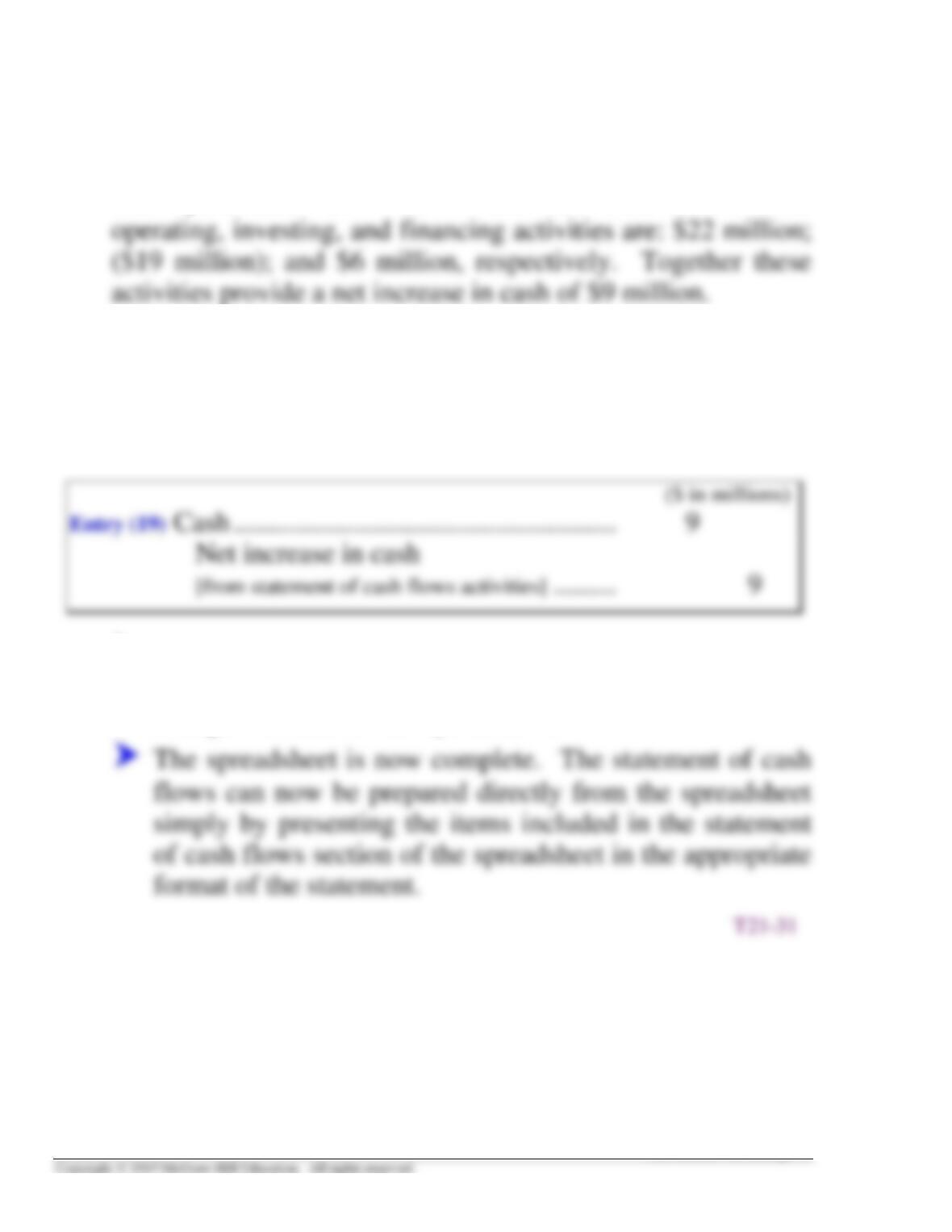
COMPLETING THE SPREADSHEET
The spreadsheet now shows that net cash flows from
This amount corresponds to the increase in the balance of the
cash account from $20 million to $29 million. To complete
the spreadsheet, we include the final summary entry:
As a final check of accuracy, we can confirm that the total
of the debits is equal to the total of the credits in the
changes columns of the spreadsheet.
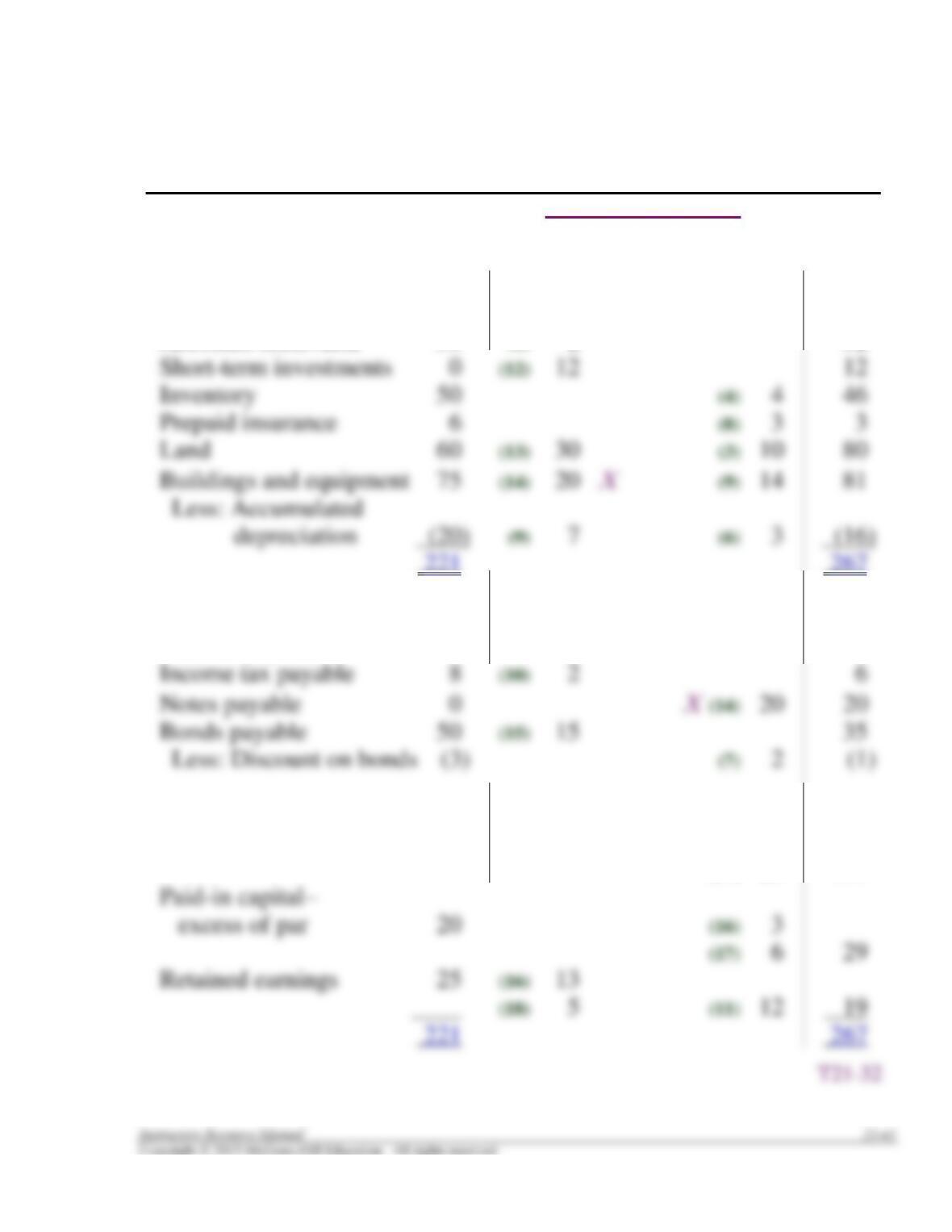
United Brands Corporation
Spreadsheet for the Statement of Cash Flows
Dec. 31 Changes Dec. 31
2015 Debits Credits 2016
Balance Sheet
Assets:
Cash 20 (19) 9 29
Accounts receivable 30 (1) 2 32
221 267
Liabilities:
Accounts payable 20 (4) 6 26
Salaries payable 1 (5) 2 3
Shareholders’ Equity:
Common stock 100 (16) 10
(17) 20 130
21-44 Intermediate Accounting, 8/e
(continued)
Dec. 31 Changes Dec. 31
2015 Debits Credits 2016
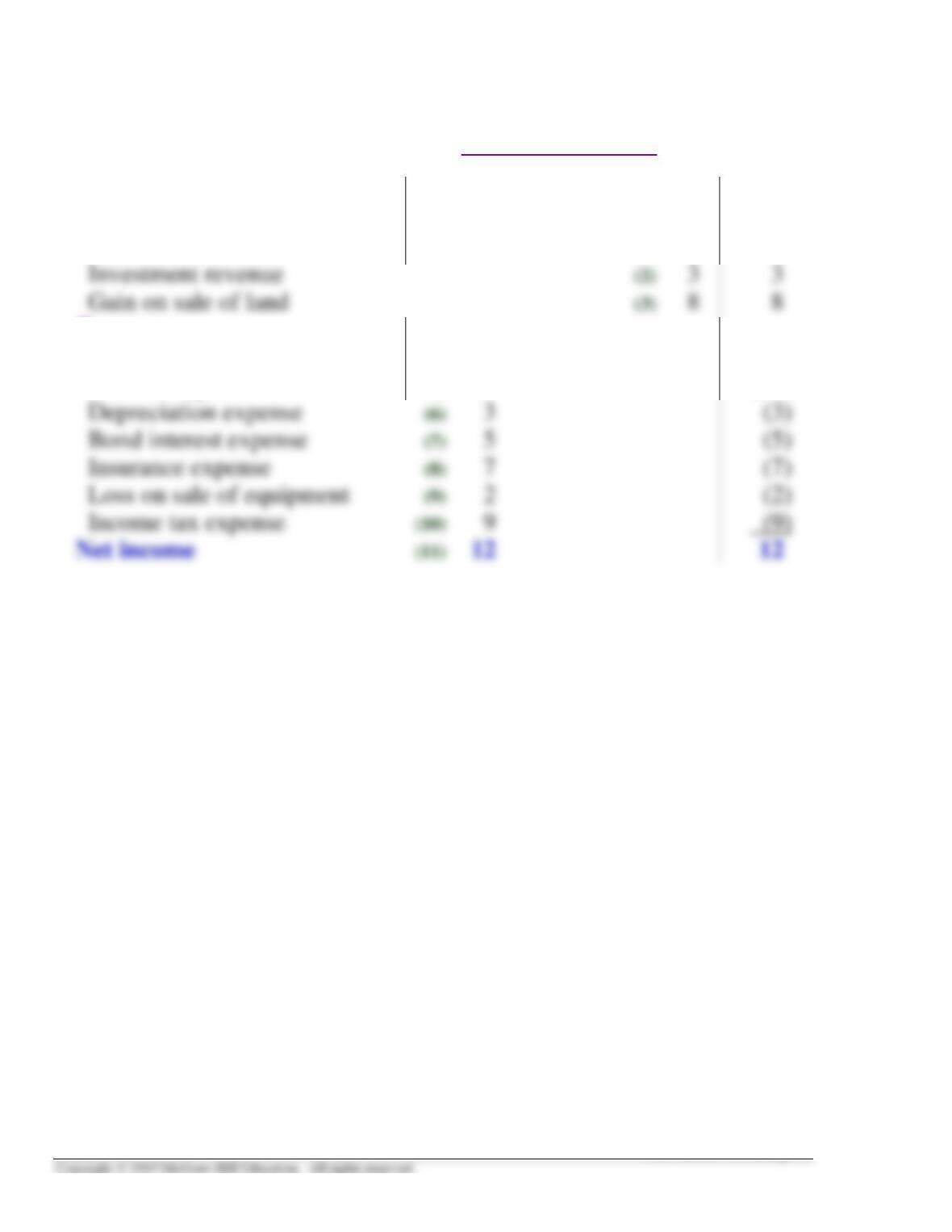
Income Statement
Revenues:
Sales revenue (1) 100 100
Expenses:
Cost of goods sold (4) 60 (60)
Salaries expense (5) 13 (13)
T21–32 (continued)
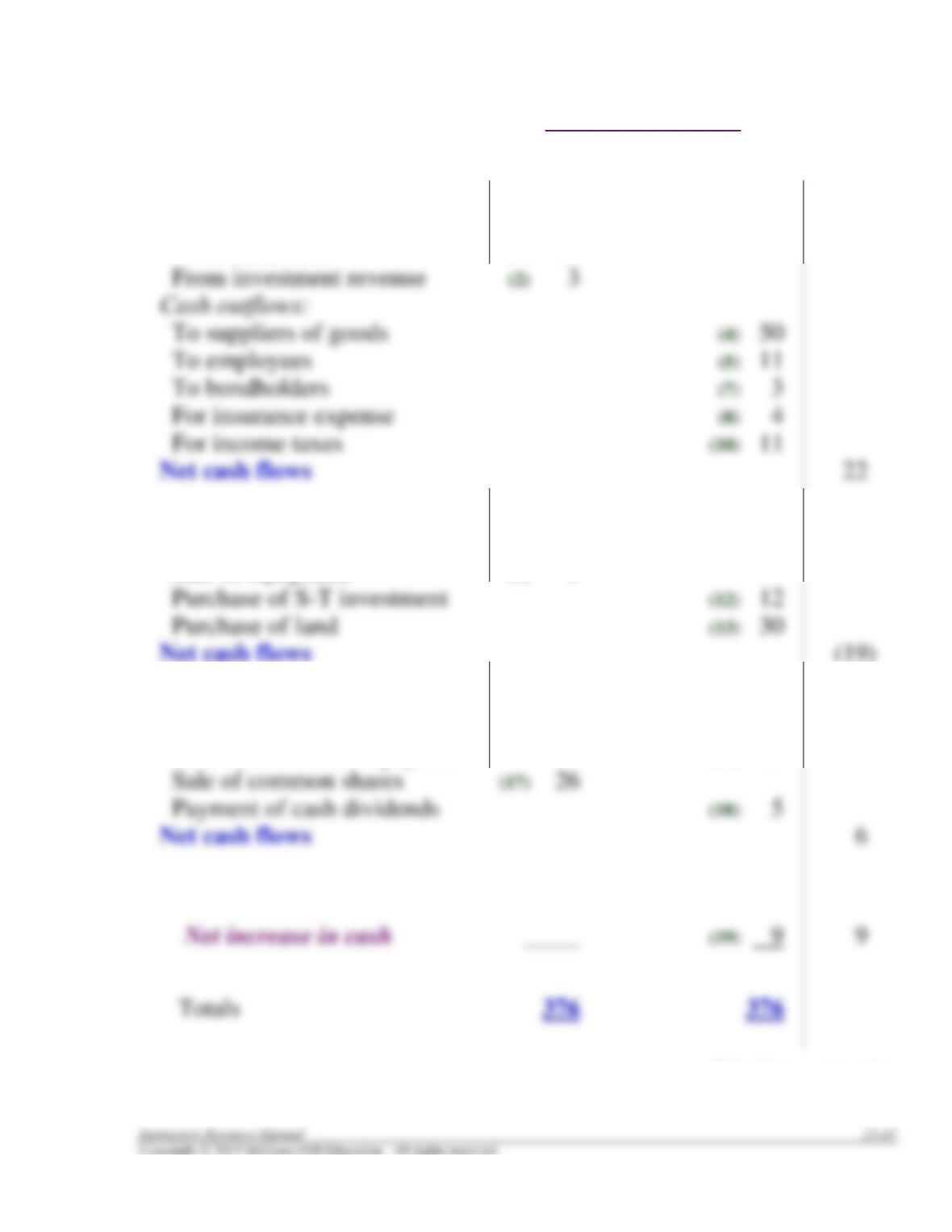
Dec. 31 Changes Dec. 31
2015 Debits Credits 2016
Statement of Cash Flows
Operating activities:
Cash inflows:
From customers (1) 98
Investing activities:
Sale of land (3) 18
Sale of equipment (9) 5
Financing activities:
Retirement of bonds payable (15) 15
T21–32 (continued)
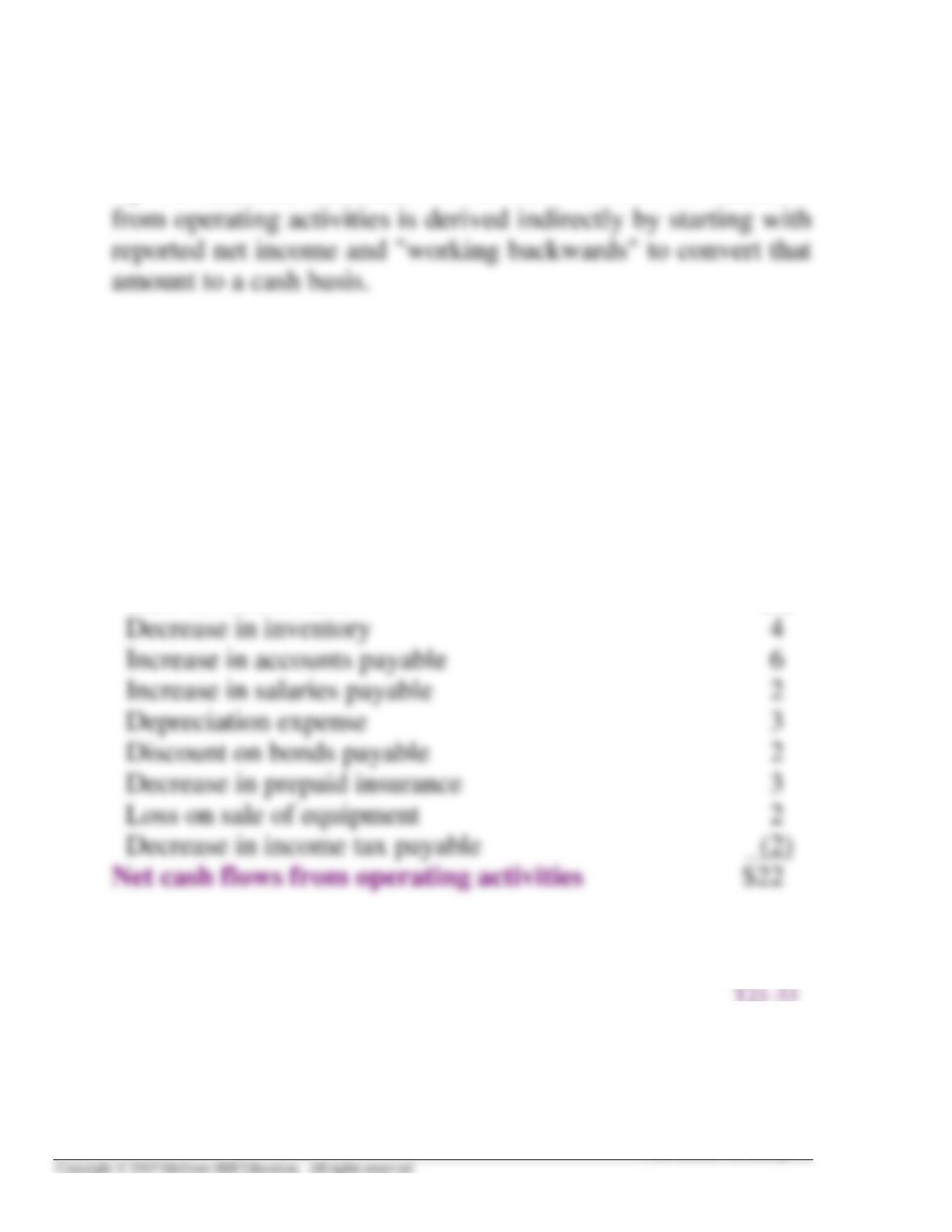
21-46 Intermediate Accounting, 8/e
INDIRECT METHOD
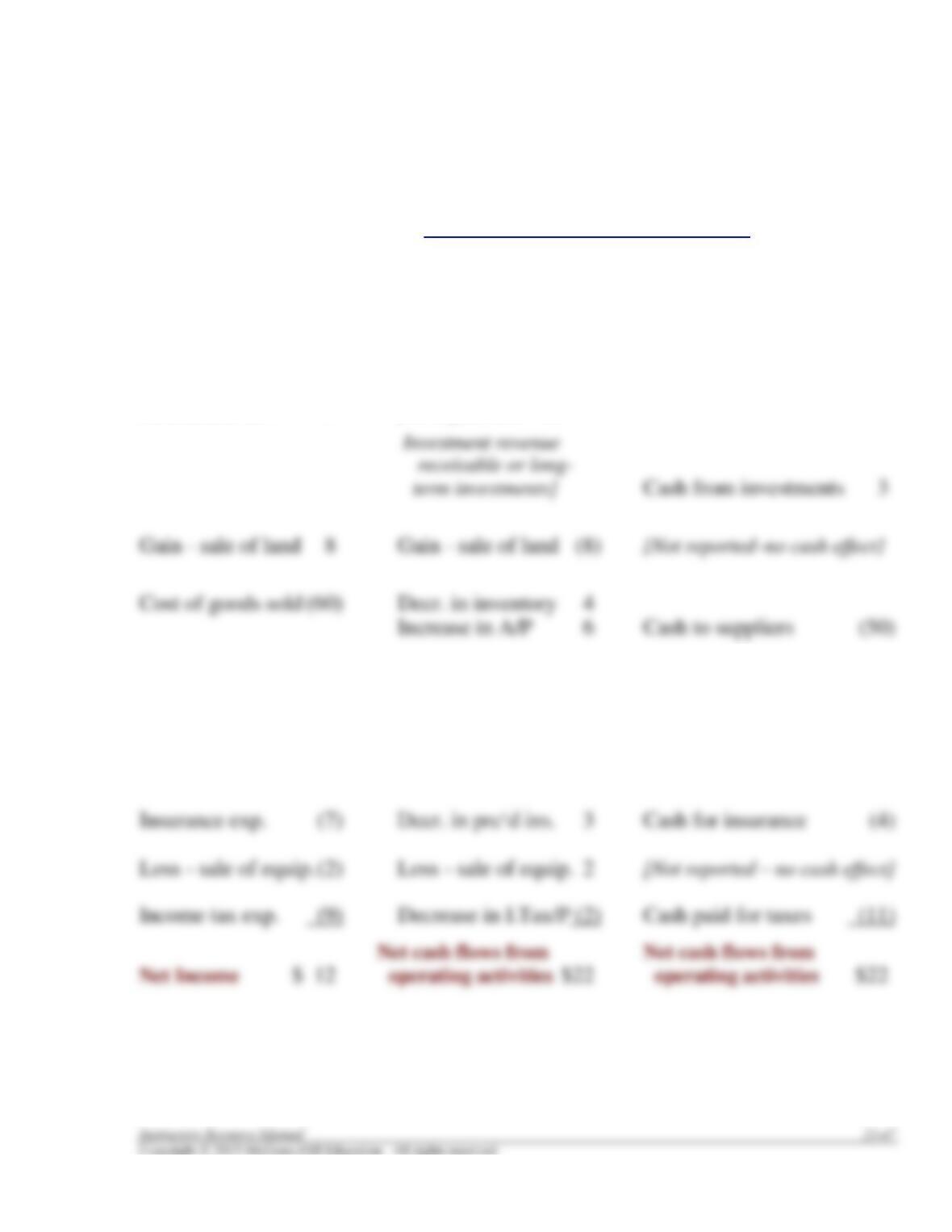
By the indirect method, the net cash increase or decrease
Cash Flows from Operating Activities – Indirect Method
and
Reconciliation of Net Income to
Net Cash Flows from Operating Activities
Net income $12
Adjustments for noncash effects:
Increase in accounts receivable (2)
Gain on sale of land (8)
COMPARISON OF DIRECT AND
INDIRECT METHODS
Cash Flows from Operating Activities
INCOME STATEMENT INDIRECT METHOD DIRECT METHOD
Net income $12
Adjustments :
Sales $100 Increase in A/R (2) Cash from customers $98
Investment rev. 3 [No adjustment – no
Salaries expense (13) Increase in sal. pay. 2 Cash to employees (11)
Depreciation exp. (3) Depreciation exp. 3 [Not reported – no cash effect]
Interest exp. (5) Decr. in bond disc. 2 Cash for interest (3)
T21–34
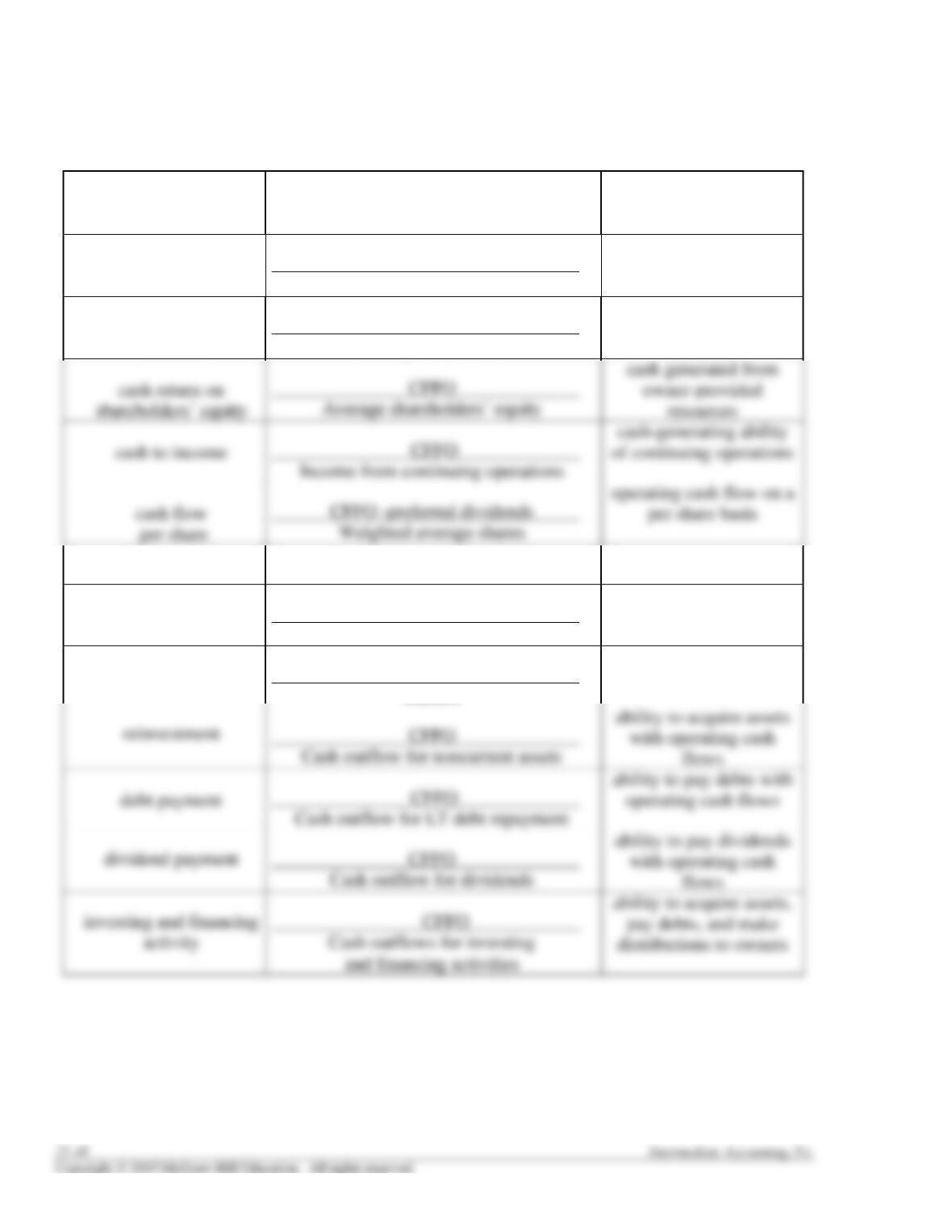
CASH FLOW RATIOS
RATIO
CALCULATION
MEASURES:
Performance Ratios
cash flow to sales
CFFO
Net sales
cash generated by each
sales dollar
cash return
on assets
CFFO
Average total assets
cash generated from all
resources
CFFO
Sufficiency Ratios
debt coverage
Total liabilities
CFFO
financial risk and
financial leverage
interest coverage
CFFO
CFFO
CFFO+interest+taxes
ability to satisfy its fixed
obligations
T21–35
S
Su
ug
gg
ge
es
st
ti
io
on
ns
s
f
fo
or
r
C
Cl
la
as
ss
s
A
Ac
ct
ti
iv
vi
it
ti
ie
es
s
1. Critical Thought Activity
Students often are lulled into believing that there is only one “right” way to report a transaction.
Accounting for cash flows provides and opportunity to consider supportable alternatives.
Suggestions:
Ask your students to consider the appropriate way to report cash payments for dividends in a
statement of cash flows.
Points to note:
GAAP designates cash outflows for interest payments and cash inflows from interest and dividends
received as operating cash flows. Dividends paid to shareholders are classified as financing cash
flows. Some feel it is inconsistent to classify the payment of cash dividends to shareholders as a
21-50 Intermediate Accounting, 8/e
2. Real World Scenario
Students learn in the text that footnote disclosure provides useful information related to the
statement of cash flows, often in the form of non-cash information. The following disclosure from
HP offers a fairly complete example of that type of disclosure.
HEWLETT PACKARD COMPANY
CONSOLIDATED STATEMENT OF CASH FLOWS (in part)
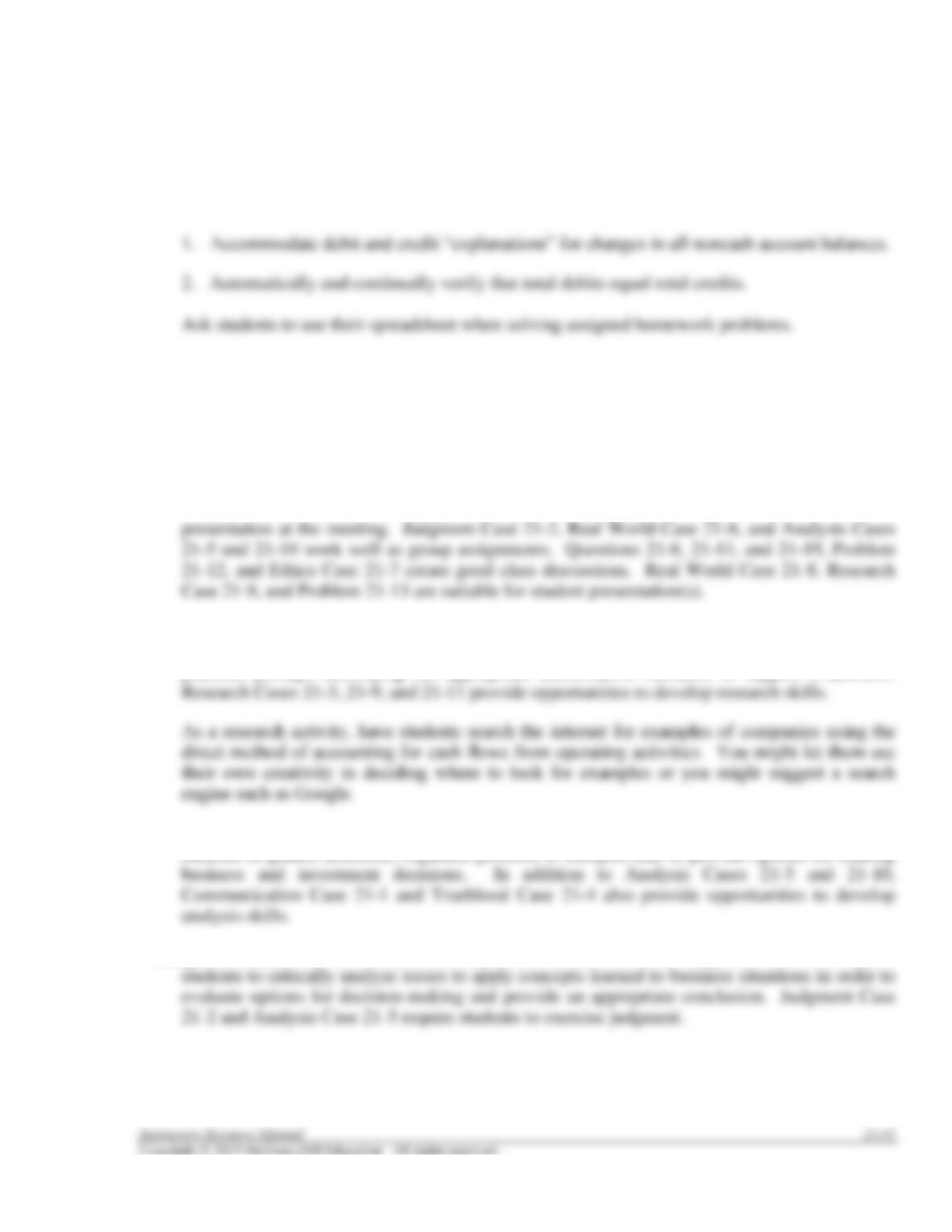
Note 5: Supplemental Cash Flow Information
Supplemental cash flow information to the Consolidated Statements of Cash Flows was as follows for the following
fiscal years ended October 31:
In millions
Suggestions:
Have your students find this information on the Internet or provide it to them. Would the
information about cash for interest and taxes be needed if HP reported operating activities by the
Points to note:
If HP reported operating activities by the direct method, the information about cash for interest
3. Spreadsheet Activity
Have students create a functional spreadsheet in Excel or some other spreadsheet program capable of
being used to help prepare a statement of cash flows. Suggest that the spreadsheet:
4. Professional Skills Development Activities
The following are suggested assignments from the end-of-chapter material that will help your
students develop their communication, research, analysis, and judgment skills.
Communication Skills. In addition to Communication Case 21-1, Judgment Case 21-2 can be
adapted to ask students to prepare a report outlining the findings of the research for
Research Skills. In their professional lives, our graduates will be required to locate and extract
relevant information from available resource material to determine the correct accounting
practice, perhaps identifying the appropriate authoritative literature to support a decision.
Analysis Skills. The “Broaden Your Perspective” section includes Analysis Cases that direct
Judgment Skills. The “Broaden Your Perspective” section includes Judgment Cases that require
21-52 Intermediate Accounting, 8/e
5. Ethical Dilemma
The chapter includes the following ethical dilemma.
ETHICAL DILEMMA
“We must get it,” Courtney Lowell, president of Industrial Fasteners, roared. “Without it
we’re in big trouble.” The “it” Mr. Lowell referred to is the renewal of a $14 million loan with
Community First Bank. The “big trouble” he fears is the lack of funds necessary to repay the
You may wish to discuss this in class. If so, discussion should include these elements.
Step 1 – The Facts:
Industrial Fasteners needs the renewal of a $14 million loan with Community First Bank.
Prospects for currently repaying the debt are poor. The bank has required an improved statement of
Step 2 – The Ethical Issue and the Stakeholders:
The ethical issue or dilemma is whether the assistant controller’s obligation to the president and
Step 3 – Values:
Values include competence, honesty, integrity, objectivity, loyalty to the company, and
Step 4 – Alternatives:
1. Follow the suggestion of the president to factor the accounts receivable.
Step 5 – Evaluation of Alternatives in Terms of Values:
1. Alternative 1 illustrates loyalty to the President and the company.
2. Alternative 2 exhibits the values of competence, honesty, integrity, objectivity, and
Step 6 – Consequences:
Alternative 1
Positive consequences: The assistant controller keeps the job and pleases the president. The
company will obtain the renewal and may avoid loan payment default and possible bankruptcy.
Alternative 2
Positive consequences: The bank receives a cash flow statement that is more relevant and
reliable regarding the cash position of the company. The company may be able to collect more
Alternative 3
Positive consequences: The assistant controller would maintain integrity. The bank receives
21-54 Intermediate Accounting, 8/e
Alternative 4
Positive consequences: The assistant controller maintains integrity and avoids conflict with
management, the board and the audit committee.
Step 7 – Decision:
Student(s) must decide their course of action.
A
As
ss
si
ig
gn
nm
me
en
nt
t
C
Ch
ha
ar
rt
t
Learning Est. time
Questions Objective(s) Topic (min.)
21-1
1, 2
Need for financial statement that reports cash
flows
5
21-2
3
Evolution of statement of cash flows
5
21-3
4
Cash equivalent
5
21-4
4
Cash equivalent
5
21-5
5
Cash flows from operating activities
5
21-6
5
Cash flows from operating activities
5
21-7
5
Cash flows from investing activities
5
21-8
5
Cash flows from financing activities
5
21-9
6
Noncash investing and financing activities
5
21-10
6
Transaction partly in cash
5
Most noteworthy item on a statement of cash
flows
5
21-12
7
Spreadsheet
5
21-13
7
Cash received from customers
5
21-14
7
When an asset is sold at a gain
5
21-15
7
Ordinary losses and extraordinary losses
5
21-16
7
Increase in the deferred income tax liability
5
21-17
8
Indirect method
5
8
Direct method
5
8
Indirect method
5
8
Indirect method
5
9
IFRS
5
9
IFRS
5
Brief Learning Est. time
Exercises Objective(s) Topic (min.)
21-1
3
Determine cash received from customers
5
21-2
3
Determine cash received from customers
5
21-3
3
Determine cash paid to suppliers
5
21-4
3
Determine cash paid to employees
5
21-5
Bond interest and discount
5
21-6
Bond interest and discount
5
21-7
Installment note
5
21-8
Sale of land
5
21-9
5
Investing activities
5
21-10
6
Financing activities
5
21-11
4
Indirect method
5
21-12
4
Indirect method
5
Learning Est. time
Exercises Objective(s) Topic (min.)
21-1
3-6
Classification of cash flows
20
21-2
3, 8
Determine cash paid to suppliers of merchandise
15
21-3
3
Determine cash received from customers
20
21-4
3
Summary entries for cash received from
customers
20
21-5
3
Determine cash paid to suppliers of merchandise
25
25
21-7
3
Determine cash paid for bond interest
20
21-9
3
Determine cash paid for income taxes
25
21-10
3
Summary entries for cash paid for income taxes
25
21-11
3
Bonds; statement of cash flows effects
20
21-12
3, 6
Installment note; statement of cash flows effects
20
and financing activities
20
5, 6
Identifying cash flows from investing activities
and financing activities
20
21-15
3, 5, 6
Lease; statement of cash flows effects
20
21-16
3, 5
Equity method investment; statement of cash
flows effects
20
21-17
4
Indirect method; reconciliation of net income to
net cash flows from operating activities
15
21-18
3 – 8
Summary entries from statement of retained
earnings
20
21-19
3, 4
Relationship among the income statement, cash
flows from operating activities (direct method),
and cash flows from operating activities
(indirect method)
30
30
21-21
3, 4
Cash flows from operating activities (direct
21-22
4
Indirect method; reconciliation of net income to
net cash flows from operating
15
method) – includes loss on sale of cash
equivalents and extraordinary loss
30
21-25
3
Cash flows from operating activities (direct
method) – includes loss on sale of cash
equivalents and extraordinary gain
30
21-26
4
Statement of cash flows; indirect method [based
on appendix 21-A]
45
Cash flows from operating activities (indirect
21-58 Intermediate Accounting, 8/e
CPA/CMA Learning Est. time
Exam Questions Objective(s) Topic (min.)
CPA-1
3
Operating activities
3
CPA-2
6
Financing activities
3
CPA-3
4
Operating activities
3
CPA-4
3
Operating activities
3
CPA-5
5
Investing activities
3
CPA-7
3
IFRS
3
CPA-8
5
IFRS
3
CPA-9
4
IFRS
3
3
Operating activities
3
Investing and financing activities
3
4
Operating activities
3
Learning Est. time
Problems Objective(s) Topic (min.)
21-1
2 , 5-7
Classifications of cash flows from investing
and financing activities
25
21-2
3, 8
Statement of cash flows; direct method
60
21-3
3, 8
Statement of cash flows; direct method
75
21-4
3, 8
Statement of cash flows; direct method
75
(indirect method)
21-7
3, 4
Cash flows from operating activities (direct
method) derived from an income statement
and cash flows from operating activities
(indirect method)
40
21-8
3, 4
Cash flows from operating activities (direct
method and indirect method) – deferred
income tax liability and amortization of
bond discount
45
21-9
3, 4
Cash flows from operating activities (direct
method) and indirect method) – gain on sale
of cash equivalents and extraordinary loss
45
cash flows from operating activities (direct
method), and cash flows from operating
activities (indirect method)
Transactions affecting retained earnings
20
Various cash flows
25
21-14
4, 8
Statement of cash flows; indirect method;
limited information
40
21-15
3, 5, 6
Integrating problem; bonds; lease
transactions; lessee and lessor; statement of
cash flow effects
40
4, 8
Statement of cash flows; indirect method
60
4, 8
Statement of cash flows; indirect method
60
3, 8
Statement of cash flows; T-account method
60
Star Problems
21-60 Intermediate Accounting, 8/e
Learning Est. time
Cases Objective(s) Topic (min.)
Communication Case 21-1
1, 3, 4
Distinguish income and cash flows
45
Judgment Case 21-2
3, 8
Distinguish income and cash flows
30
Research Case 21-3
3 – 8
Information from cash flow activities;
codification; FedEx
25
flows
40
income taxes
20
Real World Case 21-6
Analyze cash flow activities; Staples
40
Ethics Case 21-7
1, 3
25
Real World Case 21-8
Cash flow different from earnings; PetSmart,
Inc.
Research Case 21-9
3 – 8
Researching the way cash flows are reported;
retrieving information from the Internet
50
Analysis Case 21-10
3 – 8
Information from cash flow activities; PetSmart,
Inc.
25
information and cite authoritative support for a
financial reporting issue; cash flow classification
25
Air France/KLM Case
9
IFRS; statement of cash flows; Air
France/KLM
30