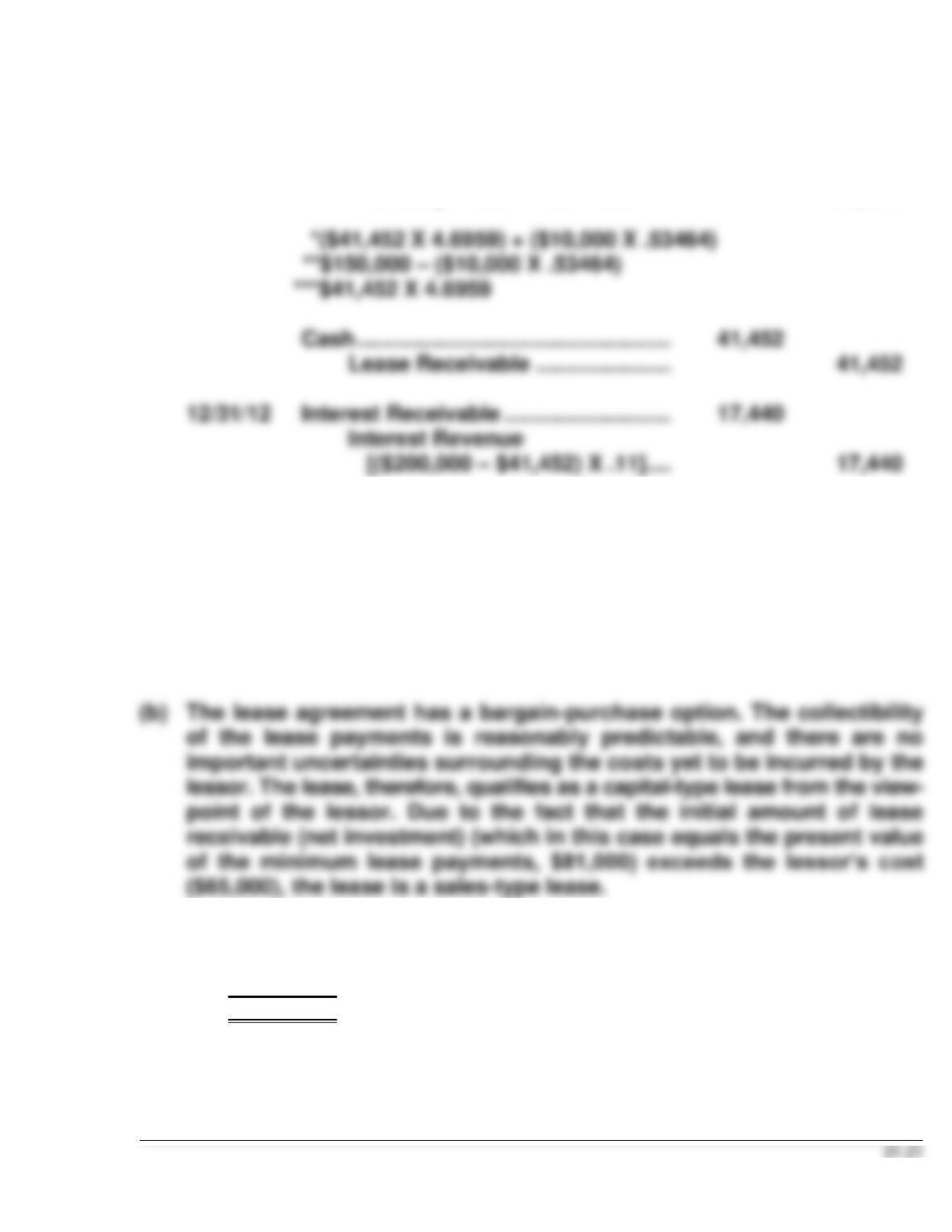
EXERCISE 21-7 (Continued)
(d) 1/1/12 Lease Receivable ……………………….. 200,000*
Cost of Goods Sold…………………….. 144,654**
Sales Revenue …………………….. 194,654***
Inventory …………………………….. 150,000
EXERCISE 21-8 (20–30 minutes)
(a) The lease agreement has a bargain-purchase option and thus meets
the criteria to be classified as a capital lease from the viewpoint of the
lessee. Also, the present value of the minimum lease payments exceeds
90% of the fair value of the assets.
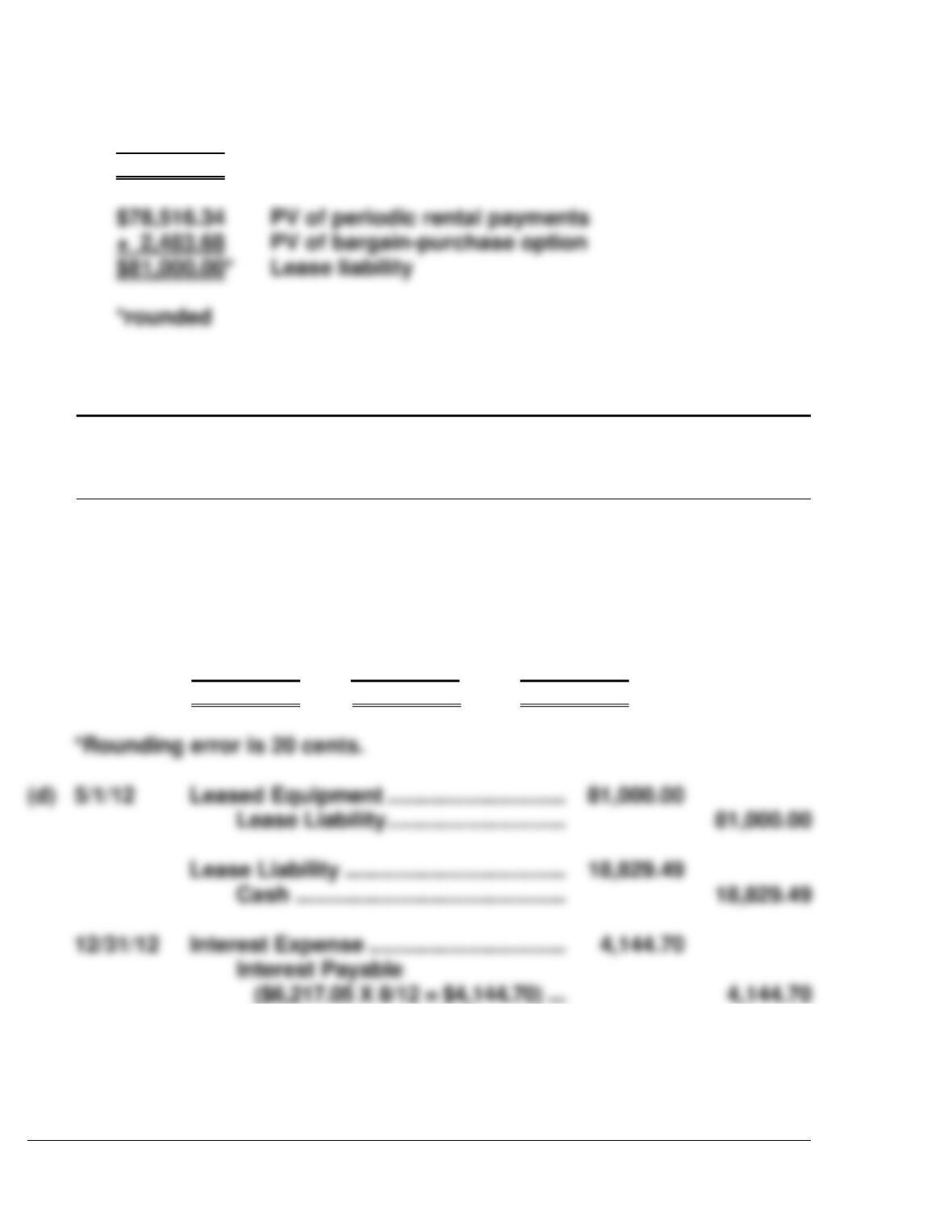
(c) Computation of lease liability:
$18,829.49 Annual rental payment
X 4.16986 PV of annuity due of 1 for n = 5, i = 10%
$78,516.34 PV of periodic rental payments
21–22
EXERCISE 21-8 (Continued)
$ 4,000.00 Bargain-purchase option
X .62092 PV of 1 for n = 5, i = 10%
$ 2,483.68 PV of bargain purchase option
GILL COMPANY (Lessee)
Lease Amortization Schedule
Date
Annual Lease
Payment Plus
BPO
Interest
(10%) on
Liability
Reduction
of Lease
Liability
Lease
Liability
5/1/12
$81,000.00
5/1/12
$18,829.49
$18,829.49
62,170.51
5/1/13
18,829.49
*$ 6,217.05
12,612.44
49,558.07
5/1/14
18,829.49
4,955.81
13,873.68
35,684.39
5/1/15
18,829.49
3,568.44
15,261.05
20,423.34
5/1/16
18,829.49
2,042.33
16,787.16
3,636.18
4/30/17
4,000.00
* 363.82*
3,636.18
0
$98,147.45
$17,147.45
$81,000.00
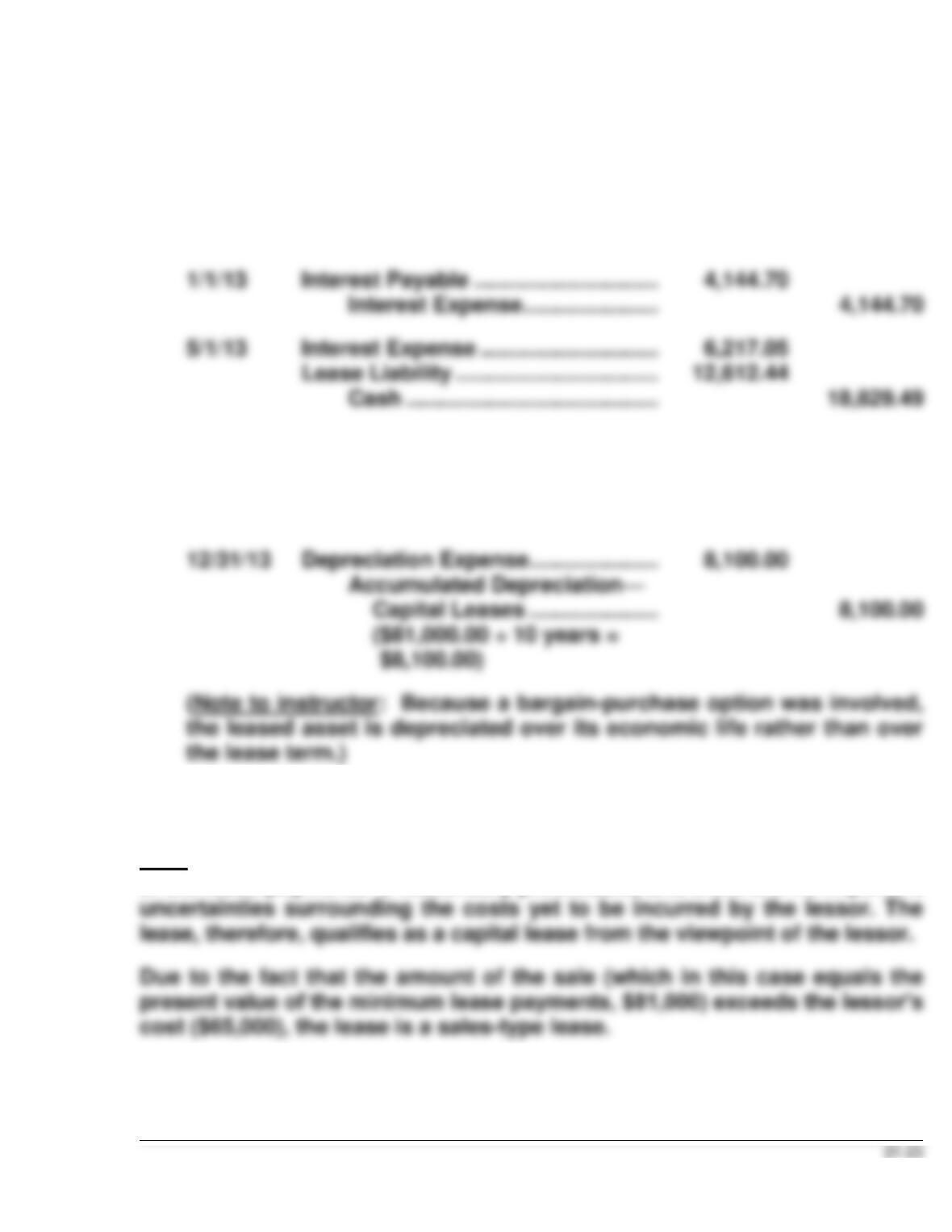
EXERCISE 21-8 (Continued)
Depreciation Expense ………………… 5,400
Accumulated Depreciation—
Capital Leases ………………… 5,400
($81,000.00 ÷ 10 =
($8,100.00; $8,100.00 X
(8/12 = $5,400)
12/31/13 Interest Expense ……………………….. 3,303.87
Interest Payable ………………….. 3,303.87
($4,955.81 X 8/12 =
($3,303.87)
EXERCISE 21-9 (20–30 minutes)
Note: The lease agreement has a bargain–purchase option. The collectibility
of the lease payments is reasonably predictable, and there are no important
21–24
EXERCISE 21-9 (Continued)
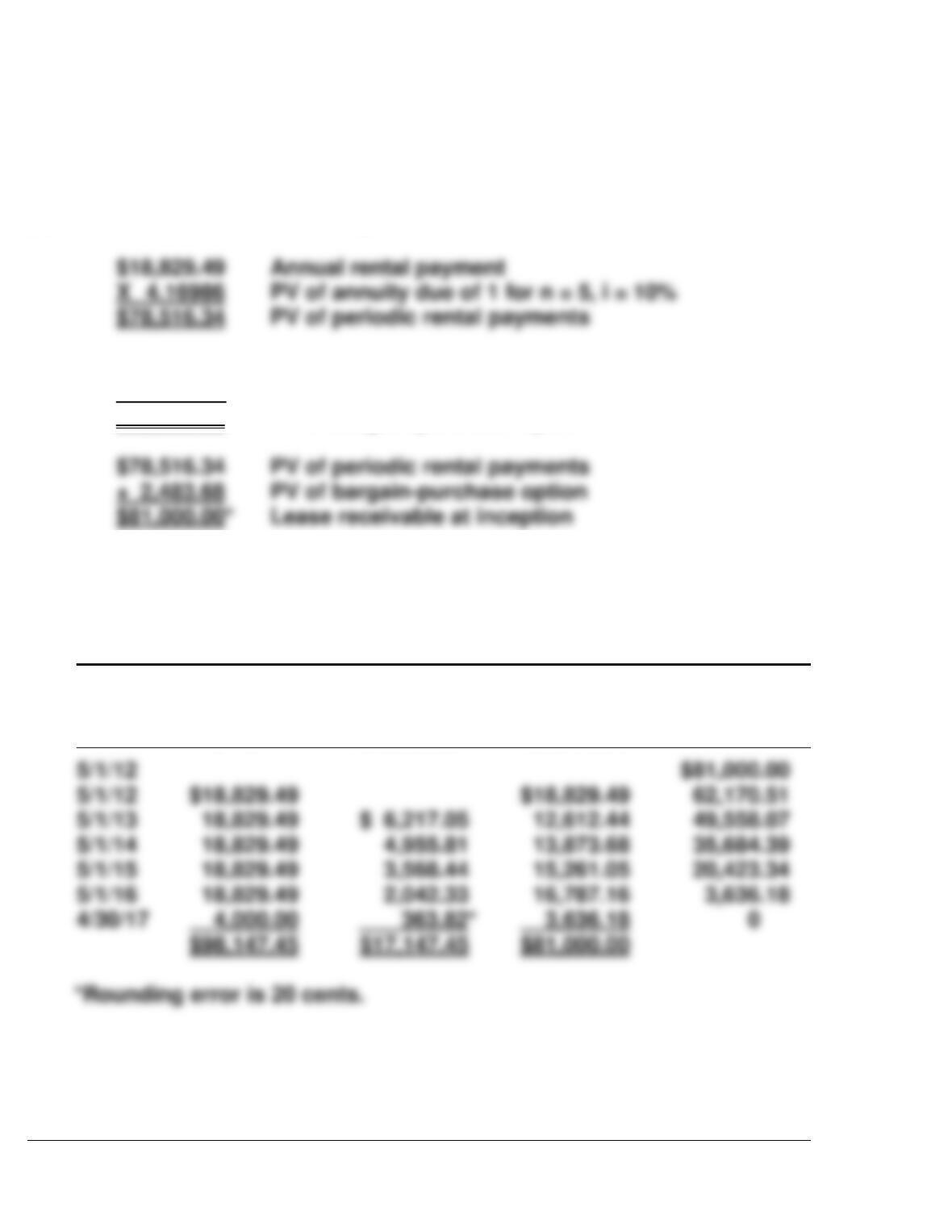
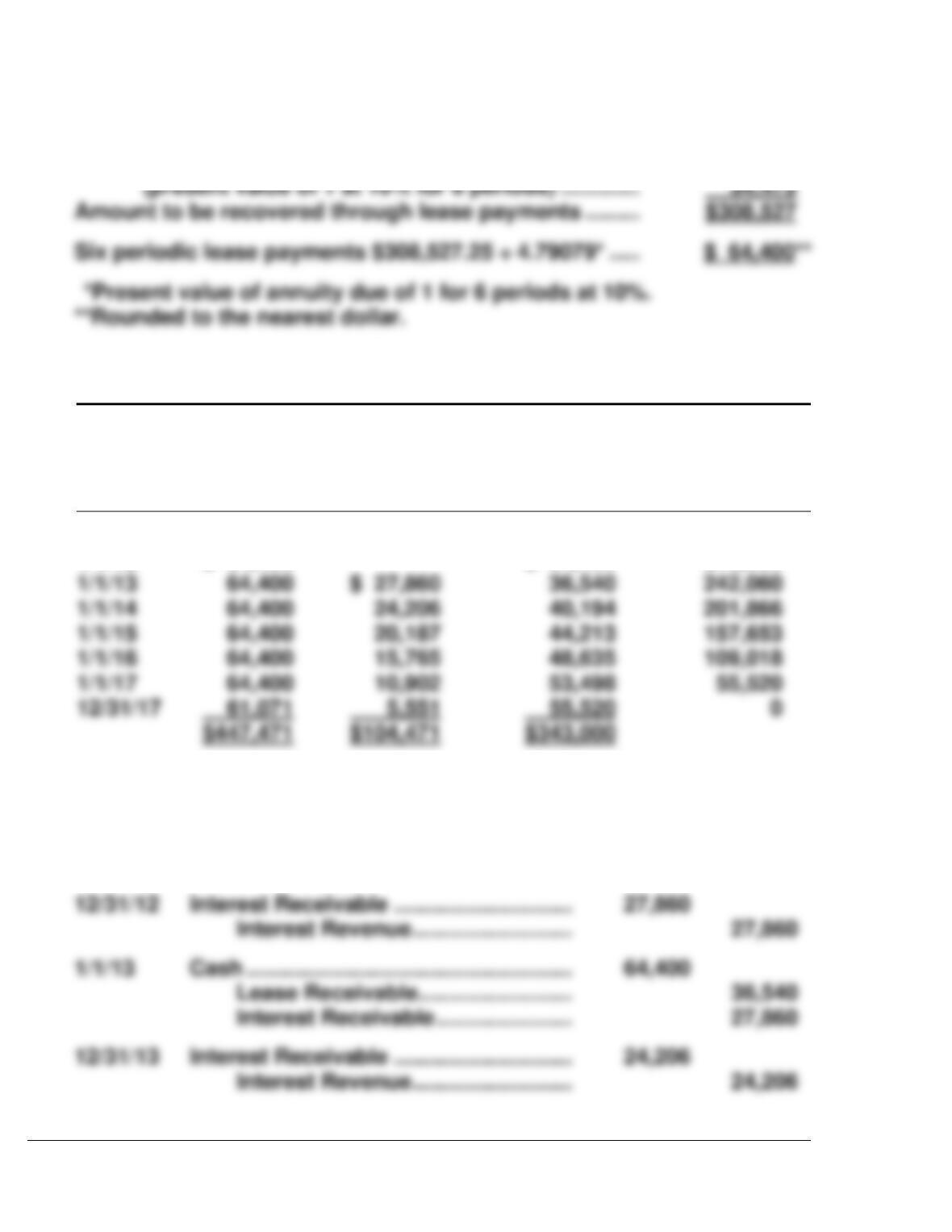
The minimum lease payments associated with this lease are the periodic
annual rents plus the bargain-purchase option. There is no residual value
relevant to the lessor’s accounting in this lease.
(a) The lease receivable is computed as follows:
$ 4,000.00 Bargain purchase option
X .62092 PV of 1 for n = 5, i = 10%
$ 2,483.68 PV of bargain-purchase option
*Rounded
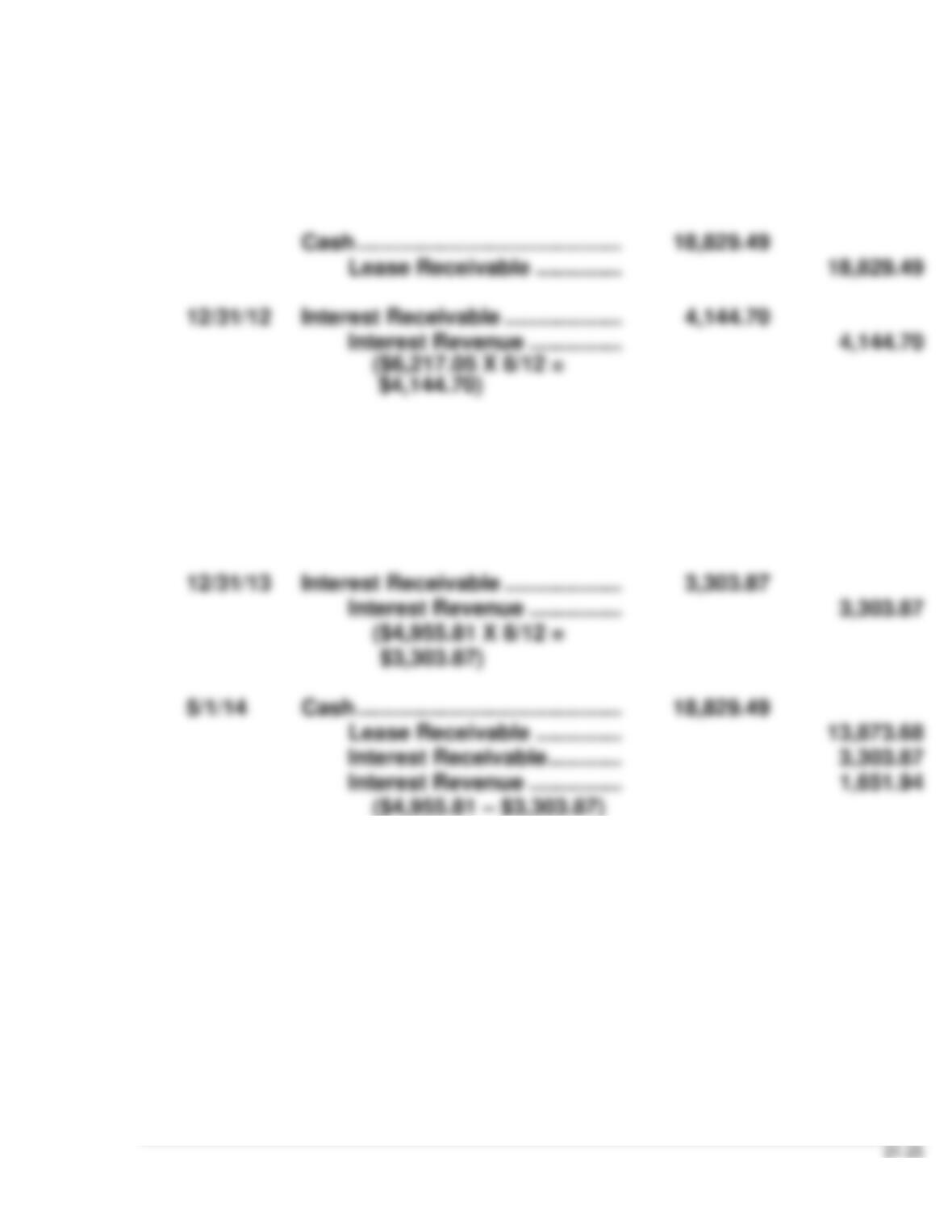
(b) LENNOX LEASING COMPANY (Lessor)
Lease Amortization Schedule
Date
Annual Lease
Payment Plus
BPO
Interest (10%)
on Lease
Receivable
Recovery
of Lease
Receivable
Lease
Receivable
EXERCISE 21-9 (Continued)
(c) 5/1/12 Lease Receivable …………………. 81,000.00
Cost of Goods Sold………………. 65,000.00
Sales Revenue ………………. 81,000.00
Inventory ………………………. 65,000.00
5/1/13 Cash ……………………………………. 18,829.49
Lease Receivable ………….. 12,612.44
Interest Receivable ………… 4,144.70
Interest Revenue …………… 2,072.35
($6,217.05 – $4,144.70)
12/31/14 Interest Receivable ………………. 2,378.96
Interest Revenue …………… 2,378.96
($3,568.44 X 8/12 =
($2,378.96)
21–26
EXERCISE 21-10 (15–25 minutes)
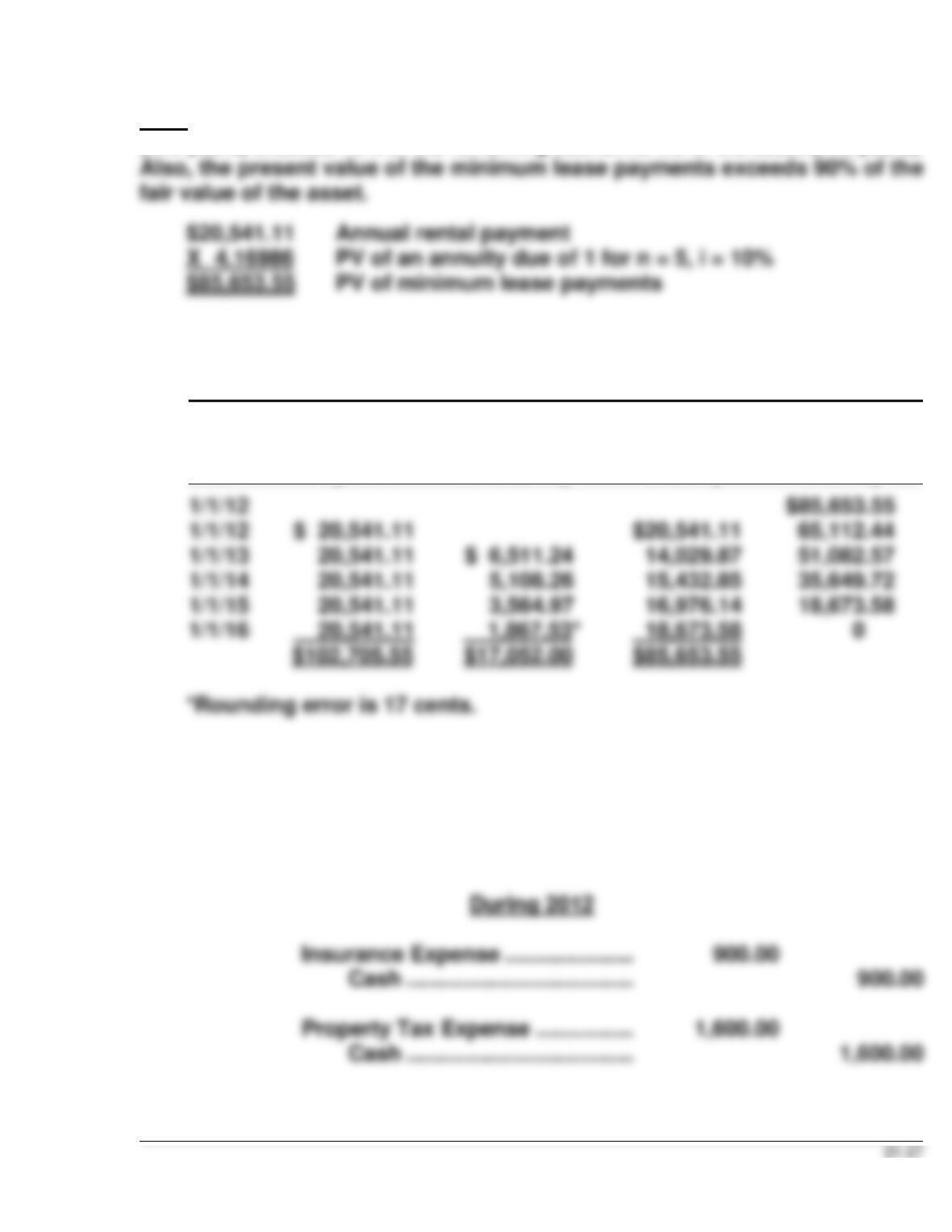
(a) Fair value of leased asset to lessor …………………………... $343,000
Less: Present value of unguaranteed
residual value $61,071 X .56447
(b) FIEVAL LEASING COMPANY (Lessor)
Lease Amortization Schedule
Date
Annual
Lease
Payment
Plus URV
Interest (10%)
on Lease
Receivable
Recovery
of Lease
Receivable
Lease
Receivable
1/1/12
$343,000
1/1/12
$ 64,400
$ 64,400
278,600
1/1/13
1/1/14
201,866
1/1/15
1/1/16
1/1/17
12/31/17
61,071
5,551
55,520
(c) 1/1/12 Lease Receivable ………………………….. 343,000
Equipment ……………………………… 343,000
1/1/12 Cash …………………………………………….. 64,400
Lease Receivable ……………………. 64,400
EXERCISE 21-11 (20–30 minutes)
Note: This lease is a capital lease to the lessee because the lease term
(five years) exceeds 75% of the remaining economic life of the asset (five years).
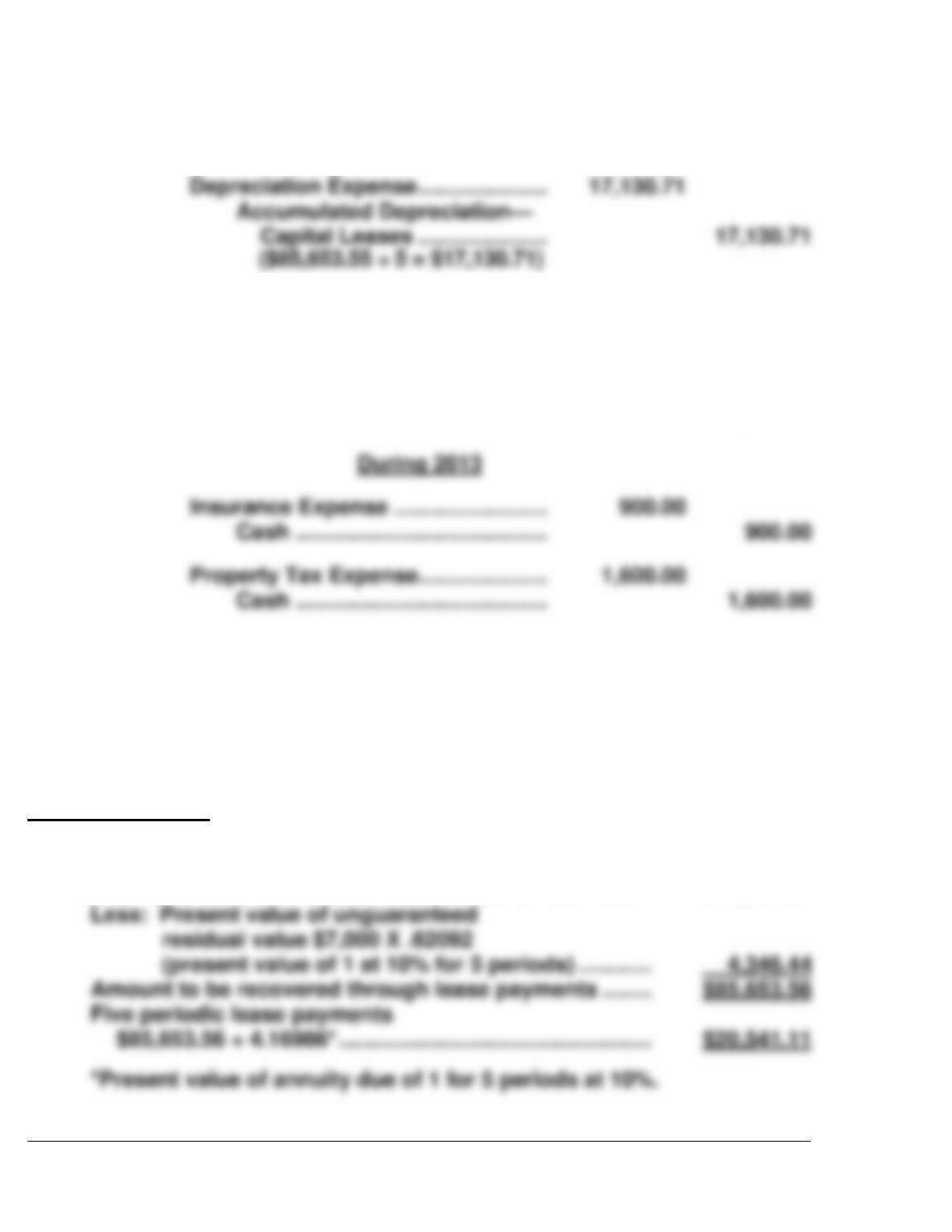
(a) AZURE COMPANY (Lessee)
Lease Amortization Schedule
Date
Annual Lease
Payment
Interest (10%)
on Liability
Reduction
of Lease
Liability
Lease
Liability
1/1/12
1/1/13
1/1/16
(b) 1/1/12 Leased Equipment …………………. 85,653.55
Lease Liability …………………. 85,653.55
1/1/12 Lease Liability ……………………….. 20,541.11
Cash ………………………………. 20,541.11
21–28
EXERCISE 21-11 (Continued)
12/31/12 Interest Expense ……………………….. 6,511.24
Interest Payable ………………….. 6,511.24
1/1/13 Interest Payable …………………………. 6,511.24
Interest Expense …………………. 6,511.24
Interest Expense ……………………….. 6,511.24
Lease Liability …………………………... 14,029.87
Cash ………………………………….. 20,541.11
12/31/13 Interest Expense ……………………….. 5,108.26
Interest Payable ………………….. 5,108.26
Depreciation Expense ………………… 17,130.71
Accumulated Depreciation—
Capital Leases ………………… 17,130.71
Note to instructor:
1. The lessor sets the annual rental payment as follows:
Fair value of leased asset to lessor ………………………….. $90,000.00
EXERCISE 21-11 (Continued)
2. The unguaranteed residual value is not subtracted when depreciating
the leased asset.
EXERCISE 21-12 (10–20 minutes)
(a) Entries for Secada are as follows:
1/1/12 Buildings …………………………………… 3,600,000
Cash …………………………………… 3,600,000
(b) Entries for Ryker are as follows:
12/31/12 Rent Expense …………………………….. 220,000
Cash …………………………………… 220,000
EXERCISE 21-13 (15–20 minutes)
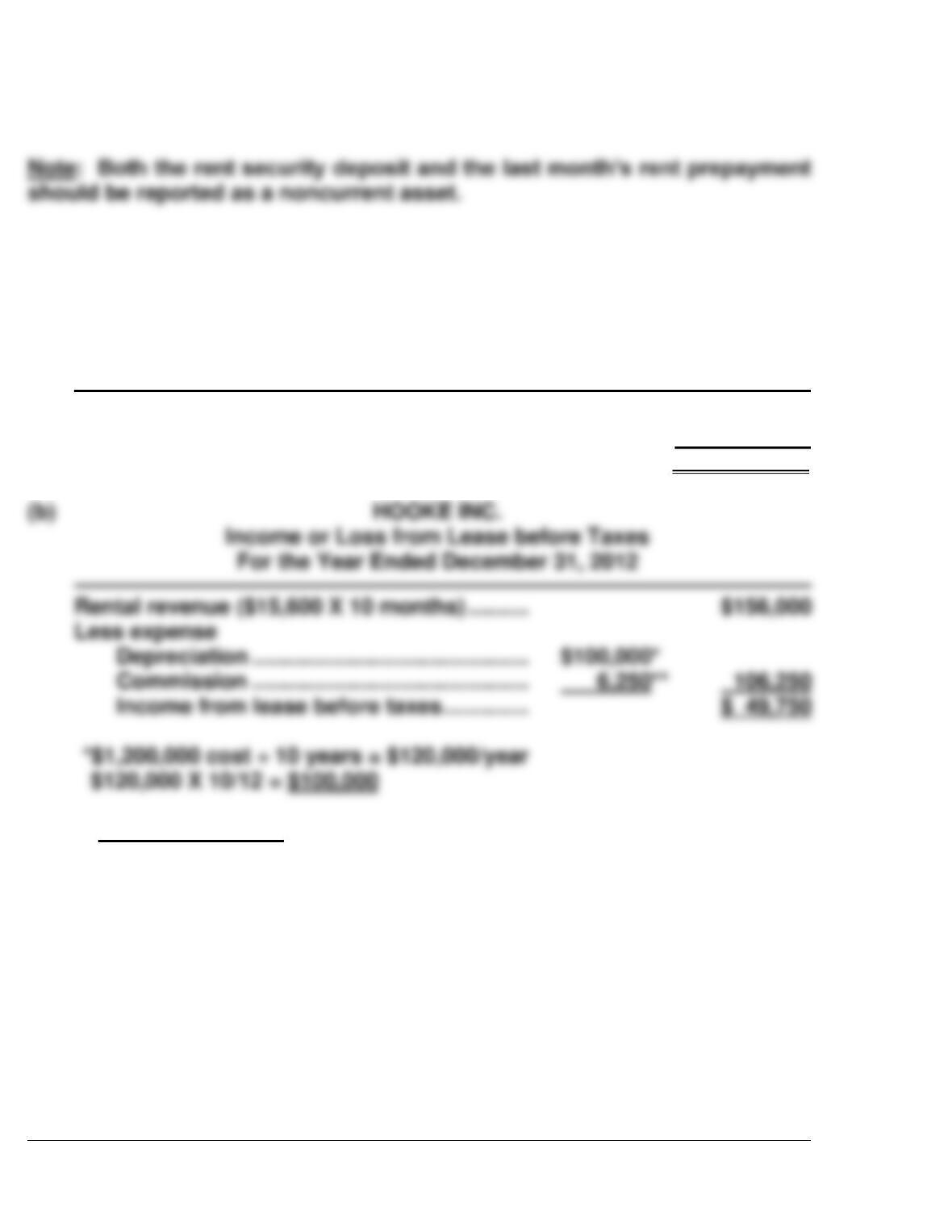
(a) Annual rental revenue ……………………………………………….. $180,000
21–30
EXERCISE 21-13 (Continued)
(b) Rent expense ……………………………………………………………. $180,000
EXERCISE 21-14 (15–20 minutes)
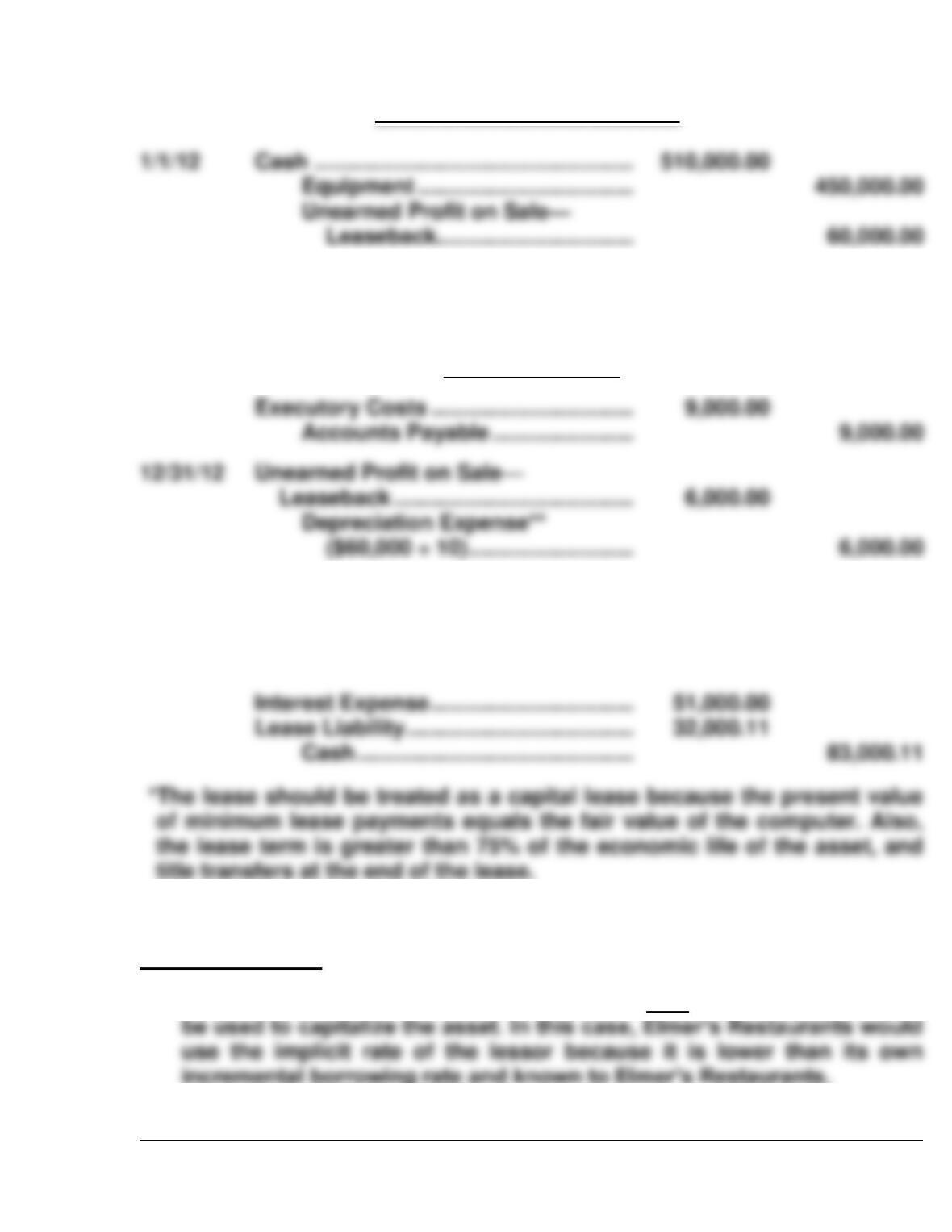
(a) SAGE COMPANY
Rent Expense
For the Year Ended December 31, 2012
Monthly rental …………………………………………………………… $ 15,600
Lease period in 2013 (March–December) …………………….. X 10 months
$ 156,000
**(Note to instructor: Under principles of accrual accounting, the com–
mission should be amortized over the life of the lease: $30,000 ÷
4 years = $7,500 X 10/12 = $6,250.)
21–31
*EXERCISE 21-15 (20–30 minutes)
Elmer’s Restaurants (Lessee)*
Leased Equipment ………………………… 510,000.00
Lease Liability
($83,000.11 X 6.14457) ………… 510,000.00
Throughout 2013
12/31/12 Depreciation Expense …………………… 51,000.00
Accumulated Depreciation—
Capital Leases
($510,000 ÷ 10) ……………………. 51,000.00
**The credit could also be to a revenue account.
Note to instructor:
1. The present value of an ordinary annuity at 10% for 10 periods should
21–32
*EXERCISE 21-15 (Continued)
2. The unearned profit on the sale-leaseback should be amortized on the
same basis that the asset is being depreciated.
Partial Lease Amortization Schedule
Date
Annual
Lease
Payment
Interest (10%)
Amortization
Balance
Lease Receivable ………………… 510,000.00
Equipment ……………………. 510,000.00
*Lease should be treated as a direct-financing lease because the present
value of the minimum lease payments equals the fair value of the
computer, and (1) collectibility of the payments is reasonably assured,
(2) no important uncertainties surround the costs yet to be incurred by
the lessor, and (3) the cost to the lessor equals the fair value of the
asset at the inception of the lease.
*EXERCISE 21-16 (20–30 minutes)
*EXERCISE 21-16 (Continued)
(b) A sale-leaseback is usually treated as a single financing transaction
in which any profit on the sale is deferred and amortized by the seller.
However, when either (1) only a minor part of the remaining use of the
(c) The profit on the sale of $99,000 should be deferred and amortized
over the lease term. Since the leased asset is being depreciated using
the sum-of-the-years’ depreciation method, the deferred gain should
also be reported in the same manner. Therefore, in the first year, $18,000
(10/55 X $99,000) of the gain would be recognized.

21–34
TIME AND PURPOSE OF PROBLEMS
Problem 21-1 (Time 20–25 minutes)
Purpose—to develop an understanding of the accounting principles used in a sales-type lease for both
the lessee and the lessor. The student is required to discuss the nature of the lease and make journal
entries for both the lessee and the lessor.
Problem 21-2 (Time 20–30 minutes)
Purpose—to develop an understanding of the accounting treatment for operating leases. The student is
required to identify the type of lease involved, explain the respective reasons for their classification, and
discuss the accounting treatment that should be applied for both the lessee and lessor. The student is
also asked to prepare the journal entries to reflect the first year of this lease contract for both the lessee
and lessor and to discuss the disclosures required of the lessee and lessor.
Problem 21-3 (Time 35–45 minutes)
Purpose—to develop an understanding of the accounting procedures involved in a sales-type leasing
arrangement. The student is required to discuss the nature of this lease transaction from the viewpoint
of both the lessee and lessor. The student is also requested to prepare the journal entries to record the
lease for both the lessee and lessor plus illustrate the items and amounts that would be reported on the
balance sheet at the end of the first year for the lessee and the lessor.
Problem 21-4 (Time 30–40 minutes)
Purpose—to provide an understanding of how lease information is reported on the balance sheet and
income statement for three different years in regard to the lessee. In addition, the year-end month is
changed in order to help provide an understanding of the complications involved with partial periods.
Problem 21-5 (Time 30–40 minutes)
Purpose—to provide an understanding of how lease information is reported on the balance sheet and
income statement for three different years in regard to the lessor. In addition, the year-end month is
changed in order to help provide an understanding of the complications involved with partial periods.
Problem 21-6 (Time 25–35 minutes)
Purpose—to provide an understanding of the journal entries to be recorded by the lessee given a
guaranteed residual value. Journal entries for two periods are required.
Problem 21-7 (Time 25–30 minutes)
Purpose—to develop an understanding of the accounting for a capital lease by the lessee in an annuity
due arrangement. The student is required to prepare the lease amortization schedule for the entire term
of the lease and all the necessary journal entries for the lease through the first two lease payments.
The student is also asked to indicate the amounts that would be reported on the lessee’s balance
sheet.
Problem 21-8 (Time 20–30 minutes)
Purpose—to develop an understanding of the accounting by the lessee for a capital lease. The student
is required to explain the relationship between the capitalized amount of leased equipment and the
leasing arrangement. The student is asked to prepare the lessee’s journal entries at the date of
inception, for depreciation of the leased asset, and for the first lease payment, as well as to indicate the
amounts that should be reported on the lessee’s balance sheet.

Time and Purpose of Problems (Continued)
Problem 21-9 (Time 20–30 minutes)
Purpose—to develop an understanding of the accounting for a capital lease by a lessee in an annuity
due arrangement. The student is required to prepare all the journal entries, with supportive
computations, which the lessee would have made to record the lease for the first period of the lease.
Problem 21-10 (Time 30–40 minutes)
Purpose—to develop an understanding of the accounting treatment accorded a sales–type lease involving
an unguaranteed residual value. The student is required to discuss the nature of the lease with regard
to the lessor and to compute the lease receivable, the sales price, and the cost of sales. The student is
also required to construct a 10-year lease amortization schedule for the leasing arrangement, and to
prepare the lessor’s journal entries for the first year of the lease contract.
Problem 21-11 (Time 30–40 minutes)
Purpose—to develop an understanding of a capital lease with an unguaranteed residual value. The
student explains why it is a capital lease and computes the amount of the initial obligation. The student
prepares a 10-year amortization schedule and all of the lessee’s journal entries for the first year.
Problem 21-12 (Time 40–50 minutes)
Purpose—to develop an understanding of the accounting for capital leases where the lease payments
for the first half of the lease term differ from those for the latter half. The student is required to compute
for the lessee the discounted present value of the leased property and the related obligation at the
lease’s inception date. The student is also asked to prepare journal entries for the lessee.
Problem 21-13 (Time 30–40 minutes)
Purpose—to develop an understanding of a sales-type lease with a guaranteed residual value. The
student discusses the classification of the lease and computes the lease receivable at inception of
lease, sales price, and cost of sales. The student prepares a 10-year amortization schedule and all of
the lessor’s journal entries for the first year.
Problem 21-14 (Time 30–40 minutes)
Purpose—to develop an understanding of a capital lease with a guaranteed residual value. The student
explains why it is a capital lease and computes the amount of the initial obligation. The student prepares
a 10-year amortization schedule and all of the lessee’s journal entries for the first year.
Problem 21-15 (Time 30–40 minutes)
Purpose—to develop a memo to your audit supervisor to discuss: (a) why you inspected the lease
agreement, (b) what you determined about the lease, and (c) how you advised your client to account for
the lease. As part of the discussion you are required to make the journal entry necessary to record the
lease property.
Problem 21-16 (Time 30–40 minutes)
Purpose—to develop an understanding of how residual values affect the accounting for the lessee and
the lessor. The student must understand both the accounting for a guaranteed and unguaranteed residual
value and determine how large the residual value must be to have operating lease treatment.
21–36
SOLUTIONS TO PROBLEMS
PROBLEM 21-1
(a) This is a capital lease to Jensen since the lease term is greater than
75% of the economic life of the leased asset. The lease term is 78%
(7 ÷ 9) of the asset’s economic life.
(b) Calculation of annual rental payment:
$700,000 –($100,000 X .51316)*
5.35526**
= $121,130
(c) Computation of present value of minimum lease payments:
PV of annual payments: $121,130 X 5.23054** = $633,575
PV of guaranteed residual value: $100,000 X .48166** = 48,166
PROBLEM 21-1 (Continued)
12/31/12 Depreciation Expense …………………….. 83,106
Accumulated Depreciation—
Capital Leases
($681,741 – $100,000) ÷ 7 ……… 83,106
12/31/13 Depreciation Expense …………………….. 83,106
Accumulated Depreciation—
Capital Leases ……………………. 83,106
Interest Expense ………………………….... 55,126
Interest Payable ………………………. 55,126
[($681,741 – $121,130 –
$59,463) X .11]
12/31/12 Interest Receivable ………………………… 57,887
Interest Revenue
[($700,000 – $121,130) X .10] …. 57,887
21–38
PROBLEM 21-2
(a) The lease is an operating lease to the lessee and lessor because:
1. it does not transfer ownership,
4. the present value of the lease payments is not at least 90% of the
fair value of the leased crane.
At least one of the four criteria would have had to be satisfied for the
lease to be classified as other than an operating lease.
(b) Lessee’s Entries
Rent Expense …………………………………………………… 33,000
Cash …………………………..……………………………… 33,000
PROBLEM 21-2 (Continued)
(c) Abriendo as lessee must disclose in the income statement the $33,000
of rent expense and in the notes the future minimum rental payments
required as of January 1 (in total, $132,000) and for each of the succeed-
ing four years: 2013—$33,000; 2014—$33,000; 2015—$33,000; 2016—
$33,000. Nothing relative to this lease would appear on the lessee’s
balance sheet.
21–40
PROBLEM 21-3
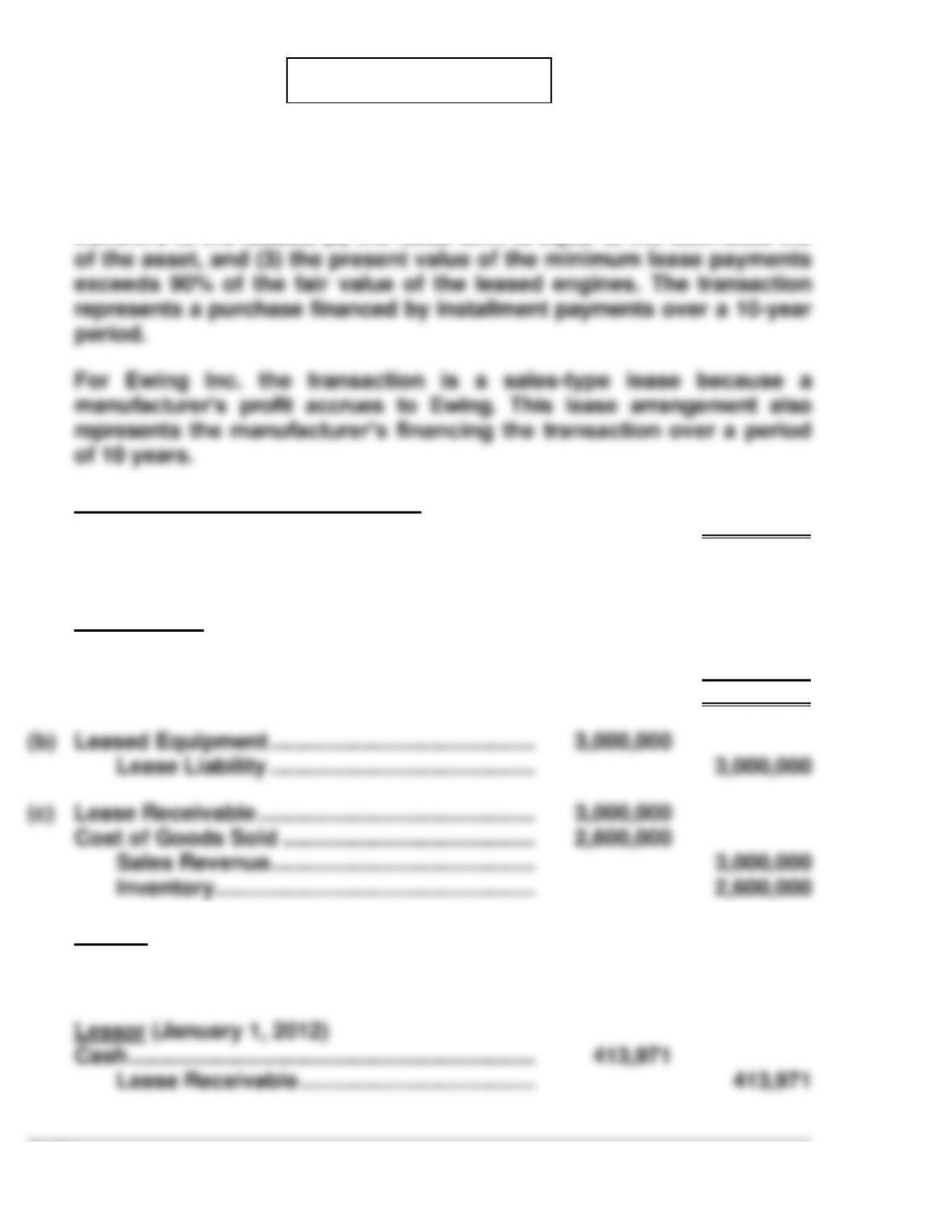
(a) The lease should be treated as a capital lease by Winston Industries
requiring the lessee to capitalize the leased asset. The lease qualifies for
capital lease accounting by the lessee because: (1) title to the engines
transfers to the lessee, (2) the lease term is equal to the estimated life
Present Value of Lease Payments
$413,971 X 7.24689* …………………………………………. $3,000,000
*Present value of an annuity due at 8% for 10 years, rounded by $2.
Dealer Profit
Sales (present value of lease payments) ……………….. $3,000,000
Less cost of engines ……………………………………………. 2,600,000
Profit on sale ………………………………………………………. $ 400,000
(d) Lessee (January 1, 2012)
Lease Liability ………………………………………….. 413,971
Cash …………………………..……………………… 413,971