CHAPTER 21
LEARNING OBJECTIVES
1. DESCRIBE MANAGEMENT’S DECISION-MAKING
PROCESS AND INCREMENTAL ANALYSIS.
2. ANALYZE THE RELEVANT COSTS IN ACCEPTING AN
ORDER AT A SPECIAL PRICE.
3. ANALYZE THE RELEVANT COSTS IN A MAKE-OR–
BUY DECISION.
CHAPTER REVIEW
Decision-Making Process and Incremental Analysis
1. (L.O. 1) Management’s decision-making process frequently involves the following steps:
a. Identify the problem and assign responsibility.
2. Business decisions involve a choice among alternative courses of action. In making such
decisions, management ordinarily considers both financial and nonfinancial information. The
3. Three important cost concepts used in incremental analysis include:
a. Relevant costs are those costs and revenues that differ across alternatives.
4. In incremental analysis, both costs and revenues may change. However, in some cases
(1) variable costs may not change under the alternative courses of action, and (2) fixed costs may
change.
Accept an Order at a Special Price
5. (L.O. 2) An order at a special price should be accepted when the incremental revenue from the
order exceeds the incremental costs.
Make or Buy
6. (L.O. 3) In a make or buy decision, management must determine the costs which are different
under the two alternatives. If there is an opportunity to use the productive capacity for another
Sell or Process Further
Repair, Retain or Replace Equipment
9. (L.O. 5) In a decision to retain or replace equipment, management compares the costs which
are affected by the two alternatives. Generally, these are variable manufacturing costs and the
Eliminate an Unprofitable Segment or Product
LECTURE OUTLINE
A. Management’s Decision-Making Process.
1. The steps are:
a. Identify the problem and assign responsibility.
B. Incremental Analysis.
1. The process used to identify the financial data that change under
alternative courses of action is called incremental analysis.
SERVICE COMPANY INSIGHT
American Express decided to offer some of its customers $300 if they would give
back their credit card. Customers could receive the $300 even if they hadn’t paid
off their balance yet, as long as they agreed to give up their credit card.
What are the relevant costs and other information that American Express would
need to know in order to determine to whom to make this offer?
4. Accept an order at a special price.
5. Make or buy.
a. In a make or buy decision, the relevant costs are:
MANAGEMENT INSIGHT
Amazon has a subscription-based free shipping program available to customers
for $79 per year. These “Prime” customers get free shipping on as many goods
as they want to buy from Amazon for an entire year.
What are the relevant revenues and costs that Amazon should consider relative
to the decision whether to offer the Prime free-shipping subscription?
6. Sell or process further.
a. Many manufacturers have the option of selling products at a given
point in the production cycle or continuing to process with the
expectation of selling them at a later point at a higher price.
7. Repair, retain or replace equipment.
a. Management often has to decide whether to continue using an asset
or replace it.
8. Eliminate an unprofitable segment or product.
a. In deciding whether to eliminate an unprofitable segment or product,
the relevant information is the contribution margin produced by the
segment or product and the disposition of the segment’s or
product’s fixed expenses.
MANAGEMENT INSIGHT
Buck Knives, a company with 260 employees and a 170,000-square foot facility,
moved from Southern California to Idaho to save itself from financial ruin. Moving
the factory would cost about $8.5 million, plus $4 million to move key employees.
The company received only $7.5 million (instead of an estimated $11 million) for
its California property, only 58 of 75 key employees were willing to move, the
new plant price increased by $1.5 million, and wages surged in Idaho due to low
unemployment.
What were some of the factors that complicated the company’s decision to
move? How should the company have incorporated such factors into its
incremental analysis?
MANAGEMENT INSIGHT
Managers of companies with excess plant capacity are often tempted to add new
products. Often, the effect on incremental overhead costs of changes in
servicing customers is less understood. For example, if customers are given the
option to purchase by the case or by the pallet, the company may need to
develop different warehousing, shipping and handling procedures to address the
two different purchase options.
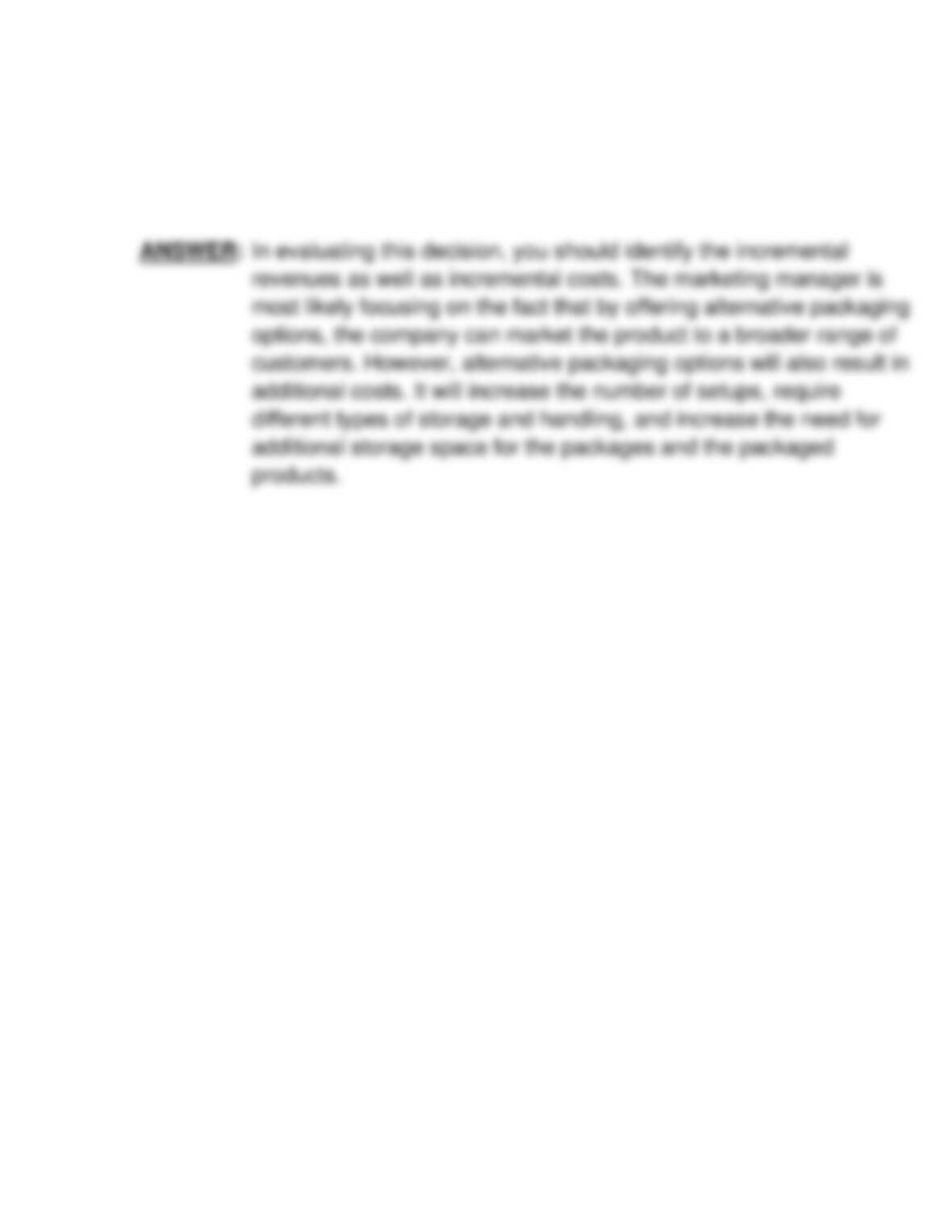
If your marketing director suggests that, in addition to selling your cereal in a
standard-size box, you should sell a jumbo size and an individual size, what
issues must you consider?
20 MINUTE QUIZ
Circle the correct answer.
True/False
1. Determining and evaluating possible courses of action is a step in management’s
decision-making process.
True False
2. In incremental analysis fixed costs may not change under alternative courses of action,
while variable costs may change.
True False
3. The relevant data to consider in accepting an order at a special price are the additional
manufacturing costs incurred and expected revenues.
True False
4. The basic decision rule to sell or process further is: process further as long as the
incremental revenue from such processing exceeds the incremental processing costs.
True False
5. Book value is a sunk cost and is therefore relevant in incremental analysis of retain or
replace equipment.
True False
6. Fixed manufacturing costs will never be relevant in a make or buy decision.
True False
7. Opportunity costs are costs that have already been incurred and will not be avoided by
any future decision.
True False
8. In deciding on the future status of an unprofitable segment, management should consider
the effect of elimination on the remaining product lines.
True False
9. Joint product costs are relevant for any sell-or-process further decisions.
True False
10. Any trade-in allowance or cash disposal value of the old asset is relevant in a retain or
replace equipment decision.
True False
Multiple Choice
1. Which of the following is not a step in management’s decision-making process?
a. Identify the problem and assign responsibility.
b. Determine and evaluate possible courses of action.
c. Make a decision.
d. Prepare financial statements.
2. If revenues are $315,000 under alternative A and $324,000 under alternative B, and
costs are $285,000 for A and $306,000 for B, then using the basic approach in
incremental analysis, incremental revenues, costs, and net income, in comparing B to A
are respectively
a. $9,000, $(21,000), $(12,000).
b. $(9,000), $21,000, $12,000.
c. $9,000, $21,000, $12,000.
d. $(9,000), $(21,000), $(12,000).
3. The cost to manufacture an unfinished unit is $120 ($90 variable, $30 fixed). The selling
price per unit is $150. The company has unused productive capacity and has determined
that units could be finished and sold for $195 with an increase in variable costs of 40%.
What is the additional net income per unit to be gained by finishing the unit?
a. $9.
b. $30.
c. $45.
d. $36.
4. The potential benefit that may be obtained from following an alternative course of action
is called
a. opportunity benefit.
b. opportunity cost.
c. relevant cost.
d. sunk cost.
5. In a make or buy decision, the relevant costs include each of the following except the
a. variable manufacturing costs that will be saved.
b. fixed manufacturing costs that can be eliminated.
c. opportunity costs.
d. each of the above is a relevant cost.
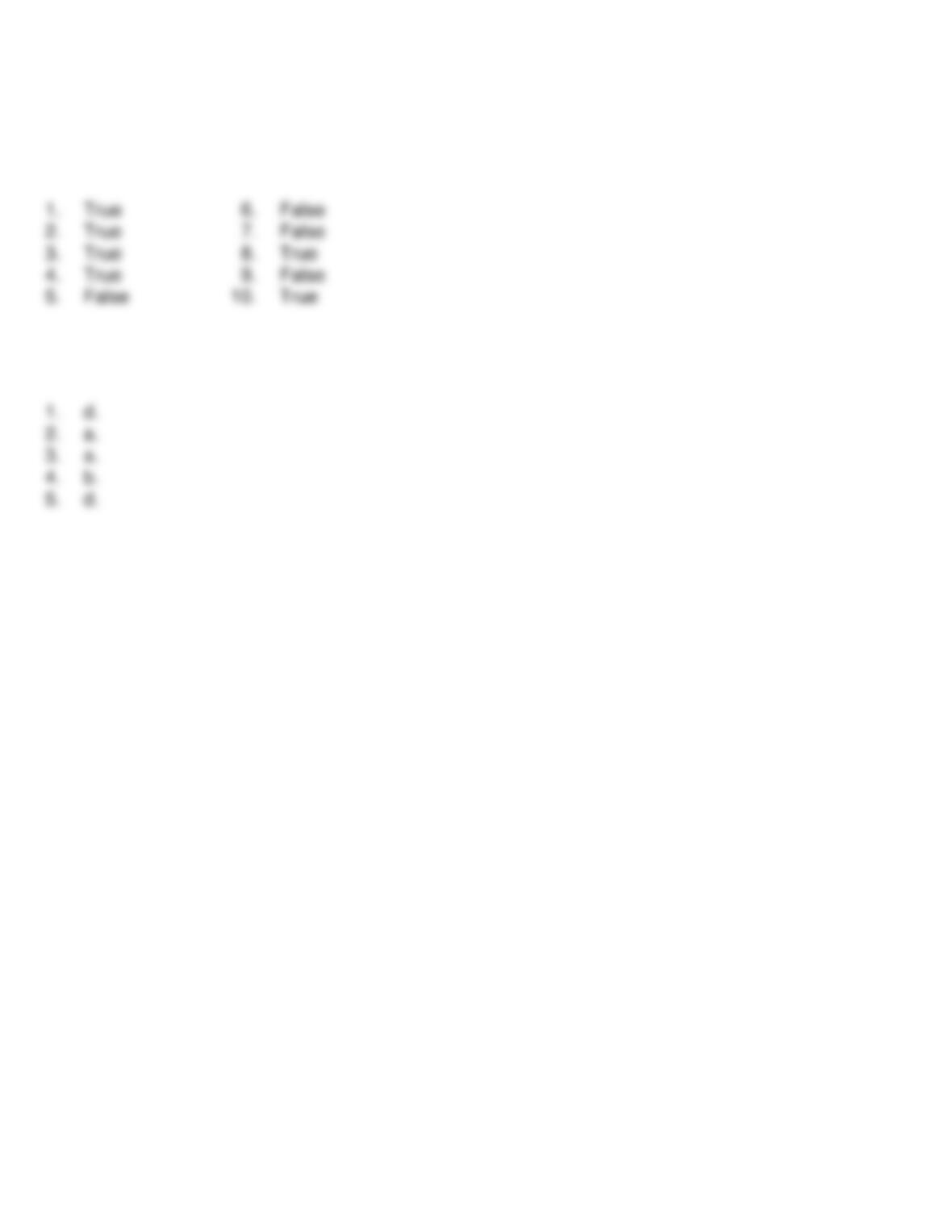
ANSWERS TO QUIZ
True/False
Multiple Choice