20–20 Intermediate Accounting, 8e
ERROR AFFECTING PREVIOUS FINANCIAL
STATEMENTS, BUT NOT NET INCOME
Example: Incorrectly recording salaries payable as accounts
payable, recording a loss as an expense, or classifying a cash
To correct incorrect accounts …. ($ in millions)
Note receivable ……………………………………………….. 2
Accounts receivable ……………………………………… 2
RECORDING AN ASSET AS AN EXPENSE
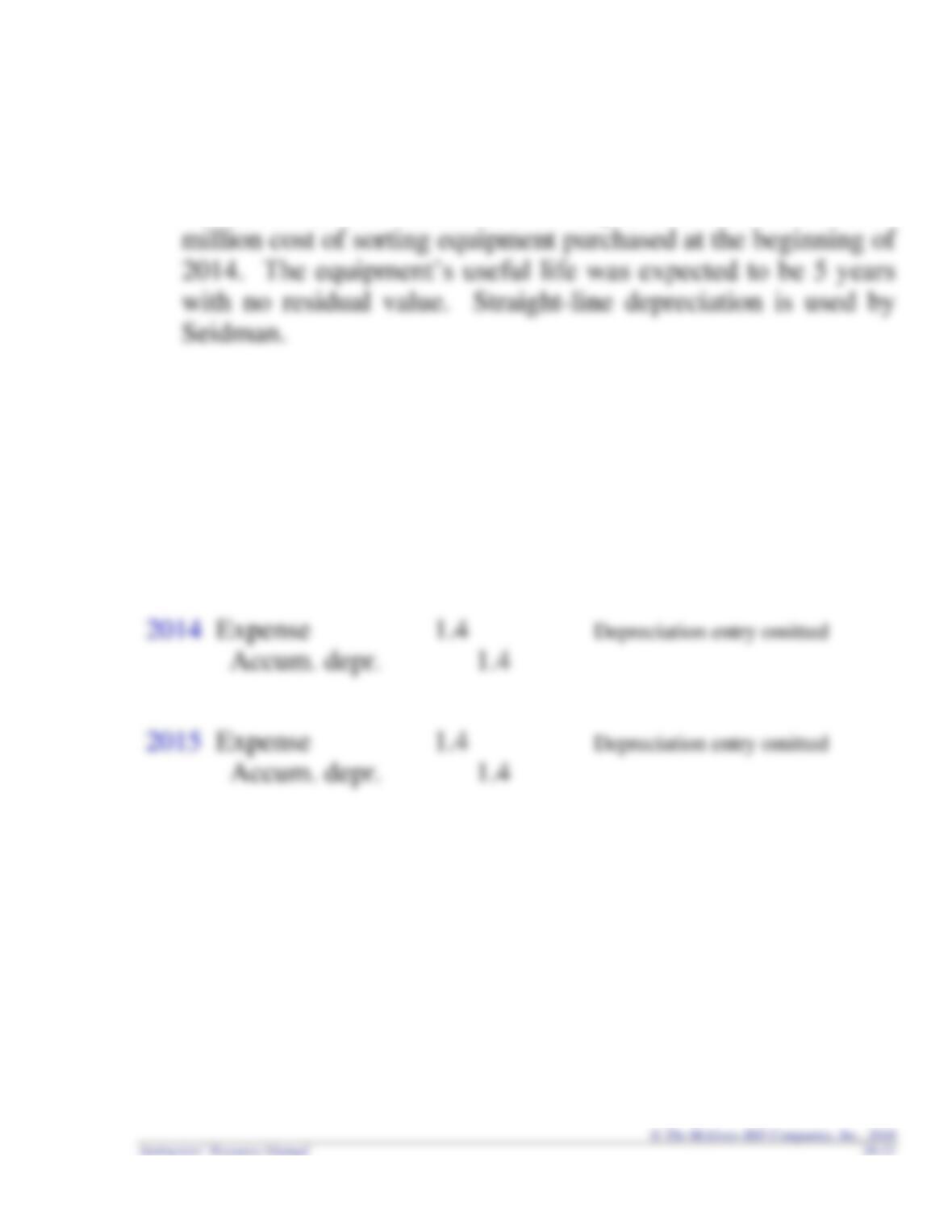
In 2016, internal auditors discovered that Seidman
Distribution, Inc. had debited an expense account for the $7
Analysis:
($ in millions)
Correct Incorrect
(Should Have Been Recorded) (As Recorded)
2014 Equipment 7.0 Expense 7.0
Cash 7.0 Cash 7.0
T20–17
20–22 Intermediate Accounting, 8e
RECORDING AN ASSET AS AN EXPENSE
(Illustration continued)
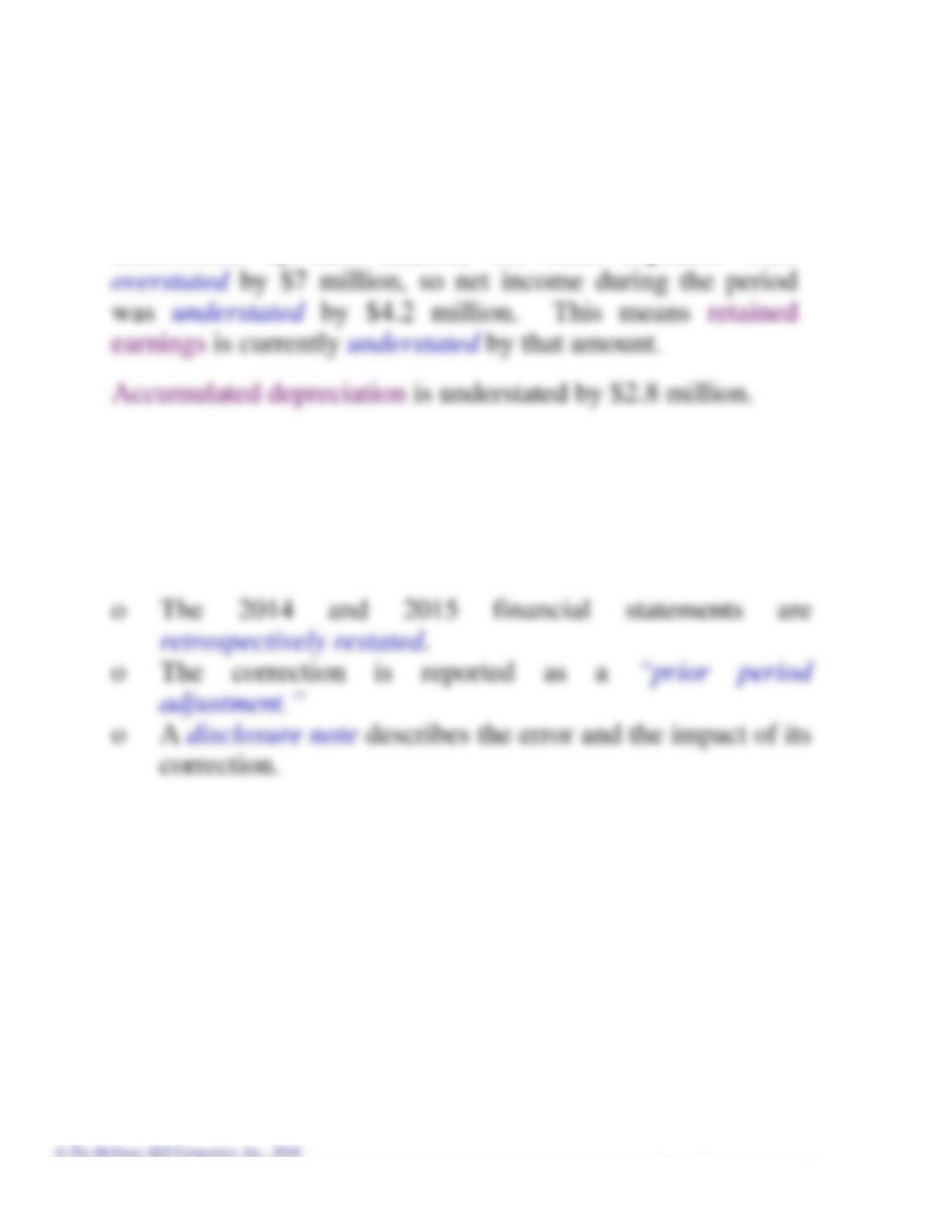
During the two-year period, depreciation expense was
understated by $2.8 million, but other expenses were
To correct incorrect accounts …. ($ in millions)
Equipment ………………………………………………………. 7.0
Accumulated depreciation …………………………….. 2.8
Retained earnings …………………………………………. 4.2
T20–17 (continued)
INVENTORY MISSTATED
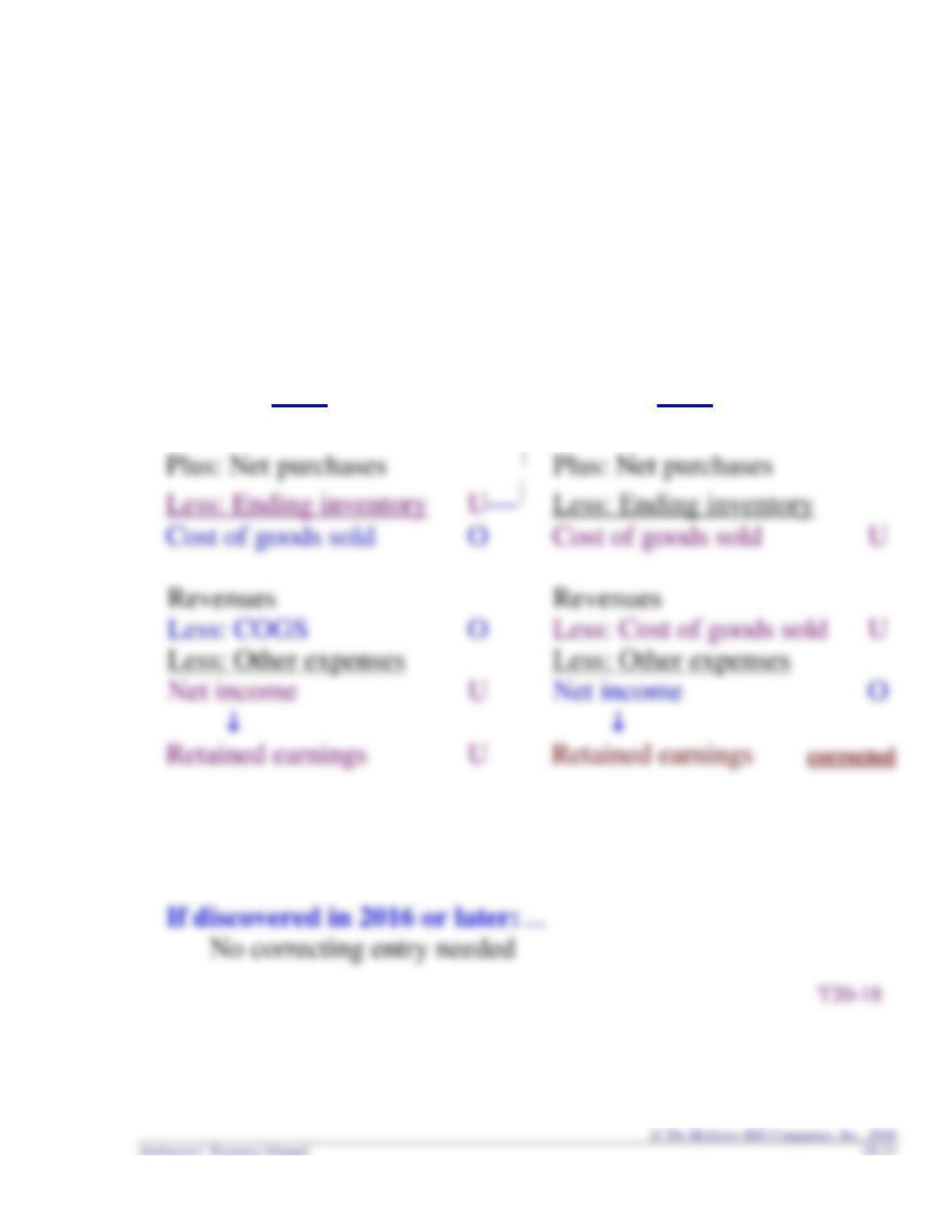
In early 2016, Overseas Wholesale Supply discovered that
$1 million of inventory had been inadvertently excluded
from its 2014 ending inventory count.
Analysis: U = Understated
O = Overstated
2014 2015
Beginning inventory → Beginning inventoryU
If discovered in 2015 (before closing): ($ in millions)
Inventory …………………………………………………………. 1
Retained earnings …………………………………………. 1
20–24 Intermediate Accounting, 8e
S
Su
ug
gg
ge
es
st
ti
io
on
ns
s
f
fo
or
r
C
Cl
la
as
ss
s
A
Ac
ct
ti
iv
vi
it
ti
ie
es
s
1. Critical Thinking Activity
It is alleged that not all accounting choices are made by management in the best interest of fair
and consistent financial reporting.
Suggestion:
Points to note:
Your students should come up with a wide variety of motives. Among them will likely be the
2. Real World Activity
The following February 22, 2013, report in Wallst.com described a change in the way
Abercrombie & Fitch accounts for inventories:
Abercrombie & Fitch Co. (NYSE: ANF) reported fourth-quarter and full-year 2012 earnings
before markets opened this morning.
For the quarter, the specialty retailer posted adjusted diluted earnings per share (EPS) of $2.21 on revenues
of $1.47 billion. In the same period a year ago, the company reported adjusted EPS of $1.12 on revenues of
Suggestion:
Ask students to consult the footnotes to the 2012 financials of Abercrombie & Fitch Co. and
describe the details of the change and to speculate on the motivation for the original method and the
change.
INVENTORIES
During the fourth quarter of Fiscal 2012, the Company elected to change its inventory valuation
method from the lower of cost or market utilizing the retail method to the lower of cost or market under the
weighted average cost method. The Company believes the new method is preferable as it is consistent with
4. CHANGE IN ACCOUNTING PRINCIPLE
The Company elected to change its method of accounting for inventory from the lower of cost or
market utilizing the retail method to the weighted average cost method effective February 2, 2013. In
accordance with generally accepted accounting principles, all periods have been retroactively adjusted to
20–26 Intermediate Accounting, 8e
As a result of the retroactive application of the change in accounting for inventory, the following items
in the Company’s Consolidated Statements of Operations and Comprehensive Income and Consolidated
Statements of Cash Flows have been restated:
Fiscal Year Ended January 28, 2012 (in thousands, except per share data)
As Reported
Effect of Change
As Restated
Net Sales
$
4,158,058
$
—
$
4,158,058
Cost of Goods Sold
1,639,188
(31,354
)
1,607,834
Gross Profit
2,518,870
31,354
2,550,224
Operating Income
31,354
Tax Expense for Continuing Operations
15,078
Net Income from Continuing Operations
16,276
Net Income
Basic
$
1.46
$
0.19
$
1.65
Diluted
$
1.42
$
0.18
$
1.60
Net Income Per Share:
Basic
$
1.47
$
0.19
$
1.66
Diluted
$
1.43
$
0.18
$
1.61
Foreign Currency Translation Adjustments
Other Comprehensive Income (Loss)
)
Comprehensive Income
16,273
As Reported
Effect of Change
As Restated
Cash flow from operating activities:
Net Income
$
$
$
Deferred Taxes
(46,330
15,078
Inventories
(184,784
Fiscal Year Ended January 29, 2011 (in thousands, except per share data)
As Reported
Effect of Change
As Restated
Net Sales
$
3,468,777
$
—
$
3,468,777
Cost of Goods Sold
1,256,596
(5,248
)
1,251,348
Gross Profit
2,212,181
5,248
2,217,429
Operating Income
5,248
Tax Expense for Continuing Operations
Net Income from Continuing Operations
5,426
Net Income
5,426
Basic
$
1.71
$
0.06
$
1.77
Diluted
$
1.67
$
0.06
$
1.73
Net Income Per Share:
Basic
$
$
$
Diluted
$
1.67
$
0.06
$
1.73
Foreign Currency Translation Adjustments
$
$
Other Comprehensive Income (Loss)
$
)
$
Comprehensive Income
$
5,265
$
As Reported
Effect of Change
As Restated
Cash flow from operating activities:
Net Income
$
$
$
Deferred Taxes
Inventories
As a result of the retroactive application of the change in accounting for inventories, the following items in
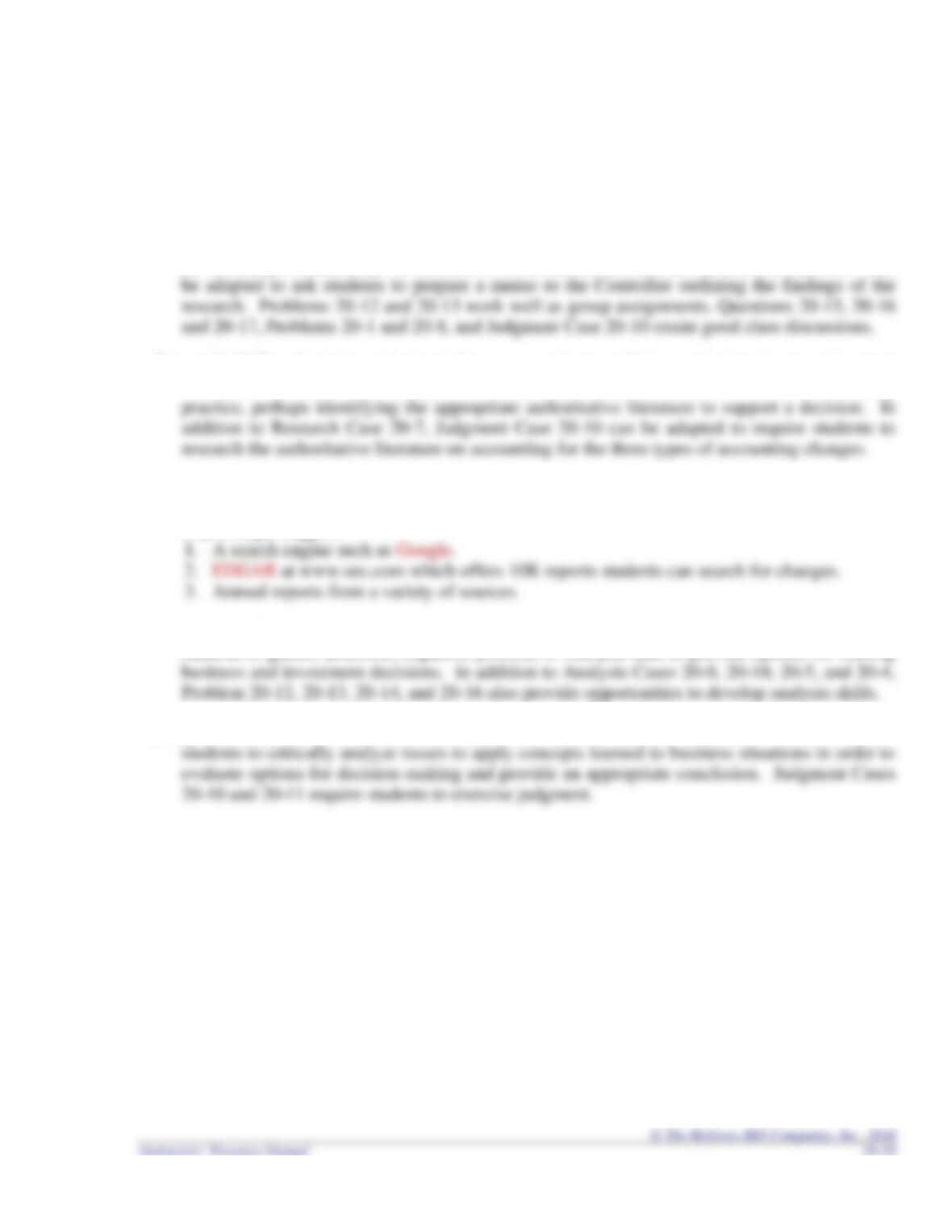
the Company’s Consolidated Balance Sheets have been restated:
January 28, 2012 (in thousands):
As Reported
Effect of Change
As Restated
Inventories
$
569,818
$
110,117
$
679,935
Deferred Income Taxes
Total Current Assets
Total Assets
Retained Earnings
Total Stockholders’ Equity
Total Liabilities and Stockholders’ Equity
3. Professional Skills Development Activities
The following are suggested assignments from the end-of-chapter material that will help your
students develop their communication, research, analysis, and judgment skills.
Communication Skills. Ethics Case 20-3, Research Case 20-7, and Problem 20-10 are suitable
for student presentation(s). In addition to Communication Case 20-5, Research Case 20-7 can
Research Skills. In their professional lives, our graduates will be required to locate and extract
relevant information from available resource material to determine the correct accounting
As a research activity, have students search the internet for examples of reported accounting
changes. You might let them use their own creativity in deciding where to look for examples
or you might suggest:
Analysis Skills. The “Broaden Your Perspective” section includes Analysis Cases that direct
students to gather, assemble, organize, process, or interpret date to provide options for making
Judgment Skills. The “Broaden Your Perspective” section includes Judgment Cases that require
20–30 Intermediate Accounting, 8e
4. Ethical Dilemmas
A. The chapter contains two ethical dilemmas. The first is:
ETHICAL DILEMMA
The net income of Union Carbide increased in in a single year by over $200 million, due
almost entirely to three changes in accounting principle: (a) the depreciation method was changed,
You may wish to discuss this in class. If so, discussion should include these elements.
Step 1 – The Facts:
The increase in net income of Union Carbide was due almost entirely to: (1) a change in
Step 2 – The Ethical Issue and the Stakeholders:
The ethical issue or dilemma is whether Union Carbide made the changes for the purpose of
Step 3 – Values:
Values include competence, integrity, objectivity, loyalty to the company, responsibility for
following accounting principles, and responsibility to users of financial statements.
Step 4 – Alternatives:
1. Continue the use of previous accounting methods regarding depreciation, interest
Step 5 – Evaluation of Alternatives in Terms of Values:
1. Alternative 1 would have caused significantly lower reported earnings, perhaps reflecting
Step 6 – Consequences:
Alternative 1.
Would have caused significantly lower reported earnings, with possible negative impact
Alternative 2.
Would have caused significantly higher reported earnings, perhaps misleading investors,
Step 7 – Decision:
Student(s) must decide their course of action.
B. The chapter contains two ethical dilemmas. The second is:
ETHICAL DILEMMA
As a second-year accountant for McCormack Chemical Company, you were excited to be
named Assistant Manager of the Agricultural Chemicals Division. After two weeks in your new
position, you were supervising the year-end inventory count when the Senior Manager mentioned
Discussion should include these elements.
Step 1 – Facts:
As a newly promoted Assistant Manager of the Agricultural Chemicals Division of McCormack
Chemical Company, you observe that two carloads of herbicides, deemed to be unsaleable, are
omitted from the ending inventory count. The Senior Manager states that the inventory should be
Step 2 – The Ethical Issue and the Stakeholders:
The ethical issue or dilemma is whether your obligations to obey your superior and support
Step 3 – Values:
Values include competence, honesty, integrity, objectivity, loyalty to employees, loyalty to the
company, and responsibility to users of financial statements.
Step 4 – Alternatives:
1. Follow the suggestion of the Senior Manager to defer the inventory write off until next
Step 5 – Evaluation of Alternatives in Terms of Values:
1. Alternative 1 illustrates loyalty to the employer and fellow employees.
Step 6 – Consequences:
Alternative 1
Positive consequences: You would keep your job and please the Senior Manager. Fellow
employees would keep their jobs and be able to support their families.
Alternative 2
Positive consequences: Users of financial statements would receive more reliable and
Alternative 3
Positive consequences: You maintain your integrity. Users may receive more reliable and
relevant information regarding assets and net income if upper management levels or the audit
Alternative 4
Positive consequences: You maintain your integrity and avoid conflict with management and
Step 7 – Decision:
Student(s) must decide their course of action.
20–34 Intermediate Accounting, 8e
A
As
ss
si
ig
gn
nm
me
en
nt
t
C
Ch
ha
ar
rt
t
Learning Est. time
Questions Objective(s) Topic (min.)
20-1
1
Classify accounting changes
5
20-2
1
Three accounting approaches to reporting
accounting changes
5
20-3
2
Change in accounting principle
5
20-4
2
Change in accounting principle
5
20-5
2
Change in accounting principle
5
20-6
3
Change in accounting principle – exception
5
20-8
4
Change in estimate
5
Distinguish between a change in principle and a
5
change in estimate
20-10
5
Change in reporting entity
5
20-11
5
Change in reporting entity
5
20-12
6
Correcting an error
5
20-13
6
Correcting an error
5
20-14
6
Correcting an error
5
20-15
6
Correcting an error
5
20-16
6
Correcting an error
5
20-17
IFRS; Correcting an error
5
Brief Learning Est. time
Exercises Objective(s) Topic (min.)
20-1
2
Change in inventory methods
5
20-2
2
Change in inventory methods
5
20-3
3
Change in inventory methods
5
20-4
3
Change in depreciation methods
5
20-5
3
Change in depreciation methods
5
20-6
4
Book royalties
5
20-7
4
Warranty expense
5
20-8
4
Change in estimate; useful life of patent
5
20-9
6
Error correction
5
20-10
6
Error correction
5
20-11
6
Error correction
5
20-12
6
Error correction
5
Learning Est. time
Exercises Objective(s) Topic (min.)
20-1
2
Change in inventory methods
15
20-2
2
Change in inventory methods
10
20-3
2
Change from the treasury stock method to
retired stock
10
20-4
2
Change to equity method
15
20-6
2
FASB codification research
15
25
20-9
3
Change in inventory methods; incomplete
information
10
20-11
3
Change in principle; change in depreciation
methods
10
20-12
4
Book royalties
15
20-13
4
Loss contingency
10
20-14
4
Warranty expense
15
20-15
4
Deferred taxes; change in tax rates
10
20-16
4
Accounting change
10
20-17
4
Change in estimate; equipment
20
20-18
Classifying accounting changes
15
20-19
6
Error correction; inventory error
20
6
Error corrections; investment
15
6
Error in amortization schedule
20
20-22
6
Error correction; accrued interest on bonds
15
20-23
6
Error correction; three errors
25
20-24
6
Inventory errors
15
20-25
Classifying accounting changes and errors
15
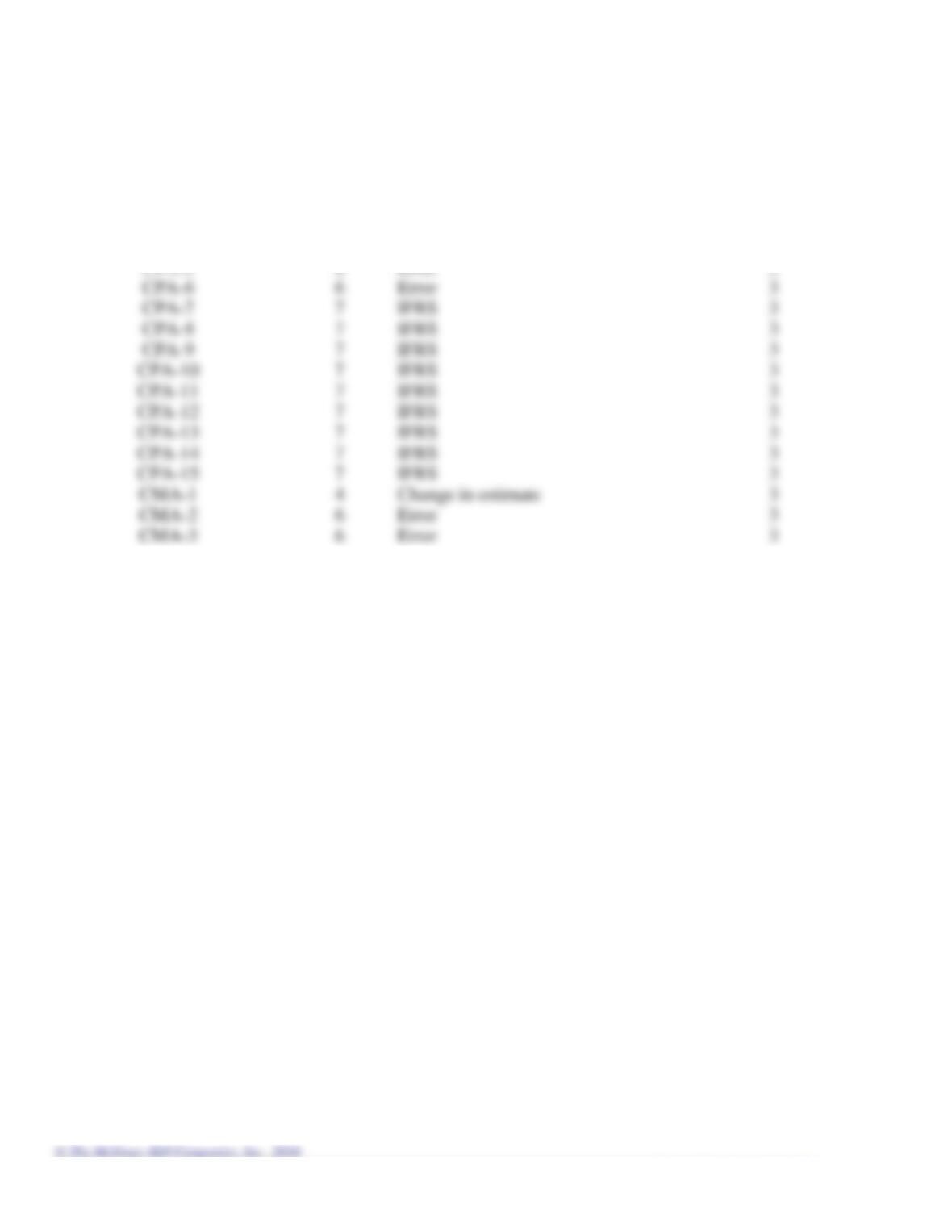
20–36 Intermediate Accounting, 8e
CPA/CMA Learning Est. time
Exam Questions Objective(s) Topic (min.)
CPA-1
3
Change in depreciation method
3
CPA-2
4
Retrospective restatement
3
CPA-3
4
Change in estimate
3
CPA-4
5
Change in reporting entity
3
CPA-5
6
Error
3
CPA-6
6
Error
3
CPA-7
7
IFRS
3
CPA-8
7
IFRS
3
CPA-9
7
IFRS
3
7
IFRS
3
7
IFRS
3
7
IFRS
3
7
IFRS
3
7
IFRS
3
7
IFRS
3
4
Change in estimate
3
6
Error
3
6
Error
3
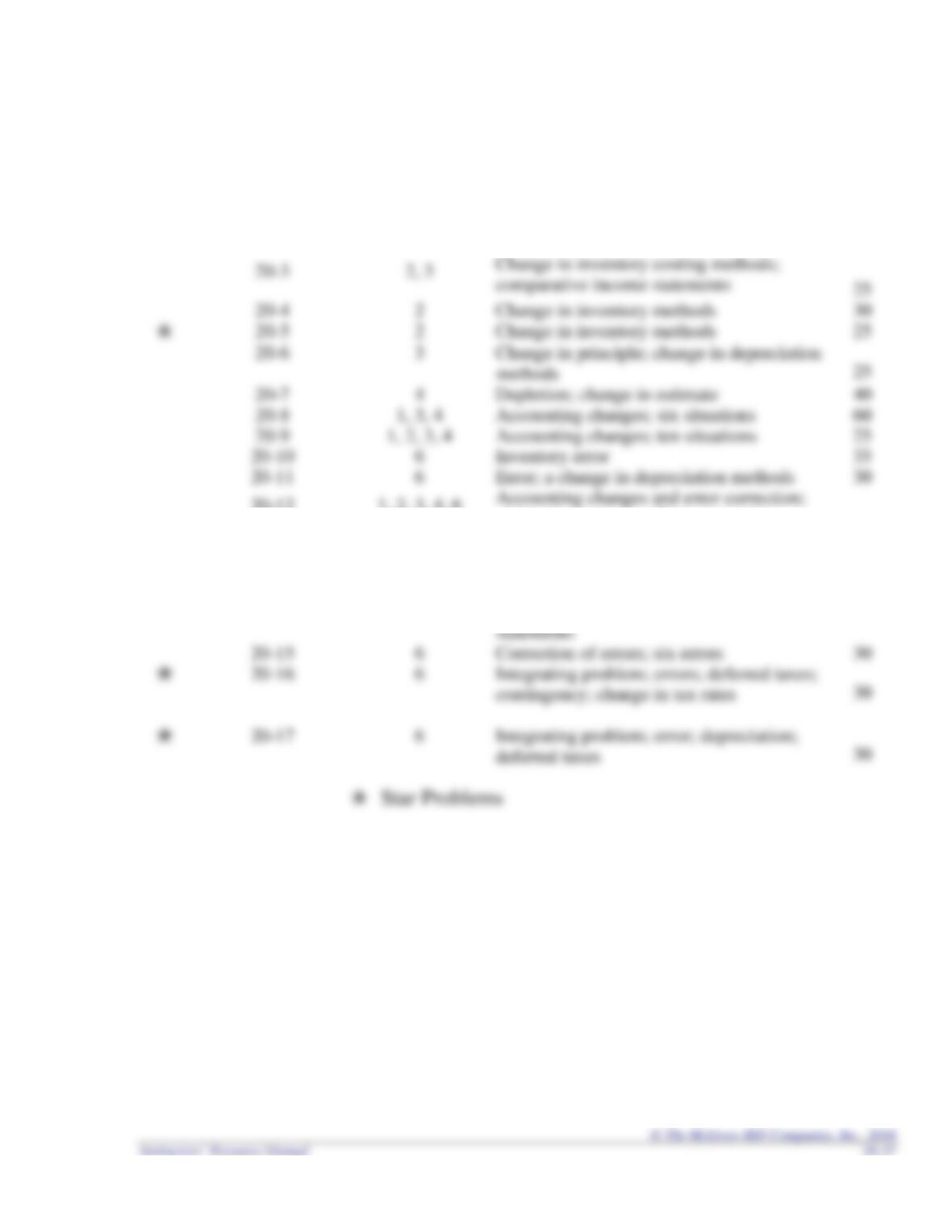
Learning Est. time
Problems Objective(s) Topic (min.)
20-1
2
Change in inventory costing methods;
comparative income statements
25
20-2
2
Change in principle; change in method of
accounting for inventories
40
20-3
Change in inventory costing methods;
comparative income statements
25
Change in inventory methods
30
Depletion; change in estimate
40
Accounting changes; six situations
60
Accounting changes; ten situations
25
Inventory error
35
Error; a change in depreciation methods
30
Accounting changes and error correction;
20-12
1, 2, 3, 4, 6
eight situations; tax effects ignored
80
20-13
1, 2, 3, 4, 6
Accounting changes and error correction;
eight situations; tax effects considered
90
20-14
1, 3, 4, 6
Correction of errors; six errors
30
Integrating problem; errors; deferred taxes;
contingency; change in tax rates
Integrating problem; error; depreciation;
Errors; change in estimate; change in
principle; restatement of previous financial
35
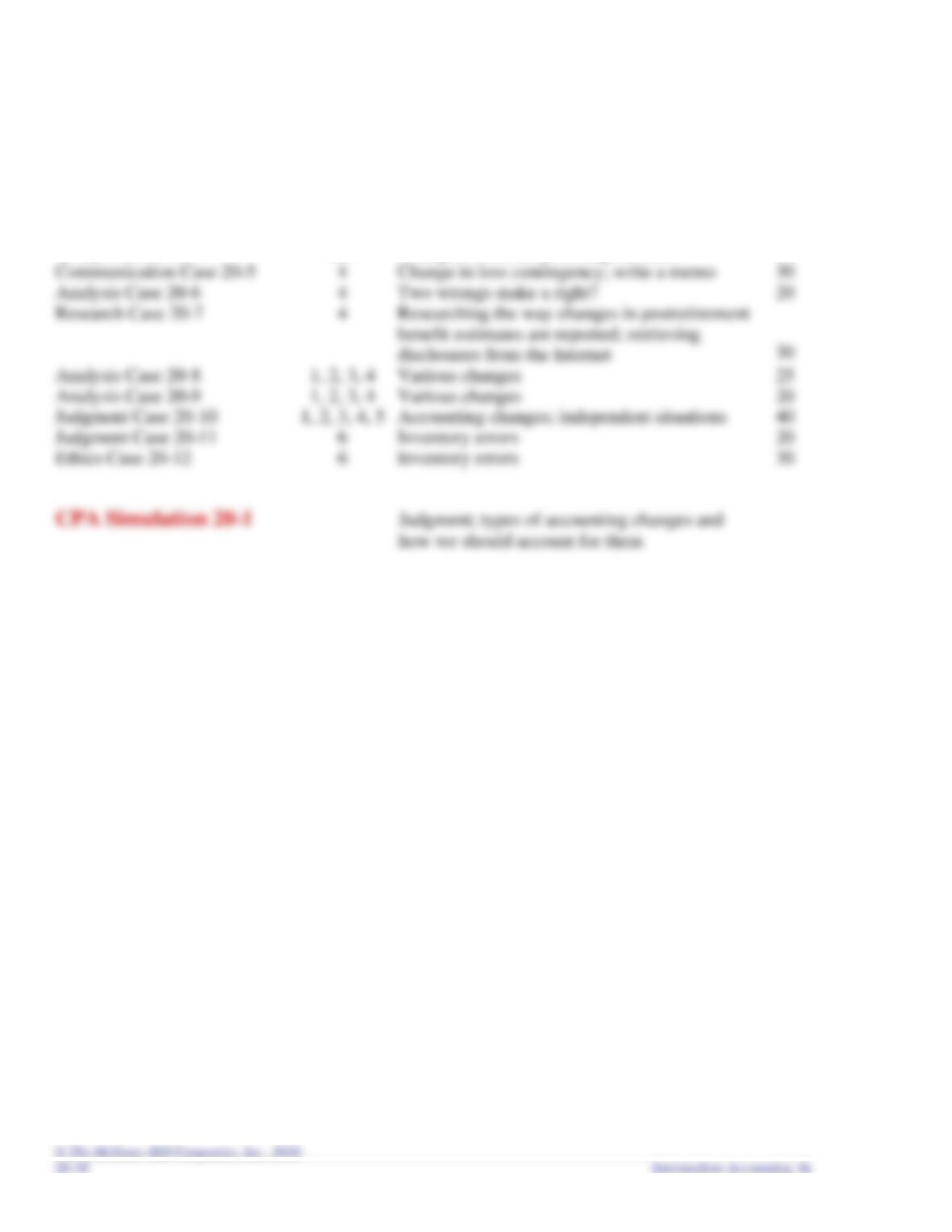
Learning Est. time
Cases Objective(s) Topic (min.)
Integrating Case 20-1
2
Change to dollar-value LIFO
25
Communication Case 20-2
2
Change in inventory costing methods
45
Ethics Case 20-3
1 ,2, 3
Softening the blow
20
Analysis Case 20-4
2, 3
Change in inventory costing methods
35
Communication Case 20-5
4
Change in loss contingency; write a memo
30
Analysis Case 20-6
4
Two wrongs make a right?
20
Analysis Case 20-9
Various changes
20
Judgment Case 20-10
1, 2, 3, 4, 5
Accounting changes; independent situations
40
Judgment Case 20-11
6
Inventory errors
20
Ethics Case 20-12
6
Inventory errors
30