Chapter 20
Electron Transport and Oxidative Phosphorylation
1
SUMMARY
Section 20.1
Electron transport from one carrier to another creates a proton gradient across
the inner mitochondrial membrane.
The proton gradient is coupled to the production of ATP in aerobic metabolism.
Section 20.2
Standard reduction potentials provide a basis for comparison among oxidation-
Section 20.3
The electron transport chain consists of four multisubunit membrane-bound
complexes and two mobile electron carriers (coenzyme Q and cytochrome c).
Section 20.4
The coupling of electron transport to oxidative phosphorylation requires a
multisubunit membrane- bound enzyme, ATP synthase. This enzyme has a
Section 20.5
bound ATP that has already been formed.
Section 20.6
Shuttle mechanisms transfer electrons, but not NADH, from the cytosol across
Section 20.7
In the complete oxidation of glucose, a total of 30 or 32 molecules of ATP are
produced for each molecule of glucose, depending on the shuttle mechanism.
2 Chapter 20
LECTURE NOTES
As is the case for much of central energy metabolism, students are likely to be at
least passingly familiar with the basics, but none of the details covered by this
LECTURE OUTLINE
I. Role of electron transport in metabolism
A. Production of proton gradient
III. Organization of electron transport complexes
A. Complex I
1. Transfer of electrons from NADH to CoQ
5. Contribution to proton gradient
B. Complex II
1. Identity as succinate dehydrogenase
C. Complex III
1. Transfer of electrons from CoQ to cytochrome c
2. Connection between two-electron and one-electron carriers
5. Proton pumping
D. Complex IV
1. Electron transfer from cytochrome c to oxygen
2. Proton pumping
3. Involvement of copper, cytochromes a and a3
E. Details of cytochromes and other iron-containing proteins
IV. Connection between electron transport and phosphorylation
Electron Transport and Oxidative Phosphorylation 3
2. FADH2 = 1.5
V. Mechanism of coupling
A. Chemiosmotic coupling — experimental evidence
B. Conformational aspects
ANSWERS TO PROBLEMS
20.1 The Role of Electron Transport in Metabolism
1. Electrons are passed from NADH to a flavin-containing protein to coenzyme Q.
2. Electron transport and oxidative phosphorylation are different processes.
Electron transport requires the respiratory complexes of the inner mitochondrial
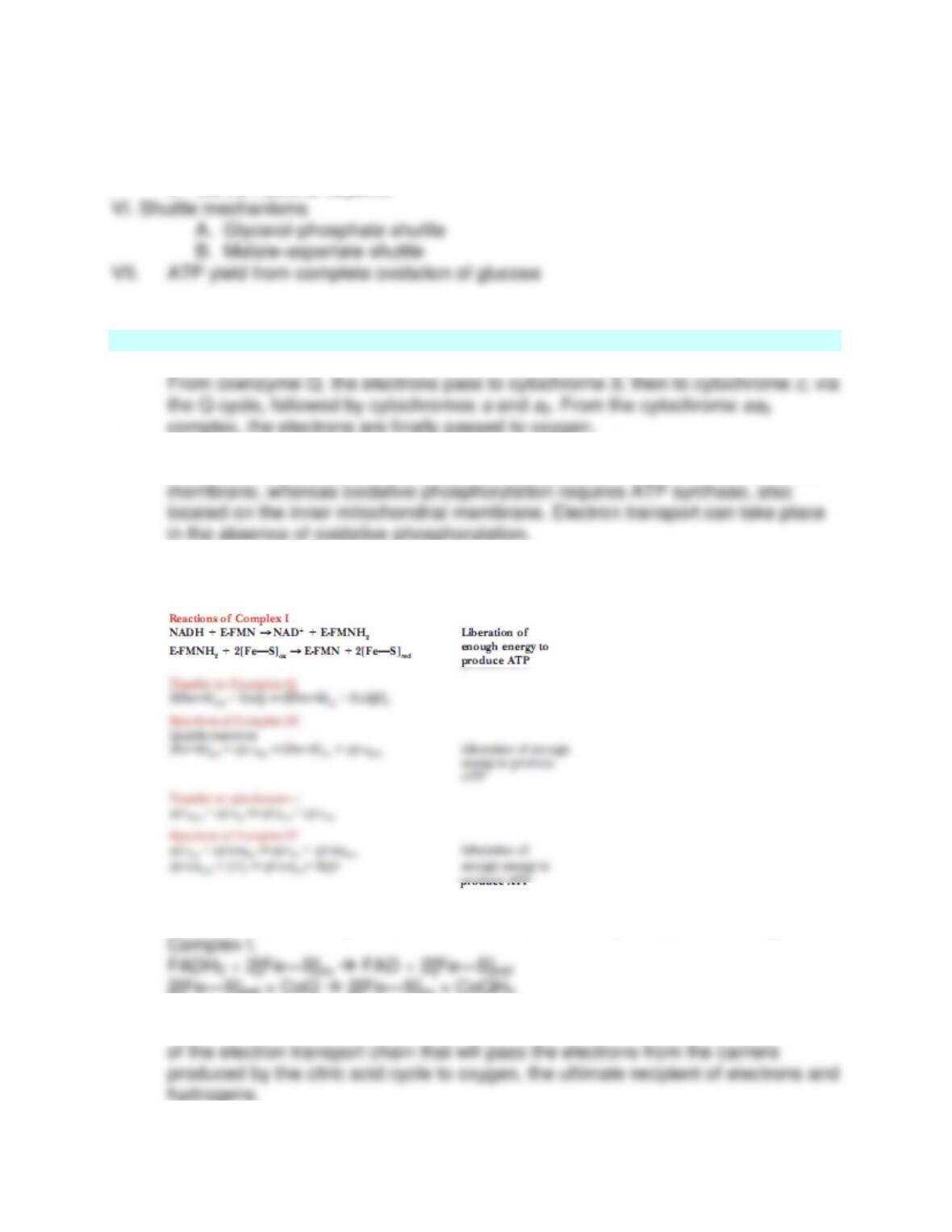
3. In all reactions, electrons are passed from the reduced form of one reactant to
the oxidized form of the next reactant in the chain. The notation [Fe—S] refers to
any one of a number of iron–sulfur proteins.
4. When FADH2 is the starting point for electron transport, electrons are passed
from FADH2 to coenzyme Q in a reaction carried out by Complex II that bypasses
5. Mitochondrial structure confines the reduced electron carriers produced by the
citric acid cycle to the matrix. There they are close to the respiratory complexes
20.2 Reduction Potentials in the Electron Transport Chain
6. The electron transport chain translocates charged particles by chemical means.
Interconversion of chemical and electrical energy is exactly what a battery does.
8. G°′ = –60 kJ/mol
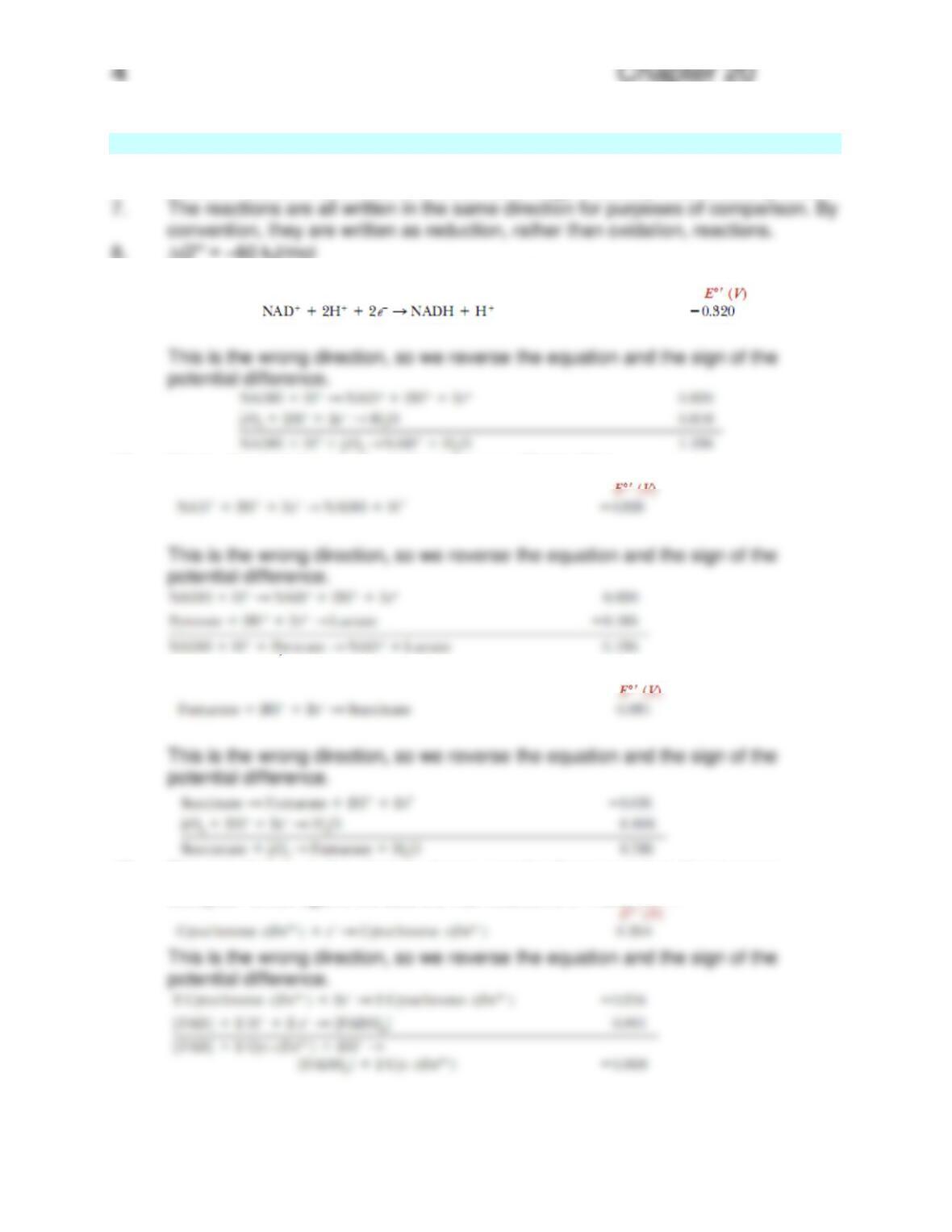
9. We fundamentally add the half reactions in Table 20.1.
10. We fundamentally add the half reactions in Table 20.1.
11. We fundamentally add the half reactions in Table 20.1.
12. The cytochrome is the electron donor, and the flavin moiety is the electron
acceptor. Once again, we add the half reactions in Table 20.1.
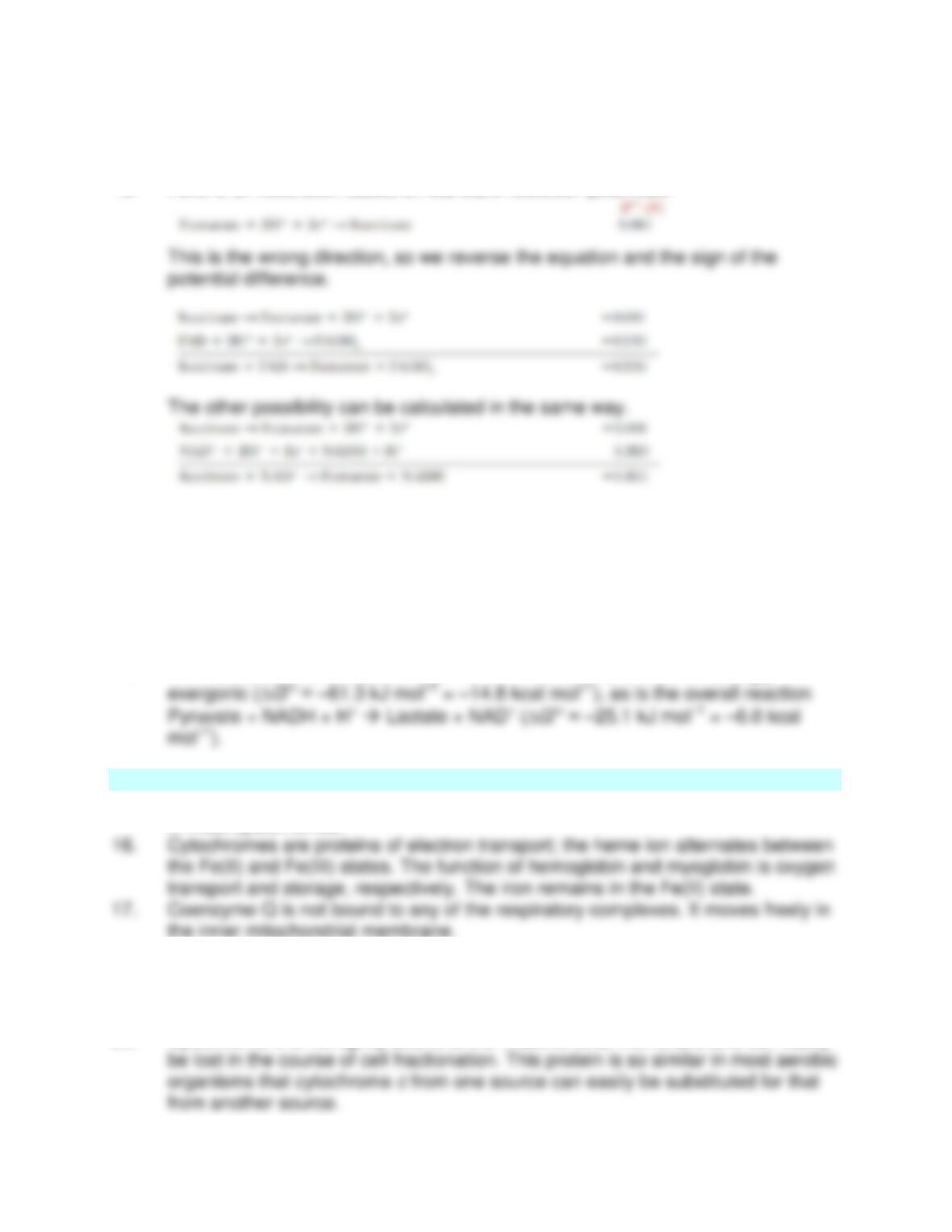
Electron Transport and Oxidative Phosphorylation 5
This was the maximum value for a bound flavin. The negative sign indicates that
this reaction will not take place as written because it is not energetically
favorable.
13. Here is an illustration based on standard reduction potentials.
Both reduction potentials indicate a reaction that is not energetically favorable,
but less so with FAD than with NAD+. Other factors enter into consideration,
however, in a living cell. The first is that the reactions do not take place under
standard conditions, altering the values of reduction potentials. The second is
that the reduced electron carriers (NADH and FADH2) are reoxidized. Coupling
the reactions we have looked at here to others also makes them less
unfavorable.
14. The half reaction of oxidation NADH + H+ NAD+ + 2H+ + 2e– is strongly
20.3 Organization of Electron Transport Complexes
15. They all contain the heme group, with minor differences in the heme side chains
in most cytochromes.
the inner mitochondrial membrane.
18. A part of Complex II catalyzes the conversion of succinate to fumarate in the
citric acid cycle.
19. Three of the four respiratory complexes generate enough energy to
phosphorylate ADP to ATP. Complex II is the sole exception.
20. Cytochrome c is not tightly bound to the mitochondrial membrane and can easily
6 Chapter 20
21. Succinate + ½ O2 Fumarate + H2O
22. The components are in the proper orientation for the electrons to be transferred
rapidly from one component to the next; if the components were in solution,
23. From an evolutionary standpoint, two different functions can be performed by
24. The key point here is not the active site, which has a low tolerance for mutations,
but the molecules with which the proteins in question are associated.
Cytochromes are membrane-bound and must associate with other members of
25. Having mobile electron carriers in addition to membrane-bound respiratory
complexes allows electron transport to use the most readily available complex
rather than to use the same one all the time.
26. The Q cycle allows for a smooth transition from two-electron carriers (NADH and
FADH2) to one-electron carriers (cytochromes).
27. The protein environment of the iron differs in each of the cytochromes, causing
20.4 The Connection between Electron Transport and Phosphorylation
31. The F1 portion of the mitochondrial ATP synthase, which projects into the matrix,
is the site of ATP synthesis.
32. The F0 portion of mitochondrial ATP synthase lies within the inner mitochondrial
membrane, but the F1 portion projects into the matrix.
Electron Transport and Oxidative Phosphorylation 7
34. The F1 part of mitochondrial ATP synthase has a stationary domain (the 33
domain) and a domain that rotates (the domain). This is exactly the
arrangement needed for a motor.
35. A P/O ratio of 1.5 can be expected because oxidation of succinate passes
electrons to coenzyme Q via a flavoprotein intermediate, bypassing the first
20.5 The Mechanism of Coupling in Oxidative Phosphorylation
38. The chemiosmotic coupling mechanism is based on the difference in hydrogen
ion concentration between the intermembrane space and the matrix of actively
respiring mitochondria. The hydrogen ion gradient is created by the proton
pumping that accompanies the transfer of electrons. The flow of hydrogen ions
back into the matrix through a channel in the ATP synthase is directly coupled to
the phosphorylation of ADP.
42. Dinitrophenol is an uncoupler of oxidative phosphorylation. The rationale was to
dissipate energy as heat.
43. The energy released as protons pass through the F particles is actually used to
cause conformational changes in the F1 proteins, thereby releasing ATP. The
―tight‖ conformation (one of three) provides a hydrophobic environment in which
ADP is phosphorylated by adding Pi without requiring immediate energy.
44. Uncouplers and respiratory inhibitors act in different ways. Uncouplers lead to
8 Chapter 20
46. Experiments with model systems have shown that electron transport and proton
pumping can take place separately.
20.6 Shuttle Mechanisms
47. The complete oxidation of glucose produces 30 molecules of ATP in muscle and
48. The transport ―product‖ (in the matrix) of the malate–aspartate shuttle is NADH,
20.7 The ATP Yield from Complete Oxidation of Glucose
49.
(a) 34
(b) 32