CHAPTER 20
The Firm in a National and a Global Setting
CHAPTER SUMMARY AND TEACHING OBJECTIVES
Firms find themselves operating in the national and in the international. It also finds that
macroeconomic policy makers like the Federal Reserve and the government can affect the income
statement and the balance sheet. The real important player is the Federal Reserve and its pursuit of
monetary policy. With a global market place a firm faces interest rate risk and exchange rate regimes. It
also finds itself competing for capital on a global market.
IMPORTANT TERMS
Business cycle the movement of the economy from a trough to a peak and back to a trough
Open market operations the buying and selling of government securities by the Federal Reserve
Discount rate interest rate charge when banks and other institutions borrow from the Federal Reserve
Reserve requirements the percentage of a dollar that a bank must keep on hand for a dollar of
deposits
TOPICS AND TEACHING SUGGESTIONS
1. The National Setting
Companies find themselves conducting business within a national economy. The state of the
national economy directly affects business conditions. An important player in this larger context is
2. Globalization
Companies are connected to the rest of the world by the extent of their global operations and by
3. The Global Capital Market
ANSWERS TO EXERCISES
1. What is monetary policy? How does the Fed increase the money supply? What is the effect of
an increase in the money supply?
2. Explain how government deficits lead to increases in the money supply.
3. An overvalued currency is one that is expected to decline in value relative to other currencies. What is
the effect on your firm which produces in the country whose currency is overvalued and sells to other
nations? Suppose you are managing a firm that produces in each of the countries listed below and sells
according to the description. How would you protect the firm from exchange rate changes? How would
you expect downturns in the United States to affect your business?
a. A small country that conducts all of its trade with the United States.
b. A country that has no international trade.
c. A country whose policies have led to a 300 percent annual rate of inflation.
d. A country that wants to offer exporters cheap access to the imported inputs they need but
to discourage other domestic residents from importing goods.
e. A large country like the United States or Japan.
An overvalued currency is one whose value is higher than indicated by equilibrium in the
foreign exchange market. If the currency is likely to fall, then that means any assets measured
in the currency will lose relative to other currencies. It also means that the price of your
products is higher than would be the case if the currency were not overvalued.
This country would be the tail wagged by the dog—it would follow the United States in ups and
downs The country would be best off pegging its rate to the U.S. dollar.
4. What does it mean to say that a currency appreciates or depreciates in value? Given an
example of each and briefly mention what might cause such a change. Explain how each
change could affect your firm’s sales when your firm produces in one nation and sells to
prices; depreciation means a firm exporting would have lower prices
5. Illustrate the exchange rate effect of a change in tastes prompting German residents to buy
more goods from the United States. How would this affect the sales of your firm that
produces in the United States but sells to German residents?
6. Your firm needs to raise $10 million for an expansion. How would you propose the money be
raised?
7. Explain the effects of an increase in the value of the domestic currency on your firm’s
revenues under each of the following conditions:
a. Your firm sells only domestically.
b. Your firm purchases supplies from other countries
c. Your firm sells products domestically and in other countries
d. Your firm has manufacturing plants located in other countries
a. Sales will decrease to the extent there are foreign produced substitutes.
8. Your firm has manufacturing facilities in an emerging market. That country decides to impose
trade restrictions requiring that all companies be majority owned by local firms. How would
you deal with this change?
9. You are being clobbered by exchange rate changes. You decided to minimize the exchange
rate risk. How would you proceed? Describe the tradeoffs of minimizing exposure via the
financial markets and establishing manufacturing sites in countries in which you do business.
10. Mexico and the United States are the only producers and consumers of a certain type of
electronic switch. The demand for and supply of the electronic switch in each country is
given below.
United States
Price Quantity Demanded Quantity Supplied
(dollars) (millions) (millions)
20 10 4
40 8 6
60 6 8
80 4 10
Mexico
Price Quantity Demanded Quantity Supplied
(Pesos) (millions) (millions)
190 5 2
380 4 6
570 3 10
760 2 14
a) Suppose there is free trade and that the exchange rate is 9.5 pesos to the dollar. What is
the equilibrium price?
b) Which country will export the switches to the other country?
c) Suppose the U.S. imposes a tariff of $100 per switch. What will happen to imports and
exports?
d) Suppose the exchange rate changes to 10 pesos to the dollar. How does that change
answers to the previous questions?
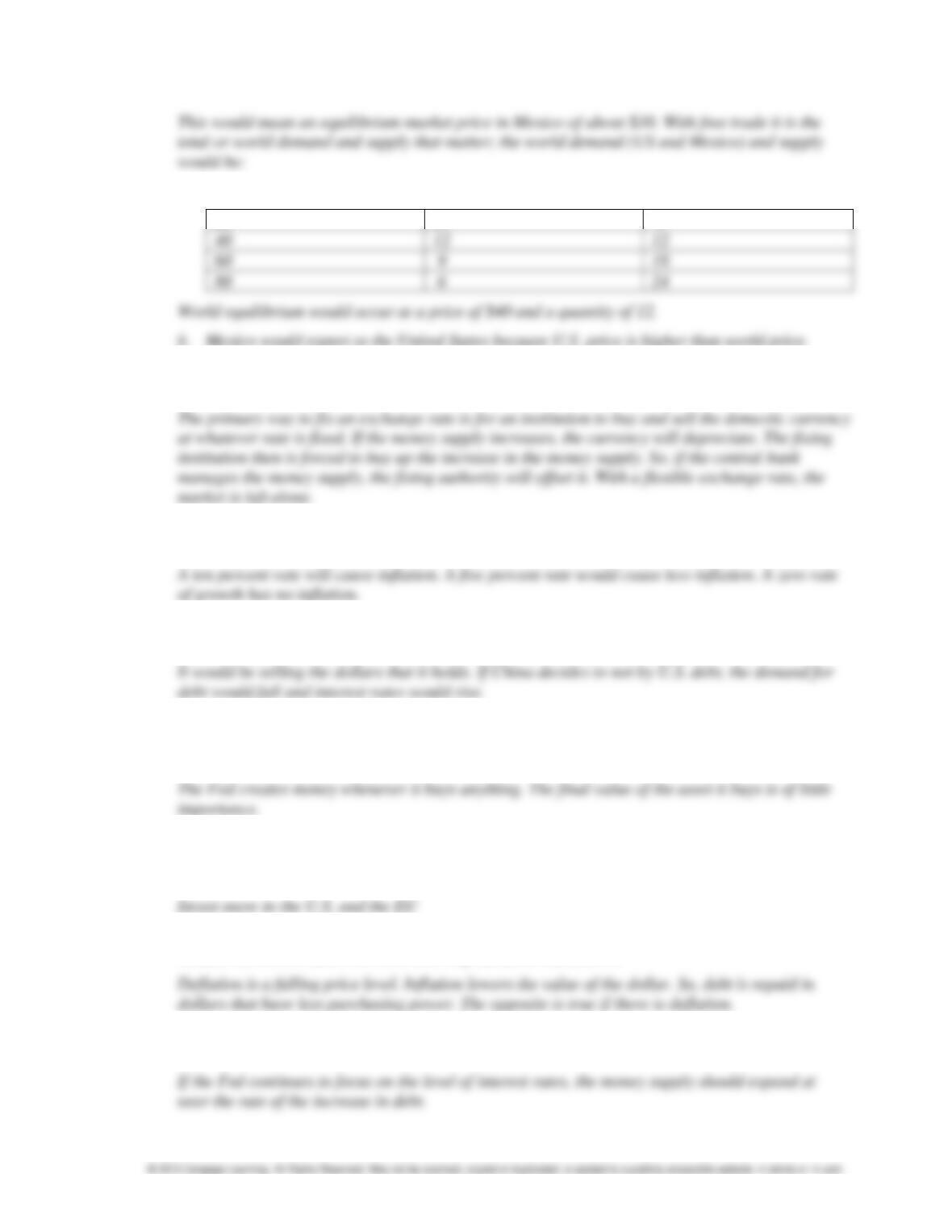
a. In the United States the market price would be 50 and the quantities supplied and demanded
Price in Dollars
20
5
2
60
3
10
80
2
14
Chapter 20: The Firm in a National and a Global Setting 99
Price in Dollars
20
15
6
60
9
18
80
6
24
b. Mexico would export to the United States because U.S. price is higher than world price.
11. Explain why flexible exchange rates allow a country to have independence for its monetary policy
and fixed exchange rates do not.
12. What would be the likely effect of the Fed allowing the money supply to grow at a rate of ten
percent a year? Five percent? Zero percent?
13. What does it mean to say that China is going to dump U.S. dollars? What if China decides not to
purchase any more U.S. debt?
14. The Federal Reserve increased its balance sheet by purchasing so-called “toxic” assets from large
banks who were holding them. This was an attempt to capitalize the banks. What does it mean
for the Fed? What happens if the assets end up having no value?
15. You are managing a multi-national enterprise that does business in the EU, the U.S., and Latin
America. What would you do if you expected Latin America’s inflation rate on average to be
double that of the U.S. and the EU?
16. If inflation is a rise in prices throughout the economy, what is deflation? Explain why inflation
reduces the cost of debt over time and why deflation increases it.
17. What type of monetary policy would you anticipate to occur over the next several years in the
United States given the huge increase in debt that occurred in 2009 and 2010? Explain.
18. An overvalued currency is one that is expected to decline in value relative to other currencies.
What is the effect on a firm that produces in the country whose currency is overvalued and sells to
other nations?
19. Explain the effects of an increase in the value of the domestic currency on your firm’s revenues
under each of the following conditions:
a. Your firm sells only domestically.
b. Your firm purchases supplies from other countries
c. Your firm sells products domestically and in other countries
d. Your firm has manufacturing plants located in other countries
a. Sales will decrease to the extent there are foreign produced substitutes.