20-1
CHAPTER 20
Accounting for Pensions and Postretirement Benefits
ASSIGNMENT CLASSIFICATION TABLE (BY TOPIC)
Topics
Questions
Brief
Exercises
Exercises
Problems
Concepts
for Analysis
1. Basic definitions and
concepts related to
pension plans.
1, 2, 3, 4,
5, 6, 7,
8, 9, 12,
24, 30
16
1, 2, 3,
4, 5, 7
5. Corridor calculation.
18
7
8, 13, 14,
16, 17, 18
2, 3, 5, 6, 7,
8, 11, 12
3, 4, 5, 6
6. Prior service cost.
12, 13, 20
5, 6, 8
1, 2, 3, 5,
9, 11, 12,
13, 14
1, 2, 3, 4,
6, 7, 8, 9,
11, 12
1, 4
7. Gains and losses.
14, 17,
21, 22
7, 9
8, 9, 13, 14,
16, 17
1, 2, 3, 4, 5, 6,
7, 8, 9, 11, 12
4, 5, 6
9, 11, 12
11, 12
*10. Postretirement benefits.
26, 27,
28, 29
11, 12
19, 20, 21,
22, 23, 24
13, 14
2. Worksheet preparation.
3
3, 4, 7, 10,
14, 15, 18
1, 2, 4, 7, 8, 9,
10, 11, 12
3. Income statement
recognition, computation
of pension expense.
9, 10, 11,
13, 16, 17
1, 2, 4
1, 2, 3, 6,
11, 13, 14,
15, 16,
17, 18
1, 2, 3, 4, 5,
6, 9, 11, 12
4, 5
4. Balance sheet recognition,
computation of pension
15, 19, 20,
22, 23
6, 10
3, 9, 11, 12,
13, 14
1, 2, 3, 4,
5, 6, 7, 8,
9, 11, 12
2, 5, 7
20-2
ASSIGNMENT CLASSIFICATION TABLE (BY LEARNING OBJECTIVE)
Learning Objectives
Brief
Exercises
Exercises
Problems
1. Distinguish between accounting for the
employer’s pension plan and accounting
for the pension fund.
11, 12
6. Describe the amortization of prior service costs.
5
1, 2, 5, 7,
12, 13
1, 2, 3, 4,
6, 7, 8, 9,
10, 11, 12
7. Explain the accounting for unexpected gains and
12, 13
1, 2, 3, 4,
5, 6, 7, 8, 9,
10, 11, 12
and losses.
7
8, 12, 13,
16, 17, 18
3, 4, 5, 6,
8, 11, 12
9. Describe the requirements for reporting pension
plans in financial statements.
6, 8, 9, 10
9, 11,12, 13
1, 2, 3, 4,
8, 11, 12
*10. Identify the differences between pensions and
postretirement healthcare benefits.
11, 12
19, 20, 21,
22, 23, 24
13, 14
*11. Contrast accounting for pensions to accounting
for other postretirement benefits.
11, 12
19, 20, 21,
22, 23, 24
13, 14
characteristics.
pension obligation.
1, 2, 4
1, 2, 6, 11,
12, 13, 15
5. Use a worksheet for employer’s pension plan
3
3, 4, 7, 10,
11, 14, 18
1, 2, 4, 7,
8, 9, 10,
20-3
ASSIGNMENT CHARACTERISTICS TABLE
Item
Description
Level of
Difficulty
Time
(minutes)
E20-1
Pension expense, journal entries.
Simple
15–20
E20-2
Computation of pension expense.
Simple
10–15
E20-3
Preparation of pension worksheet.
Moderate
15–25
E20-4
Basic pension worksheet.
Simple
10–15
pension expense.
E20-14
Worksheet for E20-13.
Complex
40–50
E20-15
Pension expense, journal entries.
Moderate
15–20
E20-16
Amortization of accumulated OCI (G/L), corridor approach,
pension expense computation.
Moderate
25–35
E20-17
Amortization of accumulated OCI balances.
Moderate
30–40
E20-18
Pension worksheet—missing amounts.
Moderate
20–25
*E20-19
Postretirement benefit expense computation.
Moderate
5–10
*E20-20
Postretirement benefit worksheet.
Moderate
25–30
*E20-21
Postretirement benefit expense computation.
Simple
10–12
*E20-22
Postretirement benefit expense computation.
Simple
10–12
*E20-23
Postretirement benefit worksheet.
Moderate
15–20
*E20-24
Postretirement benefit worksheet—missing amounts.
Moderate
25–30
P20-1
2-year worksheet.
Moderate
40–50
P20-2
3-year worksheet, journal entries, and reporting.
Complex
45–55
P20-3
Pension expense, journal entries, amortization of loss.
Complex
40–50
P20-4
Pension expense, journal entries for 2 years.
Moderate
30–40
P20-5
Computation of pension expense, amortization of net gain or
loss-corridor approach, journal entries for 3 years.
Complex
45–55
P20-6
expense, journal entries, and net gain or loss.
P20-7
Pension worksheet.
Moderate
35–45
P20-8
Comprehensive 2-year worksheet.
Complex
45–60
P20-9
Comprehensive 2-year worksheet.
Moderate
40–45
P20-10
Pension worksheet—missing amounts.
Moderate
25–30
P20-11
Pension worksheet.
Moderate
35–45
P20-12
Pension worksheet.
Moderate
35–45
*P20-13
Postretirement benefit worksheet.
Moderate
30–35
*P20-14
Postretirement benefit worksheet—2 years.
Moderate
40–45
Computation of prior service cost amortization, pension
Complex
45–60
E20-5
Application of years-of-service method.
Moderate
15–25
E20-6
Computation of actual return.
Simple
10–15
E20-7
Basic pension worksheet.
Moderate
15–25
E20-8
Application of the corridor approach.
Moderate
20–25
E20-9
Disclosures: Pension expense and other comprehensive income.
Moderate
25–35
E20-10
Pension worksheet.
Moderate
20–25
E20-11
Pension expense, journal entries, statement presentation.
Moderate
20–30
E20-12
Pension expense, journal entries, statement presentation.
Moderate
20–30
E20-13
Computation of actual return, gains and losses, corridor test, and
Complex
35–45

20-4
ASSIGNMENT CHARACTERISTICS TABLE (Continued)
Item
Description
Level of
Difficulty
Time
(minutes)
CA20-1
Pension terminology and theory.
Moderate
30–35
CA20-2
Pension terminology.
Moderate
25–30
CA20-3
Basic terminology.
20–25
CA20-4
Major pension concepts.
Moderate
30–35
CA20-5
Implications of GAAP rules on pensions.
50–60
CA20-6
Gains and losses, corridor amortization.
Moderate
30–40
CA20-7
Nonvested employees—an ethical dilemma.
Moderate
20–30
SOLUTIONS TO CODIFICATION EXERCISES
CE20-1
Master Glossary
(b) A plan that defines postretirement benefits in terms of monetary amounts (for example, $100,000
of life insurance) or benefit coverage to be provided (for example, up to $200 per day for
hospitalization, or 80 percent of the cost of specified surgical procedures). Any postretirement
benefit plan that is not a defined contribution postretirement plan is, for purposes of Subtopic
715–60, a defined benefit postretirement plan. (Specified monetary amounts and benefit
coverage are collectively referred to as benefits).
CE20-2
According to FASB ASC 715-30–35-43 (Defined-Benefit Plans – Pension – Discount Rates):
Assumed discount rates shall reflect the rates at which the pension benefits could be effectively settled.
20-6
CE20-3
According to FASB ASC 715-30–35-4 (Defined-Benefit Plans – Pension – Components of Net Periodic
Cost):
All of the following components shall be included in the net pension cost recognized for a period by an
employer sponsoring a defined-benefit pension plan:
(a) Service cost
(b) Interest cost
CE20-4
According to FASB ASC 715-20–50-6 (Defined-Benefit Plans – General – Interim Disclosure
Requirements for Publicly Traded Entities):
(a) The amount of net benefit cost recognized, for each period for which a statement of income is
presented, showing separately each of the following:
1. The service cost component
(b) The total amount of the employer’s contributions paid, and expected to be paid, during the current
fiscal year, if significantly different from amounts previously disclosed pursuant to paragraph 715–
20–50-1(g). Estimated contributions may be presented in the aggregate combining all of the
following:
ANSWERS TO QUESTIONS
**1. A private pension plan is an arrangement whereby a company undertakes to provide its retired
employees with benefits that can be determined or estimated in advance from the provisions of a
**2. A defined-contribution plan specifies the employer’s contribution to the plan usually based on a
formula, which may consider such factors as age, length of service, employer’s profit, or compen–
sation levels.
**3. The employer is the organization sponsoring the pension plan. The employer incurs the costs
and makes contributions to the pension fund. Accounting for the employer involves:
(1) allocating the cost of the pension plan to the proper accounting periods, (2) measuring the
amount of pension obligation resulting from the plan, and (3) disclosing the status and effects of
the plan in the financial statements.
**4. When the term “fund” is used as a noun, it refers to assets accumulated in the hands of a
funding agency for the purpose of meeting pension benefits when they become due. When the
term “fund” is used as a verb, it means to pay over to a funding agency (as to fund future pension
benefits or to fund pension cost).
**5. An actuary’s role is to ensure that the company has established an appropriate funding pattern to
meet its pension obligations, to make predictions and assumptions about future events and
conditions that affect pension costs, and to assist the accountant in measuring facets of the pension
**6. In measuring the amount of pension benefits under a defined-benefit pension plan, an actuary
must consider such factors as mortality rates, employee turnover, interest and earnings rates,
early retirement frequency, and future salaries.
Questions Chapter 20 (Continued)
**7. One measure of the pension obligation is the vested benefit obligation. This measure uses only
current salary levels and includes only vested benefits; that is, benefits the employee is already
entitled to receive even if the employee renders no additional services under the plan.
**8. Cash-basis accounting recognizes pension cost as being equal to the amount of cash paid by
the employer to the pension fund in any period; pension funding serves as the basis for expense
recognition under the cash basis.
**9. The five components of pension expense are:
(1) Service cost—the actuarial present value of benefits attributed by the pension benefit
formula to employee service during the period.
(2) Interest cost—the increase in the projected benefit obligation as a result of the passage of
10. The service cost component of net periodic pension expense is determined as the actuarial
present value of benefits attributed by the pension benefit formula to employee service during the
11. The interest component is the interest for the period on the projected benefit obligation outstanding
during the period. The assumed discount rate should reflect the rates at which pension benefits
could be effectively settled (settlement rates). Companies should look to rates of return on high-
quality fixed-income investments currently available whose cash flows match the timing and
amount of the expected benefit payments.
20-9
Questions Chapter 20 (Continued)
*12. Service cost is the actuarial present value of benefits attributed by the pension benefit formula to
employee service during the period. Actuaries compute service cost at the present value of
*13. When a defined-benefit plan is either initiated or amended, credit is often given to employees for
years of service provided before the date of initiation or amendment. The cost of these retroactive
benefits are referred to as prior service costs. Employers grant retroactive benefits because they
*14. Liability gains and losses are unexpected gains or losses from changes in the projected benefit
obligation. Liability gains (resulting from unexpected decreases) and liability losses (resulting
from unexpected increases) are recognized in other comprehensive income. The accumulated
gains and losses are then amortized, subject to complex amortization guidelines in other
comprehensive income.
*15. If pension expense recognized in a period exceeds the current amount funded, a liability account
referred to as Pension Asset /Liability arises; the account would be reported either as a current or
*16. Computation of actual return on plan assets
Fair value of plan assets at end of period ……………………………. $10,150,000
*17. An asset gain occurs when the actual return on the plan assets is greater than the expected
return on plan assets while an asset loss occurs when the actual return is less than the expected
return on the plan assets. A liability gain results from unexpected decreases in the pension
obligation and a liability loss results from unexpected increases in the pension obligation.
*18. Corridor amortization occurs when the accumulated OCI (G/L) balance gets too large. The gain
or loss is too large when it exceeds the arbitrarily selected FASB criterion of 10% of the larger of
Questions Chapter 20 (Continued)
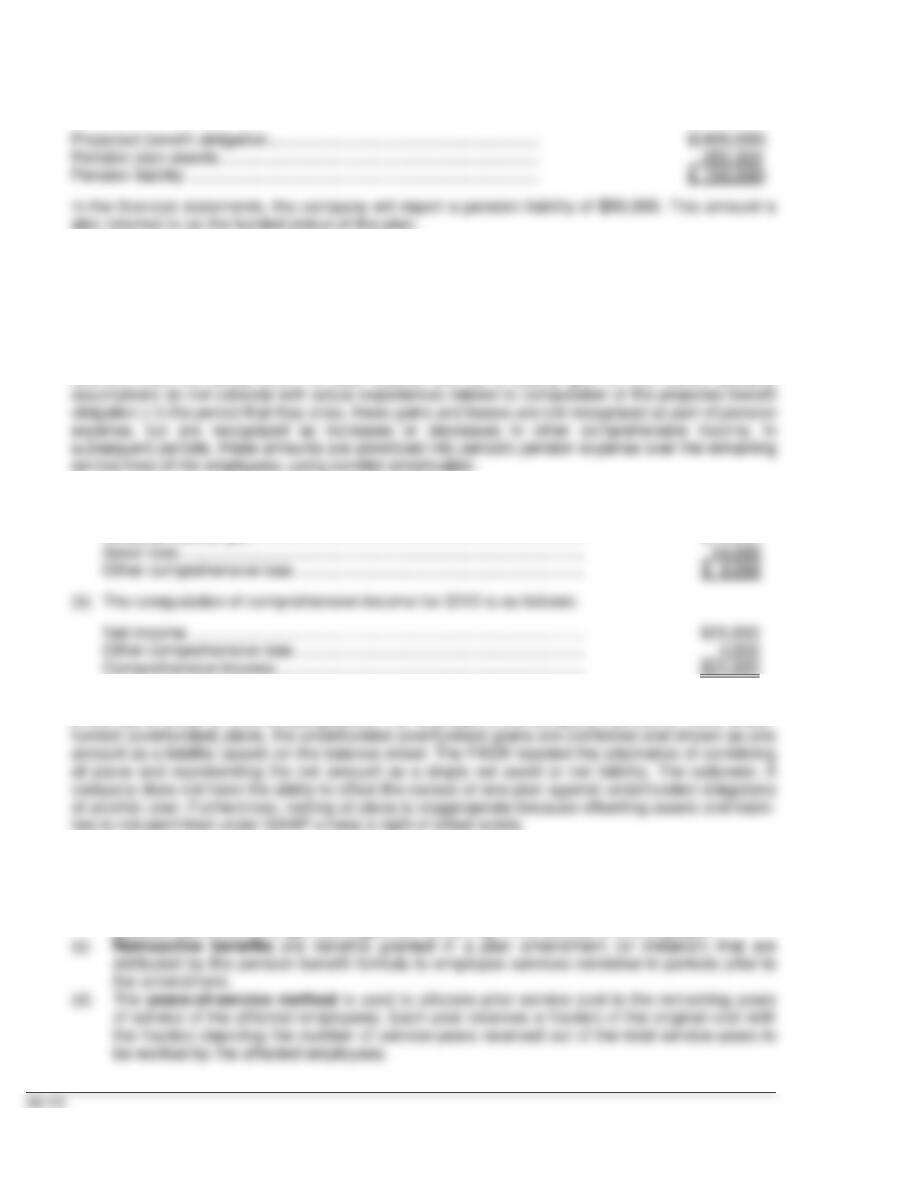
*19. The amount of the pension asset/liability to be reported on the company’s balance sheet is as
follows:
*20. The prior service cost arising in the year of the amendment (which increases the projected
benefit obligation) is recognized by an offsetting debit to Other Comprehensive Income (PSC). In
subsequent periods, the $9,150,000 will be amortized into periodic pension expense over the
remaining service lives of the employees. This approach is consistent with the treatment for
actuarial gains and losses.
*21. Actuarial gains or losses arise from (1) asset gains or losses (when the expected return is
different than the actual return on plan assets) and (2) a liability gain or loss (when actuarial
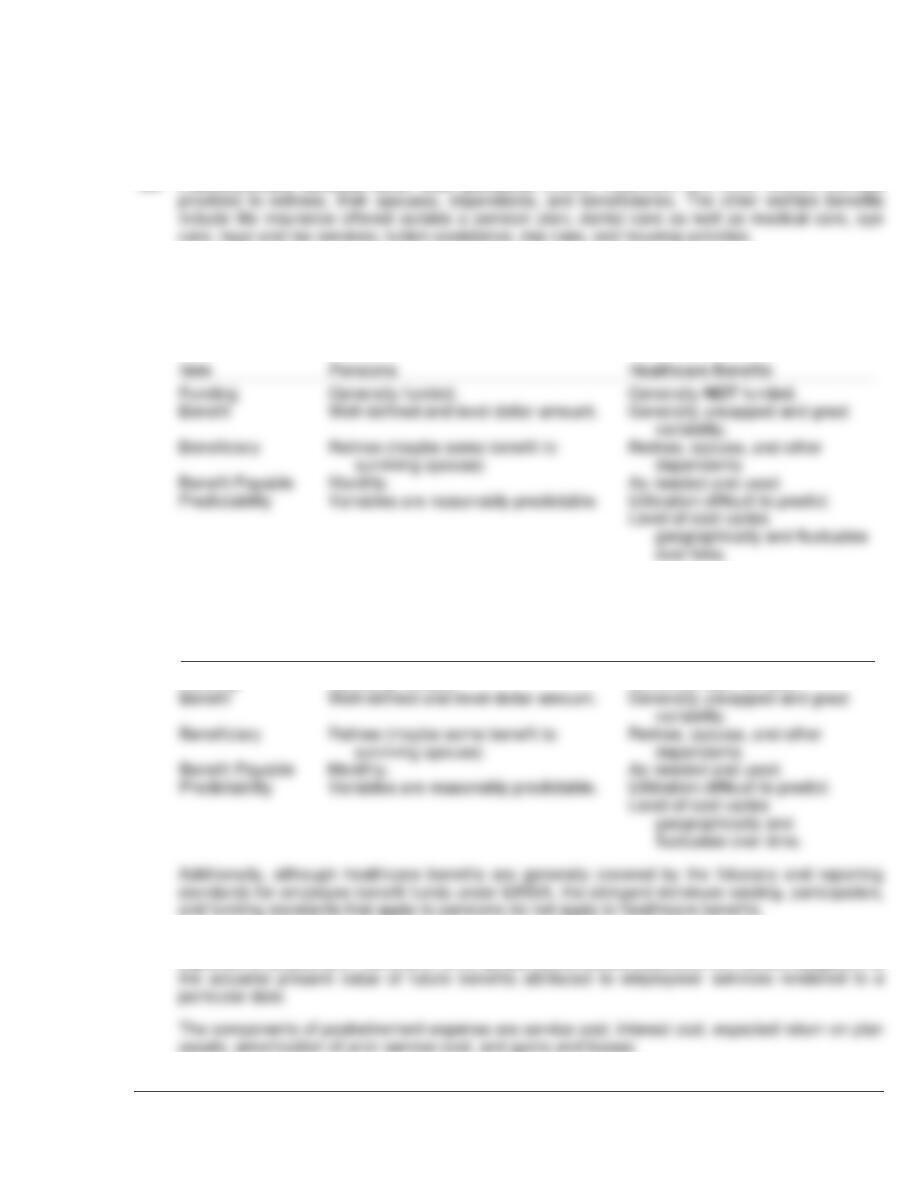
*22. (a) Other Comprehensive Income for 2013 is as follows:
Actuarial liability gain ……………………………………………………………. $10,000
*23. Multiple plans may be combined and shown as one amount on the balance sheet, only if they are
in the same under or overfunded position. For example, if the company has two or more under–
*24. (a) A contributory plan is a pension plan under which employees contribute part of the cost.
In some contributory plans, employees wishing to be covered must contribute; in other
contributory plans, employee contributions result in increased benefits.
(b) Vested benefits are benefits for which the employee’s right to receive a present or future
pension benefit is no longer contingent on remaining in the service of the employer.
20–11
Questions Chapter 20 (Continued)
*25. The accounting issue that arises from these terminations is whether a gain should be recognized
by the corporation when these assets revert (often called asset reversion transactions) to the
company. The profession requires that these gains or losses be reported immediately in most
situations.
*26. Postretirement benefits other than pensions include healthcare and other welfare benefits
*27. The FASB did not cover both pensions and healthcare benefits in the earlier pension accounting
rules because of the significant differences between the two types of postretirement benefits.
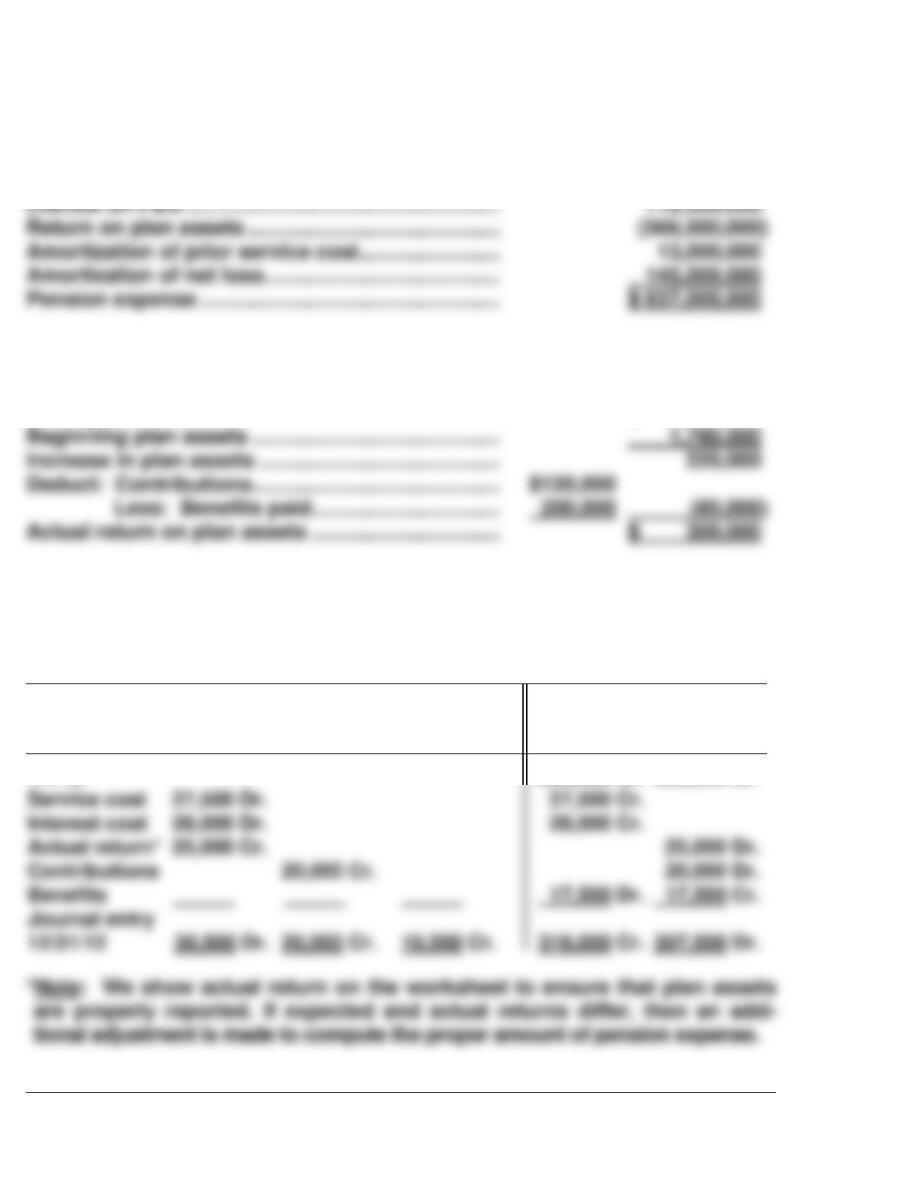
These differences are listed in the following schedule:
Differences between Postretirement Healthcare Benefits and Pensions
Item
Pensions
Healthcare Benefits
Funding
Generally funded.
Generally NOT funded.
Benefit Payable
Monthly.
As needed and used.
*28. The major differences between pension benefits and postretirement benefits are listed below:
Differences between Postretirement Healthcare Benefits and Pensions
Item
Pensions
Healthcare Benefits
Funding
Generally funded.
Generally NOT funded.
Benefit Payable
Monthly.
As needed and used.
*29. EPBO (expected postretirement benefit obligation) is the actuary’s present value of all benefits
expected to be paid after retirement, while APBO (accumulated postretirement benefit obligation) is
20–12
SOLUTIONS TO BRIEF EXERCISES
BRIEF EXERCISE 20-1
Service cost ………………………………………………….. $ 333,000,000
BRIEF EXERCISE 20-2
Ending plan assets ………………………………………… $ 2,000,000
BRIEF EXERCISE 20-3
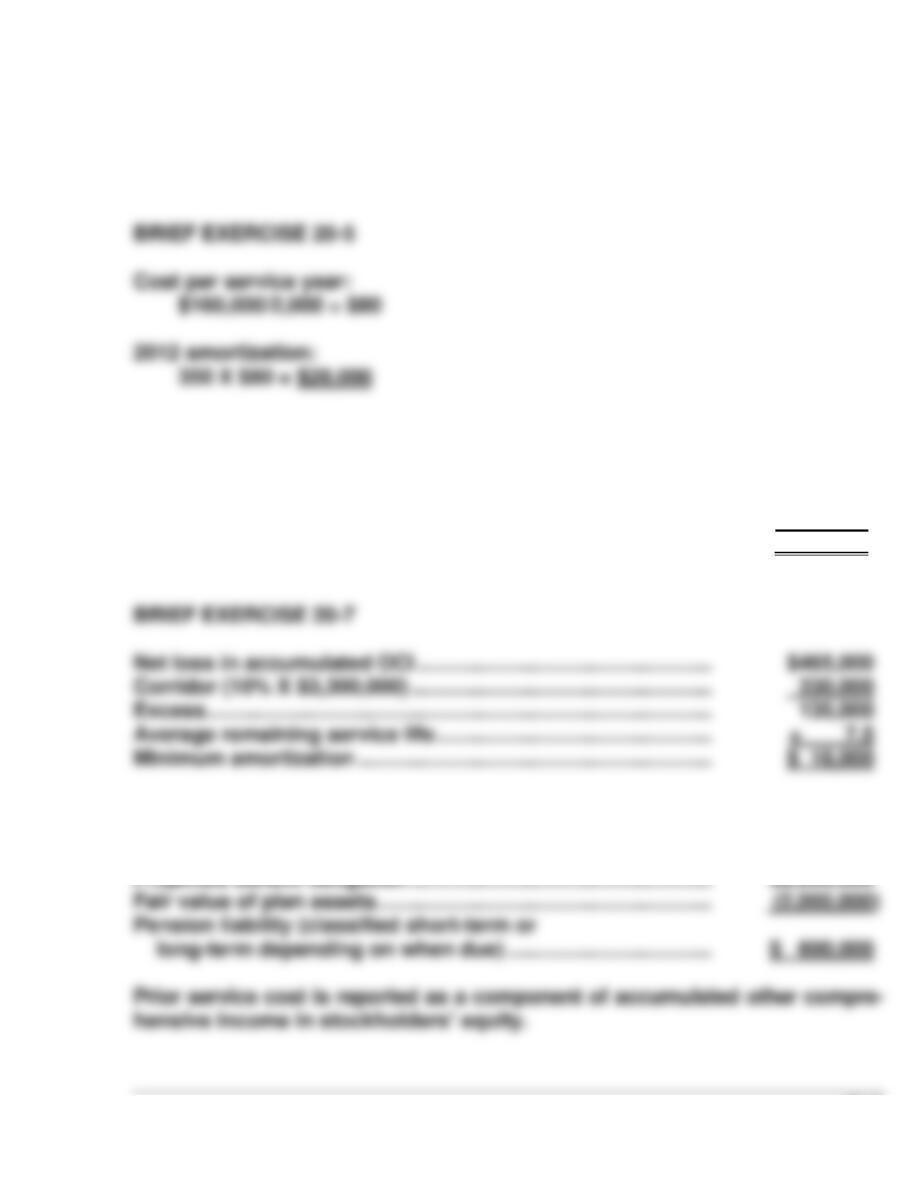
BEATY COMPANY
General Journal Entries
Memo Record
Items
Pension
Expense
Cash
Pension
Asset /Liability
Projected
Benefit
Obligation
Plan
Assets
1/1/12
280,000 Cr.
280,000 Dr.
20–13
BRIEF EXERCISE 20-4
Pension Expense……………………………………………. 68,000,000
Pension Asset/Liability …………………………………… 216,000,000
Cash ……………………………………………………….. 284,000,000
BRIEF EXERCISE 20-6
Project benefit obligation ………………………………………………. $(560,000)
Plan assets at fair value …………………………………………………. 322,000
Pension liability …………………………………………………………….. $(238,000)
BRIEF EXERCISE 20-8
20–14
BRIEF EXERCISE 20-9
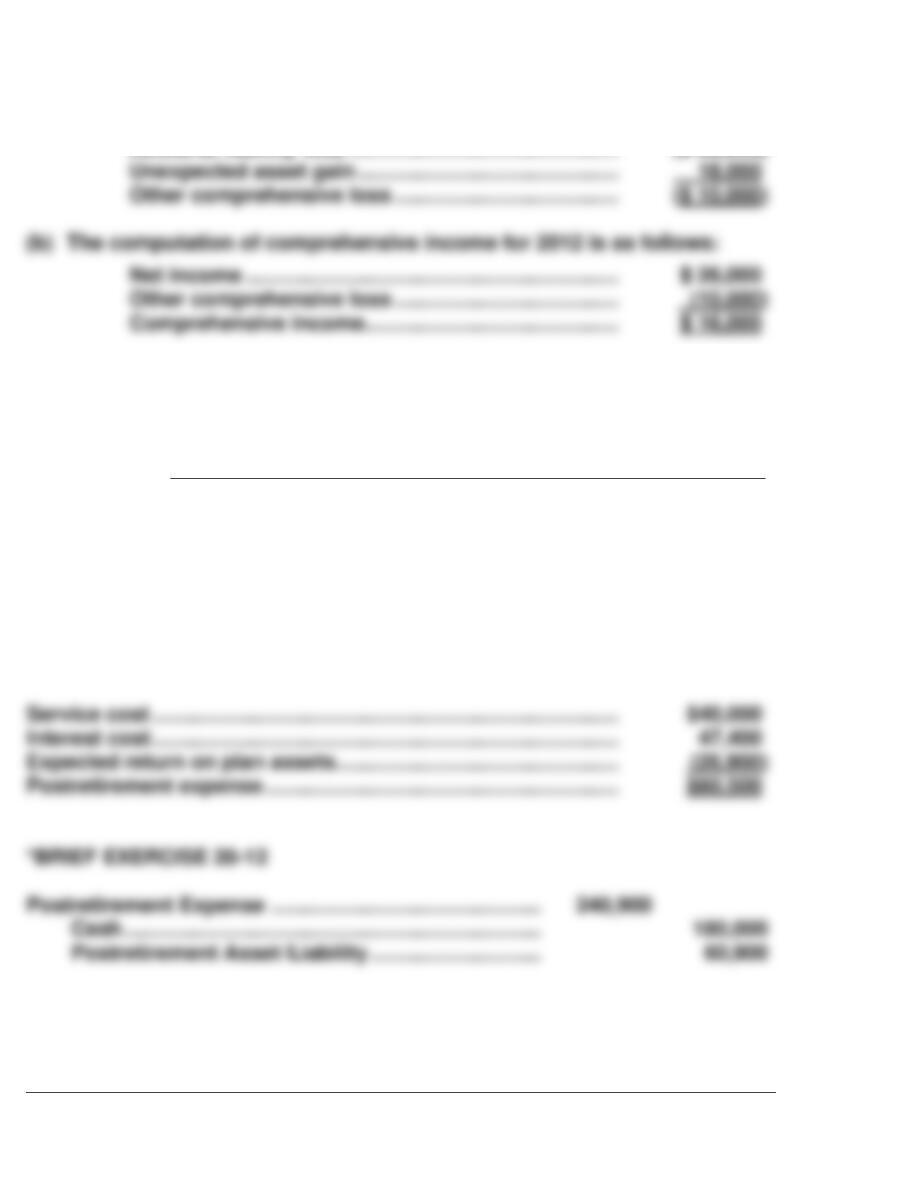
(a) Other Comprehensive Loss for 2012 is as follows:
Actuarial liability loss ………………………………………. ($ 28,000)
BRIEF EXERCISE 20-10
Pension Assets
(at fair value)
Projected Benefit
Obligation
Pension Asset /
Liability
Plan X
$600,000
$500,000
$100,000 asset
Plan Y
$900,000
$720,000
$180,000 asset
Plan Z
$550,000
$700,000
$150,000 liability
Lahey reports a pension asset of $280,000 ($100,000 + $180,000) and a pension
liability of $150,000.
*BRIEF EXERCISE 20-11
20–15
SOLUTIONS TO EXERCISES
EXERCISE 20-1 (15–20 minutes)
(a) Computation of pension expense:
Service cost …………………………………………….. $ 60,000
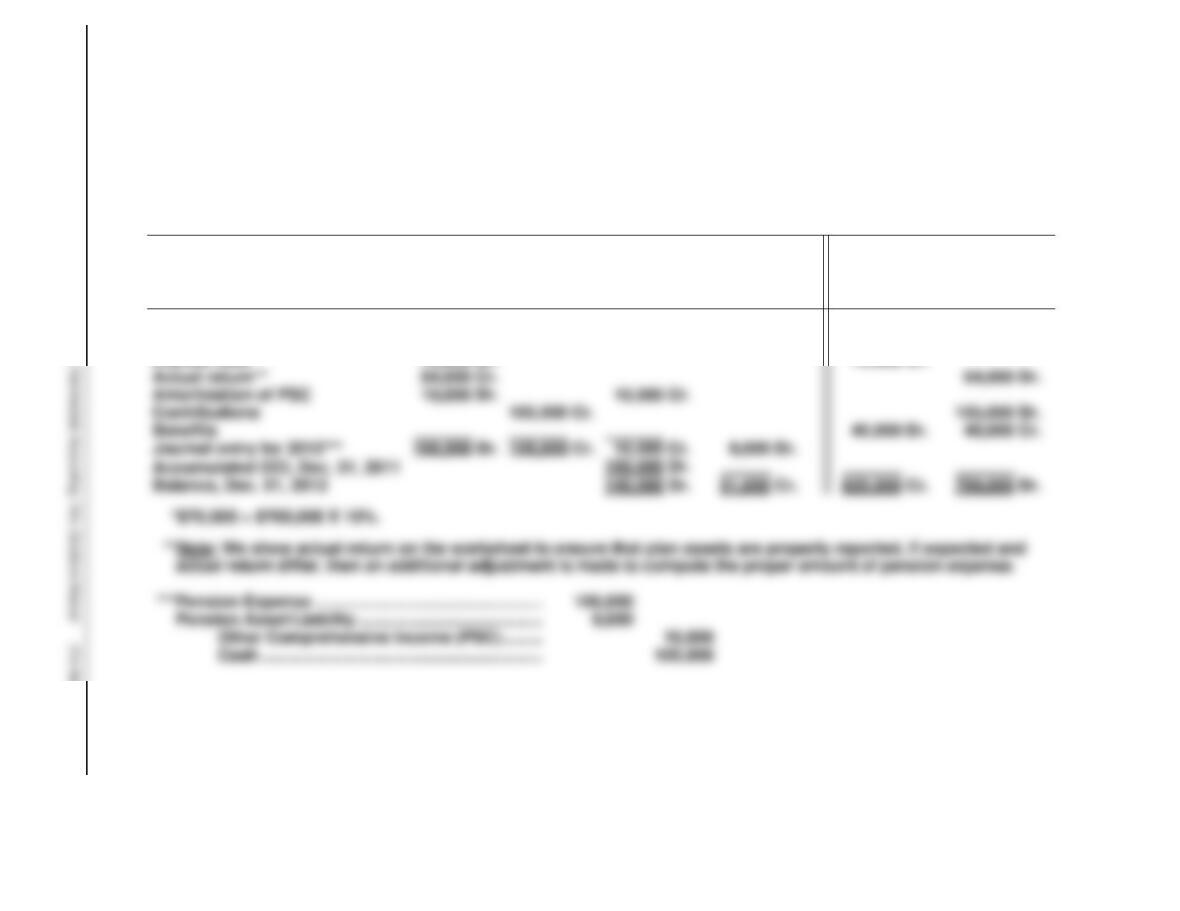
EXERCISE 20-2 (10–15 minutes)
Computation of pension expense:
EXERCISE 20-3 (15–25 minutes)
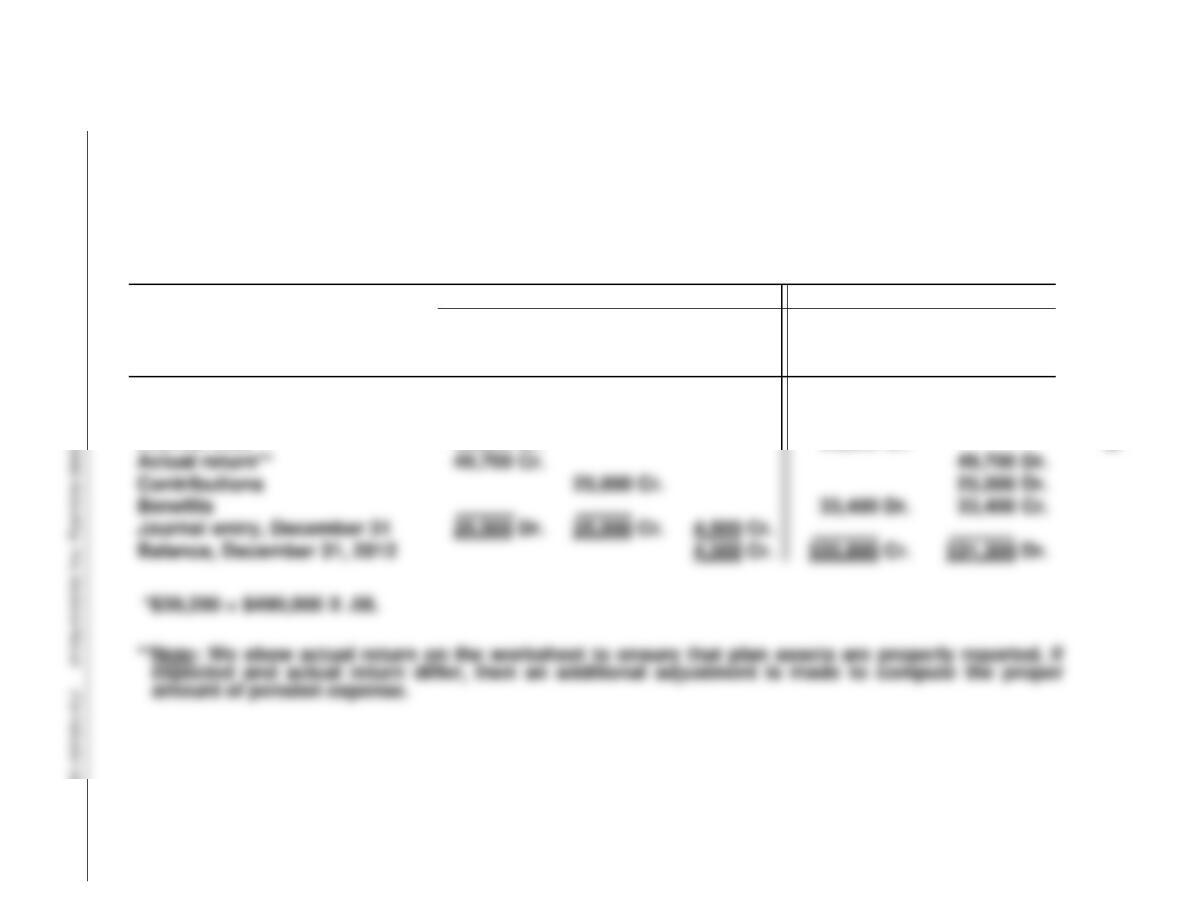
20–16 Copyright © 2011 John Wiley & Sons, Inc. Kieso, Intermediate Accounting, 14/e, Solutions Manual (For Instructor Use Only)
VELDRE COMPANY
Pension Worksheet—2012
General Journal Entries
Memo Record
Items
Annual
Pension
Expense
Cash
OCI
Prior Service
Cost
Pension
Asset/Liability
Projected
Benefit
Obligation
Plan Assets
Balance, January 1, 2012
60,000 Cr.
700,000 Cr.
640,000 Dr.
Service cost
90,000 Dr.
90,000 Cr.
Interest cost*
70,000 Dr.
70,000 Cr.
Actual return**
64,000 Cr.
Amortization of PSC
10,000 Dr.
10,000 Cr.
Contributions
Benefits
40,000 Dr.
Journal entry for 2012***
105,000 Cr.
9,000 Dr.
Balance, Dec. 31, 2012
140,000 Dr.
51,000 Cr.
820,000 Cr.
EXERCISE 20-4 (10–15 minutes)
Copyright © 2011 John Wiley & Sons, Inc. Kieso, Intermediate Accounting, 14/e, Solutions Manual (For Instructor Use Only) 20–17
BOUDREAU INC.
Pension Worksheet—2012
General Journal Entries
Memo Record
Items
Annual
Pension
Expense
Cash
Pension
Asset /
Liability
Projected
Benefit
Obligation
Plan
Assets
Balance, January 1, 2012
490,000 Cr.
490,000 Dr.
Service cost
40,000 Dr.
40,000 Cr.
Interest cost*
39,200 Dr.
39,200 Cr.
49,700 Cr.
25,000 Cr.
Balance, December 31, 2012
535,800 Cr.
531,300 Dr.
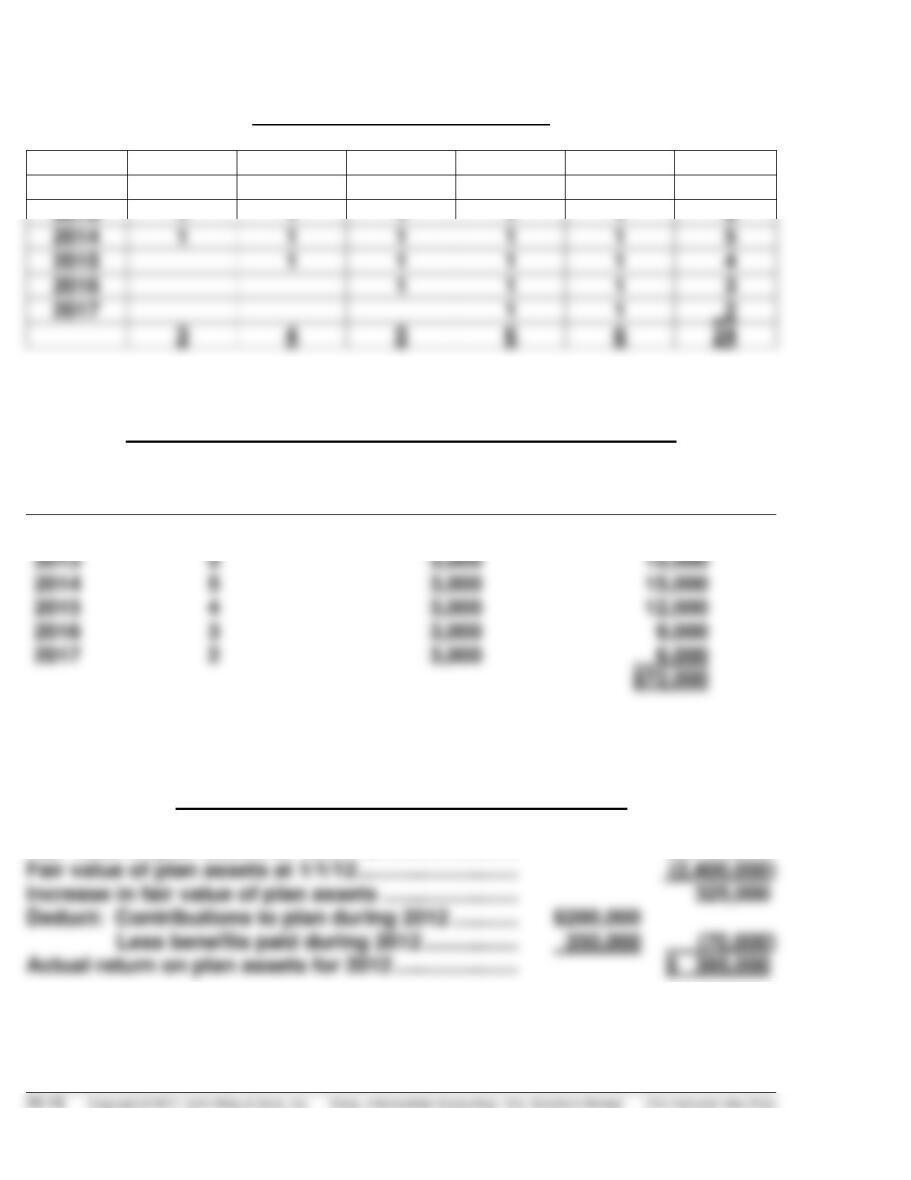
EXERCISE 20-5 (15–25 minutes)
Computation of Service-Years
Year
Jim
Paul
Nancy
Dave
Kathy
Total
2012
1
1
1
1
1
5
2014
1
1
1
1
1
5
2016
1
1
1
3
3
4
5
6
6
Cost per service-year: $72,000 ÷ 24 = $3,000
Computation of Annual Prior Service Cost Amortization
Year
Total
Service-Years
Cost Per
Service-Year
Annual
Amortization
2012
5
$3,000
$15,000
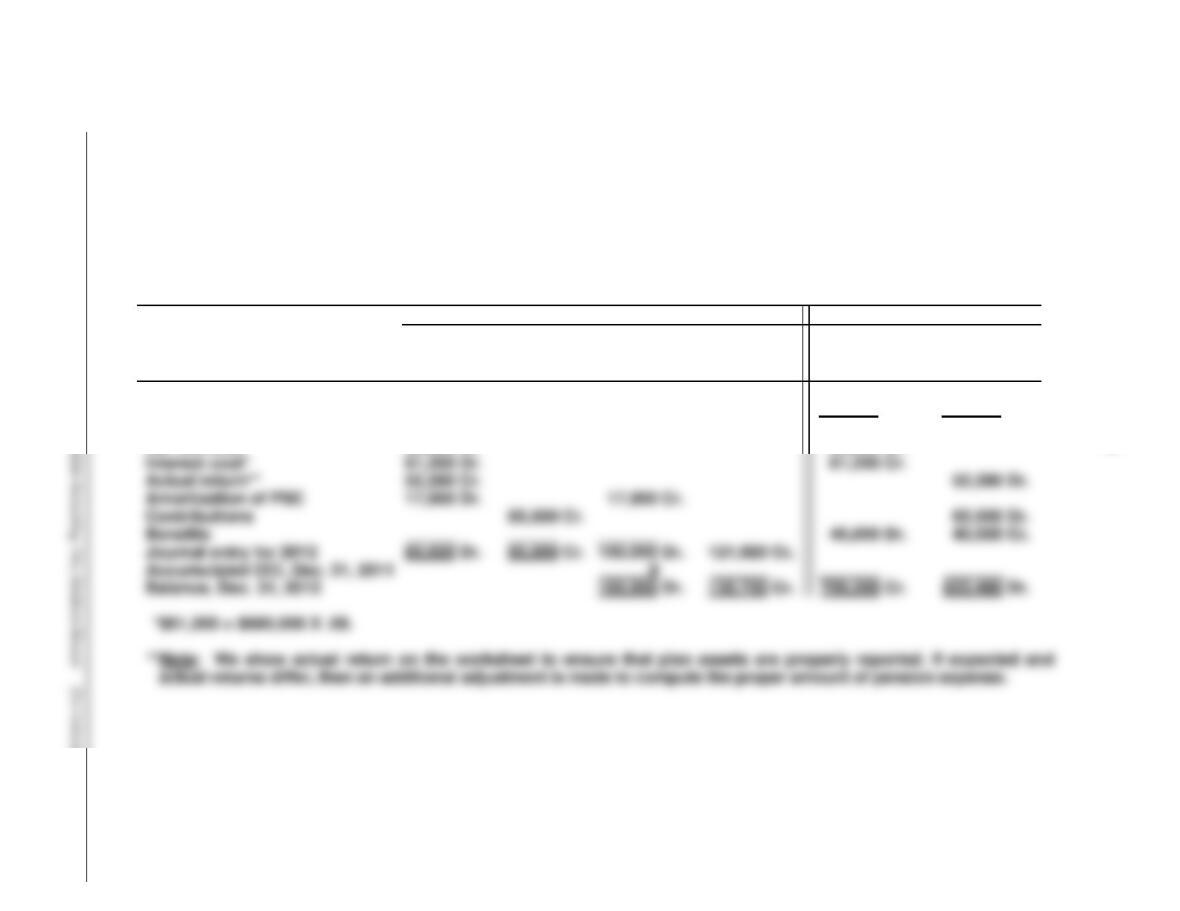
EXERCISE 20-6 (10–15 minutes)
Computation of Actual Return on Plan Assets
Fair value of plan assets at 12/31/12 ………………….. $2,725,000
EXERCISE 20-7 (15–25 minutes)
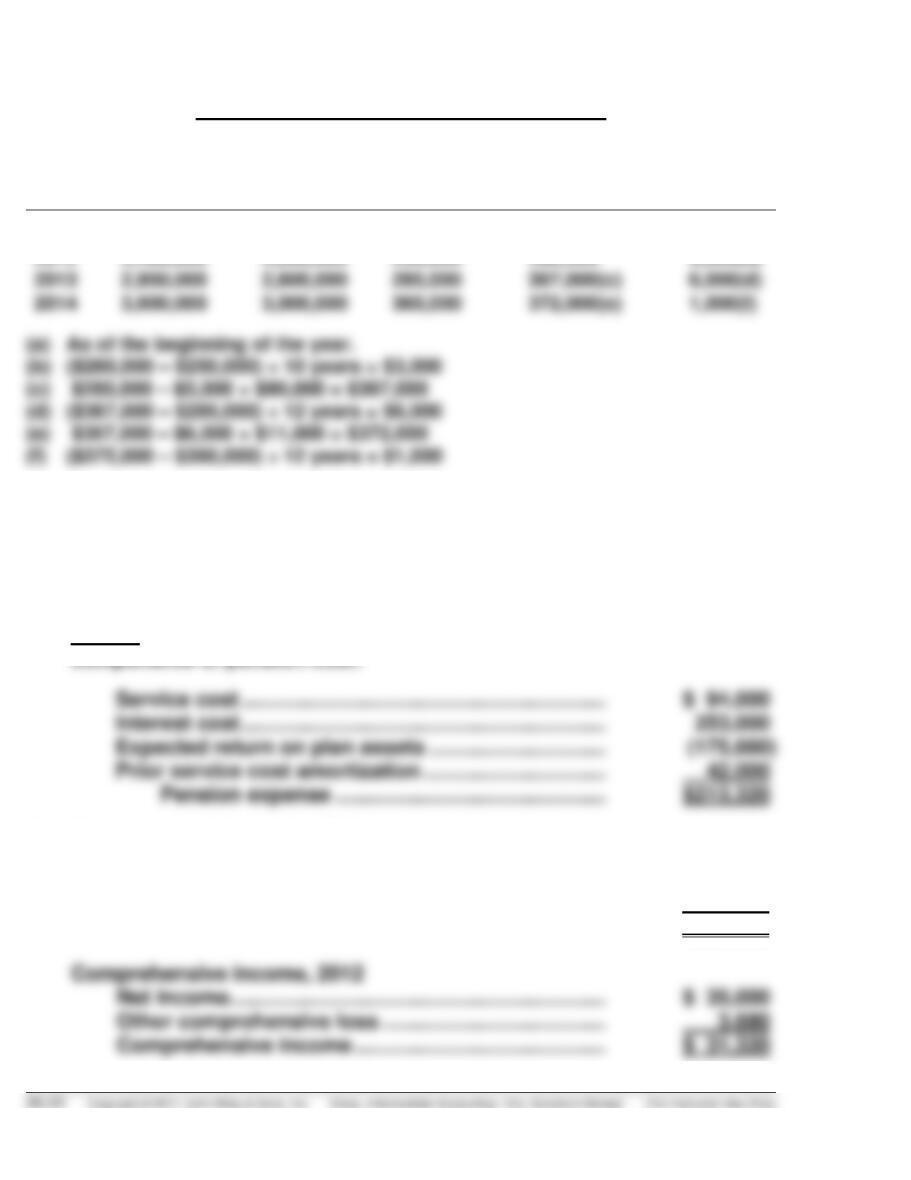
RYDELL CORP.
Pension Worksheet—2012
General Journal Entries
Memo Record
Items
Annual
Pension
Expense
Cash
OCI–Prior
Service
Cost
Pension
Asset/
Liability
Projected
Benefit
Obligation
Plan
Assets
Balance, Dec. 31, 2011
0
13,800 Cr.
560,000 Cr.
546,200 Dr.
Prior service cost
120,000 Dr.
120,000 Cr.
Balance, Jan. 1, 2012
680,000 Cr.
546,200 Dr.
Service cost
58,000 Dr.
58,000 Cr.
Copyright © 2011 John Wiley & Sons, Inc. Kieso, Intermediate Accounting, 14/e, Solutions Manual (For Instructor Use Only) 20–19
Interest cost*
61,200 Dr.
61,200 Cr.
Actual return**
52,280 Cr.
Amortization of PSC
17,000 Dr.
Contributions
65,000 Cr.
Benefits
40,000 Dr.
Journal entry for 2012
83,920 Dr.
65,000 Cr.
Accumulated OCI, Dec. 31, 2011
Balance, Dec. 31, 2012
759,200 Cr.
623,480 Dr.
EXERCISE 20-8 (20–25 minutes)
Corridor and Minimum Loss Amortization
Year
Projected
Benefit
Obligation (a)
Plan
Assets
10%
Corridor
Accumulated
OCI (G/L) (a)
Minimum
Amortization
of Loss
2011
$2,000,000
$1,900,000
$200,000
$ 0
$ 0
2012
2,400,000
2,500,000
250,000
280,000
3,000(b)
2013
2,950,000
2,600,000
295,000
367,000(c)
6,000(d)
EXERCISE 20-9 (25–35 minutes)
(a) Note to financial statements disclosing components of 2012 pension
expense:
Note X: Net pension expense for 2012 is composed of the following
components of pension cost:
(b) Comprehensive income, 2012
Amortization of prior service cost …………………….. $ (42,000)
Actuarial loss …………………………………………………… 45,680
Other comprehensive loss ……………………………….. $ 3,680