FINANCIAL REPORTING PROBLEM (Continued)
Asset Allocation at June 30
Pension Benefits
Other Retiree Benefits
Asset Category
2009
2009
Equity securities
Debt securities
Real estate
Total
These allocations appear in-line with the expected return assumptions
for these two funds:
2009 Assumptions used to
determine net periodic cost
Pensions
Other Retiree
Expected return on
plan assets
7.4%
9.3%
COMPARATIVE ANALYSIS CASE
(a) Coca-Cola sponsors and/or contributes to pension plans covering
substantially all U.S. employees and certain employees in international
locations. Coca-Cola also sponsors nonqualified, unfunded defined
benefit plans for certain officers and other employees. In addition,
Coca-Cola and its subsidiaries have various pension plans and other
forms of postretirement arrangements outside the United States.
(b) Coca-Cola reported “net periodic benefit cost” of $218 million in 2009.
PepsiCo reported “pension expense” of $258 million in 2009 for U.S. plans.
Coca-Cola
PepsiCo
Discount rate (expense)
6.00%
6.2%
Rate of increase in compensation levels
3.75%
4.4%
Expected long-term rate of return on plan
assets
8.00%
7.8%
COMPARATIVE ANALYSIS CASE (Continued)
Coca-Cola
Cash Flows
Information about the expected cash flow for our pension and other
postretirement benefit plans is as follows:
Pension Benefits
Other Benefits
Expected benefit payments:
2010
$ 230
$ 33
2011
232
35
2012
242
38
2013
252
39
2014
263
40
1,541
PepsiCo
Future Benefit Payments
Our estimated future benefit payments to beneficiaries are as follows:
2010
2011
2012
2013
2014
2015–
2019
Pension
$340
$360
$395
$415
$450
$2,825
Retiree medical
$110
$120
$125
$125
$130
$ 695
In 2010, PepsiCo will make pension contributions of approximately
$700 million, with up to approximately $600 million expected to be
discretionary. The net cash payments for retiree medical are estimated
to be approximately $100 million in 2010.
FINANCIAL STATEMENT ANALYSIS CASE
(a) The components of postretirement expense are service cost, interest
(b) The accounting for defined-benefit plans and OPEBs is very similar.
For example, the measures of the obligation are similar and the com–
ponents of expense and their calculation are the same (with similar
smoothing mechanisms employed for both types of plans with respect to
gains and losses.) There are, however, a number of differences between
Postretirement Healthcare Benefits and Pensions:
Item
Pensions
Healthcare Benefits
Funding
Generally funded.
Generally NOT funded.
dollar amount.
great variability.
Benefit Payable
Monthly.
As needed and used.
fluctuates over time.
Additionally, although healthcare benefits are generally covered by
the fiduciary and reporting standards for employee benefit funds under
ERISA, the stringent minimum vesting, participation, and funding
standards that apply to pensions do not apply to healthcare benefits.
ACCOUNTING, ANALYSIS, AND PRINCIPLES
Accounting
Balance in PBO at 12/31/2013
Balance at 1/1/2013 $820.5
$904.6
Amount of plan assets at 12/31/2013
$516.9
Corridor test and amortization of net gain/loss
Corridor limit: 10% times greater of $820.5 and $476.5 = $ 82.1
Excess of net G/L over corridor limit = $92.0 – $82.1 = 9.9
Amortization = $9.9 ÷ 15 = 0.7
$ 82.6
Balance in pension liability
Projected benefit obligation $904.6
Plan assets (516.9)
Pension liability $387.7
ACCOUNTING, ANALYSIS, AND PRINCIPLES (Continued)
($138.1)
Journal entry:
Pension Expense ……………………………………………… 82.6
Other Comprehensive Income (G/L) ………………….. 46.1
Pension Asset/Liability …………………………….. 43.7
Other Comprehensive Income (PSC) ………… 15.0
Cash………………………………………………………… 70.0
ACCOUNTING, ANALYSIS, AND PRINCIPLES (Continued)
PENCOMP, INC.
Statement of Financial Position
at Dec. 31, 2013
Assets:
Cash ……………………………………………………………………. $ 368.0
Inventory …………………………..…………………………………. 1,800.0
Liabilities:
Note payable ………………………………………………………… $1,000.0
Pension liability ……………………………………………………. 387.7
Total Liabilities ………………………………………… 1,387.7
Plant and equip. = no change from previous statement of financial position.
Accumulated depreciation = [$240 + ($2,000 ÷ 25)] = $320
Inventory = $1,800 given
Cash = $438 – $700 + $3,000 – $2,000 –$100 – $200 – $70 = $368
ACCOUNTING, ANALYSIS, AND PRINCIPLES (Continued)
Analysis
current period income (and therefore from ROE) is that a defined benefit
pension plan is a long-term contract and so it is the long term expected
return on the plan’s assets that is relevant to measuring the cost of
sponsoring the plan. Some people believe that a particularly high or low
return in a given year is not indicative of the long-term return. Others argue
that all returns, high or low, accrue to the plan sponsor and so pension
expense should reflect all returns.
Principles
PROFESSIONAL RESEARCH
(a) According to FASB ASC 715–30–35:
35–22 Asset gains and losses are differences between the actual
return on plan assets during a period and the expected return
on plan assets for that period. Asset gains and losses include
35-24 As a minimum, amortization of a net gain or loss included in
accumulated other comprehensive income (excluding asset
gains and losses not yet reflected in market-related value) shall
be included as a component of net pension cost for a year if,
PROFESSIONAL RESEARCH (Continued)
(b) According to FASB ASC 715–30–35:
Gains and Losses
35–18 As established in the definition of the term, a gain or loss
results from a change in the value of either the projected
benefit obligation or the plan assets resulting from experience
35–19 Because gains and losses may reflect refinements in estimates
as well as real changes in economic values and because some
which they arise.
(c) According to FASB ASC 715–30–25:
25-1 If the projected benefit obligation exceeds the fair value of plan
assets, the employer shall recognize in its statement of
PROFESSIONAL SIMULATION
Measurement
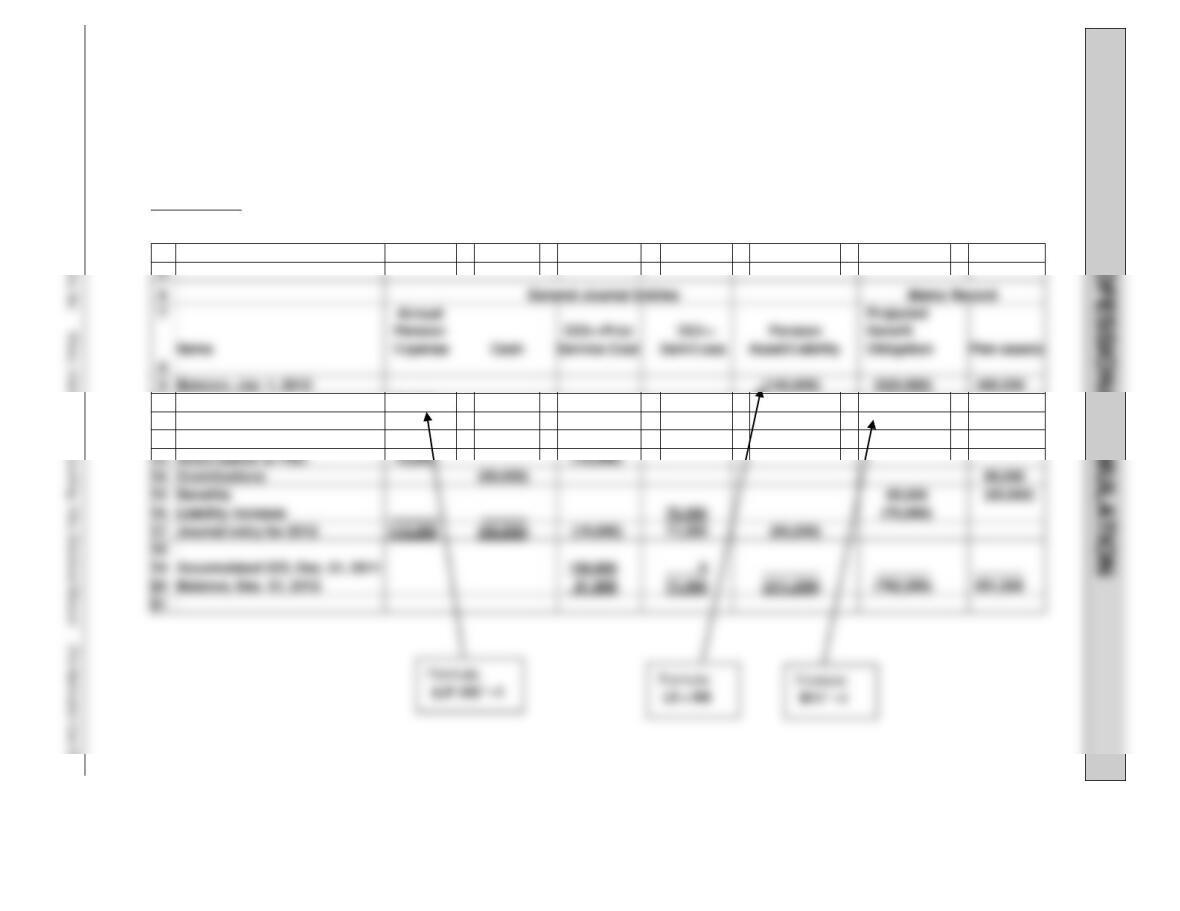
(a)
A
B
C
D
E
F
G
H
I
J
K
L
M
N
10
Service cost
90,000
(90,000)
11
Interest cost
56,250
(56,250)
12
Actual /Expected return
(52,000)
(5,000)
57,000
13
Amortization of PSC
19,000
(19,000)
15
Benefits
(85,000)
16
Liability increase
76,000
(76,000)
17
Journal entry for 2012
113,250
(99,000)
(19,000)
71,000
18
19
Accumulated OCI, Dec. 31, 2011
100,000
20
Balance, Dec. 31, 2012
71,000
(762,250)
21
20–90 Copyright © 2011 John Wiley & Sons, Inc. Kieso, Intermediate Accounting, 14/e, Solutions Manual (For Instructor Use Only)
5
6
Items
Expense
Obligation
Plan assets
Balance, Jan. 1, 2012
(625,000)
480,000
PROFESSIONAL SIMULATION (Continued)
(b) Simply change the formula in cell B11 to multiply by .07; change the
formula in cell B12 to multiply .10 times (N9* – 1).
Journal Entry
Other Comprehensive Income (PSC) ………………… 19,000
Disclosure
Financial Statements
Income Statement
Pension expense …………………………………………….. $113,250
IFRS CONCEPTS AND APPLICATION
IFRS20-1
When a defined benefit plan is either initiated or amended, credit is often
given to employees for years of service provided before the date of initiation
or amendment. The cost of these retroactive benefits are referred to as past
and is a component of net periodic pension expense each period.
IFRS20-2
Corridor amortization occurs when the accumulated unrecognized net gain
or loss balance gets too large. The gain or loss is too large when it exceeds
IFRS20-3
The IASB allows companies to immediately recognize actuarial gains and
losses. If a company chooses immediate recognition, the actuarial gain or
loss can either adjust net income or other comprehensive income.
IFRS20-4
IFRS20-5
Joshua Co. would report a pension liability of $74,300 ($335,000 – $245,000 –
$24,000 + $8,300).
IFRS20-7
(a) Income Statement
Revenues $125,000
Expenses 85,000
Doreen Corp.
Pension Worksheet—2012
General Journal Entries
Memo Record
Items
Annual
Pension
Expense
Cash
Pension
Asset/
Liability
Defined
Benefit
Obligation
Plan
Assets
Unrecognized
Past
Service Cost
(d) Actual return*
52,280 Cr.
52,280 Dr.
(e) Amortization of PSC
17,000 Dr.
17,000 Cr.
(f) Contributions
55,000 Cr.
55,000 Dr.
(g) Benefits
40,000 Dr.
40,000 Cr.
Journal entry, December 31
82,120 Dr.
55,000 Cr.
Balance, December 31, 2012
613,480 Dr.
83,000 Dr.
20–94 Copyright © 2011 John Wiley & Sons, Inc. Kieso, Intermediate Accounting, 14/e, Solutions Manual (For Instructor Use Only)
IFRS20-8
Balance, January 1, 2012
546,200 Dr.
(a) Prior service cost
New balance, January 1, 2012
546,200 Dr.
(b) Service cost
58,000 Dr.
58,000 Cr.
(c) Interest cost
59,400 Dr.
59,400 Cr.
(a) Buhl Corp.
Pension Worksheet
General Journal Entries
Memo Record
Items
Annual
Pension
Expense
Cash
Pension
Asset/
Liability
Defined
Benefit
Obligation
Plan
Assets
Unrecognized
Past
Service Cost
Unrecognized
Net Gain
or Loss
Balance, January 1, 2012
45,000 Cr.
625,000 Cr.
480,000 Dr.
100,000 Dr.
(h) Benefits
85,000 Dr.
85,000 Cr.
Journal entry
113,250 Dr.
99,000 Cr.
14,250 Cr.
Balance, December 31, 2012
59,250 Cr.
762,250 Cr.
551,000 Dr.
81,000 Dr.
71,000 Dr.
(b) $56,250 = $625,000 X .09.
(d) Expected return = $52,000.
Copyright © 2011 John Wiley & Sons, Inc. Kieso, Intermediate Accounting, 14/e, Solutions Manual (For Instructor Use Only) 20–95
IFRS20-9
(a) Service cost
90,000 Cr.
(b) Interest cost
56,250 Cr.
(c) Actual return
57,000 Dr.
(d) Unexpected gain
(e) Amortization of PSC
19,000 Cr.
(f) Liability increase
76,000 Cr.
76,000 Dr.
IFRS20–10
(a) Actual Return = (Ending – Beginning) – (Contributions – Benefits)
Fair value of plan assets,
(b) Computation of pension liability gains and losses and pension asset
gains and losses.
1. Difference between 12/31/12 actuarially computed DBO and 12/31/12
recorded defined benefit obligation (DBO):
DBO at end of year $3,645
2. Difference between actual fair value of plan assets and
expected fair value:
12/31/12 actual fair value
of plan assets $2,620
IFRS20-11
(a) According to IAS 19, paragraph 105, “The expected return on plan
assets is one component of the expense recognised in profit or loss.
(b) Paragraph 95 states “In the long term, actuarial gains and losses may
offset one another. Therefore, estimates of post-employment benefit
obligations may be viewed as a range (or ‘corridor’) around the best
estimate. An entity is permitted, but not required, to recognise actuarial
subsequent actuarial gains.”
(c) According to paragraph 54, “The amount recognised as a defined benefit
liability shall be the net total of the following amounts:
(1) the present value of the defined benefit obligation at the end of the
reporting period (see paragraph 64);
IFRS20-11 (Continued)
Further, as stated in paragraph 58, “The amount determined under
paragraph 54 may be negative (an asset). An entity shall measure the
resulting asset at the lower of:
IFRS20–12
(a) M&S provides pension arrangements for the benefit of its UK
retirement healthcare scheme and unfunded retirement benefits.
(b)
2010
Pension expense
£46,500,000
2009
Pension expense
(£199,500,000)