
20-1
CHAPTER 20
ACCOUNTING FOR POSTEMPLOYMENT BENEFITS
CONTENT ANALYSIS OF EXERCISES AND PROBLEMS
Number
Content
Time Range
(minutes)
E20-1
Pension Expense. (Easy) Computation of pension expense,
journal entry.
5-10
E20-5
Pension Expense Different than Funding. (Moderate)
Computation of pension expense, journal entries. Multiple
years.
5-15
E20-6
Projected Benefit Obligation. (Moderate) Determination of
projected benefit obligation.
10-15
E20-10
Prior Service Cost. (Moderate) Straight-line amortization using
average remaining service life, journal entries. IFRS differences.
15-20
E20-11
Straight-line Amortization. (Moderate) Computation of average
remaining service life, amortization schedule.
5-10

20-2
Number
Content
Time Range
(minutes)
E20-15
Net Gain or Loss. (Moderate) Determination of net gain or loss
and net gain or loss to include in pension expense. IFRS
differences.
15-25
P20-3
Pension Expense Worksheet. (Challenging) Prepare pension
plan worksheet, including pension expense and liability, journal
entries, prior service cost, projected benefit obligation
reconciliation, and plan asset reconciliation.
20-35
P20-6
Amortization of Prior Service Cost. (Moderate) Computation of
amortization fraction, schedule, journal entries.
15-25
P20-7
Net Gain or Loss. (Moderate) Determination of net gain or loss
included in pension expense.
20-25
P20-8
Pension Liability Adjustments. (Challenging) Journal entries,
balance sheet amounts.
20-30

Number
Content
Time Range
(minutes)
P20-12
Accounting for an OPEB Plan. (Moderate) Computation of
annual OPEB expense. Preparation of OPEB plan journal
entries.
10-15
ANSWERS TO QUESTIONS
Q20-1 A pension plan is an agreement between a company and its employee group
whereby the company promises to provide annual income to its retired employees in
Q20-2 Under a defined benefit pension plan, retirement income is determined on the basis
of the employee’s income and length of service with the company. The plan either
Q20-3 Pension plans may either be funded or unfunded. Under a funded plan, the
company makes periodic payments to a funding agency that assumes the
responsibility for safeguarding and investing the pension assets to earn a return on the
Q20-4 Service cost is the actuarial present value of benefits attributed by the pension
benefit formula to services rendered by employees during the current period.
Q20-5 Projected benefit obligation is the actuarial present value, at a specified date, of all
the benefits attributed by the pension benefit formula to employee service rendered

20-4
Q20-6 Assumptions are estimates of the occurrence of future events affecting pension costs,
such as mortality, withdrawal, disablement and retirement, changes in
Q20-7 The five components of pension expense are:
1. Service cost. The service cost is the actuarial present value of the benefits
attributed by the pension benefit formula to services of the employees during the
current period.
Q20-8 An accrued pension cost liability is a liability that a company recognizes and reports
on its ending balance sheet if the projected benefit obligation is greater than the fair
Q20-9 The disclosures that a company must make for its defined benefit pension plan are:
1. A narrative description of investment policies and strategies, including target
allocations for each major category of plan assets, and other factors that are
Q20-9 (continued)
6. A reconciliation of the beginning and ending balances of the projected benefit
obligation, including the amounts of the service cost, interest cost, actuarial gains
and losses, benefits paid, and plan amendments.
9. The amount of pension expense, including the service cost, the interest cost, the
expected return on plan assets, the amortization of any prior service cost, the
Q20-10 The conceptual issues of importance in regard to pension expense are:
1. Identification of the proper amount of pension cost to recognize and when to
report that amount as pension expense on the employer’s income statement.
Q20-11 Five alternative methods have been suggested to account for the prior service cost
that arises from pension plan modifications. The first alternative would be to account
for the cost prospectively by expensing it in the current and future periods and not

20-6
Q20-12 The conceptual issues of importance to pension liabilities are:
1. Whether the employer‘s obligation is an obligation to make contributions to the
The conceptual issues relating to pension assets are:
Q20-13 The potential components of pension expense are:
1. The primary component of pension cost is the deferred compensation (service
cost) to be paid to employees in the future for their current services.
2. Since employees’ compensation is deferred until retirement, they are, in effect,
4. An employer that begins a pension plan or makes modifications in its existing plan
Q20-14 The five possible methods of determining the extent of a company‘s pension plan
liability are:
1. Contributions based on an actuarial funding method, which is based on the
argument that the employer has an obligation to make contributions to the plan

20-7
Q20-14 (continued)
4. The amount of vested benefits, which views that the employer’s obligation is
based on the vested benefits earned by the employees. Nonvested benefits are
Q20-15 A defined contribution pension plan is a pension plan where the employer’s
contribution is based on a specified formula, and any future benefits paid to retired
Q20-16 The annual financial statements issued by a funding agency must include:
1. A financial statement (on an accrual accounting basis) presenting information
about the net assets (at fair value) available for benefits at the end of the plan
year.
4. Information regarding the significant effects of factors affecting the year-to-year
change in the actuarial present value of accumulated plan benefits.
Q20-17 No, GAAP does not specify the minimum amount that a company must pay into its
pension fund each year. The amount is determined using the guidelines in the
Q20-18 A pension plan settlement is the termination of a company’s defined benefit pension
plan. Under a pension plan curtailment, the benefits to be paid to employees are

Q20-19 Under IFRS, any vested prior service cost is immediately recognized on the income
statement as an expense while any unvested prior service cost is amortized into
Q20-20 Unlike U.S. GAAP, IFRS do not allow prior service cost to be recognized on the
balance sheet as a component of equity. In addition, IFRS treat actuarial gains and
losses differently than under U.S. GAAP. IFRS allow companies to choose to either
Q20-21 Other postemployment benefits are benefits provided to employees after
Q20-22 The five components of OPEB expense are:
1. Service cost. The service cost is the actuarial present value of the expected
postretirement benefit obligation attributed to services of the employees during
the current period.
4. Amortization of prior service cost. The prior service cost is the increase in the
accumulated postretirement benefit obligation that results from plan
amendments (and at the initiation of the plan). The prior service cost is amortized

20-9
Q20-23 Accounting for postemployment benefits differs from accounting for defined benefit
plans in three main ways. (1) For pension plans the date of retirement and the date
of full eligibility are the same, whereas the attribution period for OPEBs ends on the
ANSWERS TO MULTIPLE CHOICE
SOLUTIONS TO REVIEW EXERCISES
RE20-1
RE20-2
RE20-3
Service cost $230,000
RE20-4
Service cost $330,000
RE20-5
Service cost $560,000
RE20-6
Accrued/Prepaid Pension Cost 6,000*
Other Comprehensive Income: Net Gain/Loss 6,000
20-11
RE20-7
Accrued/Prepaid Pension Cost 12,000*
Other Comprehensive Income: Net Gain/Loss 12,000
RE20-8
01/01 Other Comprehensive Income:
RE20-9
Employees
Years of
Future Service
1
2
3
4
5
RE20-10
RE20-11
Service cost $ 5,000
20-12
SOLUTIONS TO EXERCISES
E20-1
Service cost $115,000
Interest cost on projected benefit obligation 16,000
E20-2
1. Service cost $105,000
2. (a) 2010
Dec. 31 Pension Expense 108,000
Cash 108,000
E20-3
1. Service cost $120,000
2. (a) 2010
Dec. 31 Pension Expense 128,000
E20-4
Service cost $127,000
Interest cost ($634,000 x 0.09) 57,060
E20-5
2010 2011
1. Service cost $160,000 $172,000
Interest cost on projected benefit obligation 9,600a 23,168b
20-14
E20-5 (continued)
2. (continued)
2011
E20-6
Cash contribution (12/31/2010) $143,000
Accrued/prepaid pension cost (credit) 8,200
E20-7
2010 2011
1. Service cost $200,000 $215,000
Interest cost on projected benefit obligation 16,200a 35,658c
2. 2010
Dec. 31 Pension Expense 201,800

E20-8
Other Comprehensive Income: Prior Service Cost 200,000
Accrued/Prepaid Pension Cost 200,000
To record liability for prior service cost at
beginning of 2010.
E20-9
Other Comprehensive Income: Prior Service Cost 300,000
Accrued/Prepaid Pension Cost 300,000
To record liability for prior service cost at
beginning of 2010.
20-16
E20-10
2010 2011
1. Service cost $147,000 $153,000
Interest cost on projected benefit obligation 125,000a 152,200c
2. (a) 2010
Jan. 01 Other Comprehensive Income:
Prior Service Cost 1,250,000
Accrued/Prepaid Pension Cost 1,250,000
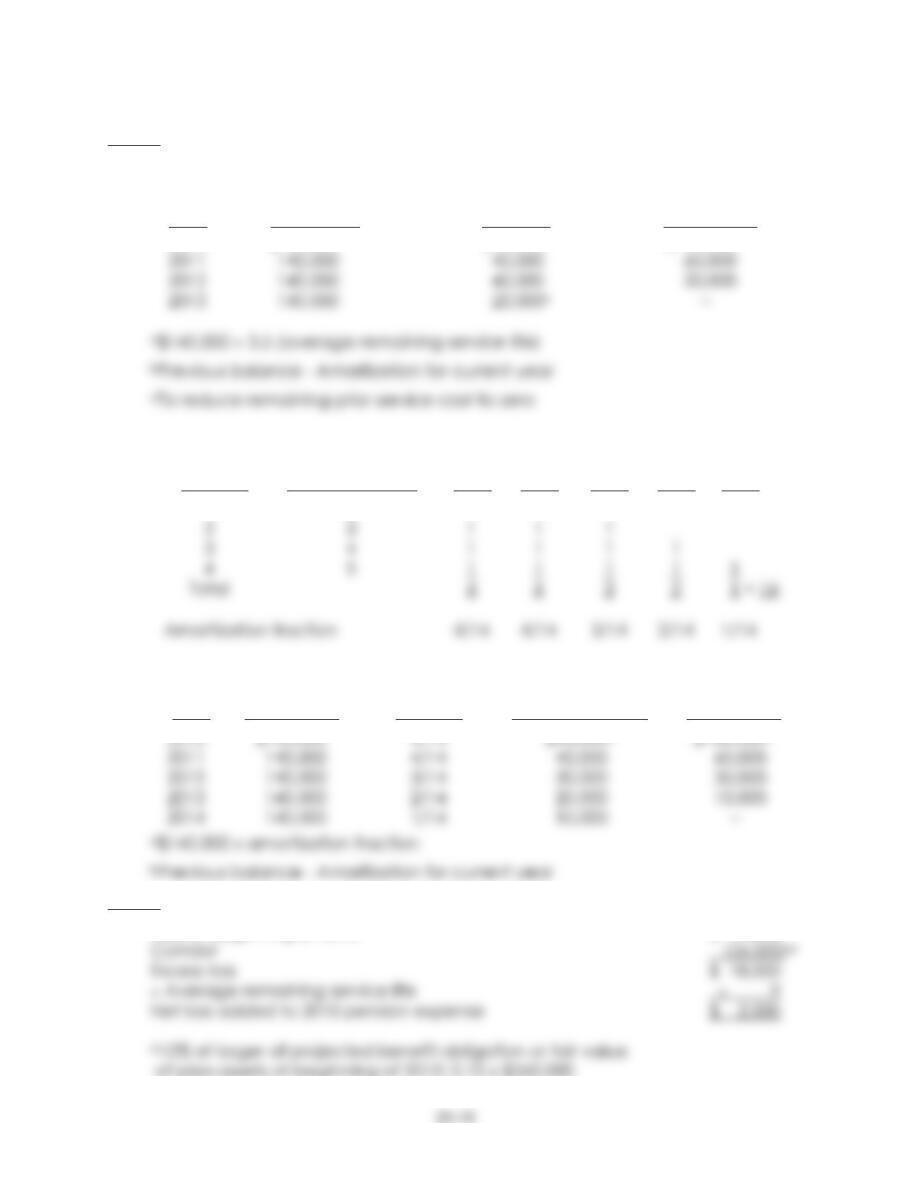
E20-11
Service Years
1. Employee Rendered
A 1 Average remaining Service years Number of
E20-11 (continued)
2.
Year
Total
Prior Service
Cost
Amortization
to Increase
Pension
Expense
Remaining
Prior Service
Cost
2010
$330,000
$110,000a
$220,000b
E20-12
Expected Years of
Number of Service Years
Rendered in Each Year
1. Employee Future Service 2010 2011 2012 2013 2014
A
1
1
2.
Year
Total
Prior Service
Cost
Amortization
Fraction
Amortization
to Increase
Pension Expense
Remaining
Prior Service
Cost
2010
$330,000
5/15
$110,000a
$220,000b
E20-13
Employee Service Years
1(a). Numbers Rendered
1 2 Average remaining Service years Number of
E20-13 (continued)
1(b).
Year
Total
Prior Service
Cost
Amortization
to Increase
Pension
Expense
Remaining
Prior Service
Cost
2010
$140,000
$40,000a
$100,000b
Employee
Expected Years of
Number of Service Years
Rendered in Each Year
2(a). Number Future Service 2010 2011 2012 2013 2014
1
2
1
1
2(b).
Year
Total
Prior Service
Cost
Amortization
Fraction
Amortization
to Increase
Pension Expense
Remaining
Prior Service
Cost
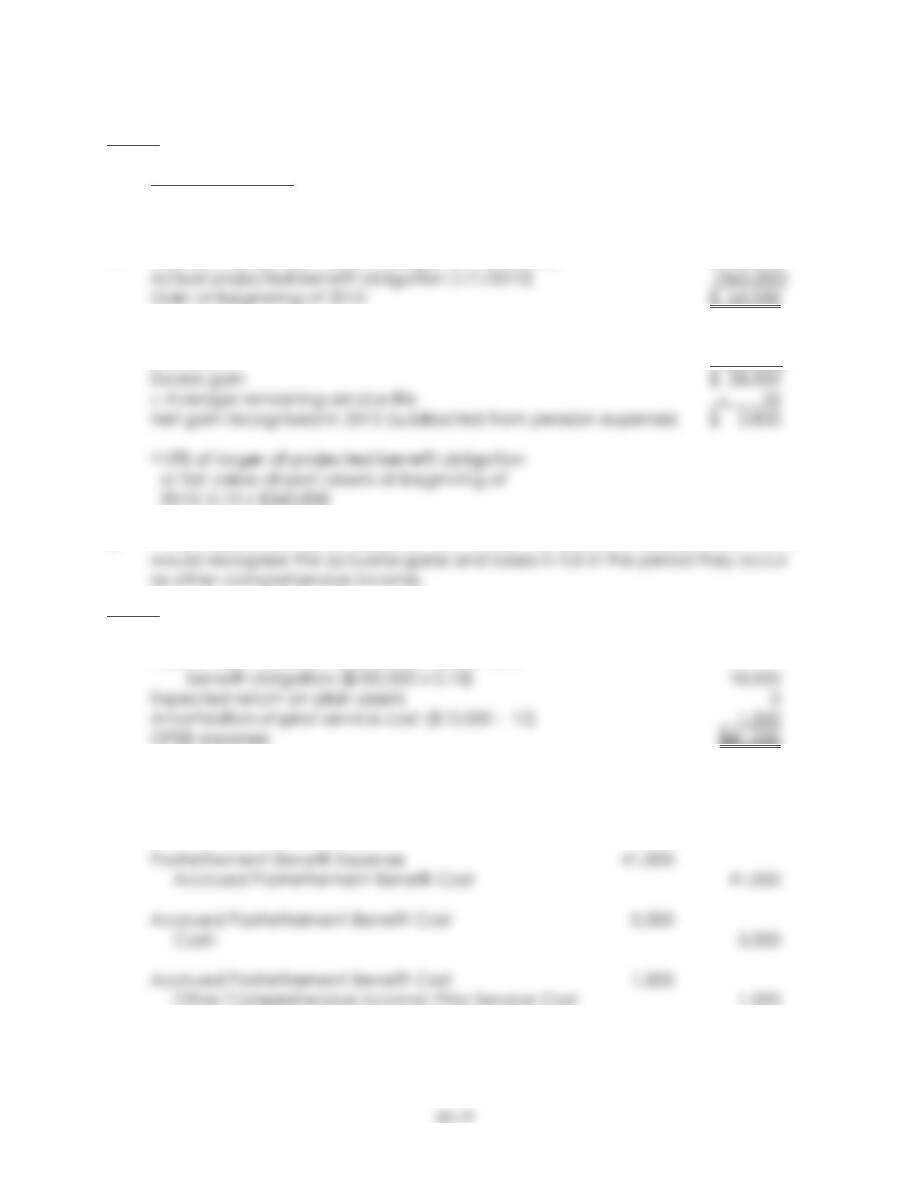
E20-14
Loss at beginning of 2010 $ 44,000
E20-15
Note to Instructor: Students must determine that the difference between the
expected projected benefit obligation and the projected benefit obligation is
the gain/loss.
1. Expected projected benefit obligation (1/1/2010) $424,000
2. Gain at beginning of 2010 $ 64,000
Corridor (36,000
)a
3. If the Hudson Company does not wish to use the corridor method under IFRS, it
E20-16
1. Service cost $30,000
Interest cost on accumulated postretirement
2. Other Comprehensive Income: Prior Service Cost 100,000
Accrued Postretirement Benefit Cost 100,000
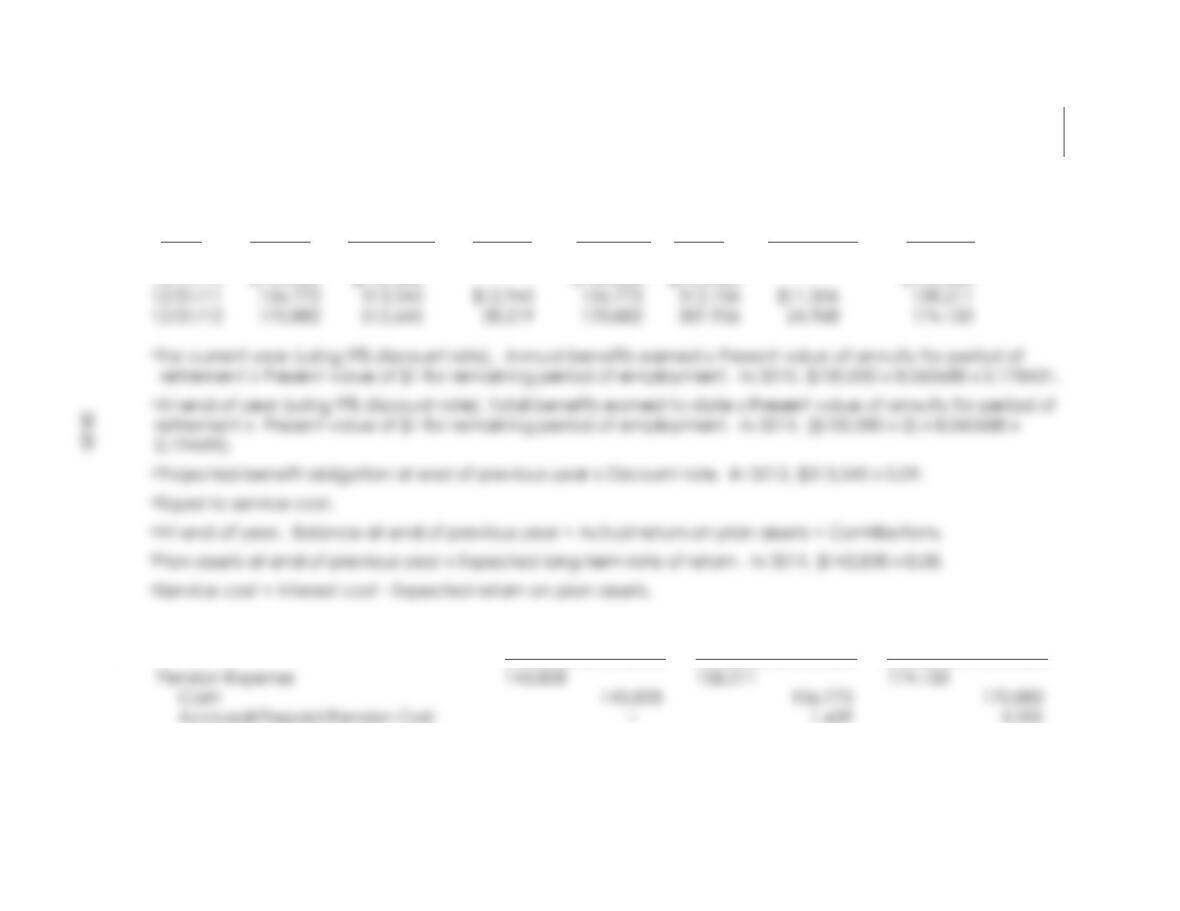
E19-16
1. and 2.
Expected
Projected (and Actual)
Service Benefit Interest Cash Plan Return on Pension
1. Date Costa Obligationb Costc Paymentd Assetse Plan Assetsf Expenseg
12/31/10 $143,828 $143,828 — $143,828 $143,828 — $143,828
2. December 31, 2010 December 31, 2011 December 31, 2012
E20-17
1. and 2.