Tijuana Bronze Machining
Teaching Commentary
OVERVIEW
This is a basic case in Activity-Based Costing (ABC) and Activity-Based Management (ABM). There is enough
richness to the fact-situation to create a non-trivial calculational challenge for students without taking the case beyond an
ANSWERS TO ASSIGNMENT QUESTIONS
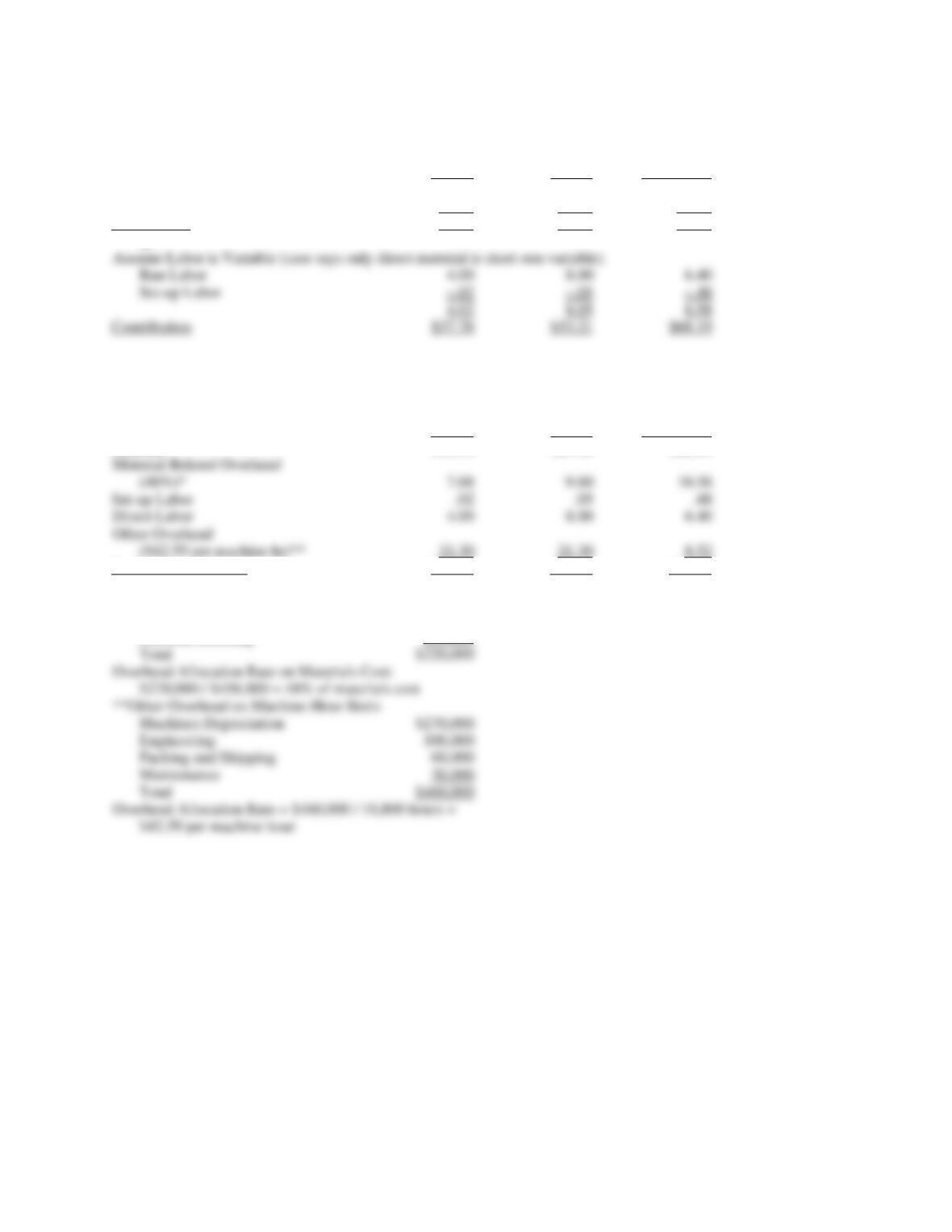
Question 1. Product Costs per Unit – Current System
Valves
Pumps
Flow
Controllers
Material
$16.00
$20.00
$22.00
Direct Labor
4.00
8.00
6.40
Overhead
17.56
35.12
28.10
(439% of Direct Labor $)*
Standard unit cost
*Overhead
Set-up labor
2,688
Receiving
Materials handling
Engineering
Packing and shipping
Maintenance
30,000
Total overhead
Total run labor = 9,725 hours x $16 = $155,600
33-2
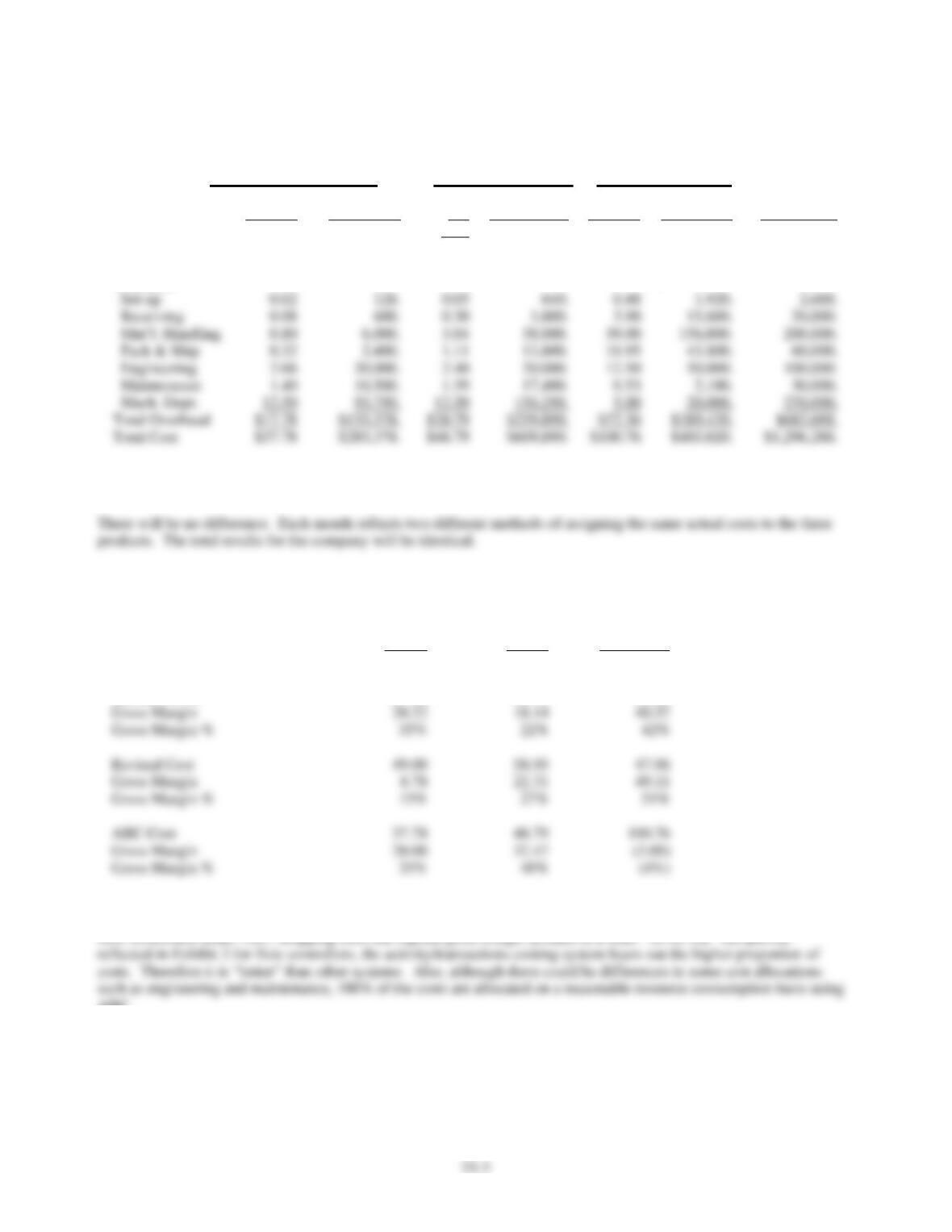
Question 2. Estimated “Contribution Margin” for Products
Valves
Pumps
Flow
Controllers
Revenue
$57.78
$81.26
$97.07
Variable Costs—Material only
16.00
20.00
22.00
Contribution
41.78
61.26
75.07
or
Question 3. Revised Product Unit costs per “More Modern View”
Valves
Pumps
Flow
Controllers
Material
$16.00
$20.00
$22.00
Material Related Overhead
(48%)*
10.56
Set-up Labor
Other Overhead
($42.59 per machine hr)**
21.30
Revised standard cost
$49.00
$58.95
$47.96
*Material Related Overhead
Receiving
$ 20,000
Material Handling
200,000
Total
Overhead Allocation Rate on Materials Cost:
$220,000 / $458,000 = 48% of materials cost
Machines Depreciation
Engineering
Packing and Shipping
Maintenance
30,000
Total
Overhead Allocation Rate = $460,000 / 10,800 hours =
$42.59 per machine hour
Assume Labor is Variable (case says only direct material is short-run variable).
Run Labor
Set-up Labor
~.02
Contribution
$37.76
$53.21
$68.19
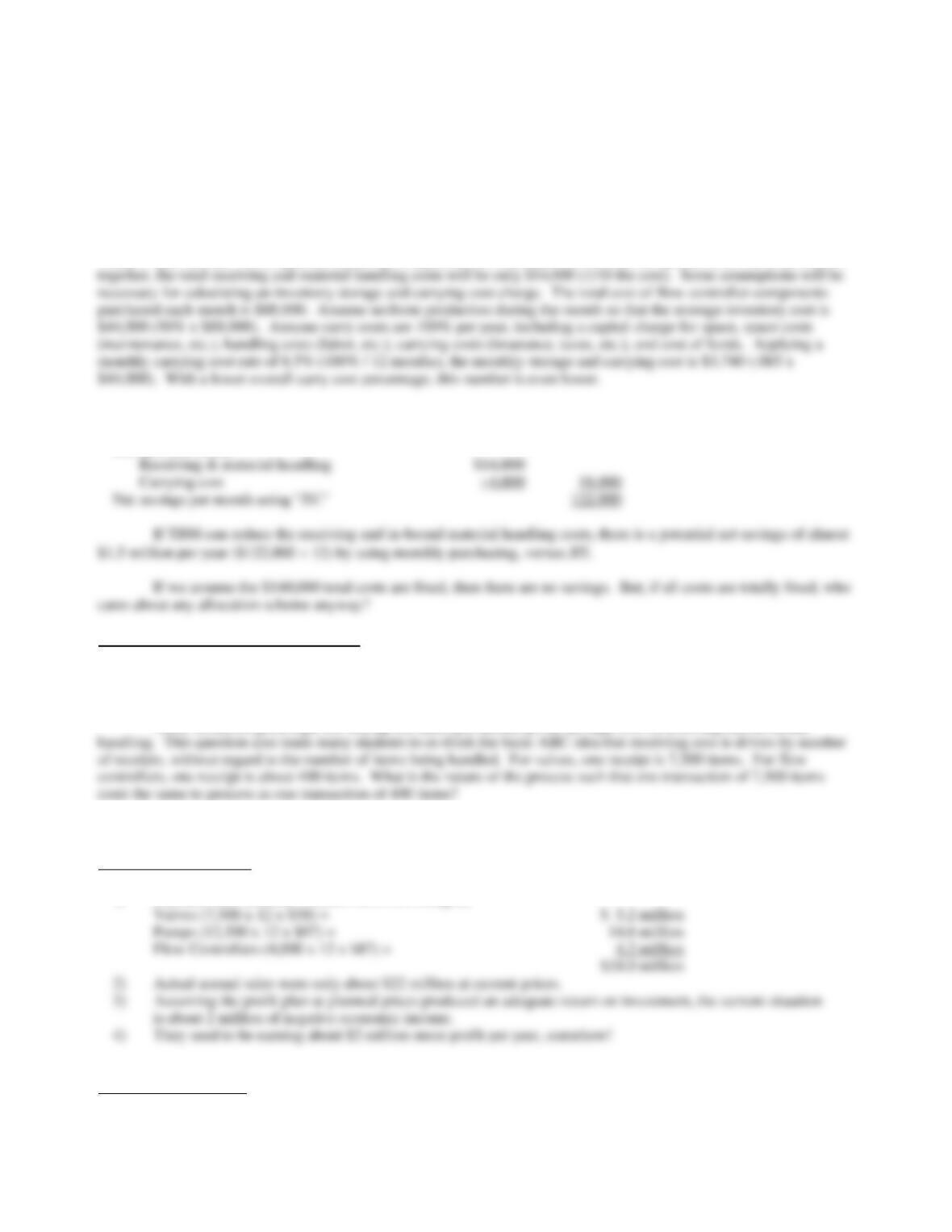
Question 4. Products Costs Using “Activity Based Costing”
Valves Pumps Flow Controllers
Total Month
Per Unit
Total 7,500
Per
Unit
Total 12,500
Per Unit
Total 4,000
24,000 units
Material
$16.00
$120,000.
$20.00
$250,000.
$22.00
$88,000.
$458,000.
Labor
4.00
30,000.
8.00
100,000.
6.40
25,600.
155,600.
Overhead:
.
0.05
0.08
0.30
3,800.
3.90
15,600.
20,000.
0.80
3.04
156,000.
200,000.
1.11
2.66
20,000.
2.40
50,000.
100,000.
1.40
10,500.
1.39
0.53
30,000.
93,750.
5.00
20,000.
270,000.
Total Cost
$37.78
$283,378.
$48.79
$609,890.
Question 5. Comparisons of Reported Income Between the Two Methods
Question 6. Comparison of Product Profitability Under Three Costing Systems
Valves
Pumps
Flow
Controllers
Actual Selling Price
$57.78
$81.26
$97.07
Standard Cost
37.56
63.12
56.50
Gross Margin
Gross Margin %
Revised Cost
49.00
58.95
47.96
Gross Margin
Gross Margin %
ABC Cost
100.76
Gross Margin
32.47
Gross Margin %
The total reported results are the same for the company under the three methods. The accounting allocations for
individual product lines change the gross margins significantly. Product line profitability changes most significantly for
flow controllers under ABC, dropping from the highest gross margin product to a loser. Given the “complexity”
ABC.
33-4
Question 7. Using “ABC” to Re-evaluate JIT Purchasing Policy for Flow Controllers
Flow Controllers require ten components for each of ten runs per month for a total of 100 receipts and 200 material
handling transactions under the JIT arrangement with suppliers. The total cost of both receiving and material handling is
$220,000 ($20,000 receiving and $200,000 material handling). Receiving and inbound handling is $140,000 of this total
($20,000 + .6 x $200,000).
Under a “just–in–case” or JIC practice where all components for a month’s Flow Controller production will be purchased
RECAP:
Just-in-Time Costs:
$140,000
Just-in-Case Costs:
“JIC” for Flow Controller Purchasing?
This alone lowers cost by ~$30.5 per unit ($122,000 / 4,000 units) which yields a 28% gross margin at current
prices! [(97-70) / 97 = 28%].
There seems no good logic for buying ten times per month, given the high cost of receiving and in–bound
Question 8. Recommendations for Management
A. How are they doing?
1) Planned Sales (assume volumes have not changed)
Drop Flow Controllers?
33-5
Adding flow controllers to the product line (to use idle capacity?) doubled the manufacturing complexity (4 or 5
components versus 10 components). Is this a reasonable thing to do in our factory?
Or Raise Selling Price?
Given the “no-competition” market for flow controllers, perhaps the selling price could be increased gradually,
but who knows? Who are the customers? What do they want? How much will they pay?
What About Pumps?
The selling price for flow controllers increased more than 12% this past month while the selling price for pumps
decreased more than 16%.
Cost Reduction (Re-engineering) for Pumps?
There is a lot of buyer power in this market, so TBM must undertake cost reduction and re-engineering
programs to be the low cost producer. The case says pumps require less precision manufacturing than valves. Pumps
involve only one more component than valves.
Apparently, the one valve customer is pleased with our quality and competitive price. Competitors are not
attempting price cuts. The case implies that automation and efficient production processes are helping control costs and
TEACHING STRATEGY
In class, I go through the questions in order, trying to save at least 20 minutes (in a 90-minute class) for question 8.
Usually, questions 1 through 6 are pretty straightforward for students who are willing to spend about 3 hours in