C
CH
HA
AP
PT
TE
ER
R
2
20
0
A
Ac
cc
co
ou
un
nt
ti
in
ng
g
C
Ch
ha
an
ng
ge
es
s
a
an
nd
d
E
Er
rr
ro
or
r
C
Co
or
rr
re
ec
ct
ti
io
on
ns
s
Overview
Chapter 4 provided an overview of accounting changes and error correction. Later, we discussed
changes encountered in connection with specific assets and liabilities as we dealt with those topics in
subsequent chapters.
Now, in this chapter, we revisit accounting changes and error correction with the intent to
Learning Objectives
After studying this chapter, you should be able to:
LO20-1 Differentiate among the three types of accounting changes and distinguish between the
retrospective and prospective approaches to accounting for and reporting accounting
changes.
LO20-2 Describe how changes in accounting principle typically are reported.
L
Le
ec
ct
tu
ur
re
e
O
Ou
ut
tl
li
in
ne
e
I. Accounting changes fall into one of three categories. (T20-1)
A. Changes in principle.
B. Changes in estimates.
C. Changes in reporting entity.
20-2 Intermediate Accounting, 8e
A. For each year reported in the comparative statements, we revise those statements to appear as if
the newly adopted accounting method had been applied all along. (T20-4) (T20-5) (T20-6)
B. In addition to reporting revised amounts in the comparative financial statements, we must also
adjust the book balances of affected accounts. This means creating a journal entry to change
IV. EXCEPTIONS NECESSITATING THE PROSPECTIVE APPROACH
A. Sometimes a lack of information makes it impracticable to report a change retrospectively so
the new method is simply applied prospectively. (T20-9)
1. If it’s impracticable to adjust each year reported, the change is applied retrospectively as of
B. Another exception to retrospective application is when an FASB Statement or another
authoritative pronouncement requires prospective application for specific changes in
accounting methods.
C. We account for a change in depreciation method as a change in accounting estimate that is
achieved by a change in accounting principle. Therefore, we account for such a change
prospectively; that is, precisely the way we account for changes in estimates.
V. Changes in estimates are accounted for prospectively.
VIII. When errors are discovered, they should be corrected and accounted for retrospectively.
(T20-14) Illustrations: T20-15, T20-16, T20-17, T20-18
A. A journal entry is made to correct any account balances that are incorrect as a result of
20-4 Intermediate Accounting, 8e
PowerPoint Slides
A PowerPoint presentation of the chapter is available in the Connect library.
Teaching Transparency Masters
The following can be reproduced on transparency film as they appear here, or
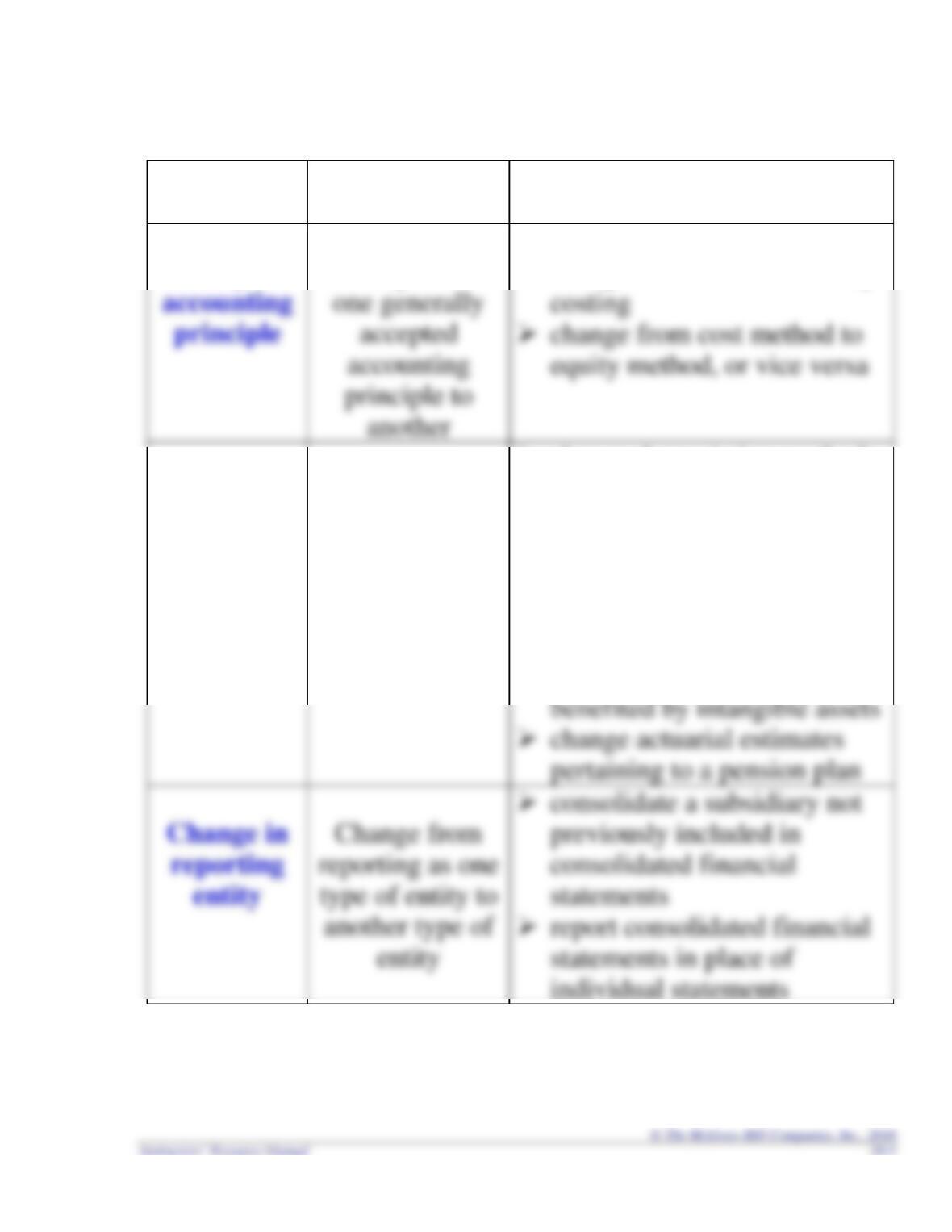
ACCOUNTING CHANGES
Type of
Change
Description
Examples
Change in
Change from
➢ adopt a new FASB standard
➢ change methods of inventory
Change in
estimate
Revision of an
estimate because
of new
information or
new experience
➢ change depreciation methods
➢ change estimate of useful life
of depreciable asset
➢ change estimate of residual
value
➢ change estimate of warranty
expense percentage
➢ change estimate of periods
Graphic 20-1 T20-1
20-6 Intermediate Accounting, 8e
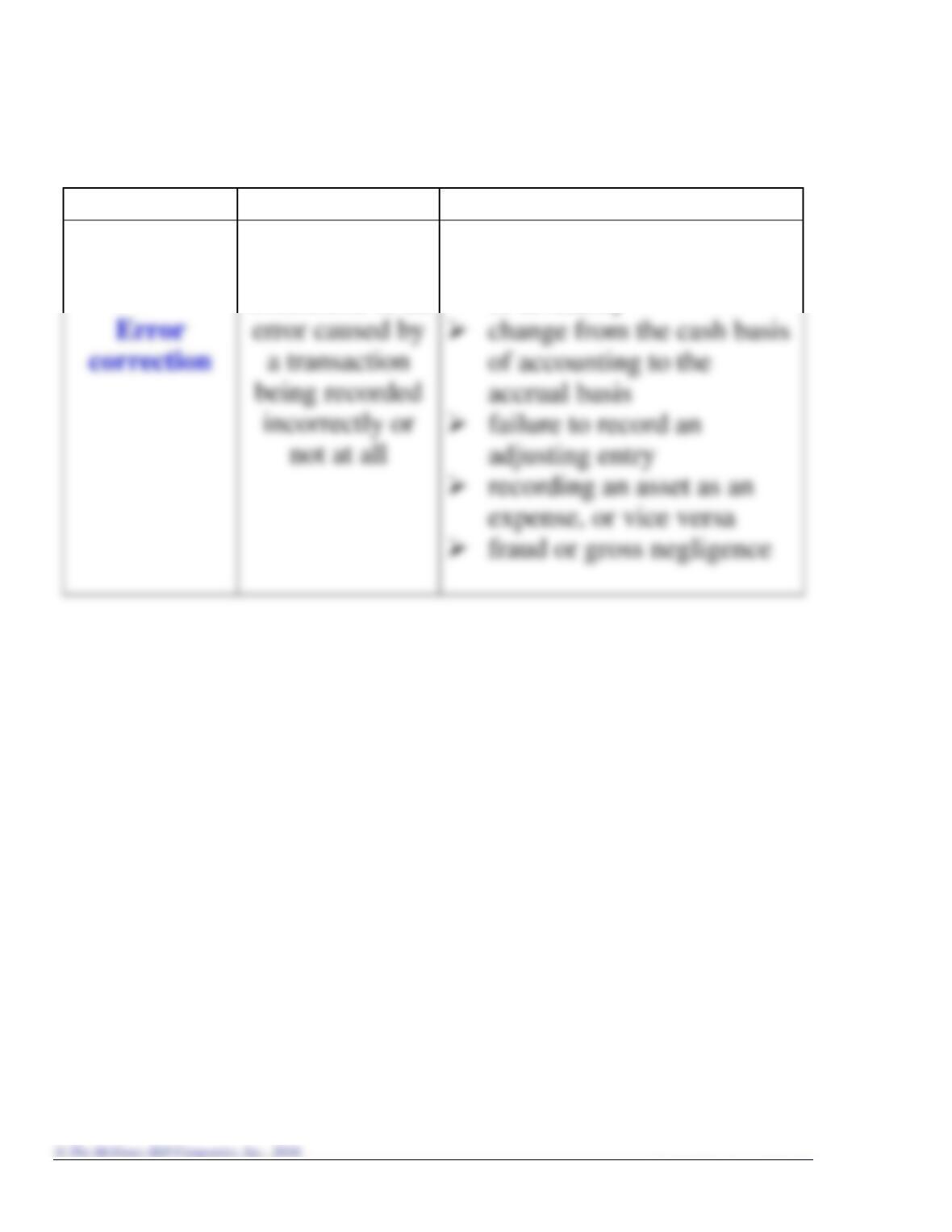
CORRECTION OF AN ERROR
Type
Description
Examples
Correction of an
➢ mathematical mistakes
➢ inaccurate physical count
of inventory
T20-2
CHANGE IN ACCOUNTING PRINCIPLE
Although consistency and comparability are desirable,
changing to a new method sometimes is appropriate.
T20-3
20-8 Intermediate Accounting, 8e
Illustration
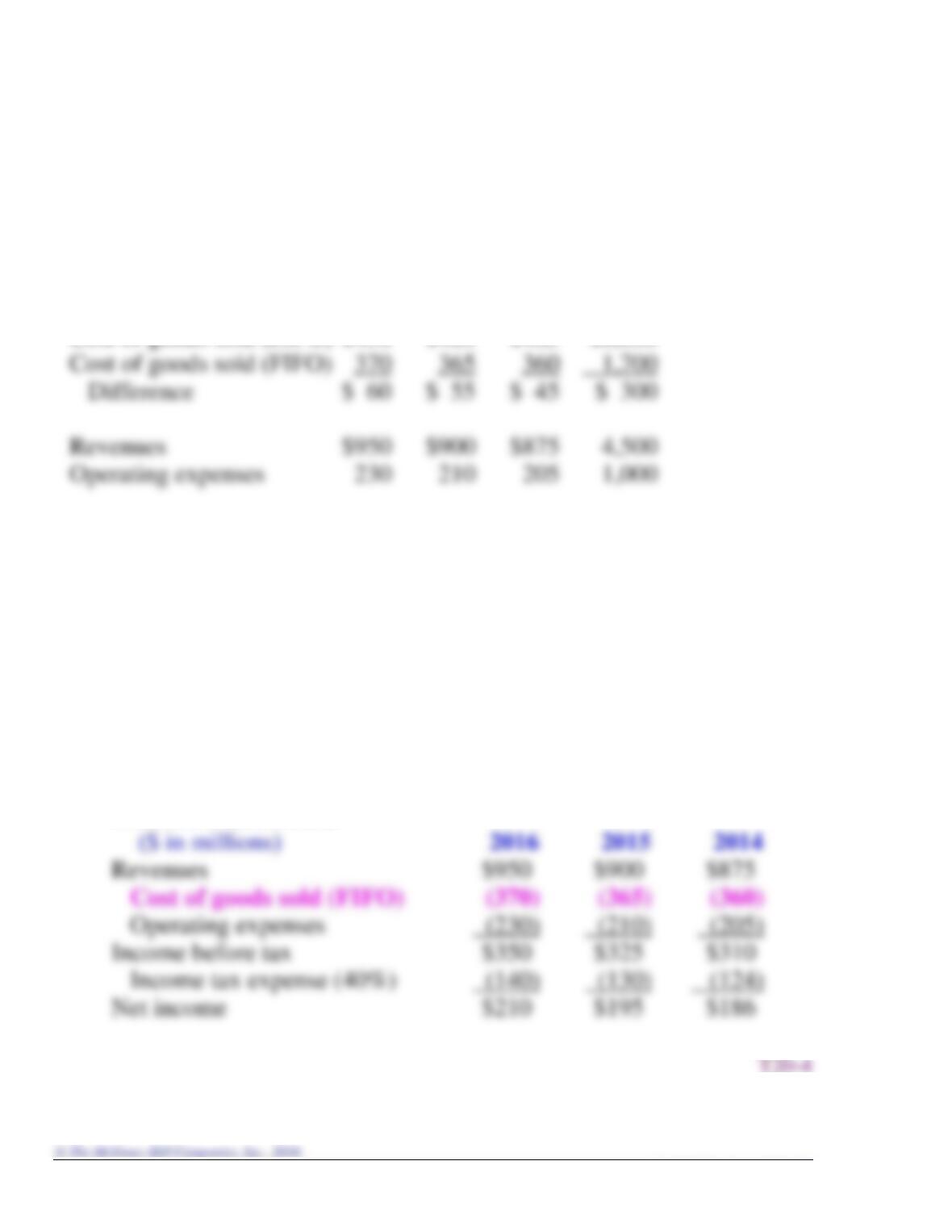
Air Parts Corporation used the LIFO inventory costing method.
At the beginning of 2016, Air Parts decided to change to the
FIFO method. Income components for 2016 and prior years
were as follows ($ in millions):
previous
2016 2015 2014 years
Cost of goods sold (LIFO) $430 $420 $405 $2,000
Air Parts has paid dividends of $40 million each year beginning
in 2006. Its income tax rate is 40%. Retained earnings on
January 1, 2014, was $700 million; inventory was $500 million.
For each year reported in the comparative statements, Air
Parts makes those statements appear as if the newly adopted
accounting method (FIFO) had been applied all along.
Income Statements
Balance Sheets
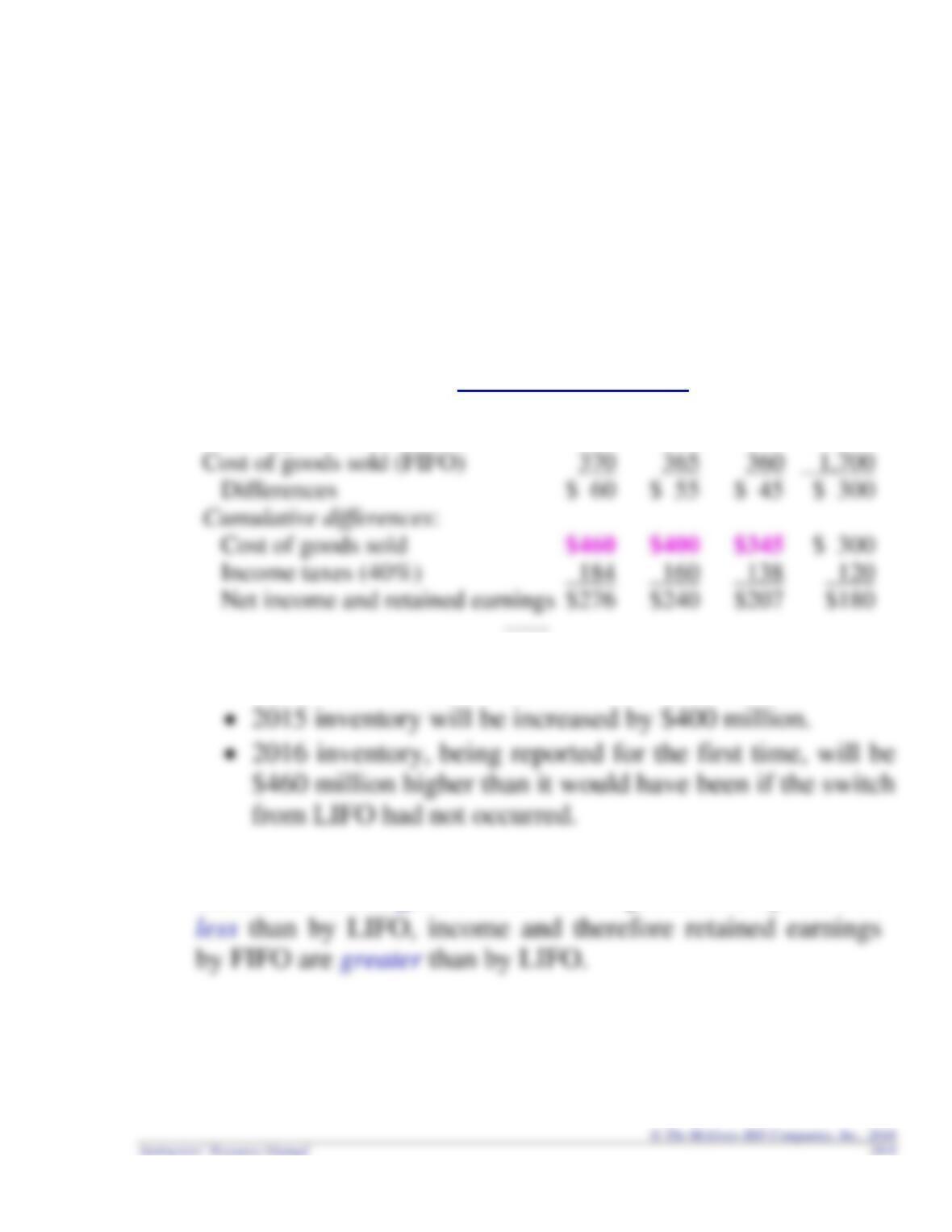
Inventory. Air Parts will report 2016 inventory by its newly
adopted method, FIFO, and also will revise the amounts it
reported last year for its 2015 and 2014 inventory. Each
year, inventory will be higher than it would have been by
LIFO.
Years ending Dec. 31: previous
($ in millions) 2016 2015 2014 years
Cost of goods sold (LIFO) $430 $420 $405 $2,000
• 2014 inventory will be $345 million higher than it was
reported in last year’s statements.
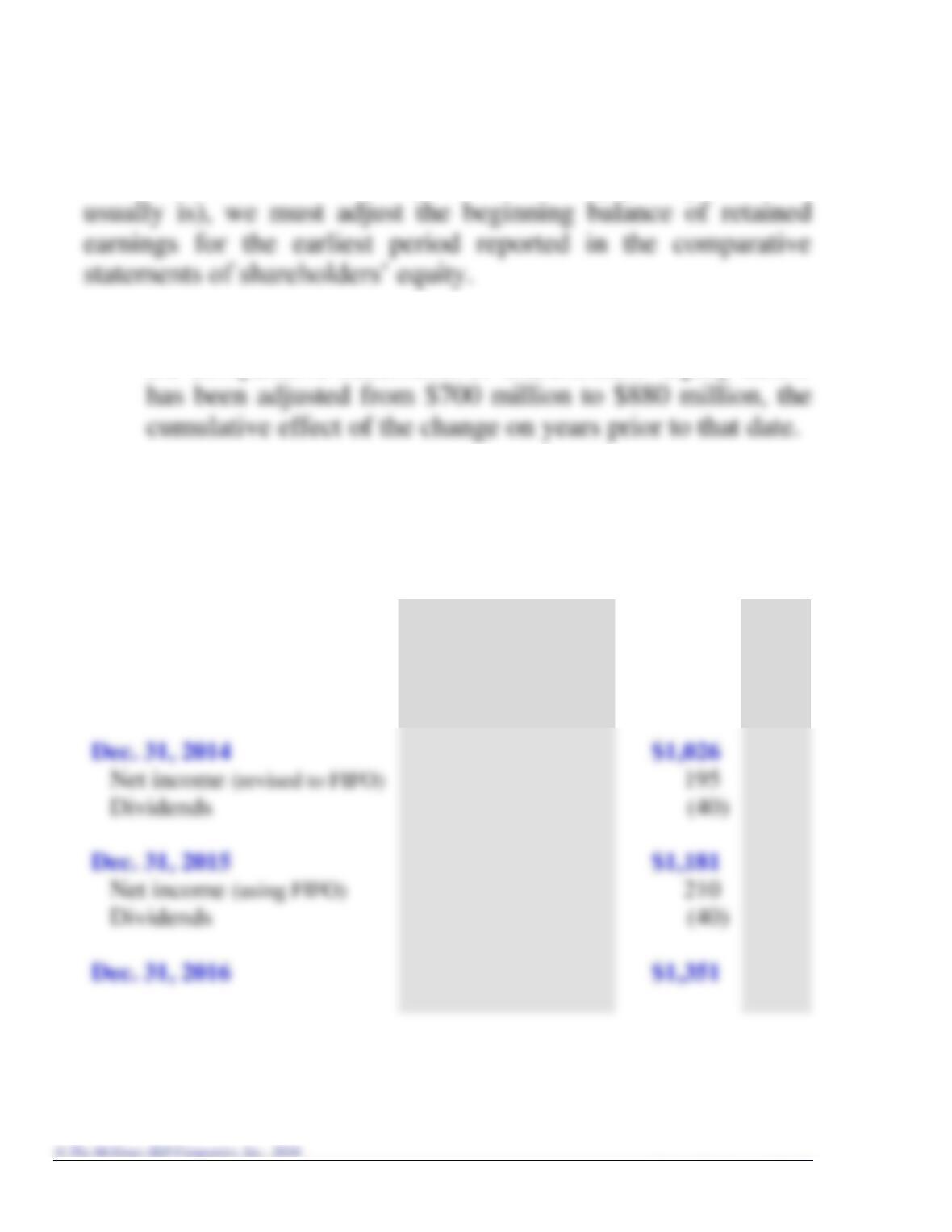
Retained Earnings. Because cost of goods sold by FIFO is
T20-5
20–10 Intermediate Accounting, 8e
Statements of Shareholders’ Equity
If adjustment due to a change in accounting principle (and it
The January 1, 2014, retained earnings balance reported in
the comparative statements of shareholders’ equity below
($ in millions)
Common
Stock
Additional
Paid-in
Capital
Retained
Earnings
Total
SE
Jan. 1, 2014
$ 880
Net income (revised to FIFO)
186
Dividends
(40)
Dec. 31, 2014
Net income (revised to FIFO)
195
Dividends
(40)
Dec. 31, 2015
Dividends
(40)
Dec. 31, 2016
T20-6
Adjust Accounts for the Change
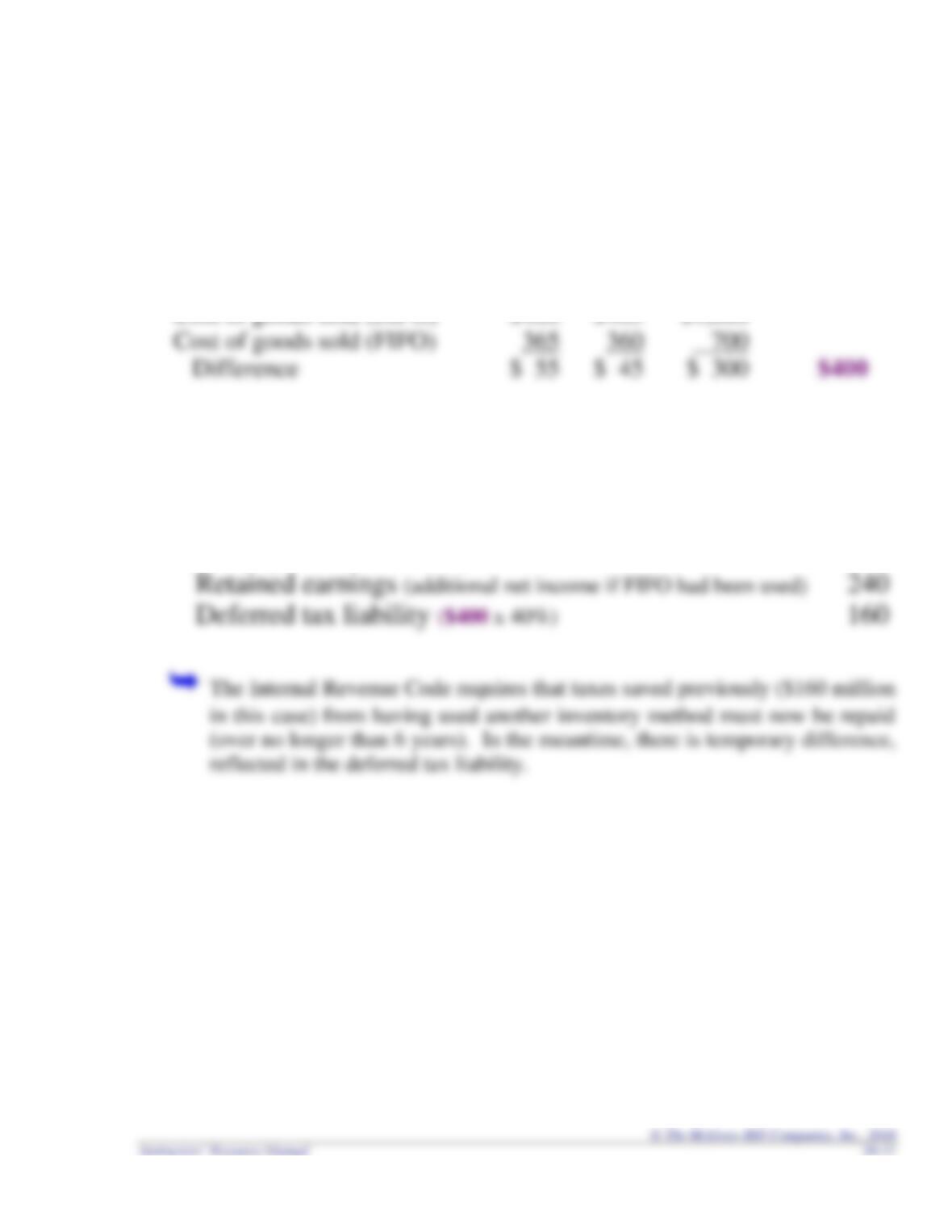
The journal entry updates inventory, retained earnings, and the
income tax liability for revisions resulting from differences in the
LIFO and FIFO methods prior to the switch, pre-2016.
Cumulative Cumulative
Difference Difference
($ in millions) 2015 2014 pre-2014 pre-2016
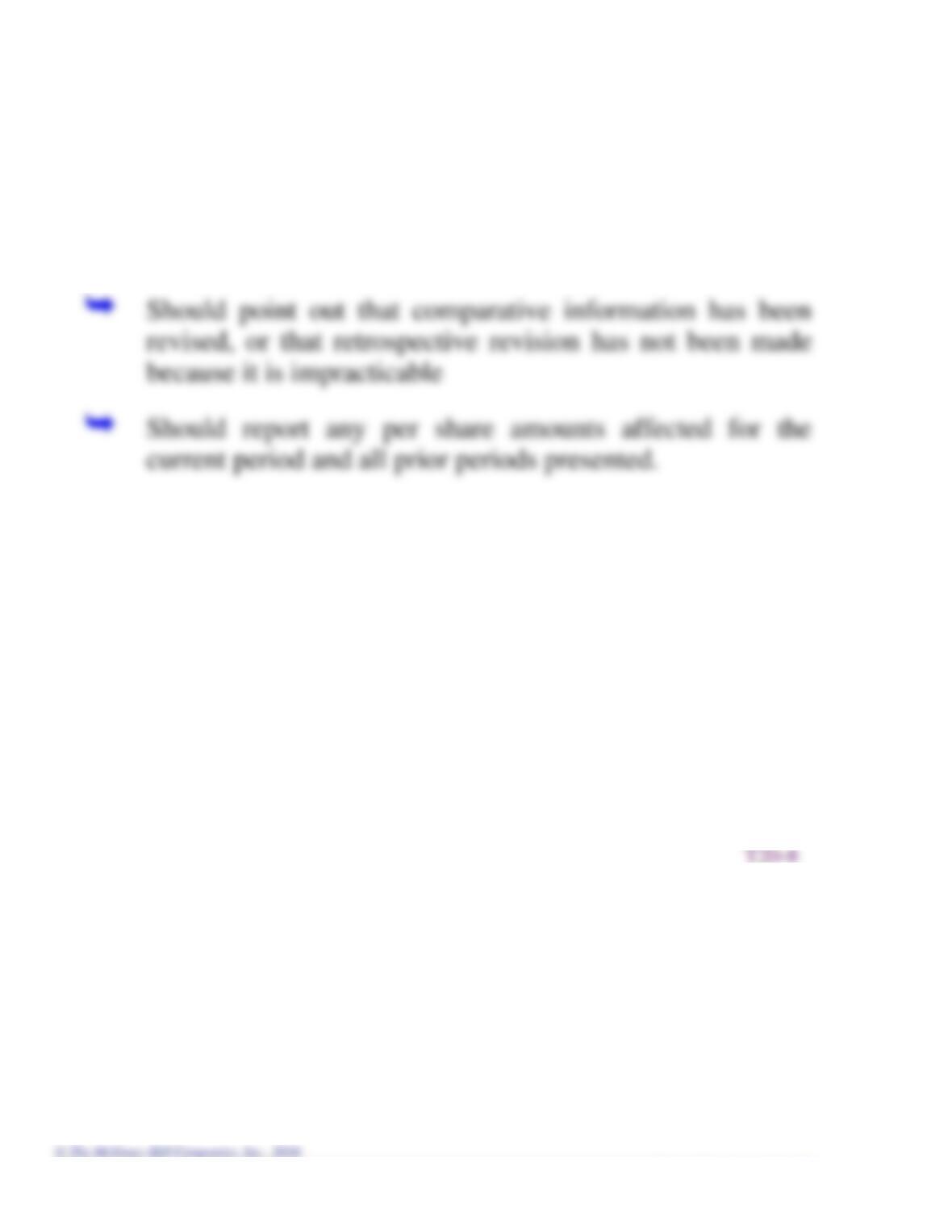
Journal entry to record the change in principle.
January 1, 2016
($ in millions)
Inventory (additional inventory if FIFO had been used) 400
T20-7
20–12 Intermediate Accounting, 8e
DISCLOSURE NOTE
In the first set of financial statements after the change, a
disclosure note is needed to provide justification that the
new method is clearly preferable.
EXCEPTIONS NECESSITATING THE PROSPECTIVE APPROACH
1. WHEN RETROSPECTIVE APPLICATION IS IMPRACTICABLE
Sometimes a lack of information makes it impracticable to report a
change retrospectively so the new method is simply applied
2. WHEN MANDATED BY AUTHORITATIVE PRONOUNCEMENTS
Another exception to retrospective application is when a new
3. CHANGING DEPRECIATION, AMORTIZATION, DEPLETION
METHODS
We account for a change in depreciation method as a change in
T20-9
CHANGE IN ACCOUNTING ESTIMATE
20–14 Intermediate Accounting, 8e
Changes in estimates are accounted for prospectively.
When a company revises a previous estimate, prior
Illustration
CHANGE IN ACCOUNTING ESTIMATE
Universal Semiconductors estimates warranty expense as 2%
of credit sales. After a review during 2016, Universal
determined that 3% of credit sales is a more realistic
estimate of its payment experience. Credit sales in 2016 are
$300 million. The effective income tax rate is 40%.
($ in millions)
Warranty expense (3% x $300 million) 9
Warranty liability 9
20–16 Intermediate Accounting, 8e
CHANGE IN REPORTING ENTITY
A reporting entity can be a single company, or it can be a
group of companies that reports a single set of financial
statements. A change in reporting entity occurs as a result
of:
(1) Presenting consolidated financial statements in place of
Reported by restating all previous periods’ financial
statements as if the new reporting entity existed in those
periods.
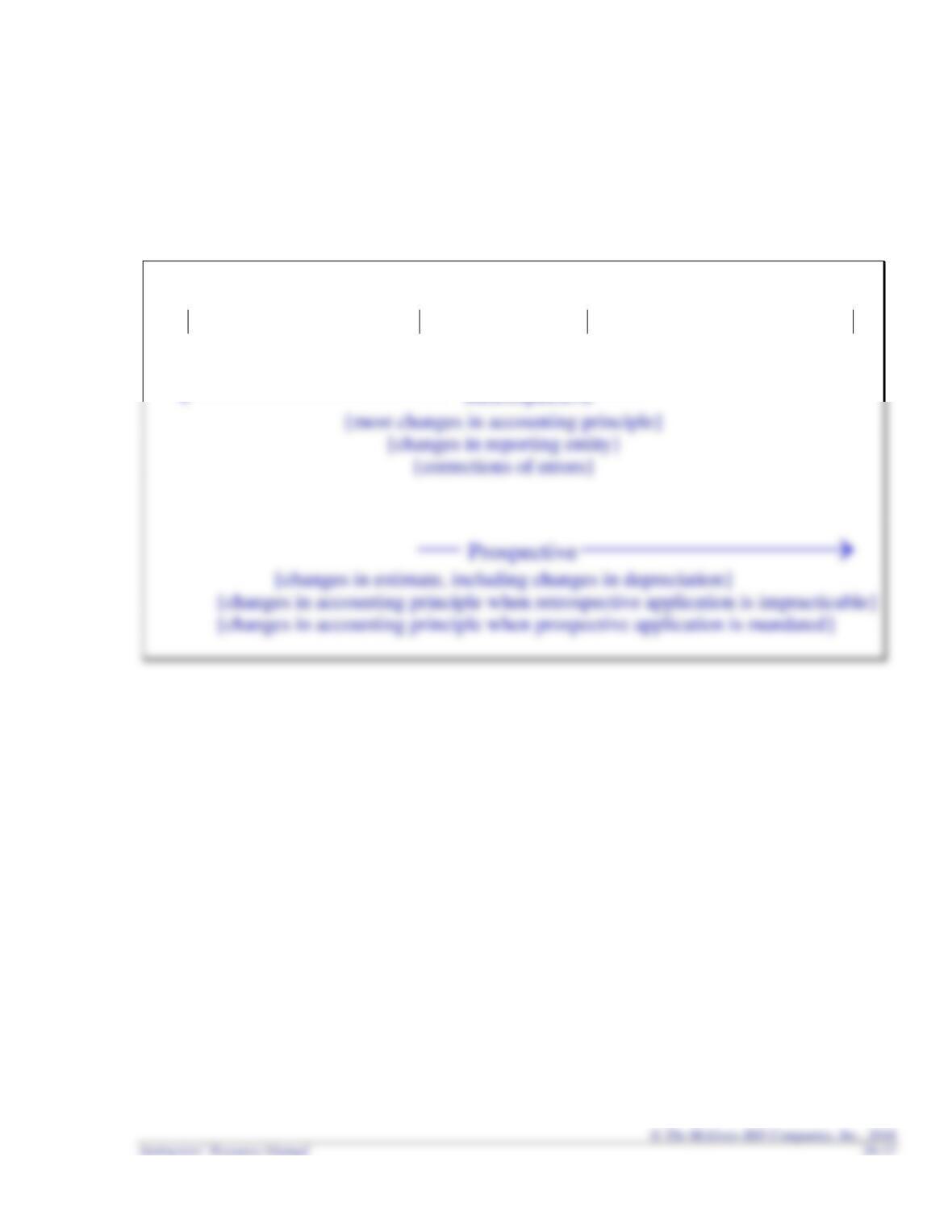
APPROACHES TO REPORTING ACCOUNTING
CHANGES AND ERROR CORRECTIONS
Current
Previous Years Year Later Years
______________________________________________________________
T20–13
20–18 Intermediate Accounting, 8e
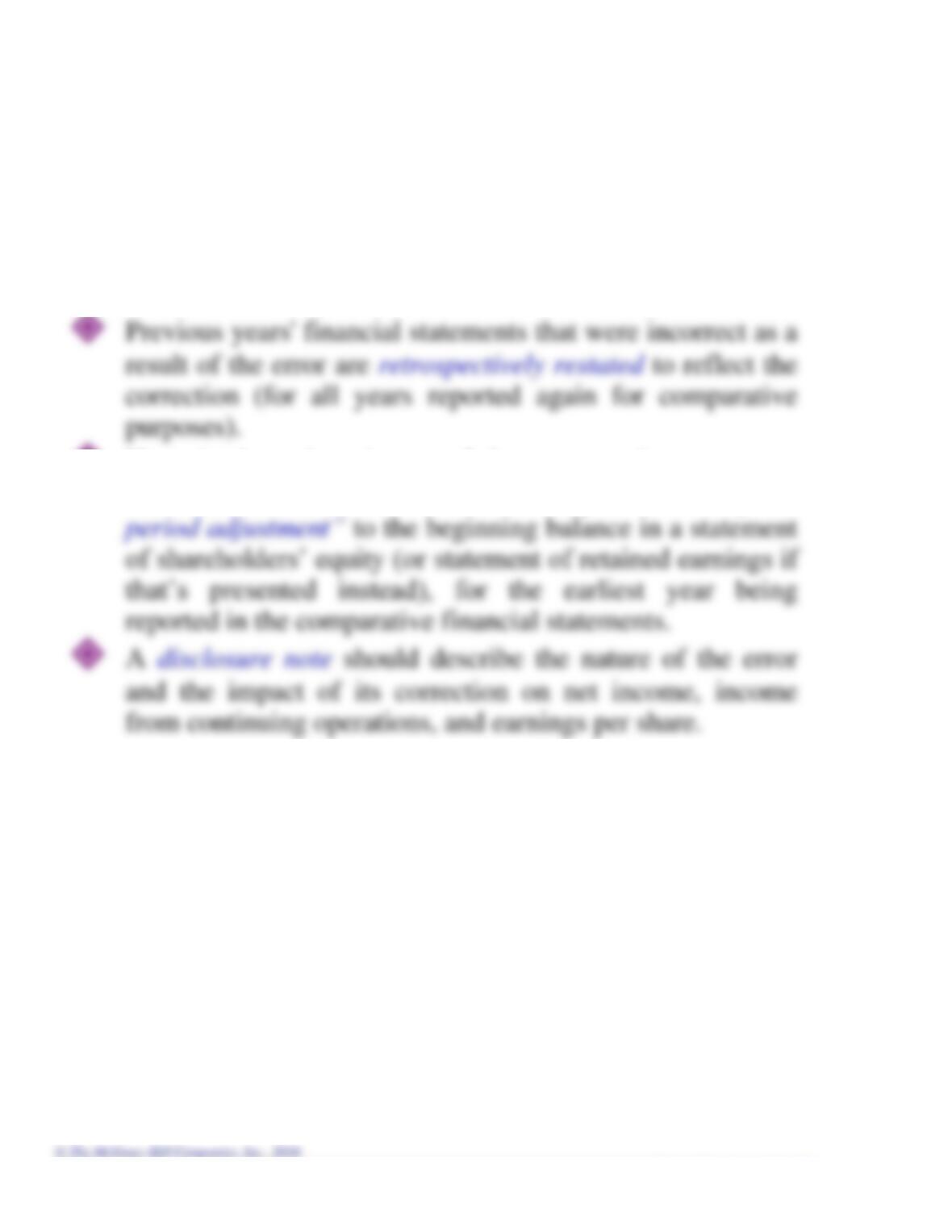
ERROR CORRECTION
Steps to Correct an Error:
A journal entry is made to correct any account balances
that are incorrect as a result of the error.
If retained earnings is one of the accounts incorrect as a
result of the error, the correction is reported as a “prior
T20–14
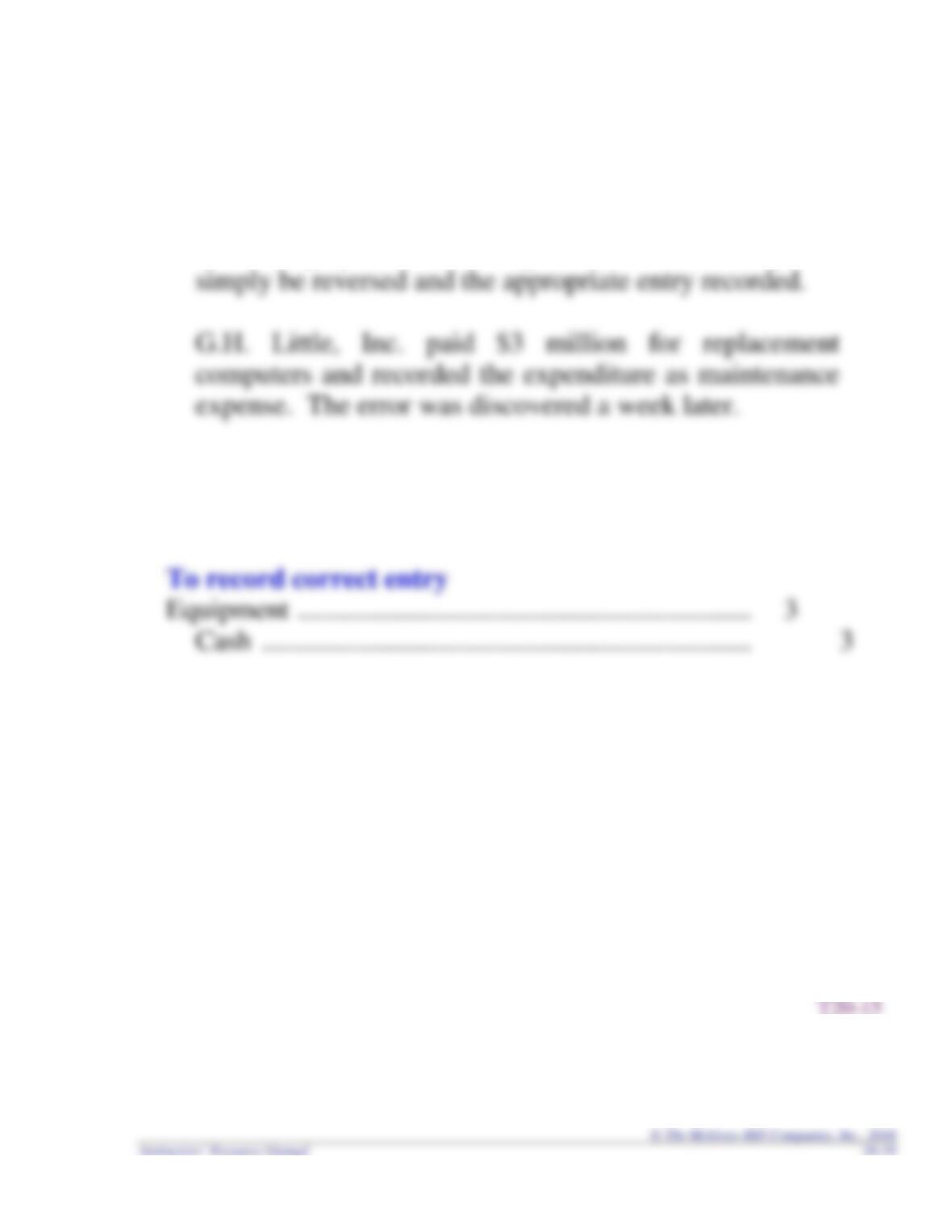
ERROR DISCOVERED IN THE SAME REPORTING
PERIOD THAT IT OCCURRED
If an accounting error is made and discovered in the same
accounting period, the original erroneous entry should
To reverse erroneous entry($ in millions)
Cash ………………………………………………………………. 3
Maintenance expense ……………………………………. 3