20-32
P20-10 (continued)
3. Service cost $183,000
Interest cost on projected benefit obligation
4. 2010
Jan. 01 Other Comprehensive Income:
Prior Service Cost 88,000
Accrued/Prepaid Pension Cost 88,000
5. Liability: Accrued pension cost $110,090
P20-11
Employee Expected Years of Service Years
1. Numbers
Future Service Rendered
1-5 3 15
6-10 6 30
20-33
P20-11 (continued)
1. (continued)
ofNumber
yearsService
remainingAverage ÷=
2.
Year
Cumulative
Net Loss
Corridor
Excess
Net Loss
Amortized Net
Loss (Gain)
2010
$29,000
$47,000a
–
—c
3. 2010 2011
4. 2010
Dec. 31 Pension Expense 175,500
Cash 175,000
Accrued/Prepaid Pension Cost 500
5. Liability (end of 2010): Accrued pension cost $65,500
20-34
P20-12
1. Service cost $ 8,000
Interest cost 12,900a
2. Other Comprehensive Income: Prior Service Cost 129,000
Accrued Postretirement Benefit Cost 129,000
20-35
E19-16
1. and 2.
Date
Service
Costa
Projected
Benefit
Obligationb
Interest
Costc
Cash
Paymentd
Plan
Assetse
Expected
(and Actual)
Return on
Plan Assetsf
Amortization
of Prior
Service Costg
Pension
Expenseh
12/31/10
$ 81,590
$ 81,590
–
$ 81,590
$ 81,590
–
–
$ 81,590
aFor current year (using 10% discount rate). Annual benefits earned x Present value of annuity for period of
retirement x Present value of $1 for remaining period of employment. In 2010, ($2,000 x 60) x 7.366687 x
0.092296. In 2013, the annual benefits are increased to $144,000 ($80,000 x 0.03 x 60).
bAt end of year (using 10% discount rate). Total benefits earned to date x Present value of annuity for period
20-35
20-36
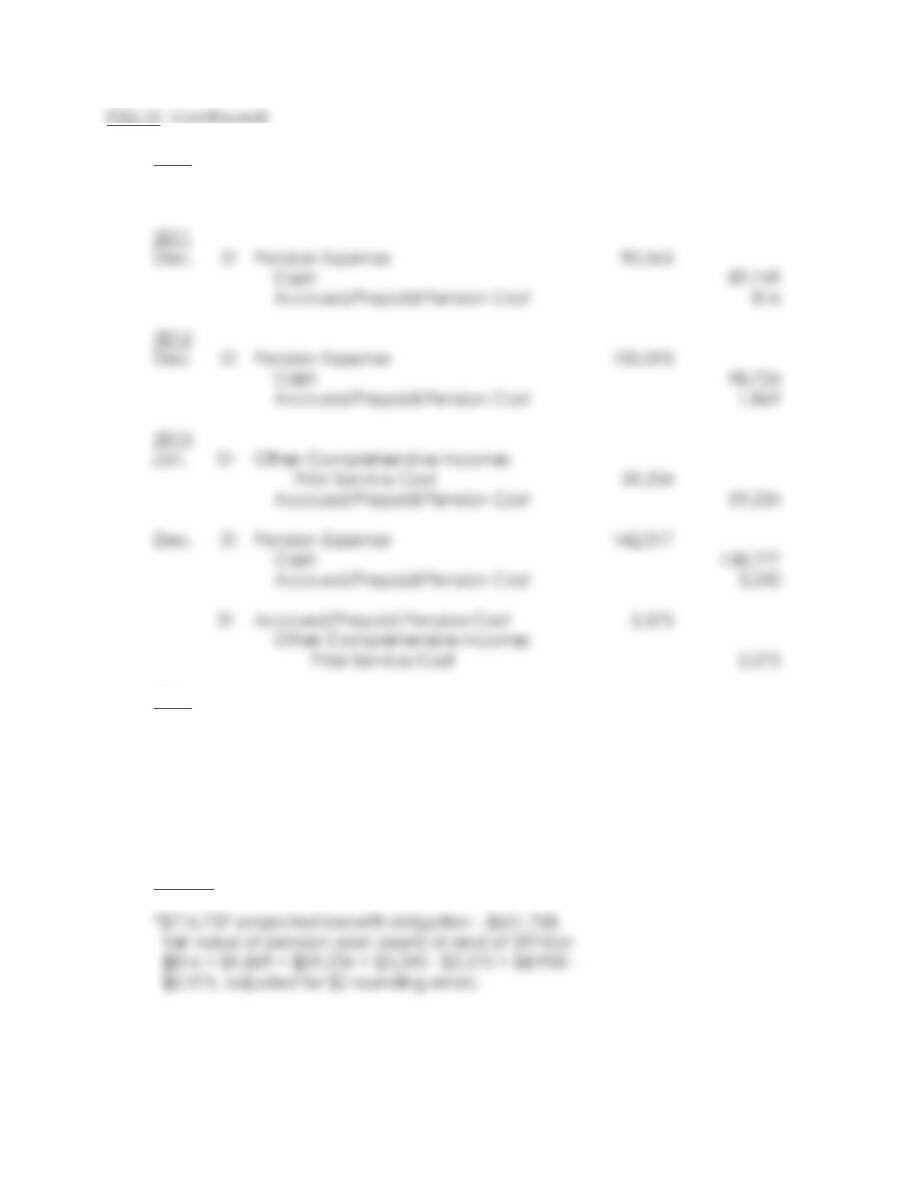
2. 2010
Dec. 31 Pension Expense 81,590
Cash 81,590
2014
Dec. 31 Pension Expense 156,767
Cash 151,809
Accrued/Prepaid Pension Cost 4,958
31 Accrued/Prepaid Pension Cost 2,575
Other Comprehensive Income:
Prior Service Cost 2,575
3. Liability: Accrued pension cost $64,969*

20-37
ANSWERS TO CASES
C20-1
The following items related to a defined benefit pension plan may be included in the
financial statements of the sponsoring company:
1. Pension expense. The pension expense reported on the income statement is computed
as follows: service cost + interest on the projected benefit obligation – expected return on
2. Accrued pension cost. A liability, accrued pension cost, is reported on the balance sheet
when the projected benefit obligation is more than the fair value of the pension plan
assets.
C20-2 (AICPA adapted solution)
1. The two accounting issues resulting from the nature of the defined benefit pension plan
are as follows:
2. Carson should determine the service cost component of the net pension cost as the

20-38
C20-2 (continued)
4. Carson should determine the expected return on plan assets component of the net
C20-3 (AICPA adapted solution)
1. The interest cost component of the net pension cost for a period is the increase in the
2. Prior service cost is the cost of retroactive benefits (increased benefits based on services
rendered in prior periods) granted at the date of adoption or amendment of a pension
plan. Essex should record the initial recognition of prior service cost as a decrease in other
3. Essex must accrue compensation for future vacations if all of the following conditions are
met:
(a) Essex’s obligation relating to employees‘ rights to receive compensation for future
vacations is attributable to employees’ services already rendered.
C20-4
1. Pension Expense. The conceptual issues related to pension expense involve (a) the
definition of an expense and (b) the components of pension cost (expense).
a. An expense is an outflow of assets or incurrence of a liability during a period from

20-39
C20-4 (continued)
2. Pension Liabilities. The conceptual issue related to a pension plan liability involves (a) the
definition of a liability and (b) when to and what amount to record as the liability.
a. A liability is a probable future sacrifice of economic benefits arising from a present
obligation of the company to transfer assets or provide services in the future as a result
3. Pension Plan Assets. The conceptual issue related to a pension plan asset involves the
disclosure of assets used in the pension plan. An asset is a probable future economic
benefit obtained and controlled by a company as a result of a past transaction or event.
C20-5
The accounting principles for OPEBs and those for pensions are very similar. They both
1. Although the attribution period is defined in the same way, the effect is different because
the benefit formulas for most pension plans link benefits to years of service and salary
2. The interest component of the net postretirement benefit expense is based on the
3. The OPEB liability (or asset) is the difference between the accumulated postretirement

20-40
C20-5 (continued)
4. There are a number of additional disclosures not required for pensions, including: (a) the
assumed healthcare cost trend rates, (b) the effect of a 1% increase and a 1% decrease
in the assumed healthcare cost trend rates on the aggregate of the service cost and the
C20-6
1. Pension expense is based on the expected return on plan assets rather than the actual
2. Gains and losses offset each other in the calculation of the net gain or loss. Therefore, the
amortization is less each period than if the more common accounting policy of
immediately recognizing losses and amortizing gains was followed.
3. The cumulative net gain or loss is amortized only if it exceeds the corridor amount (10% of
4. The fair market value of plan assets may be based on a market related value which
C20-7
GAAP for pension expense, requires management judgment in several aspects of its
application. This flexibility is appropriate since all companies do not operate in the same
environment, or have the same philosophy towards risk. However, flexibility can be
20-41
C20-7 (continued)
Since the discount rate is a market-based rate, it will have to be based on current market
C20-8
1. The following items in the advertisement raise issues:
a. The FASB does not establish “regulations.” Instead it establishes accounting
“principles.” However, for a company that reports to the SEC, the principles may be
perceived as regulations.
2. Companies may reduce benefits when they adopt GAAP for several reasons. First, and
most rationally, the computation of the costs incurred in OPEBs may make management
C20-9 (In millions)
1. (a) The company’s pension expense for 2007 is $113 (p. 108).
C20-9 (continued)
3. (a) The benefit obligation for pensions at December 31, 2007 is $3,517 (p. 106).
5. The increase in the discount rate in 2007 (a) decreased the benefit obligations and (b)
decreased the pension expense because the service cost and the interest cost were
lower.
C20-10
Note to Instructor: This case does not have a definitive answer. From a financial reporting
perspective, GAAP is identified and summarized. From an ethical perspective, various
issues are raised for discussion purposes.
From a financial reporting perspective, the issue involves whether a company can select
From an ethical perspective, the issue involves whether it is appropriate to influence
pension expense. The primary stakeholders are the company’s employees and retirees,