682 ChapTEr 20 • INvESTmENTS
ClaSSrOOm aCTIvITy
In groups, have students work Try
differences.
REvIEw ExERcIsEs
20
Section i
b. Proceeds from selling stock
step 1. Value of shares = 54.31 × 350 = $19,008.50
step 2. Broker’s commission = Cost of shares × Commission rate
c. Gain (or loss) on the transaction
Gain (or loss) on transaction =Proceeds −Total cost
tryitexerciSe 7
You purchase 225 shares of Gulfstream Industries common stock at $44.80 per share. A few
months later you sell the shares at $53.20. Your stockbroker charges 2% commission on round
Calculate the preferred and common dividend per share for the following companies.
Preferred Stock
Company
Common
Stock Shares Shares Div. or Par Cum.
Dividend
Declared Arrears
Preferred
Div./Share
Common
Div./Share
1. Bearing & CO. 4,000,000 1,000,000 $100 3% yes $8,000,000 1 year
$6.00
$.50
2. Suntech, Inc. 5,000,000 none $3,000,000 none
—
$.60
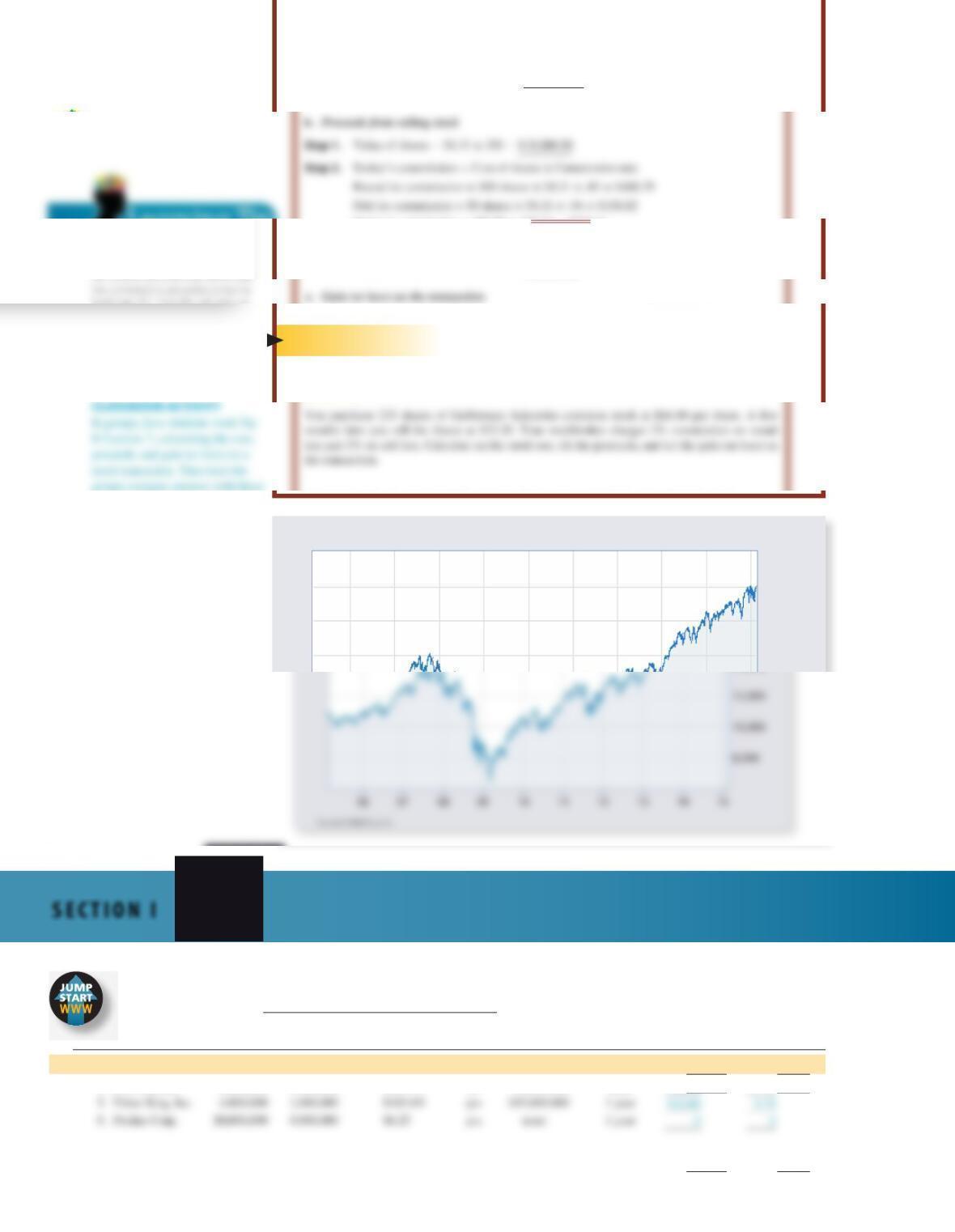
The Dow Jones Industrial Average before and after the downturn of 2008 and 2009.
18,000
16,00
0
14,00
0
the stock to get total cost; when sold,
the commissions are deducted by the
brokerage firm from the sale price to
get the proceeds of the sale.
SECTION I • STOCKS 683
Use exhibit 20-3, stock Quotation Table, on page 677 to fill in the blanks for exercises 7–12.
7. Wal-Mart Stores, Inc.—Symbol, Open price, Percent change: WMT, $51.02, up .06%
8. American Express Co.—High and low for the past 52 weeks: High: $49.19; Low: $31.68
Calculate the missing information for the following stocks.
Company
Earnings
per Share
Annual
Dividend
Current Price
per Share
Current
Yield
Price-Earnings
Ratio
13. Huntington Corp. $2.18 $.55 $32.70
1.7%
15
14. Tangiers, Inc. $6.59 $1.60 $46.13
3.5%
7
$1.31
1.6%
13
Calculate the total cost, proceeds, and gain (or loss) for the following stock market transactions.
Commissions
Company
Number of
Shares
Purchase
Price
Selling
Price Buy Sell Odd Lot
Total
Cost Proceeds
Gain
(or Loss)
19. Prime Time, Inc. 200 $19.60 $24.80 1% 1% —
$3,959.20
$4,910.40
$951.20
20. United Gas & Oil 100 $47.20 $56.06 3% 3%
$4,861.60
$5,437.82
$576.22
$6,585.15
$9,997.57
25. The Newmark Corporation has 500,000 shares of common stock outstanding. If a dividend of
$425,000 was declared by the company directors last year, what is the dividend per share of
common stock?
26. The board of directors of Fortune Industries has declared a dividend of $3,000,000. The company
has 700,000 shares of preferred stock that pay $0.90 per share and 1,600,000 shares of common
stock.
a. What are the dividends due the preferred shareholders?
b. What is the dividend per share of common stock?
27. Apex Developers, Inc., has 1,800,000 shares of $100 par value, 5%, cumulative preferred stock
and 9,750,000 shares of common stock. Although no dividend was declared for the past two
years, a $44,000,000 dividend has been declared for this year.
a. How much is due the preferred shareholders?
85461_ch20_hr_672-710_1.indd 683 9/23/15 5:10 PM
684 ChapTEr 20 • INvESTmENTS
b. What is the dividend per share of common stock?
28. Bio-Science Labs stock is currently selling for $47.35 per share. The earnings per share are
$3.14, and the dividend is $1.70.
a. What is the current yield of the stock?
b. What is the price-earnings ratio?
29. You purchase 650 shares of Sunrise Electric common stock at $44.25 per share. A few months
later you sell the shares at $57.29. Your stockbroker charges 3% commission on round lots and
an extra
11
2
% on odd lots.
a. What is the total cost of the purchase?
b. What are the proceeds on the sale?
c. What is the gain (or loss) on the transaction?
busInEss DEcIsIon: DollaR-cost avERagIng
30. Though investing all at once works best when stock prices are rising, dollar-cost averaging can
be a good way to take advantage of a fluctuating market. Dollar-cost averaging is an investment
strategy designed to reduce volatility in which securities are purchased in fixed dollar amounts at
regular intervals regardless of what direction the market is moving. This strategy is also called
the constant dollar plan.
You are considering a hypothetical $1,200 investment in Century Media Corporation stock.
Your choice is to invest the money all at once or dollar-cost average at the rate of $100 per
month for one year. Assume that Century Media allows you to purchase “fractional” shares of its
stock.
a. If you invested all of the money in January and bought the shares for $10 each, how many
shares could you buy?
85461_ch20_hr_672-710_1.indd 684 9/23/15 5:11 PM
Section ii • BondS 685
Understanding Bonds and reading a Bond QUotation taBle
A bond is a loan, or an IOU, where the bond buyer lends money to the bond issuer. With
stock, the investor becomes a part-owner of the corporation; with bonds, the investor becomes
a creditor. Bonds are known as fixed-income securities because the issuer promises to pay
Corporate bonds represent the number one source of corporate borrowing for both large
and small companies. Corporations use the money raised from bonds to finance modernization
and expansion programs. Secured bonds are backed by a lien on a plant, equipment, or another
corporate asset. Unsecured bonds, also known as debentures, are backed only by the general
credit of the issuing corporation. Some bonds are convertible, which means they can be converted
Bonds
20
Section ii
20-6
bondA loan, or an IOU, in the form of an
interest-bearing note in which the bond
equipment, or another corporate asset.
unsecured bonds, or debentures
Bonds that are backed only by the general
credit of the issuing corporation, not on
specific collateral pledged as security.
convertible bondsBonds that can be
par value of a bond that is paid to the
bondholder on a regular basis.
According to whatitcosts.com, the
Golden Gate Bridge in San Francisco
was built over a four-and-a-half year
period between 1933 and 1937. It is
the second-largest suspension bridge
b. From the following chart of share prices, calculate the number of shares that would be
purchased each month using dollar-cost averaging and the total shares for the year. Round to
the nearest tenth.
Month
Amount
Invested
Cost per
Share
Shares
Purchased Month
Amount
Invested
Cost per
Share
Shares
Purchased
January $100 $10.00
10.0
July $100 $11.50
8.7
c. What is the average price you pay per share if you purchase them all in January?
d. What is the average price you pay per share if you purchase them using dollar-cost averaging?
85461_ch20_hr_672-710_2.indd 685 9/23/15 5:11 PM
690 chapter 20 • inveStmentS
CalCUlating the CUrrent Yield of a Bond
Just as with stocks, the current yield of a bond is a simple measure of the return on investment
based on the current market price. When bonds are purchased at par, the current yield is equal
to the coupon rate. For example, a bond purchased at par for $1,000 with a coupon rate of 7%
20-8
StepS To CaLCULaTE CUrrEnT YiELd of a Bond
STEP 1. Calculate the annual interest and current price of the bond.
STEP 2. Divide the annual interest of the bond by the current market price.
EXAMPLE11
caLcuLating the current YieLd
of a Bond SaLe
Calculate the current yield of an Evergreen Corp. bond with a coupon rate of 13.5%
currently selling at a premium of 107.25.
SOLUTIONSTRATEGY
Annual interest = Par value × Coupon rate = 1,000 × .135 = $135
TRYITEXERCISE 11
REviEw ExERcisEs
Use Exhibit 20-5, Corporate Bond Quotation Table, on page 687 to fill in the blanks for
Exercises 1–10.
1. Ford Motor Credit (F.GSQ)—Coupon, High: 8.000%, 107.250
Section ii
20
Remember, bond interest is constant
regardless of what you paid for
Learning Tip
Section ii • BondS 691
5. Which bond has the lowest coupon rate? Citigroup
6. Altria GP—Ratings: Baa1/BBB/BBB+
Calculate the accrued interest and the total purchase price of the following bond purchases.
Company
Coupon
Rate
Market
Price
Time
Since Last
Interest
Accrued
Interest
Commission
per Bond
Bonds
Purchased
Total
Price
11. Xerox 5.5% 86.25 2 months
$9.17
$5.00 1
$876.67
12. U.S. West 7.25 102.50 78 days
$15.71
$4.50 15
$15,678.15
$34.90
$12,199.80
$16.56
$11,433.10
Calculate the accrued interest and the total proceeds of the following bond sales.
Company
Coupon
Rate
Market
Price
Time
Since Last
Interest
Accrued
Interest
Commission
per Bond
Bonds
Sold
Total
Proceeds
16. Textron 6.25% 91.50 21 days
$3.65
$6.00 10
$9,126.50
$28.33
$20,788.60
Calculate the annual interest and current yield of the following bonds.
Company Coupon Rate Annual Interest Market Price Current Yield
21. Kroger 6.625%
66.25
91.125
7.3%
26. On March 1, Wayne Michaels bought 10 Metro Petroleum bonds with a coupon rate of 9.125%.
The purchase price was 88.875, and the commission was $6 per bond. Metro Petroleum bonds
pay interest on February 1 and August 1.
a. What is the current yield of the bond?
Annual interest =Par value ×Coupon rate
b. What is the total purchase price of the bonds?
c. If Wayne sold the bonds on November 1 for 93.875, what are the proceeds from the sale?
Complete worked-out solutions
85461_ch20_hr_672-710_2.indd 691 9/23/15 5:11 PM
692 Chapter 20 • INVESTMENTS
Mutual Funds
Understanding MUtUal FUnds and reading
a MUtUal FUnd QUotation table
Mutual funds are a very popular way of investing. Essentially, mutual funds are professionally
managed investment companies that pool the money from many individuals and invest it in stocks,
bonds, and other securities. Most individual investors do not have the time or the ability to research
the literally thousands of investment possibilities. By pooling the financial resources of thousands of
shareholders, mutual funds can use the expertise of the country’s top professional money managers.
Mutual funds are corporations known as investment trusts. Their assets are stocks and
bonds purchased with the hope that the value of the securities will increase. Investors pur-
chase shares of stock of the fund. If the fund is successful in its investments, it pays dividends
and capital gains to its shareholders.
With mutual funds, instead of choosing individual stocks and bonds, investors pick a fund
Column 1 (Family/Fund) Fidelity Invest/Magellan Mutual funds are listed alphabetically
by the fund’s family name and in subcategories by the various funds available
within that family. In this example, the family name is Fidelity Invest and the
particular fund name is Magellan.
20-9
mutual funds or investment trusts
Corporations that are investment pools of
money with a wide variety of investment
goals.
BusInEss dECIsIOn: taXaBlE OR taX-FREE BOnds
27. More than 50,000 state and local governments and their agencies borrow money by issuing
municipal bonds to build, repair, or improve schools, streets, highways, hospitals, sewer
systems, and so on. When the federal income tax law was adopted in 1913, interest on
municipal bonds was excluded from federal taxation. As a result, municipal bond investors are
willing to accept lower yields than those they can obtain from taxable bonds.
As part of your portfolio, you are considering investing $50,000 in bonds. You have the
choice of investing in tax-exempt municipal bonds yielding 2.75% or corporate bonds yielding
4% in taxable interest income.
a. What is the annual interest income and tax status of the municipal bond investment?
b. What is the annual interest income and tax status of the corporate bond investment?
c. If you are in the 30% marginal tax bracket for federal income taxes and your state and local taxes
d. What is the actual percent yield realized on the corporate bonds after taxes?
SECTION III
20
3,079 different mutual funds with total
net assets of just over $1 billion. Twenty
years later the number of U.S. mutual
funds had grown to over 15,000 with
more than $13 trillion in assets.
85461_ch20_hr_672-710_3.indd 692 9/23/15 5:11 PM
SEcTIoN III • MuTual FuNdS 697
REvIEw EXERCIsEs
Use Exhibit 20-6, Mutual Fund Quotation Table, on page 693 to fill in the blanks
forExercises1–10.
1. PIMCO Fds Institutional, AllAsset—Symbol and Net asset value: PAAIX, $12.30
claSSRooM acTIVITy
SolutionStrategy
Step 1. Total cost of purchase = 1,000 shares × 5.30 = $5,300
Step 2. In addition to the gain on sale, Parker also made $380 (1,000 × .38) in dividends.
tryitexerciSe 16
Maggie Flowers purchased 2,000 shares of Harley Escape Mutual fund for an offer price of $8.60
per share. She later sold the shares at a net asset value of $9.18 per share. During the time Maggie
owned the shares, Harley Escape paid dividends of $0.27 and $0.42 per share. What is her return
on investment?
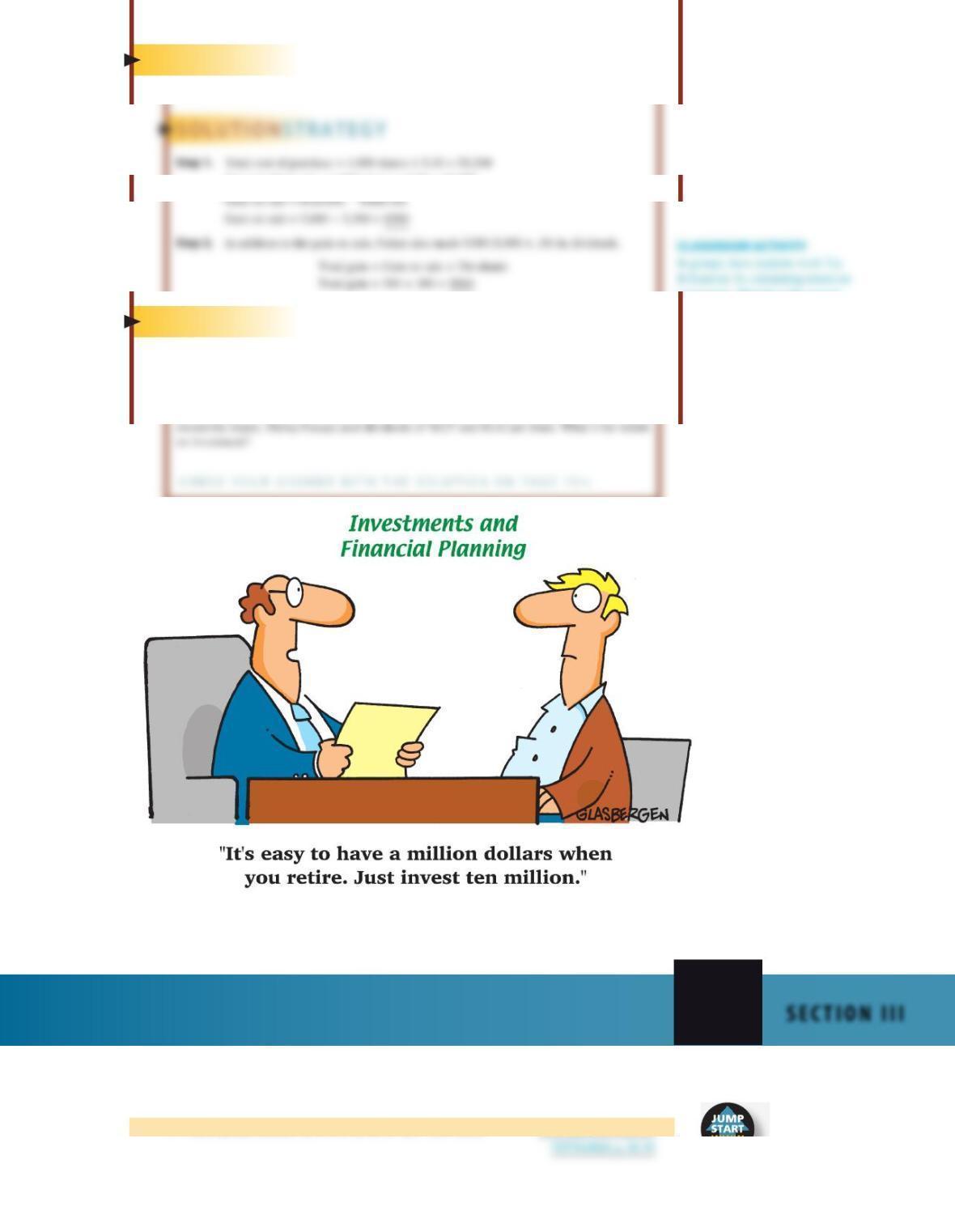
Copyright 2002 by Randy Glasbergen www.glasbergen.com
20
SECTION III
85461_ch20_hr_672-710_3.indd 697 9/23/15 5:11 PM
698 Chapter 20 • INVESTMENTS
4. Which mutual fund has the highest YTD % return? How much? Fidelity Invest,
GoldInst r, 16.3%
Calculate the sales charge and sales charge percent for the following mutual funds.
Fund
Offer
Price
Net Asset
Value
Sales
Charge
Sales
Charge %
11. Prime Value CT $18.25 $17.58
$.67
3.8%
12. Northstar A:
MuFl A
$13.35 $12.82
$.53
4.1%
$1.28
$.55
4.2%
Calculate the net asset value and number of shares purchased for the following mutual funds.
round shares to thousandths (three decimal places).
Total
Assets
Total
Liabilities
Shares
Outstanding
Net Asset
Value
Offer
Price
Total
Investment
Shares
Purchased
16. $25,000,000 $6,300,000 2,000,000
$9.35
$9.92 $8,000
806.452
17. $52,000,000 $1,800,000 6,100,000
$8.23
$9.50 $5,000
526.316
$10.68
2,281.022
Calculate the total cost, proceeds, total gain (or loss), and return on investment for the
following mutual fund investments. The offer price is the purchase price of the shares, and
the net asset value is the price at which the shares were later sold.
Shares
Offer
Price
Total
Cost
Net Asset
Value Proceeds
Per Share
Dividends
Total Gain
(or Loss)
Return on
Investment
%
21. 300 $12.50
$3,750
$14.20
$4,260
$.25
$585
15.6
22. 500 $10.40
$5,200
$12.90
$6,450
$.68
$1,590
30.6
26. The Victoria Growth fund has an offer price of $13.10 and a net asset value of $12.35.
a. What is the sales charge?
b. What is the sales charge percent?
Complete worked-out solutions
for Exercises 11–25 appear in

SEcTIoN III • MuTual FuNdS 699
27. The Capital MGT fund has total assets of $25,000,000 and liabilities of $3,500,000. If there are
8,600,000 shares outstanding, what is the net asset value of the fund?
28. Stuart Spector invested a lump sum of $10,000 in a mutual fund with an offer price of $14.50.
How many shares did he purchase?
29. Butch Gold purchased 500 shares of Shoreline Value fund for an offer price of $8.90 per share.
He later sold the shares at a net asset value of $10.50 per share. During the time that he owned
the shares, the fund paid a dividend of $0.75 per share three times. What is Butch’s return on
investment?
BusInEss dECIsIOn: CapItal GaIns
30. There are many tax rules and regulations you should be aware of when investing—whether it
be in stocks; bonds; mutual funds; real estate; or collectibles such as artwork, antiques, gems,
memorabilia, stamps, and coins. Capital gains are proceeds derived from these types of invest-
Capital Gains Rates
Stocks Held 10% Tax Bracket
15%–35% Tax
Bracket
39.6% Tax
Bracket
1 year or less
(short-term)
Bracket rate (10%) Bracket rate
(15%–35%)
Bracket rate
(39.6%)
Over 1 year
(long-term)
0% 15% 20%
a. If you are in the 20% tax bracket, how much tax will you save by waiting for an invest-
ment to become long-term before selling it if your taxable profit from this investment is
$25,000?
b. How much will you save if you are in the 39.6% tax bracket?