CHAPTER 2
INDEX AND CLASSIFICATION PROPERTIES OF SOILS
2-1. From memory, draw a phase diagram (like Fig. 2.2, but don’t look first!). The “phases” have
a Volume side and Mass side. Label all the parts.
2-2. From memory, write out the definitions for water content, void ratio, dry density, wet or moist
density, and saturated density.
2-3. Assuming a value of
ρ
s = 2.7 Mg/m3, take the range of saturated density in Table 2.1 for the
six soil types and calculate/estimate the range in void ratios that one might expect for these soils.
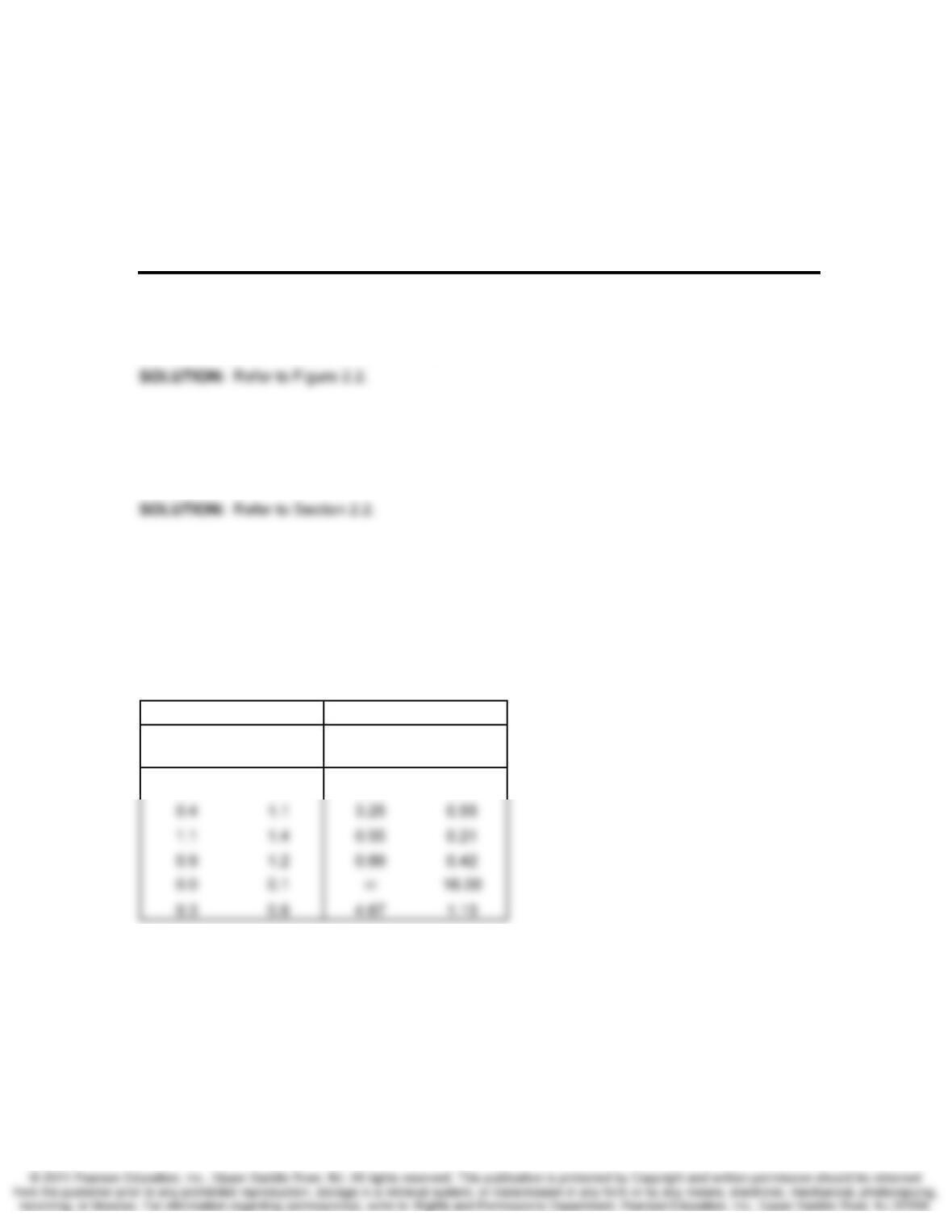
SOLUTION: Create a spreadsheet using input values from Table 2.1 and Eq. 2.18.
ρ‘ – min ρ‘ – max e
max
e
min
(Mg/m
3
)(Mg/m
3
)
0.9 1.4 0.89 0.21
(Given) (see Eq. 2.18)
Index and Classification Properties of Soils Chapter 2
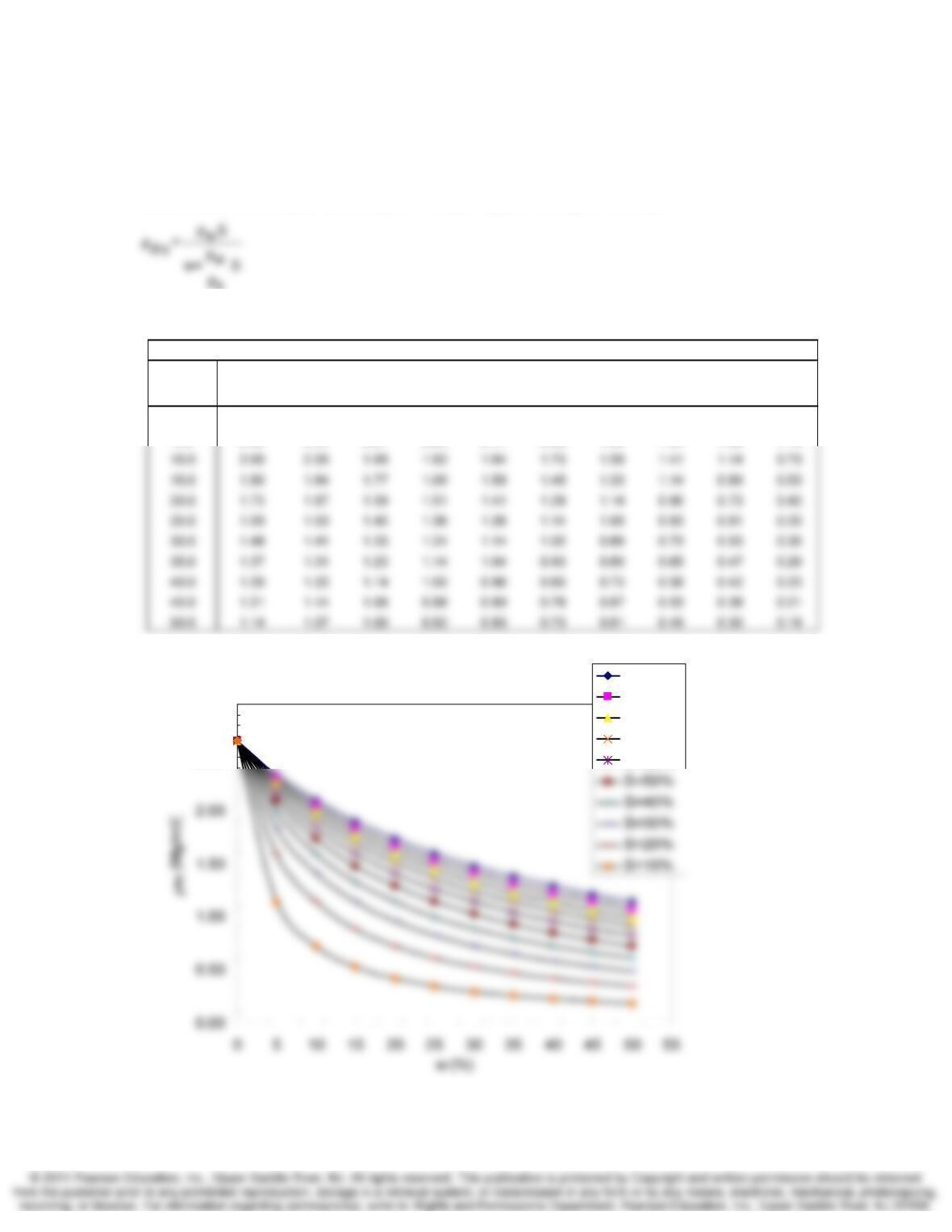
2-4. Prepare a spreadsheet plot of dry density in Mg/m3 as the ordinate versus water content in
percent as the abscissa. Assume
ρ
s = 2.65 Mg/m3 and vary the degree of saturation, S, from
100% to 40% in 10% increments. A maximum of 50% water content should be adequate.
SOLUTION: Solve Eq. 2.12 and Eq. 2.15 for ρd = f(ρs, w, S, Gs), or use Eq. 5.1.
S = 100 90 80 70 60 50 40 30 20 10
wρ
dry
ρ
dry
ρ
dry
ρ
dry
ρ
dry
ρ
dry
ρ
dry
ρ
dry
ρ
dry
ρ
dry
(%) (Mg/m
3
)(Mg/m
3
)(Mg/m
3
)(Mg/m
3
)(Mg/m
3
)(Mg/m
3
)(Mg/m
3
)(Mg/m
3
)(Mg/m
3
)(Mg/m
3
)
0.0 2.65 2.65 2.65 2.65 2.65 2.65 2.65 2.65 2.65 2.65
5.0 2.34 2.31 2.27 2.23 2.17 2.09 1.99 1.84 1.59 1.14
Problem 2-4
2.50
3.00
S=100%
S=90%
S=80%
S=70%
S=60%
Index and Classification Properties of Soils Chapter 2
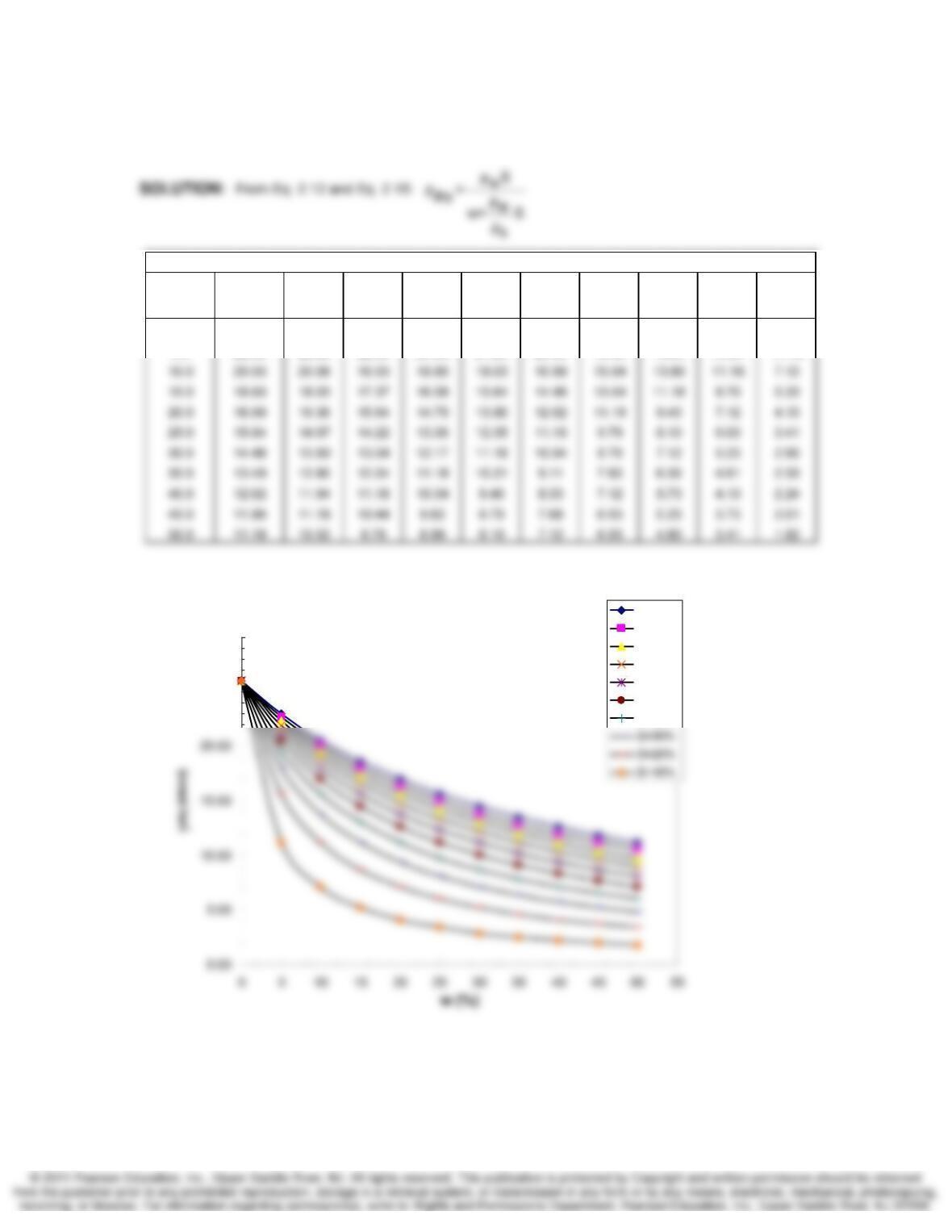
2-5a Prepare a graph like that in Problem 2.4, only use dry density units of kN/m3 and pounds
per cubic feet.
S = 100 90 80 70 60 50 40 30 20 10
wγ
dry
γ
dry
γ
dry
γ
dry
γ
dry
γ
dry
γ
dry
γ
dry
γ
dry
γ
dry
(%) (kN/m
3
)(kN/m
3
)(kN/m
3
)(kN/m
3
)(kN/m
3
)(kN/m
3
)(kN/m
3
)(kN/m
3
)(kN/m
3
)(kN/m
3
)
0.0 26.00 26.00 26.00 26.00 26.00 26.00 26.00 26.00 26.00 26.00
5.0 22.95 22.66 22.30 21.86 21.29 20.55 19.53 18.03 15.64 11.18
Problem 2-5a
25.00
30.00
S=100%
S=90%
S=80%
S=70%
S=60%
S=50%
S=40%
Index and Classification Properties of Soils Chapter 2
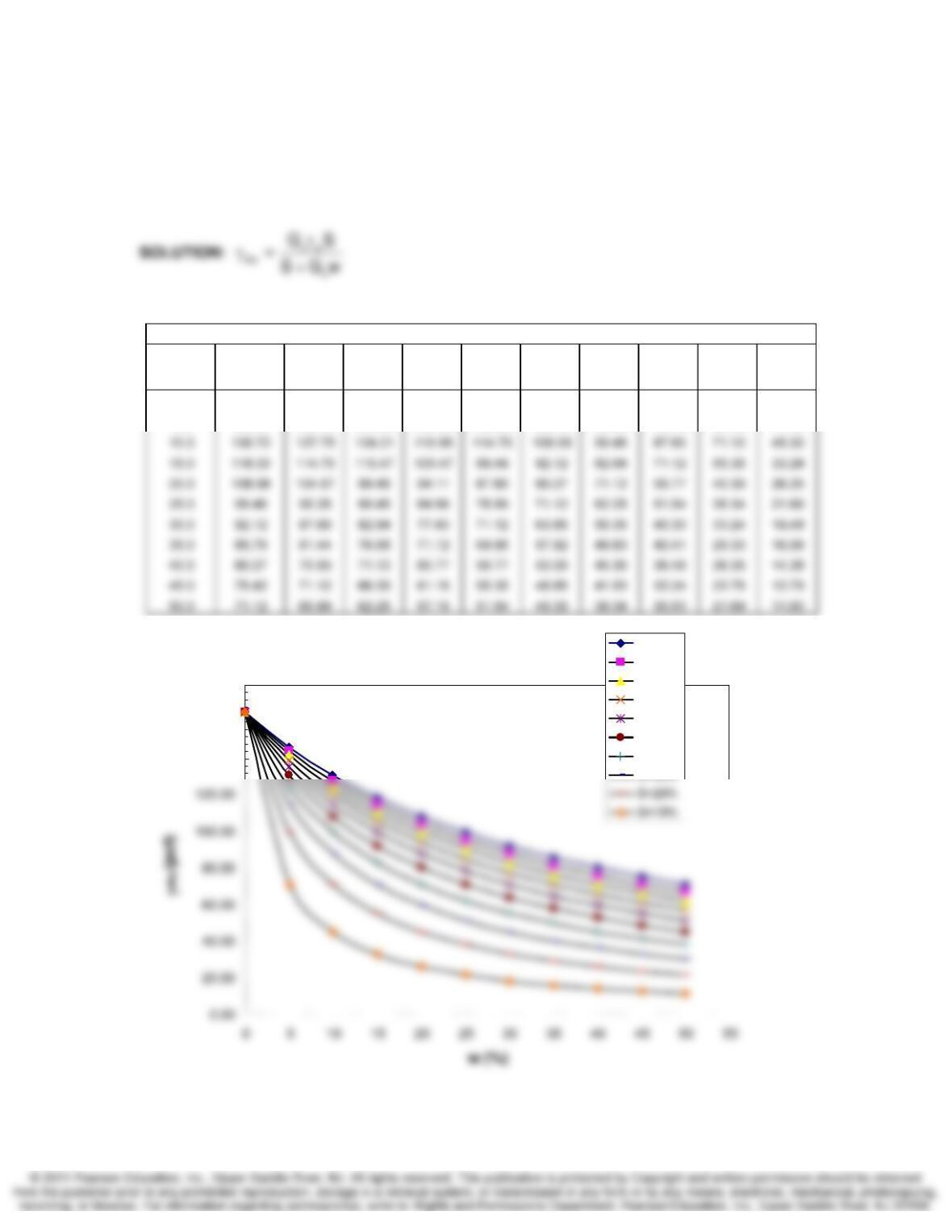
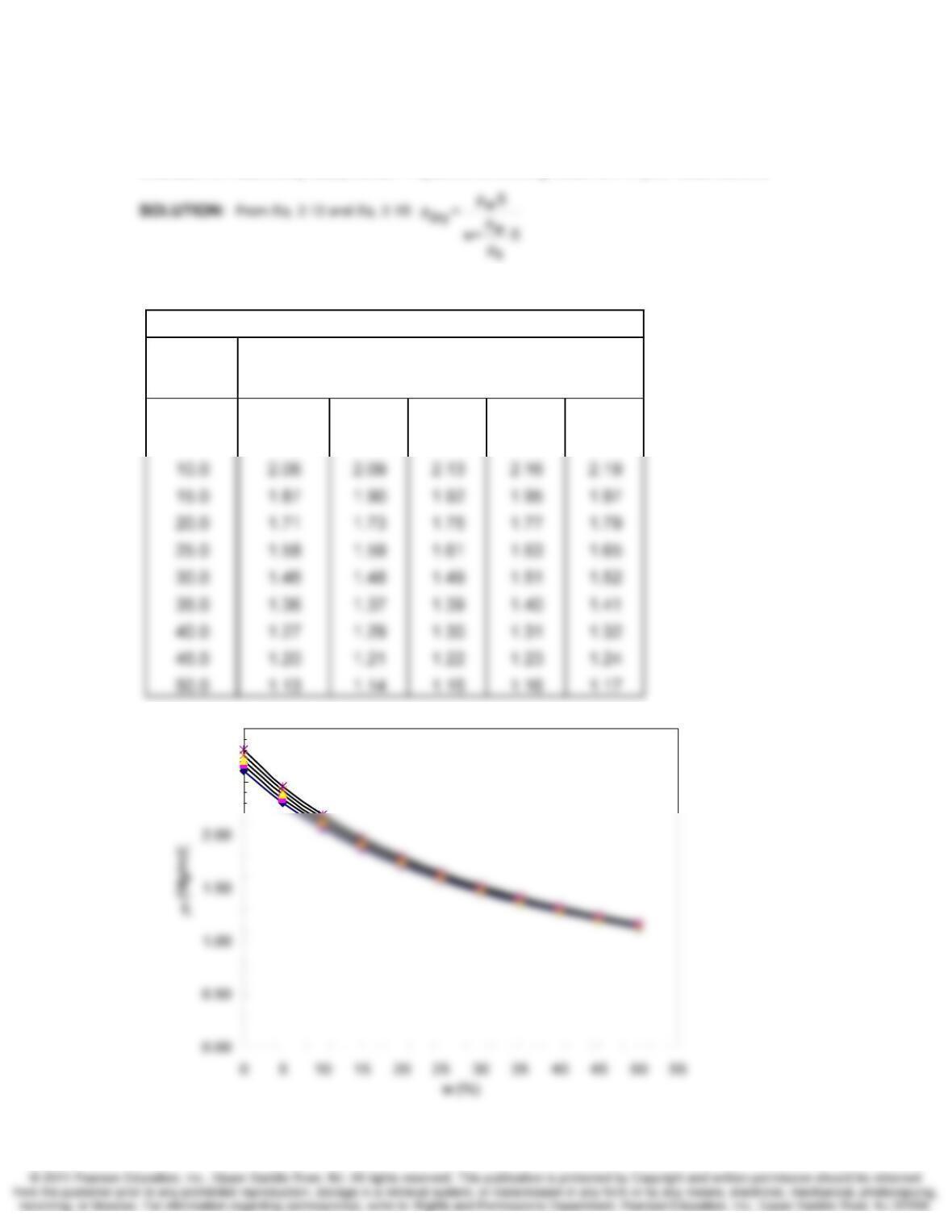
2-5b Prepare a graph like that in Problem 2.4, only use dry density units of pounds per cubic
feet.
S = 100 90 80 70 60 50 40 30 20 10
wγ
dry
γ
dry
γ
dry
γ
dry
γ
dry
γ
dry
γ
dry
γ
dry
γ
dry
γ
dry
(%) (pcf) (pcf) (pcf) (pcf) (pcf) (pcf) (pcf) (pcf) (pcf) (pcf)
0.0 165.36 165.36 165.36 165.36 165.36 165.36 165.36 165.36 165.36 165.36
5.0 146.01 144.14 141.86 139.04 135.45 130.72 124.21 114.70 99.46 71.12
Problem 2-5b
140.00
160.00
180.00
S=100%
S=90%
S=80%
S=70%
S=60%
S=50%
S=40%
S=30%
Index and Classification Properties of Soils Chapter 2
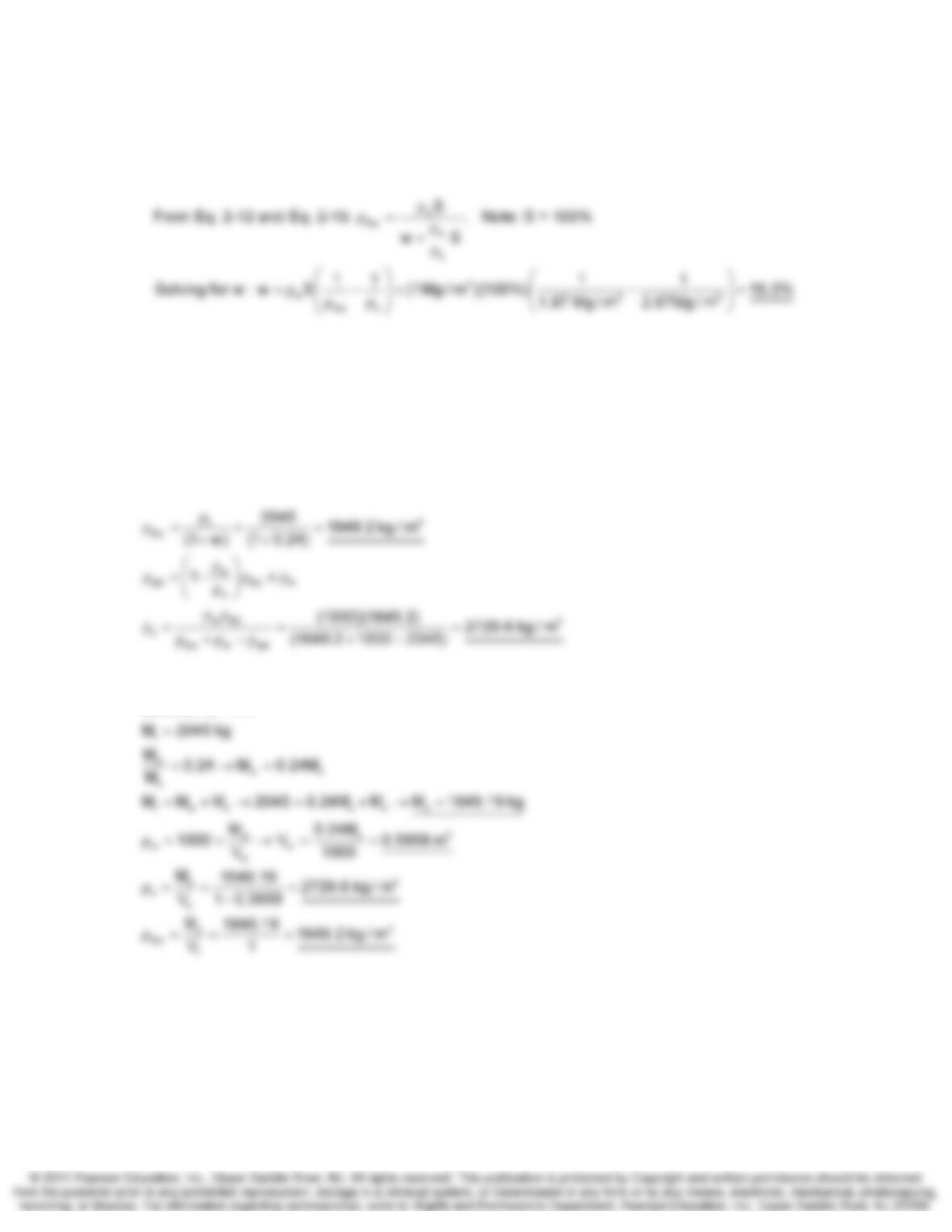
2.6. Prepare a graph like that in Problem 2.4, only for S = 100% and vary the density of solids
from 2.60 to 2.80 Mg/m3. You decide the size of the increments you need to “satisfactorily”
evaluate the relationship as
ρ
s varies. Prepare a concluding statement of your observations.
Note: The relationship between ρdry and w is not overly sensitive to ρs.
ρ
s
= 2.6 2.65 2.7 2.75 2.8
wρ
dry
ρ
dry
ρ
dry
ρ
dry
ρ
dry
(%) (Mg/m
3
)(Mg/m
3
)(Mg/m
3
)(Mg/m
3
)(Mg/m
3
)
0.0 2.60 2.65 2.70 2.75 2.80
5.0 2.30 2.34 2.38 2.42 2.46
2.50
3.00
Index and Classification Properties of Soils Chapter 2
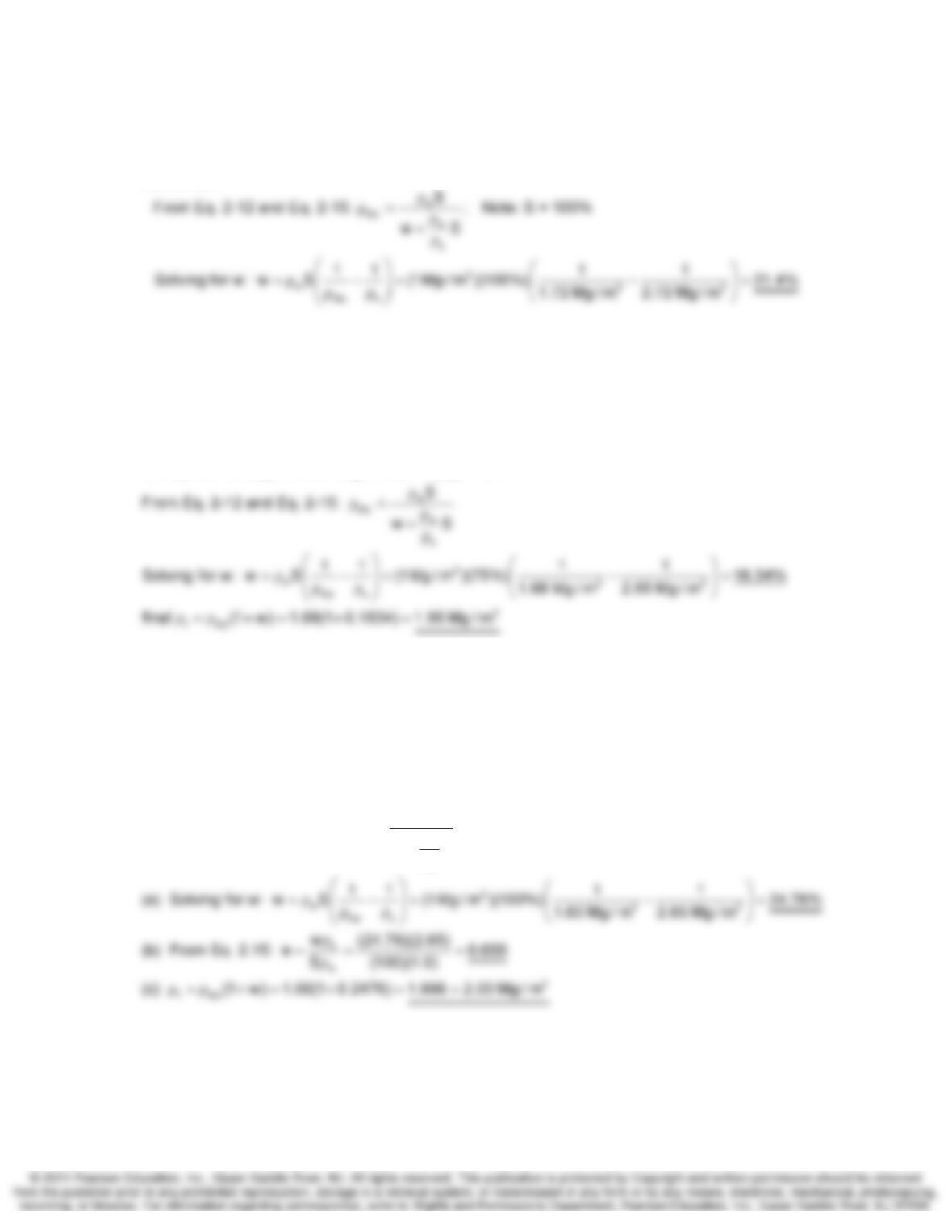
2.7. The dry density of a compacted sand is 1.87 Mg/m3 and the density of the solids is 2.67
Mg/m3. What is the water content of the material when saturated?
SOLUTION:
2.8. A soil that is completely saturated has a total density of 2045 kg/m3 and a water content of
24%. What is the density of the solids? What is the dry density of the soil?
SOLUTION:
a) Solve using equations or phase diagrams:
b) Solve using phase diagram relationships:
assume V 1.0
=
Index and Classification Properties of Soils Chapter 2
2.9 What is the water content of a fully saturated soil with a dry density of 1.72 Mg/m3? Assume
ρ
s = 2.72 Mg/m3.
SOLUTION:
2.10. A dry quartz sand has a density of 1.68 Mg/m3. Determine its density when the degree of
saturation is 75%. The density of solids for quartz is 2.65 Mg/m3.
SOLUTION:
dry dry (final)
Recognize that (initial) (final); S = 75%
ρ=ρ
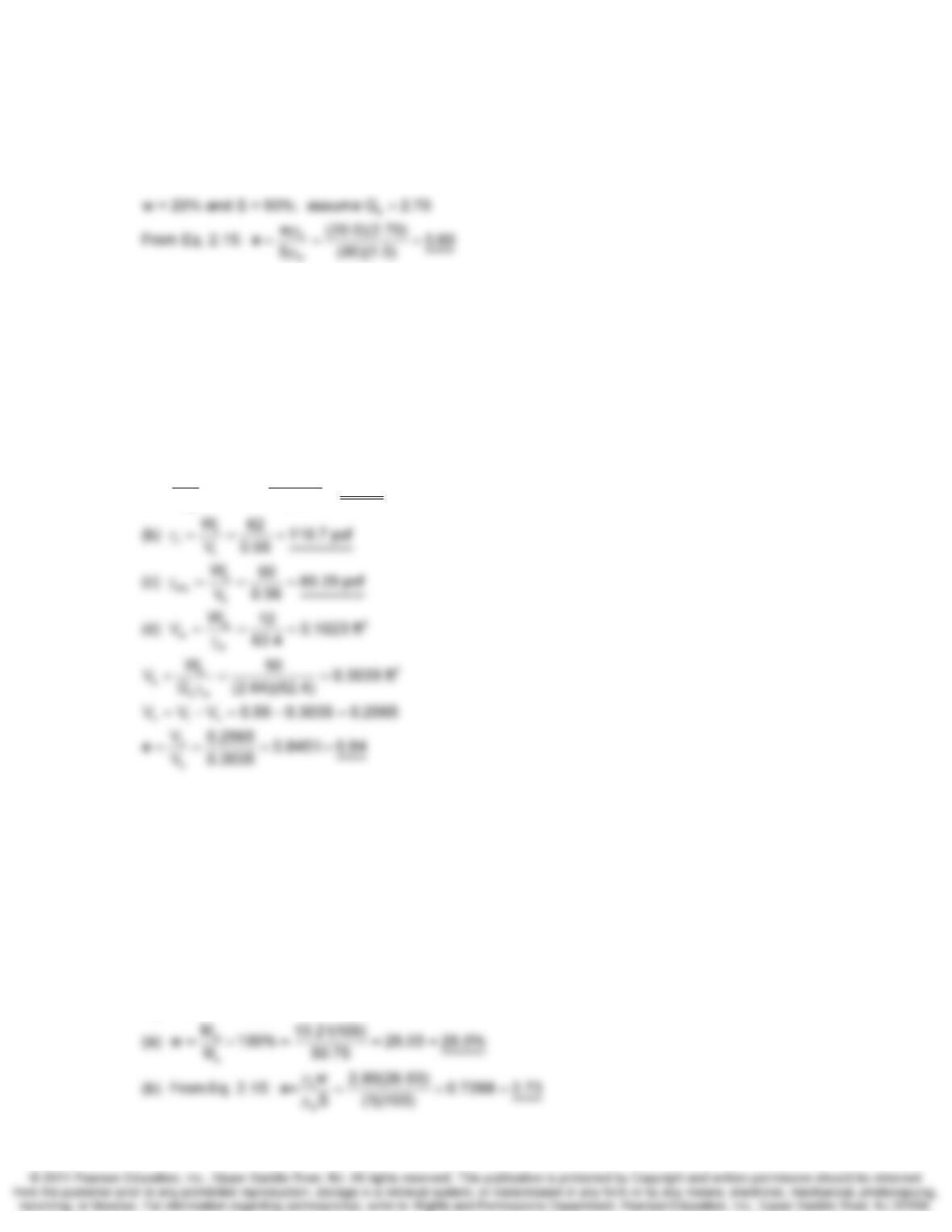
2.11. The dry density of a soil is 1.60 Mg/m3 and the solids have a density of 2.65 Mg/m3. Find
the (a) water content, (b) void ratio, and (c) total density when the soil is saturated.
SOLUTION:
w
dry
w
s
Given: S = 100%
S
From Eq. 2-12 and Eq. 2-15:
wS
ρ
ρ= ρ
+ρ
Index and Classification Properties of Soils Chapter 2
2.12. A natural deposit of soil is found to have a water content of 20% and to be 90% saturated.
What is the void ratio of this soil?
SOLUTION:
2.13. A chunk of soil has a wet weight of 62 lb and a volume of 0.56 ft3. When dried in an oven,
the soil weighs 50 lb. If the specific gravity of solids Gs = 2.64, determine the water content, wet
unit weight, dry unit weight, and void ratio of the soil.
SOLUTION: Solve using phase diagram relationships.
wts
w
s
(a) W W W 62 50 12 lb
W12(100)
w 100% 24.0%
W50
= − =−=
=× = =
2.14. In the lab, a container of saturated soil had a mass of 113.27 g before it was placed in the
oven and 100.06 g after the soil had dried. The container alone had a mass of 49.31 g. The
specific gravity of solids is 2.80. Determine the void ratio and water content of the original soil
sample.
SOLUTION: Solve using phase diagram relationships.
s
w
M 100.06 49.31 50.75 g
M 113.27 100.06 13.21 g
=−=
=−=
Index and Classification Properties of Soils Chapter 2
2.15. The natural water content of a sample taken from a soil deposit was found to be 12.0%. It
has been calculated that the maximum density for the soil will be obtained when the water
content reaches 22.0%. Compute how many grams of water must be added to each 1000 g of
soil (in its natural state) in order to increase the water content to 22.0%.
SOLUTION:
w
ws
s
Natural state
M
w 0.12 M (0.12)M
M
== →=
2.16. A cubic meter of dry quartz sand (Gs = 2.65) with a porosity of 60% is immersed in an oil
bath having a density of 0.92 g/cm3. If the sand contains 0.27 m3 of entrapped air, how much
force is required to prevent it from sinking? Assume that a weightless membrane surrounds the
specimen. (Prof. C. C. Ladd.)
SOLUTION:
33
t
V 1m 1,000,000 cm
==
Index and Classification Properties of Soils Chapter 2
2.17. A soil sample taken from a borrow pit has a natural void ratio of 1.15. The soil will be used
for a highway project where a total of 100,000 m3 of soil is needed in its compacted state; its
compacted void ratio is 0.73. How much volume has to be excavated from the borrow pit to meet
the job requirements?
SOLUTION:
ts t
v
ss
VV V
V
VV
ee e1
Embankment
−
== →=
+
2.18. A sample of moist soil was found to have the following characteristics:
Total volume: 0.01456 m3
Total mass: 25.74 kg
Mass after oven drying: 22.10 kg
Specific gravity of solids: 2.69
Find the density, unit weight, void ratio, porosity, and degree of saturation for the moist soil.
SOLUTION:
3
kg
tm
25.74
(a) 1767.857 1768
0.01456
ρ= = =
Index and Classification Properties of Soils Chapter 2
2.19. A gray silty clay (CL) is sampled from a depth of 12.5 feet. The “moist” soil was extruded
from a 6-inch-high brass liner with an inside diameter of 2.83 inches and weighed 777 grams. (a)
Calculate the wet density in pounds per cubic feet. (b) A small chunk of the original sample had a
wet weight of 140.9 grams and weighed 85.2 grams after drying. Compute the water content,
using the correct number of significant figures. (c) Compute the dry density in Mg/m3 and the dry
unit weight in kN/m3.
SOLUTION:
()
(
)
()
()
2
3t
tt
3
3
t
1lb
777 g 453.6 g
M
(2.83)
(a) V 6 37.741in , 78.429 78.4 pcf
4V
1ft
37.741in 12 in
π
=×= γ== ==
2.20. A cylindrical soil specimen is tested in the laboratory. The following properties were
obtained:
Sample diameter 3 inches
Sample length 6 inches
Wt. before drying in oven 2.95 lb
Wt. after drying in oven 2.54 lb
Oven temperature 110°C
Drying time 24 hours
Specific gravity of solids 2.65
What is the degree of saturation of this specimen?
SOLUTION:
2
33
t
(3)
V 6 42.4115 in 0.02454 ft
4
π
=×= =
Index and Classification Properties of Soils Chapter 2
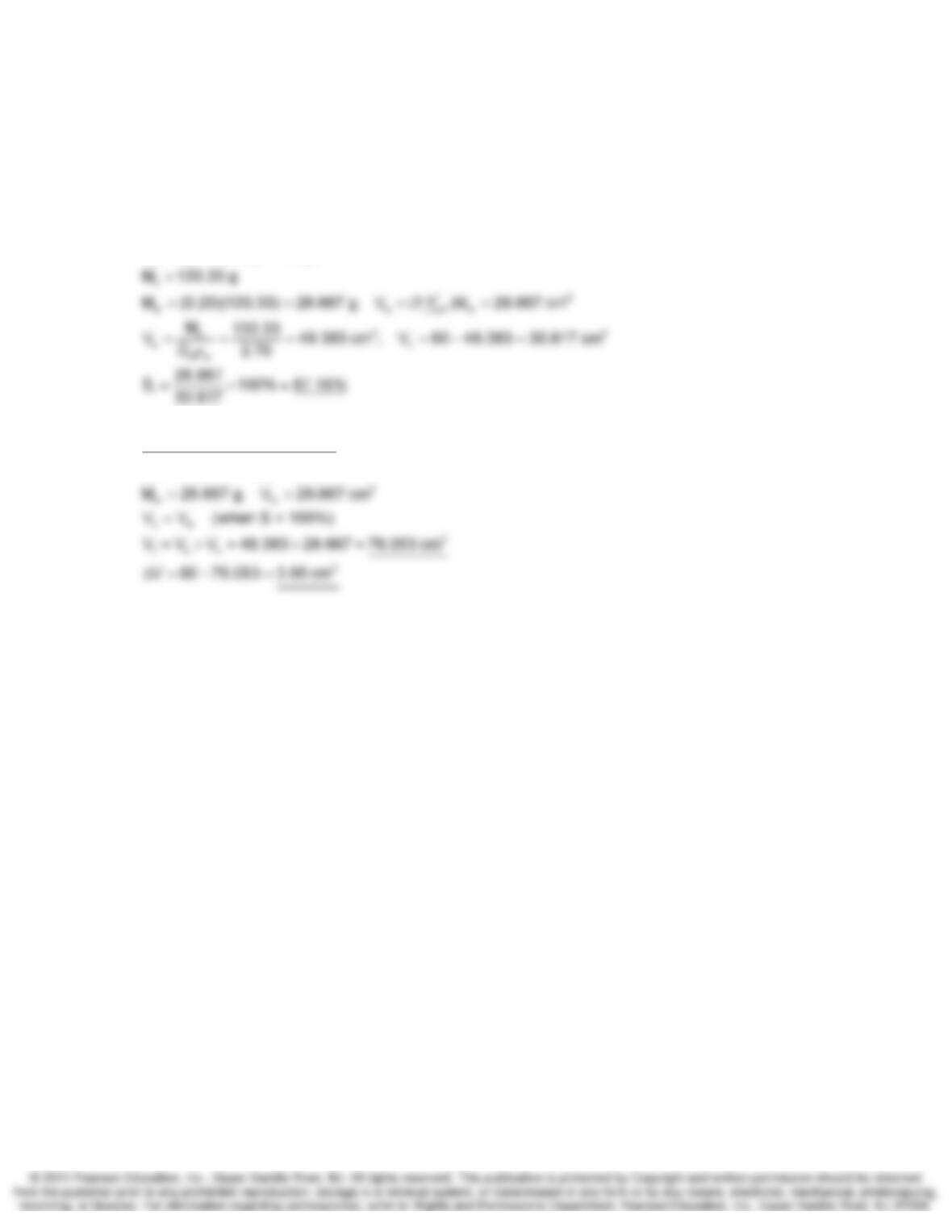
2.21 A sample of saturated silt is 10 cm in diameter and 2.5 cm thick. Its void ratio in this state is
1.35, and the specific gravity of solids is 2.70. The sample is compressed to a 2-cm thickness
without a change in diameter.
(a) Find the density of the silt sample, in prior to being compressed.
(b) Find the void ratio after compression and the change in water content that occurred
from initial to final state.
SOLUTION:
2
3
t
w
wv
(10)
(a) V 2.5 196.350 cm
4
V
S1 V V
V
π
=×=
== → =
2
3
t2
3
s
(10)
(b) V 2.0 157.08 cm
4
V 83.553 cm (no change)
−
π
=×=
=
Index and Classification Properties of Soils Chapter 2
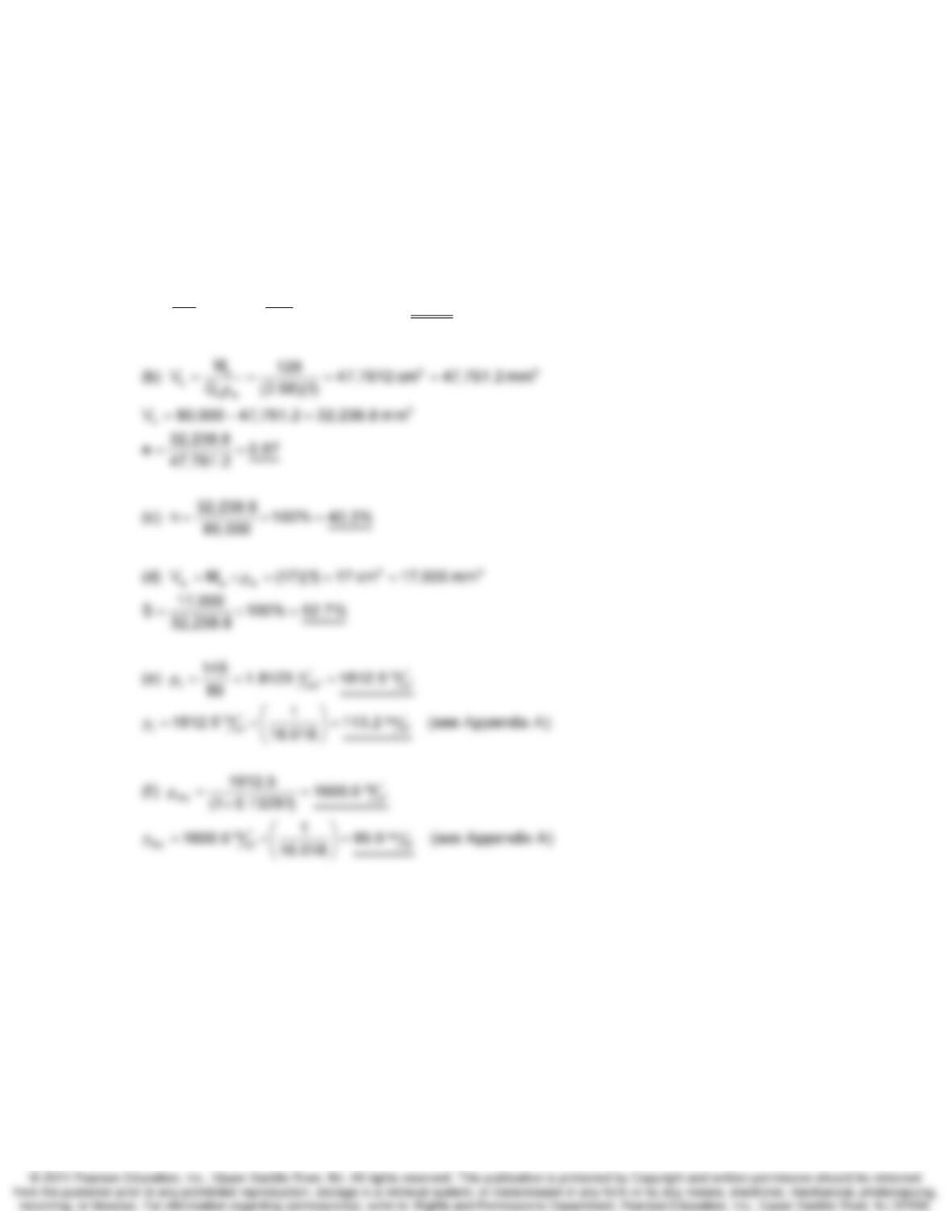
2.22. A sample of sand has the following properties: total mass Mt = 160 g; total volume Vt =80
cm3; water content w = 20%; specific gravity of solids Gs =2.70. How much would the sample
volume have to change to get 100% saturation, assuming the sample mass Mt stayed the same?
SOLUTION:
ws s
ts s
t
MwM(0.20)M
MM0.20M160g
Desired condition: S 100%
Vch
=× =
=+ =
=
ss
anges, but V and M remain the same
Index and Classification Properties of Soils Chapter 2
2.23. Draw a phase diagram and begin to fill in the blanks: A soil specimen has total volume of
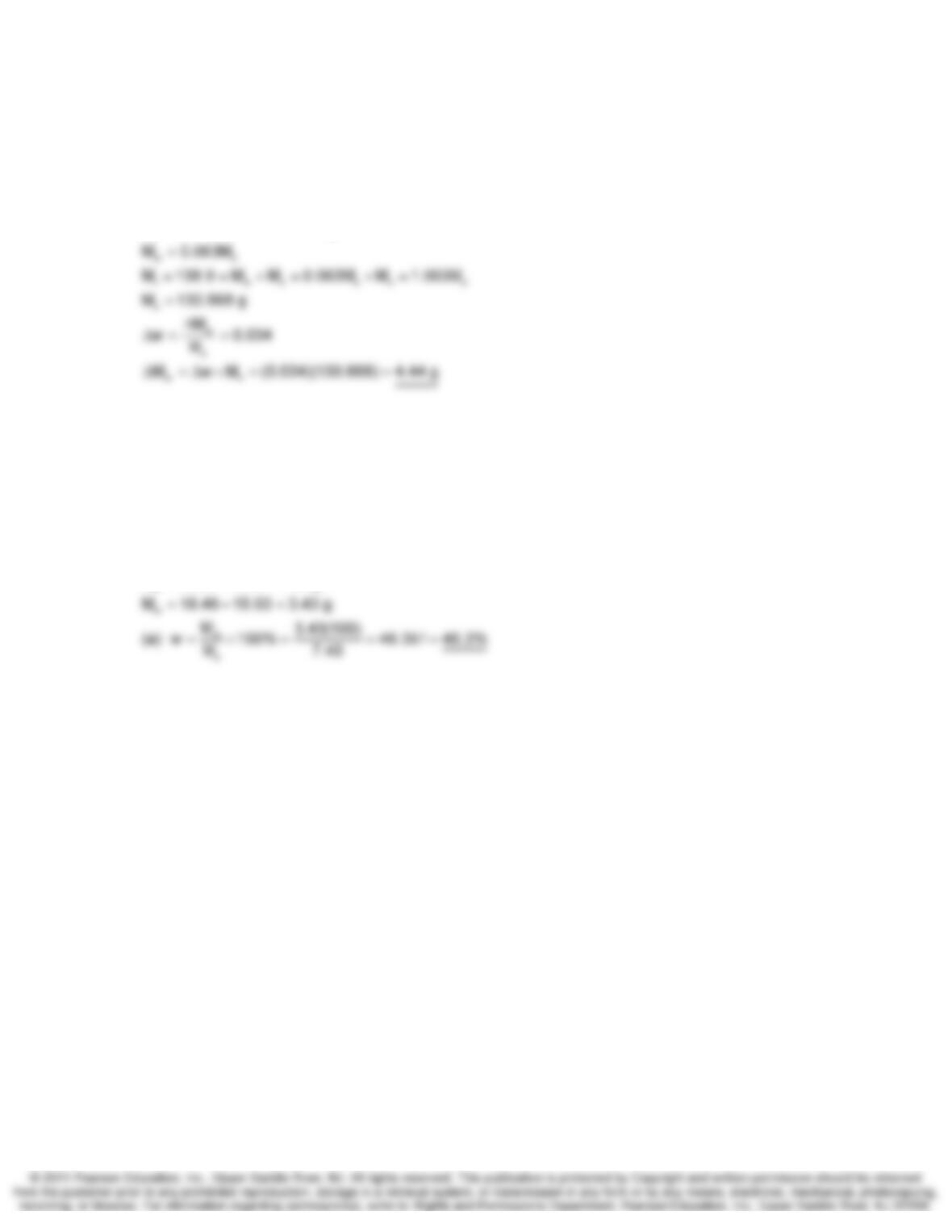
80,000 mm3 and weighs 145 g. The dry weight of the specimen is 128 g, and the density of the
soil solids is 2.68 Mg/m3. Find the: (a) water content, (b) void ratio, (c) porosity, (d) degree of
saturation, (e) wet density, and (f) dry density. Give the answers to parts (e) and (f) in both SI and
British engineering units.
SOLUTION:
w
w
s
(a) M 145 128 17 g
M17
w 100% 100 13.281 13.3%
M128
−=
=× = ×= =
Index and Classification Properties of Soils Chapter 2
2.24. A sample of soil plus container weighs 397.6 g when the initial water content is 6.3%. The
container weighs 258.7 g. How much water needs to be added to the original specimen if the
water content is to be increased by 3.4%? After U.S. Dept. of Interior (1990).
SOLUTION:
t
M 397.6 258.7 138.9 g
=−=
2.25. A water-content test was made on a sample of clayey silt. The weight of the wet soil plus
container was 18.46 g, and the weight of the dry soil plus container was 15.03 g. Weight of the
empty container was 7.63 g. Calculate the water content of the sample.
SOLUTION:
s
M 15.03 7.63 7.40 g
=−=
Index and Classification Properties of Soils Chapter 2
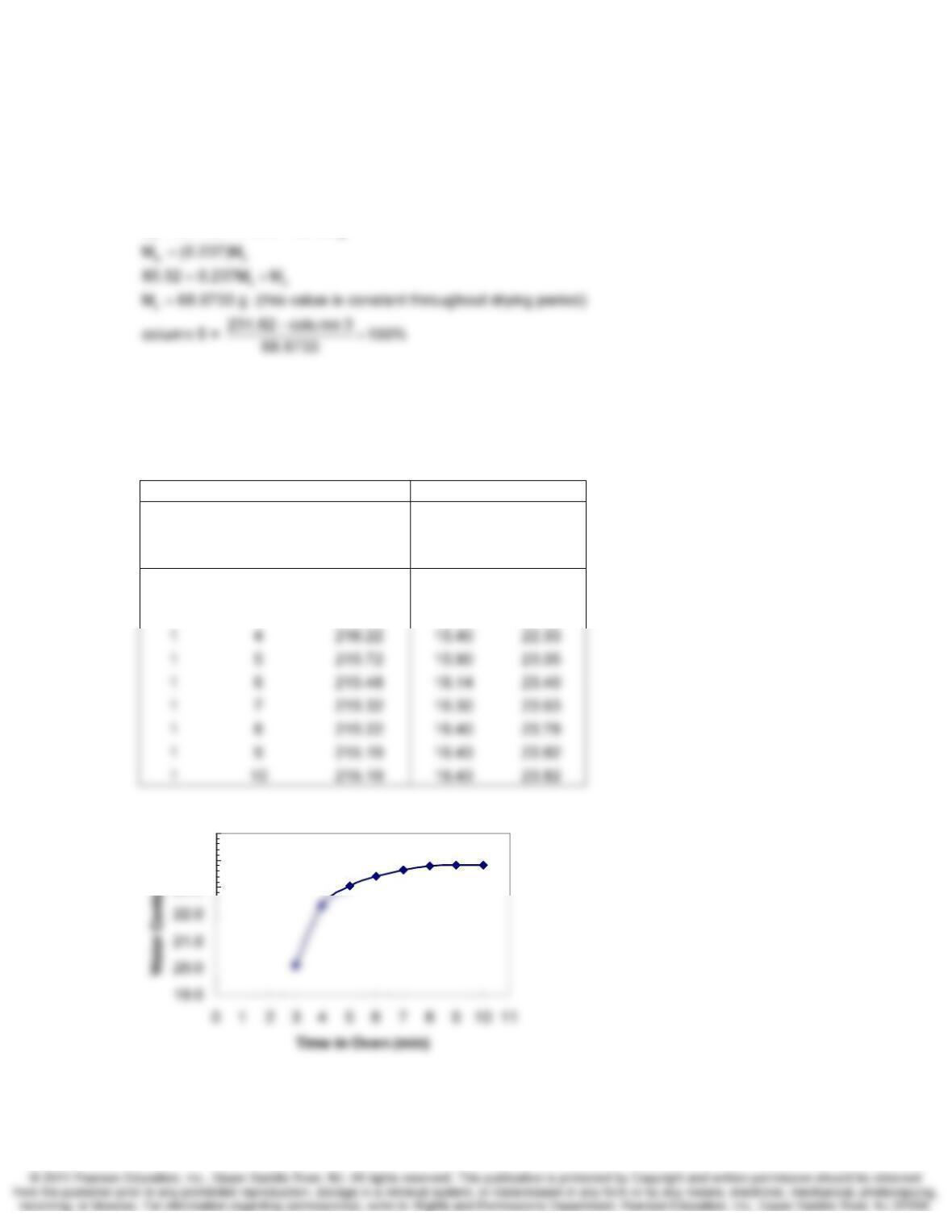
2.26. A soil sample is dried in a microwave oven to determine its water content. From the data
below, evaluate the water content and draw conclusions. The oven-dried water content is 23.7%.
The mass of the dish is 146.30 grams. After U.S. Dept. of Interior (1990).
SOLUTION:
t
M 231.62 146.3 85.32 g
=−=
CONCLUSION: The loss of additional water in the soil sample becomes negligible after 8 to 10
minutes in the microwave oven used in the experiment.
GIVEN CALCULATED
Time in Total Oven Mass of Mass of Water
Oven Time Soil + Dish Water Content
(min) (min) (g) (g) (%)
0 0 231.62 — —
3 3 217.75 13.87 20.11
23.0
24.0
25.0
)
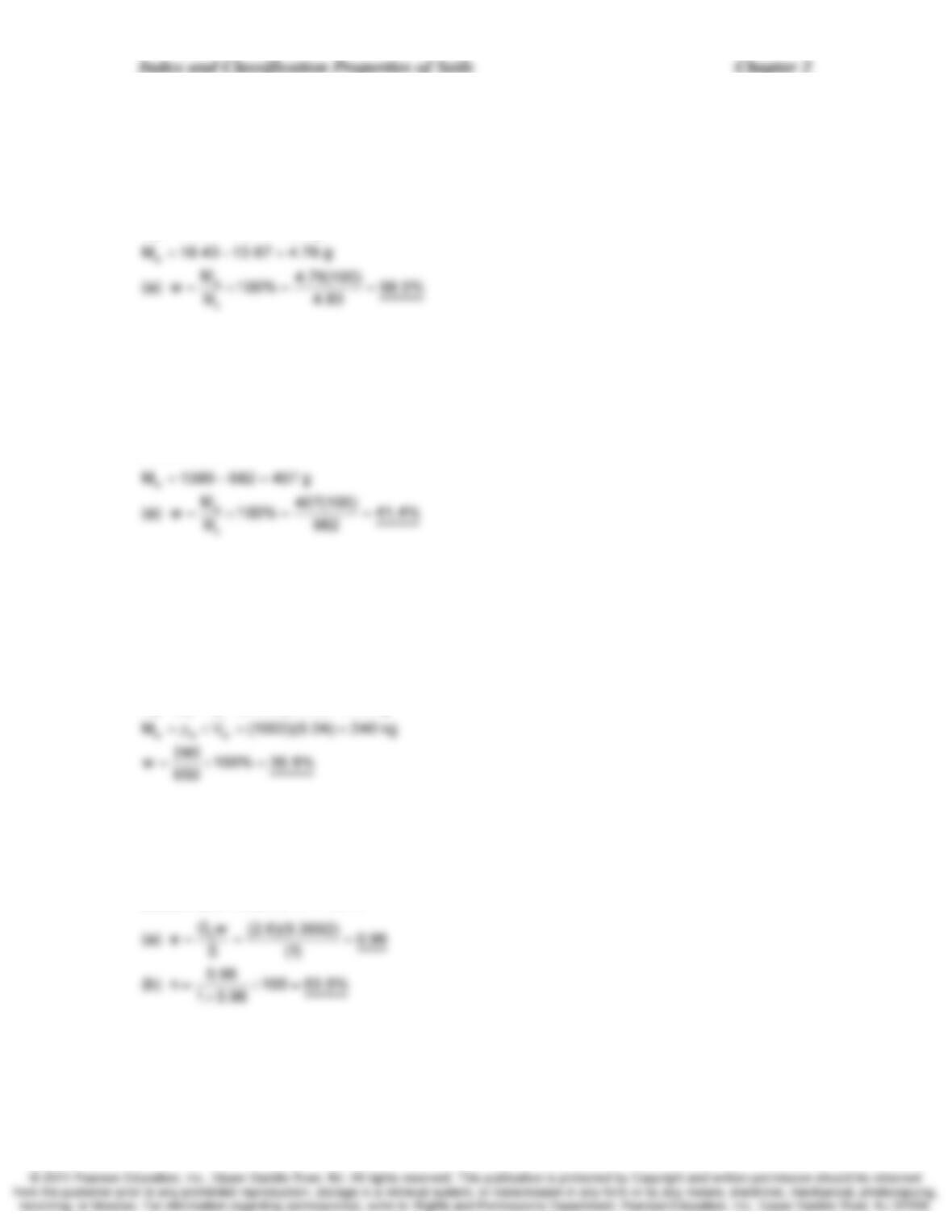
2.27. The mass of a sample of silty clay soil plus container is 18.43 g and the weight of the dry
soil plus container is 13.67 g. The container weighs 8.84 g. Compute the water content of the
sample.
SOLUTION:
s
M 13.67 8.84 4.83 g
=−=
2.28. A specimen of fully saturated clay soil that weighs 1389 g in its natural state weighs 982 g
after drying. What is the natural water content of the soil?
SOLUTION:
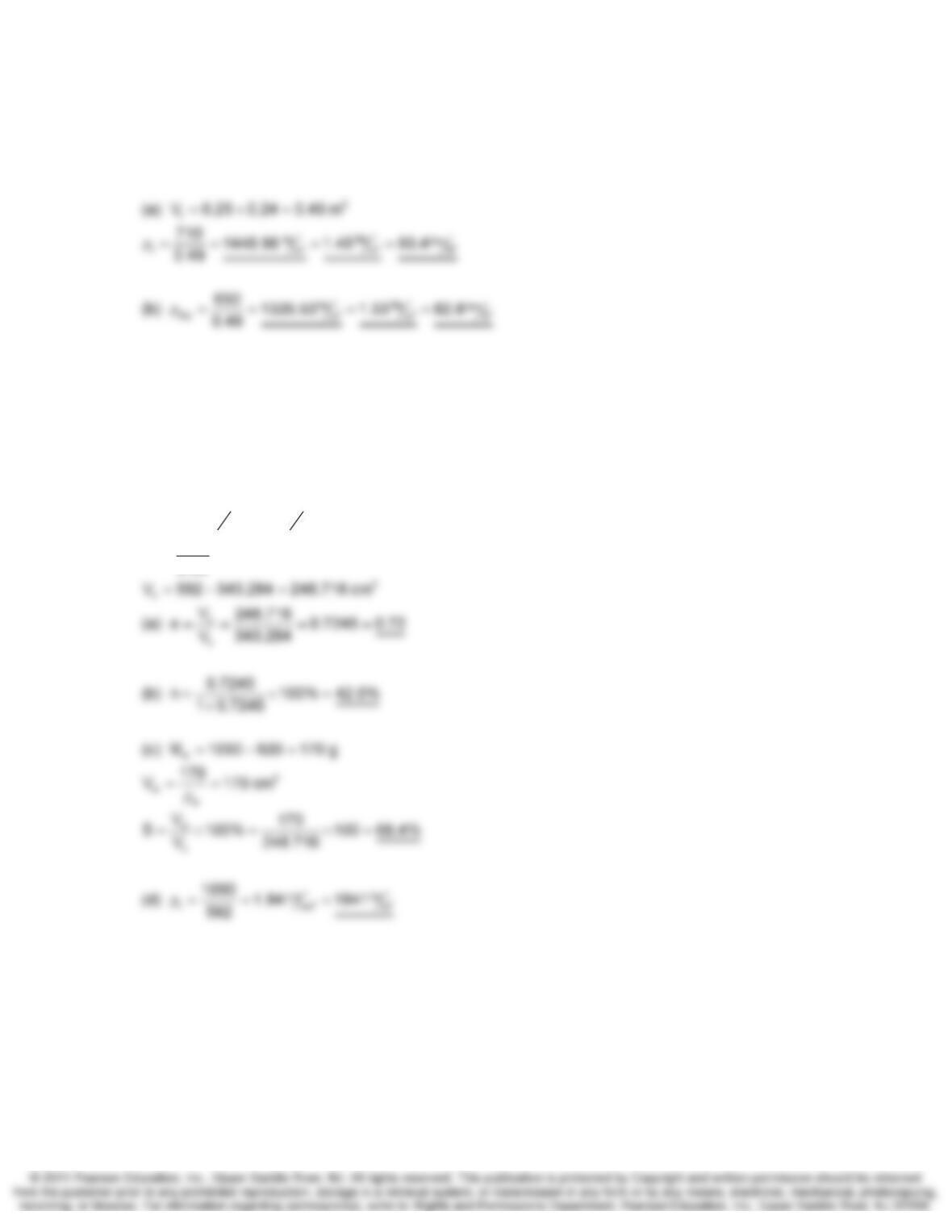
2.29. The volume of water in a sample of moist soil is 0.24 m3. The volume of solids Vs is 0.25
m3. Given that the density of soil solids
ρ
s is 2600 kg/m3, find the water content.
SOLUTION:
sss
M V (2600)(0.25) 650 kg
=ρ × = =
2.30. For the soil sample of Problem 2.29, compute (a) the void ratio and (b) the porosity.
SOLUTION: Assume S = 100%
Index and Classification Properties of Soils Chapter 2
2.31. For the soil sample of Problem 2.29, compute (a) the total or wet density and (b) the dry
density. Give your answers in Mg/m3, kg/m3, and lbf/ft3.
SOLUTION: Assume S = 100%
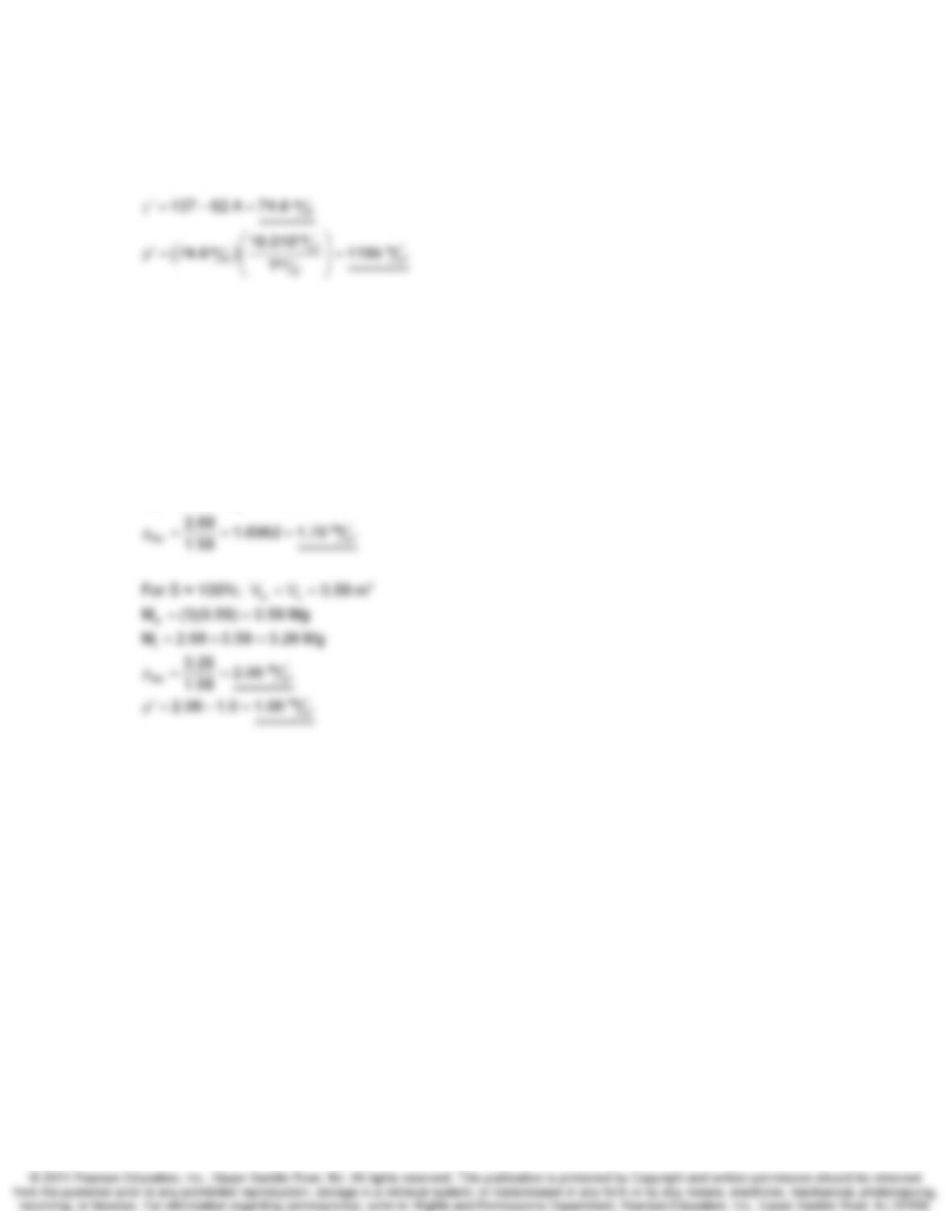
2.32. A 592-cm3 volume of moist sand weighs 1090 g. Its dry weight is 920 g and the density of
solids is 2680 kg/m3. Compute the void ratio, porosity, water content, degree of saturation, and
total density in kg/m3.
SOLUTION:
33
kg g
smcm
3
s
2680 2.68
920
V 343.284 cm
2.68
ρ= =
==
Index and Classification Properties of Soils Chapter 2
2.33. The saturated density
γ
sat of a soil is 137 lbf/ft3. Find the buoyant density of this soil in both
lbf/ft3 and kg/m3.
SOLUTION:
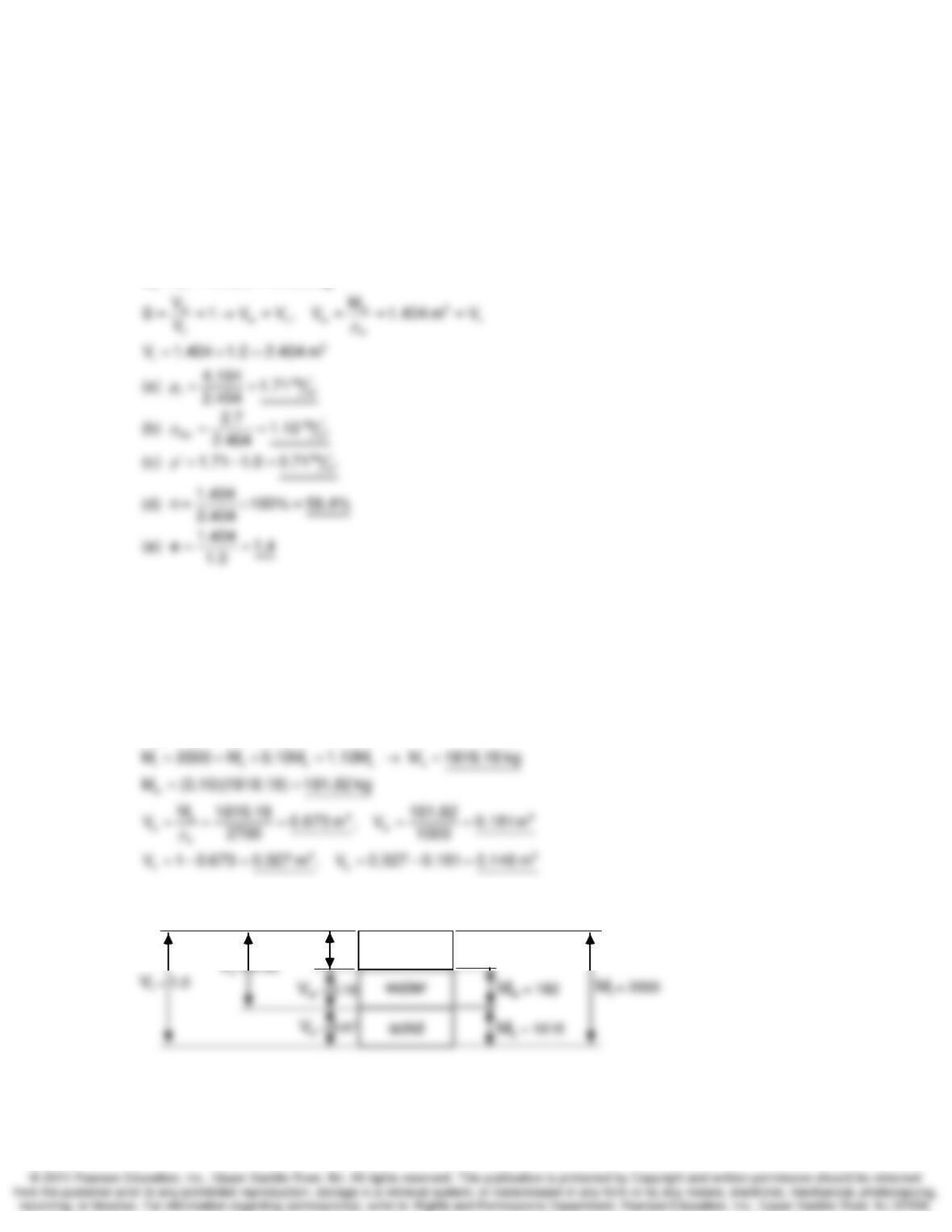
2.34. A sand is composed of solid constituents having a density of 2.68 Mg/m3. The void ratio is
0.58. Compute the density of the sand when dry and when saturated and compare it with the
density when submerged.
SOLUTION:
3
s
3
vt
Assume V 1m
V 0.58, V 1 0.58 1.58 m
=
==+=
Index and Classification Properties of Soils Chapter 2
2.35. A sample of natural glacial till was taken from below the groundwater table. The water
content was found to be 52%. Estimate the wet density, dry density, buoyant density, porosity,
and void ratio. Clearly state any necessary assumptions.
SOLUTION:
3
ss
ssss w s
Assume V 1m , Assume G 2.7
M G V (2.7)(1)(1) 2.7 Mg, M w M (0.52)(2.7) 1.404 Mg
M 2.7 1.404 4.104 Mg
==
=××ρ= = =×= =
=+ =
2.36. A 1-m3 sample of moist soil weighs 2000 kg. The water content is 10%. Assume
ρ
s = 2.70
Mg/m3. With this information, fill in all blanks in the phase diagram of Fig. P2.36.
SOLUTION:
ws s
MMw0.10M
=×=
air
V
a
=
0.15
Mass (kg)
Volume (m
3
)