Problem 2.141
A child’s balloon is a sphere 1 ft. in diameter. The balloon is filled with helium
ρ
3
= 0.014 lbm/ft(). The balloon material weighs 2
0.008 lbf/ft of surface area. If the child
releases the balloon, how high will it rise in the Standard Atmosphere. (Neglect expansion
of the balloon as it rises.)
Solution 2.141
A force balance in the vertical direction for the balloon gives
g
D
ρ
air
gV
Problem 2.142
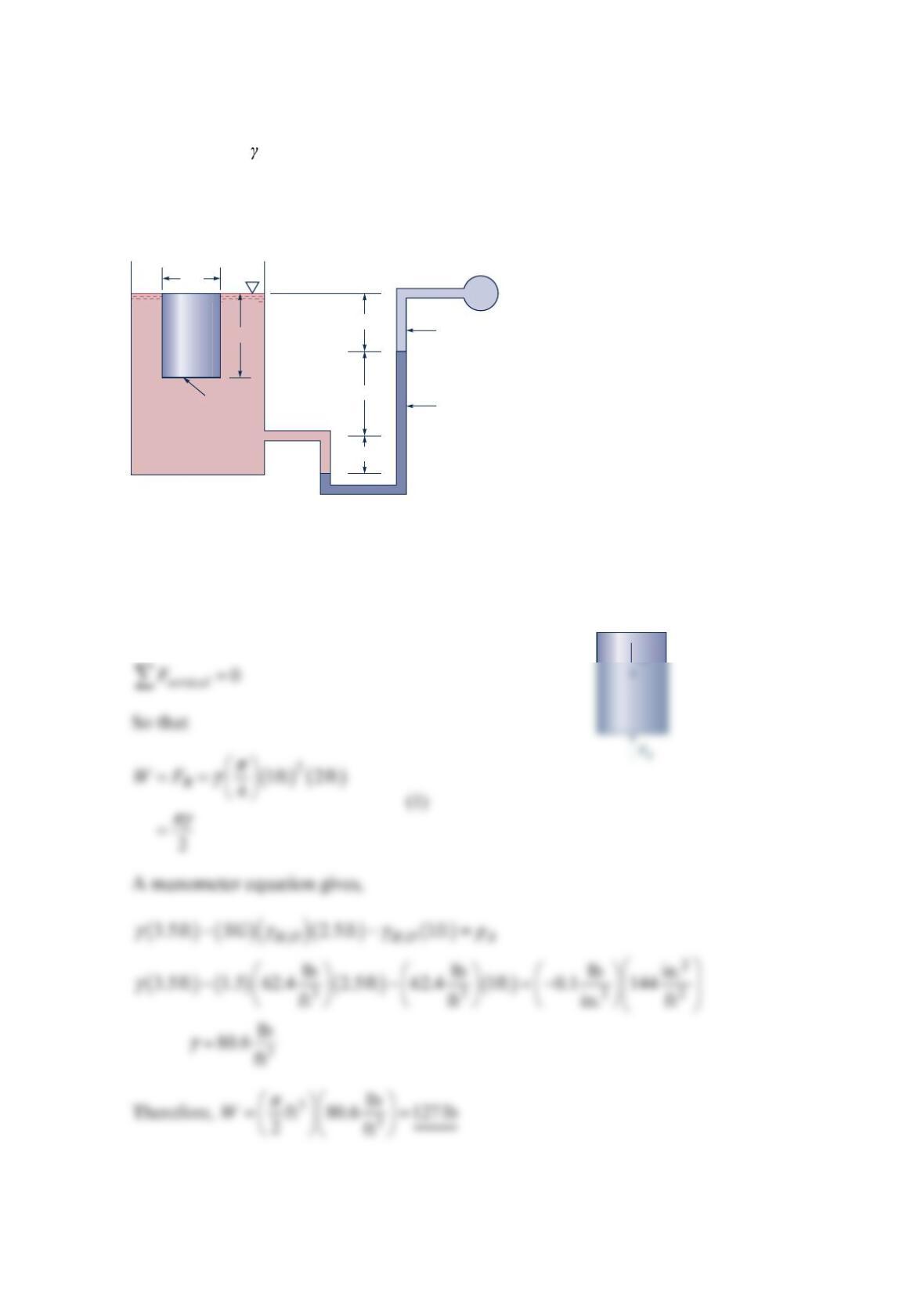
A 1-ft-diameter, 2-ft-long cylinder floats in an open tank containing a liquid having a
specific weight . A U-tube manometer is connected to the tank as shown in the figure
below. When the pressure in pipe A is 0.1 psi below atmospheric pressure, the various fluid
levels are as shown. Determine the weight of the cylinder. Note that the top of the cylinder
is flush with the fluid surface.
Solution 2.142
From a free-body-diagram of the cylinder
A
1 ft
1 ft
2 ft
2 ft
0.5 ft
Water
Cylinder Gage fluid SG = 1.5
Sp. wt. =
pa = – 0.1 psi
γ
Problem 2.143
A not-too-honest citizen is thinking of making bogus gold bars by first making a hollow
iridium
()
=22.5SG ingot and plating it with a thin layer of gold
()
=19.3SG of negligible
weight and volume. The bogus bar is to have a mass of
1
00 lbm. What must be the volumes
of the bogus bar and of the air space inside the iridium so that an inspector would conclude
it was real gold after weighing it in air and water to determine its density? Could lead
()
=11.35SG or platinum
()
=21.45SG be used instead of iridium? Would either be a good
idea?
Solution 2.143
() ()
==iridiu o22.5 ; 19.3 g l ;md
xG
SGSGV=
BB V+
xV==; 100 lbm
AS BB x
mm
Neglect the weight of air in the air space and the buoyant force of air on the bar.
The volume of a pure gold bar would be
The bogus bar volume is
Problem 2.144
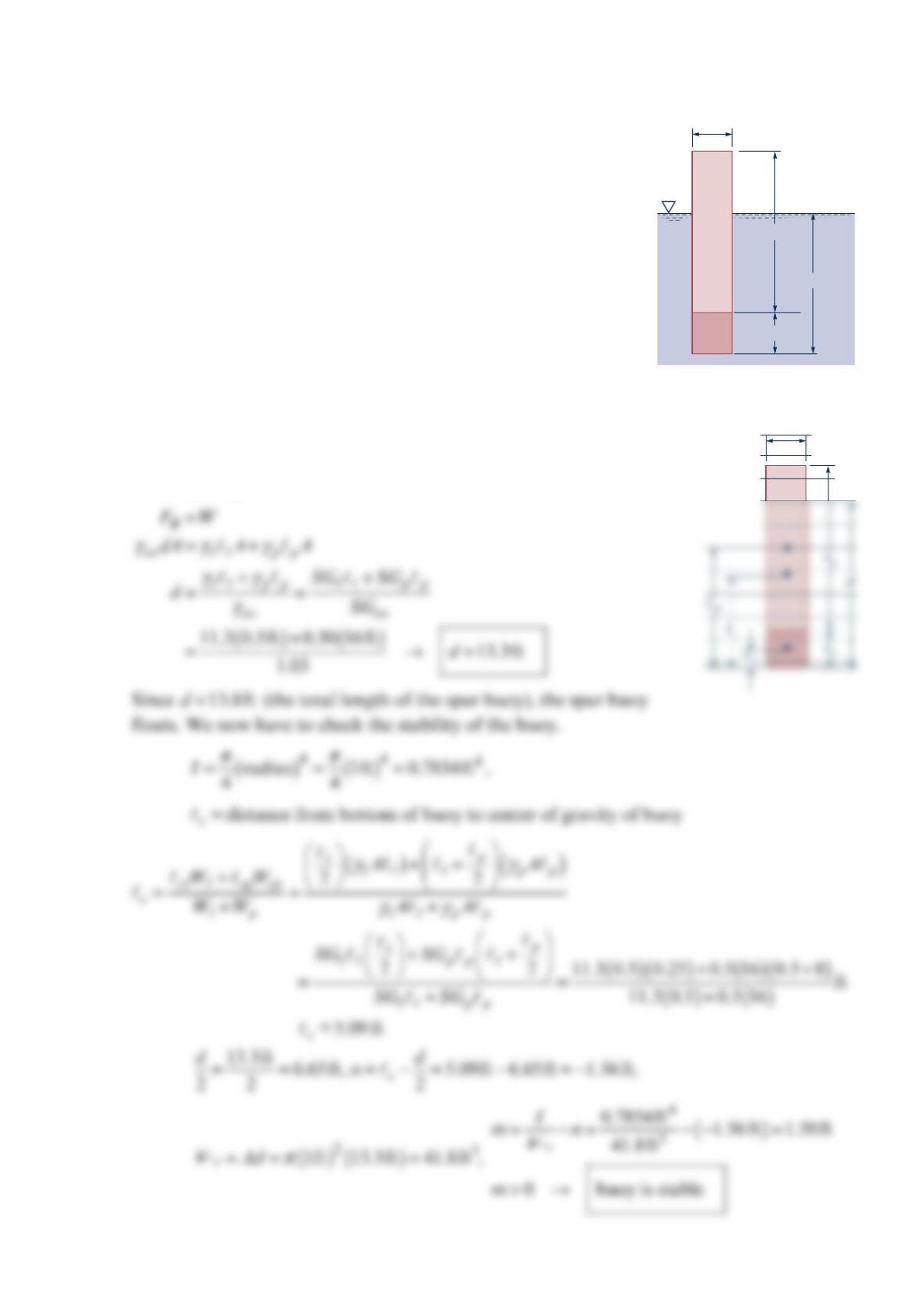
A solid cylindrical pine
()
= 0.50SG spar buoy has a cylindrical
lead
()
= 11.3SG weight attached, as shown in the figure below.
Determine the equilibrium position of the spar buoy in seawater
(i.e., find
d
). Is this spar buoy stable or unstable? For seawater,
= 1.03SG .
Solution 2.144
The equilibrium position is found by equating the buoyant force and
the body weight.
d
0.5′
16′
2′
Lead
A
Problem 2.145
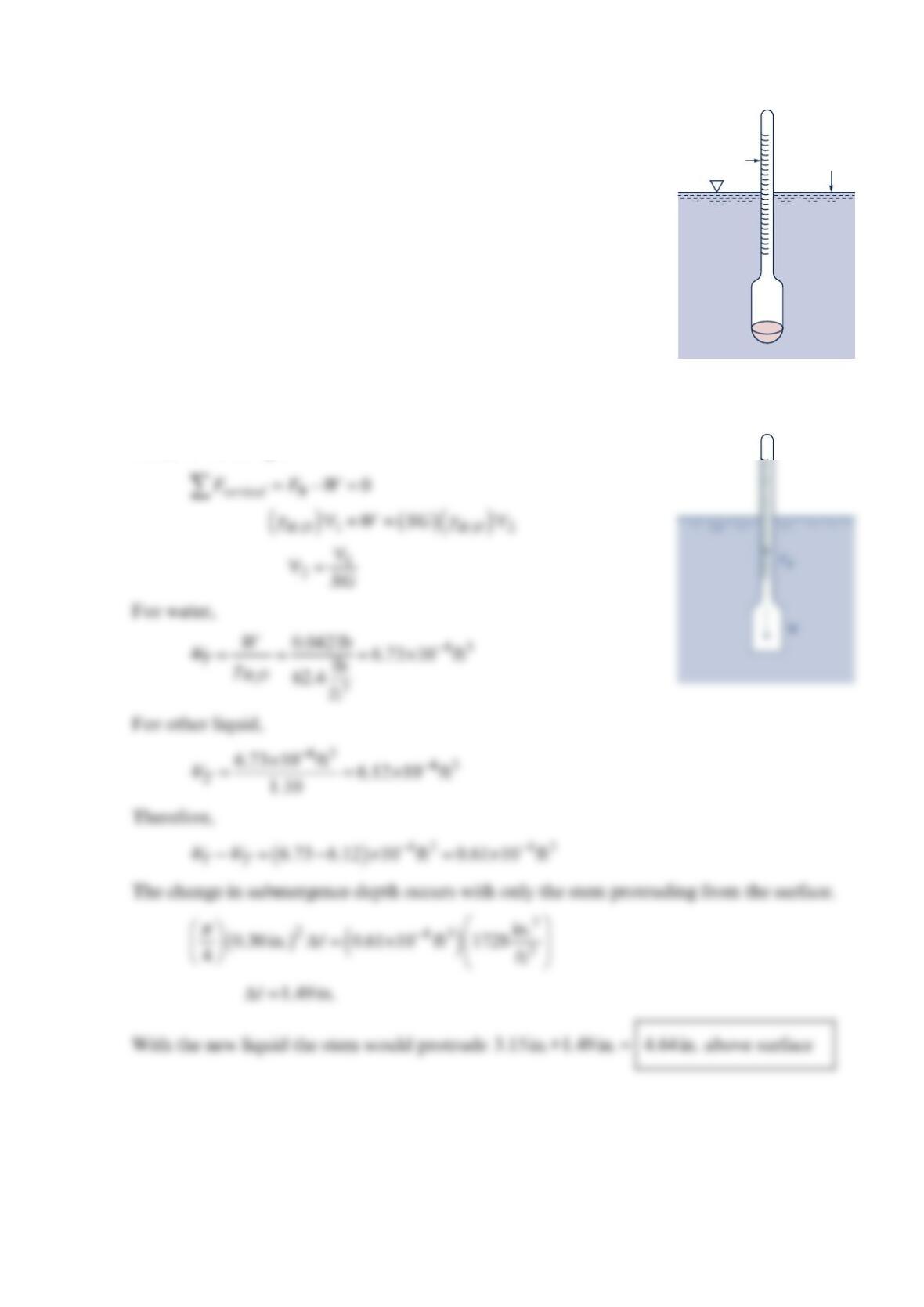
When a hydrometer (see the figure below) having a stem diameter
of 0.30 in. is placed in water, the stem protrudes 3.15 in. above the
water surface. If the water is replaced with a liquid having a
specific gravity of
1
.10, how much of the stem would protrude
above the liquid surface? The hydrometer weighs0.042 lb.
Solution 2.145
When the hydrometer is floating its weight, W, is balanced by the
buoyant force, B
F.,
Fluid
surface
Hydrometer
Problem 2.146
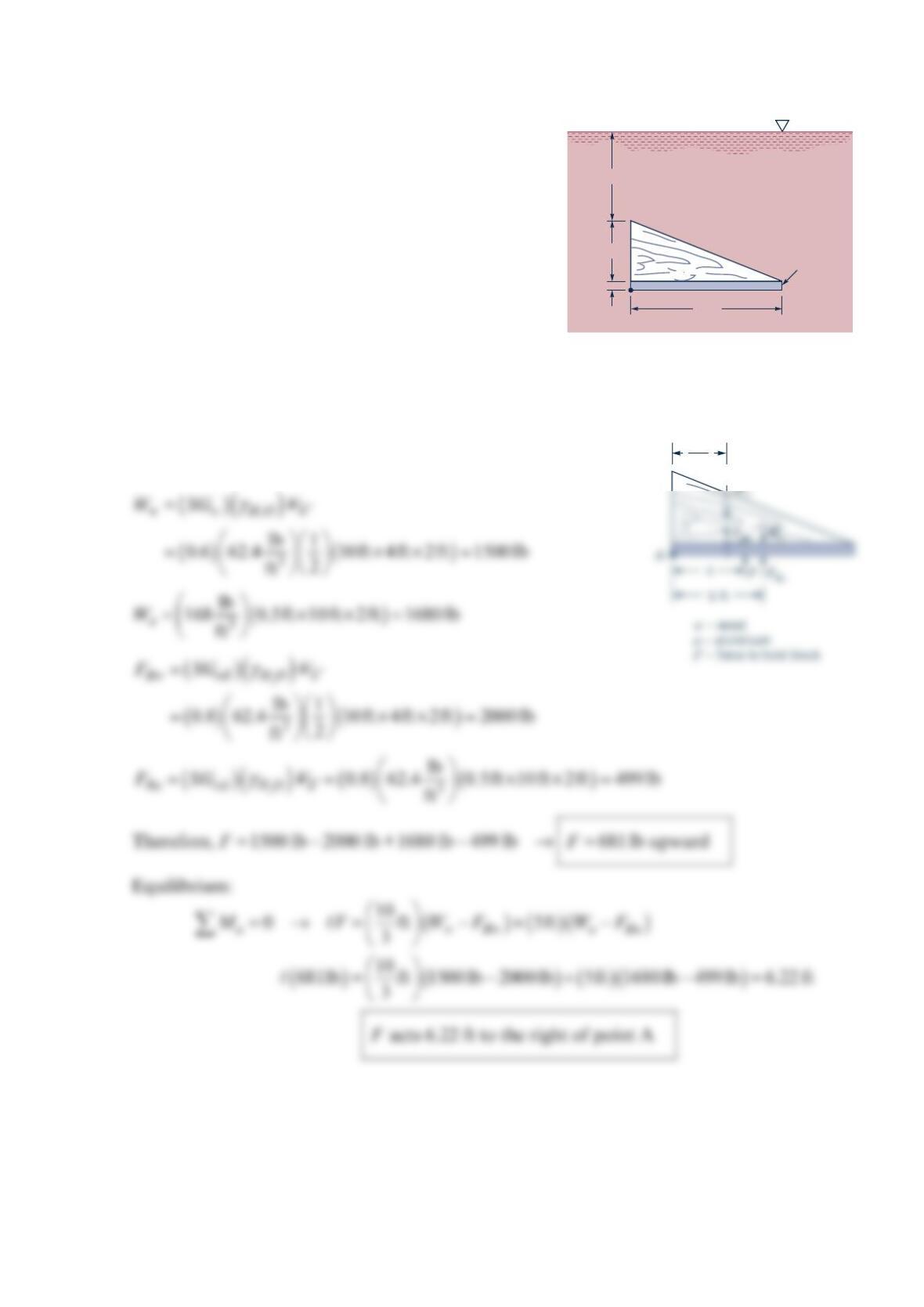
A 2-ft-thick block constructed of wood
()
=0.6SG is
submerged in oil
()
=0.8SG and has a 2-ft-thick
aluminum (specific weight = 3
168lb / ft ) plate
attached to the bottom as indicated in the figure
below. Determine completely the force required to
hold the block in the position shown. Locate the
force with respect to point A.
Solution 2.146
Equilibrium: =− + − + =
0
vertical w Bw a Ba
FFWFWF
Oil
Aluminum
4 ft
0.5 ft
A
6 ft
10 ft
10 ft
3
Problem 2.147
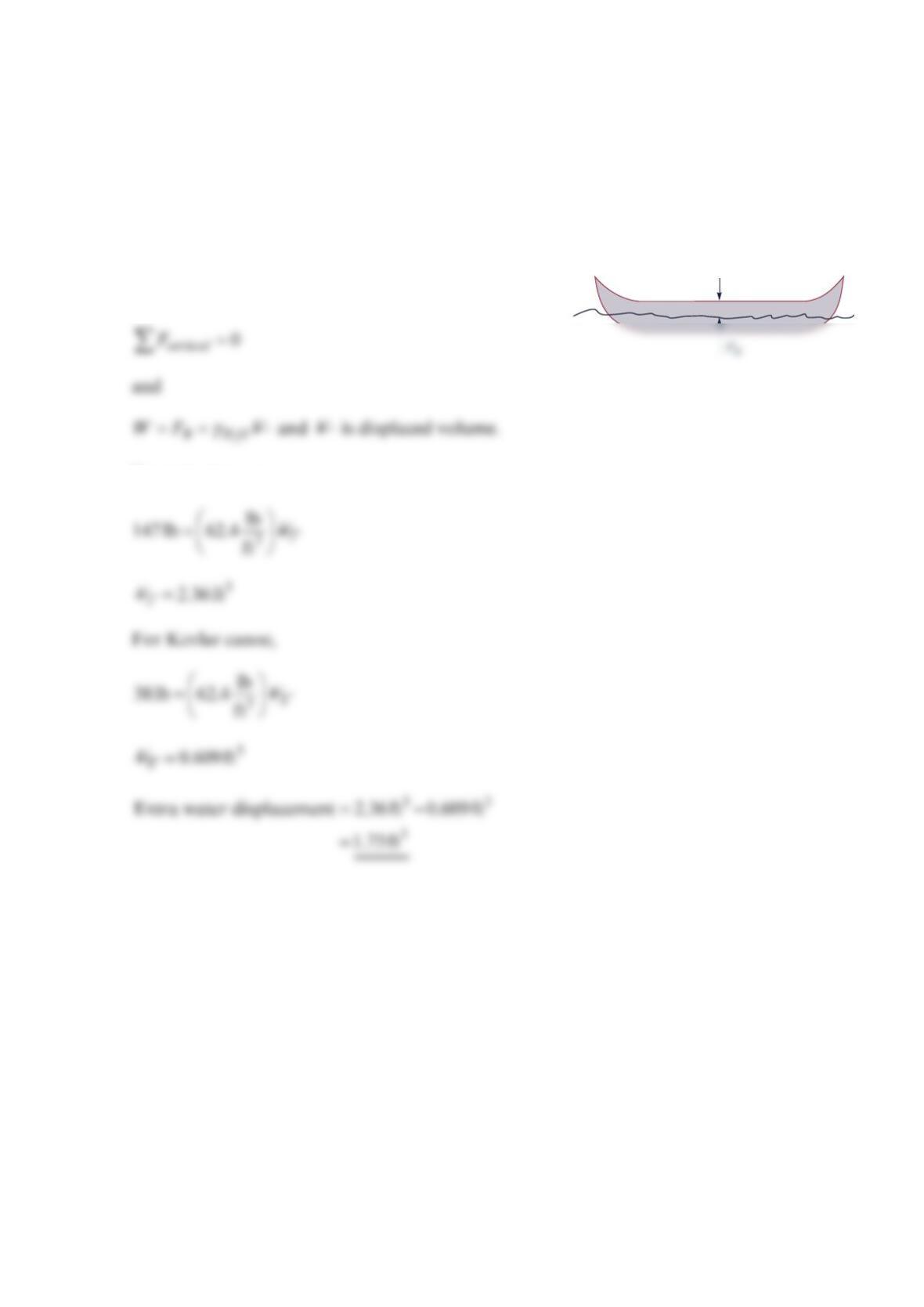
How much extra water does a −147 lb concrete canoe displace compared to an
ultralightweight −38 lb Kevlar canoe of the same size carrying the same load?
Solution 2.147
For equilibrium,
For concrete canoe,
𝒲
Problem 2.148
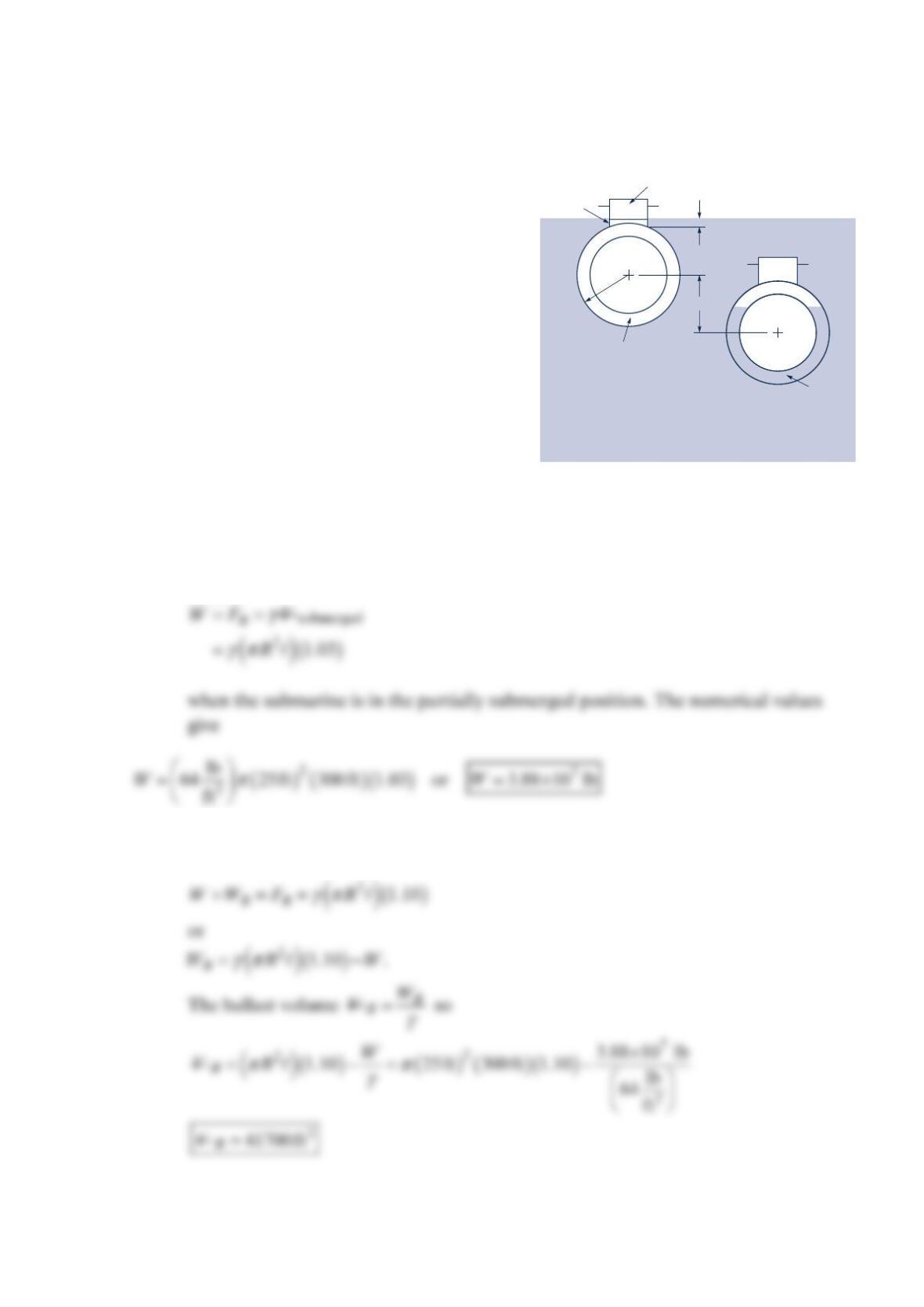
A submarine is modeled as a cylinder with a length of
3
00 ft, a diameter of 50 ft, and a
conning tower as shown in the figure below. The submarine can dive a distance of 50 ft
from the floating position in about
3
0 s. Diving is
accomplished by taking water into the ballast
tank so the submarine will sink. When the
submarine reaches the desired depth, some of the
water in the ballast tank is discharged leaving the
submarine in “neutral buoyancy” (i.e., it will
neither rise nor sink). For the conditions
illustrated, find (a) the weight of the submarine
and (b) the volume (or mass) of the water that
must be in the ballast tank when the submarine is
in neutral buoyancy. For seawater, = 1.03S.
Solution 2.148
(a) Denoting the cylinder radius by
R
, the submarine weight is equal to the buoyant
force so
(b) For neutral buoyancy at the lower depth, the submarine weight W plus the ballast
weight B
W must equal the buoyant force so
25′50′
3′
p
water
= 64 lbm/ft
3
7% of cylinder volume3% of cylinder
volume
Ballast tank
Partially
submerged
position
Totally
submerged
position
Water
Problem 2.150
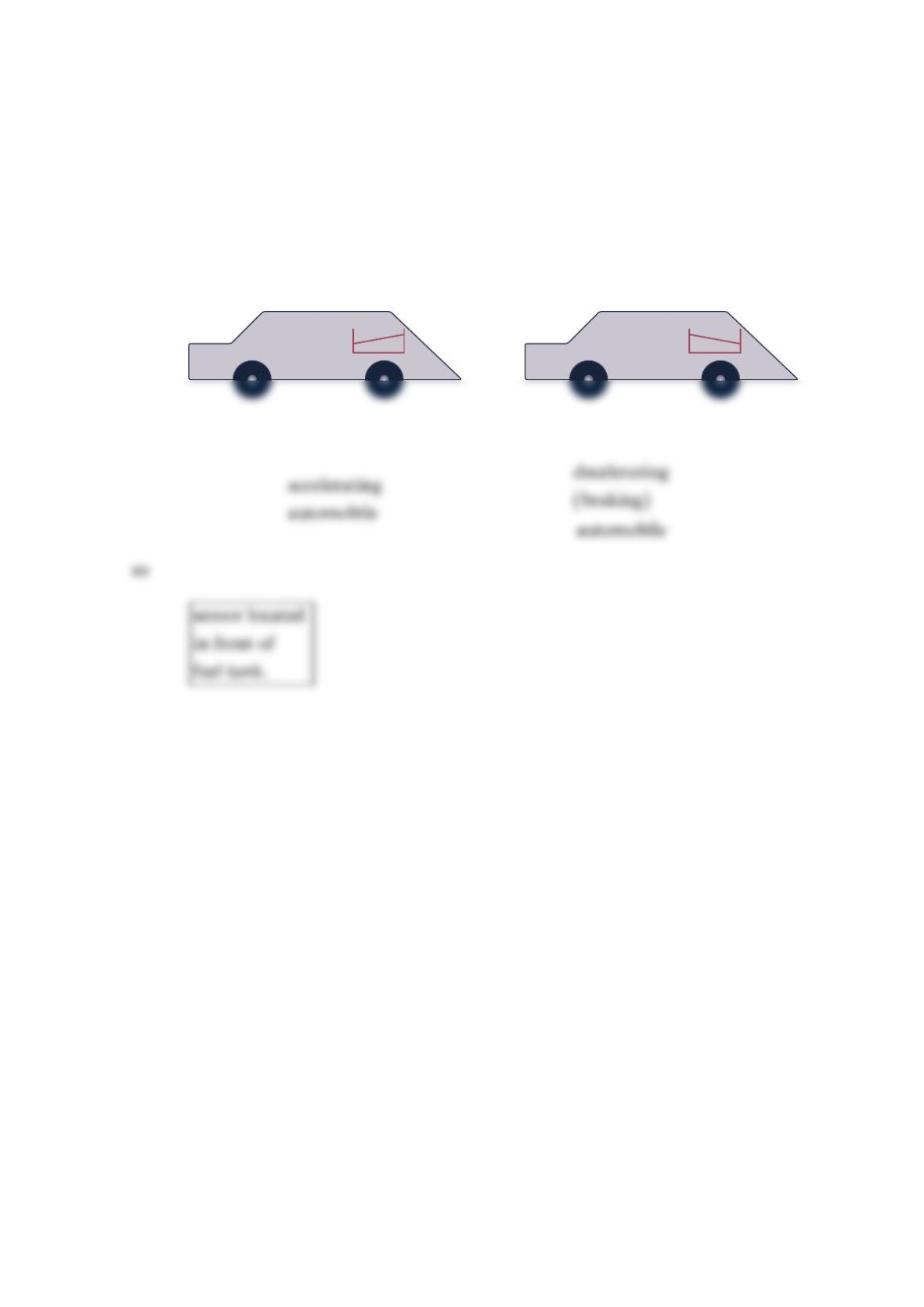
When an automobile brakes, the fuel gage indicates a fuller tank than when the automobile
is traveling at a constant speed on a level road. Is the sensor for the fuel gage located near
the front or rear of the fuel tank? Assume a constant deceleration.
Solution 2.150
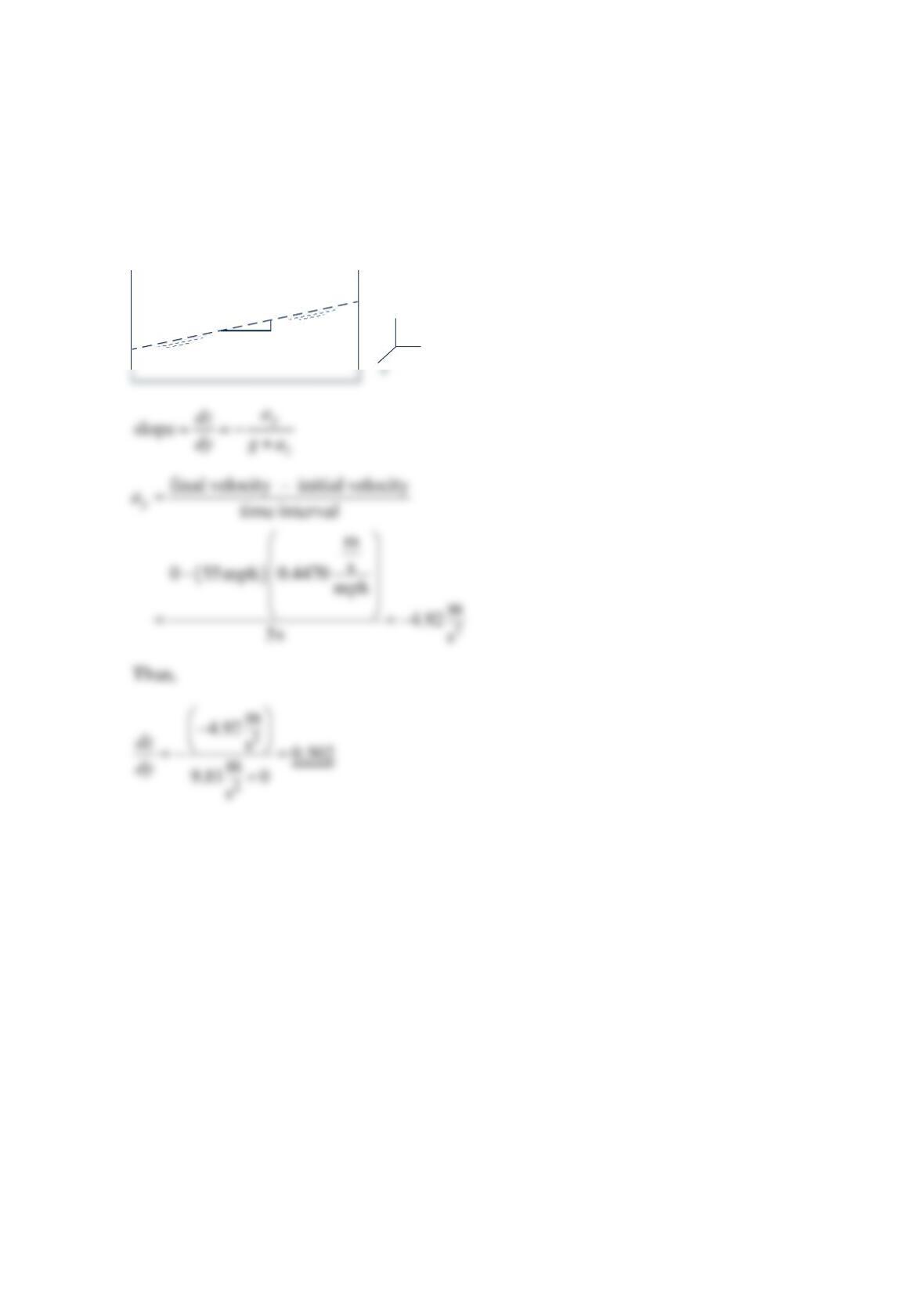
Problem 2.151
An open container of oil rests on the flatbed of a truck that is traveling along a horizontal
road at 55 mi / hr. As the truck slows uniformly to a complete stop in 5 s, what will be the
slope of the oil surface during the period of constant deceleration?
Solution 2.151
dy
dz z
y
Problem 2.152
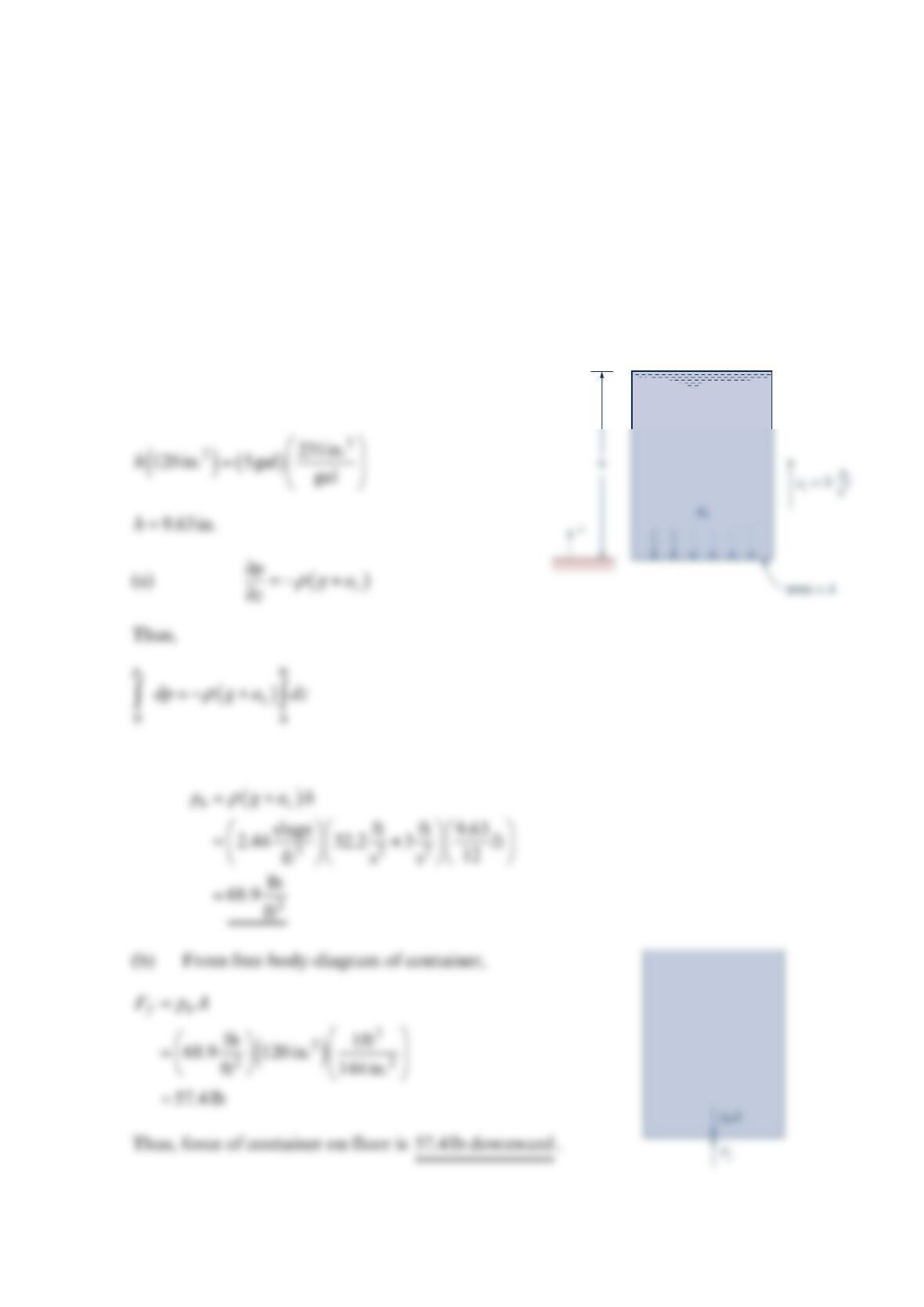
A 5-gal, cylindrical open container with a bottom area of 2
120 in. is filled with glycerin and
rests on the floor of an elevator. (a) Determine the fluid pressure at the bottom of the
container when the elevator has an upward acceleration of 2
3ft/s . (b) What resultant force
does the container exert on the floor of the elevator during this acceleration? The weight of
the container is negligible. (Note: =3
1 gal 231 in. )
Solution 2.152
=volumehA
and
Problem 2.153
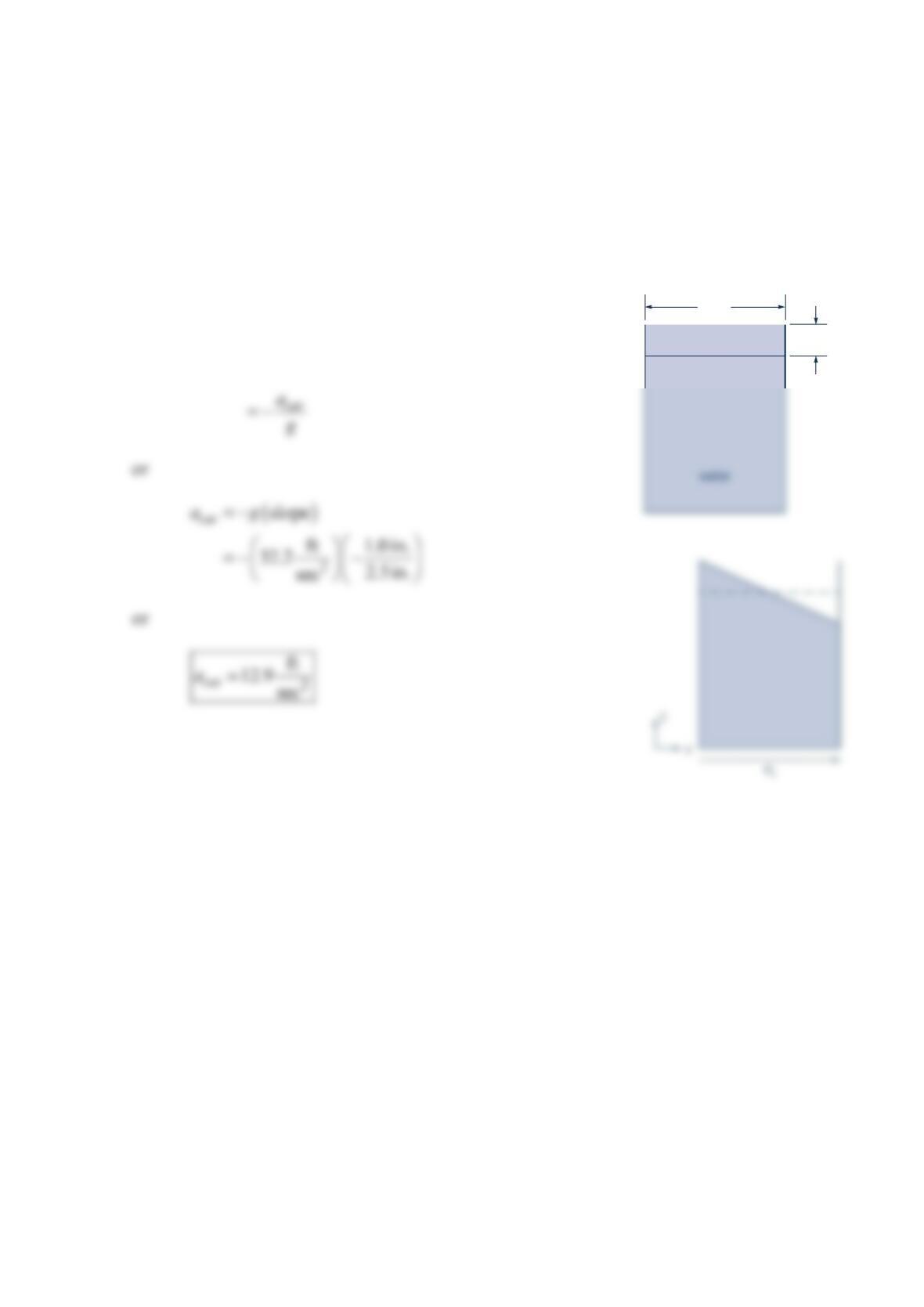
A plastic glass has a square cross section measuring 2½ in. on a side and is filled to within
½ in. of the top with water. The glass is placed in a level spot in a car with two opposite
sides parallel to the direction of travel. How fast can the driver of the car accelerate along a
level road without spilling any of the water?
Solution 2.153
Slope of water surface
1
––––
2
″
2.5
″