CHAPTER 2
Preparing for the Entrepreneurial Journey
SUMMARY AND AUTHOR’S NOTE
Entrepreneurship is very much a mindset and personal journey that involves a set of skills that
can be learned and applied in a variety of settings. This is important when you consider that
about two-thirds of students will go to work for someone else, either as their career or to prepare
themselves to go out on their own. Although we don’t expect everyone to become entrepreneurs,
we can enlighten our students and help them to see that learning some entrepreneurial skills and
thinking like an entrepreneur can give them huge advantages in their career, whatever they
choose to do.
side of entrepreneurship.
CHAPTER OBJECTIVES
After reading this chapter, students will be able to:
• Dispel the myths about entrepreneurs.
CHAPTER OUTLINE
OPENING CASE: One Journey That Inspired an Industry
I. Saying Goodbye to Stereotypes—dispels myths surrounding entrepreneurs
a. Myth 1: Entrepreneurs Start Businesses Solely to Make Money—entrepreneurs
primarily start businesses for independence and to create something new
Chapter 2: Preparing for the Entrepreneurial Journey 7
b. Myth 2: It Takes a Lot of Money to Start a Business—resources are more important
than the amount of capital at startup
II. Paths to Entrepreneurship—reasons and ways entrepreneurs start new businesses
a. The Home-Based Entrepreneur—many start their businesses from home
b. The Serial or Portfolio Entrepreneur—some entrepreneurs focus on the pre-launch
and startup of new businesses
organization
III. Entrepreneurship as a Way of Life: Challenges and Opportunities—a realistic look at
the life of an entrepreneur
• Table 2.1—Challenges and Opportunities with the Entrepreneur Career
Path
IV. Preparing to Become an Entrepreneur—steps to take to increase the chances of success
• Figure 2.1—Preparing for Entrepreneurship
a. Find a Mentor—find an experienced guide and sounding board
b. Build a Professional Network—exchange information and resources
RELEVANT CASE STUDIES
Instructor notes for the following cases can be found at the end of this manual.
Case 2 MySpace
Case 7 1-800-Autopsy
8 Chapter 2: Preparing for the Entrepreneurial Journey
ANSWERS TO QUESTIONS ON KEY ISSUES
1. Why do myths emerge around phenomena such as entrepreneurs?
In general, people rely on myths and stereotypes to categorize behavior or characterize
2. How are corporate entrepreneurs different from other types of entrepreneurs?
Corporate entrepreneurs—those who act like entrepreneurs inside large companies—are
3. What are the steps you should take to prepare yourself for entrepreneurship?
To prepare for entrepreneurship, it is important to consider your reasons for wanting to own
4. What might explain the rise in interest in social or nonprofit entrepreneurship?
One could debate whether there is more interest in social entrepreneurship now or whether
5. Why are more ventures started by teams than by solo entrepreneurs?
More ventures are started by teams because the global business environment is more
SUGGESTIONS FOR EXPERIENCING ENTREPRENEURSHIP
1. Identify an entrepreneur who is leading the kind of personal and business life that you
aspire to lead. Interview that person to find out more about how he or she achieved that
lifestyle. During the interview, and only if the two of you have developed a rapport,
approach the entrepreneur about the possibility of becoming your mentor.
Chapter 2: Preparing for the Entrepreneurial Journey 9
2. Entrepreneurship is a journey, and many people contribute to that journey. Begin a contact
portfolio that will contain the names of all the people you meet as you network. Record
their contact information, how you met them, and what they contributed to your journey.
Strive to meet three to five contacts a week.
Three to five “strangers” a week is a lofty goal, but I have found that it is very doable. You
SUPPLEMENTARY LECTURE MATERIAL
What Type of Entrepreneur are You?
It’s important that students understand that entrepreneurs come in many flavors and that there is
no one precise picture of an entrepreneur. To help students see where they might fit in the world
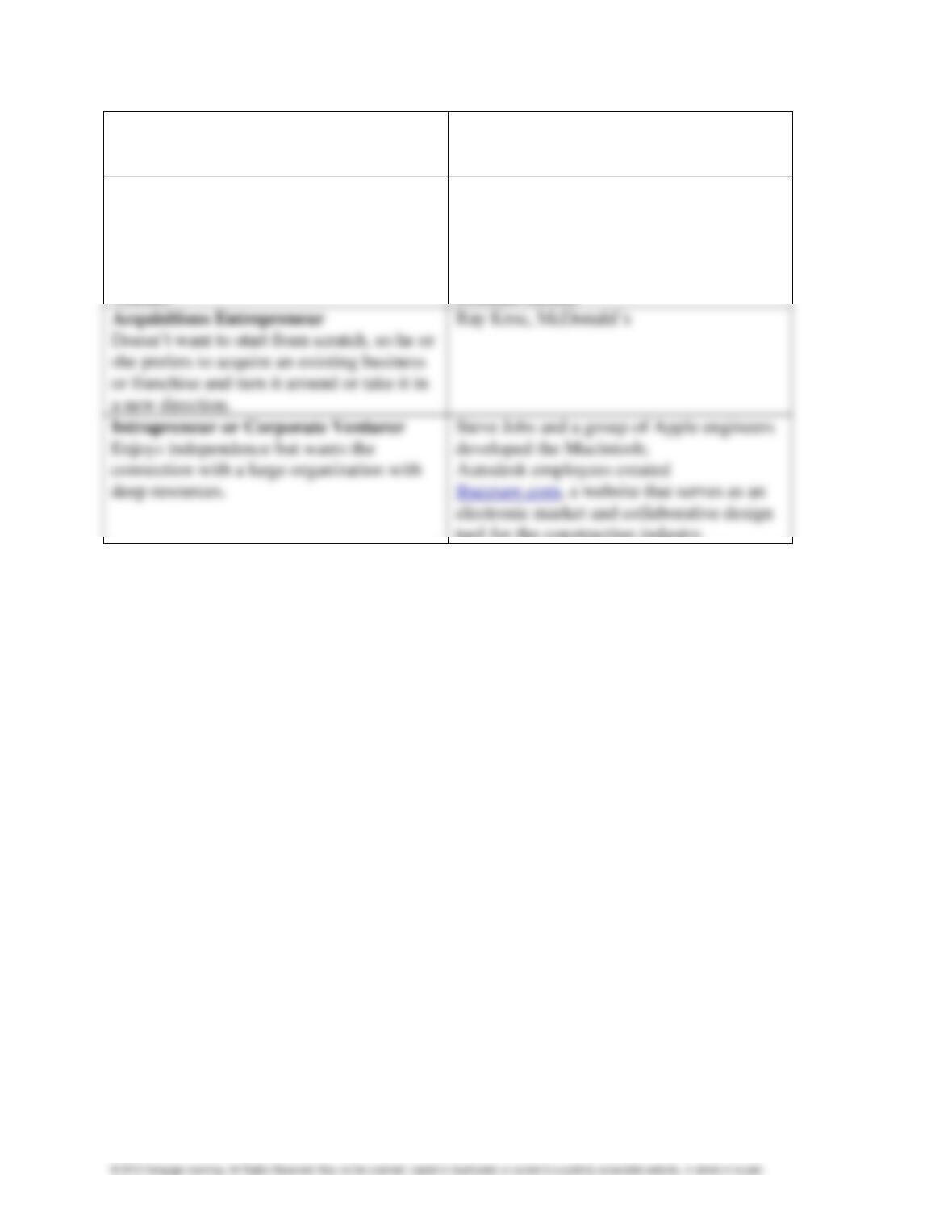
The Many Paths to Entrepreneurship
Entrepreneurial Type
Examples
Visionary Entrepreneur
Starts a company, usually with a team, to
Bill Gates and Paul Allen of Microsoft;
Google founders Larry Page and Sergey
10 Chapter 2: Preparing for the Entrepreneurial Journey
the appropriate time. May or may not
maintain a majority stake and typically has
an exit strategy.
Serial Entrepreneur
Likes to start businesses and get them to
the survival stage, and then hands the
business off to professional management or
sells it while going on to start another
venture.
Wayne Huizenga (Blockbuster, Waste
Management, Auto Nation);
Lanny Goodman, Management
Technologies;
Richard Rosenblatt (iMall, Intermix Media,
Demand Media)
or franchise and turn it around or take it in
a new direction.
deep resources.
electronic market and collaborative design
tool for the construction industry