Chapter 2
FJ
JF
and
2.3.60 Proceeding as in Exercise 59, we find that this equation has no solutions.
2.3.61 We need to solve the matrix equation
2.3.62 The matrix equation
90
Section 2.3
JH
37 ◦
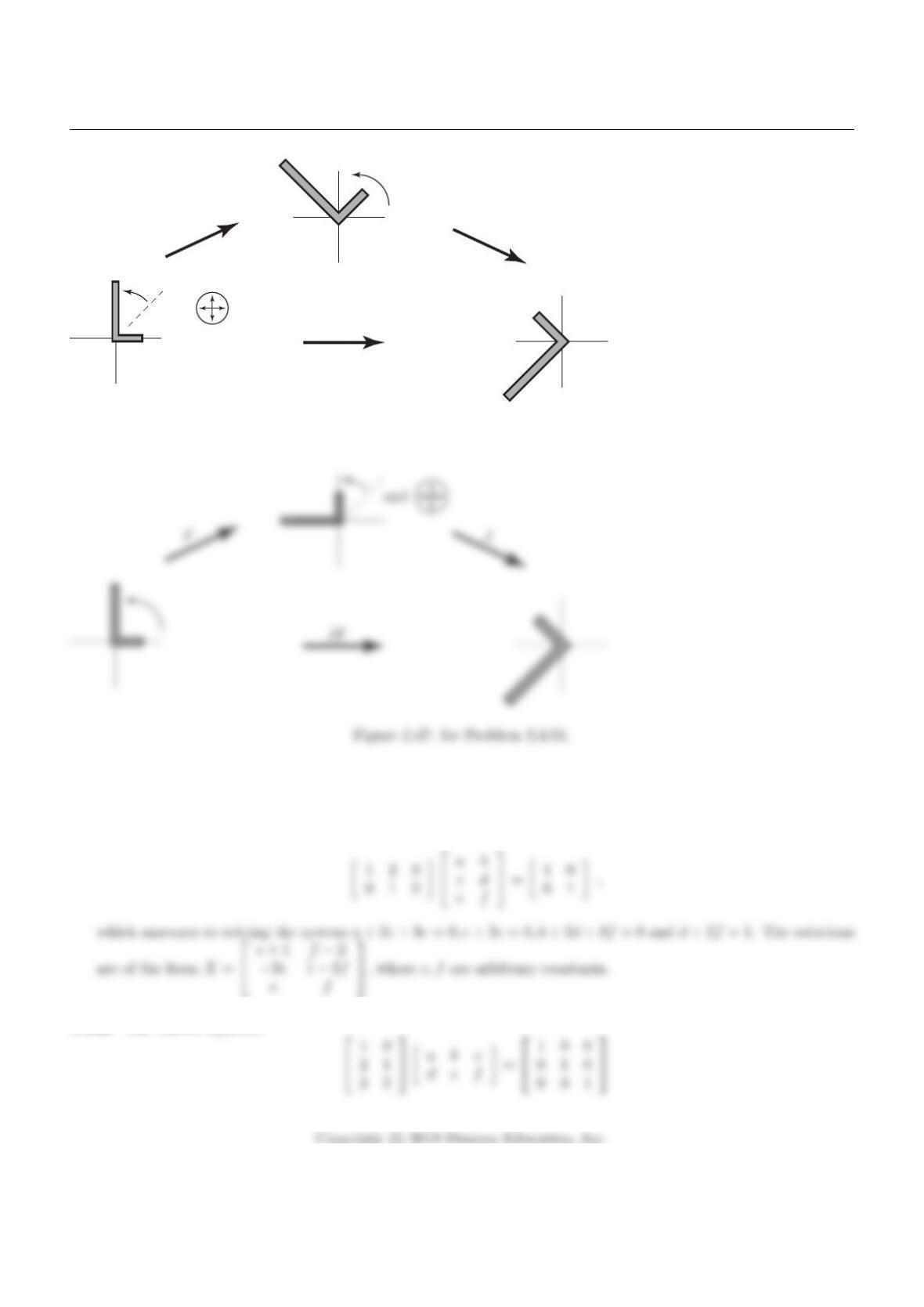
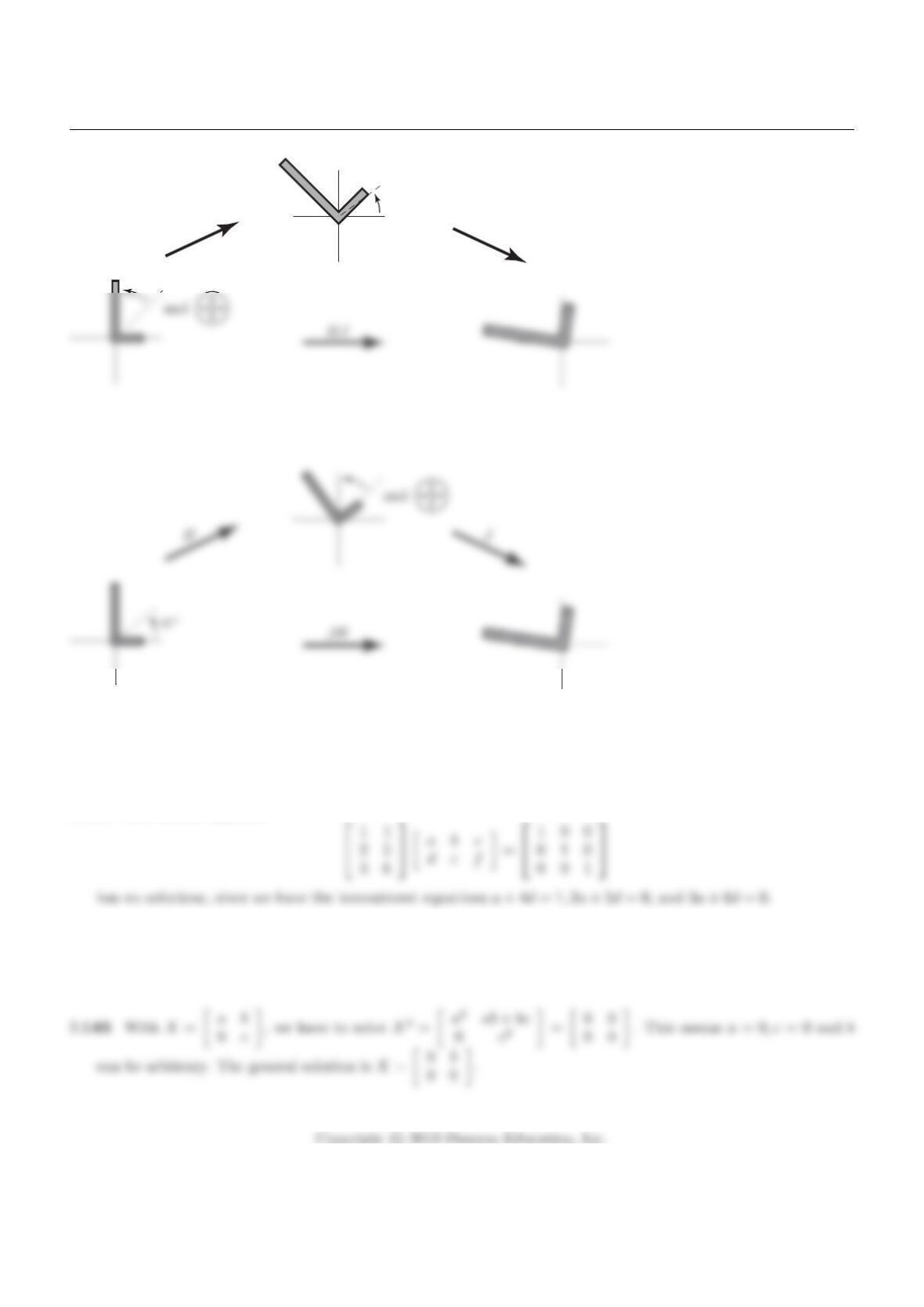
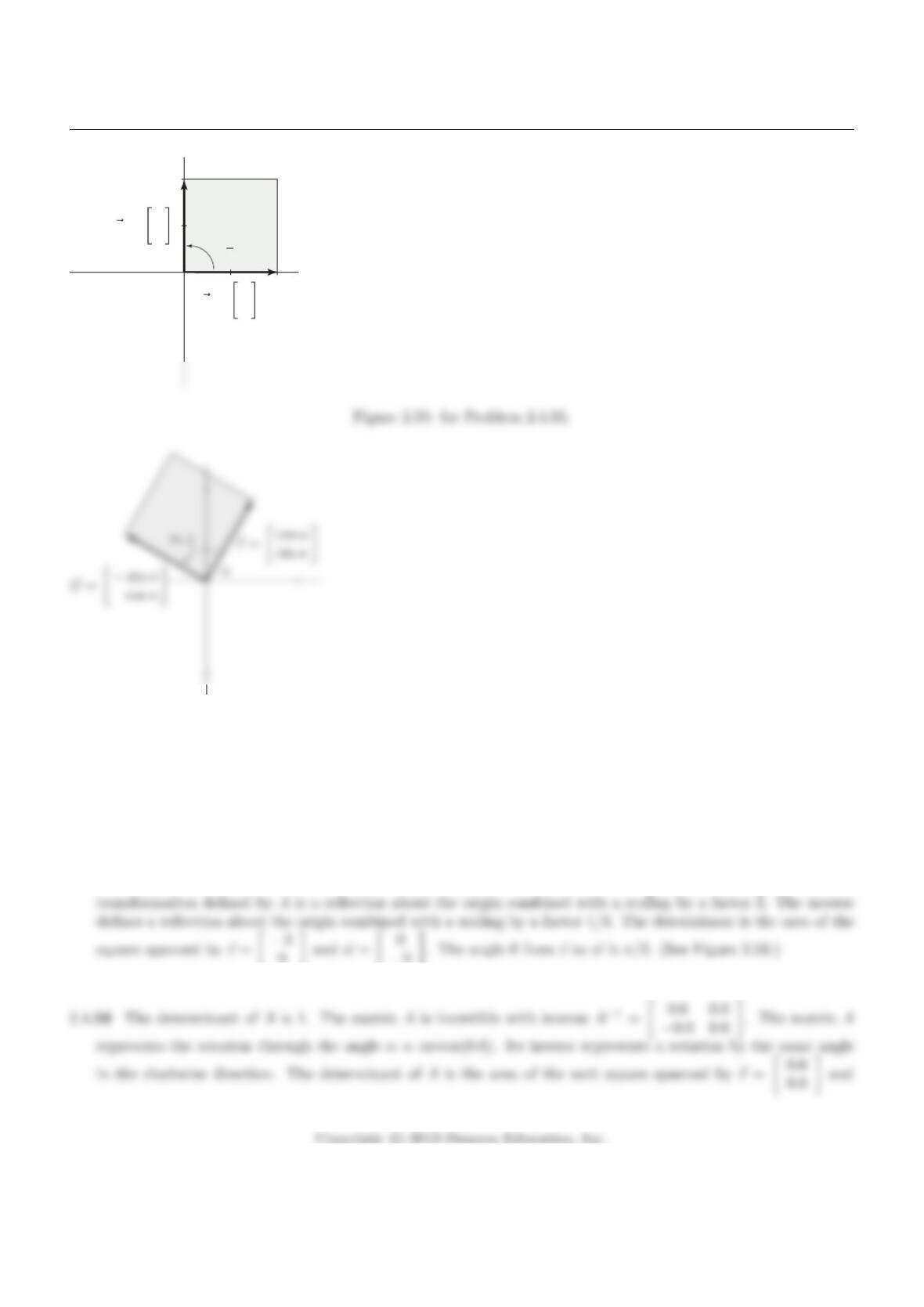
Figure 2.48: for Problem 2.3.52.
has no solutions, since we have the inconsistent equations a= 1,2a+d= 0 and 3a+ 2d= 0.
2.3.63 The matrix equation
2.3.64 Proceeding as in Exercise 61, we find X=
e−5/3f+ 2/3
−2e+ 4/3−2f−1/3
e f
, where e, f are arbitrary constants.
91
Chapter 2
CD
DC
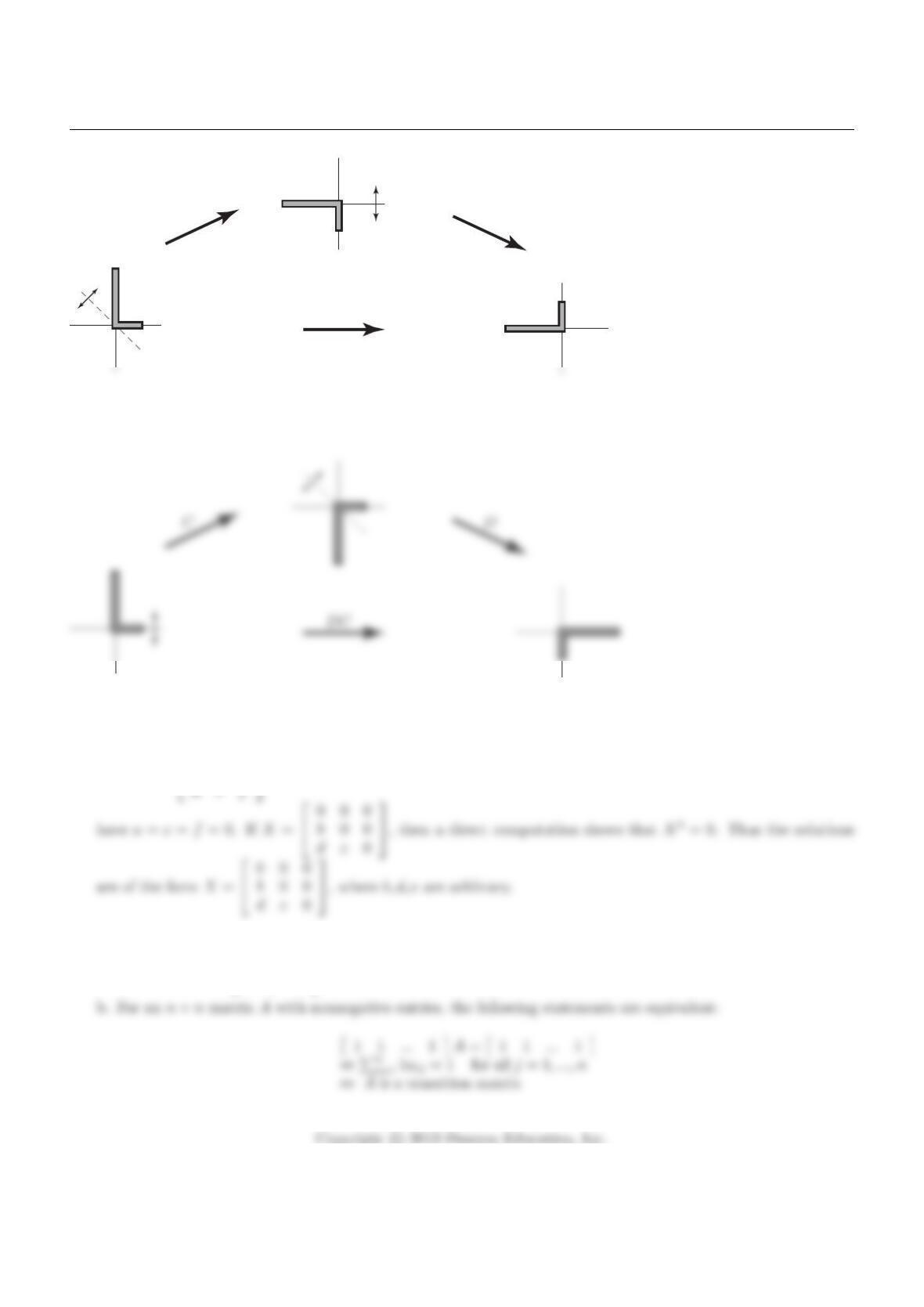
Figure 2.49: for Problem 2.3.53.
2.3.66 If X=
a0 0
b c 0
then the diagonal entries of X3will be a3,c3, and f3. Since we want X3= 0, we must
2.3.67 a. 1 1 1
a d g
b e h
c f i
=a+b+c d +e+f g +h+i=1 1 1 , by Definition 2.1.4.
92
Section 2.3
BE
EB
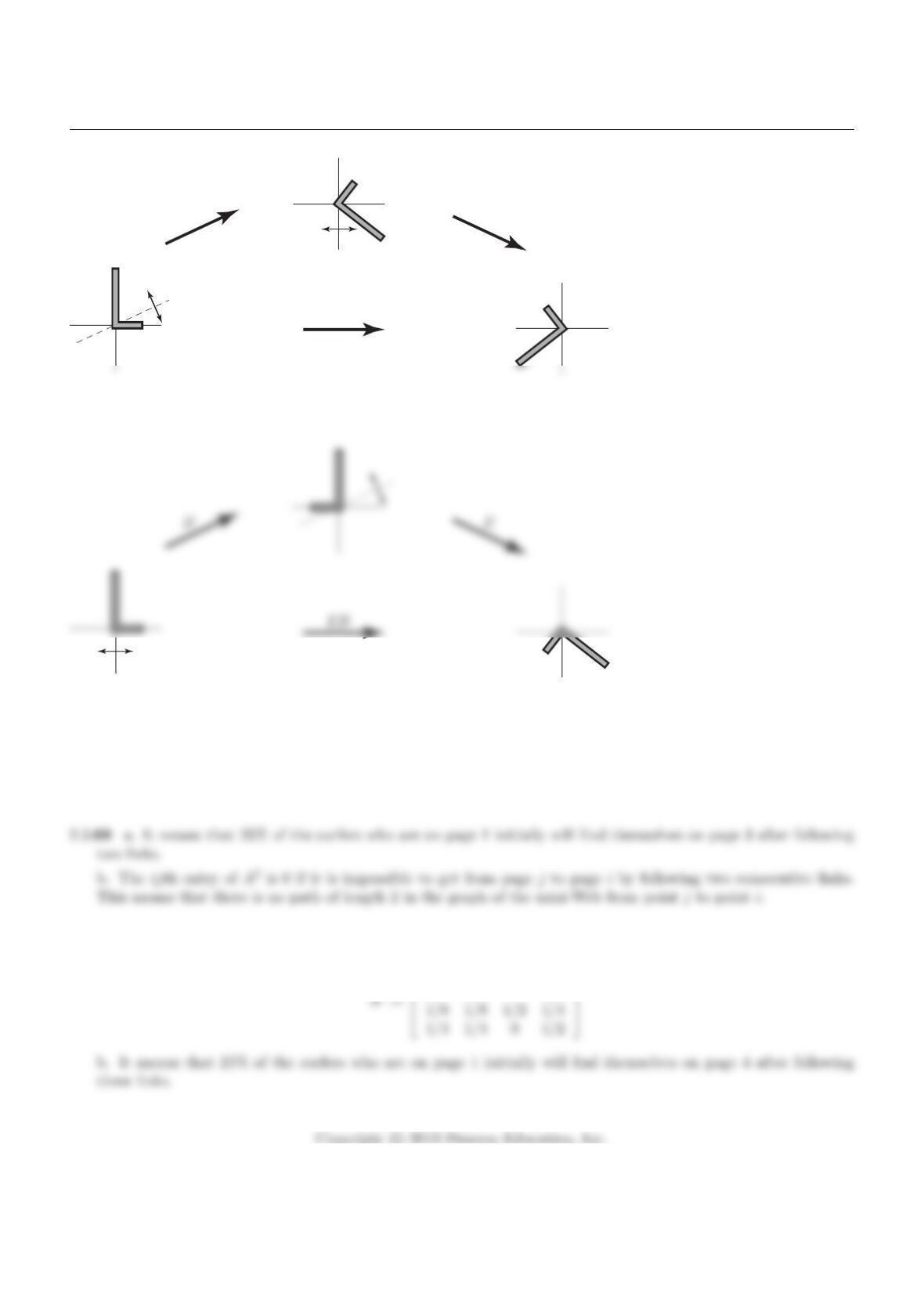
Figure 2.50: for Problem 2.3.54.
2.3.68 From Exercise 67b we know that 1 1 … 1A=1 1 … 1and 1 1 … 1B=1 1 … 1.
Now1 1 … 1AB = (1 1 … 1A)B=1 1 … 1B=1 1 … 1, so that AB is a tran-
sition matrix, again by Exercise 67b (note that all entries of AB will be nonnegative).
2.3.70 a.
0 1/8 1/2 0
5/8 1/2 0 1/4
93
Chapter 2
c. The ijth entry of A3is 0 if it is impossible to get from page jto page iby following three consecutive links.
2.3.71 We compute
5/16 1/4 0 1/8
1/4 5/16 1/4 1/2
2.3.72 We compute
1/8 5/32 1/8 1/4
9/32 1/4 1/2 5/16
2.3.73 lim
m→∞ (Am~x) = lim
m→∞ Am~x =
~xequ ~xequ … ~xequ
x1
x2
…
xn
= (x1+x2+… +xn)~xequ =~xequ.
Note that x1+x2+… +xn= 1 since ~x is a transition vector.
2.3.74 The transition matrix AB is not necessarily positive. Consider the case where Ahas a row of zeros, for
example, A=1 1
0 0 and B=1/2 1/2
1/2 1/2, with AB =1 1
0 0 .
2.3.76 A=
0 1/200
1 0 1 0
0 0 0 1
0 1/200
and A20 ≈
0.2002 0.2002 0.2002 0.1992
0.4004 0.3994 0.4004 0.4004
0.1992 0.2002 0.1992 0.2012
0.2002 0.2002 0.2002 0.1992
94
Section 2.3
0.2
0.2
0.2
Page 2 has the highest naive PageRank.
2.3.77 A10 ≈
0.5003 0.4985 0.5000
0.0996 0.1026 0.0999
0.4002 0.3989 0.4001
suggests ~xequ =
0.5
0.1
0.4
.
2.3.79 An extreme example is the identity matrix In, where In~x =~x for all distribution vectors ~x.
2.3.82 a. A1
2=1
2and A1
−1=1
10 1
−1.
b. ~x =1
0=1
31
2+2
31
−1
95
Chapter 2
2.3.84 Let ~v1, . . . , ~vnbe the columns of the matrix X. Solving the matrix equation AX =Inamounts to solving the
linear systems A~vi=~eifor i= 1, . . . , n. Since Ais a n×mmatrix of rank n, all these systems are consistent, so
2.3.85 Let ~v1, . . . , ~vnbe the columns of the matrix X. Solving the matrix equation AX =Inamounts to solving the
linear systems A~vi=~eifor i= 1, . . . , n. Since Ais an n×nmatrix of rank n, all these systems have a unique
solution, by Theorem 1.3.4, so that the matrix equation AX =Inhas a unique solution as well.
Section 2.4
2.4.1rref “2 3.
.
. 1 0
5 8.
.
. 0 1 #=
1 0.
.
. 8 −3
0 1.
.
.−5 2
, so that 2 3
5 8 −1
=8−3
−5 2 .
2.4.4Use Theorem 2.4.5; the inverse is
1−2 1
0 1 −2
0 0 1
.
2.4.7rref
1 2 3
0 0 2
0 0 3
=
1 2 0
0 0 1
0 0 0
, so that the matrix fails to be invertible, by Theorem 2.4.3.
Section 2.4
2.4.9rref
1 1 1
1 1 1
1 1 1
=
1 1 1
0 0 0
0 0 0
, so that the matrix fails to be invertible, by Theorem 2.4.3.
2.4.12 Use Theorem 2.4.5; the inverse is
3−5 0 0
−1 2 0 0
0 0 5 −2
0 0 −2 1
.
2.4.15 Use Theorem 2.4.5; the inverse is
−6 9 −5 1
9−1−5 2
−5−5 9 −3
1 2 −3 1
2.4.16 Solving for x1and x2in terms of y1and y2we find that
x1=−8y1+ 5y2
x2= 5y1−3y2
2.4.18 Solving for x1, x2, and x3in terms of y1, y2, and y3we find that
97
Chapter 2
2.4.19 Solving for x1, x2, and x3in terms of y1, y2, and y3, we find that
2.4.20 Solving for x1, x2, and x3in terms of y1, y2, and y3we find that
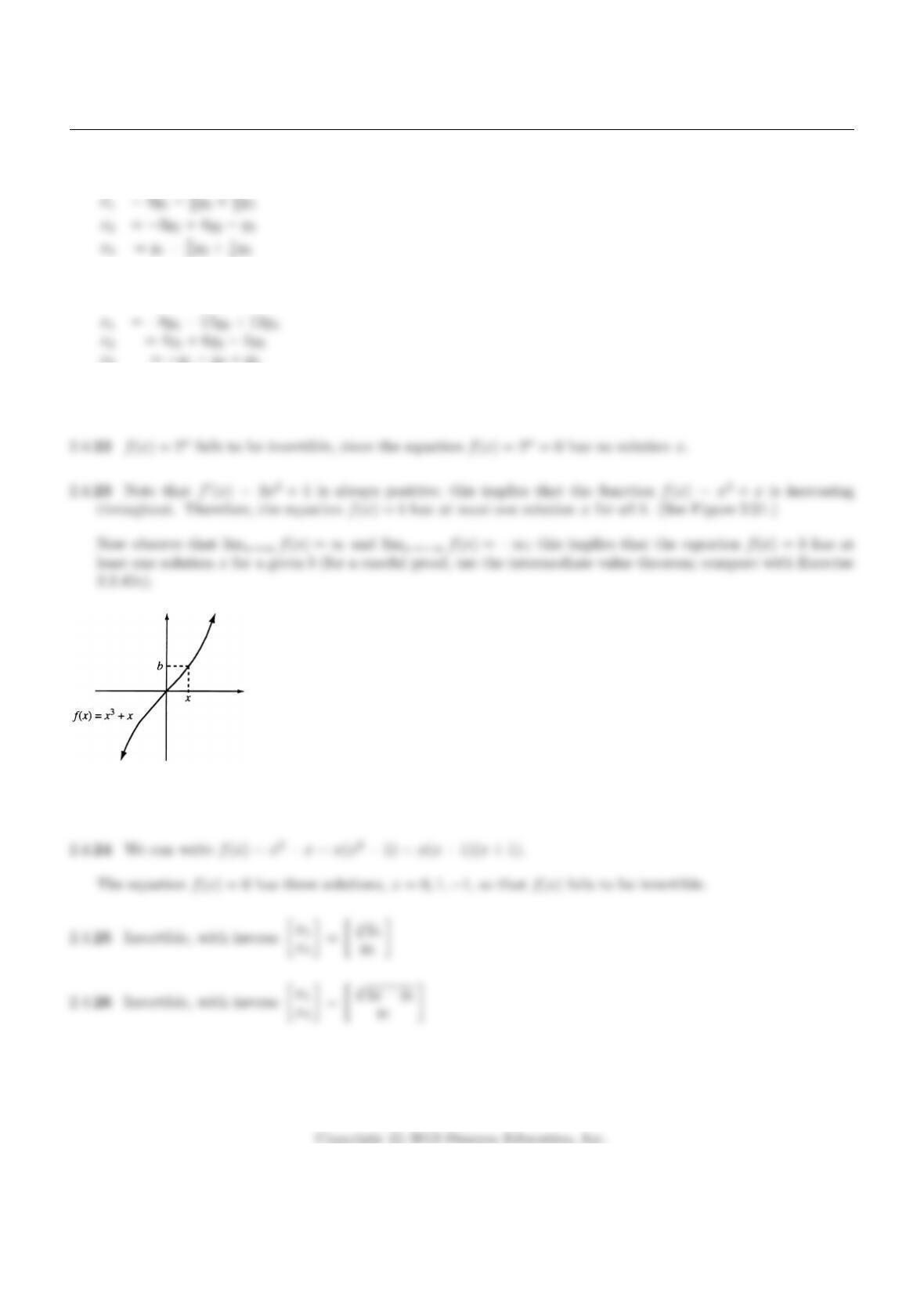
2.4.21 f(x) = x2fails to be invertible, since the equation f(x) = x2= 1 has two solutions, x=±1.
Figure 2.51: for Problem 2.3.23.
2.4.27 This transformation fails to be invertible, since the equation x1+x2
x1x2=0
1has no solution.
98
Section 2.4
2.4.29 Use Theorem 2.4.3:
1 1 1
1 2 k
1 4 k2
−I
−I→
1 1 1
0 1 k−1
0 3 k2−1
−II
−3(II)→
1 0 2 −k
0 1 k−1
0 0 k2−3k+ 2
The matrix is invertible if (and only if) k2−3k+ 2 = (k−2)(k−1) 6= 0, in which case we can further reduce it
to I3. Therefore, the matrix is invertible if k6= 1 and k6= 2.
2.4.31 Use Theorem 2.4.3; first assume that a6= 0.
0a b
−a0c
−b−c0
swap :
I↔II →
−a0c
0a b
−b−c0
÷(−a)
→
1 0 −c
a
0a b
−b−c0
+b(I)→
2.4.32 Use Theorem 2.4.9.
If A=a b
c d is a matrix such that ad −bc = 1 and A−1=A, then
Chapter 2
2.4.33 Use Theorem 2.4.9.
The requirement A−1=Ameans that −1
a2+b2−a−b
−b a =a b
b−a. This is the case if (and only if)
a2+b2= 1.
2.4.35 aAis invertible if (and only if) all its diagonal entries, a, d, and f, are nonzero.
b As in part (a): if all the diagonal entries are nonzero.
2.4.36 If a matrix Acan be transformed into Bby elementary row operations, then Ais invertible if (and only if)
Bis invertible. The claim now follows from Exercise 35, where we show that a triangular matrix is invertible if
(and only if) its diagonal entries are nonzero.
2.4.37 Make an attempt to solve the linear equation ~y = (cA)~x =c(A~x) for ~x:
100
Section 2.4
2.4.39 Suppose the ijth entry of Mis k, and all other entries are as in the identity matrix. Then we can find
2.4.40 If you apply an elementary row operation to a matrix with two equal columns, then the resulting matrix
will also have two equal columns. Therefore, rref(A) has two equal columns, so that rref(A)6=In. Now use
Theorem 2.4.3.
2.4.41 a Invertible: the transformation is its own inverse.
b Not invertible: the equation T(~x) = ~
bhas infinitely many solutions if ~
bis on the plane, and none otherwise.
2.4.42 Permutation matrices are invertible since they row reduce to Inin an obvious way, just by row swaps. The
[A.
2.4.43 We make an attempt to solve the equation ~y =A(B~x) for ~x:
2.4.44 a rref(M4) =
1 0 −1−2
0 1 2 3
0 0 0 0
0 0 0 0
, so that rank(M4) = 2.
b To simplify the notation, we introduce the row vectors ~v = [1 1 … 1] and ~w = [0 n2n . . . (n−1)n] with n
components.
101
Chapter 2
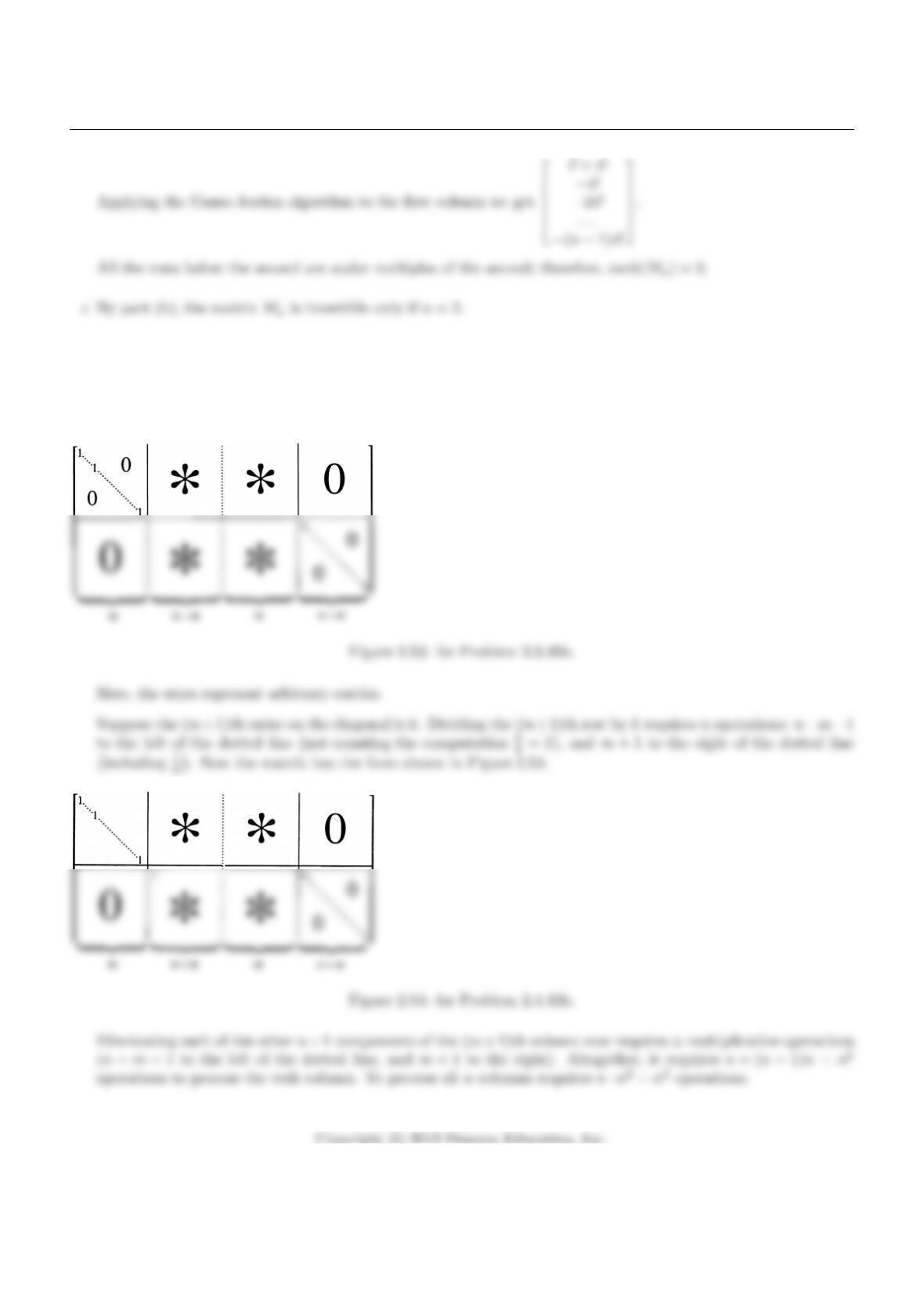
2.4.45 a Each of the three row divisions requires three multiplicative operations, and each of the six row subtractions
requires three multiplicative operations as well; altogether, we have 3 ·3 + 6 ·3 = 9 ·3 = 33= 27 operations.
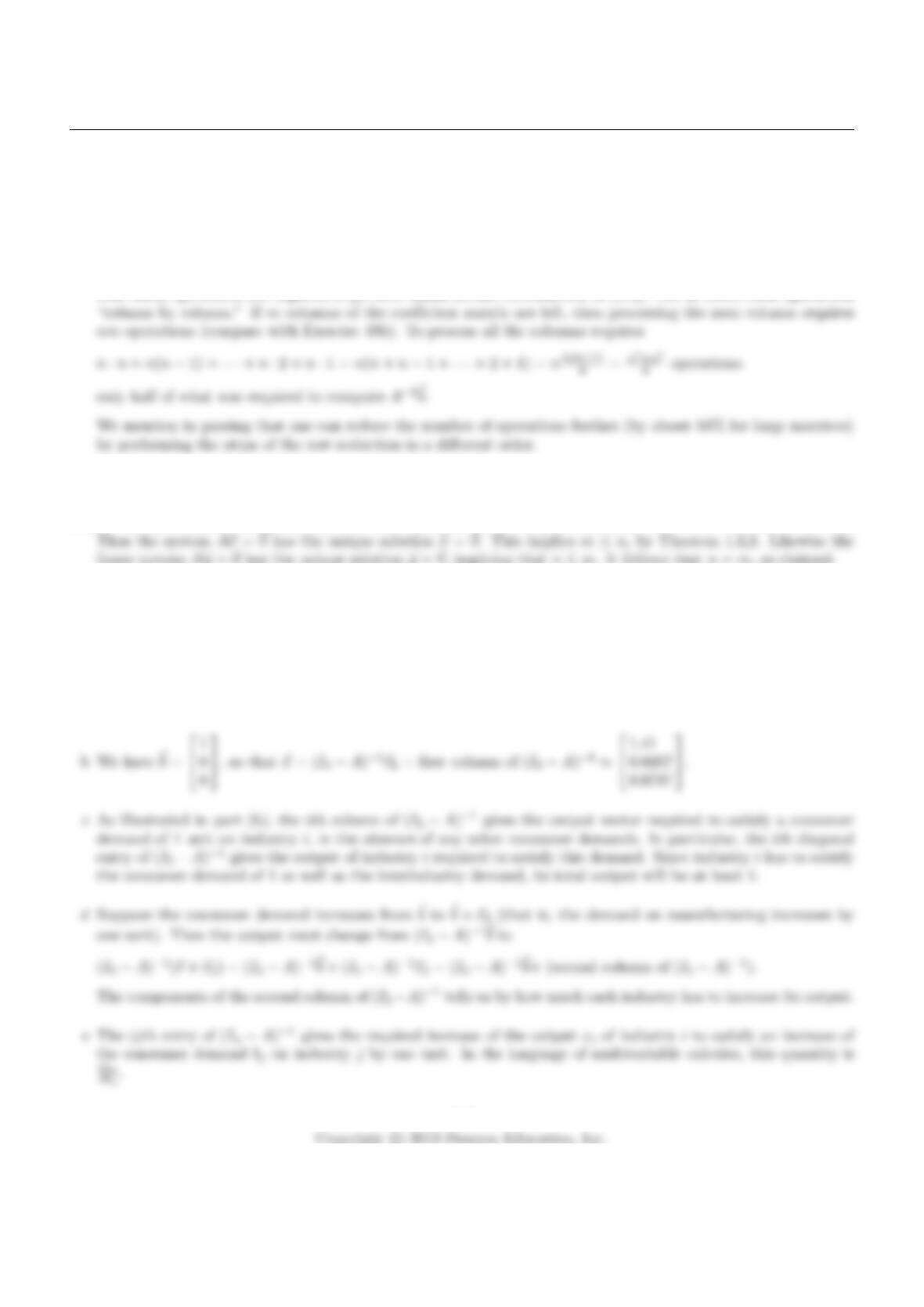
b Suppose we have already taken care of the first mcolumns: [A.
.
.In] has been reduced the matrix in Figure 2.53.
102
Section 2.4
c The inversion of a 12 ×12 matrix requires 123= 4333= 64 ·33operations, that is, 64 times as much as the
inversion of a 3 ×3 matrix. If the inversion of a 3 ×3 matrix takes one second, then the inversion of a 12 ×12
matrix takes 64 seconds.
2.4.46 Computing A−1~
brequires n3+n2operations: First, we need n3operations to find A−1(see Exercise 45b)
and then n2operations to compute A−1~
b(nmultiplications for each component).
How many operations are required to perform Gauss-Jordan eliminations on [A.
.
.~
b]? Let us count these operations
2.4.47 Let f(x) = x2; the equation f(x) = 0 has the unique solution x= 0.
2.4.48 Consider the linear system A~x =~
0. The equation A~x =~
0 implies that BA~x =~
0, so ~x =~
0 since BA =Im.
2.4.49 aA=
0.293 0 0
0.014 0.207 0.017
0.044 0.01 0.216
, I3−A=
0.707 0 0
−0.014 0.793 −0.017
−0.044 −0.01 0.784
(I3−A)−1=
1.41 0 0
0.0267 1.26 0.0274
0.0797 0.0161 1.28
103
Chapter 2
2.4.50 Recall that 1 + k+k2+···=1
1−k.
The top left entry of I3−Ais I−k, and the top left entry of (I3−A)−1will therefore be 1
1−k, as claimed:
→… (first row will remain unchanged).
In terms of economics, we can explain this fact as follows: The top left entry of (I3−A)−1is the output of
2.4.51 a Since rank(A)< n, the matrix E=rref(A) will not have a leading one in the last row, and all entries in the
last row of Ewill be zero.
b Since rank(A)≤min(n, m), and m < n, rank(A)< n also. Thus, by part a, there is a ~
bsuch that A~x =~
bis
inconsistent.
2.4.53 aA−λI2=3−λ1
3 5 −λ.
This fails to be invertible when (3 −λ)(5 −λ)−3 = 0,
104
Section 2.4
b For λ= 6, A−λI2=−3 1
3−1.
c For λ= 6, A~x =3 1
3 5 1
3=6
18 = 6 1
3.
For λ= 2, A~x =3 1
3 5 1
−1=2
−2= 2 1
−1.
2.4.54 A−λI2=1−λ10
−3 12 −λ.This fails to be invertible when det(A−λI2) = 0,
2.4.55 The determinant of Ais equal to 4 and A−1=1/2 0
0 1/2. The linear transformation defined by Ais a
2.4.56 The determinant of Ais 1. The matrix is invertible with inverse A−1=cos(α) sin(α)
−sin(α) cos(α). The linear
2.4.57 The determinant of Ais −1. Matrix Ais invertible, with A−1=A. Matrices Aand A−1define reflection
about the line spanned by the ~v =cos(α/2)
sin(α/2) . The absolute value of the determinant of Ais the area of the
105
Chapter 2
w=0
2
v=2
0
θ=π
2
Figure 2.56: for Problem 2.4.56.
unit square spanned by ~v =cos(α)
sin(α)and ~w =sin(α)
−cos(α). The angle θfrom ~v to ~w is −π/2. (See Figure
2.57.)
2.4.58 The determinant of Ais 9. The matrix is invertible with inverse A−1=−3−10
0−3−1. The linear
106
Section 2.4
v=cos α
sin α
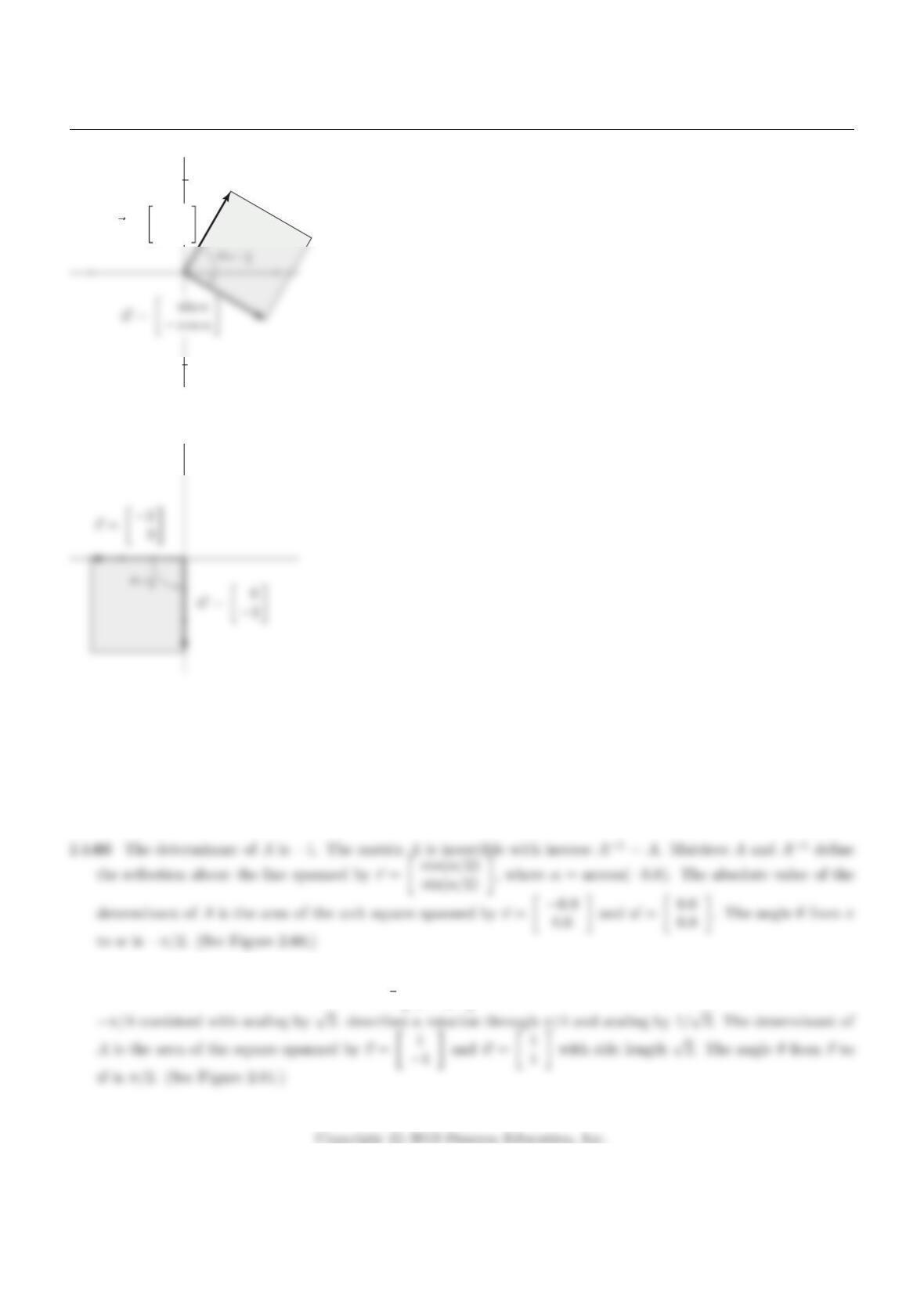
Figure 2.57: for Problem 2.4.57.
Figure 2.58: for Problem 2.4.58.
~w =−0.8
0.6. The angle θfrom ~v to ~w is π/2. (See Figure 2.59.)
2.4.61 The determinant of Ais 2 and A−1=1
21−1
1 1 . The matrix Arepresents a rotation through the angle
107
Chapter 2
w=
−0.8
0.6
v=0.6
0.8
θ=π
2
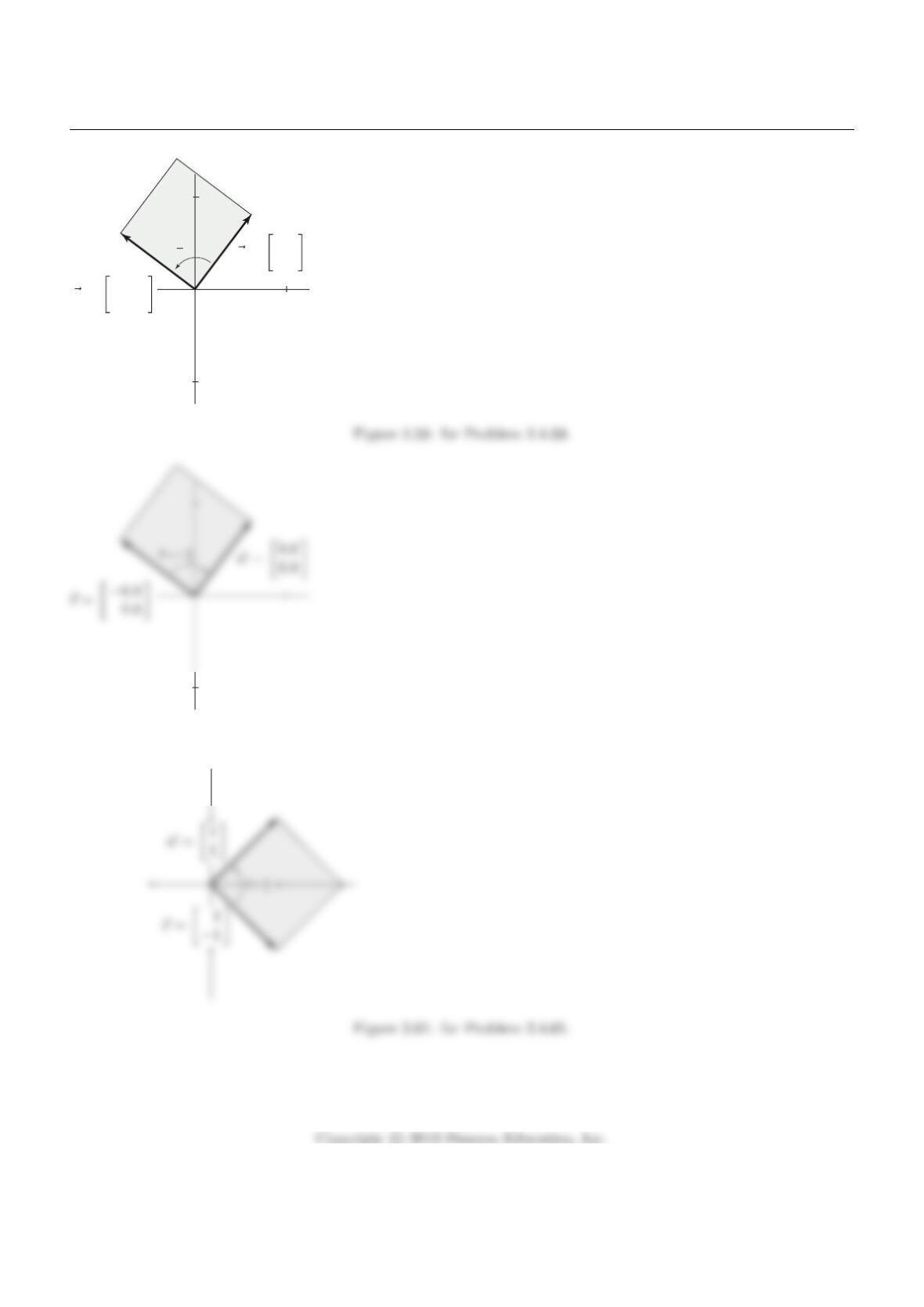
Figure 2.60: for Problem 2.4.60.
108