
CHAPTER 2
Engineering Geology
QUESTIONS AND PRACTICE PROBLEMS
Section 2.1 The Geologic Cycle
2.1 Describe the inter-relationships in the geologic cycle among magma, different types of
rocks, and soil.
Solution
Refer to Figure 2.1. Igneous rocks are formed by the cooling and solidification of
Section 2.2 Rocks
2.2 Which would probably provide better support for a large, heavy building, a diorite or a
shale? Why?
Solution
Diorite is a hard igneous rock that is very strong and thus provides excellent support for
2.3 Would a tunnel excavated in a granite require more or less support than a tunnel
excavated in a mudstone? Why?
Solution
Granite generally has excellent engineering properties and would require less support
2.4 Fossils are imprints in rock of ancient plants and animals. What type of rock might
contain fossils? What type would never contain fossils? Explain.

2-2 Engineering Geology Chap. 2
Solution
Fossils are formed when plants or animals, or at least evidence of their presence (e.g.,
2.5 What type of rock is most likely to develop sinkholes? Why?
Solution
Carbonate sedimentary rocks, especially limestone, are most prone to have sinkholes
2.6 In general, how does the age of a rock affect its engineering characteristics?
Solution
In general, there may be a relationship between the age of a sedimentary rock and its
Section 2.3 Rock-Forming Minerals
2.7 Name four common minerals. For each mineral named, state one characteristic or
property of the mineral and describe how this characteristic or property may be reflected
in the property of a rock that contains the mineral.
Solution
• Feldspar has a moderate hardness, making rocks containing feldspar susceptible
Section 2.4 Structural Geology
2.8 Define “bedding planes” and explain why it is important to assess their orientations as a
part of slope stability analyses.
Chap. 2 Engineering Geology 2-3
Solution
Bedding planes are the interfaces between the layers in a sedimentary rock. The shear
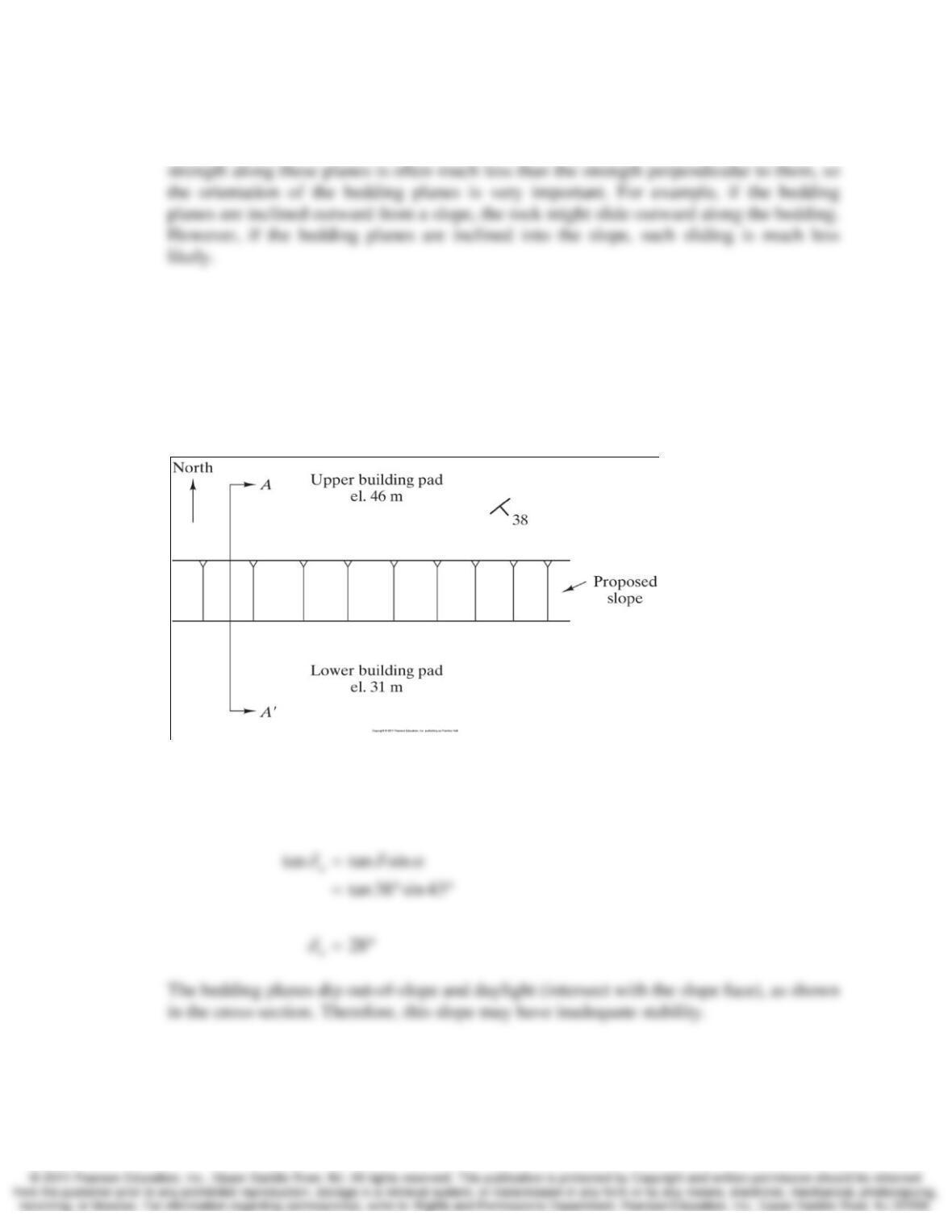
2.9 The bedding planes in a certain sedimentary rock have an average strike of N43°E and an
average dip of 38°SE, as shown by the attitude in Figure 2.28. A 15-m tall, east-west
striking cut slope inclined at 34° with the horizontal is to be made in this rock. The
ground surface above and below this proposed slope will be nearly level. Compute the
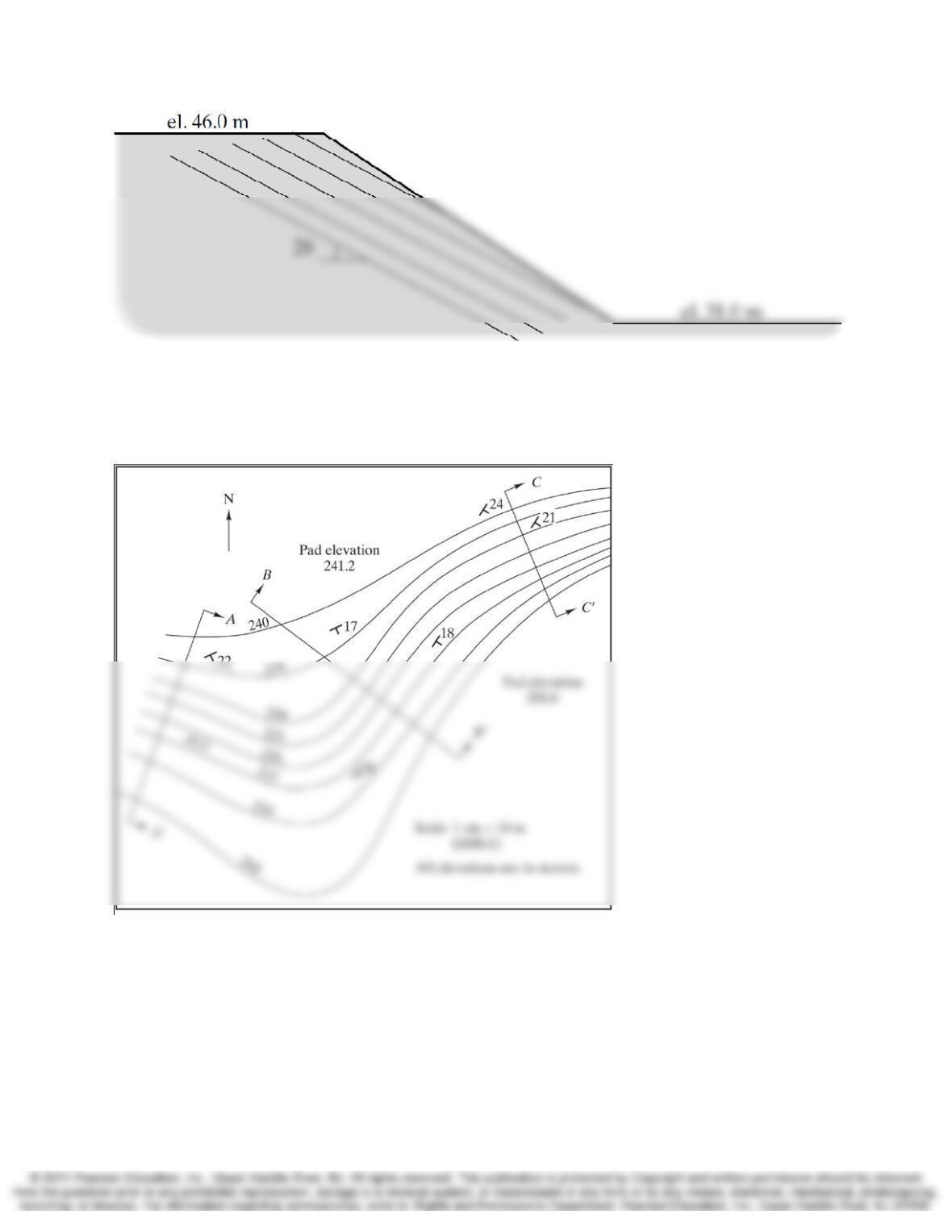
apparent dip of the bedding planes as they will appear in cross-section A-A′, then draw
this cross-section. Your drawing should show the ground surface and the bedding planes.
Do these bedding planes pose a potential slope stability problem? Explain.
Figure 2.28 Plan view of proposed slope for Problem 2.9. el. = elevation.
Solution
The apparent dip in cross-section A-A’ is:
2-4 Engineering Geology Chap. 2
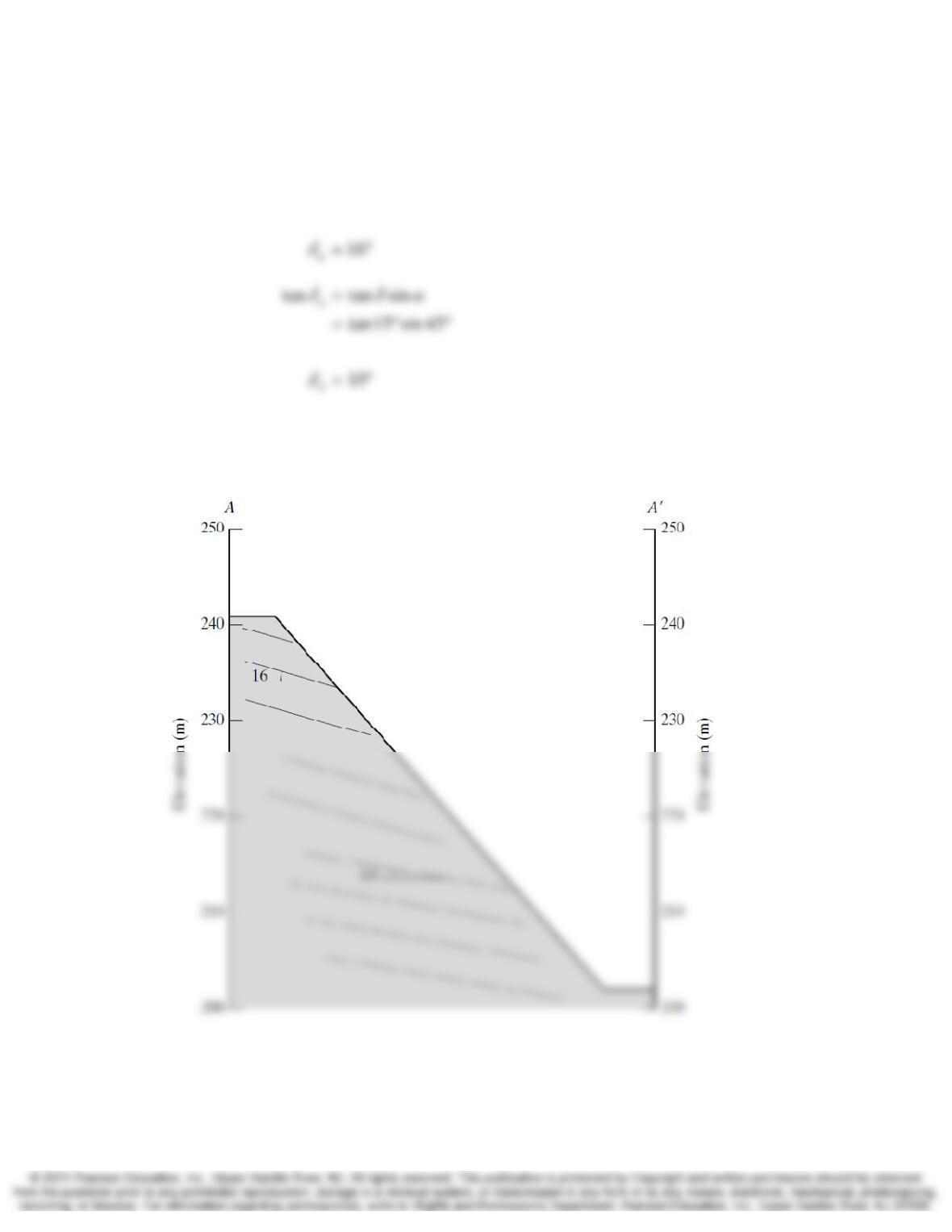
2.10 Draw cross-section A-A′ in Figure 2.11 and compute the apparent dip of the bedding
planes as they would appear in this cross-section. There are two nearby attitudes, so
compute the apparent dip for each. Then, sketch in the bedding planes on the cross-
section. Do these bedding planes pose a potential stability problem? Why or why not?
Figure 2.11 Geologic map showing bedrock attitudes. In this case, the attitudes
represent the bedding planes in a sedimentary rock.
Chap. 2 Engineering Geology 2-5
Solution
°°=
=
47sin22tan
sintantan
a
α
δ
δ
The apparent dip is 16° in the upper portion of the slope and 10° in the central portion.
Both of these produce bedding planes that are inclined out-of-slope, and thus pose a
potential instability problem
α
δ
δ
2-6 Engineering Geology Chap. 2
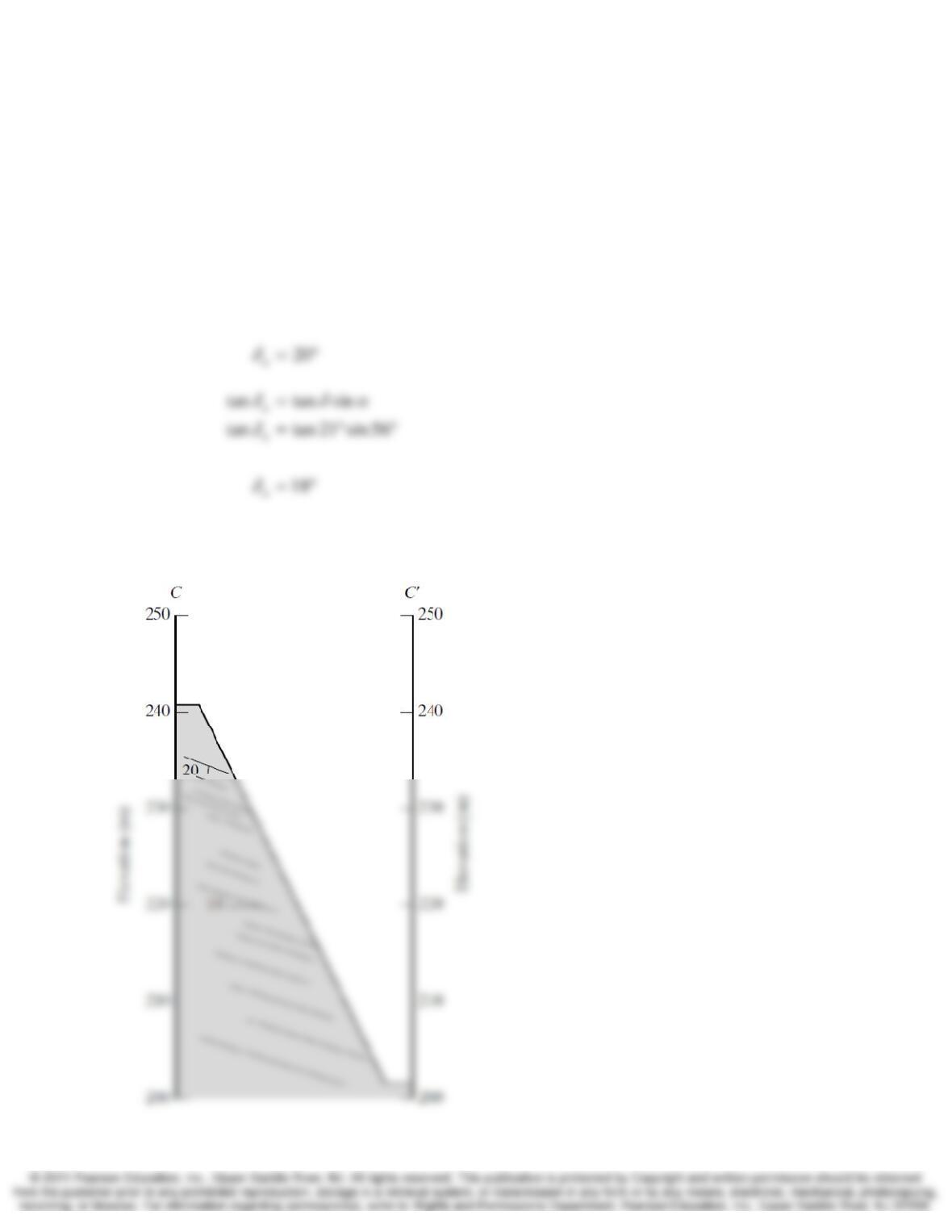
2.11 Draw cross-section C-C′ in Figure 2.11 and compute the apparent dip of the bedding
planes as they would appear in this cross-section. There are two nearby attitudes, so
compute the apparent dip for each. Then, sketch in the bedding planes on the cross-
section. Do these bedding planes pose a potential stability problem? Why or why not?
Solution
°°=
=
55sin24tan
sintantan
a
α
δ
δ
These bedding planes are inclined out-of-slope and daylight, so they pose a potential
stability problem.
α
δ
δ
Chap. 2 Engineering Geology 2-7
Section 2.5 Weathering
2.12 Name the three major types of weathering and define each.
Solution
• Physical weathering is the disintegration of rock into smaller particles through
2.13 Discuss how weathering affects the engineering properties, e.g. density and strength, of a
rock.
Solution
Section 2.6 Soil Formation, Transport, and Deposition
2.14 Define residual soils. Name one type of residual soil and describe its typical engineering
characteristics.
Solution
Residual soils are soils weathered in-place from their parent rocks. A residual soil
2.15 Define transported soils. Name the major types of transported soils and describe how
each is formed.
Solution
Transported soils are formed by the deposition of sediments that have been transported
2-8 Engineering Geology Chap. 2
2.16 Explain the difference between ablation till and lodgement till. Which would provide
better support for heavy civil engineering projects? Why?
Solution
Lodgement till is soil that has been covered by a glacier, and thus has been heavily
2.17 Which would probably provide better support for a proposed structure, an alluvial sand or
an aeolian sand? Why?
Solution
Aeolian sands are those that were deposited by wind. Because of this deposition process,
2.18 A new car dealership has recently been built in an area known for occasional strong
winds. Unfortunately, an open field of fine sandy soil exists immediately upwind of the
dealership. Soon after construction, a 70 mi/hr wind blew large quantities of this soil
onto the new cars, seriously damaging their paint. Could this problem have been
anticipated? What mode of aeolian transport brought the sand from the field to the cars?
Given the current conditions, how might this problem be avoided in the future?
Solution
Yes, this problem could have been anticipated because the area known for having strong
Chap. 2 Engineering Geology 2-9
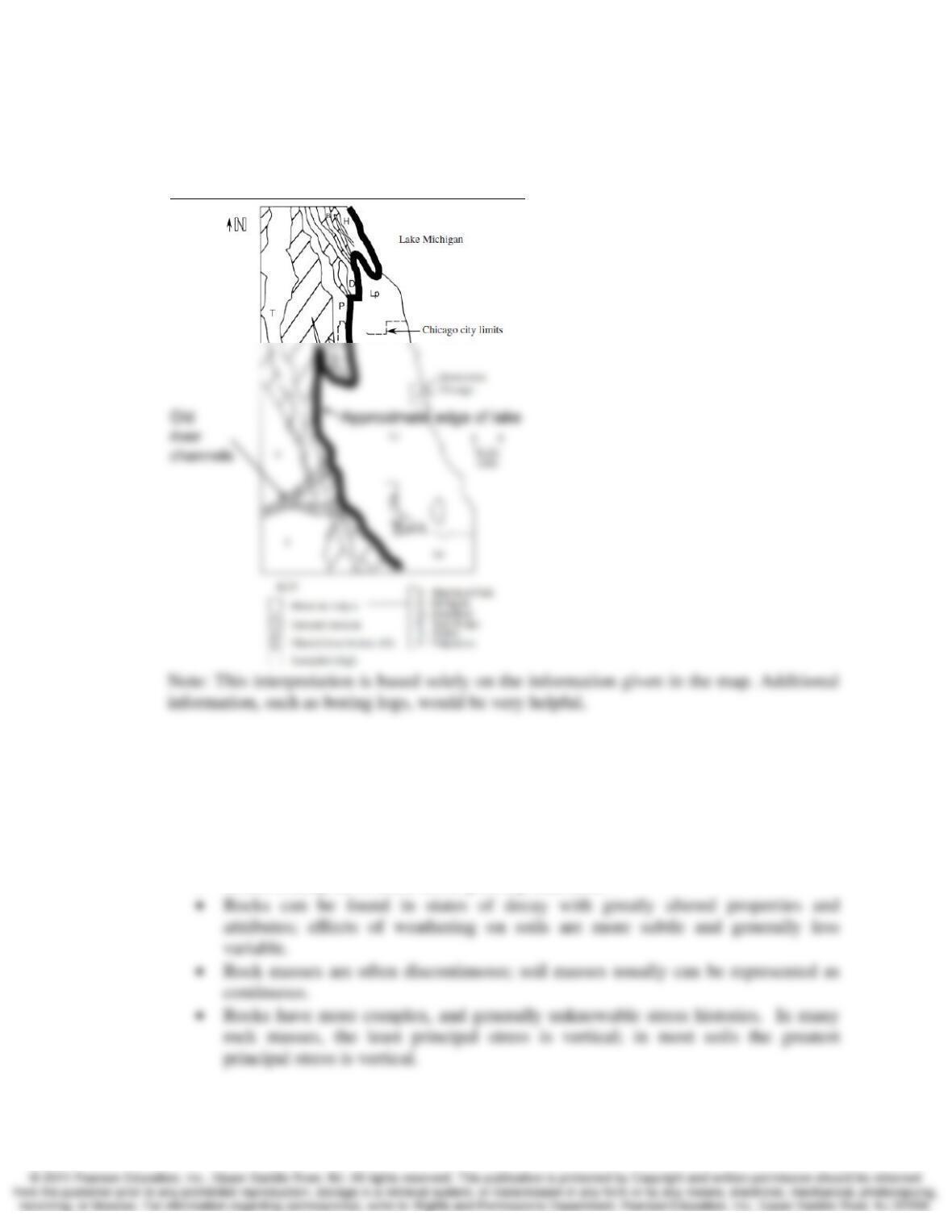
2.19 Make a copy of Figure 2.18 and indicate the probable lateral limits of Lake Michigan and
the probable locations of previous river channels.
Solution
Section 2.7 Rock and Soil as Geomaterials
2.20 What are the major differences between a rock and a soil?
Solution
• Rocks are generally cemented; soils are rarely cemented.
• Rocks usually have much lower porosity than soils.
2-10 Engineering Geology Chap. 2
2.21 Geologists and engineers do not always use the same definitions of “rock” and “soil.”
Thus, there are some materials that are “rock” in the geologic sense, but not in the
engineering sense. For example, some mudstones might be classified as rock by a
geologist, yet be weaker than some “soils.” Give an example of a situation where this
difference could cause problems in the design or construction of a civil engineering
project.
Solution
• Example 1: Some people think all “rock” is very difficult to excavate, while all
“soil” is easy to excavate. However, some rocks, such as mudstone, can easily be
excavated by normal earthmoving equipment, while some soils, such as caliche,
Comprehensive
2.22 A proposed construction site is underlain by a sedimentary rock containing rounded
gravel-size particles and sand. The gravel-size particles represent about 75 percent of the
total mass. What is the name of this rock? Would you expect it to provide good support
for the proposed structural foundations? Would it be difficult to excavate?
Solution
According to Table 2.1, this is a conglomerate. It will probably provide excellent support
2.23 As the glaciers in North America melted, the runoff formed a large lake in what is now
southern Manitoba, eastern North Dakota, and western Minnesota. Called Lake Agassiz,
it was larger than all of the current Great Lakes combined. The present Lake Winnipeg is

Chap. 2 Engineering Geology 2-11
a remnant of this ancient lake. The City of Winnipeg is located on the ancient lakebed.
What kinds of soils would you expect to find beneath the city, and what would be their
likely geologic origin? What would be the typical engineering characteristics of these
soils?
Solution
The soils deposited along the bottom of the former Lake Agassiz would be lacustrine
2.24 Would you expect to find till in Houston, Texas? Why or why not?
Solution
2.25 A heavy structure is to be built on a site adjacent to the Hudson River near Albany, NY.
This area was once covered with glaciers that left deposits of lodgement till and
glaciofluvial soils. Since then, the river has deposited alluvial soils over the glacial
deposits. The design engineer wishes to support the structure on pile foundations
extending to the lodgement till, and you are planning a series of exploratory borings to
determine the depth to these strata. What characteristics would you expect in the
lodgement till, i.e. how would you recognize it?
Solution
The lodgement till would be much harder than the overlying glaciofluvial and alluvial
2.26 New Orleans, Louisiana is located near the mouth of the Mississippi River. What
geological process has been the dominant source of the soils beneath this city? What
engineering characteristics would you expect from these soils, i.e. overall quality,
uniform or erratic, etc.? Explain.
Solution
New Orleans is in the Mississippi River Delta, which is primarily alluvial soils deposited
2.27 A project is to be built on a moderately sloping site immediately below the mouth of a
canyon near Phoenix, Arizona. Using the geologic terms described in Section 2.6, what
type of soil is most likely to be found? Why? What engineering characteristics would
you expect from these soils? Explain.

2-12 Engineering Geology Chap. 2
Solution
Considering its location near the mouth of a canyon in an arid area, and the moderate
2.28 A varved clay deposit has been progressively buried by other deposits and eventually has
been lithified into a sedimentary rock. What type of rock is it? Would you expect its
bedding planes to be distinct or vague? What engineering characteristics would you
expect from these soils? Explain.
Solution
This rock might be a mudstone, siltstone, claystone, or shale, depending on the relative