
33
PART I
THE STRATEGIC POSITION
34
C H A P T E R 2
THE ENVIRONMENT
Introduction
The first part of this chapter has been substantially re-written, with new concepts such as the
non-market environment, weak signals, megatrends and inflection points introduced. The core
of the chapter remains Porters Five Forces analysis.
Illustration 2.1
Oils troubled waters
BPs predicament after the Deepwater Horizon disaster allows one to illustrate the full range of
the PESTEL factors. The first question helps move students on from simple PESTEL lists
towards priorities and action; the second question addresses explicitly the fuzzy boundaries of
PESTELs categories, something students will often have to cope with in strategy.
1. Which of the above PESTEL factors offer the most important opportunities to BP, and
which the most important threats?
Important opportunities and threats: BP seems surrounded by threats, from hostility in the
2. Which of the above factors spill over from one PESTEL category to another? Does this
matter?
Spill-overs between categories: several of these factors spill-over: for instance, shale gas
under Economic, Technological and Ecological; the ramifications of the Deepwater Horizon
35
Illustration 2.2
Scenarios for the global fashion industry, 2025
Scenarios help students think long term and very broadly: here Levi Strauss and the London
fashion students have been looking 15 years ahead and thinking about major social and
technological change as well as the fashion market in a narrow sense.
1. Which scenario would Levi Strauss most desire and which would it most fear?
Desirable and undesirable scenarios: this question helps go beyond the general descriptive
nature of scenarios to strategic implications for particular companies, here Levi Strauss. All
2. What are the implications of these fashion industry scenarios for other industries, for
example hotels or retail?
Implications for other industries: the scenario whose relevance students would hesitate over
most is probably Techno-chic. Here, one approach would be to suggest that a world of
Illustration 2.3
The consolidating steel industry
The steel industry provides a fairly easy-to-understand case of rapid structural change, and one
led by industry actors. Understanding how the leading companies are making an impact helps to
counter a risk of determinism in Porterian analyses; such determinism is liable to give an
undue sense that structures are given rather than changeable.
1. How attractive is the world steel industry? What accounts for this?
Attractiveness of the world steel industry: the first question can be approached using the
Johnson, Whittington, Scholes, Angwin and Regnér, Exploring Strategy, 10th edition,
Instructors Manual on the Web
36
The small enclosed area indicates low profit potential: the industry is unattractive. Buyers
are sophisticated (in automobiles) and still relatively concentrated (in canning at least,
though less so in automobiles now). Iron ore suppliers are highly concentrated and can
maintain relatively high prices even in recession (compare with the steel price trend, the
2. In the future, what might change to make the steel industry less attractive or more attractive?
More or less attractive in the future. The big threat is the flooding of world markets by the
huge Chinese steel producers, increasing rivalry in order to use up surplus capacity due to
Rivalry
Low
37
Illustration 2.4
Chugging and the structure of the charity sector
1. Which of Porters Five Forces are creating problems for the United Kingdoms charity
sector?
2. What type of industry structure might the charity industry be moving towards? What would
be the benefits and disadvantages of that structure?
The aim of this illustration, of course, is to show that industry structure analysis is relevant to
not-for-profits as well. Indeed, charities appear ruthlessly competitive hence the High Street
chuggings.
Key Debate
How much does industry matter?
This debate addresses an enduring source of controversy in strategy research, and allows
students to review the importance of the contents of Chapter 2 (particularly the Five Forces),
at the same time as introducing the more internally focused issues of Chapter 3 that follows.
Turning to the precise question, the kinds of industries that influence members profitabilities
more than others seem generally to be service industries (explaining the greater industry effects
in the Porter and McGahan study than in Rumelts). But to go on from here, industry influences
Video assignment
Environmental change for Nationwide and Pearson
The video features Paul Carvell who is the head of the credit card product at Nationwide and
Mark Pearson who is responsible for strategy and business development in the international
division of the Pearson group. They discuss changes in the macro and competitive environment
for their organisations and how these changes can open up opportunities and create threats. The
video links to Sections 2.2 and 2.3 in the text.
1. This question looks at the external (macro) environment facing the Nationwide building
society and invites students to apply the PESTEL model to pick out some key drivers of
change. Speaking in 2013, it is no surprise that it is economic changes that dominate his
thinking. The period from 2008 to 2013 was a period of recession especially in Europe. He
2. The first part of this question refers particularly to the inner circle in Figure 2.1
competitors. It is also relevant to the discussion of industry convergence in Section 2.3:
the formerly distinct industries of textbook publishing, education and digital media are
The second part of this question refers to the critical success factors discussed in the value
curve analysis in Section 2.4. It might be useful to draw these value curves. Traditional
Assignment 2.1
PESTEL analysis
PESTEL analysis is a useful starting point for environmental analysis. Illustration 2.1 provides
some initial guidance for students.
The danger is that long lists of forces or influences can be generated by this device. So the
Assignment 2.2
Building scenarios
Assignment 2.2 requires students to focus on change in industrial characteristics and
competitive forces through the construction of scenarios. Guidelines for the construction of
scenarios are given in Section 2.2.2. It is recommended that students follow these, building
either two or four scenarios for a given industry. The work done in Assignment 2.1 should
provide the bases of identifying the key industry forces or influences which will enable them to
do this. Some of the problems of scenario building should be emphasised to students:
then to assess the companys strategic position in the light of the different scenarios (e.g. see the
notes above on the brewing industry).
One of the issues that might surface is the ease or difficulty with which scenarios can be
constructed. It usually emerges that scenarios are much easier to construct where the number of
Assignment 2.3
Five competitive forces
Five Forces analysis is an absolutely fundamental technique in strategy. Section 2.3 should give
students the ability to carry out a basic Five Forces analysis of any industry. They should be
Assignment 2.4
Comparisons between industries and over time
This assignment allows students to build on Assignment 2.3 in order to consider the investment
implications of differences between industries and change over time. The assignment is a
substantial one if relying on students own research. However, time can be saved if two case
studies are used (e.g. brewing, pharmaceuticals or Vodafone, perhaps looking backwards at
41
At the same time, it is worth countering the implications of Five Forces analysis with two
thoughts:
Industries that are highly attractive are likely to have high barriers to entry, so the costs of
Assignment 2.5
Strategic groups
This assignment builds on the notion of strategic groups and strategic space outlined in Section
2.4.1 in the text. Figure 2.8 provides an example of how the exercise could be carried out. This
could, for example, be applied to the advertising industry:
Key strategic dimensions might come under either of the scope or resource commitment
characteristics in Section 2.4.1 for example, product range or extent of vertical integration.
Assignment 2.6
Critical success factors and the strategy canvas
It is very likely that students will concentrate on success factors that are salient to them as
consumers for example, the product ranges of a clothing retailer. Less visible elements, such
as ownership by a diversified parent company, may be neglected. However, for a short
Integrative assignment 2.7
Full analysis of an industry or a sector
This assignment would be a demanding research project over a significant part of the course. It
is however a very good test of students ability to apply tools to real data appropriately, as well
as developing their research skills. Students will see it as practical and, if allowed a choice of
sectors, relevant to their own interests.
Good research resources are essential. As well as free web-based resources such as company
You would also want to guide students on which industries or sectors to choose. Very broad
industries for example, the world airline industry are likely to overwhelm students with data.
It might be helpful to encourage focus for example, the airline industry in India, or similar.
Industry focus also reduces the risk of plagiarism. There are many student assignments of a
Case Example
Global forces and the advertising industry
This case focuses on the key techniques of PESTEL, Five Forces, megatrends, inflection points
and weak signals that are central to this chapter. Strategy in this industry is further explored in
the Strategy Experience simulation (http://www.mystrategylab.com/strategy-experience).
43
1. Carry out a PESTEL analysis of the advertising industry in 2012, with particular attention to
megatrends, inflexion points and weak signals.
PESTEL:
Here it would be helpful to ask students to draw on their wider knowledge as consumers of
advertising via television and hand-held devices to access the internet and social media. A
wide range of issues may be raised. To highlight some for the purposes of illustration:
Technological: Emergence of the power of digital engine search advertising offering
measurable analytics, resulting in the creation of a new, dominant industry sector.
Technological convergence of hand-held mobile devices, computers and TV enables
targeting of niche markets. The continuing change in consumer buying preferences with
emergence of online shopping versus urban retail shopping.
Megatrends, inflection points and weak signals:
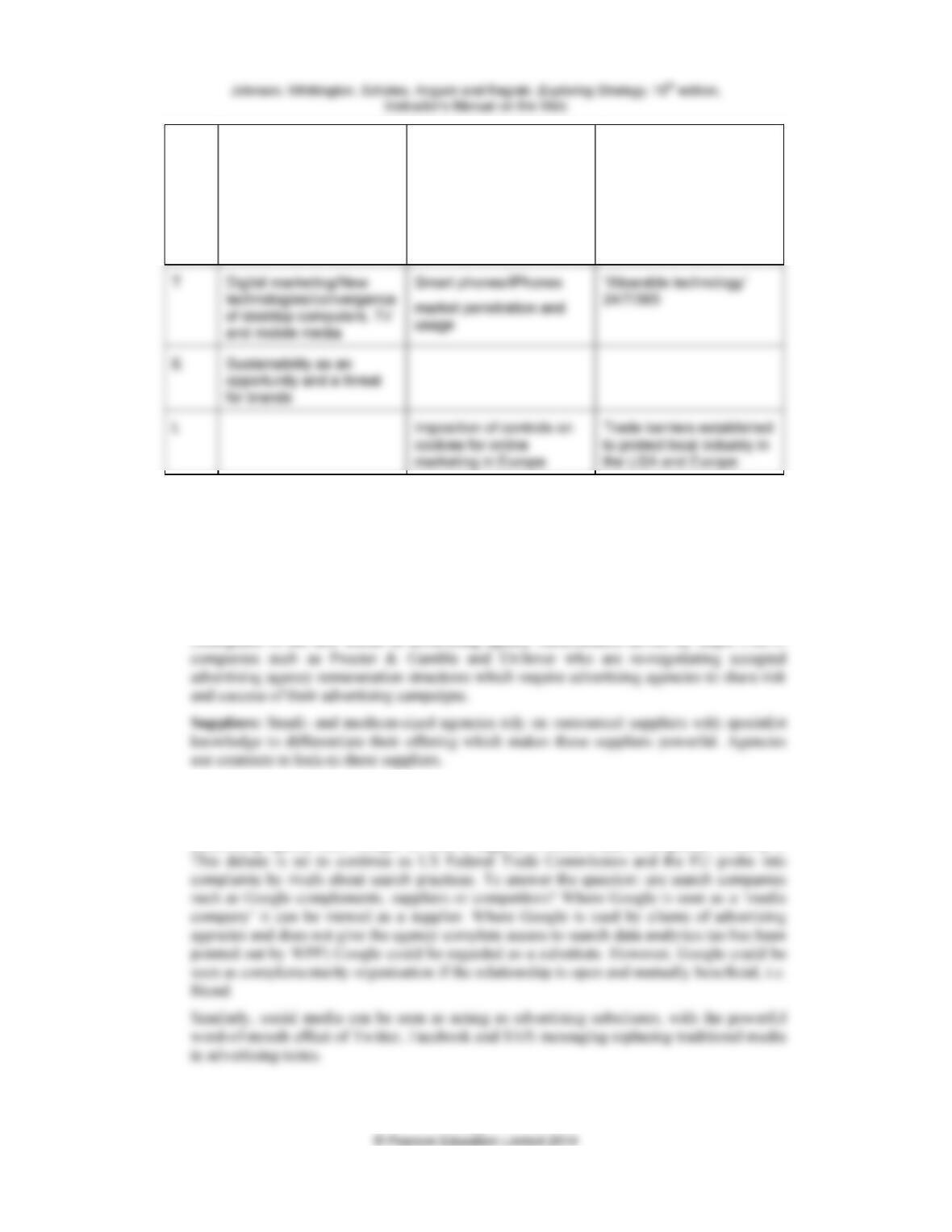
The following table summarises megatrends, inflection points and weak signals in terms of
PESTEL categories:
MEGATRENDS INFLECTION POINTS WEAK SIGNALS
P The Arab Spring,
government change and
attitudes to Western
consumerism
44
S Aging demographics in
Western cultures
Changing attitudes to sub-
Saharan Africa as a target
for brands designed to
meet social
needs/spending power
The rise of Islamic
marketing based on
Muslim values
Personal choice of life
span based on quality of
life requirements/ability to
end life
2. Carry out a Five Forces analysis of the advertising industry in 2012. Which forces are
becoming more negative or positive for the major advertising agencies?
Five Forces:
With the Five Forces analysis, it is beneficial to draw students out on the so what question
on their analysis.
Buyers: The Top 100 advertisers globally account for nearly 50% of measured advertising.
Substitutes: Google is a potential supplier to advertising agencies, i.e. a medium/media
partner, but is also a substitute, i.e. Google competes for a share of the marketing budget
targeted by advertising agencies. In the case, it is pointed out that WPP the worlds largest
advertising agency sees Google as both a supplier (friend) and a competitor (enemy).
New entrants: Technologically focused digital agencies are taking more advertising
budget away from traditional media focused agencies. There are different levels of
response from advertising agencies, depending on their size and access to capital for
acquisitions. Phone companies could emerge as a potential new entrant by creating their
own marketing medium as technologies converge.
Rivalry: Lower advertising budgets in Western Europe and North America; new
technology-based entrants, increase the scope for rivalry. However, sector expertise and