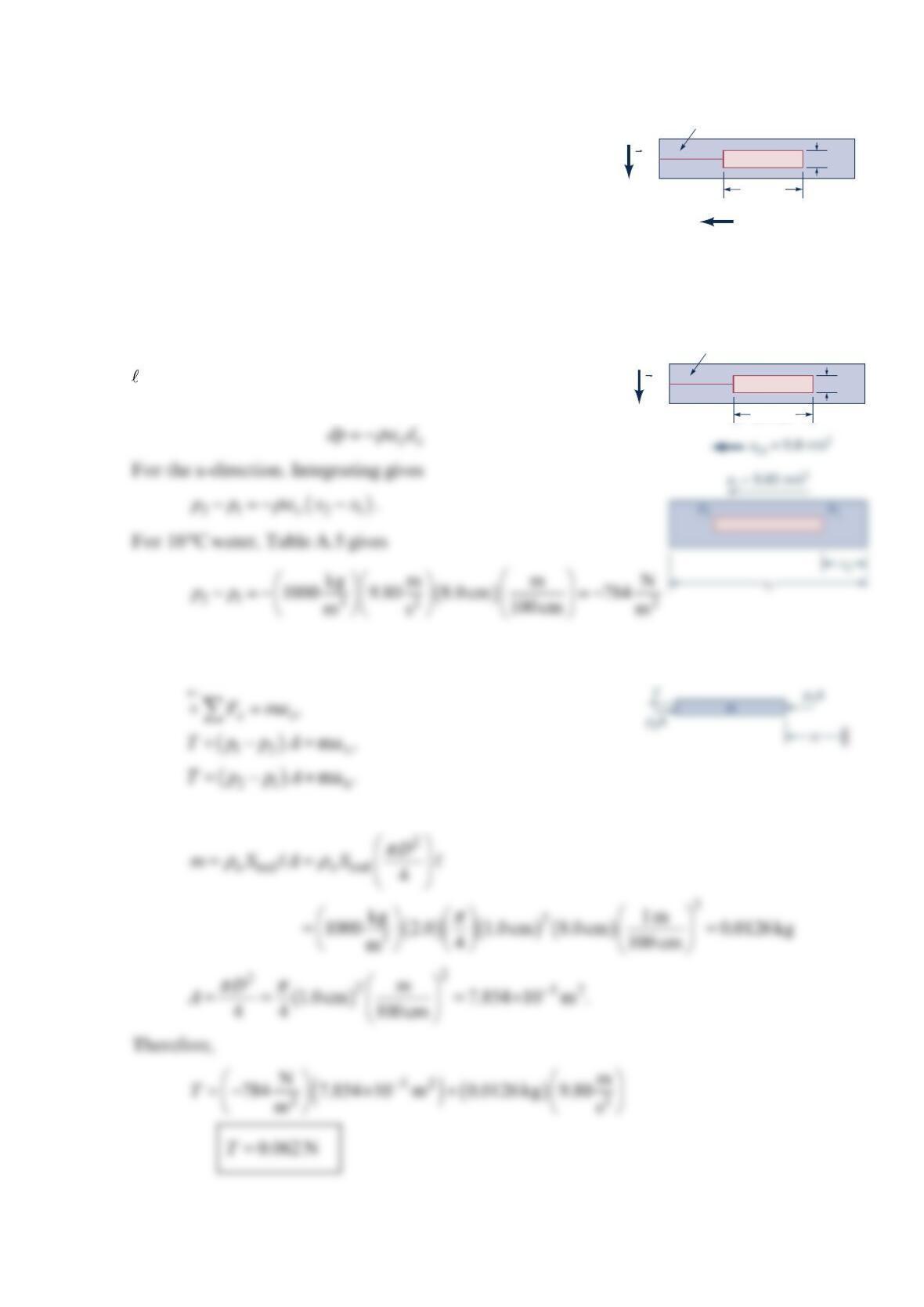
Problem 2.154
The cylinder in the figure below accelerates to the left at the
rate of 2
9.80 m/s . Find the tension in the string connecting
at rod of circular cross section to the cylinder. The volume
between the rod and the cylinder is completely filled with
water at
1
0°C.
Solution 2.154
First find the pressure difference in the water over a length
8.0 cm=. Since gravity is perpendicular to the rod, Eq.(2.41)
gives
We next apply Newton’s second law to the rod
Using the specified information,
S
fluid
= 1.0
S
rod
= 2.0
8.0 cm
1.0 cm
String
g
S
fluid
= 1.0
a
cyl
= 9.8 m/s
2
S
rod
= 2.0
8.0 cm
1.0 cm
String
g
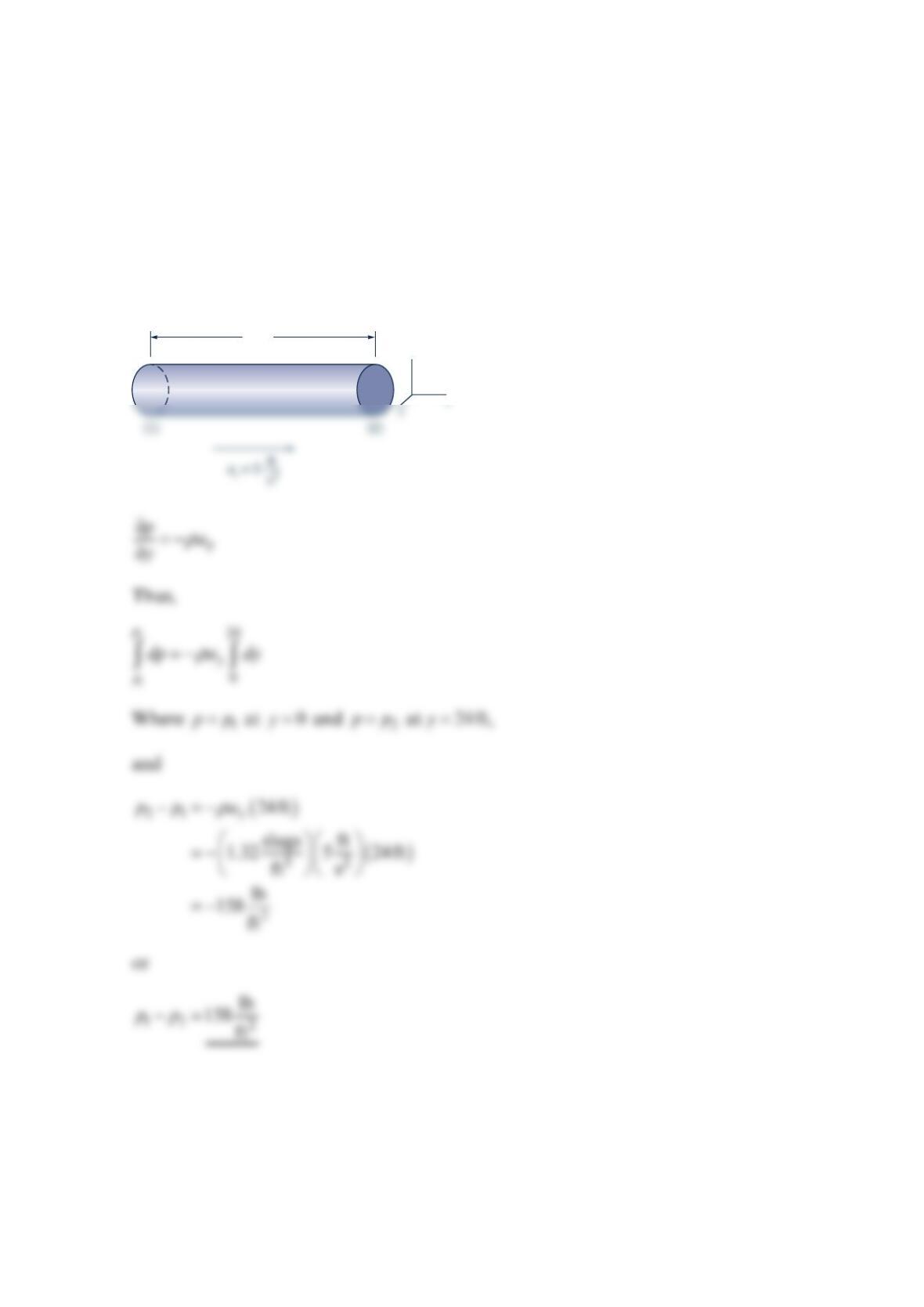
Problem 2.155
A closed cylindrical tank that is 8ft in diameter and 24 ft long is completely filled with
gasoline. The tank, with its long axis horizontal, is pulled by a truck along a horizontal
surface. Determine the pressure difference between the ends (along the long axis of the
tank) when the truck undergoes an acceleration of 2
5ft/s .
Solution 2.155
z
24 ft
y
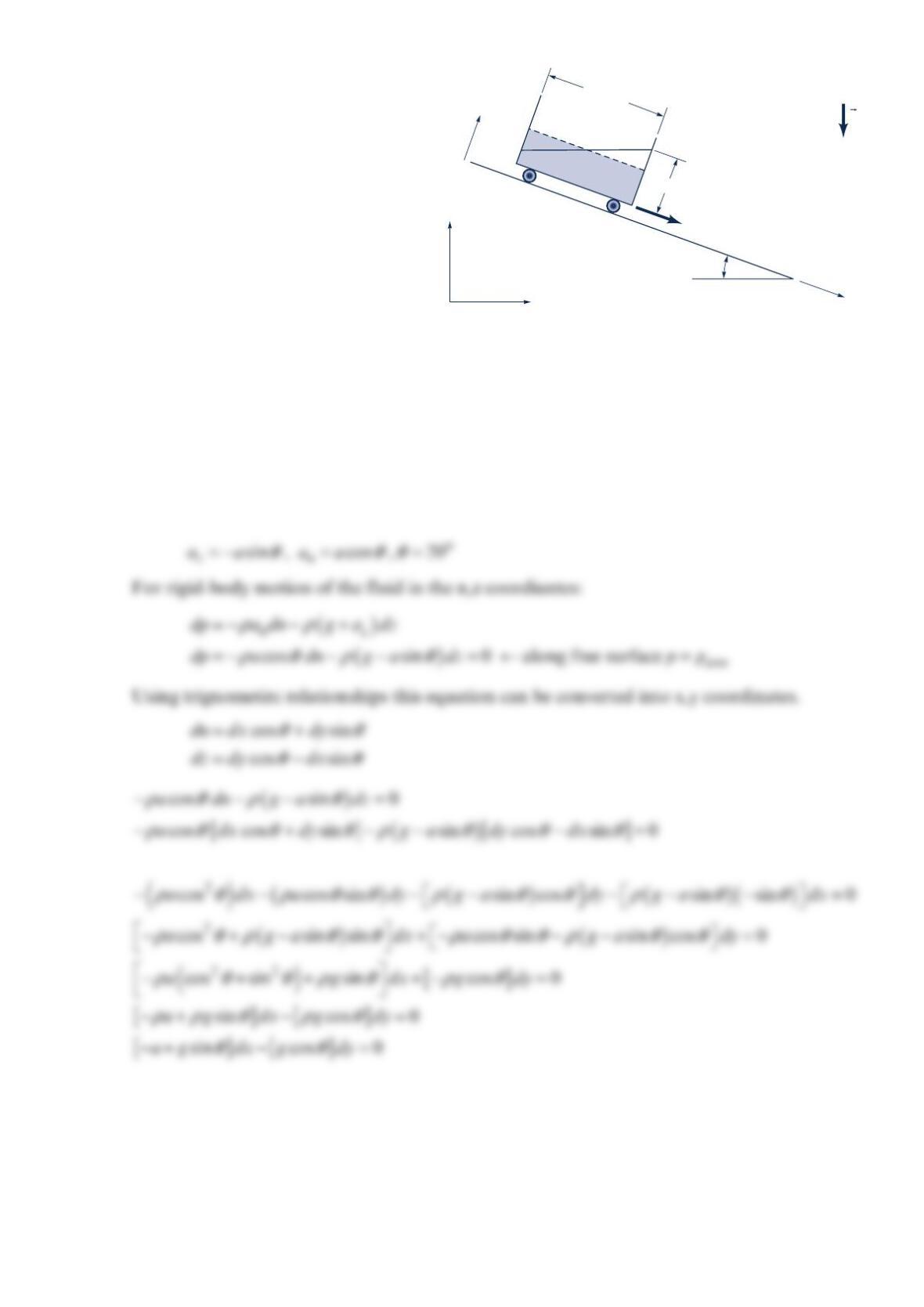
Problem 2.156
The cart shown in the figure below
measures 10.0 cm long and 6.0 cm
high and has rectangular cross
sections. It is half-filled with water
and accelerates down a °20 incline
plane at =2
1.0 m/sa. Find the
height h.
Solution 2.156
Unfortunately, there are 2 x-directions in the problem statement.
Noting that the gravisty vector is in the negative z-direction, change the label on the axis
normal to the z-direction to be “n”. Resolving the acceleration along the plane into n,z
components:
x
x
z
yℓ = 10.0 cm
20°
g
a
h
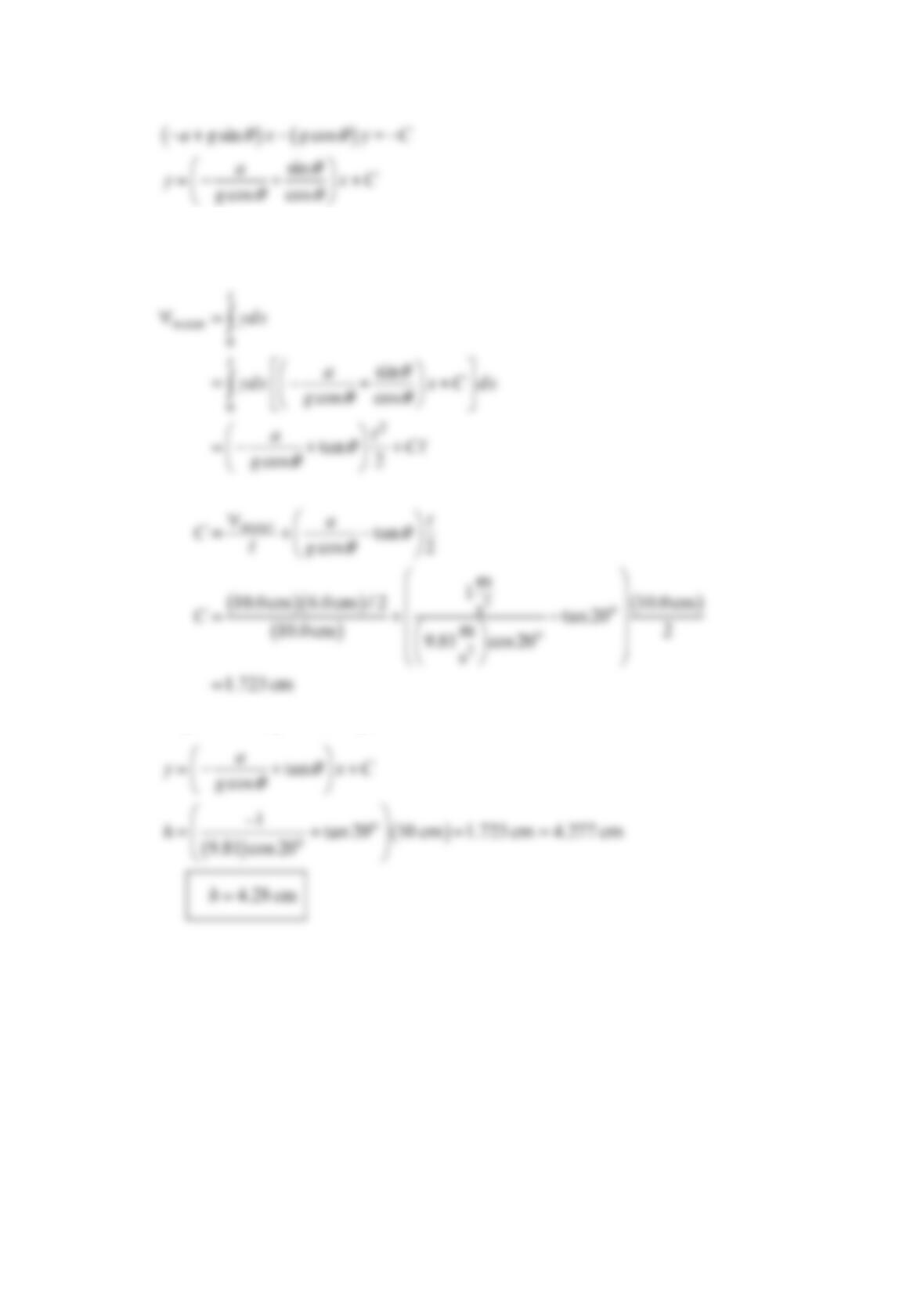
Integration yields:
The constant of integration can be determined by noting that the container is ½-full:
Solving for the requested length:
Problem 2.157
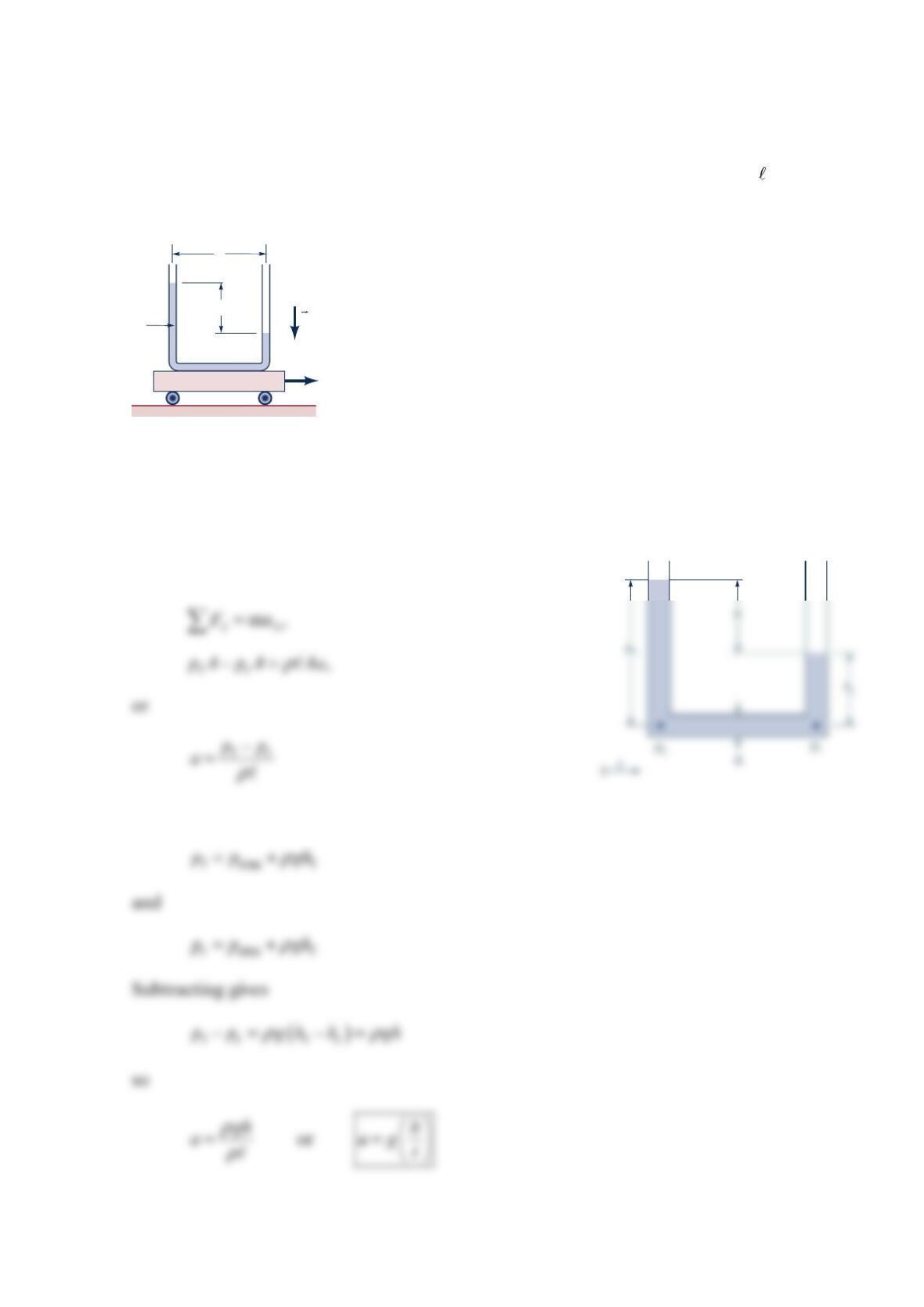
The U-tube manometer in the figure below is used to measure the acceleration of the cart
on which it sits. Develop an expression for the acceleration of the cart in terms of the liquid
height
h
, the liquid density
ρ
, the local acceleration of gravity g, and the length .
Solution 2.157
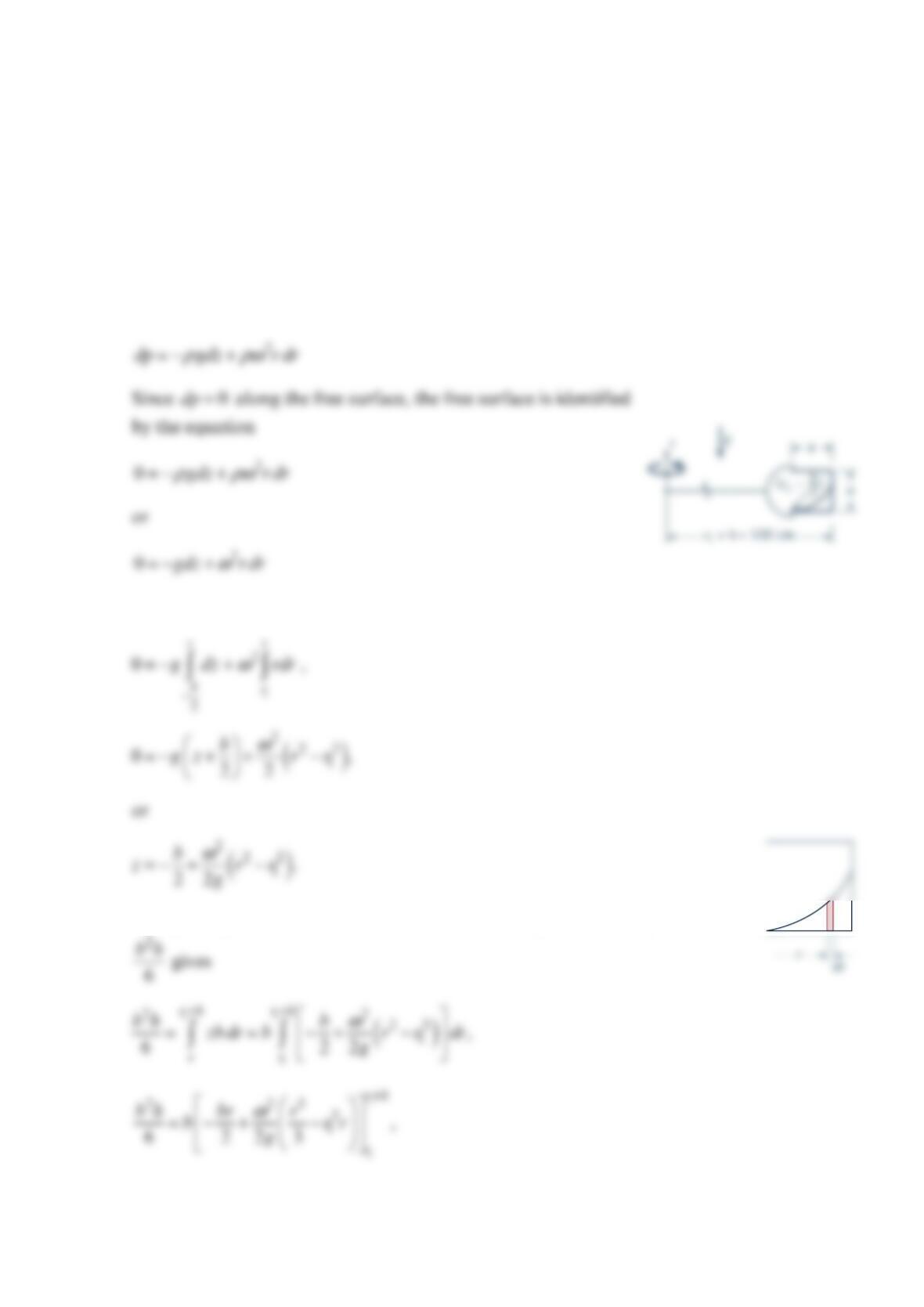
Writing Newton’s second law in the horizontal direction
(x-direction) for the bottom leg of the manometer gives
Applying the manometer rule to the two legs of the manometer gives
ℓ
g
h
a
p
p
atm
Problem 2.158
A tank has a height of 5.0 cm and a square cross section measuring 5.0 cm on a side. The
tank is one-third full of water and is rotated in a horizontal plane with the bottom of the
tank 100cm from the center of rotation and two opposite sides parallel to the ground.
What is the maximum rotational speed that the tank of water can be rotated with no water
coming out of the tank?
Solution 2.158
Integrating gives
Recognizing that the volume of water in the rotating tank must equal
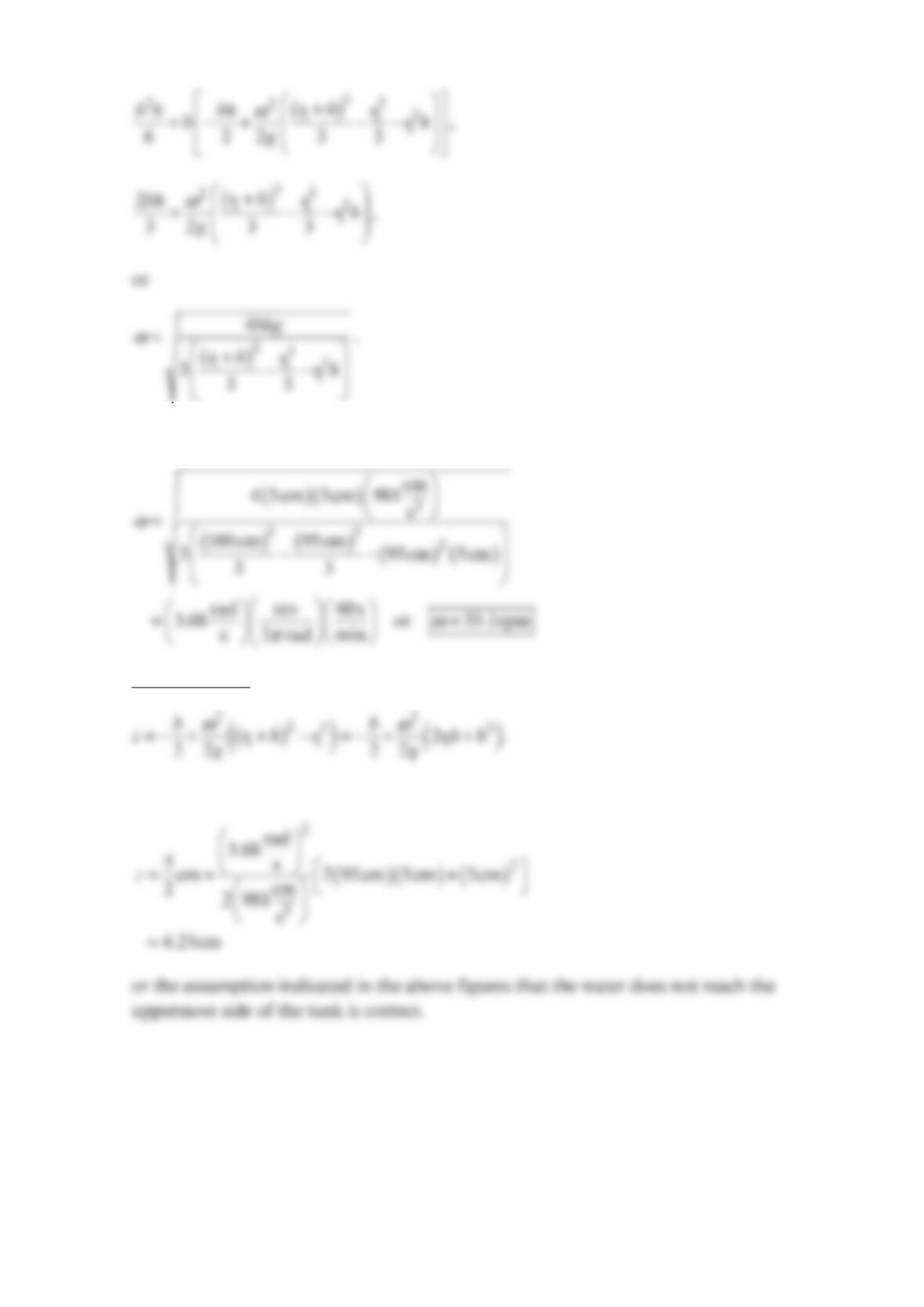
The numerical values give
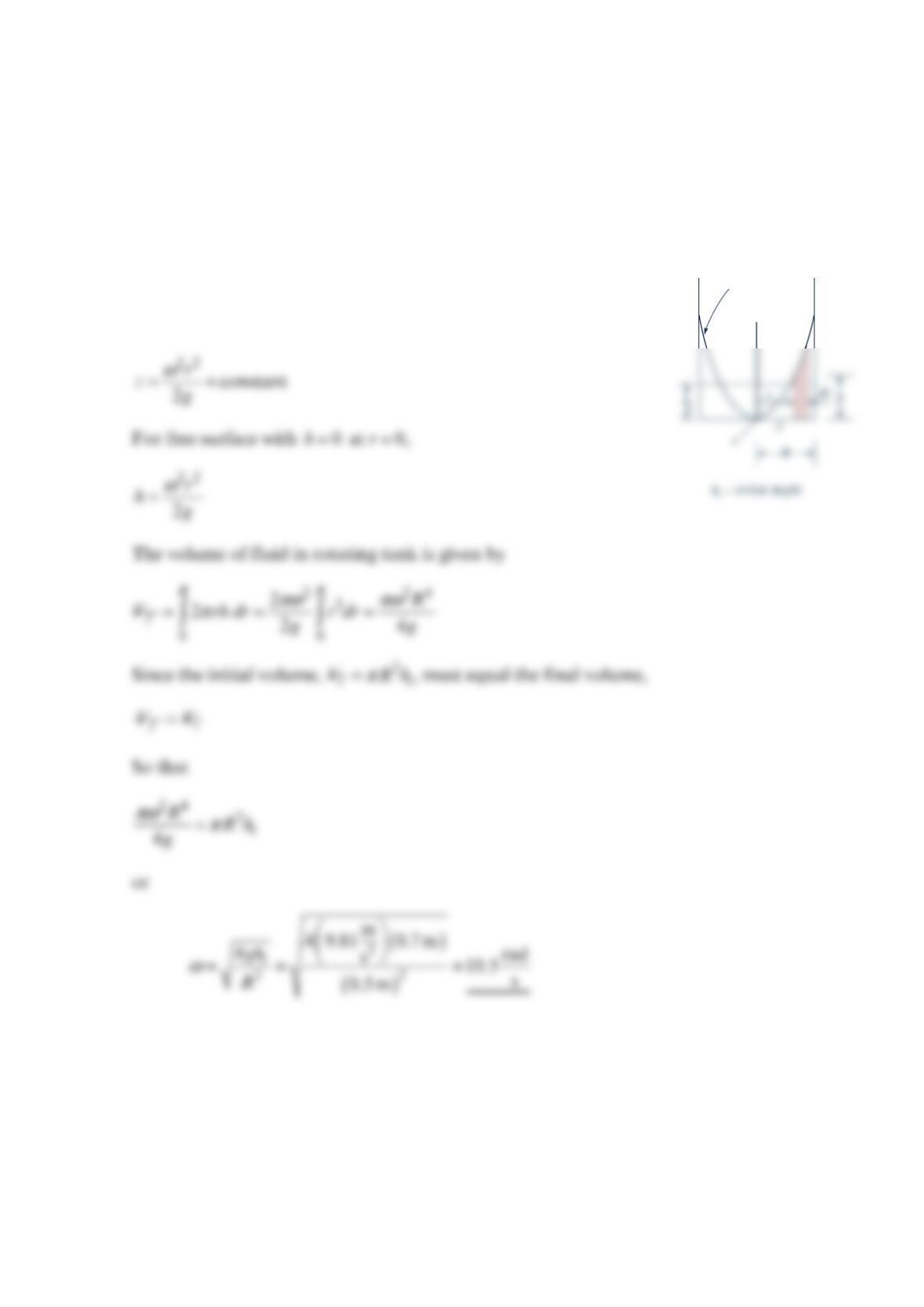
DISCUSSION Note the that when 1
rrh=+,
The numerical values give
Problem 2.159
An open 1-m-diameter tank contains water at a depth of 0.7 m when at rest. As the tank is
rotated about its vertical axis the center of the fluid surface is depressed. At what angular
velocity will the bottom of the tank first be exposed? No water is spilled from the tank.
Solution 2.159
Equation for surfaces of constant pressure:
z
fluid surface
Problem 2.160
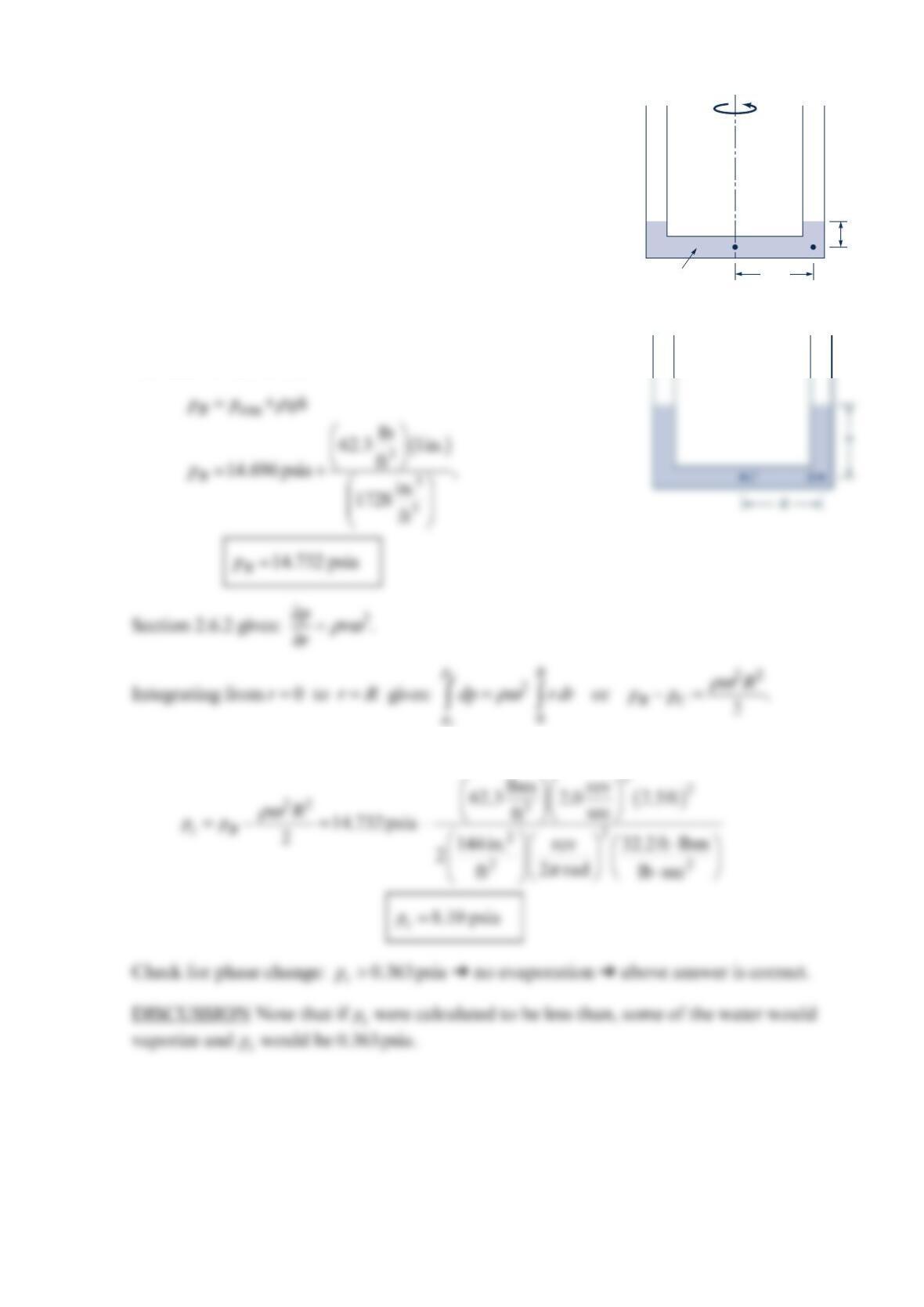
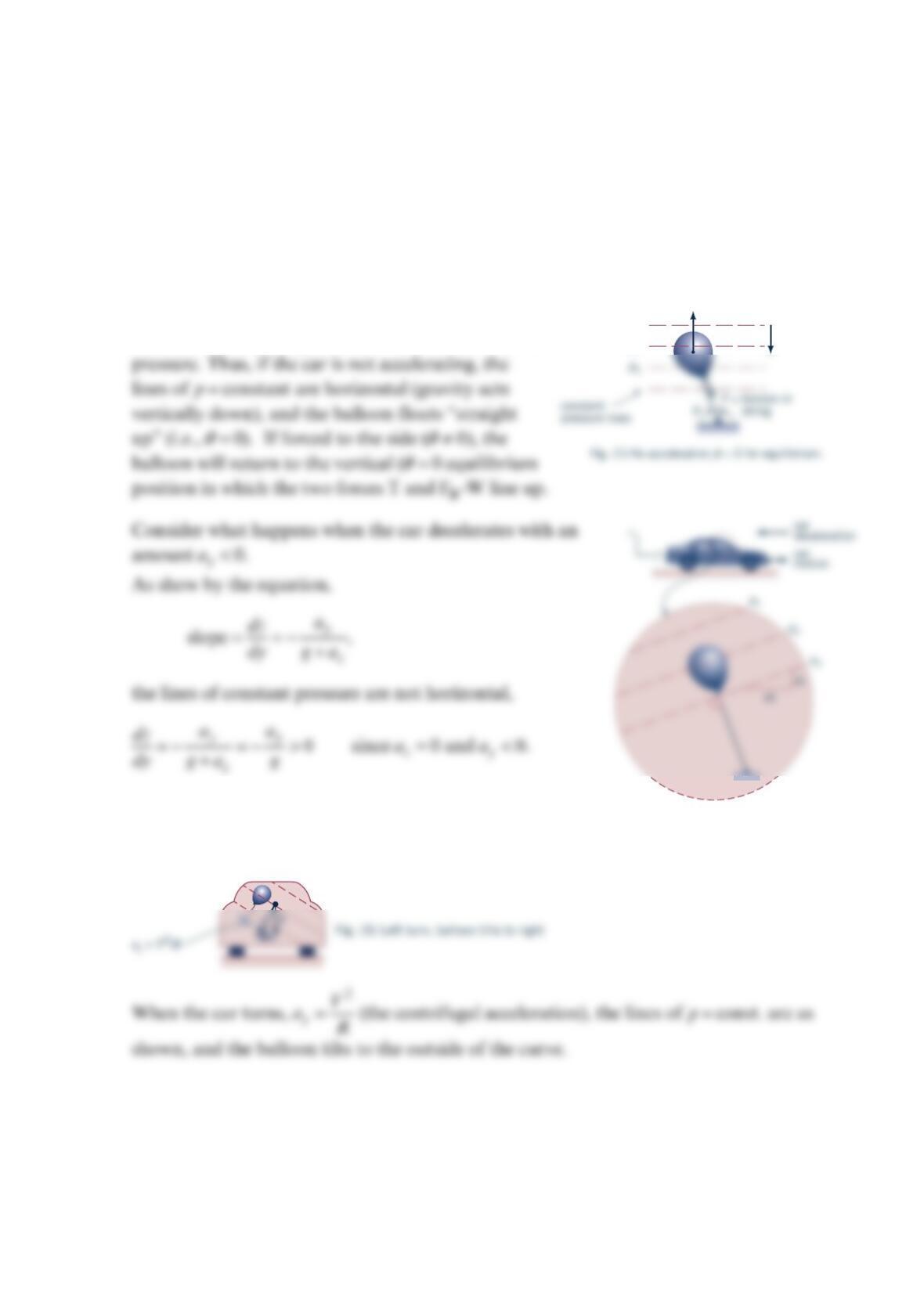
The U-tube in the figure below rotates at 2.0 rev/sec. Find the
absolute pressures at points C and B if the atmospheric
pressure is
1
4.696 psia. Recall that
7
0°F water evaporates at an
absolute pressure of 0.363 psia . Determine the absolute
pressures at points C and B if the U-tube rotates at
2
.0 rev/s.
Solution 2.160
Applying the manometer rule to one of the legs and using
the data in Table A.6,
Therefore,
A
BC
1′
2.5′
70°F water
ω
p
atm
Problem 2.161
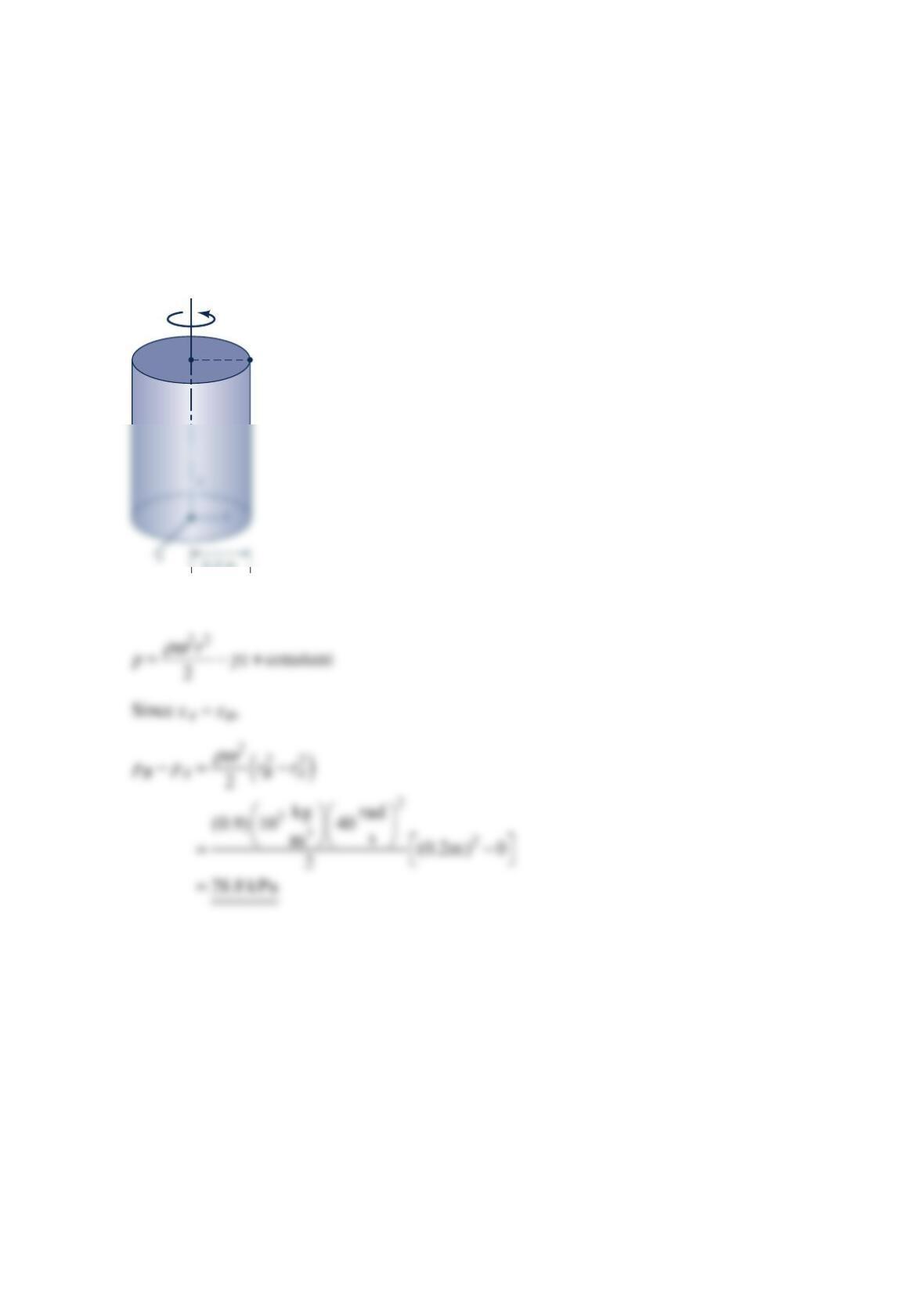
A child riding in a car holds a string attached to a floating, helium-filled balloon. As the car
decelerates to a stop, the balloon tilts backwards. As the car makes a right-hand turn, the
balloon tilts to the right. On the other hand, the child tends to be forced forward as the car
decelerates and to the left as the car makes a right-hand turn. Explain these observed effects
on the balloon and child.
Solution 2.161
A floating balloon attached to a string will align
itself so that the string it normal to lines of constant
Again, the balloon’s equilibrium position is with the string
normal to const.
p
= lines. That is, the balloon tilts back as
the car stops.
F
B
–
W
= buoyant force – weight
p
1
p
2
g
Fig. (2) Balloon aligned so that
string is normal to p = constant lines
Problem 2.162
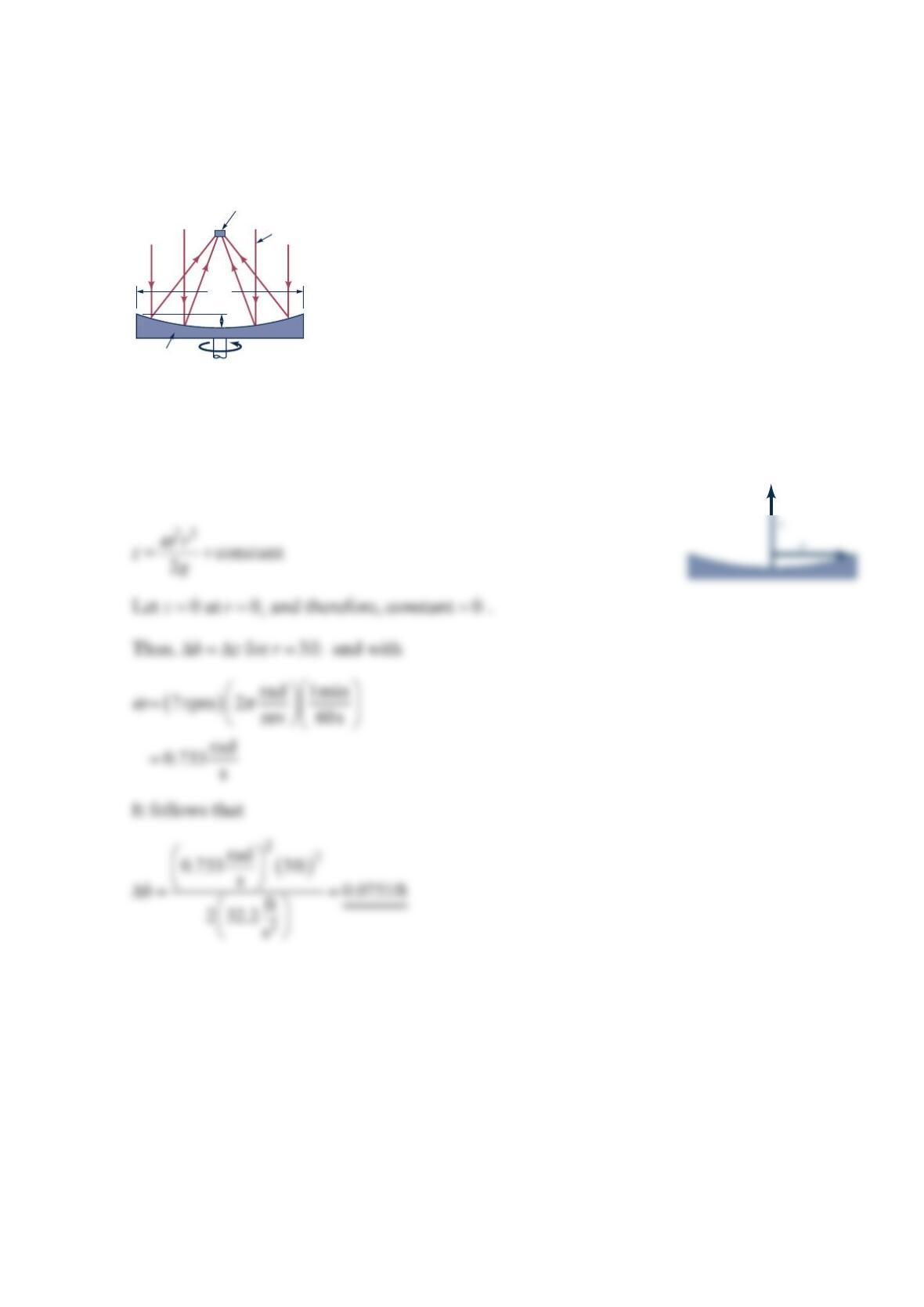
A closed, 0.4-m-diameter cylindrical tank is completely filled with oil
()
0.9SG = and rotates
about its vertical longitudinal axis with an angular velocity of 40 rad / s. Determine the
difference in pressure just under the vessel cover between a point on the circumference and
a point on the axis.
Solution 2.162
Pressure in a rotating fluid varies in accordance with the equation,
ω
0.2 m
AB
Problem 2.163
The largest liquid mirror telescope uses a 6-ft-diameter tank of mercury rotating at
7
rpm to
produce its parabolic-shaped mirror as shown in the figure below. Determine the difference
in elevation of the mercury, h
Δ
, between the edge and the center of the mirror.
Solution 2.163
For free surface of rotating liquid,
Receiver
Light rays
6 ft
Δ
h
= 7 rpm
Mercury
ω