Section 2.4
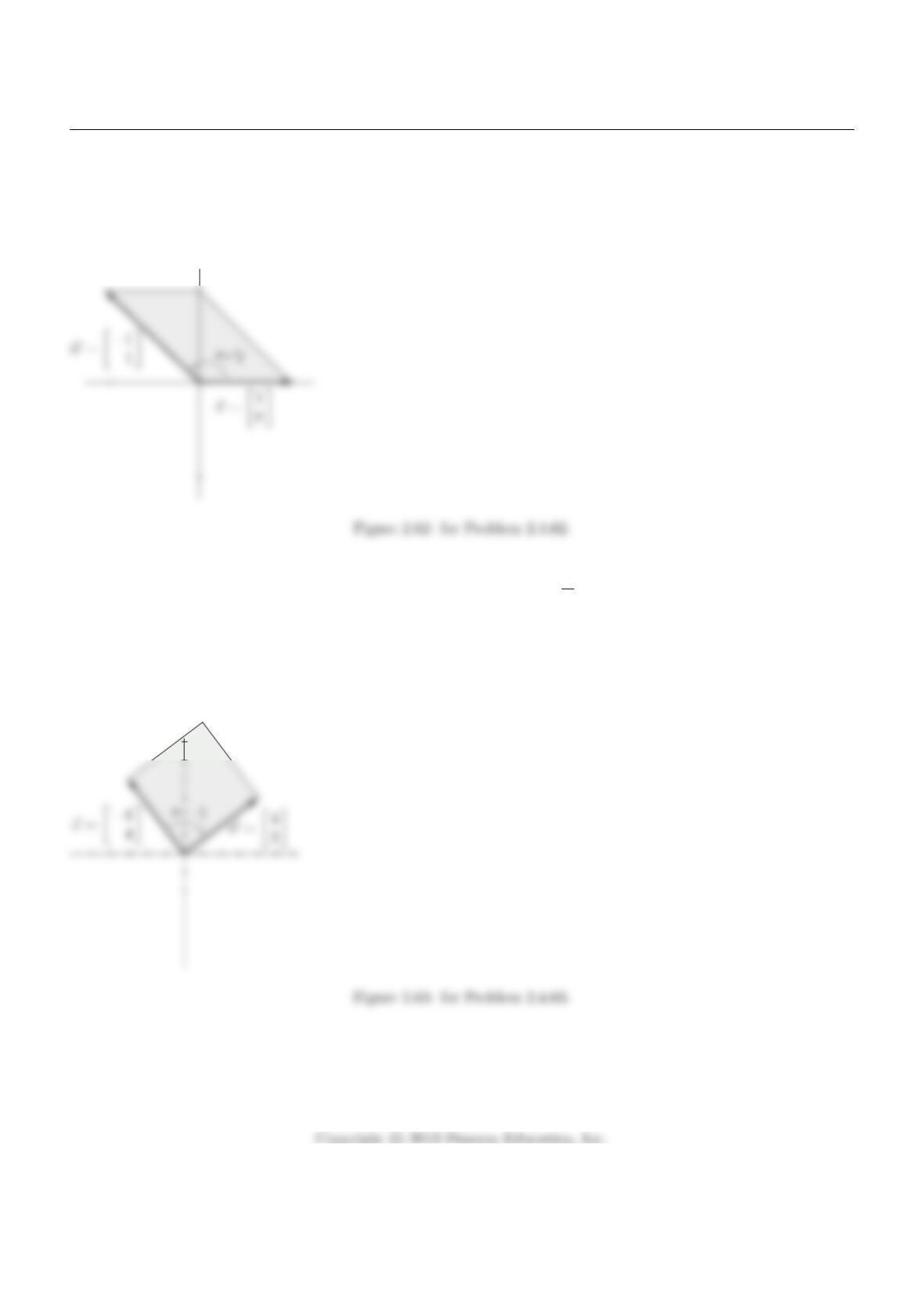
2.4.62 The determinant of Ais 1 and A−1=1 1
0 1 . Both Aand A−1represent horizontal shears. The
determinant of Ais the area of the parallelogram spanned by ~v =1
0and ~w =−1
1. The angle from
~v to ~w is 3π/4. (See Figure 2.62.)
2.4.63 The determinant of Ais −25 and A−1= (1/25) −3 4
4 3 =1
25 A. The matrix Arepresents a reflection
about a line combined with a scaling by 5 whilc A−1represents a reflection about the same line combined with
a scaling by 1/5. The absolute value of the determinant of Ais the area of the square spanned by ~v =−3
4
and ~w =4
3with side length 5. The angle from ~v to ~w is −π/2. (See Figure 2.63.)
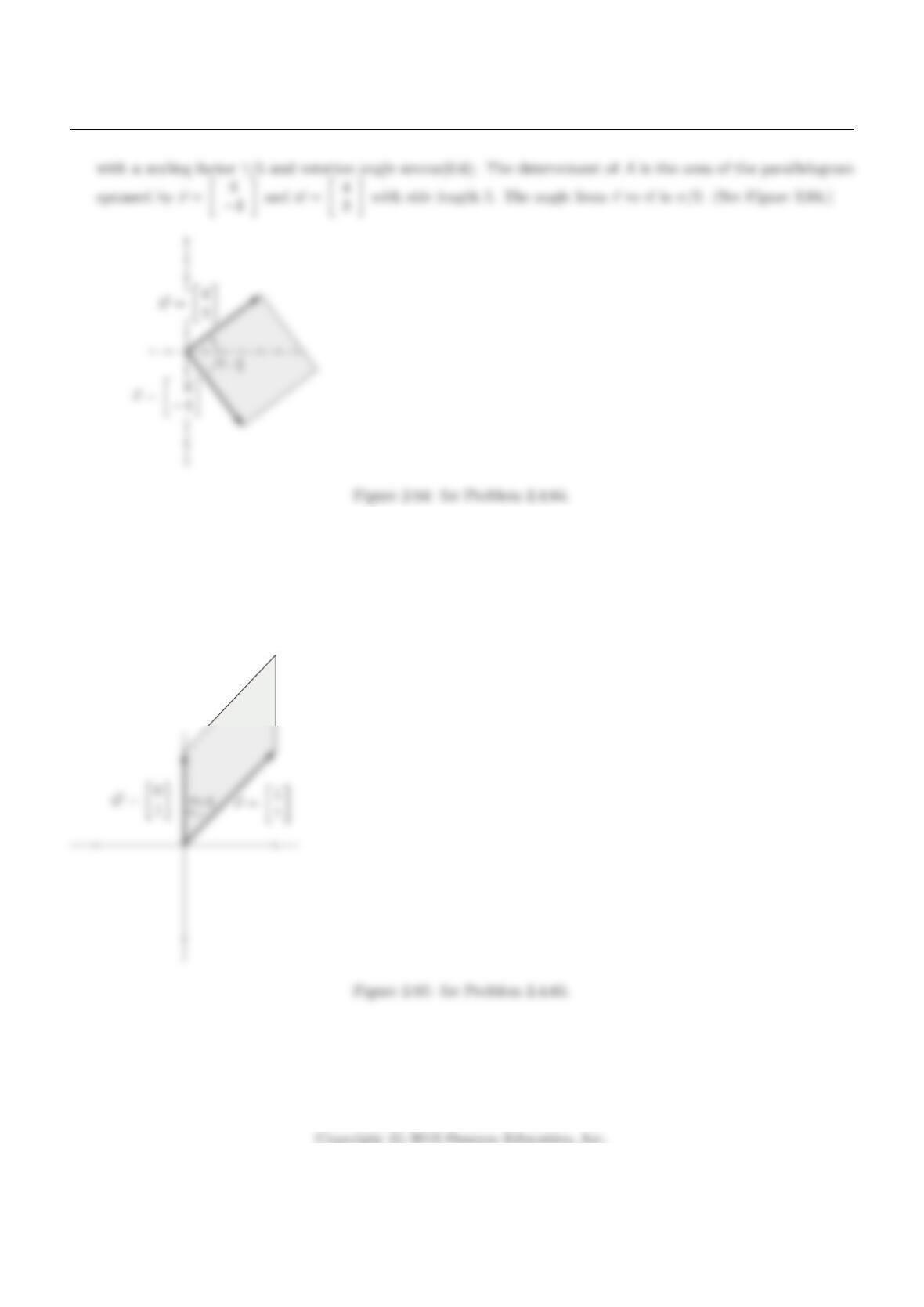
2.4.64 The determinant of Ais 25. The matrix Ais a rotation dilation matrix with scaling factor 5 and rotation by
an angle arccos(0.6) in the clockwise direction. The inverse A−1= (1/25) 3−4
4 3 is a rotation dilation too
109
Chapter 2
2.4.65 The determinant of Ais 1 and A−1=1 0
−1 1 . Both Aand A−1represent vertical shears. The determinant
of Ais the area of the parallelogram spanned by ~v =1
1and ~w =0
1. The angle from ~v to ~w is π/4. (See
Figure 2.65.)
2.4.66 We can write AB(AB)−1=A(B(AB)−1) = Inand (AB)−1AB = ((AB)−1A)B=In.
By Theorem 2.4.8, Aand Bare invertible.
110
Section 2.4
2.4.71 True; ABB−1A−1=AInA−1=AA−1=In.
2.4.72 Not necessarily true; the equation ABA−1=Bis equivalent to AB =BA (multiply by Afrom the right),
which is not true in general.
2.4.73 True; (ABA−1)3=ABA−1ABA−1ABA−1=AB3A−1.
2.4.77 We want Asuch that A~vi=~wi, for i= 1,2,…,m, or A[~v1~v2. . . ~vm] = [ ~w1~w2. . . ~wm], or AS =B.
Multiplying by S−1from the right we find the unique solution A=BS−1.
2.4.79 Use the result of Exercise 2.4.77, with S=3 1
1 2 and B=6 3
2 6 ;
A=BS−1=1
59 3
−2 16 .
111
Chapter 2
2.4.81 Let Abe the matrix of Tand Cthe matrix of L. We want that AP0=P1, AP1=P3, and AP2=P2. We
can use the result of Exercise 77, with S=
1 1 −1
1−1 1
1−1−1
and B=
1−1−1
−1−1 1
−1 1 −1
.
2.4.82 aEA =
a b c
d−3a e −3b f −3c
g h k
The matrix EA is obtained from Aby an elementary row operation: subtract three times the first row from the
second.
d An elementary n×nmatrix Ehas the same form as Inexcept that either
•eij =k(6= 0) for some i6=j[as in part (a)], or
•eii =k(6= 0,1) for some i[as in part (b)], or
•eij =eji = 1, eii =ejj = 0 for some i6=j[as in part (c)].
112
Section 2.4
2.4.83 Let Ebe an elementary n×nmatrix (obtained from Inby a certain elementary row operation), and let F
2.4.84 a The matrix rref(A) is obtained from Aby performing a sequence of pelementary row operations. By
Exercise 2.4.82 [parts (a) through (c)] each of these operations can be represented by the left multiplication with
an elementary matrix, so that rref(A) = E1E2. . . EpA.
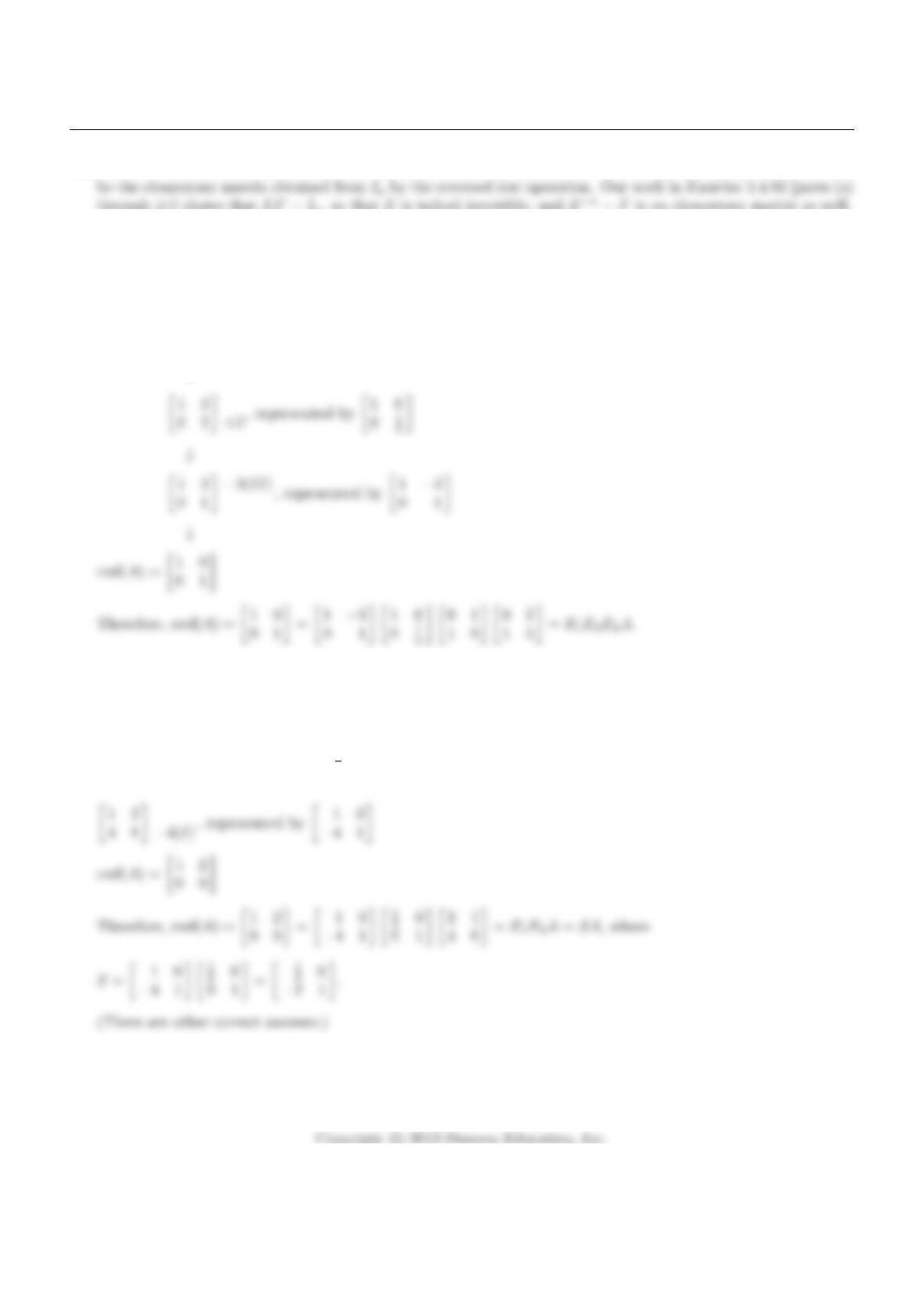
bA=0 2
1 3 swap rows 1 and 2, represented by 0 1
1 0
↓
2.4.85 a Let S=E1E2. . . Epin Exercise 2.4.84a.
By Exercise 2.4.83, the elementary matrices Eiare invertible: now use Theorem 2.4.7 repeatedly to see that Sis
invertible.
bA=2 4
4 8 ÷2, represented by 1
20
0 1
2.4.86 a By Exercise 2.4.84a, In= rref(A) = E1E2. . . EpA, for some elementary matrices E1,…,Ep. By Exercise
2.4.83, the Eiare invertible and their inverses are elementary as well. Therefore,
113
Chapter 2
A= (E1E2. . . Ep)−1=E−1
p. . . E−1
2E−1
1expresses Aas a product of elementary matrices.
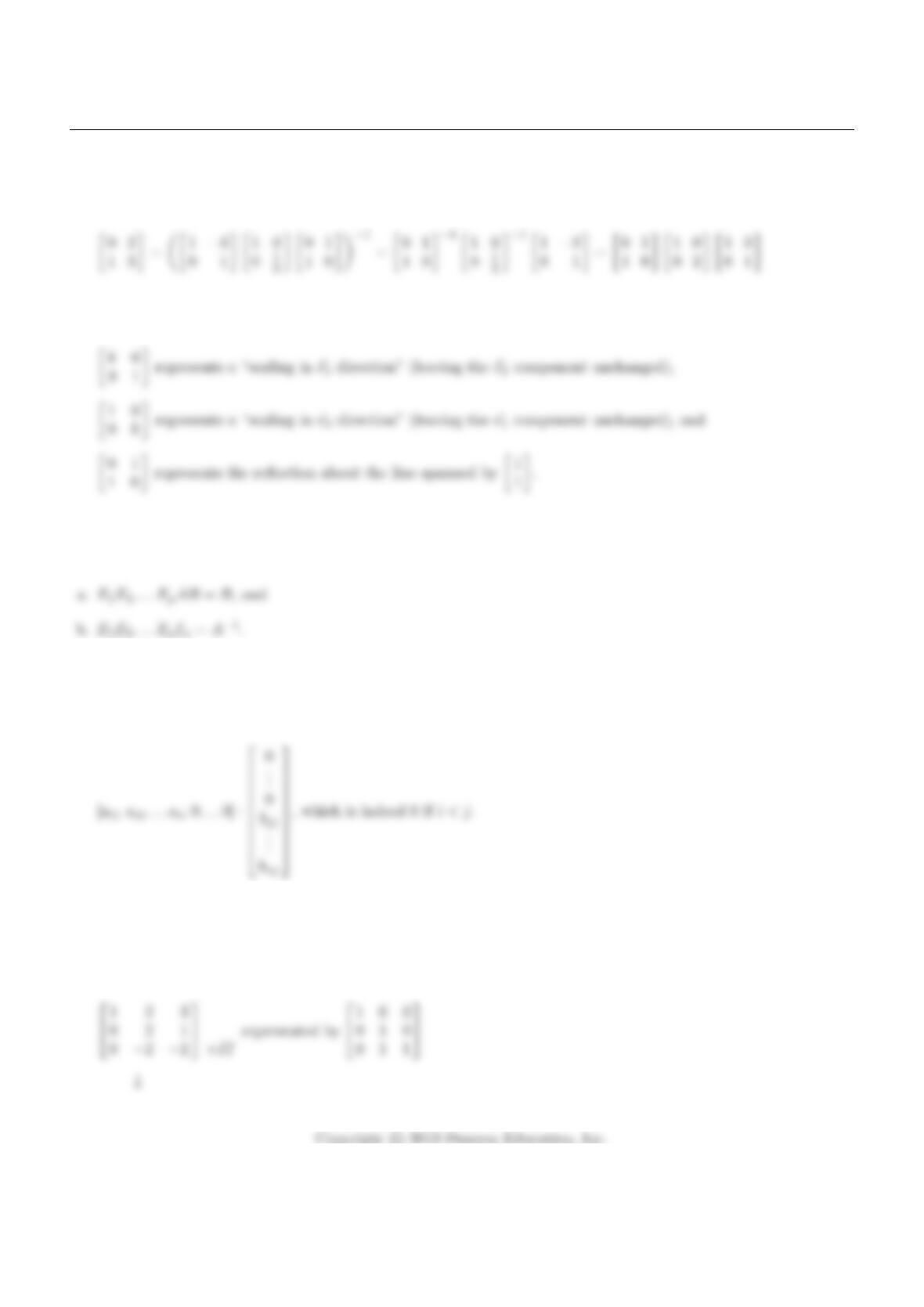
b We can use out work in Exercise 2.4.84 b:
2.4.87 1k
0 1 represents a horizontal shear, 1 0
k1represents a vertical shear,
2.4.88 Performing a sequence of pelementary row operations on a matrix Aamounts to multiplying A with
E1E2. . . Epfrom the left, where the Eiare elementary matrices. If In=E1E2. . . EpA, then E1E2. . . Ep=A−1,
so that
2.4.89 Let Aand Bbe two lower triangular n×nmatrices. We need to show that the ijth entry of AB is 0 whenever
i < j.
This entry is the dot product of the ith row of Aand the jth column of B,
2.4.90 a
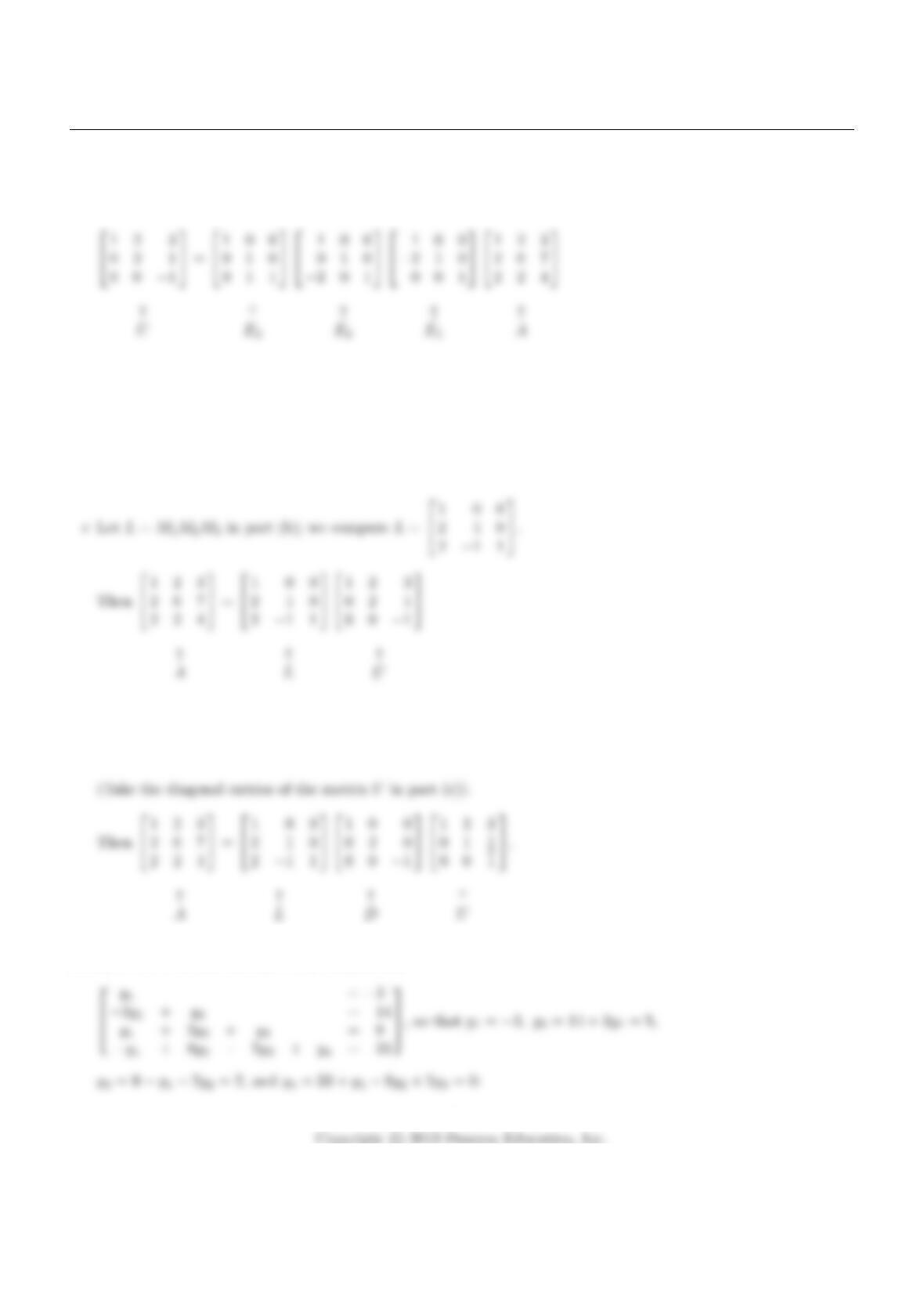
1 2 3
2 6 7
2 2 4
−2I
−2I
, represented by
1 0 0
0 1 0
−2 0 1
100
−210
001
↓
114
Section 2.4
1 2 3
0 2 1
0 0 −1
,so that
bA= (E3E2E1)−1U=E−1
1E−1
2E−1
3U=
1 0 0
2 1 0
0 0 1
1 0 0
0 1 0
2 0 1
1 0 0
0 1 0
0−1 1
1 2 3
0 2 1
0 0 −1
↑
M1
↑
M2
↑
M3
↑
U
d We can use the matrix Lwe found in part (c), but Uneeds to be modified. Let D=
1 0 0
0 2 0
0 0 −1
.
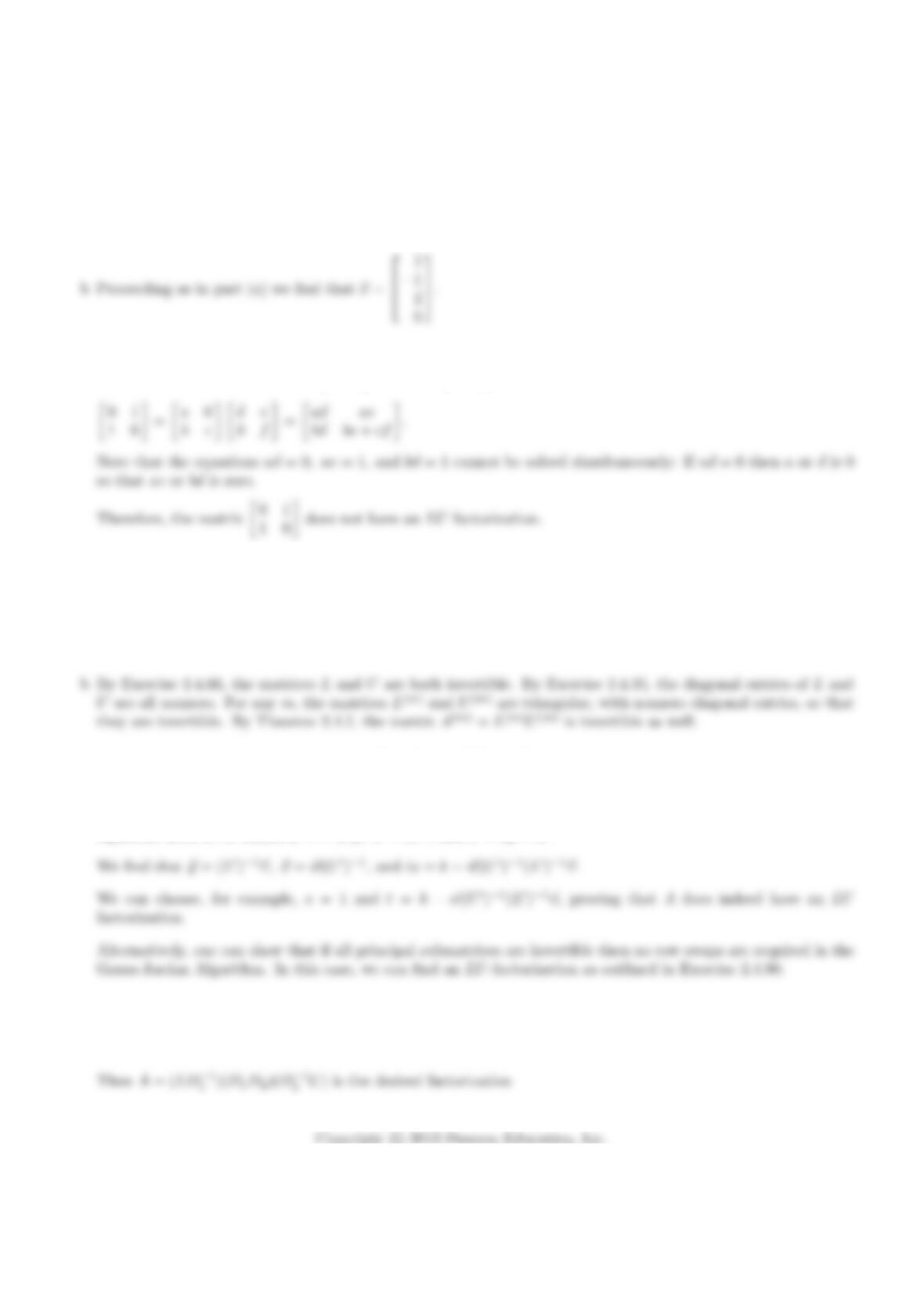
2.4.91 a Write the system L~y =~
bin components:
115
Chapter 2
~y =
−3
5
2
0
.
2.4.92 We try to find matrices L=a0
b c and U=d e
0fsuch that
2.4.93 a Write L=L(m)0
L3L4and U=U(m)U2
0U4.
Then A=LU =L(m)U(m)L(m)U2
L3U(m)L3U2+L4U4, so that A(m)=L(m)U(m), as claimed.
c Using the hint, we write A=A(n−1) ~v
~w k =L′0
~x t U′~y
0s.
We are looking for a column vector ~y, a row vector ~x, and scalars tand ssatisfying these equations. The following
equations need to be satisfied: ~v =L′~y, ~w =~xU′, and k=~x~y +ts.
2.4.94 a If A=LU is an LU factorization, then the diagonal entries of Land Uare nonzero (compare with Exercise
2.4.93). Let D1and D2be the diagonal matrices whose diagonal entries are the same as those of Land U,
respectively.
116
Section 2.4
b If A=L1D1U1=L2D2U2and Ais invertible, then L1, D1, U1, L2, D2, U2are all invertible, so that we can
multiply the above equation by D−1
2L−1
2from the left and by U−1
1from the right:
2.4.95 Suppose A11 is a p×pmatrix and A22 is a q×qmatrix. For Bto be the inverse of Awe must have AB =Ip+q.
Let us partition Bthe same way as A:
B=B11 B12
B21 B22 , where B11 is p×pand B22 is q×q.
2.4.96 This exercise is very similar to Example 7 in the text. We outline the solution:
A11 0
A21 A22 B11 B12
B21 B22 =Ip0
0Iqmeans that
A11B11 =Iq, A11B12 = 0, A21B11 +A22B21 = 0, A21B12 +A22B22 =Iq.
117
Chapter 2
2.4.97 Suppose A11 is a p×pmatrix. Since A11 is invertible, rref(A) = IpA12 ∗
0 0 rref(A23), so that
rank(A) = p+ rank(A23) = rank(A11) + rank(A23).
2.4.99 Multiplying both sides with A−1we find that A=In: The identity matrix is the only invertible matrix with
this property.
2.4.101 The ijth entry of AB is
2.4.102 a We proceed by induction on m. Since the column sums of Aare ≤r, the entries of A1=Aare also ≤r1=r,
so that the claim holds for m= 1. Suppose the claim holds for some fixed m. Now write Am+1 =AmA; since
118
Section 2.4
the entries of Amare ≤rmand the column sums of Aare ≤r, we can conclude that the entries of Am+1 are
≤rmr=rm+1, by Exercise 101.
b For a fixed iand j, let bmbe the ijth entry of Am. In part (a) we have seen that 0 ≤bm≤rm.
2.4.103 a The components of the jth column of the technology matrix Agive the demands industry Jjmakes on
the other industries, per unit output of Jj. The fact that the jth column sum is less than 1 means that industry
Jjadds value to the products it produces.
b A productive economy can satisfy any consumer demand ~
b, since the equation
(In−A)~x =~
bcan be solved for the output vector ~x :~x = (In−A)−1~
b(compare with Exercise 2.4.49).
2.4.104 a We write our three equations below:
I=1
3R+1
3G+1
3B
L=R−G
S=−1
2R−1
2G+B
, so that the matrix is P=
1
3
1
3
1
3
1−1 0
−1
2−1
21
.
119
Chapter 2
c This matrix is P A =
1
3
1
30
1−1 0
−1
2−1
20
(we apply first A, then P.)
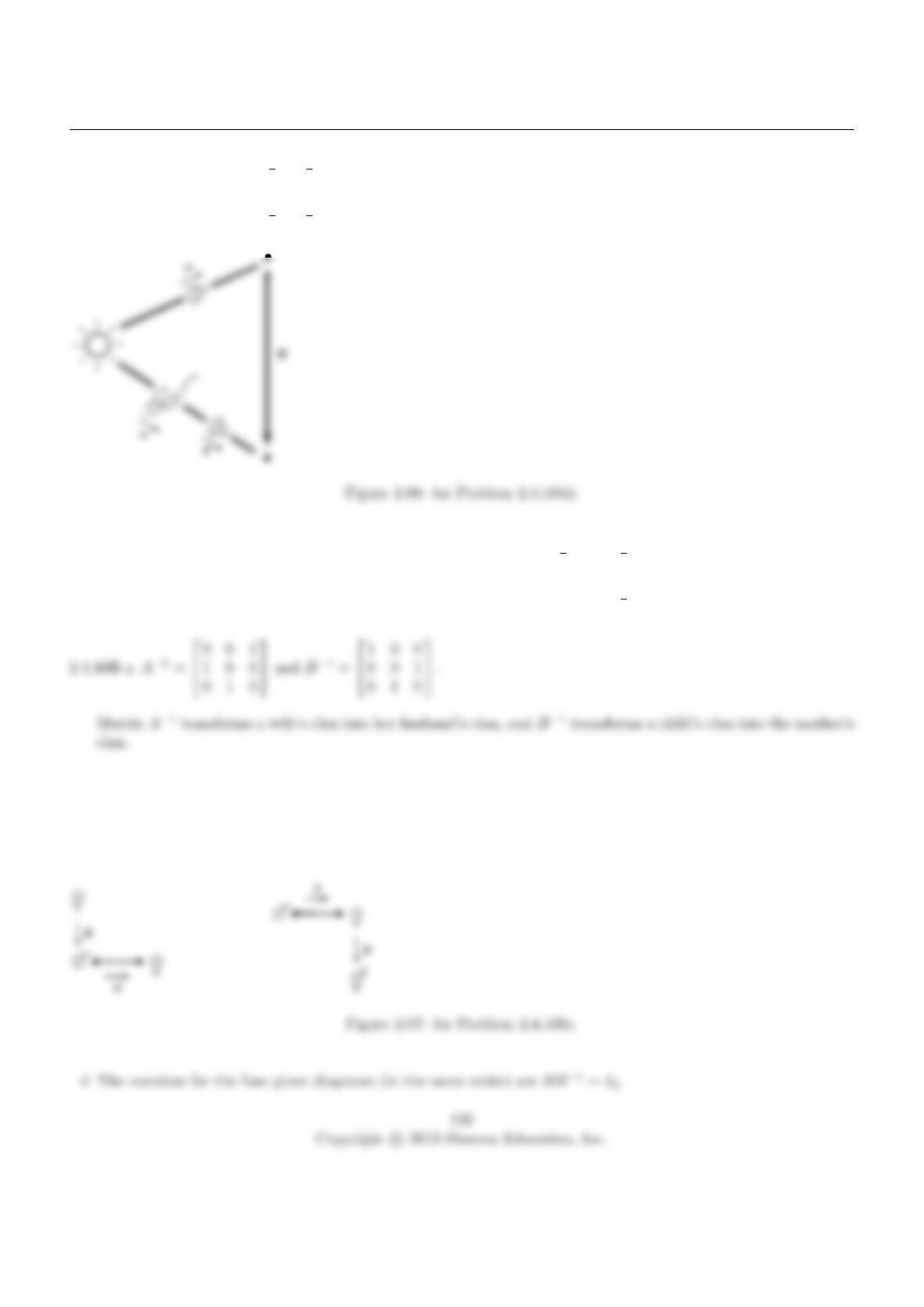
d See Figure 2.66. A “diagram chase” shows that M=P AP −1=
2
30−2
9
0 1 0
−1 0 1
3
.
bB2transforms a women’s clan into the clan of a child of her daughter.
cAB transforms a woman’s clan into the clan of her daughter-in-law (her son’s wife), while BA transforms a man’s
clan into the clan of his children. The two transformations are different. (See Figure 2.67.)
Section 2.4
2.4.106 a We need 8 multiplications: 2 to compute each of the four entries of the product.
b We need nmultiplications to compute each of the mp entries of the product, mnp multiplications altogether.
2.4.107 g(f(x)) = x, for all x, so that g◦fis the identity, but f(g(x)) = xif xis even
x+ 1 if xis odd .
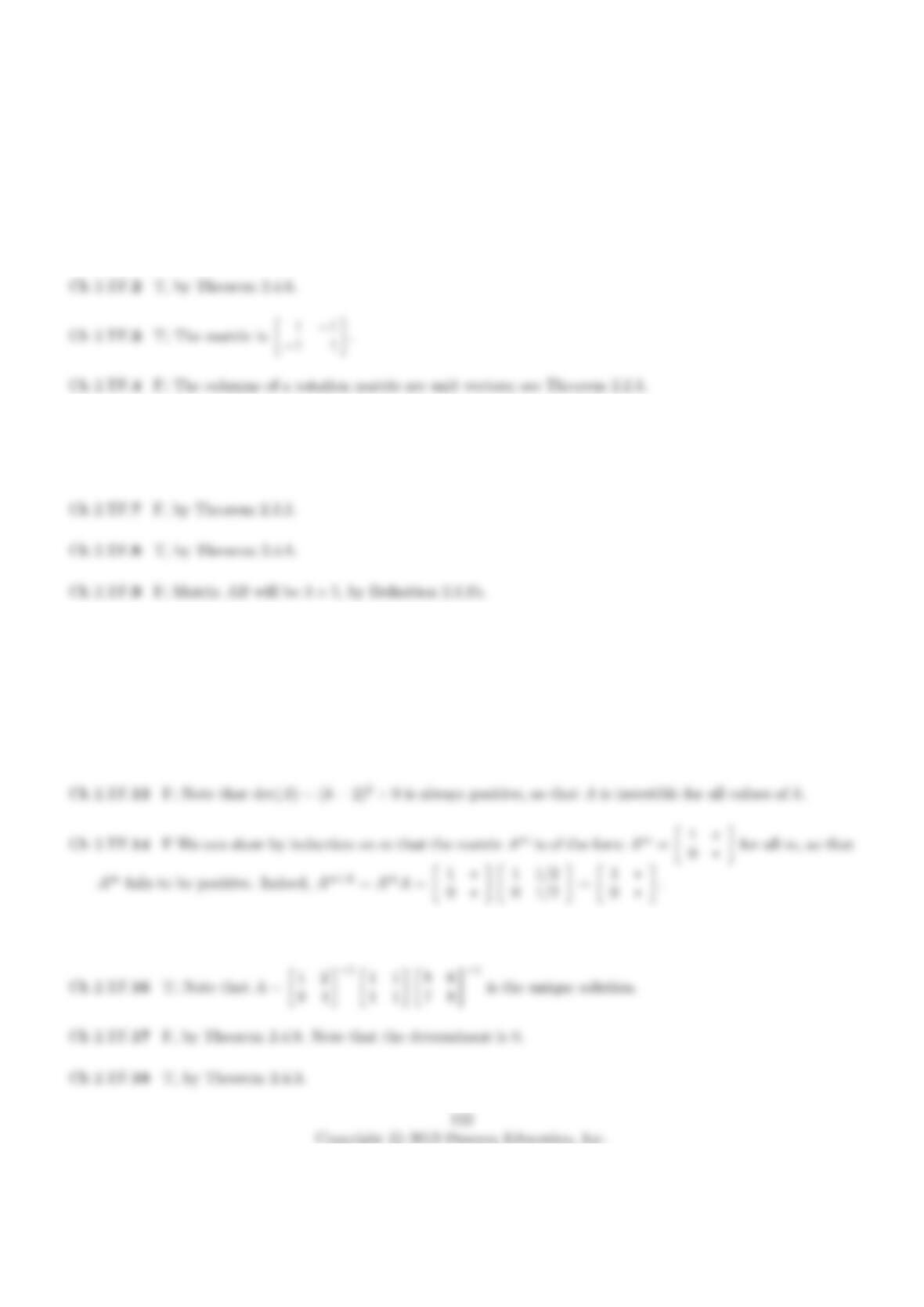
c Here the transformation is
y
n=1 0
−k111D
0 1 1 0
−k11x
m=1−k1D D
k1k2D−k1−k21−k2Dx
m.
We want the slope nof the outgoing rays to depend on the slope mof the incoming rays alone, and not on x;
this forces k1k2D−k1−k2= 0, or, D=k1+k2
k1k2=1
k1+1
k2, the sum of the focal lengths of the two lenses. See
Figure 2.68.
121
Chapter 2
True or False
Ch 2.TF.1T, by Theorem 2.2.4.
Ch 2.TF.5T, by Theorem 2.4.3.
Ch 2.TF.6T; Let A=Bin Theorem 2.4.7.
Ch 2.TF.10 F; Note that T0
0=0
1. A linear transformation transforms ~
0 into ~
0.
Ch 2.TF.11 T; The equation det(A) = k2−6k+ 10 = 0 has no real solution.
Ch 2.TF.12 T; The matrix fails to be invertible for k= 5 and k=−1, since the determinant det A=k2−4k−5 =
(k−5)(k+ 1) is 0 for these values of k.
Ch 2.TF.15 F; Consider A=I2(or any other invertible 2 ×2 matrix).
True or False
Ch 2.TF.19 T; The shear matrix A=11
2
0 1 works.
Ch 2.TF.23 F; For any 2 ×2 matrix A, the two columns of A1 1
1 1 will be identical.
Ch 2.TF.24 T; One solution is A=1 1
0 0 .
Ch 2.TF.29 T; Note that the matrix 0−1
1 0 represents a rotation through π/2. Thus n= 4 (or any multiple
of 4) works.
Ch 2.TF.30 F; If a matrix Ais invertible, then so is A−1. But 1 1
1 1 fails to be invertible.
123
Chapter 2
Ch 2.TF.34 T; Apply Theorem 2.4.8 to the equation (A2)−1AA =In, with B= (A2)−1A.
Ch 2.TF.38 T; The equation A~ei=B~eimeans that the ith columns of Aand Bare identical. This observation
applies to all the columns.
Ch 2.TF.39 T; Note that A2B=AAB =ABA =BAA =BA2.
Ch 2.TF.43 F; Consider A=I2and B=−I2.
Ch 2.TF.44 T; Since A~x is on the line onto which we project, the vector A~x remains unchanged when we project
again: A(A~x) = A~x, or A2~x =A~x, for all ~x. Thus A2=A.
0 0
Ch 2.TF.48 F; By Theorem 1.3.3, there is a nonzero vector ~x such that B~x =~
0, so that AB~x =~
0 as well. But
I3~x =~x 6=~
0, so that AB 6=I3.
124
True or False
Ch 2.TF.52 F; Consider T(~x) = 2~x, ~v =~e1, and ~w =~e2.
Ch 2.TF.55 F; We will show that S−10 1
0 0 Sfails to be diagonal, for an arbitrary invertible matrix S=a b
c d .
Now, S−10 1
0 0 S=1
ad−bc d−b
−c a c d
0 0 =1
ad−bc cd d2
−c2−cd . Since cand dcannot both be zero (as S
must be invertible), at least one of the off-diagonal entries (−c2and d2) is nonzero, proving the claim.
Ch 2.TF.58 F; Consider a 2×2 matrix A=a b
c d .We make an attempt to solve the equation A2=a2+bc ab +bd
ac +cd cb +d2=
a2+bc b(a+d)
c(a+d)d2+bc =1 0
0−1.Now the equation b(a+d) = 0 implies that b= 0 or d=−a.
Ch 2.TF.59 T; Recall from Definition 2.2.1 that a projection matrix has the form u2
1u1u2
u1u2u2
2, where u1
u2is a
unit vector. Thus, a2+b2+c2+d2=u4
1+ (u1u2)2+ (u1u2)2+u4
2=u4
1+ 2(u1u2)2+u4
2= (u2
1+u2
2)2= 12= 1.
125
Chapter 2
126